ISSN 2287-6782 (Online)
Korean J Endocr Surg 2014;14:162-166
Endocrine Surgery
Bilateral Chylothorax Following Modified Radical Neck Dissection in Thyroid Cancer: A Case Report
Youngpeck Song, Jeoghun Lee, Ji Woo Choi, Euy Young Soh
Department of Surgery, Ajou University School of Medicine, Suwon, Korea
Bilateral chylothoraxis an extremely rare complication of modified radical neck dissection.
It is a potentially life-threatening condition that can lead to severe respiratory, nutritional, metabolic, and immunologic disorders. Use of a multi-disciplinary approach including drainage of chyle, reduction of chyle formation, adequate nutritional support, use of somatostatin or its analogue, surgical ligation of the thoracic duct, and thoracic duct embolization is the best method for treatment of bilateral chylothorax. We report on a case of bilateral chylothorax following total thyroidectomy with modified radical neck dissection and discuss its management.
Key Words: Chylothorax, Neck dissection, Thyroidectomy
Received August 5, 2014, Revised September 14, 2014, Accepted September 15, 2014 Correspondence: Euy Young Soh Division of Surgery, Thyroid Center, Ajou University School of Medicine, 164, Worldcup-ro, Yeoungtong-gu, Suwon 443-380, Korea
Tel: +82-31-219-5201 Fax: +82-31-219-5755 E-mail: [email protected]
INTRODUCTION
Chylous fistula occurs in 1∼2% of patients who undergo neck dissection, with the majority being localized to the left side of the neck.(1) It can be recognized by drainage of milky fluid from the neck. In almost all of the cases, it can be diagnosed promptly. However, postoperative bilateral chylothorax is rare, and hence, it is difficult to detect and treat this condition.(2) Stuart (3) reported the first case of bilateral chylothorax following neck dissection in 1907.
Persistent high-output chylothorax can result in a life- threatening condition because of malnutrition, suscep- tibility to infection, metabolic derangements, and cardio- pulmonary problem.(1,4) Recently we experienced a case of bilateral chylothorax without evidence of chyle leakage from the neck after bilateral neck dissection.
The aim of this article is to present a case of chylothorax following modified radical neck dissection and to discuss the appropriate treatment through literature review.
CASE REPORT
A 38-year-old woman presented with a right thyroid
mass detected 2 years ago. Ultrasonography revealed that the mass was 0.82 cm in size and had spiculated margins and microcalcification. The mass was cytologically sus- picious for malignancy according to the Bethesda system.
Metastatic lymphadenopathy was detected by computed tomography in the level VI and the left level IV area. We had planned thyroidectomy, but the patient wanted to put off the operation because she became pregnant. Two years later, we reexamined the tumor by performing ultrasono- graphy and the tumor had grown up to 1.0 cm in size. And then we performed fine needle aspiration cytology about suspicious lymph node in left level IV area. The result of cytology was positive for malignant cells. She had no underlying diseases and family history of thyroid cancer.
Preoperative thyroid function test was normal. She under- went total thyroidectomy with bilateral central compart- ment neck dissection and bilateral modified radical neck dissection. Intraoperative findings were as follows: 0.7 cm sized mass in the right thyroid without capsular invasion, a 3.0 cm sized lymph node in the pretracheal area, and multiple enlarged lymph nodes in the left level IV area including a 3.0 cm sized lymph node and other small lymph nodes in the bilateral levels III and IV areas. There were
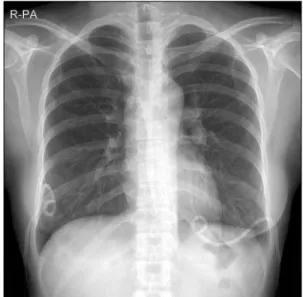
Fig. 1. Chest X-ray shows bilateral pleural effusion (Fourth postoperative day).
Fig. 2. Chest X-ray shows complete resolution of bilateral pleural effusion (Eighth postoperative day).
multiple engorged lymphatic ducts with lymphatic spillage in the left level IV area after node dissection. Therefore, we performed multiple suture ligations in the level IV area including the thoracic duct and no more spillage of chyle was observed. Postoperative amount of drainage was de- creased from 270 mL to 41 mL in 3 days. No milky fluid was drained postoperatively. The drain was removed on the third postoperative day (POD). After that, the patient experienced dyspnea without any abnormal breath sounds. On POD 4, dyspnea was aggravated with de- creased breath sounds. Oxygen saturation measured by pulse oximetry was 95% after 3 L/min oxygen supplement via nasal prongs. Chest X-ray revealed large, bilateral pleural effusion (Fig. 1). We inserted percutaneous drains (PCD) in the bilateral pleural space, and 1,240 mL of milky fluid was drained from the right pleural space and 1,520 mL of milky fluid was drained from the left pleural space on POD 4. Triglyceride (TG) level in the fluid drained from the right pleural space was 597 mg/dL and that in the fluid drained from the left pleural space was 700 mg/dL. Dys- pnea was improved after PCD insertion. ‘Nil per os’ (NPO) order was applied immediately. On POD 6, the serum TG level in the fluid drained from the right pleural space was 20 mg/dL and that in the fluid drained from the left pleural space was 18 mg/dL. Amount of drainage was decreased to16 mL from the right PCD and to 12 mL from the left PCD, and the color of drainage was serous on POD 7. No more
milky drainage was detected. Normal diet was started on POD 8. The color of drainage continued to be serous and chest X-ray returned to normal; therefore, we removed both the PCD (Fig. 2). She was discharged uneventfully on POD 11. Final pathology was papillary thyroid carcinoma and lymph node metastasis existed in central and bilateral lateral neck area.
DISCUSSION
Chylous fistula is a rare complication of neck dissection and three-quarters of them occur on the left side.(1) It is usually recognized as a milky fluid in the neck drains postoperatively. Bilateral chylothorax can occur following neck dissection, but it rarely occurs after thyroid opera- tion. Only 39 cases of bilateral chylothorax associated with neck dissection have been reported in the literature.
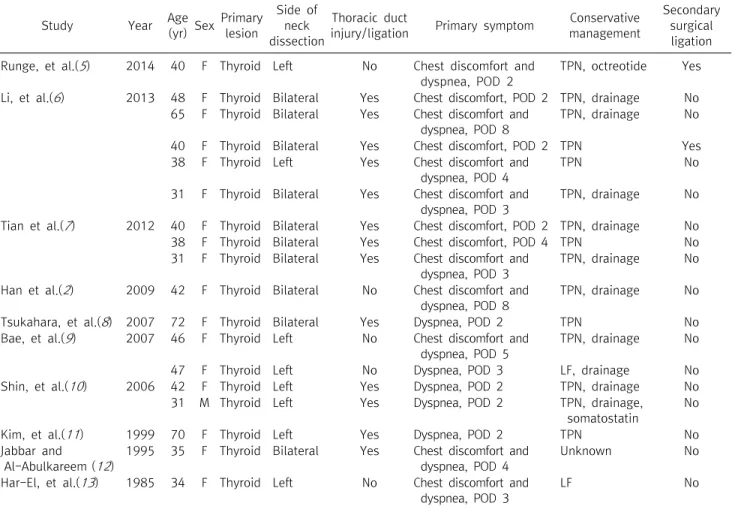
Among them, 18 cases were associated with thyro- idectomy (Table 1). The exact pathophysiology of chylo- thorax is not fully understood. However, two hypotheses have been postulated. One hypothesis is that the chyle escaping from the base of the neck flows directly into the mediastinum.(14) This may be possible because of rupture of the mediastinal pleura caused by tissue maceration and the inflammatory reaction.(2) Another hypothesis is that chylothorax leads to high intraluminal hydrostatic pres-
Study Year Age
(yr) Sex Primary lesion
Side of neck dissection
Thoracic duct
injury/ligation Primary symptom Conservative management
Secondary surgical ligation Runge, et al.(5) 2014 40 F Thyroid Left No Chest discomfort and
dyspnea, POD 2
TPN, octreotide Yes
Li, et al.(6) 2013 48 F Thyroid Bilateral Yes Chest discomfort, POD 2 TPN, drainage No 65 F Thyroid Bilateral Yes Chest discomfort and
dyspnea, POD 8
TPN, drainage No
40 F Thyroid Bilateral Yes Chest discomfort, POD 2 TPN Yes
38 F Thyroid Left Yes Chest discomfort and dyspnea, POD 4
TPN No
31 F Thyroid Bilateral Yes Chest discomfort and dyspnea, POD 3
TPN, drainage No
Tian et al.(7) 2012 40 F Thyroid Bilateral Yes Chest discomfort, POD 2 TPN, drainage No
38 F Thyroid Bilateral Yes Chest discomfort, POD 4 TPN No
31 F Thyroid Bilateral Yes Chest discomfort and dyspnea, POD 3
TPN, drainage No
Han et al.(2) 2009 42 F Thyroid Bilateral No Chest discomfort and dyspnea, POD 8
TPN, drainage No
Tsukahara, et al.(8) 2007 72 F Thyroid Bilateral Yes Dyspnea, POD 2 TPN No
Bae, et al.(9) 2007 46 F Thyroid Left No Chest discomfort and dyspnea, POD 5
TPN, drainage No
47 F Thyroid Left No Dyspnea, POD 3 LF, drainage No
Shin, et al.(10) 2006 42 F Thyroid Left Yes Dyspnea, POD 2 TPN, drainage No
31 M Thyroid Left Yes Dyspnea, POD 2 TPN, drainage,
somatostatin
No
Kim, et al.(11) 1999 70 F Thyroid Left Yes Dyspnea, POD 2 TPN No
Jabbar and Al-Abulkareem (12)
1995 35 F Thyroid Bilateral Yes Chest discomfort and dyspnea, POD 4
Unknown No
Har-El, et al.(13) 1985 34 F Thyroid Left No Chest discomfort and dyspnea, POD 3
LF No
POD = postoperative day; TPN = total parenteral nutrition; Drainage = continuous closed chest drainage; LF = low fat diet.
Table 1. Review of the literature for bilateral chylothorax following neck dissection in thyroid cancer
sure after thoracic duct ligation, which can cause chyle extravasation or rupture of the thoracic duct in the media- stinum.(15) Intraluminal pressure exceeds the capacity of the lymphatic collateral channels, and this is coupled with the negative intrathoracic pressure caused by inspira- tion.(2) There was no evidence of chyle leakage in the lateral neck portion in our case, but chylothorax deve- loped. This can be explained by the second hypothesis. We performed multiple suture ligations in the level IV area including the thoracic duct because there were multiple engorged lymphatic ducts with lymphatic spillage. The area was rich in lymphatics, and hence, the intraluminal hydrostatic pressure might be high after thoracic duct ligation. There was a high probability of chyle extra- vasation, but not of thoracic duct rupture because chyle leakage was dramatically improved after PCD insertion combined with NPO.
Chylothorax can be lethal because of severe compli-
cations such as cardiopulmonary problems.(16,17) Hence, prompt and accurate diagnosis is important. Our patient experienced dyspnea, whitish sputum, and chest discom- fort. Chest X-ray is a convenient way to confirm pleural effusion. If the chest X-ray confirms pleural effusion, a diagnostic thoracentesis can be proposed. Milky appea- rance of the pleural fluid is helpful for making the diagnosis of chylothorax. But, the classical milky appearance is seen in only 50% of the cases. It can also manifest as a serous or serosanguineous effusion.(18) Measurement of the fluid cholesterol and TG levels or Sudan III staining are also useful for making the diagnosis of chylothorax. A TG level above 110 mg/dL is diagnostic for chylothorax, while a TG level below 50 mg/dL can exclude chylothorax in patients on a normal diet.(18) Our patient was diagnosed as having chylothorax because the TG levels in the drainage were more than 110 mg/dL on POD 4.
Chylothorax should be treated at an early stage because
it can be a harmful condition.(1,4,12) Conservative treat- ment is the initial line of treatment. It includes drainage of chyle, reduction of chyle formation, and adequate nutri- tional supplementation. Nutritional program for reducing chyle formation consists of medium-chain TG (MCT)- based oral diet or NPO with total parenteral nutri- tion.(19,20) Chest PCD for chyle drainage, NPO for reduc- tion of chyle formation, and total parenteral nutrition for nutritional support were used in our patient. Somatostatin and octreotide may inhibit chyle production and reduce the thoracic duct flow; hence, they could be incorporated in the conservative management.(21) However, we did not administer somatostatin in this case.
The use of surgical intervention is controversial; but, it can be employed in cases where patients fail to respond to the conservative management.(22) The indications for surgical management are as follows: persistent leak for more than two weeks despite optimal conservative treat- ment; severe metabolic or nutritional complications; chyle leakage of more than 1 L per day for more than five days.(23)
Thoracic duct embolization can also be used to treat chylothorax. While the effect of thoracic duct emboli- zation is doubtful, the literature suggests that it can replace more invasive surgical procedures; thus, reducing patient morbidity and mortality.(24)
A multi-disciplinary approach with optimized conser- vative management was successful in treating chylothorax and preventing complications in our patient. This condi- tion can be easily overlooked because of its rarity, but surgeons have to consider the possibility of chylothorax in patients with chest discomfort or dyspnea after neck dissection. Early diagnosis and treatment seem to be important for reducing life-threatening complications and for achieving good results.
REFERENCES
1. Spiro JD, Spiro RH, Strong EW. The management of chyle fistula. Laryngoscope 1990;100:771-4.
2. Han C, Guo L, Wang KJ, Zhao JQ. Bilateral chylothorax follow- ing neck dissection for thyroid cancer. Int J Oral Maxillofac Surg 2009;38:1119-22.
3. Stuart WJ. Operative injuries of the thoracic duct in the neck.
Edinb Med J 1907;22:301-17.
4. Postma GN, Keyser JS. Management of persistent chylothorax.
Otolaryngol Head Neck Surg 1997;116:268-70.
5. Runge T, Borbély Y, Candinas D, Seiler C. Bilateral chylothorax following neck dissection: a case report. BMC Res Notes 2014;
7:311.
6. Li ZY, Tian W, Cai HK, Wang P, Deng YC. Clinical manifestations and managements of post-neck dissection chylothorax. Chin Med J (Engl) 2013;126:2570-2.
7. Tian W, Li ZY, Wang P, Lin XB. Chylothorax after neck dis- section for thyroid carcinomas: report of three cases. Surg Today 2012;42:89-92.
8. Tsukahara K, Kawabata K, Mitani H, Yoshimoto S, Sugitani I, Yonekawa H et al. Three cases of bilateral chylothorax develop- ing after neck dissection. Auris Nasus Larynx 2007;34:573-6.
9. Bae JS, Song BJ, Kim MR, Park WC, Kim JS, Jung SS. Bilateral chylothoraces without chyle leakage after left-sided neck dis- section for thyroid cancer: report of two cases. Surg Today 2007;37:652-5.
10. Shin JH, Lee J, Yun JS, Lim CY, Nam KH, Chung WY, et al.
Bilateral chylothorax after left modified radical neck dissec- tion: two cases. Korean J Head Neck Oncol 2006;22:179-82.
11. Kim YW, Kim CS, Chun SH, Choi DR. A case of bilateral chylo- thorax following neck dissection without chyle leakage of neck.
Korean J Otolaryngol-Head Neck Surg 1999;42:795-9.
12. Jabbar AS, al-Abdulkareem A. Bilateral chylothorax following neck dissection. Head Neck 1995;17:69-72.
13. Har-El G, Segal K, Sidi J. Bilateral chylothorax complicating radical neck dissection: report of a case with no concurrent ex- ternal chylous leakage. Head Neck Surg 1985;7:225-30.
14. Prabhu V, Passant C. Left-sided neck dissection and chylothor- ax: a rare complication and its management. J Laryngol Otol 2012;126:648-50.
15. Al-Sebeih K, Sadeghi N, Al-Dhahri S. Bilateral chylothorax fol- lowing neck dissection: a new method of treatment. Ann Otol Rhinol Laryngol 2001;110:381-4.
16. Oi K, Haraguchi N, Machida S, Beppu T, Ogawa A, Yeh YF, et al.
Dyspnea resulting from accumulation of pleural effusion after radical neck dissection. A case report. Oral Surg Oral Med Oral Pathol 1989;67:258-61.
17. Khurana H, Mishra S, Jain R, Goyal GN, Bhatnagar S. Manage- ment of postoperative chylothorax in a patient with carcinoma of thyroid and lymphadenopathy--a case report. Middle East J Anesthesiol 2009;20:121-3.
18. Valentine VG, Raffin TA. The management of chylothorax.
Chest 1992;102:586-91.
19. Ng RS, Kerbavaz RJ, Hilsinger RL Jr. Bilateral chylothorax from radical neck dissection. Otolaryngol Head Neck Surg 1985;
93:814-7.
20. Bozzetti F, Arullani A, Baticci F, Terno G, Ammatuna M, Cappello G. Management of lymphatic fistulas by total paren- teral nutrition. JPEN J Parenter Enteral Nutr 1982;6:526-7.
21. Sharkey AJ, Rao JN. The successful use of octreotide in the treat- ment of traumatic chylothorax. Tex Heart Inst J 2012;39:
428-30.
22. Srikumar S, Newton JR, Westin TA. Bilateral chylothorax fol- lowing left-sided radical neck dissection. J Laryngol Otol 2006;120:705-7.
23. Selle JG, Snyder WH 3rd, Schreiber JT. Chylothorax: indications
for surgery. Ann Surg 1973;177:245-9.
24. Patel N, Lewandowski RJ, Bove M, Nemcek AA Jr, Salem R.
Thoracic duct embolization: a new treatment for massive leak after neck dissection. Laryngoscope 2008;118:680-3.