• 검색 결과가 없습니다.

Correlation between Standing Balance and Forward Head Posture in Adolescents

N/A
N/A
Protected

Academic year: 2021

Share "Correlation between Standing Balance and Forward Head Posture in Adolescents"

Copied!
9
0
0

로드 중.... (전체 텍스트 보기)

전체 글

(1)

| Abstract |

Purpose: This study investigated the correlation between standing balance and head-forward posture in adolescents.

Methods: The participants in this study were 15 female adolescents. We took photographs of the participants’ craniovertebral angle with a digital camera to determine the degree of head-forward posture. Standing balance was evaluated using the 30-second Romberg test of BT4. The measurements were taken on a stable-support surface and on an unstable-support surface using a balance pad. The data measured in this study were analyzed using SPSS version 23.0, and the statistical significance level α was established as 0.05. Pearson correlation coefficient analysis was performed to identify the correlation between the degree of head-forward position of the participants and their balance ability.

Results: When we measured 30 seconds of the Romberg test, we observed that, with their eyes open, the participants’

head-forward posture and balance were not correlated. However, with their eyes closed, there was a strong correlation between the forward position of the head and the balance ability, which declined as the head position increased.

Conclusion: Adolescents with severe head-forward posture exhibited problems with balance in posture control with closed eyes when visual information was not available. It can be inferred that an abnormality occurs in proprioceptor sensation due to their habitual head-forward posture. Education on correct posture and preventive activities should be recommended to improve the health of such adolescents and avoid possible future problems of physical deterioration.

Key Words: Forward head posture, Craniovertebral angle, Balance, Adolescents

†Corresponding Author : Eun-Ju Lee ([email protected])

Original Article Open Access

청소년의 전방머리자세와 선 자세 균형간의 상관관계 연구
이은주

1)

경성대학교 이과대학 물리치료학과

Correlation between Standing Balance and Forward Head Posture in Adolescents

Eun-Ju Lee, P.T., Ph.D

Department of Physical Therapy, College of Health Science, Kyungsung University Received: December 2, 2019 / Revised: December 27, 2019 / Accepted: December 27, 2019

ⓒ 2020 Journal of Korea Proprioceptive Neuromuscular Facilitation Association

This is an Open Access article distributed under the terms of the Creative Commons Attribution Non-Commercial License

(http://creativecommons.org/licenses/by-nc/3.0) which permits unrestricted non-commercial use, distribution, and reproduction

in any medium, provided the original work is properly cited.

(2)

Ⅰ. 서 론

우리 나라 청소년들은 의자에 오래 앉아 학습하고 인터넷기기를 많이 사용하는 환경으로 인해 머리가 앞쪽으로 돌출되는 전방머리자세가 증가하고 있다 (Bang & Leem, 2015; Park, 2003). 전방머리자세는 신체 배열이 잘못 변화된 자세로 시상면에서 머리가 신체 중력선 앞으로 돌출되며 목의 움직임 범위는 제한된 다. 또한 전방머리자세는 연결된 다른 신체부위와 조 직에 변형, 통증, 경직을 동반한 질환을 발생시키며 균형을 유지하는데 더 높은 근육활동과 에너지 소비 를 필요로 하게 한다(Hickey et al., 2000; Park et al., 2015; Shah et al., 2019).

정상적이고 안정적인 자세는 출생 후 8-10년 사이 에 성인과 비슷한 척추만곡을 형성하며 신체 중력선 이 관자뼈의 꼭지돌기 , 목뼈의 중간부위, 엉덩관절 중 앙의 바로 뒤, 무릎관절과 발목관절의 약간 앞쪽을 지나 신체의 무게중심을 지지기저면내에 유지하며 넘 어지지 않게 균형을 조절하는 자세이다(Haughie et al., 1995). 신체의 무게중심을 기저면내에 유지하며 균형 을 조절하는 것은 일상생활활동 수행에 있어 매우 중 요한 선행 능력으로 이때 자세유지를 위한 근육 활동 이 최소한으로 수행하게 된다(Geurts, 1996; Winter et al., 1990).

전방머리자세는 머리척추각으로 설명될 수 있다.

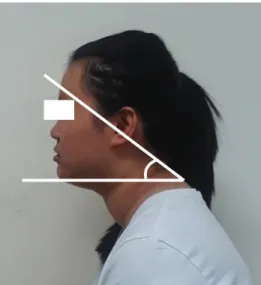
머리척추각은 머리의 측면 영상을 촬영하여 C7과 귀 의 이주에 서로 선을 그어 각도를 재는 방법으로 전방 머리자세가 심할수록 머리척추각은 감소하게 되며 머 리척추각의 50도 이하를 전방머리자세라고 한다 (Ahmadi et al., 2016; Nemmers, 2009; Ruivo et al., 2017).

머리척추각이 감소되어 있는 전방머리자세는 뒤통수 밑근, 반가시근, 머리널판근 등 목뼈를 지지하고 교정 하는 목폄근은 단축과 높은 긴장도를 보이고 목굽힘 근에서는 신장과 약화를 보이게 된다(Kim et al., 2016;

Fernandez-de-las-Penas, 2006). 목 주위 근육 중 고유수 용체인 근방추를 인체에서 가장 많이 가지고 있는 뒤 통수밑근은 머리의 안정성과 폄, 내밈, 돌림 역할을

하는 중요한 근육이다(Cho et al., 2015). 전방머리자세 가 지속되면 뒤통수밑근의 단축과 변형이 발생하게 되는데 이는 자세조절에 있어서 중요한 역할을 하는 고유수용성 감각 정보에 이상 변화를 일으켜 균형 능 력을 감소시키는 결과를 초래하게 된다(Silva &

Johnson, 2013). 또한 전방머리자세는 목에서 지지하는 머리무게를 증가시켜 자세유지 근육의 에너지 소모와 피로 증가를 유발하며 머리로의 혈류량을 감소시키고 학습능력의 근간이 되는 집중력도 저하시킬 수 있다 (Pavan et al., 2013; Rizo et al., 2012).

청소년기 환경은 장시간 전방머리자세에 노출될 위험이 많고 추후 그로 인한 신체기능 저하가 나타날 위험성이 높다. 청소년들이 머리전방자세로 인하여 나머지 생애주기에서 신체기능 저하로 이어질 수 있 음에도 불구하고 현재까지의 전방머리자세와 신체기 능에 관한 연구는 성인에 대한 것이 활발하고(de Vries, 2015; Lee & Jung, 2009; Lee et al., 2014; Lee et al., 2015; Quek et al. 2013) 청소년에 관한 연구는 거의 전무한 실정이다.

따라서 본 연구에서는 전방머리자세와 청소년의 균형능력간의 관련성을 알아보아 전방머리자세로 인 해 청소년에게 발생될 수 있는 신체기능 저하를 예방 하고 건강증진프로그램에 활용될 수 있는 기초자료를 제시하고자 한다.

Ⅱ. 연구 방법

1. 연구대상

부산 D여자중학교 학생들을 대상으로 교내 게시판

을 통해 모집하였으며 본 연구의 목적과 방법 , 연구자

의 지시사항을 충분히 이해하고 수행할 수 있는 학생

들 15명을 대상으로 하였다. 모든 대상자들은 본인과

법적 보호자가 자발적으로 본 연구에 동의하였다. 대

상자들은 과거에 안뜰계, 정형계, 신경계 손상과 관련

된 진단을 받은 적이 없고 평상시에 눈을 감은 활동이

(3)

나 자세 전환 시 어지러움이 없으며 움직임 동안 주시 안정화(gaze stabilization)되어 머리 흔들림이 없었다.

대상자의 나이, 일일 수면시간, 일일 운동시간, 주간 운동일 수, 운동강도에 대해서는 설문 조사하였고 설 문 문항 중 운동강도는 학생들의 이해를 돕기 위해 1저강도(예: 천천히 걷기), 2중강도(예: 빠르게 걷기, 요가, 자전거타기), 3 고강도(예: 조깅, 등산, 줄넘기, 수영)로 예를 들어 제시하였다. 몸무게, 키, 신체질량 지수는 신장 및 체중 측정기(DS 102, Dongsahn jenix, Korea)로 측정하였다. 본 연구는 부산 K 대학 임상연구 윤리위원회(institutional review board, IRB)로부터 연구 승인을 받았다(KSU-19-08-004).

2. 측정방법 및 도구

1) 머리척추각(craniovertebral angle, CVA) 측정

일반적으로 머리척추각의 측정은 방사선 검사와 근전도 및 3D 동작분석법, 디지털카메라로 촬영하는 방식이 있다. 본 연구에서는 방사선 노출의 위험과 비용 부담이 없는 디지털 카메라로 촬영하는 방식을 사용하였다 (Ahn & Jung, 2013). 도수촉진을 하여 대상 자의 제 C7가시돌기에 마커를 부착하였고 대상자로

부터 2m 떨어진 곳에 디지털카메라(Galaxy note 10, Samsung, Korea)를 고정대에 설치하였다. 대상자를 의 자에 앉게 한 후 양팔을 이완하여 몸통 옆에 편안하게 놓게 하였다. 대상자의 자연스러운 평소의 머리자세 (natural head posture, NHP)를 위해 목뼈의 굽힘과 폄을 큰 범위로 수행하게 한 후 , 점차적으로 그 범위를 줄여 나가게 하여 대상자가 가장 편안하게 느끼는 위치에 머리가 놓이게 되었을 때 연속적으로 3회 촬영하였다.

전방머리자세가 심할수록 머리척추각은 감소하게 된 다(Watson & Trott, 1993)(Fig. 1).

2) 균형 측정

정적 균형능력을 알아보기 위하여 전문 균형 평가 및 훈련 시스템(BT4-AP1173, Ab Hur Oy, Finland)의 롬버그 테스트(Romberg test) 30초를 사용하였다. 측정 은 안정적인 지지면과 균형패드(Balance-pad, AIREX, Switzerland)를 적용한 불안정 지지면에서 각각 2회 측 정하여 둘 중 더 좋은 값을 채택 하였다. 대상자가 눈을 뜨고 균형능력을 측정할 때 벽면에 표시된 한 점을 응시하도록 하여 시선의 위치를 통제하였고 각 측정 사이에는 5분간의 휴식시간을 두었다. 정적 균형 능력에 사용한 결과 값으로는 압력중심점이 움직인 범위인 C90 area (mm 2 ), 압력중심점이 움직인 거리인 trace length (mm), 일정한 측정시간 동안에 움직인 trace length (mm)를 측정시간으로 나눈 sway average velocity (mm/s)를 사용하였다. 모든 측정수치의 값은 증가할 수록 자세 및 균형 조절 능력이 감소되며 낙상 의 위험이 높다는 것을 의미한다.

3. 자료분석

본 연구에서 측정된 자료는 SPSS version 25.0(IBM SPSS Inc. USA)을 사용하였고 통계적 유의수준 α는 0.05로 하였다. 대상자의 전방머리자세 정도와 균형능 력간의 상호 관련성을 알아보기 위해 피어슨(pearson) 상관계수 분석을 실시하였다.

Fig. 1. Measurement of craniovertebral angle.

(4)

Ⅲ. 연구 결과

1. 연구대상자의 일반적인 특성

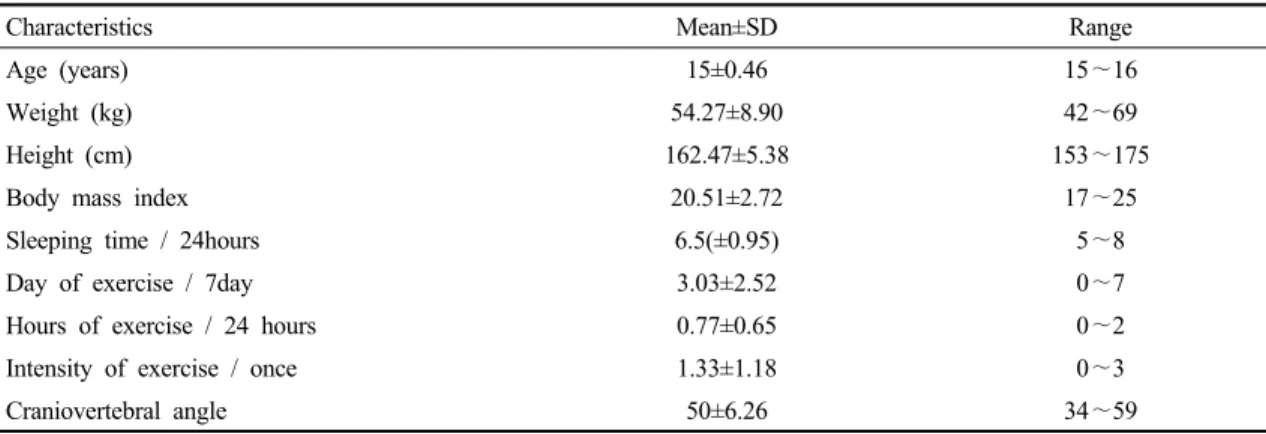
본 연구에 참여한 대상자 15명의 일반적인 특성은 다음과 같다. 평균 연령은 15±(0.46), 평균 체중은 54.27±(8.90), 평균키는 162.47±(5.38), 체질량 지수는 25.51±(2.72), 하루 평균 수면시간은 6.5±(0.95), 한주간 평균 운동일 수는 3.03±(2.52), 하루 평균 운동시간은 0.77±(0.65), 하루 평균 운동 강도는 1.33±(1.18), 평균 머리척추각은 50±(6.26) 이었다(Table 1).

2. 머리척추각과 안정한지지면에서 각 변수와의 상관관계

대상자들의 머리척추각과 안정적인 지지면에서 균 형검사 수행간의 상관분석 결과는 다음과 같다 . 머리 척추각은 눈을 뜬 상태의 trace length (r=-0.37), C90 area (r=-0.49), velocity (r=-0.37)는 상관관계가 없었지 만, 눈을 감은 상태의 trace length (r=-0.69), velocity (r=-0.69), C90 area (r=-0.82)와의 관계에서는 뚜렷하고 강한 음의 상관관계를 보였다(p<0.01)(Table 2).

3. 머리척추각과 불안정한 지지면에서 각 변수와의 상관관계

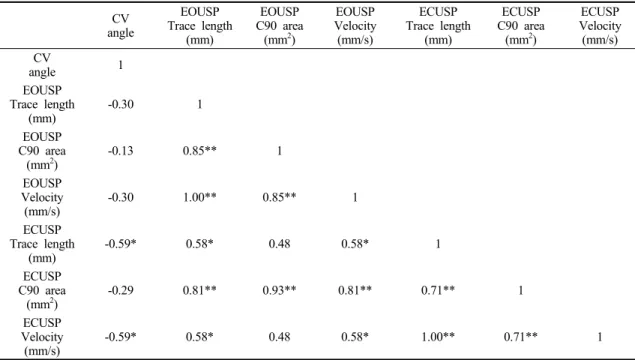
대상자들의 머리척추각과 불안정한 지지면에서 균

형검사 수행간의 상관분석 결과는 다음과 같다 . 머리 척추각은 눈을 뜬 상태의 trace length (r=-0.30), C90 area (r=-0.13), velocity (r=-0.30)와 눈을 감은 C90 area (r=-29)는 상관관계가 없었지만, 눈을 감은 상태의 trace length (r=-0.59), velociy (r=-0.59)와의 관계에서는 뚜렷하고 강한 음의 상관관계를 보였다 (p<0.01)(Table 3).

Ⅳ. 고 찰

본 연구는 청소년 전방머리자세 정도가 선 자세 균형능력에 미치는 영향을 알아보는 연구로 연구 결 과 전방머리자세가 심할수록 눈을 감은 상태에서의 균형능력이 감소되는 것을 확인할 수 있었다 . 일상생 활을 성공적으로 수행하기 위해 필수적으로 갖추어야 하는 균형능력은 체성감각 , 시각, 안뜰감각 등의 말초 적 요소들과 중추적 요소들의 상호작용으로 이루어진 다. 특히, 체성감각 중 고유수용성감각은 피부, 근육, 힘줄에 있는 수용기를 통해 신체의 자극과 위치에 대 해 알려주고 관절안정화와 운동조절에 중요한 역할을 한다 (Alexader & Kinney LaPier, 1998; Eun et al., 2015;

Shumway-cook & Horak, 1986). 목 근육에서 고유수용 성감각은 자세 제어에 더욱 중요한데 고유수용성감각 에 장애가 생기면 일상생활 동작을 수행하는 능력까 지도 함께 손상된다고 하였다(Cho et al., 2015; Slilva

& Johnson, 2013).

Characteristics Mean±SD Range

Age (years) 15±0.46 15∼16

Weight (kg) 54.27±8.90 42∼69

Height (cm) 162.47±5.38 153∼175

Body mass index 20.51±2.72 17∼25

Sleeping time / 24hours 6.5(±0.95) 5∼8

Day of exercise / 7day 3.03±2.52 0∼7

Hours of exercise / 24 hours 0.77±0.65 0∼2

Intensity of exercise / once 1.33±1.18 0∼3

Craniovertebral angle 50±6.26 34∼59

Table 1. General characteristics of subjects (n=15)

(5)

CV angle

EOSP Trace length

(mm)

EOSP C90 area

(mm 2 )

EOSP Velocity

(mm/s)

ECSP Trace length

(mm)

ECSP C90 area

(mm 2 )

ECSP Velocity

(mm/s) CV

angle 1

EOSP Trace length

(mm) -0.37 1

EOSP C90 area

(mm 2 ) -0.49 0.80 1

EOSP Velocity

(mm/s) -0.37 1.00** 0.80** 1

ECSP Trace length

(mm) -0.69** 0.34 0.25 0.34 1

ECSP C90 area

(mm 2 ) -0.82** 0.21 0.29 0.21 0.81** 1

Velocity ECSP

(mm/s) -0.69** 0.34 0.25 0.34 1.00** 0.81** 1

CV: craniovertebral angle, EOSP: eye open stable platform, ECSP: eye closed stable platform

**p<0.01

Table 2. Correlation of CV angle and stable platform balance (n=15)

CV angle

EOUSP Trace length

(mm)

EOUSP C90 area

(mm 2 )

EOUSP Velocity

(mm/s)

ECUSP Trace length

(mm)

ECUSP C90 area

(mm 2 )

ECUSP Velocity (mm/s) CV

angle 1

EOUSP Trace length

(mm) -0.30 1

EOUSP C90 area

(mm 2 ) -0.13 0.85** 1

EOUSP Velocity

(mm/s) -0.30 1.00** 0.85** 1

ECUSP Trace length

(mm) -0.59* 0.58* 0.48 0.58* 1

ECUSP C90 area

(mm 2 ) -0.29 0.81** 0.93** 0.81** 0.71** 1

ECUSP Velocity

(mm/s) -0.59* 0.58* 0.48 0.58* 1.00** 0.71** 1

CV: craniovertebral angle, EOUSP: eye open unstable platform, ECUSP: eye closed unstable platform

*p<0.05, **p<0.01

Table 3. Correlation of CV angle and unstable platform balance (n=15)

(6)

Kang등 (2012) 은 장시간 컴퓨터 작업으로 인하여 전방머리자세가 있는 30명의 성인들을 관찰하였는데 그 결과 균형능력 저하가 있음을 확인하였다 . 또 다른 전방머리자세에 관한 연구들에서도 전방머리자세가 심할수록 근육원섬유마디 수와 고유수용성감각 입력 이 변화되어 근력저하와 자세불안정성이 야기된다고 하였다(Lee et al., 2014; Sajjadi., 2014; Yong et al., 2016).

본 연구에서도 전방머리자세 정도가 심한 청소년일수 록 균형능력의 감소가 나타났는데 이는 전방머리자세 가 연령대와 상관없이 균형능력을 저하시키는 요인이 될 수 있음을 보여준다.

고유수용성감각 신경원인 근방추는 근육의 긴장과 자세 및 운동을 감지하여 중추에 정보를 보내고 팔다 리의 동적 측면과 정적 측면에 관한 위치인식에 기여 한다. 고유수용성감각에 결함이 생기면 중추신경계 운동출력과 관절기능은 영향을 받아 근육반응이 지연 되며 균형능력이 감소된다고 하였다(Liu, 2003). 위의 연구 결과를 바탕으로 본 연구의 청소년들이 전방머 리자세가 심할수록 균형능력이 감소되는 결과를 보였 던 것은 평소 지속적이고 반복적인 전방머리자세가 청소년들의 고유수용성 감각입력을 저하시켰고 그로 인해 자세불안정성이 증가되었기 때문일 것으로 사료 된다.

시각은 고유수용성감각과 함께 자신의 신체와 팔 다리 위치변화를 계속해서 관찰하며 움직임의 정확성 을 확인하고 미세한 조종을 통해 공간에서 몸을 똑바 로 유지하고 안전하게 이동하게 한다(Rose &

Christina, 2006). 눈을 감고 선 자세는 시각을 활용할 수 없으므로 자세 조절 시 고유수용성 감각의 섬세한 조절 능력이 더욱 요구되는 자세인데 본 연구 결과 눈을 뜬 상태에서 전방머리자세와 균형능력은 유의한 상관관계가 없었지만 눈을 감은 상태에서는 전방머리 자세가 심할수록 균형능력이 저하되는 강한 음의 상 관관계를 볼 수 있었다. 이는 전방머리자세로 인해 고유수용성감각 변화가 있는 청소년들이 평소에는 변 화된 고유수용성감각 저하의 문제를 시각에 의존하여 자세조절을 해오다가, 시각적 정보를 활용하지 못하

는 자세조절이 요구되었을 때 변화된 고유수용성 감 각저하 문제를 그대로 드러내며 균형능력이 저하되는 결과로 이어졌을 것이다 . 만성적인 목 통증으로 인하 여 목 움직임에 제한이 있는 환자들에 관한 연구들에 서도 고유수용성감각 저하로 인해 시각에 대한 의존 성이 상대적으로 증가하고 눈을 감은 상태에서 균형 을 유지하기 위한 자세활동이 크게 증가되었다고 보 고되어 본 연구의 결과 해석을 뒤받침한다(Hopkins

& Palmieri, 2004; Maldeleine et al., 2004; Treleaven et al., 2003).

Silva와 Johnson (2013)은 25명의 성인을 대상으로 눈을 감은 상태와 눈을 뜬 상태에서 시간차를 두고 전방머리자세와 정상머리자세를 교차로 취하게 한 후 그에 따른 자세조절을 측정 하였는데 시각적 조건이 자세조절 능력에 영향을 미치지는 않았다고 하였다.

그러나 이와 같은 결과가 나왔던 것은 위 연구가 평상 시 전방머리자세가 없는 젊고 건강한 성인들에게 전 방머리자세를 일시적으로 취하게 한 후 그에 따른 자 세조절 측정하였기 때문에 평소 고유수용성감각의 문 제가 없던 대상자들은 균형능력 수행에도 문제가 없 다는 결과가 나왔을 것이고 , 본 연구에서는 전방머리 자세가 이미 진행되어 고유수용성감각 저하 문제가 내재되어 있을 것으로 예상되는 청소년들을 대상으로 하였기 때문에 눈을 감은 자세조절에서 균형능력이 저하되는 결과를 보였을 것이다.

흔들림이 있는 불안정한 지지면에서 자세조절은

고유수용성감각보다 안뜰감각의 역할을 더욱 많이 필

요로 한다 . Migliares 와 White (2019)는 노인들에게서

전방머리자세가 안뜰감각 질환과도 연관이 있다고 하

였다. 그러나 본 연구에서는 시각적 차단 유무에 따른

균형능력의 불안정성만 확인되었고 안뜰감각과 관련

이 깊은 안정한 지지면과 불안정한 지지면 간의 균형

능력은 차이가 없어 전방머리자세를 가진 청소년들의

균형능력 저하 원인은 고유수용성감각의 문제임을 알

수 있었다. 또한 본 연구의 대상자 선정기준이 평상시

눈을 감은 활동이나 자세 전환에서 어지러움이 없고

머리 흔들림이 없이 주시 안정화가 확인된 청소년만

(7)

을 대상으로 하였기 때문에 본 연구에서 균형능력 저 하 원인으로 안뜰감각 결핍은 더욱 거리가 멀 것으로 사료된다.

Ⅴ. 결 론

본 연구에서는 청소년들의 전방머리자세 정도에 따른 균형능력을 알아보았고 그 결과 청소년기에 이 미 습관화된 전방머리자세는 고유수용성감각 이상을 발생시키고 균형능력에 문제를 일으키고 있음을 확인 할 수 있었다. 생의 초기에 있는 청소년기는 전방머리 자세의 유발요인이 높은 환경에 있고 이때 발생한 전 방머리자세는 이후의 나머지 생애주기에서 나쁜 영향 을 미치며 지속적인 신체기능 저하로 이어질 수 있다.

이에 본 연구자는 청소년에게 추후 발생될 수 있는 신체기능 저하를 예방하고 청소년들의 건강증진을 위 해 올바른 자세에 대한 교육과 예방활동 프로그램이 청소년들에게 필요하다고 제안하는 바이다.

본 연구의 제한점으로는 연구대상자의 수가 적고 성별, 지역, 연령대가 국한되어 있어 모든 성별과 모든 연령대의 청소년들에게 일반화하기 어렵고 고유수용 성 감각 평가를 직접적으로 하지 못하여 연구 결과를 선행연구에 기반하여서만 해석했다는 것이다. 향후 다양한 연령대와 성별을 모두 포함한 연구와 전방머리 자세를 가진 청소년들의 고유수용성 감각을 측정하여 보다 정확한 청소년들의 신체기능 저하 원인을 확인하 는 연구가 필요할 것이며 청소년들의 전방머리자세를 해결하고 예방할 수 있는 프로그램을 개발하고 그 효과 성을 확인하는 연구도 필요할 것으로 사료된다.

References

Ahmadi A, Maroufi N, Sarrafzadeh J. Evaluation of forward head posture in sitting and standing positions.

European Spine Journal. 2016;25(11):3577-3582.

Ahn SH, Jung HS. A validity study of the craniovertebral angle measurement on forward head posture. Research Journal of Complementary and Alternative Medicine.

2013;4:145-153.

Alexander KM, Kinney LaPier TL. Differences in static balance and weight distribution between normal subjects and subjects with chronic unilateral low back pain. Journal of Orthopaedic & Sports Physical Therapy. 1998;

28(6):378-383.

Bang HK, Leem YM. A study on shirts design for postural stability of teenagers considering human sensibility ergonomics. Journal of Korea Safety Management

& Science. 2015;17(1):139-148.

Cho S, Kim S, Park D. The comparison of the immediate effects of application of the suboccipital muscle inhibition and self-myofascial release techniques in the suboccipital region on short hamstring. Journal of Physical Therapy Science. 2015;27(1):195-197.

de Vries J, Ischebeck BK, Voogt LP, et al. Joint position sense error in people with neck pain: a systematic review. Manual Therapy. 2015; 20(6):736-744.

Eun NR, Chang WN, Song BK. Effects of trunk control on sitting posture and standing balance - by adults Bobath concept. Neurotherapy. 2015;19(3):47-58.

Fernandez-de-Las-Penas C, Alonso-Blanco C, Cuadrado M, et al. Forward head posture and neck mobility in chronic tension-type headache: A blinded, controlled study. Cephalalgia. 2006;26(3):314-319.

Geurts AC, Ribbers GM, Knoop JA, et al. Identification of static and dynamic postural instability following traumatic brain injury. Archives of Physical Medicine and Rehabilitation. 1996;77(7):639-644.

Haughie LJ, Fiebert IM, Roach KE. Relationship of forward head posture and cervical backward bending to neck pain. Journal of Manual & Manipulative Therapy.

1995;3(3):91-97.

Hickey ER, Rondeau MJ, Corrente JR, et al. Reliability of

(8)

the cervical range of motion (CROM) device and plumb-line techniques in measuring resting head posture (RHP). Journal of Manual & Manipulative Therapy. 2000;8(1):10-17.

Hopkins JT, Palmieri R. Effects of ankle joint effusion on lower leg function. Clinical Journal of Sport Medicine.

2004;14(1):1-7.

Kang JH, Park RY, Lee SJ, et al. The effect of the forward head posture on postural balance in long time computer based worker. Annals of Physical and Rehabilitation Medicine. 2012;36(1):98-104.

Kim BB, Lee JH, Jeong HJ, et al. Effects of suboccipital release with craniocervical flexion exercise on craniocervical alignment and extrinsic cervical muscle activity in subjects with forward head posture. Journal of Electromyography and Kinesiology. 2016;30:

31-37.

Lee KJ, Han HY, Cheon SH, et al. The effect of forward head posture on muscle activity during neck protraction and retraction. Journal of Physical Therapy Science. 2015;27(3):977-979.

Lee KS, Jung HY. Analysis of the change of the forward head posture according to computer using time.

Journal of the Korean Society of Physical Medicine.

2009;4(2):117-124.

Lee MY, Lee HY, Yong MS. Characteristics of cervical position sense in subjects with forward head posture. Journal of Physical Therapy Science. 2014;26(11):1741-1743.

Liu J, Thornell L, Pedrosa-Domellöf F. Muscle spindles in the deep muscles of the human neck: a morphological and immunocytochemical study. Journal of Histochemistry & Cytochemistry. 2003;51(2):175- 186.

Madeleine P, Prietzel H, Svarrer H, et al. Quantitative posturography in altered sensory conditions: a way to assess balance instability in patients with chronic whiplash injury. Archives of Physical Medicine and

Rehabilitaion. 2004;85(3):432-438.

Migliarese S, White E. Review of forward-head posture and vestibular deficits in older adults. Current Geriatrics Reports. 2019:1-8.

Nemmers TM, Miller JW, Hartman MD. Variability of the forward head posture in healthy community-dwelling older women. Journal of Geriatric Physical Therapy.

2009;32(1):10-14.

Park H, Lee S, Kim T. The exception case about the diagnose forward head posture using the craniovertebra angle, craniorotation angle and Cobb angle: a case report.

Journal of the Korean Society of Physical Medicine.

2015;10(2):29-34.

Park S, Lee D, Lee I, et al. Internet addiction and VDT syndrome in the middle and high school male students using PC bangs in a small sized city. Korean Public Health Research. 2003;29(1):10-16.

Pavan EE, Frigo CA, Pedotti A. Influence of an eccentric load added at the back of the head on head-neck posture. Gait & Posture. 2013;38(4):951-955.

Quek J, Pua Y, Clark RA, et al. Effects of thoracic kyphosis and forward head posture on cervical range of motion in older adults. Maunal Therapy. 2013;18(1):65-71.

Rizo AMH, Pascual-Vaca ÁO, Cabello MA, et al. Immediate effects of the suboccipital muscle inhibition technique in craniocervical posture and greater occipital nerve mechanosensitivity in subjects with a history of orthodontia use: a randomized trial. Journal of Manipulative and Physiological Therapeutics. 2012;

35(6):446-453.

Rose DJ, Christina RW. A multilevel approach to the study of motor control and learning. Boston. MA: Allyn and Bacon. 2006.

Ruivo RM, Pezarat-Correia P, Carita AI. Effects of a resistance

and stretching training program on forward head and

protracted shoulder posture in adolescents. Journal

of Manipulative and Physiological Therapeutics.

(9)

2017;40(1):1-10.

Sajjadi E, Olyaei GR, Talebian S, et al. The effect of forward head posture on cervical joint position sense. Journal of Paramedical Sciences (JPS). 2014;5(4):27-31.

Shah A, Lemans JV, Zavatsky J, et al. Spinal balance/alignment

—clinical relevance and biomechanics. Journal of Biomechanical Engineering. 2019;141(7):14.

Shumway-Cook A, Horak FB. Assessing the influence of sensory interaction on balance: suggestion from the field. Physical Therapy. 1986;66(10):1548-1550.

Silva AG, Johnson MI. Does forward head posture affect postural control in human healthy volunteers? Gait & Posture.

2013;38(2):352-353.

Treleaven J, Jull G, Sterling M. Dizziness and unsteadiness

following whiplash injury: characteristic features and relationship with cervical joint position error. Journal of Rehabilitaion Medicine. 2003;35(1):36-43.

Watson DH, Trott PH. Cervical headache: an investigation of natural head posture and upper cervical flexor muscle performance. Cephalalgia. 1993;13(4):

272-284.

Winter DA, Patla AE, Frank JS. Assessment of balance control in humans. Medical Progress through Technology.

1990;16(1-2):31-51.

Yong M, Lee H, Lee M. Correlation between head posture and proprioceptive function in the cervical region.

Journal of Physical Therapy Science. 2016;28(3):

857-860.

수치

Fig.  1.  Measurement  of  craniovertebral  angle.
Table  1.  General  characteristics  of  subjects  (n=15)
Table  3.  Correlation  of  CV  angle  and  unstable  platform  balance  (n=15)

참조

관련 문서

Moreover, this study examined the relationships between externalized and internalized maladaptive behaviours of adolescents on probation and analysed the

This study aims to identify whether socioeconomic level of parents affects obesity of adolescents and whether the relations between adolescent's obesity

Health behavior of multicultural and general family adolescents in Korea: the Korea Youth Risk.. Behavior

 Bent posture, and as a fast check of the measurement major pectoral muscle case, the patient lying immediately behind the head comes along,

This study aims to analyse the relations between stress and eating habits of adolescents as it was assumed that adolescents need lots of nutrients and eating habits

Vector/tensor

straight cylinder (no problems with toroidal force balance) - The 1-D radial pressure balance relation is valid for.. tokamaks, stellarators, RFP’s,

radial pressure balance, toroidal force balance, β limits, q-profiles, etc.. - The stream function ψ is closely related to the poloidal flux