• 검색 결과가 없습니다.

Desmoplastic Small Round Cell Tumor : A Case Report

N/A
N/A
Protected

Academic year: 2021

Share "Desmoplastic Small Round Cell Tumor : A Case Report"

Copied!
6
0
0

로드 중.... (전체 텍스트 보기)

전체 글

(1)

Vol.23 No.1 p90-95, June 2006

INTRODUCTION

Desmoplastic small round cell tumor (DSRCT) is composed of small round tumor cells of uncertain histogenesis, associated with prominent stromal desmoplasia and polyphenotypic differentiation.

1)

It was first described by Geral and Rosai

2)

in 1989, and has most commonly been reported in children and young adults, with a male-to-female ratio of 4:1. The location for this tumor has primarily

been in the abdominal cavity. It mostly occurs in the abdominal cavity. Other primary sites have been rarely reported, have included the paratesticular region,

3)

the pleural serosa,

4)

the posterior cranial fossa,

5)

soft tissue and bone,

6)

ovary,

7)

and kidney.

8)

We report a case of desmoplastic small round cell tumor that occurred in the abdominal cavity of a 50-year-old man, and review the medical literature.

책임저자:최준혁, 대구광역시 남구 대명동 317-1, 영남대학교 의과대학 병리학교실 Tel: (053) 620-3335, FAX: (053) 656-1429, E-mail: [email protected]
Desmoplastic Small Round Cell Tumor : A Case Report

Joon Hyuk Choi, Sung Soo Yun*, Jay Chun Chang

Department of Pathology, Department of Surgery* and Department of Diagnostic Radiology

College of Medicine, Yeungnam University, Daegu, Korea

-Abstract-

Desmoplastic small round cell tumor (DSRCT) is a rare and highly malignant mesenchymal tumor found in the abdominal cavity. It mainly affects young male patients. We report a case of DSRCT that occurred in the abdominal cavity of a 50-year-old man. The tumor was characterized by small round tumor cells with irregular nests in the prominent desmoplastic stroma. The tumor cells showed immunoreactivity for epithelial membrane antigen, desmin, vimentin, and neuron specific enolase.

1)

Key Words: Desmoplastic small round cell tumor, Abdominal cavity, Soft tissue,

Immunohistochemical stain

(2)

CASE REPORT

A 50-year-old man presented with abdominal discomfort for two months. He had a history of chronic hepatitis B and cirrhosis. Physical examination revealed an abdominal mass.

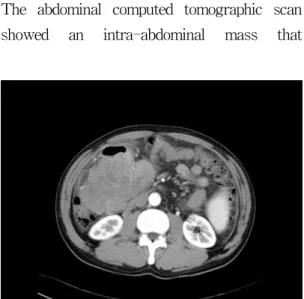
The abdominal computed tomographic scan showed an intra-abdominal mass that

appeared malignant on the right side of the abdomen (Fig. 1). A right hemicolectomy with excision of the mass was performed. A well circumscribed, gray-white, rubbery firm mass, measuring 14.0 x 12.5 x 8.5 cm in size, was attached to the transverse colon (Fig. 2). Multiple tumor nodules were present.

Microscopic examination revealed variably sized nests in the desmoplastic stroma (Fig. 3).

Tumor cells were uniform, small, and round

Fig. 1. The abdominal contrast-enhanced computed tomographic scan shows a large tumor in the right abdominal cavity.

Fig. 2. Gross photograph shows a 14.0 x 12.5 x 8.5 cm, circumscribed, nodular, gray-white tumor attached to the serosa of the right colon.

Fig. 3. Tumor shows variably sized nests in the desmoplastic stroma (Hematoxylin-eosin stain, x40).

Fig. 4. Tumor cells are uniform, small, and round

(Hematoxylin-eosin stain, x200).

(3)

(Fig. 4). Some tumor cells showed rosette formation (Fig. 5). Mitotic figures were seen.

Tumor cell necrosis was also present (Fig. 6).

Proliferation of endothelial cells was noted (Fig. 7). Lymphovascular invasion was found.

The tumor showed direct invasion into the colon wall. Eight out of twenty nine regional lymph nodes showed metastasis. On the immunohistochemical stain, the tumor cells showed positivity for epithelial membrane antigen (Fig. 8), desmin, vimentin, and

neuron specific enolase and negativity for alpha-fetoprotein, carcinoembryonic antigen, chromogranin, cytokeratin 7 and cytokeratin 20. A pathologic diagnosis of desmoplastic small round cell tumor was made. The patient died 40 months after surgery.

DISCUSSION

Desmoplastic small round cell tumor Fig. 5. Tumor cells show rosette formation (Hematoxylin-

eosin stain, x200).

Fig. 6. Tumor cell necrosis is found (Hematoxylin- eosin stain, x100).

Fig. 7. The proliferation of endothelial cells is seen (Hematoxylin-eosin stain, x200).

Fig. 8. Tumor cells show strong cytoplasmic

positivity for epithelial membrane antigen

(Immunohistochemical stain, x200).

(4)

(DSRCT) is a rare and aggressive malignant tumor. It usually present with widespread abdominal serosal involvement. There is a striking male predominance, with a peak incidence in the third decade of life (with a wide range from first to the fifth decade).

1)

There have been 10 prior cases reported in Korea.

7-17)

The histogenesis of DSRCT is uncertain.

Its predilection for serosal involvement suggests the possibility of a mesothelial origin. Presenting symptoms are usually related to the primary site and include: pain, abdominal distension, palpable mass, acute abdomen, ascites and organ obstruction.

1)

The computed tomographic features of DSRCT include bulky intra- abdominal soft tissue masses that involve omental and serosal surfaces, without a distinct organ of origin.

18)

DSRCT shows multiple tumor nodules studding the peritoneal surface. The cut surface is firm, gray-white, with foci of hemorrhage and necrosis.

1)

Histologically, DSRCT is characterized by variably size and shape as well as, sharply outlined nests of small neoplastic cells surrounded by a prominent desmoplastic stroma. Some tumors exhibit focal epithelial differentiation, with glands or a rosette growth pattern. The tumor cells are typically uniform with small hyperchromatic nuclei and scant cytoplasm. The desmoplastic stroma is composed of fibroblasts or myofibroblasts embedded in a loose extracellular material or collagen.

The immunoprofile of DSRCT is consistent and distinctive, showing a complex pattern of simultaneous multi-phenotypic differentiation, expressing proteins associated with epithelial, muscular and neural differentiation.

19)

The present case showed positivity for epithelial membrane antigen (epithelial marker), desmin (muscle marker), and neuron specific enolase (neural marker). These findings suggest that this tumor has a capacity for epithelial, muscular, and neural differentiation. The present case showed the morphological and immunohis- tochemical characteristics consistent with the diagnosis of a DSRCT. The presence of the t(11;22)(p13:q12) translocation is a common cytogenetic feature.

20)

EWS/WT1 gene fusion is specific for DSRCT.

21)

The differential diagnosis for DSRCT includes Ewing’s sarcoma/PNET, neuroblastoma, embryonal rhabdomyosarcoma, malignant mesothelioma, poorly differentiated carcinoma or neuroendocrine carcinoma.

22)

Ewing’s sarcoma /PNET, neuroblastoma and embryonal rhabdomyosarcoma lack prominent desmoplastic stroma. Poorly differentiated carcinoma and neuroendocrine carcinoma are desmin-negative.

Malignant mesotheliomas are CD15 and CD57 negative, whereas most DSRCT are positive for CD15 and CD57. Futhermore, malignant mesothelioma usually does not resemble DSRCT cytologically. The distinct immunohistochemical pattern of DSRCT is diagnostic.

DSRCT has a poor overall prognosis. In

(5)

our case, the patient died 40 months after surgery. Treatment consists of a combination of surgery, chemotherapy and radiotherapy.

Typically, an initial partial response to tumor debulking and chemotherapy is followed by uncontrollable tumor relapse. Despite multidrug chemotherapy, 75% of the patients die within four to 72 months (average, 26 months) after presentation and only about five percent live beyond five years without evidence of tumor.

22)

Intensive alkylator-based therapy with aggressive surgery and radiotherapy to high risk sites has resulted in prolonged progression-free survival.

23)

요 약

결합조직형성소원형세포종양은 매우 드문 악 성 연부조직 종양으로 소아와 청소년기에 복강 과 골반강 내에 주로 발생한다. 저자들은 복강 에 발생한 결합조직형성소원형세포종양 1예를 경험하였기에 문헌 고찰과 함께 보고한다. 50 세 남자가 2개월간의 복부 불쾌를 주소로 내원 하였다. 방사선 소견에서 오른쪽 복강 내에 종 괴가 관찰되었다. 절제된 종괴는 크기가 14.0 x 12.5 x 8.5 cm 이며, 회백색을 띠었으며 가 로 잘록창자의 장막에 붙어 있었다. 조직학적 으로 종괴는 결합조직을 형성하는 기질 내에 작고 둥근 핵을 가진 종양세포들의 증식이 보 였다.

REFERENCES

1. Antonescu CR, Gerald W. Desmoplastic small

round cell tumour. In: Fletcher CDM, Unni K, Mertens F: WHO classification of tumours.

Pathology and genetics of tumours of soft tissue and bone. Lyon: IARCPress; 2002. p.

216-8.

2. Gerald WL, Rosai J. Case 2. Desmoplastic small cell tumor with divergent differentiation.

Pediatr Pathol 1989;9(2):177-83.

3. Cummings OW, Ulbright TM, Young RH, Del Tos AP, Fletcher CD, Hull MT. Desmoplastic small round cell tumors of the paratesticular region. A report of six cases. Am J Surg Pathol 1997 Feb;21(2):219-25.

4. Parkash V, Gerald WL, Parma A, Miettinen M, Rosai J. Desmoplastic small round cell tumor of the pleura. Am J Surg Pathol 1995 Jun;19(6):659-65.

5. Tison V, Cerasoli S, Morigi F, Ladanyi M, Gerald WL, Rosai J. Intracranial desmoplastic small-cell tumor. Report of a case. Am J Surg Pathol 1996 Jan;20(1):112-7.

6. Adsay V, Cheng J, Athanasian E, Gerald W, Rosai J. Primary desmoplastic small cell tumor of soft tissues and bone of the hand.

Am J Surg Pathol 1999 Nov;23(11):1408-13.

7. Slomovitz BM, Girotra M, Aledo A, Saqi A, Soslow RA, Spigland NA, et al.. Desmoplastic small round cell tumor with primary ovarian involvement: case report and review. Gynecol Oncol 2000 Oct;79(1):124-8.

8. Su MC, Jeng YM, Chu YC. Desmoplastic small round cell tumor of the kidney. Am J Surg Pathol 2004 Oct;28(10):1379-83.

9. Ju MJ, Lee KM, Lee HK, Chung DK. Intra- abdominal desmoplastic small round cell tumor diagnosed by lymph node biopsy: A case report. Korean J Pathol 1995 Oct;29(5):698-701.

10. Kim JY, Kim BG, Kim SK, Baek HS, Jo DS,

Lee TG, et al. A case of intra abdominal

desmoplastic small round cell tumor (DSRCT).

(6)

Korean J Med 1997 Mar;52(3):405-11.

11. Park DH, Kim KH, Lee EC, Yoo JY, Chin SY. Desmoplastic small round cell tumor:

Radiologic findings. J Korean Radiol Soc 1998 May;38(5):843-7.

12. Kim HJ, Ahn HJ, Cho OK. Intraabdominal desmoplastic small round cell tumor: Report of two cases. J Korean Radiol Soc 1998 May;

38(5):875-8.

13. Kim KI, Kim JY, Kim I. Desmoplastic small round cell tumor of the sigmoid colon. Korean J Pathol 2001 Oct;35(5):451-4.

14. Chung SH, Lee SY, Kum DS, Kim SH, Kwon HC, Kim JS, et al.. A case of desmoplastic small round cell tumor. Korean J Med 2003 Nov;65(5):610-4.

15. Cho YB, Ahn HS, Shin HY, Choi HS, Park ES, Kim CJ. A case of desmoplastic small round cell tumor. Korean J Pediatr Hematol- Oncol 2004 Apr;11(1):62-7.

16. Lee SH, Ahn BK, Baek SU, Kim YO.

Retroperitoneal desmoplastic small round cell tumor. J Korean Surg Soc 2005 Oct;69(4):

338-41.

17. Kim JK, Lee YS, Ahn SN, Shin HC, Lee CJ, Kim WG, et al. A case of peritoneal desmoplastic small round cell tumor which involved both ovaries. Korean J Obstet Gynecol 2006 Jan;49 (1):224-9.

18. Bellah R, Suzuki-Bordalo L, Brecher E, Ginsberg

JP, Maris J, Pawel BR. Desmoplastic small round cell tumor in the abdomen and pelvis:

report of CT findings in 11 affected children and young adults. Am J Roentgenol 2005 Jun;

184(6):1910-4.

19. Lae ME, Roche PC, Jin L, Lloyd RV, Nascimento AG. Desmoplastic small round cell tumor: a clinicopathologic, immunohistochemical, and molecular study of 32 tumors. Am J Surg Pathol 2002 Jul;26(7):823-35.

20. Biegel JA, Conard K, Brooks JJ. Translocation (11;22)(p13;q12): primary change in intra- abdominal desmoplastic small round cell tumor.

Genes Chromosomes Cancer 1993 Jun;7(2):

119-21.

21. Gerald WL, Haber DA. The EWS-WT1 gene fusion in desmoplastic small round cell tumor.

Semin Cancer Biol 2005 Jun;15(3):197-205.

22. Kempson RL, Fletcher CD, Evans HL.

Hendrickson MR, Sibley RK. Atlas of tumor pathology: Tumors of the soft tissues. Third series, Fascicles 30. Whashington, DC: Armed Forces Institute of Pathology; 2001. p. 452-8.

23. Kushner BH, LaQuaglia MP, Wollner N, Meyers PA, Lindsley KL, Ghavimi F, Merchant TE, et al. Desmoplastic small round-cell tumor:

prolonged progression-free survival with

aggressive multimodality therapy. J Clin Oncol

1996 May;14(5):1526-31.

수치

Fig. 1. The  abdominal  contrast-enhanced  computed  tomographic  scan  shows  a  large  tumor  in  the  right  abdominal  cavity
Fig. 8. Tumor  cells  show  strong  cytoplasmic  positivity  for  epithelial  membrane  antigen  (Immunohistochemical  stain,  x200).

참조

관련 문서

1 John Owen, Justification by Faith Alone, in The Works of John Owen, ed. John Bolt, trans. Scott Clark, "Do This and Live: Christ's Active Obedience as the

- draw normal to each faces from the center of the sphere - cut the surface of the sphere in the indicated points (pole) - great circles- circles whose radius is that of the

Micro- and nano-sized pores were formed on the surface of the alloy using PEO and anodization methods, and the pore shape change according to the Zr

The proliferations of MC3T3-E1 cell seeded on pristine PCL scaffold and surface modified scaffolds for 1, 3, and 5 days... ALP activity of the MC3T3-E1 cell seeded

Intraoperative photograph shows grossly total removal of tumor using the navigation system

MC3T3-E1 cell morphorologies on the (a) CP-Ti surface and (b) nano-mesh surface for 20 min culturing time.. MC3T3-E1 cell morphorologies on the (a) CP-Ti surface and

In this study, it is shows that the stream of CO 2 is more effective in the reduction of unreacted TEGDMA and the increase of surface microhardness than that of N 2

They suggested that vaporization of a thin layer of liquid between the growing bubble and the heating surface caused removal of heat from the surface, thus lowing