The comparative immunotoxicity of mesoporous silica nanoparticles and colloidal silica
nanoparticles in mice
Soyoung Lee
1,* Mi-Sun Kim
1,* Dakeun Lee
2Taeg Kyu Kwon
3Dongwoo Khang
4Hui-Suk Yun
5Sang-Hyun Kim
11
CMRI, Laboratory of
Immunotoxicology, Department of Pharmacology,School of Medicine, Kyungpook National University, Daegu, Republic of Korea;
2
Department of Pathology, School of Medicine, Kyungpook National University, Daegu, Republic of Korea;
3
Department of Immunology, School of Medicine, Keimyung University, Daegu, Republic of Korea;
4School of Nano and Advanced Materials Science and Engineering, Gyeongsang National University, Jinju, Republic of Korea;
5
Engineering Ceramics Department, Powder and Ceramics Division, Korea Institute of Materials Science, Changwon, Republic of Korea
*These authors contributed equally to this work
Correspondence: Sang-Hyun Kim Department of Pharmacology, School of Medicine, Kyungpook National University, 101 Dong-In, Jung-Gu, Daegu 700-422, Republic of Korea Fax +82 53 423 4838
Email [email protected] Hui-Suk Yun
Engineering Ceramics Department, Powder and Ceramics Division, Korea Institute of Materials Science, 797 Changwondaero, Changwon 641-831, Republic of Korea
Fax +82 55 280 3392 Email [email protected]
Background: Mesoporous silica (MPS) nanoparticles (NPs), which have a unique pore struc- ture and extremely large surface area and pore volume, have received much attention because of their biomedical application potential. Using MPS NPs for biomedical devices requires the verification of their biocompatibility because the surface area of NPs is one of the most important determinants of toxicity, including the cellular uptake and immune response. We have previ- ously reported that the cytotoxicity and inflammation potential of MPS NPs have been shown to be lower than those of general amorphous colloidal silica (Col) NPs in macrophages, but the low cytotoxicity does not guarantee high biocompatibility in vivo. In this study, we compared the in vivo immunotoxicity of MPS and Col NPs in the mouse model to define the effects of pore structural conditions of silica NPs.
Materials and methods: Both MPS and Col NPs (2, 20, and 50 mg/kg/day) were intraperi- toneally administered in female BALB/c mice for 4 weeks, and clinical toxicity, lymphocyte population, serum IgG/IgM levels, and histological changes were examined.
Results: There was no overt sign of clinical toxicity in either MPS- or Col-treated mice.
However, MPS NPs led to significant increases in liver and spleen weight and splenocyte proliferation. Mice treated with MPS NPs showed altered lymphocyte populations (CD3
+, CD45
+, CD4
+, and CD8
+) in the spleen, increased serum IgG and IgM levels, and histological changes. Despite slight changes in lymphocyte populations in the spleen, Col NPs did not alter other immunological factors.
Conclusion: The results indicate that in vivo exposure to MPS NPs caused more damage to systemic immunity than that of Col NPs through the dysregulation of the spleen. The results for in vivo data are inconsistent with those for in vitro data, which show lower cytotoxicity for MPS NPs. These results suggest the importance of verifying biocompatibility both in vitro and in vivo during the design of new nanomaterials.
Keywords: immunotoxicity, mesoporous silica nanoparticle, colloidal silica nanoparticle, spleen
Introduction
Any advancements in nanomaterials, which are engineered structures with at least one dimension measuring 100 nm or less, require parallel efforts to understand their health and environmental effects.
1Silica (SiO
2) nanoparticles (NPs), which represent a typical nanomaterial, have been used in various applications, such as chemical mechanical polishing, varnishes, cosmetics, food, and biomedical devices.
2,3Mes- oporous silica (MPS) NPs are designed to have increased the surface areas and pore volumes, and to arrange pore structure as compared to amorphous colloidal silica (Col) NPs.
4Studies have suggested that, by taking advantage of these characteristics, O R I G I N A L R E S E A R C H
open access to scientific and medical research Open Access Full Text Article
Number of times this article has been viewed
This article was published in the following Dove Press journal:
International Journal of Nanomedicine 4 January 2013
MPS NPs have the potential to be used as novel biomedical devices and in applications such as matrices for drug/ gene delivery, biosensors, imaging for diagnosis, and tissue engineering.
5,6In addition, their unique pore structure properties show biological responses different from those of their bulk counterparts. The unusual physicochemical properties of silica NPs can be attributed to their surface area, size distribution, impurity, crystallinity, electronic properties, surface properties, solubility, aggregation, and shape.
7Although silica is generally considered to be noncytotoxic,
8designing silica as nanomaterials may change its biocompat- ibility because of changes in its physicochemical properties, and its use for biomedical devices should be verified.
7,9,10A previous study of the biocompatibility of MPS has investigated the general effects of nanomaterials such as size, surface charge, concentration, and morphology.
11However, the largest expected influence on the difference in biocompatibility between MPS and Col NPs is the pore structure property. Changes in the pore structure can have considerable influence on biological responses because of its high reactivity.
12In this regard, we previously compared the effects of MPS and Col NPs on apoptosis and inflammation, and MPS NPs have been found to show better biocompat- ibility in vitro than Col NPs.
4However, the results of an in vitro study cannot guarantee biocompatibility in vivo, and therefore data from in vitro studies may be misleading and require verification through animal experiments. In vivo systems are extremely complicated and interactions between NPs and biological components such as proteins and cells can lead to unique biodistribution, clearance, and immune response.
13,14In addition, there is no study that has examined the effects of the pore structure property of NPs on immu- notoxicity in vivo.
The present study compares the repeated-dose toxicity of two types of silica NPs (MPS and Col) in mice for 4 weeks (5 days/week) by focusing on the reticuloendothelial system (RES), which is part of the immune system that consists of phagocytic cells located in reticular connective tissue. RES organs such as the liver, spleen, and lymph nodes have been found to have a predisposition toward the rapid recognition and clearance of nanomaterials.
15,16Although previous stud- ies have attempted to help NPs be hidden from the RES by employing various strategies such as polyethylene glycol conjugation, RES organs remain well-recognized as major NP targets.
17,18Therefore, there is a need for a better understand- ing of the relationship between the pore structure property
of silica NPs and immune system organs such as the liver, spleen, and thymus for the bioapplication of MPS NPs.
Materials and methods Nanoparticle preparation
MPS and Col NPs were prepared using a similar process, except for the addition of the ionic surfactant cetyl trimeth- ylammonium bromide (CTAB), as a template to MPS. The MPS NPs were prepared under dilute tetraethyl orthosilicate (TEOS) and a low surfactant concentration condition, as fol- lows: 0.66 g of CTAB was dissolved in a mixture of 800 mL of distilled water and 26.4 mL of ammonium hydroxide (29 wt%
NH
3in water); 3 mL of TEOS was then carefully added, with vigorous stirring. The precursor solution was stirred for another 3 hours at room temperature. To remove the surfactant template, the synthesized MPS was refluxed in a solution of 1 mL of HCl (37.4%) and 100 mL of methanol, followed by repeated (10 times, in general) washing with methanol and water. The surfactant-removed MPS NPs were placed in etha- nol and sonicated before using, to prevent aggregation of NPs.
The Col NPs were synthesized in a similar process to the MPS NPs by mixing 500 mL of ethanol, 20 mL of distilled water, 20 mL of ammonium hydroxide, and 30 mL of TEOS. The precursor solution was then stirred for 24 hours and filtered, washed with water, and re-dispersed in ethanol.
Structural characterization
The structural characterization was carried out by field emission scanning electron microscopy (JEOL5800, 5 kV;
JEOL, Tokyo, Japan) and transmission electron microscopy (JEOL-JEM2100F, 200 kV; JEOL). The specific surface area and pore volume were measured by the N
2-gas adsorption method, using a BET apparatus (Belsorp mini II; BEL Japan, Osaka, Japan).
Animal care and handling
Inbred female BALB/c mice, 6 weeks of age and with an average body weight of 19–21 g, were procured from Dae-Han Experimental Animal Center (Daejeon, Korea).
Mice were randomly assigned to treatment groups (five per
cage) and acclimatized for 1 week in the housing facility
maintained at 23 °C ± 1°C with a 12 hour/12 hour light/dark
cycle. Mice were housed in polycarbonate shoebox-style
cages lined with Harlan Tekiad Laboratory Grade Sani-chips
(Harlan Tekiad, Madison, WI, USA), which were changed
every other day. Rodent chow (Superfeed Co, Wonju, Korea)
and purified water (Milli-Q Water Purification system;
Millipore, Bedford, MA, USA) were supplied ad libitum.
Food and water consumption, as well as body weight gain, were recorded daily. All procedures involving the use of animals were approved by the Institutional Care and Use Committee and carried out in accordance with the guide- lines established by the Public Health Service Policy on the Humane Care and Use of Laboratory Animals, Kyungpook National University, Daegu, Republic of Korea.
Treatment
The animals received silica NPs suspended in distilled water.
Mice were intraperitoneally injected with silica NPs (2, 20, and 50 mg/kg/day) for 4 weeks (5 days/week). At the end of the treatment period, the mice were fasted overnight and euthanized by carbon dioxide. Trunk blood was collected, and various organs were aseptically excised and weighed.
Preparation of single-cell lymphocyte populations
Single-cell lymphocyte populations were prepared from the spleen and thymus as described earlier
19with modifications as noted below. The spleen and thymus were aseptically excised and maintained in 10 mL of cold complete Roswell Park Memorial Institute (RPMI) medium (RPMI 1640 with 10%
heat-inactivated fetal bovine serum and 1% antibiotics [Gibco, Grand Island, NY, USA]). Monocellular suspensions were pre- pared using a Stomacher laboratory blender (Stomacher 80;
Seward, Thetford, UK). The cell suspension was washed with RPMI medium. The cell pellets were resuspended in RPMI medium and incubated for 4 hours in 5% CO
2at 37 °C. To collect lymphocytes, the suspended cells were transferred to a new tube separating macrophages and granulocytes. Viable cells were counted using a hemocytometer (Paul Marienfeld GmbH and Co. KG, Lauda-Königshofen, Germany).
Proliferation assay
The proliferation of splenocytes and thymocytes was determined by 3-(4,5-dimethylthiazol-2-yl)-2,5- diphenyltetrazolium bromide (MTT) assay. At the end of the animal treatment, isolated splenocytes and thymocytes were dispensed into 96-well plates containing mitogens in either 10 µg/mL concanavalin A (Con A) or lipopolysac- charide (LPS). Cells were incubated for 72 hours followed by MTT for 4 hours, and then 100 µL of dimethyl sulfoxide was added to dissolve the formazan crystals. The absorbance was read at 570 nm using the Biochrom Anthos 2010 spec- trophotometer (Biochrom Ltd, Cambridge, UK).
Phenotyping of splenic and thymic lymphocytes A flow cytometer (BD Biosciences, San Jose, CA, USA) was used to determine the prevalence of specific lympho- cyte populations in the spleen and thymus as described earlier.
20Monoclonal antibodies were conjugated with fluorescein isothiocyanate ([FITC] emission at 525 nm) or phycoerythrin ([PE] emission at 575 nm). Antibodies to cell-specific receptors (Sasnta Cruz Biotechnology, Santa Cruz, CA, USA) included hamster anti-mouse CD3- FITC (T lymphocyte), rat anti-mouse CD45R/B220-PE (B lymphocyte), rat anti-mouse CD4-FITC (T helper lymphocyte), and rat anti-mouse CD8-PE (T cytotoxic/
suppressor lymphocyte). Cells were washed with phosphate-buffered saline. Antibodies were added to samples, gently vortexed, and followed by incubation for 30 minutes at 4 °C.
Measurement of serum immunoglobulin G (IgG) and immunoglobulin M (IgM)
Immunoglobulin levels were analyzed using a mouse IgG and IgM enzyme-linked immunsorbent assay (ELISA) Quantitation Kit (Bethyl Laboratories, Montgomery, TX, USA) following the manufacturer’s instructions. Briefly, 96-well plates were coated with affinity purified mouse IgG and IgM coating antibody. After overnight incubation at 4 °C, the plates were washed with wash buffer and blocked for 30 minutes in blocking solution. Samples or standards (IgG and IgM) were added to each well and incubated at room temperature for 1 hour. After incubation, horseradish peroxidase detection antibodies were added to each well and incubated at room temperature for 1 hour; the plates were washed, developed by adding 3,3 ′,5,5′-tetramethylbenzidine substrate solution (100 µL), and incubated for 15 minutes.
The reaction was stopped by adding sulfuric acid (100 µL, 0.18 M) and the absorbance at 450 nm was measured with an ELISA reader.
Histology
The histology of the liver and spleen were determined
by light microscopy as previously described.
21Liver and
spleen tissues were fixed in 4% formalin for 16 hours and
embedded in paraffin. The paraffin-embedded samples
were sectioned at 4 µm thickness and then stained with
hematoxylin and eosin. The slides were examined with
light microscopy by two pathologists (Dr Shin and Dr Lee),
independently.
Statistical analysis
Statistical analyses were performed using SAS statistical software (SAS institute, Cary, NC, USA). Treatment effects were analyzed using ANOVA, followed by Dunnett’s mul- tiple range tests. Significance was set at P , 0.05.
Results
Characterization of materials
According to the images of MPS and Col NPs in Figure 1, both showed the same spherical morphology (approximately 100 nm in diameter) and were clearly discrete. Both NPs showed narrow particle size distribution at 98 ± 6 nm and 102 ± 6 nm for MPS and Col, respectively (Figure S1).
However, MPS NPs were composed of a 2D hexagonally well-ordered mesostructure, the average pore size of which was 2.4 nm, and their specific surface area and pore volume were 1150 m
2/g and 1.46 cm
3/g, respectively. On the other hand, Col NPs had no mesopore structure, and their specific surface area and pore volume were 40 m
2/g and 0.29 cm
3/g, respectively.
4Clinical manifestation and blood biochemical assay
For the repeated administration experiment, female BALB/c mice were intraperitoneally administered with MPS and Col NPs (2, 20, and 50 mg/kg/day) for 4 weeks (5 days/week).
No overt clinical toxicity or behavioral changes were observed during the treatment period, and no significant changes in body weight were observed between treatment groups ( Figure 2). Only the group treated with 50 mg/kg/day of Col NPs showed increased food consumption, and water
A B
Col MPS
C D
200 nm 200 nm
50 nm 50 nm
Figure 1 (A and B) FE-SEM and (C and D) TEM images of Col and MPS NPs.
Abbreviations: FE-SEM, field emission scanning electron microscopy;
TEM, transmission electron microscopy; MPS, mesoporous silica; Col, colloidal silica; NPs, nanoparticles.
A
25B
C
20
15
10
5
0
5 CON
Body weight (g) Food consumption (g) Water consumption (mL)
2 20
MPS Col
(mg/kg/day)
50 2 20 50
CON 2 20
MPS Col
(mg/kg/day)
50 2 20 50
CON 2 20
MPS Col
(mg/kg/day)
50 2 20 50
4
3
2
1
0
8
6
4
2
0
*
* *
Figure 2 Effects of MPS and Col NPs on (A) body weight, (B) food consumption, and (C) water consumption in female BALB/c mice.
Notes: MPS and Col NPs were intraperitoneally administered to mice at doses of 2, 20, or 50 mg/kg/day for 4 weeks (5 days/week). The results are presented as mean ± SE (n = 5). *P , 0.05: significantly different from the control group values.
Abbreviations: MPS, mesoporous silica; Col, colloidal silica; NPs, nanoparticles;
CON, control; SE, standard error.
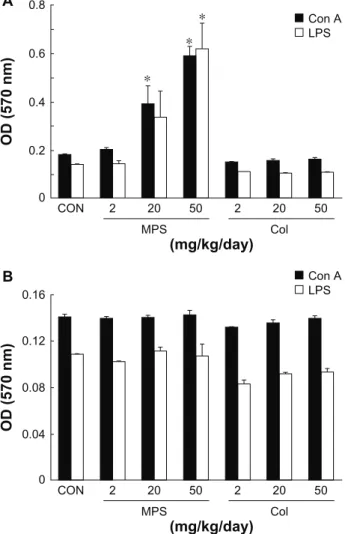
with the control after 72 hours, whereas no increase was observed for Col NPs. In the thymus, no changes in thymo- cyte proliferation were observed for both MPS and Col NPs (Figure 3B).
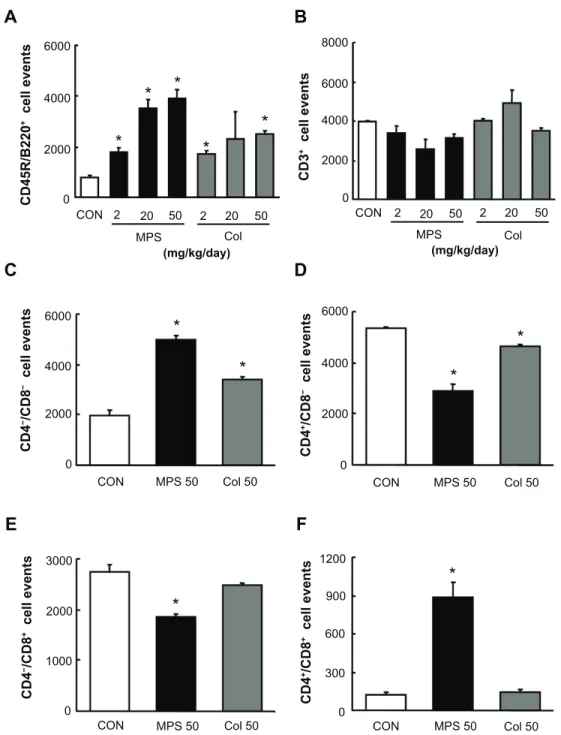
Silica NPs altered lymphocyte populations and pheno- types in the spleen. Intraperitoneal exposure to MPS NPs at doses of 2, 20, and 50 mg/kg/day led to 2.3-, 4.6-, and 5.1- fold increases, respectively, in CD45
+B lymphocytes in the spleen (Figure 4A). Col NPs increased CD45
+B lymphocytes in the spleen, although not as much as MPS NPs. Neither NP had an effect on the population of CD3
+T lymphocytes (Figure 4B). Next, the phenotype of T lymphocytes in the spleen was examined. Figure 4C–F show the changes in this consumption increased in both of the treatment groups that
were administered 50 mg/kg/day silica NPs.
The effects of MPS and Col NPs on the weight of the liver, kidney, spleen, and thymus were examined (Table 1).
A high MPS dose significantly increased the relative weight of the liver and spleen. However, Col NPs had no effect on the weight of the liver and spleen. MPS and Col NPs had no effects on the weight of the kidney and thymus.
Previous studies have proposed the hepatotoxic potential of silica NPs.
1,22Therefore, the hepatotoxic potential of MPS and Col NPs was examined through an animal experiment.
Histologically, occasional spotty necrosis and focal sinusoidal dilatation with hemorrhage were observed in the liver tissue of both MPS and Col treated mice (Figure S2). By contrast, neither NP influenced the serum aspartate transaminase and alanine transaminase levels, as a marker of liver toxicity, or creatinine and blood urea nitrogen levels, as a marker of kidney toxicity, (Table S1). Although there was an increase in liver weight in MPS treated mice, this increase was observed only at the highest MPS dose (Table 1). Taken together, the results indicate the weak hepatotoxic potential of both NPs.
Cell proliferation and lymphocyte population in immune organs
The toxic effects of MPS and Col NPs on immune organs (spleen and thymus) were examined. As shown in Figure 3A, in the spleen, continuous exposure to MPS NPs led to dose-dependent increases in proliferative responses to the lymphocyte mitogens, Con A or LPS. Treatment with 20 and 50 mg/kg/day of MPS NPs showed 2.2- and 3.3-fold increases, respectively, in proliferation for Con A and 2.4- and 4.4-fold increases, respectively, for LPS in comparison
Table 1 Effects of MPS and Col NPs on organ weight of female BALB/c mice
Dose of nanoparticles (mg/kg/day)
Organ weight/body weight ratio (g/100 g) for
Liver Kidney Spleen Thymus
CON 4.62 ± 0.04 1.58 ± 0.03 0.38 ± 0.01 0.32 ± 0.02 MPS 2 4.75 ± 0.10 1.51 ± 0.02 0.34 ± 0.03 0.24 ± 0.01 MPS 20 4.87 ± 0.17 1.48 ± 0.02 0.45 ± 0.04* 0.37 ± 0.04 MPS 50 5.25 ± 0.11* 1.37 ± 0.10 0.70 ± 0.02* 0.39 ± 0.01 Col 2 4.29 ± 0.11 1.41 ± 0.07 0.32 ± 0.02 0.28 ± 0.03 Col 20 4.02 ± 0.06 1.35 ± 0.03 0.37 ± 0.02 0.27 ± 0.01 Col 50 4.18 ± 0.20 1.40 ± 0.07 0.37 ± 0.03 0.25 ± 0.03
Notes: The results are presented as mean ± SE (n = 5). *P , 0.05: significantly different from the control group values.Abbreviations: MPS, mesoporous silica; Col, colloidal silica; NPs, nanoparticles;
CON, control; SE, standard error.
0.8
0.6
0.4
0.2
0 CON 2 20
MPS
50 2 20
(mg/kg/day) Col
OD (570 nm )
50 Con A LPS
0.16
0.12
0.08
0.04
0 CON 2 20
MPS
50 2 20
(mg/kg/day) Col
OD (570 nm )
50 Con A
B LPS
A ∗
∗
∗
Figure 3 Proliferation assays of (A) splenocytes and (B) thymocytes in mice treated with MPS and Col NPs.
Notes: MPS and Col NPs were intraperitoneally administered to mice at doses of 2, 20, or 50 mg/kg/day for 4 weeks (5 days/week). Splenocytes and thymocytes were isolated and cultured into 96-well plates containing mitogens, either Con A (10 µg/mL) or LPS (10 µg/mL), for 72 hours and evaluated for their proliferation using MTT assay. The results are presented as mean ± SE (n = 5). *P , 0.05:
significantly different from the control group values.
Abbreviations: MPS, mesoporous silica; Col, colloidal silica; NPs, nanoparticles; CON, control; Con A, concanavalin A; LPS, lipopolysaccharide; MTT, 3-(4,5-dimethylthiazol- 2-yl)-2,5-diphenyltetrazolium bromide; OD, optical density; SE, standard error.
6000
A B
C D
E F
CON
CON MPS 50 Col 50
CON MPS 50 Col 50
CON MPS 50 Col 50
CON MPS 50 Col 50 2 20 50
MPS
2 20 50 Col
(mg/kg/day)CON 2 20 50 MPS
2 20 50 Col
(mg/kg/day)4000
2000
0
8000
*
* *
*
*
*
*
*
*
*
*
6000
4000
CD3
+cell event s
CD45R/B220
+cell events CD4
−/CD8
−cell events CD4
+/CD8
−cell events
CD4
−/CD8
+cell events CD4
+/CD8
+cell events
2000
0
6000
4000
2000
0
6000
4000
2000
0
1200
900
600
0 300 3000
2000
1000
0
Figure 4 Effects of MPS and Col NPs on lymphocyte populations in the spleen. (A and B) MPS and Col NPs were intraperitoneally administered to mice at a dose of 2, 20, or 50 mg/kg/day. Effects of MPS and Col NPs on B- and T-lymphocyte populations, respectively. Populations are shown as absolute cell counts for given receptors. (C–F) Effects of MPS and Col NPs (50 mg/kg/day) on T-lymphocyte phenotype populations, respectively. Populations show as absolute cell counts for given receptors.
Notes: The results are shown as mean ± SE (n = 5). *P , 0.05: significantly different from the control group.
Abbreviations: MPS, mesoporous silica; Col, colloidal silica; NPs, nanoparticles; CON, control; SE, standard error.
phenotype (helper and cytotoxic T cells). Exposure to MPS NPs led to the dramatic restructuring of the population of T lymphocytes. MPS NPs increased CD4
-/CD8
-and CD4
+/ CD8
+phenotypes, but decreased CD4
+/CD8
-and CD4
-/CD8
+phenotypes. Col NPs also induced some changes, although not as much as MPS NPs. Lymphocyte populations and thymus phenotypes remained unchanged by both MPS and Col NPs (Figure S3).
Histopathological examination
Histological examination was performed to confirm the
serological differences found in the above studies (splenocyte
proliferation and lymphocyte population) in the tissue sec-
tion (Figure 5). In the spleen tissues of the vehicle control
animals, several distinct white pulps of variable size were
interwoven by the filtering red pulp. On the other hand,
red pulp expansion with many macrophage infiltration and
relative white pulp shrinkage was observed in high-dose MPS-NP treated groups. In Col NPs treated groups, white pulps appeared to fuse with one another. Neither red pulp expansion nor increased macrophage infiltration was evident in Col NPs treated groups.
Immunoglobulin production in serum
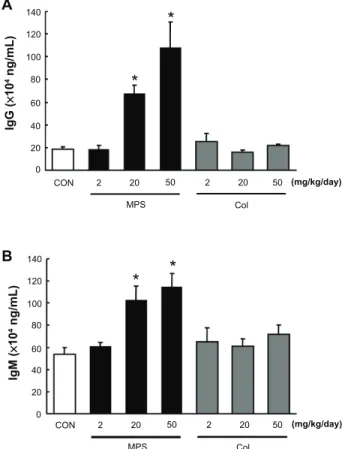
For an analysis of the systemic immune response, the serum level of immunoglobulins was observed in mice administered with MPS and Col NPs (Figure 6). Previous studies have shown that IgG and IgM can bind to vari- ous pathogens and protect the body against them through agglutination and immobilization, complement activation (classical pathway), opsonization for phagocytosis, and the neutralization of their toxins. There were significant increases
in IgG and IgM levels in MPS-treated mice at doses of 20 and 50 mg/kg/day. However, Col-treated mice showed no changes in these levels, although there were slight increases in CD45
+B lymphocytes.
Discussion
MPS NPs have the potential to be drug delivery vehicles and may be used for other biomedical applications. Some studies have shown that polyethylene glycol conjugation is the most efficient modification strategy for minimizing immune responses to biomedical applications. Polyethylene glycols can form a hydrophilic layer around particles with increased dispersity, and can greatly increase the half-life by delaying opsononization.
23However, the potential adverse effect of MPS NPs on biological systems, specifically the immune
Figure 5 Histological analysis of the spleen. Micromorphological changes in the spleen after treatment with MPS and Col NPs at a dose of 50 mg/kg/day for 4 weeks (5 days/week). Spleen sections were stained with H&E. (A and B) Control; (C and D) 50 mg/kg/day of MPS NPs; (E and F) 50 mg/kg/day of Col NPs. Original magnification (A, C, and F) ×200; (B, D, and E) ×400.
Abbreviations: MPS, mesoporous silica; Col, colloidal silica; NPs, nanoparticles; H&E, hematoxylin and eosin.
CON 2 20 2 20 50 (mg/kg/day) MPS
IgG (×104 ng/mL)IgM (×104 ng/mL)
Col 50
CON 2 20 2 20 50 (mg/kg/day)
MPS Col
50 120
A
140B *
*
*
*
100 80 60 40 20 0
120 140
100 80 60 40 20 0
Figure 6 Effects of MPS and Col NPs on the secretion of IgG and IgM in the serum.
The secretion of (A) IgG and (B) IgM was measured using ELISA, as described in the Materials and methods section.
Notes: The results are shown as mean ± SE (n = 5). *P , 0.05: significantly different from the control group.
Abbreviations: MPS, mesoporous silica; Col, colloidal silica; NPs, nanoparticles;
IgG, immunoglobulin G; IgM, immunoglobulin M; CON, control; ELISA, enzyme- linked immunosorbent assay; SE, standard error.
system, is currently not well understood and awaits further investigation.
24A clear understanding of adverse effects of new materials is essential for their commercialization in the biomedical market. We previously studied the effects of pore structural properties of silica NPs on cytotoxicity and inflammation in vitro and found that highly porous MPS NPs can better reduce cytotoxicity, inflammation, and hypersen- sitivity than Col NPs because of the reduced activation of mitogen-activated protein kinases, NF- κB, and caspases.
4In the present study, we compared the immunotoxicity of MPS and Col NPs in mice. Surprisingly, we observed the opposite toxicity of MPS and Col NPs in vitro.
Some studies have shown that silica NPs of various sizes induce pro-inflammatory responses
25and that the liver and spleen are major target organs for toxicity.
26The liver and spleen are RES organs and recognized as major NP targets.
Silica NPs (70 and 100 nm) cause hepatic injury in mice after intravenous administration.
27,28Some reports suggested that nano- and submicron-sized silica NPs are similar in terms
of the severity of liver damage, which is dependent on the exposure dose, and that the mechanism underlying this toxic- ity is almost the same.
1,22In this study, both types of silica NPs induced mild liver damage based on increases in liver weight and histological analyses.
The spleen has been found to be one of the most impor- tant lymphoid organs involved in the initiation of immune responses.
29,30The spleen has a central function in the immune system and is highly sensitive to damage by xenobiotics.
21,31Lymphocyte proliferation is an important phase in the immune response.
32The intraperitoneal inoculation of nano- sized bioceramic particles (30 nm) in mice can function as an efficient gene delivery vehicle specifically for the spleen.
33In the present study, although there were no changes in body weight, relative spleen weight and splenocyte proliferation increased in mice treated with MPS NPs. These results sug- gest that the intraperitoneal injection of MPS NPs can cause immunotoxicity and that the spleen is the target organ.
The spleen has two distinct components: red pulp and white pulp.
31White pulp contains mainly lymphocytes and is responsible for the immunological response. The histopatho- logical results indicate that the spleen of mice treated with MPS NPs showed a decrease in white pulp and an increase in the number of macrophages. A significant increase in the area of lymphoid follicles and increased cellular density were observed. These results suggest that MPS NPs may cause mild inflammation and T-cell maturation in the spleen.
In addition, exposure to MPS NPs significantly increased B-lymphocyte (CD45
+) and they led to increased IgG/IgM responses in mice. IgG and IgM are dominant immunoglobu- lins in the serum and are important indices of the humoral immune function. After exposure to a pathogen, IgG plays a dominant role in humoral immunity and resists a variety of bacteria to protect the body from infection. IgM binds with complement to dissolve pathogens.
34A particularly striking immunological feature of individuals with silica exposure or silicosis is elevated IgG and IgM in blood.
35In the present study, the results indicating increased levels of IgG and IgM suggest that MPS NPs disordered the humoral immune function. In addition, although MPS NPs did not induce any significant changes in total T lymphocytes (CD3
+), they led to significant changes in T-lymphocyte phenotypes.
More specifically, there were significant increases in CD4
-/
CD8
-and CD4
+/CD8
+populations in mice treated with MPS
NPs, reflecting the stimulated immature splenocytes. The
results indicating decreased CD4
-/CD8
-and CD4
-/CD8
+phenotypes suggest that MPS NPs cause the disruption of the
CD4/CD8 inversion ratio. Although the CD4/CD8 inversion
ratio is 2:1 in normal spleen, the mice treated with MPS NPs showed approximately a 3:2 ratio. Taken together, these results suggest that MPS NPs can induce dysregulation of lymphocyte population.
Silica has generally been considered to be noncytotoxic, and some studies have suggested that NPs can be applied to biomedicine because of their biosafety.
36,37Recent research has found that silica NPs with extremely large surface areas do not impair essential functional responses of human macrophages, including the engulfment of target cells and cytokine secretion.
24Previous studies have shown that mesoporous materials show low toxicity in primary human dendritic cells.
38By contrast, the cytotoxicity of Col NPs in cultured human lung cells and hepatocytes has been shown to increase in a time- and dose-dependent manner.
3,39In addition, MPS NPs have been found to produce greater reductions in cytotoxicity, inflammation, and hypersensi- tivity than Col NPs.
4However, in this study, despite slight changes in T- and B-lymphocyte populations in mice treated with Col NPs, Col NPs did not alter splenocyte proliferation, spleen weight, and serum IgG/IgM levels. By contrast, MPS NPs produced higher immunotoxicity than Col NPs. These results suggest that MPS NPs may cause more damage to the immunological function and the dysregulation of the spleen than Col NPs.
Differences in experimental conditions (eg, those between in vitro and in vivo studies) may cause differences in the toxicity of nanomaterials such as nano-C60 and nanoparticular iron complexes.
40,41Because of hydrophilicity and silanols on the surface, MPS NPs bind easily to plasma proteins or blood cells. In addition, the masking of surface silanols through functionalization reduces the toxicity of MPS NPs.
7This suggests that MPS NPs may induce in vivo toxicity because of their surface properties (hydrophilicity and silanols) and large surface area. Although we try to compare the in vivo data with in vitro data, this comparison might be difficult, because different cell types were taken into consideration. Moreover, the way in which the particles were applied differs and also the fact that the in vivo experi- ments are performed by repeated intraperitoneal injection.
The observed effects might therefore be due to differences in uptake and particle counts, since surface and size affect the uptake to a huge extent. However, an in vivo study is considered to be essential for assessing the biocompatibility and toxicity of nanomaterials. For a better understanding of the in vivo toxicity of MPS NPs and the underlying mecha- nism, future research should take a proteomic approach and target lymphocytes.
Conclusion
We compared the immunotoxicity of MPS and Col NPs in mice to examine the effects of pore structure conditions of silica NPs. MPS NPs increased spleen weight and splenocyte proliferation. Mice treated with MPS NPs showed changes in the lymphocyte population of the spleen, increased serum IgG/IgM levels, and histological changes. The results suggest that in vivo exposure to MPS NPs caused more damage to systemic immunity than Col NPs through the dysregulation of the spleen. These results for in vivo data are inconsistent with those for in vitro data, which show lower cytotoxicity for MPS NPs. Understanding these effects can not only guide the rational design of biocompatible particles but also provide insights into how systemic immunotoxicity can be induced. Therefore, researchers investigating NPs should carefully design their materials with consideration of toxicity tests both in vitro and in vivo to use them in bioapplication fields. In this regard, future research should employ this study’s results to develop better drug-delivery systems using silica NPs.
Acknowledgment
This work was supported by the Mid-career Researcher Program through an NRF grant funded by the Korean Min- istry of Education, Science and Technology (MEST) (No 2012-005709).
Disclosure
The authors report no conflicts of interest in this work.
References
1. Nishimori H, Kondoh M, Isoda K, Tsunoda S, Tsutsumi Y, Yagi K. Silica nanoparticles as hepatotoxicants. Eur J Pharm Biopharm. 2009;72(3):
496–501.
2. Bottini M, D’Annibale F, Magrini A, et al. Quantum dot-doped silica nano- particles as probes for targeting of T-lymphocytes. Int J Nanomedicine.
2007;2(2):227–233.
3. Lin W, Huang YW, Zhou XD, Ma Y. In vitro toxicity of silica nanopar- ticles in human lung cancer cells. Toxicol Appl Pharmacol. 2006;217(3):
252–259.
4. Lee S, Yun HS, Kim SH. The comparative effects of mesoporous silica nanoparticles and colloidal silica on inflammation and apoptosis.
Biomaterials. 2011;32(35):9434–9443.
5. Slowing II, Vivero-Escoto JL, Wu CW, Lin VS. Mesoporous silica nanoparticles as controlled release drug delivery and gene transfection carriers. Adv Drug Deliv Rev. 2008;60(11):1278–1288.
6. Yun HS, Kim SE, Hyeon YT. Design and preparation of bioactive glasses with hierarchical pore networks. Chem Commun (Camb). 2007;21:
2139–2141.
7. Zhao Y, Sun X, Zhang G, Trewyn BG, Slowing II, Lin VS. Interaction of mesoporous silica nanoparticles with human red blood cell membranes:
size and surface effects. ACS Nano. 2011;5(2):1366–1375.
8. Cho M, Cho WS, Choi M, et al. The impact of size on tissue distribution and elimination by single intravenous injection of silica nanoparticles.
Toxicol Lett. 2009;189(3):177–183.
9. Guzman E, Liggieri L, Santini E, Ferrari M, Ravera F. Effect of hydro- philic and hydrophobic nanoparticles on the surface pressure response of DPPC Monolayers. J Phys Chem C. 2011;115(44):21715–21722.
10. Guzman E, Liggieri L, Santini E, Ferrari M, Ravera F. Influence of silica nanoparticles on dilational rheology of DPPC-palmitic acid Langmuir monolayers. Soft Matter. 2012;8(14):3938–3948.
11. Hudson SP, Padera RF, Langer R, Kohane DS. The biocompatibility of mesoporous silicates. Biomaterials. 2008;29(30):4045–4055.
12. Yun HS, Park JW, Kim SH, Kim YJ, Jang JH. Effect of the pore structure of bioactive glass balls on biocompatibility in vitro and in vivo. Acta
Biomater. 2011;7(6):2651–2660.13. Fischer HC, Chan WC. Nanotoxicity: the growing need for in vivo study. Curr Opin Biotechnol. 2007;18(6):565–571.
14. Liu T, Li L, Teng X, et al. Single and repeated dose toxicity of mes- oporous hollow silica nanoparticles in intravenously exposed mice.
Biomaterials. 2011;32(6):1657–1668.
15. Kagan VE, Bayir H, Shvedova AA. Nanomedicine and nanotoxicology:
two sides of the same coin. Nanomedicine. 2005;1(4):313–316.
16. Linkov I, Satterstrom FK, Corey LM. Nanotoxicology and nanomedicine:
making hard decisions. Nanomedicine. 2008;4(2):167–171.
17. Oberdörster G. Safety assessment for nanotechnology and nano- medicine: concepts of nanotoxicology. J Intern Med. 2010;267(1):
89–105.
18. Liu T, Li L, Fu C, Liu H, Chen D, Tang F. Pathological mechanisms of liver injury caused by continuous intraperitoneal injection of silica nanoparticles. Biomaterials. 2012;33(7):2399–2407.
19. Kim SH, Johnson VJ, Sharma RP. Oral exposure to inorganic mercury alters T lymphocyte phenotypes and cytokine expression in BALB/c mice. Arch Toxicol. 2003;77(11):613–620.
20. Son HY, Lee S, Tak EN, et al. Perfluorooctanoic acid alters T lym- phocyte phenotypes and cytokine expression in mice. Environ Toxicol.
2009;24(6):580–588.
21. Son HY, Lee S, Park SB, et al. Toxic effects of mercuric sulfide on immune organs in mice. Immunopharmacol Immunotoxicol. 2010;32(2):
277–283.
22. Lu X, Tian Y, Zhao Q, Jin T, Xiao S, Fan X. Integrated metabonomics analysis of the size-response relationship of silica nanoparticles-induced toxicity in mice. Nanotechnology. 2011;22(5):055101.
23. Veronese FM, Pasut G. PEGylation, successful approach to drug delivery. Drug Discov Today. 2005;10(21):1451–1458.
24. Witasp E, Kupferschmidt N, Bengtsson L, et al. Efficient internal- ization of mesoporous silica particles of different sizes by primary human macrophages without impairment of macrophage clearance of apoptotic or antibody-opsonized target cells. Toxicol Appl Pharmacol.
2009;239(3):306–319.
25. Park EJ, Park K. Oxidative stress and pro-inflammatory responses induced by silica nanoparticles in vivo and in vitro. Toxicol Lett. 2009;
184(1):18–25.
26. Nishimori H, Kondoh M, Isoda K, Tsunoda S, Tsutsumi Y, Yagi K.
Histological analysis of 70-nm silica particles-induced chronic toxicity in mice. Eur J Pharm Biopharm. 2009;72(3):626–629.
27. Hasezaki T, Isoda K, Kondoh M, Tsutsumi Y, Yagi K. Hepatotoxicity of silica nanoparticles with a diameter of 100 nm. Pharmazie. 2011;66(9):
698–703.
28. Li X, Kondoh M, Watari A, et al. Effect of 70-nm silica particles on the toxicity of acetaminophen, tetracycline, trazodone, and 5-aminosalicylic acid in mice. Pharmazie. 2011;66(4):282–286.
29. Mebius RE, Kraal G. Structure and function of the spleen. Nat Rev
Immunol. 2005;5(8):606–616.30. Tupin E, Poirier B, Bureau MF, et al. Non-viral gene transfer of murine spleen cells achieved by in vivo electroporation. Gene Ther. 2003;10(7):
569–579.
31. de Visser KE, Eichten A, Coussens LM. Paradoxical roles of the immune system during cancer development. Nat Rev Cancer. 2006;6(1):
24–37.
32. Sang X, Zheng L, Sun Q, et al. The chronic spleen injury of mice fol- lowing long-term exposure to titanium dioxide nanoparticles. J Biomed
Mater Res A. 2012;100(4):894–902.33. Tan K, Cheang P, Ho IA, Lam PY, Hui KM. Nanosized bioceramic particles could function as efficient gene delivery vehicles with target specificity for the spleen. Gene Ther. 2007;14(10):828–835.
34. Schroeder HW Jr, Cavacini L. Structure and function of immunoglobulins.
J Allergy Clin Immunol. 2010;125(2 Suppl 2):S41–S52.
35. Huang SH, Hubbs AF, Stanley CF, et al. Immunoglobulin responses to experimental silicosis. Toxicol Sci. 2001;59(1):108–117.
36. Vallhov H, Gabrielsson S, Strømme M, Scheynius A, Garcia-Bennett AE.
Mesoporous silica particles induce size dependent effects on human dendritic cells. Nano Lett. 2007;7(12):3576–3582.
37. Huang DM, Chung TH, Hung Y, et al. Internalization of mesoporous silica nanoparticles induces transient but not sufficient osteogenic signals in human mesenchymal stem cells. Toxicol Appl Pharmacol.
2008;231(2):208–215.
38. Murdock RC, Braydich-Stolle L, Schrand AM, Schlager JJ, Hussain SM.
Characterization of nanomaterial dispersion in solution prior to in vitro exposure using dynamic light scattering technique. Toxicol Sci.
2008;101(2):239–253.
39. Ye Y, Liu J, Xu J, Sun L, Chen M, Lan M. Nano-SiO2 induces apoptosis via activation of p53 and Bax mediated by oxidative stress in human hepatic cell line. Toxicol in Vitro. 2010;24(3):751–758.
40. Sayes CM, Marchione AA, Reed KL, Warheit DB. Comparative pulmonary toxicity assessments of C60 water suspensions in rats: few differences in fullerene toxicity in vivo in contrast to in vitro profiles.
Nano Lett. 2007;7(8):2399–2406.
41. Roth S, Langguth P, Spicher K, Enzmann H. Comparative toxicity and
cell-tissue distribution study on nanoparticular iron complexes using
avian embryos and HepG2-cells. Transl Res. 2008;151(1):36–44.
Supplementary materials
Table S1 Toxicity markers of liver and kidney in female BALB/c mice after intraperitoneal exposure to MPS and Col nanoparticles for 4 weeks
Test substance CON MPS 50 (mg/kg/day)
Col 50 (mg/kg/day)
AST (U/L) 72.50 ± 10.50 75.50 ± 0.50 78.50 ± 5.50 ALT (U/L) 45.00 ± 7.00 44.00 ± 0.00 40.00 ± 3.00 Creatinine (mg/dL) 0.17 ± 0.02 0.15 ± 0.02 0.14 ± 0.01
BUN (mg/dL) 26.5 ± 0.5 30.5 ± 3.5 28.0 ± 0.0
Notes: The results are shown as mean ± SE (n = 5).
Abbreviations: CON, control; MPS, mesoporous silica; Col, colloidal silica; AST:
aspartate aminotransferase activity; ALT, alanine aminotransferase activity; BUN, blood urea nitrogen; SE, standard error.
Figure S2 Histological analysis of the liver. Silica NPs were intraperitoneally administered to mice at a dose of 50 mg/kg/day. The histological section of the liver was stained with H&E.
(A) In the vehicle control, liver sections showed normal hepatic cells with well-preserved cytoplasm, prominent nucleus and nucleus. (B) The occasional spotty hepatic necrosis was observed in the liver tissue of both MPS- and Col-treated mice. (C) Focal sinusoidal dilatation with congestion was noted in the liver tissue of both MPS- and Col-treated mice.
Note: Original magnification ×400.
Abbreviations: NPs, nanoparticles; H&E, hematoxylin and eosin.
120
60 80 100
40
20
0
MPS Col
MPS Col
Size (nm)
B
140
60 80 100 120
40
20
0
Size (nm)
A
Figure S1 Particle size distribution of MPS and Col NPs.
Abbreviations: MPS, mesoporous silica; Col, colloidal silica; NPs, nanoparticles.
International Journal of Nanomedicine
Publish your work in this journal
Submit your manuscript here: http://www.dovepress.com/international-journal-of-nanomedicine-journal
The International Journal of Nanomedicine is an international, peer- reviewed journal focusing on the application of nanotechnology in diagnostics, therapeutics, and drug delivery systems throughout the biomedical field. This journal is indexed on PubMed Central, MedLine, CAS, SciSearch®, Current Contents®/Clinical Medicine,
Journal Citation Reports/Science Edition, EMBase, Scopus and the Elsevier Bibliographic databases. The manuscript management system is completely online and includes a very quick and fair peer-review system, which is all easy to use. Visit http://www.dovepress.com/
testimonials.php to read real quotes from published authors.
6000
A B
C D
E F
CON
CON MPS 50 Col 50
CON MPS 50 Col 50
CON MPS 50 Col 50
CON MPS 50 Col 50 2 20 50
MPS
2 20 50
(mg/kg/day)Col
CON 2 20 50 MPS
2 20 50 Col
(mg/kg/day)4000
2000
0
2000
1500
1000
CD3
+cell event s
CD45R/B220
+cell events CD4
−/CD8
−cell events CD4
+/CD8
−cell events
CD4
−/CD8
+cell events CD4
+/CD8
+cell events
500
0
1200
900
600
300
0
3000
2000
1000
0
9000
6000
3000
0 2500
2000 1500 1000 500 0
Figure S3 Effects of MPS and Col NPs on lymphocyte populations in the thymus. MPS and Col NPs were intraperitoneally administered to mice at a dose of 2, 20, or 50 mg/kg/day. Populations are shown as absolute cell counts for a given receptor. (A and B) Effects of MPS and Col NPs (50 mg/kg/day) on B- and T-lymphocyte populations, respectively. (C–F) Populations are shown as absolute cell counts for a given receptor.
Notes: The results are shown as mean ± SE (n = 5).
Abbreviations: MPS, mesoporous silica; Col, colloidal silica; NPs, nanoparticles; CON, control; SE, standard error.