KISEP Original Article
생물 정신의 학Vol. 13, No. 1, February 2006
산후우울증 환자에서 혈중 Nitric Oxide Metabolites의 혈장 농도의 변화
*이분희1)·김계현2)·신영철3)·김정범4)·김용구1)†
Plasma Levels of Nitric Oxide Metabolites in Patients with Postpartum Depression
*Bun-Hee Lee, M.D.,
1)Kye Hyun Kim, M.D.,
2)Young Chul Shin, M.D.,
3)Jung Bum Kim, M.D.,
4)Yong-Ku Kim, M.D.
1)†ackground :Some reports have suggested that decreased nitric oxide metabolites(NO
x) and activity of nitric oxide synthase could be related to the pathophysiology of depression. We evaluated plasma levels of NO
xin pregnant women with and without postpartum depression at prenatal and postnatal period.
Methods :The plasma concentrations of NO
xwere measured in 104 pregnant women in the third trimester and at 6 weeks postpartum and in 64 normal controls. The severity of depression and anxiety was measured with the Edinburgh Postnatal Depression Scale(EPDS), Beck Depression Inventory(BDI), and Beck Anxiety Scale(BAI).
Results :Plasma NO
xlevels at 6 weeks postpartum were significantly lower in cases of postpartum major de - pression(EDPS scores≥13 points) than in cases without depression(EDPS scores≤9 points). Plasma NO
xlevels had significantly negative correlation with EPDS scores at 6 weeks postpartum.
Conclusion :We demonstrate that decreased plasma NO
xis associated with postpartum depression. Further studies are required to determine whether individual serum concentration of plasma NO
xalone could predict maternal depression.
KEY WORDS :Postpartum depression·EPDS·Nitric oxide·NO
x.
B
ABSTRACT
*
본 연구는 보건복지부 보건의료기술진흥사업의 지원에 의해 이루어진 것임(A050047).
1)
고려대학교 의과대학 안산병원 정신과학교실
Department of Psychiatry, College of Medicine, Korea University Ansan Hospital, Ansan, Korea
2)
성균관대학교 의과대학 강북삼성병원 산부인과학교실
Department of Obstetrics, KangBuk Samsung Medical Center, College of Medicine, Sungkyunkwan University, Seoul, Korea
3)
성균관대학교 의과대학 강북삼성병원 정신과학교실
Department of Psychiatry, KangBuk Samsung Medical Center, College of Medicine, Sungkyunkwan University, Seoul, Korea
4)
계명대학교 의과대학 정신과학교실
Department of Psychiatry, Keimyung University School of Medicine, Daegu, Korea
†
교신저자:김용구, 425-707 경기도 안산시 단원구 고잔동 516
전화) (031) 412-5140, 전송) (031) 412-5144 E-mail) [email protected]
서 론
임신과 출산은 급격한 생리적인 변화가 있는 시기이다.
이런 임신 전후의 생리적 변화가 산모에게 우울기분을 유 발할 수 있는지에 대한 관심과 연구가 증가하고 있다. 산 후우울증(postpartum depression)은 그 정의에 따라 발 생율이 다르지만 일반적으로 산모의 10~15% 정도에서 나타나는 것으로 알려져 있다.
1)2)DSM-Ⅳ에서는 산후 4주 이내에 발생한 주요우울증 삽화로 정의하고 있다.
3)산후 우울기분은 산후 우울감(postpartum blue)에서 산후우울증까지 다양하다. 산후 우울감의 발현에 대한 주요 가설은 기분 변화가 출산 직후의 급격한 호르몬 감 소에 의해 유발된다는 것이지만,
4)5)또 다른 가설은 모 자의 애착에 의한 생리적 변화의 결과에 의하여 산후 우 울감이 유발될 수 있으며 이 과정은 oxytocin에 의해 조 절된다고 한다.
4)따라서 산후우울증은 호르몬, 유전학적, 환경적, 그리고 문화적 인자 등의 다양한 원인들에 의해 서 유발되는 것으로 생각되고 있다.
6)산후 우울증은 출 산 직후에 발생하는 급격한 호르몬 변화만으로는 설명 되지 않으므로, 산후우울증에서 호르몬과 신경전달물질 에 대한 연구가 일부 진행되고 있다.
5)국내에서는 산후우울증에 대한 심리사회적 원인에 대 한 연구는 있으나,
7)8)산후우울증의 생물학적 원인에 대 한 연구는 아직 부족하다. Nitric oxide는 신경전달물질, 신경조절물질 또는 이차전령물질(second messenger) 로 작용하는 것으로 알려진 유리기(free radical)이며, 중추신경계, 말초신경계, 그리고 혈관계에서 작용을 나 타낸다. Nitric oxide는 nitric oxide synthases(NOS) 에 의하여 L-arginine으로부터 합성된다. NOS는 신경 아교세포에 존재하는 유도형(inducible form)인 induci - ble NOS(iNOS), 신경세포에 분포하는 neuronal NOS (nNOS), 혈관내피세포에 존재하는 endothelial NOS (eNOS)의 세 가지 종류가 있다.
9)혈관내피세포에서 eNOS에 의해 생성되는 nitric oxide 는 혈관을 확장시키는 작용을 한다.
10)뇌에서는 nitric oxide는 nNOS와 eNOS에 의해 생성되며, nitric oxide 는 다양하게 작용하여 신경회로, 신경 형성(neuron pla - sticity), 신경보호 또는 신경독성 등에 작용한다.
11-13)또한 nitric oxide는 세로토닌 등의 단가아민의 신경전달 물질의 분비와 작용을 조절한다.
14)15)주요우울증에서 nitric oxide 또는 NOS의 변화에 대 한 연구들이 있다. 주요우울증 환자를 대상으로 한 연구 에서 전전두엽 피질(prefrontal cortex)의 NOS 활성도 가 감소되어 있었다.
16)최근 연구에서는 정상대조군과 비교하여 주요우울증 환자에서 혈중 nitric oxide 대사 산물의 농도가 저하되어 있는 결과가 있었다.
17)본 연구는 산후우울증에서 nitric oxide가 주요우울증 에서와 같이 감소하는지 관찰하기 위해, 산후우울증을 가진 여성 환자들에서 nitric oxide 대사산물의 혈중 농 도의 변화를 알아보고자 한다. 이를 위해 임신 중인 여 성으로 대상으로 임신 제 3분기와 출산 후 6주에 우울 및 불안 증상을 평가하고 혈중의 nitric oxide 대사산물 농도를 측정하였다. 또한 출산 전후의 우울 및 불안 증 상과 혈중의 nitric oxide 대사산물 농도의 상호 관계를 비교하였다.
방 법
1. 연구 대상
2003년 9월부터 2004년 11월까지 서울 S 대학병원 산과 외래에 임신 중 정기검진을 위해 방문하고 있는 임신 제 3분기, 특히 임신 28주에서 32주에 있는 임산 부 중에서 연구에 동의한 환자 115명의 임산부를 대상 으로 하였다. 본 연구에서는 연구 참여 시기에 신체질환 이나 정신과적 질환을 가진 환자들은 연구 대상자에서 제 외되었고 또한 임신성 고혈압이나 자간전증(preeclam - sia) 등의 임신으로 인한 합병증을 동반한 임산부는 연 구에서 제외하였다. 115명의 연구 대상자들 중 본 연구 과정을 모두 수행한 104명의 임산부가 본 연구의 최종 연구 대상자로 선정되었다. 본 연구는 임상연구윤리위원 회의 승인을 받았으며, 연구 대상자에게 본 연구의 목적 과 방법에 대해 설명한 후 동의서를 받았다.
정상 대조군은 K대학병원에 정기건강검진을 위해 내
원한 여성 중에서 대상 임산부와 연령이 일치하는 64명
을 대상으로 선정하였다. 정상 대조군은 신체질환, 정신
과적 질환 또는 임신 중인 자를 모두 배제하였다. 모든 대
상자들은 혈액 화학, 신장기능, 갑상선기능, 간기능, VDRL
검사 및 흉부 X선 검사와 뇌파검사에서 정상 소견을 보였
다. 표 1에 연구 대상자 104명의 인구통계학적 자료들
을 제시하였다.
2. 우울 및 불안 증상의 평가
연구 대상자들의 우울 및 불안 증상은 산후우울증 평 가 척도(Edinburgh Postnatal Depression Scale:이 하 EPDS),
18)19)Beck 우울 척도(Beck Depression Inventory:이하 BDI),
20)21)그리고 Beck 불안 척도 (Beck Anxiety Scale:이하 BAI)
22)23)의 평가 도구를 이용하여 임신 제 3분기와 출산 후 6주에 평가하였다.
출산 후 6주에 측정한 EPDS의 총점에 따라 0~9점 인 대상자를 비우울군, 10~12점을 경도우울군(minor depression), 그리고 13점 이상을 주요우울군(major depression)으로 구분하였다.
18)19)24)3. 혈장 Nitric Oxide 대사산물의 측정
연구 대상자에서 채혈은 임신 제3분기와 출산 후 6주
에 시행하였다. 연구 대상자와 정상 대조군 모두에서 오 전 8시에서 9시 사이 공복 시에 10 ml의 혈액을 헤파린 (lithium heparin)이 포함된 진공 시험관에 채취하였다.
혈장 nitric oxide 대사산물(nitrite와 nitrate, 이하 NO
x) 의 농도는 Griess 법으로 측정하였다.
25)50㎕의 준비된 검채와 동량의 1% sulfanilamide를 각각의 well에 넣은 후 5~10분간 방치한다. 그 후 동량의 0.1% N-1-na- phthylethylenediamine dihydrochloride를 넣고 실온 에서 다시 5~10분간 방치한 후 ELISA reader를 사용 하여 540 nm에서 흡광도를 측정하였다. 검사-재검사 및 검사간 변량 범위(intra and inter assay coefficiency of variance)는 10% 이내이다.
4. 통계적 분석
연구 대상군과 정상 대조군의 연속된 공변량을 비교 는 student t-test와 Mann-Witney U 검증을 이용하 였다. 임산부에서 임신 제3분기와 출산 6주 후에 측정 된 공변량의 비교는 Wilcoxon Signed Ranks 검증으로 비교하였다. 출산 후 6주에 시행한 임산부의 EPDS 총 점에 따란 비우울군, 경도우울군, 그리고 주요우울군 간 의 비교는 Kruskal-Wallis H검증을 이용하였다. 혈중 nitric oxide 대사산물 농도와 임상적으로 평가한 변수 들 사이의 관계는 Spearman’ s product moment corre - lation coefficients로 계산하였다. 모든 통계의 유의 수 준은 0.05미만으로 양측 검증을 시행하였고, 통계 분석 은 윈도우용 SPSS 12.0을 사용하였다.
결 과
1. 임산부에서 출산 제3분기와 출산 후 6주 사이의 변화
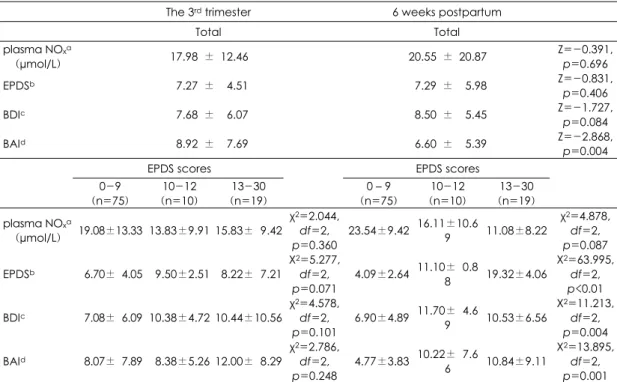
전체 연구대상자인 임산부에서 출산 전후의 EPDS와 BDI총점의 차이는 통계적으로 유의미하지 않았으나(각 각 Z=-0.831, p=0.406, Z=-1.727, p=0.084), 출산 전후의 BAI 총점의 차이는 통계적으로 유의미하였다 (Z=-2.868, p=0.004)(표 2).
출산 전후의 혈중 NO
x농도는 통계적으로 유의미한 차이는 보이지 않았다(Z=-0.391, p=0.696)(표 2). 임 산부의 혈중 NO
x의 평균 농도는 측정 시기와 상관없이 정상 대조군의 NO
x의 평균 농도(9.45±5.42 μmol/L) 보다 유의미하게 증가된 상태였다(임신 제3분기:Z=- 5.659, p<0.01, 출산 후 6주: Z=-3.872, p< 0.01)(표
Table 1. The demographic characteristics of normalcontrols and pregnant women with or with- out depressed mood
Variables
Pregnant Women (n=104)
Normal controls
(n=64)
pAge (years) 32.4±3.1 31.8±7.8 .488 Education (years) 14.7±2.1 Marital status (%)
Married 102 (98.1)
Single/divorced
002 (01.9)Job in pregnant state (%)
No job
071 (68.3)Part-time
004 (03.8)Full-time
029 (27.9)Previous treated
depression (%)
0 episode 101 (97.1) 1 episode
001 (01.0)2 episodes
002 (01.9)Previous experience of
delivery (%)
First
077 (740.)Second
025 (240.)More than third
002 (01.9)Delivery method (%)
Vaginal delivery
077 (740.) Caesarean section
027 (260.) Feeding method (%)
Breast-feeding
066 (63.5)Bottle-feeding
016 (41.4)Both
022 (21.2)2). 출산 후의 NO
x농도는 출산 방법, 모유 수유 여부, 그리고 출산 경험과 관련된 변인들에 따른 통계적으로 유의한 차이를 보이지 않았다.
2. 산후 비우울군, 경증 우울군, 그리고 중증 우울군의 비교
표 2는 산후 비우울군, 경도우울군, 그리고 주요우울 군에 따라 EPDS, BDI, BAI, 그리고 혈중 NO
x농도를 비교하였다. 전체 대상자인 임산부에서는 출산 전과 후 에 시행한 EPDS와 BDI의 총점은 통계적으로 유의한 정적 상관관계를 보였다(출산 전 EPDS와 BDI:rs=
0.656, p<0.01, 출산 후 EPDS와 BDI:rs=0.435, p<
0.01). 산후 EPDS, BDI, 그리고 BAI에 있어서 각 군 은 통계적으로 유의미한 차이를 보였다(각각 χ
2=63.995, df=2, p<0.01, χ
2=11.213, df=2, p=0.004, χ
2= 2.786, df=2, p=0.001). 주요우울군의 산후 NO
x농도 는 비우울군의 농도보다 통계적으로 유의미하게 감소하 였다(Z=-2.175, p=0.030)(그림 1). 또한 산후의 BDI 총점 10점 이상, 그리고 EPDS 총점 10점 이상을 모두 충족하는 연구대상자는 12명이었고, 이들의 산후 NO
x농도는 나머지 연구대상와 비교하면 유의미하게 감소하
였다(12명 우울증군의 산후 NO
x농도의 평균:21.94 μmol/L, 92명의 비우울군의 산후 NO
x농도의 평균:
9.94 μmol/L, Z=-2.096, p=0.036).
Table 2. Comparison of the scores of EDPS, BDI, and BAI and the levels of plasma NOx
among undepressive group, minor depressive group, and major depressive group
The 3
rdtrimester 6 weeks postpartum
Total Total
plasma NO
xa(µmol/L) 17.98 ± 12.46 20.55 ± 20.87 Z=-0.391,
p=0.696
EPDS
b 07.27 ± 04.51 07.29 ± 05.98Z=-0.831,
p=0.406
BDI
c 07.68 ± 06.07 08.50 ± 05.45Z=-1.727,
p=0.084
BAI
d 08.92 ± 07.69 06.60 ± 05.39Z=-2.868,
p=0.004
EPDS scores EPDS scores
0-9
(n=75) 10-12
(n=10) 13-30
(n=19) 0 – 9
(n=75) 10-12
(n=10) 13-30 (n=19) plasma NO
xa(µmol/L) 19.08±13.33 13.83±9.91 15.83±09.42 χ
2= 2.044,
df=2, p=0.36023.54±9.42 16.11±10.6
9 11.08±8.22 χ
2= 4.878,
df=2, p=0.087EPDS
b 06.70±04.05 09.50±2.51 08.22±07.21Χ
2=5.277,
df=2,p=0.071 04.09±2.64
11.10±00.8
8 19.32±4.06
Χ
2=63.995,
df=2, p<0.01BDI
c 07.08±06.09 10.38±4.72 10.44±10.56χ
2=4.578,
df=2, p=0.101
06.90±4.89
11.70±04.6
9 10.53±6.56 Χ
2=11.213,
df=2, p=0.004BAI
d 08.07±07.89 08.38±5.26 12.00±08.29χ
2= 2.786,
df=2, p=0.248
04.77±3.83
10.22±07.6
6 10.84±9.11 Χ
2= 13.895,
df=2, p=0.001NO
x:nitric oxide metabolites, EPDS:Edinburgh Postnatal Depression Scale, BDI:Beck Depression Inventory, BAI:Beck Anxiety Scale
0-9 10-12 13-30 EPDS at 6 week postpartum 0.0
5.0 10.0 15.0 20.0 25.0 30.0
Mean Nox at 6 week postpartum *
Fig. 1. Comparison of plasma NOx
levels among unde-
pressive group, mild depressive group, and major
depressive group according to EPDS scores at 6
weeks postpartum. *Z=-2.175, p=0.030 when
comparing plasma NO
xlevels in the cases of po-
stpartum major depression (EDPS scores≥13 po-
ints) than those in cases without depression(EDPS
scores≤9 points). NO
x: nitric oxide metabolites,
EPDS:Edinburgh Postnatal Depression Scale.
혈중 NO
x농도와 우울 및 불안 증상(EPDS, BDI, 그 리고 BAI의 총점) 사이의 상관관계 분석에서는 산후 혈중 NO
x농도와 산후 EDPS 총점 사이에 통계적으로 유의미한 부적 상관관계가 관찰되었다(rs=-0.238, p=
0.015).
고 찰
본 연구에서 출산 후 6주에 우울증을 자가 평가한 EPDS 총점과 혈중 NO
x농도 사이에 유의미한 상관관 계가 있으며, EPDS 총점이 높을수록, 즉, 산후우울증이 심각할수록 혈중 NO
x농도가 감소하는 것을 관찰할 수 있었다. 또한 출산 후 6주에 측정한 혈중 NO
x농도가 산후 주요우울군이 산후 비우울군과 비교하여 더 낮음을 관찰할 수 있었다.
본 연구에서는 출산 후 6주에 EPDS 자가 평가에 의 하여 10점 이상으로 경도 이상의 우울증을 보고한 임산 부가 104명 중 29명(27.9%)이었고, 주요우울증은 19 명(18.3%)이었다. 최근 국내에서 148명의 산모를 대 상으로 출산 후 6~8주에 EPDS 척도로 우울증을 평가 한 결과 8.1%가 경도우울증이고 7.4%가 주요우울증으 로 평가되었다.
26)일반적으로 산후우울증의 발생율은 산모의 10~15% 정도라고 알려져 있으나,
1)2)연구에 따 라서 산후 우울감도 포함한 경우에는 산모의 50~80%
까지도 산후 우울기분이 있다는 보고도 있다.
1)본 연구는 산후 우울증과 혈중 NO
x농도 사이의 관 련성을 관찰한 첫 연구이다. 본 연구에서는 출산 전후의 산모의 혈중 NO
x농도가 임신을 하지 않은 정상 여성 대조군과 비교하여 증가하였다. 동물 연구에서 임신 중 이거나 여성 호르몬인 에스트로겐을 투약한 경우 eNOS 와 nNOS의 활성이 모두 증가하는 것이 보고되었다.
27)본 연구 결과, 출산 후 6주에 측정한 혈중 NO
x농도는 EPDS 총점과 통계적으로 유의미한 부적 상관관계를 보였다( r
s=-0.238, p=0.015). 즉, 산후우울증의 심각 도가 높을수록 혈중 NO
x농도는 감소하였다. 이와 같은 관계는 산후 NO
xNO
x농도와 BDI 총점 사이에서는 보 이지 않았다. 그러나, 출산 후 6주에 측정한 혈중 NO
x농도가 산후 EPDS 총점에 따른 산후 주요우울군이 산 후 비우울군과 비교하여 더 낮음을 관찰할 수 있었다(Z=
-2.175, p=0.030,). 또한 출산 후 6주의 BDI와 EPDS 총점 모두에서 10점 이상으로 경도 이상의 우울증을 보
이는 산모의 혈중 NO
x농도는 두 척도 모두에서 우울 증을 보이지 않는 산모와 비교하면 유의미하게 감소하 였다(Z=-2.096, p=0.036). 임산부가 아닌 주요우울 증을 가진 환자에서 16명을 대상으로 혈중 NO
x농도를 측정한 연구에서 정상 대조군보다 주요우울증 환자의 혈 중 NO
x농도가 낮았다.
17)또한 주요우울증 환자를 대상 으로 한 연구에서 부뇌실 신경세포(paventricular neu - rons)의 NOS 면역활성을 보이는 신경세포가 감소되어 있는 소견을 보였고,
28)전전두엽 피질(prefrontal cortex) 에서 NOS의 활성도가 감소되어 있다는 연구결과도 있 다.
16)주요우울증에서 nitric oxide 또는 NOS의 활성도 의 감소는 주요우울증에서 나타나는 시상하부-뇌하수체- 부신 기능(hypothalamus-pituitary-adrenal axis, 이하 HPA axis)의 기능 항진에 의해서 NOS의 활성도가 감소 하는 것으로 설명된다.
29)30)동물실험에서 cortisol이 eNOS 의 활성을 낮게 조절한다는 것이 관찰되었다.
31)32)또한 cortisol의 증가는 쥐의 해마에서 NOS mRNA 합성을 감소시킨다고 한다.
33)34)한 연구에서는 우울증의 과거 력이 없고 신체적 상태와 정신과적 상태가 정상인 17명 의 임산부를 임신 제 2분기부터 출산 후 12주까지 전향 적으로 관찰하면서 우울기분과 CRH에 대한 ACTH 반 응을 평가하였다.
35)이 연구 결과에서는 출산 이후 산후 우울증이 없는 임산부와 비교하여 산후우울증이 있는 임 산부에서 CRH에 대한 ACTH 반응이 둔화된 소견을 보 였다. 또한 47명의 건강한 일본인 임산부를 출산 전후 로 전향적으로 관찰한 연구에서는 출산 후 3 또는 4일 에 측정한 혈중 cortisol 농도가 산후 우울감이 없는 임 산부보다 산후 우울감이 있는 임산부에서 더 높은 것이 관찰되었다.
36)본 연구는 산후우울증에서 혈중 NO
x농도의 변화를 관 찰한 첫 연구라는 의의가 있다. 그러나 산후우울증의 유 무를 EPDS와 BDI 등의 자가 평가 척도의 총점만을 기 준으로 평가했다는 점과, 혈장에서 측정한 nitric oxide 대사산물의 기원이 명확하지 않다는 제한점이 있다. 또한 향후 혈중 nitric oxide 대사산물의 측정이 산후우울증을 예측할 수 있는가를 증명하기 위해서는 더 많은 수의 대 상자를 통해서 연구가 필요하다.
중심 단어