• 검색 결과가 없습니다.

IgG4-Related Lung Disease without Elevation of Serum IgG4 Level: A Case Report

N/A
N/A
Protected

Academic year: 2021

Share "IgG4-Related Lung Disease without Elevation of Serum IgG4 Level: A Case Report"

Copied!
4
0
0

로드 중.... (전체 텍스트 보기)

전체 글

(1)

184

ing of bronchovascular bundles, interlobular septa, round- shaped ground-glass opacity (GGO), honeycombing, and bronchiectasis in chest computed tomography (CT), and it is difficult to discern that it comes from other lung diseases

4

.

In this paper, we report a case that a patient who came to hospital due to hemoptysis and had lung mass in chest CT was diagnosed IgG4-related disease by biopsy.

Case Report

A 63-year-old man visited the pulmonary clinic complain- ing hemoptysis which has lasted for 5 days. His past medical history were pulmonary tuberculosis (completely healed 20 years ago), diabetes mellitus, hypertension, and chronic kidney disease. He did not smoke and drink. There was no specific family history. Lung sound was clear and heart sound was normal without murmur. There was no palpable mass or lymph node in the neck. Blood pressure was 130/70 mm Hg, body temperature was 36.8

o

C, pulse rate was 92 beats per minute, and respiratory rate was 20 breaths per minute. Labo- ratory findings revealed hemoglobin 8.4 g/dL, white blood cell 4,530/mm

3

(neutrophils, 64.3%; lymphocytes, 21.7%;

eosinophils, 4.5%), platelets 234,000/mm

3

, C-reactive protein 1.10 mg/dL, aspartate aminotransferase 16 IU/L, alanine ami- notransferase 9 IU/L, total bilirubin 0.26 IU/L, creatinine 2.72 mg/dL, blood urea nitrogen 33 mg/dL, and hemoglobin A1c 10.4%. In chest X-ray a simple mass was noted at left upper

Introduction

IgG4-related disease is newly recognized fibroinflamma- tory condition characterized by edema of invaded organ, a dense lymphoplasmacytic infiltration rich in IgG4-positive plasma cells, storiform pattern of fibrosis, and, often but not always, elevated serum IgG4 concentration level

1,2

. The most commonly involved organs are pancreas and salivary gland. It may also intrude thyroid, retroperitoneum, kidney, lung, and lymph node, but the invasion of lung is rare

1-3

. IgG4-related lung disease may be asymptomatic or has symptoms such as cough, hemoptysis, dyspnea, and chest pain

1-3

. IgG4-related lung disease could appear as solitary nodular lesion, thicken-

IgG4-Related Lung Disease without Elevation of Serum IgG4 Level: A Case Report

Min Kyu Kang, M.D., Yongseon Cho, M.D., Minsoo Han, M.D., Sun Young Jung, M.D., Kyoung Min Moon, M.D., Jinyoung Kim, M.D., Ju Ri Kim, M.D., Dong-kyu Lee, M.D., Jun Hyung Park, M.D. and So Hee Chung, M.D.

Division of Pulmonary Medicine, Department of Internal Medicine, Eulji University Hospital, Daejeon, Korea

Since IgG4-related pancreatitis was first reported in 2001, IgG4-related disease has been identified in other organs such as salivary gland, gallbladder, thyroid, retroperitoneum and kidney; but lung invasion is rare. A 63-year-old man presented with hemoptysis at the pulmonary clinic and chest computed tomography revealed about 4.1 cm irregular shaped mass with spiculated margin at the left upper lobe. Despite no elevation of serum IgG4 level, he was finally diagnosed as IgG4- related lung disease by transthoracic needle biopsy. After treatment with oral glucocorticoids, hemoptysis disappeared and the size of lung mass was decreased.

Keywords: Immunoglobulins; Lung Diseases; Hemoptysis

Copyright © 2016

The Korean Academy of Tuberculosis and Respiratory Diseases.

All rights reserved.

Address for correspondence: Yongseon Cho, M.D.

Division of Pulmonary Medicine, Department of Internal Medicine, Eulji University Hospital, 95 Dunsanseo-ro, Seo-gu, Daejeon 35233, Korea Phone: 82-42-611-3154, Fax: 82-42-259-1162

E-mail: [email protected] Received: Aug. 10, 2015 Revised: Sep. 15, 2015 Accepted: Sep. 24, 2015

cc

It is identical to the Creative Commons Attribution Non-Commercial License (http://creativecommons.org/licenses/by-nc/4.0/).

CASE REPORT

http://dx.doi.org/10.4046/trd.2016.79.3.184

ISSN: 1738-3536(Print)/2005-6184(Online) • Tuberc Respir Dis 2016;79:184-187
(2)

The case of IgG4-related lung disease

http://dx.doi.org/10.4046/trd.2016.79.3.184 185

www.e-trd.org

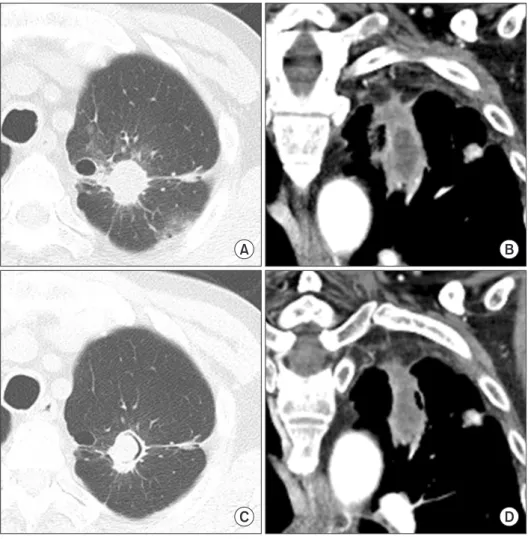
lobe, which was not found in the past film. In chest CT about 4.1-cm irregular shaped mass with spiculated margin was seen at left upper lobe (Figure 1A, B). We performed bron- choscopy and transthoracic needle biopsy. In bronchoscopy, there were no specific endobronchial findings and bronchial washing smear for acid-fast bacilli was negative. Transthoracic needle biopsy showed multiple scattered infiltrations of IgG4- positive plasma cells more than 40 in high-power field (Figure 2B), lymphoplasmacytic infiltration and a storiform pattern of fibrosis (Figure 2A). Although serum IgG (1,010 mg/dL; nor- mal range, 670–1,600 mg/dL) and IgG4 (25.1 mg/dL; normal range, 6.1–121.4 mg/dL) levels were not elevated because the biopsy showed typical IgG4-related disease pathologic find- ing, we diagnosed as IgG4-related lung disease. There were no specific findings of pancreas in abdomen CT. After the patient was treated with oral glucocorticoids, hemoptysis disappeared and the size of mass was decreased (Figure 1C, D).

Discussion

Since IgG4-related pancreatitis was reported by Hamano

et al. in 2001 for the first time

5

, IgG4-related disease has been identified in other organs such as salivary gland, gallblad- der, thyroid, retroperitoneum, and kidney. The first case of IgG4-related lung disease in Korea was reported by Yoo et al. in 2009

6

, and a few cases have been reported ever since.

According to the presentation of Inoue et al. in 2009

4

, IgG4- related lung disease could be categorized into four major subtypes: solid nodular type having a solitary nodular lesion that includes a mass; round-shaped GGO type characterized by multiple round-shaped GGOs; alveolar interstitial type showing honeycombing, bronchiectasis, and diffuse GGO;

and bronchovascular type showing thickening of bronchovas- cular bundles and interlobular septa. In Korea, total nine cases of IgG4-related lung disease have been reported. These cases showed multiple lung nodules or mass

6,7

, consolidative mass

8

, pleural nodules or mass

9,10

, pleural effusion

11

, interstitial lung disease

12

, or bronchovascular bundle thickening

13

in chest CT, and accompanying symptoms were cough, sputum, fever, dys- pnea, or asymptomatic. All serum IgG4 levels in Korea cases elevated except the case of bronchial thickening with eosino- philic angiocentric fibrosis patient, in which case serum IgG level was normal and serum IgG4 level was not mentioned

6-13

.

A B

C D

Figure 1. Enhanced chest computed to-

mography (CT) findings. (A, B) Chest CT

on admission day shows about 4.1-cm

irregular shaped mass with spiculated

margin at left upper lobe. (C, D) Chest CT

after 1 month of treatment reveals mass

size decreased to 3.6 cm.

(3)

MK Kang et al.

186 Tuberc Respir Dis 2016;79:184-187 www.e-trd.org

However, in our case presenting symptom was hemoptysis and serum IgG4 level was normal.

Solitary pulmonary lesion could be malignancy, infectious granuloma (e.g., aspergillosis and tuberculosis), harmatoma, or nonspecific granuloma

14

. Lesion larger than 3 cm was called mass and is often malignant

14

. Therefore, we performed biopsy.

The critical histopathologic features of IgG4-related disease are a dense lymphoplasmacytic infiltration, a storiform pat- tern of fibrosis, and obliterative phlebitis

15

. Furthermore, the diagnosis of IgG4-related disease rests on both presence of the characteristic histopathological appearance and increased numbers of IgG4-positive plasma cells infiltration. Elevated serum concentrations of IgG4 are found in approximately 70%

of patients with IgG4-related disease

1

. In this case even though serum IgG4 level was normal, histopathologic feature of lung biopsy showed dense lymphoplasmacytic infiltration, stori- form pattern of fibrosis (Figure 2A), and more than 40 IgG4- positive plasma cells in high-power field (Figure 2B). Thus, we diagnosed as IgG4-related lung disease.

Although the optimal treatment for IgG4-related disease has not been established yet, it has been known that glucocor- ticoids have an effect on most IgG4-related disease patients.

The effects of glucocorticoids are alleviation of symptoms, reductions of mass size, improvement of organ function, and decrease in serum levels of IgG4

1

. In this case patient was treated with methylprednisolone 0.4 mg/kg for 1 month and methylprednisolone was tapered. After 1 month of treatment, hemoptysis disappeared and lung mass size was decreased as well (Figure 1C, D).

This case showed that solitary lung mass with normal se- rum IgG4 level could be IgG4-related lung disease and IgG4-

related lung disease could present hemoptysis.

Conflicts of Interest

No potential conflict of interest relevant to this article was reported.

References

1. Stone JH, Zen Y, Deshpande V. IgG4-related disease. N Engl J Med 2012;366:539-51.

2. Kamisawa T, Funata N, Hayashi Y, Eishi Y, Koike M, Tsuruta K, et al. A new clinicopathological entity of IgG4-related autoim- mune disease. J Gastroenterol 2003;38:982-4.

3. Zen Y, Inoue D, Kitao A, Onodera M, Abo H, Miyayama S, et al. IgG4-related lung and pleural disease: a clinicopathologic study of 21 cases. Am J Surg Pathol 2009;33:1886-93.

4. Inoue D, Zen Y, Abo H, Gabata T, Demachi H, Kobayashi T, et al. Immunoglobulin G4-related lung disease: CT findings with pathologic correlations. Radiology 2009;251:260-70.

5. Hamano H, Kawa S, Horiuchi A, Unno H, Furuya N, Akamat- su T, et al. High serum IgG4 concentrations in patients with sclerosing pancreatitis. N Engl J Med 2001;344:732-8.

6. Yoo JW, Roh JH, Lim CM, Lee SD, Kim WS, Kim DS, et al. Two cases of pulmonary involvement of immunoglobulin G4 re- lated autoimmune disease. Tuberc Respir Dis 2009;67:359- 63.

7. Kwon SH, Lee YK, Shim MS, Lee HI. A case of immunoglobu- lin G4-related sclerosing disease mimicking lung cancer. J Korean Soc Radiol 2013;69:53-6.

A B

Figure 2. Histopathological findings of the lung. (A) Heavy infiltration of plasma cells, admixed with lymphocytes and neutrophils and stori-

form pattern of fibrosis are identified (H&E stain, ×200). (B) In IgG4 immunochemical staining, more than 40 multiple scattered infiltrations

of IgG4-positive plasma cells are identified in high-power field (×400).

(4)

The case of IgG4-related lung disease

http://dx.doi.org/10.4046/trd.2016.79.3.184 187

www.e-trd.org

8. Park HY, Han J, Kang G, Yi CA, Chung MP. IgG4-related lung disease presenting as a consolidative mass: a case report. J Lung Cancer 2010;9:103-5.

9. Kim DH, Koh KH, Oh HS, Kim SJ, Kang SH, Jung BW, et al. A case of immunoglobulin g4-related disease presenting as a pleural mass. Tuberc Respir Dis 2014;76:38-41.

10. Choi IH, Jang SH, Lee S, Han J, Kim TS, Chung MP. A case report of IgG4-related disease clinically mimicking pleural mesothelioma. Tuberc Respir Dis 2014;76:42-5.

11. Choi JH, Sim JK, Oh JY, Lee EJ, Hur GY, Lee SH, et al. A case of IgG4-related disease presenting as massive pleural effusion and thrombophlebitis. Tuberc Respir Dis 2014;76:179-83.

12. Ahn JH, Hong SI, Cho DH, Chae EJ, Song JS, Song JW. A case of IgG4-related lung disease presenting as interstitial lung disease. Tuberc Respir Dis 2014;77:85-9.

13. Kim WJ, Kim YI, Kim JE, Choi YH, Cho HH, Choi YD, et al.

Unexplained persistent dyspnea in a young woman with eo- sinophilic angiocentric fibrosis. Respir Care 2014;59:e72-6.

14. Ost D, Fein AM, Feinsilver SH. Clinical practice: the solitary pulmonary nodule. N Engl J Med 2003;348:2535-42.

15. Deshpande V, Zen Y, Chan JK, Yi EE, Sato Y, Yoshino T, et al.

Consensus statement on the pathology of IgG4-related dis-

ease. Mod Pathol 2012;25:1181-92.

수치

Figure 1. Enhanced chest computed to- to-mography (CT) findings. (A, B) Chest CT  on admission day shows about 4.1-cm  irregular shaped mass with spiculated  margin at left upper lobe
Figure 2. Histopathological findings of the lung. (A) Heavy infiltration of plasma cells, admixed with lymphocytes and neutrophils and stori- stori-form pattern of fibrosis are identified (H&E stain, ×200)

참조

관련 문서

Stop transfusion. Emergency management of anaphylaxis, then test serum of both donor/blood and recipient for quantitative IgA level. Future blood products only

(in case of partially miscible and form a low-boiling azeotrope).

It considers the energy use of the different components that are involved in the distribution and viewing of video content: data centres and content delivery networks

After first field tests, we expect electric passenger drones or eVTOL aircraft (short for electric vertical take-off and landing) to start providing commercial mobility

1 John Owen, Justification by Faith Alone, in The Works of John Owen, ed. John Bolt, trans. Scott Clark, "Do This and Live: Christ's Active Obedience as the

24 Comparison between profiles of acoustic pressure and heat transfer augmentation in case of output power level of 300W.. 25 Comparison between profiles of acoustic pressure

The purpose of this case study was to find comparison of sports related physical fitness and anaerobic power changes of college hockey players and

w ater level in case of water injection into spreading com