1. Introduction
The issue of energy sustainability is one of the biggest concerns in the field of architecture, engineering and construction (AEC) these days, and many researches and developments are handling innovative processes and methods to decrease energy consumption using in buildings. Buildings, in fact, are using about forty percent of the entire energies consumed in the Earth, and especially eighty percent of the total amount is needed for building maintenance and fifty six percent occupies for operating lighting, heating and cooling. In other words, applicable suggestions in the architectural field could help resolve problems mentioned above. [1]
Building energies used for utilities such as heating, ventilation and air-conditioning (HVAC) and lighting are deeply related to the envelope system that causes severe energy loss depending on its configuration. For example, there is not only a sort of conventional method to compose the façade like either horizontal or vertical louver, but also an integrated way to cover multiple functions such as light shelves. [2] Light shelf is especially known as one of efficient eco-friendly lighting technologies. Furthermore, building design including light shelf is acceptable for the Leadership in Energy & Environmental Design (LEED).
Currently, further innovated envelope systems have been
pISSN 2288-968X, eISSN 2288-9698 http://dx.doi.org/10.12813/kieae.2015.15.3.015
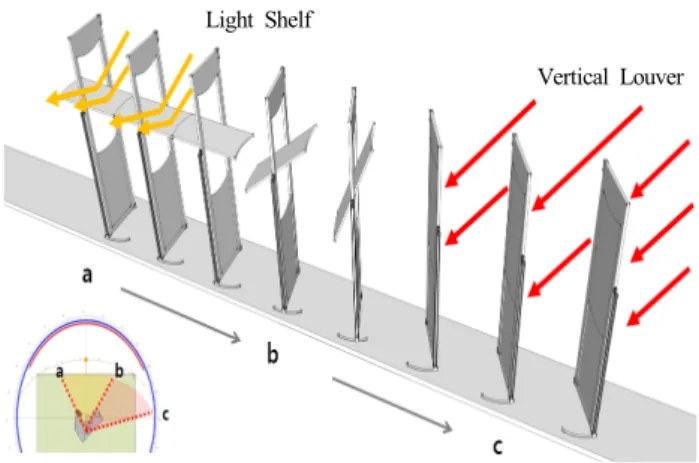
suggested, and one of the representative instances is the kinetic façade that is added to the above basic components and motorized to operate them by programmed logics. [3] In this sense, this paper proposes a prototype of the kinetic envelopes derived from existing standard formations, examines the mechanism and analyzes its building energy performance in comparison to the previous cases.
This study aims to investigate a new kind of the kinetic building envelope operated along the path of the Sun and to reveal its energy efficiency through relevant analyses. The process to achieve the goal is as follows; first, conventional fixed-louver types are reviewed through previous studies, second, an integrated kinetic envelope system is proposed and its configuration is assumed as a motorized type added to the conventional specimen, third, the most suitable method for simulation analyses is selected with comparing normal tools used currently, and finally, required simulations for the suggested envelope are performed in comparison to the conventional cases.
Through this study, it is expected to examine a possible resolution to reform fundamental functions of building envelopes, adaptability to the façade design, energy efficiencies through the lifecycle by comparative analyses, and so on.
2. Settings and Procedures
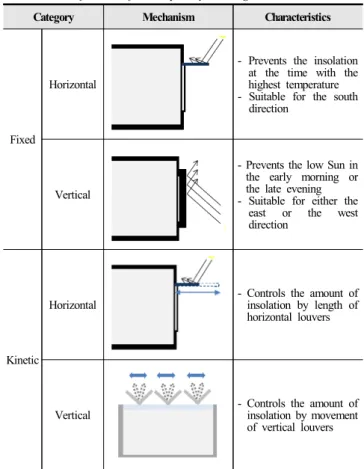
2.1. Classification of the Shading Devices
Shading device is an important building component to prevent
KIEAE Journal
Korea Institute of Ecological Architecture and Environment
73
1)
Energy Sustainability of an Integrative Kinetic Light Shelf Unit
Han, Seung-Hoon
** Corresponding Author, School of Architecture, Chonnam National University, South Korea ([email protected])
A B S T R A C T K E Y W O R D
Purpose: Suggesting a working prototype of a kinetic light shelf unit and revealing its energy efficiency by a series of building performance simulations were presented. Recently, kinetic building envelope has been an emerging technology as an innovative way to control exterior building environment, but products from many researches about the façade could not been reached to the industrialization so far. That is because its initial installation, operation and maintenance costs are still too high to use for the practical field, although buildings using kinetic envelopes could decrease their energy consumption significantly. This narrow point of view needs to be reconsidered, since buildings require great amount of energies to run their functions through the whole life and using better building components can lead to achieve much more benefits in aspects of the lifecycle cost (LCC). Method: A series of certified simulation tools like Ecotect and Green Building Studio that are normally used for researches and developments in the field of architecture were utilized. Result: Based on simulation analyses, the result of the study has showed that the proposed system definitely has adaptability to the professions and positively shows practicability as advanced integrative building envelopes with renewable energy association.
ⓒ 2015 KIEAE Journal
Kinetic Envelope Building Façade
Building Information Modeling Energy Simulation
Sustainability
A C C E P TA N C E IN F O Received April 21, 2015
Final revision received May 11, 2015 Accepted May 13, 2015