SIP-3 한약 처방 및 도네페질의 병용 치료: 아밀로이드 베타로 유도된 알츠하이머병 생쥐 모델에서의 NGS 연구
오영제, 송수진, 류천봉, 손태권*, 김근우, 구병수
동국대학교 한의과대학 한방신경정신과학교실, 서울대학교 약학대학 종합약학연구소*
Combination Treatment with SIP-3 Herb Formula and
Donepezil: An NGS Study in the Mouse Model of Alzheimer’s Disease Induced by Amyloid-β
Young-je Oh, Sue-jin Song, Quan Feng Liu, Tae-kwon Son*, Geun-woo Kim, Byung-soo Koo
Department of Neuropsychiatry, College of Oriental Medicine, Dongguk University, *Research Institute of Pharmaceutical Sciences, College of Pharmacy, Seoul National University
Received: November 14, 2019 Revised: December 5, 2019 Accepted: December 14, 2019
Objectives: Alzheimer’s disease (AD) is a complex disease accompanied by slow impairment of memory and coordination leading to behavioral changes. To date, the only treatment option is to delay the progress of the disease. The purpose of this study was to investigate the synergistic effects of combina- tion treatment with donepezil and three herbal extracts SIP-3 in the AD mouse model induced by amy- loid-β (Aβ).
Methods: We tested SIP-3 extracts for the cytotoxicity on Aβ-treated SH-SY5Y cells. Then the syner- gistic effects of SIP-3 and donepezil were evaluated in the AD mouse model using animal experiments and the next generation sequencing (NGS) study.
Results: We found that co-treatment with SIP-3 extracts and donepezil increased the viability in Aβ- treated SH-SY5Y cells. The beneficial effects of the co-treatment were also observed in the Aβ-induced AD mouse model. The NGS study was performed to show that the co-treatment of SIP-3 and donepezil restored the disease phenotype closely to the normal level in the AD mouse model in terms of mRNA expression. However, the phenotypes were only partially restored.
Conclusions: This study suggests that the combination treatment has a potential to be used for the treatment of AD. However, longer periods of treatment may be required.
Key Words: Alzheimer disease, Santalum album, Illicium verum, Polygala tenuifolia, Combination treatment, Next Generation Sequencing.
Correspondence to Byung-soo Koo Department of Oriental
Neuropsychiatry, Dongguk University Ilsan Medical Center, 27 Dongguk-ro, Ilsandong-gu, Goyang, Korea.
Tel: +82-31-961-9140 Fax: +82-31-961-9009 E-mail: [email protected] Acknowledgement
This work was supported by the Basic Science Research Program through the National Research Foundation of Korea (NRF) funded by the Ministry of Educa- tion (NRF-2016R1D1A1B03932530).
Copyright © 2019 by The Korean Society of Oriental Neuropsychiatry. All rights reserved.
CC This is an open access article distributed under the terms of the Creative Commons Attribution Non-Commercial License (http://creativecommons.org/licenses/by-nc/4.0) which permits unrestricted non-commercial use, distribution, and reproduction in any medium, provided the original work is properly cited.
I. 서론
알츠하이머병(Alzheimer’s disease; AD)은 아밀로이드 베타(amyloid-β; Aβ) 플라크의 축적으로 인해 점차적인 기억력 저하와 인지 장애를 수반하는 신경퇴행성 뇌질환이 다1). 전 세계적으로 AD 발병 경향이 증가하고 있으며 2011 년 미국에서 매 68초에 한 명의 새로운 AD 환자가 발생하던 것이 2050년에는 매 33초마다 새로운 AD 환자가 발생한다.
따라서 2050년까지 환자 수가 2배 가까이 증가할 것으로 예상된다2). 현재 AD에 이용 가능한 약물은 증상을 완화시 키거나 과정을 지연시킬 뿐이며, 병을 치료할 수는 없다3,4). AD의 병리는 산화적 스트레스, 미토콘드리아 기능 장애, 신경염증, 자가포식, 소포체 기능 장애, 세포주기 조절 장애 등과 관련이 있는 것으로 보인다5). 현재 AD 병인에 대한 주된 가설은 콜린성 가설이며, 이는 뇌 세포에서 콜린성 기 능의 상실이 인지기능 저하에 영향을 미친다는 것이다6). AD 약물의 대부분은 아세틸콜린 분해를 촉진하는 아세틸콜 린분해효소(acetylcholinesterase; AChE)를 억제함으로써 아세틸콜린의 농도를 증가시키는 데 중점을 둔다7). AD의 치료를 위해 미국 FDA에서 승인한 AChE 억제제는 도네페 질(donepezil), 리바스티그민(rivastigmine), 갈란타민(ga- lantamine)이 있다8-10). 그러나 AChE 억제제를 사용한 치 료가 모두 AD를 성공적으로 치료할 수 있는 것은 아니며, AD 치료기전과 정반대인 항콜린성 약물이 AD와 관련된 불 면과 섬망을 치료하기 위해 함께 사용된다. 이는 콜린성 가 설이 원인이 아니라 단순히 AD 발병 과정의 결과일 수 있음 을 시사한다11).
AChE 억제제로 치료받는 환자에게서 AD와 관련된 증상 을 더욱 개선시키기 위해, 본 연구진은 기억력 저하, 불안과 같은 증상에 대해 효과적인 한약을 발굴하고자 하였다. 한약 은 AD를 포함하여 다양한 질병을 치료하기 위해 당나라 이 전부터 사용되어 왔다12,13). 도네페질은 AD에 가장 널리 처 방되는 약물이지만, 대조군과 비교하였을 때 AD 환자에게 서 불안이나 불면과 같은 치매의 행동심리증상(behavioral and psychological symptoms of dementia; BPSD)을 다 소 증가시킨다는 보고가 있다14,15). 많은 연구자들이 도네페 질과 함께 BPSD를 개선하는 것으로 알려진 혼합 한약 추출 물을 사용하여 이 문제를 해결하려고 하였다.
예를 들어, 신경보호 효과를 위해 메만틴(memantine)과
비타민 D의 병용 투여16,17), 그리고 메만틴과 도네페질의 병
용 투여18,19)에 대한 연구가 수행되었다. 이외에도 도네페질
과 한약을 결합한 연구가 다수 수행되었다. 바코파 몬니에리 (Bacopa monnieri)20), 지황음자(地黃飮子)21), 스마트 수프 (Smart soup)22), 가미온담탕(加味溫膽湯)23), 은행 추출물(EGb 761)24), 칠복음(七福飮)25) 등과 도네페질을 병용 투여한 결 과, 동물 실험, 세포 실험 및 임상 연구에서 유익한 효과가 관찰되었다. 장기 병용요법이 AChE 억제제 단독요법에 비 해 AD의 인지기능 장애의 진행을 지연시킨다는 보고도 있 다26).
본 연구에서는 세 가지 한약재의 추출물을 혼합한 SIP-3 한약 처방과 도네페질 병용 치료의 시너지 효과를 확인하는 것을 목표로 하였다. 이에 앞서 본 연구진은 한약 처방을 선 택하기 위하여 문헌 검색을 수행한 후, 세포 실험을 통해27) 신경보호 효과의 유의성이 가장 높게 나온 세 가지 한약, 즉 백단향(白檀香; Santalum album), 대회향(大茴香; Illicium verum), 원지(遠志; Polygala tenuifolia)를 최종적으로 선 정하여 이들의 혼합 추출물을 SIP-3로 명명하였다.
SIP-3 추출물과 도네페질의 병용치료 효과를 조사하기 위해서 세포 실험, 동물 행동 실험, 차세대 염기서열 분석법 (Next Generation Sequencing; NGS)과 같은 다양한 방 법이 이용되었다. Aβ25-35를 처리한 세포에서의 세포생존율 을 측정하고, AD 동물 모델을 이용하여 Y-미로 및 수중미로 실험을 하였으며, AD 동물 모델의 대뇌 피질에서 RNA 발현 프로파일을 분석하였다. 대뇌 피질 조직에서의 유전자 발현 평가 후에는 단백질 상호작용 데이터베이스를 활용하여 SIP-3의 표적 단백질을 확인하였다. 본 연구진은 이들 결과 를 바탕으로 SIP-3 추출물이 도네페질과의 병용 치료에 유 망한 후보가 될 수 있음을 제안하는 바이다.
II. 재료 및 방법
1. SIP-3 추출물
본 연구에 사용된 SIP-3 구성 한약재 중에서 백단향은 TFS Corporation Ltd. (Nedlands, Australia) 회사로부터 제공받은 것을 이용하였고, 대회향 및 원지는 태원당약업사 (대구, 대한민국)에서 구입하였다. 백단향(100 g; voucher number: CYWDU-KP0014), 대회향(100 g; voucher num- ber: CYWDU-KP0015), 원지(100 g; voucher number:
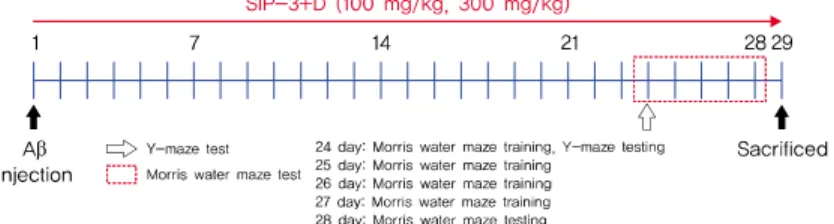
Fig. 1. A schematic drawing of animal experiments.
D: donepezil.
CYWDU-KP0013)를 4°C cold chamber에 보관하였다.
세 가지 한약을 1:1:1 비율로 100 g씩 혼합하여 세말한 후 reflux condenser (EYELAN-1200A, EYELA, Tokyo, Japan) 를 이용해 혼합물을 30% 에탄올로 100°C에서 3시간 동안 추출하는 것을 2회 반복하였다. 이를 50 μm 필터(Millipore, MA, USA)로 여과한 다음 -60°C의 동결건조기(일신바이오 베이스, 동두천, 대한민국)에서 농축시켜 최종적으로 약 8.7 g 의 추출물(평균 수득률 8.7%)을 얻었다. 건조된 SIP-3 추출 물은 사용할 때까지 -70°C에서 보관하였다.
2. 세포 배양
인간 신경모세포종(neuroblastoma cell line) SH-SY5Y 세포는 American Type Culture Collection (Rockville, MD, USA)에서 구입하였다. 세포는 37°C, 5% CO2 인큐베 이터에서 10% Fetal bovine serum (FBS; Invitrogen, Carls- bad, CA, USA)이 함유된 Dulbecco’s modified Eagle’s minimum essential medium (DMEM; Invitrogen, Carls- bad, CA, USA) 배지를 사용하여 유지하였다. 항생제로는 100 unit/ml 페니실린 및 100 μg/ml 스트렙토마이신 (Gibco-BRL, Rockville, MD, USA)을 첨가하였다. 세포에 는 5 μg/ml 또는 200 μg/ml의 한약 추출물 그리고/또는 2.5 μM 또는 5 μM의 도네페질을 처리하였다.
3. 세포생존율 측정
세포생존율은 3-(4,5-dimethylthiazol-2-yl)-2,5-diphe- nyl tetrazolium bromide (MTT; Abcam, Cambridge, MA, USA) assay를 통해 확인하였다. 먼저 SH-SY5Y 세포 를 12-well plate (Corning Incorporated, USA)에 5×10³ cells/well 밀도로 분주하여 FBS가 첨가된 DMEM 배지에 서 16시간 동안 배양하였으며, SIP-3 추출물 또는 도네페 질, SIP-3 추출물과 도네페질 병용 처리하여 24시간 동안
다시 배양하였다. 이후 배지를 제거하고 2 mg/ml의 MTT 용액을 넣어 37°C, 5% CO2 인큐베이터에서 4시간 동안 배 양하였다. 배양 후에는 상등액을 제거하고 dimethylsulf- oxide (DMSO; Sigma, USA)로 용해시킨 다음 570 nm의 파장에서 microplate reader (UV max, Molecular Devices, USA)를 이용하여 흡광도(optical density; OD)를 측정하였 다.
세포생존율(%)은 세포의 미토콘드리아 활성으로 결정되 며 다음과 같은 공식으로 표현된다. 정상군의 OD 값을 100%로 정의하고 이에 대한 실험군의 OD 값을 백분율로 환산한 수치를 세포생존율로 정의하였다.
4. 동물 실험
본 실험은 동국대학교 동물실험 윤리위원회의 승인 하에 시행하였으며(승인번호: IACUC-2017-011-1), 실험동물 에 대한 규정을 준수하였다. 실험동물은 11∼12주령, 30∼
32 g 무게의 ICR 수컷 생쥐를 주식회사 오리엔트바이오(성 남, 대한민국)에서 공급받아 사용하였다. 실험 과정 동안에 는 온도 20±2°C, 습도 55±5%로 조절된 환경을 유지하였 다. 명암주기(light/dark cycle)는 12시간 단위로 주기적으 로 바꾸었으며, 사료는 물과 함께 자유롭게 공급하였다. 실 험의 전체적인 일정은 Fig. 1에 제시하였다.
1) Aβ 로 유도된 생쥐 모델
Aβ25-35 (Sigma-Aldrich, USA)는 37°C에서 4일 동안
증류수 (1 mg/ml)에서 배양하였으며, 실험 직전에 식염수 로 희석하여 최종 농도를 맞추었다28). 생쥐를 ketamine (100 mg/kg, i.p.) 및 xylazine (10 mg/kg, i.p.)으로 마취 시킨 후29) stereotactic apparatus (Motorized Stereotaxic StereoDrive, Neurostar)에 넣었다. 각각의 생쥐에게 Aβ 뇌실 주입을 위해 정수리(bregma)의 0.3 mm 후방(poste-
rior), 1.0 mm 측방(lateral), 2.5 mm 복측(ventral) 위치로
Aβ25-35 4 nM을 주사하였다. 이 때, 분당 0.2 μl 속도의
stepper-motorized microsyringe를 사용하였고, 주입 부 위는 Indian ink 염색으로써 확인하였다. 대조군으로는 동 일한 부피의 vehicle을 주입하여 실험하였다.
2) 실험군 구성
실험동물을 각 군당 5∼7 마리의 5개 군으로 무작위 배 정하였다.
(1) 정상군(Normal group): 식염수를 뇌실 내로(intra- cerebral ventricle; ICV) 주입한 후 28일 동안 식염수를 경구 투여(p.o.)
(2) 대조군(Control group): Aβ25-35 ICV 주입 후 28일 동안 식염수를 경구 투여(p.o.)
(3) SIP-3 저농도군(SIP-3L+D group): Aβ25-35 ICV 주 입 후 28일 동안 100 mg/kg SIP-3 및 0.124 mg/kg 도네 페질을 경구 투여(p.o.)
(4) SIP-3 고농도군(SIP-3H+D group): Aβ25-35 ICV 주 입 후 28일 동안 300 mg/kg SIP-3 및 0.124 mg/kg 도네 페질을 경구 투여(p.o.)
(5) 도네페질군(Donepezil group): Aβ25-35 ICV 주입 후 28일 동안 0.124 mg/kg 도네페질을 경구 투여(p.o.)
도네페질의 투여량은 인간에게 사용되는 표준 용량에 따 라 적용하였다.
3) Y-미로 실험(Y-maze test)
공간 작업 기억(spatial working memory)에 대한 조사 를 위해 Aβ 주입 24일 차에 Y-미로 실험을 수행하였다.
생쥐는 이전에 갔던 길로 다시 돌아가는 것보다 새로운 길을 찾는 것을 선호하기 때문에, 자발적인 Y-미로 교차는 새로 운 환경을 탐색하려는 생쥐의 의지를 측정하는 행동 테스트 이다. 미로의 규격은 표준을 따랐으며, 미로 교차는 다음과 같이 정의되었다. 교차 행동률(%)은 가능한 모든 교차에 대 해 실제로 교차한 비율로 표현하였다(교차 입장 횟수에서 2 를 빼고 100을 곱한 값으로 정의). 교차 행동률이 높은 것은 뇌 기능 중에서도 특히 해마(hippocampus), 중격(sep- tum), 기저 전뇌(basal forebrain) 및 전전두엽 피질(pre- frontal cortex)에서의 기능이 활동적임을 나타내고, 교차 비율이 낮은 것은 뇌 기능 활동이 줄어듦을 의미한다30,31).
4) 모리스 수중 미로 실험(Morris water maze test) 모리스 수중 미로 실험은 다음과 같이 수행되었다32). 원 형의 물탱크(직경 100 cm, 높이 35 cm)에 검은색 잉크를 넣어 물을 까맣게 만들고 물의 온도를 실온으로 유지하였다.
투명한 아크릴 플라스틱 플랫폼은 그 상단이 수면 1 cm 아 래에 위치하도록 하였다. 훈련하는 동안, 실험 대상 생쥐를 물에 넣고 120초 동안 플랫폼을 찾을 수 있게 하였다. 생쥐 를 플랫폼에 머무르게 한 후 케이지로 들어가게 하였다. 생 쥐의 경로에 대한 추적은 물탱크 위 천정에 설치된 카메라 (Ethovision XT, Noldus, VA, USA)를 이용해 녹화 분석하 였다.
5. mRNA 시퀀싱
TRIzol® RNA Isolation Reagents (Life technolo- gies, Carlsbad, CA, USA)를 사용하여 RNA 전체를 생쥐의 대뇌 조직으로부터 분리하였다. RNA 보존상태(RNA in- tegrity)는 Agilent RNA 6000 Pico Kit (Agilent, Santa Clara, CA, USA)를 사용하여 바이오분석으로 확인하였다.
분리된 전체 RNA는 mRNA 시퀀싱 라이브러리(mRNA se- quencing library)를 위해 TruSeq stranded mRNA sam- ple preparation kit (Illumina, San Diego, CA, USA)를 사용하여 처리되었다. 각각의 라이브러리에 대해, Agilent DNA Kit (Agilent, Santa Clara, CA, USA)의 바이오분석 으로 약 220 bp의 삽입 크기(insert size)를 확인하였고, CFX96 real time system (BioRad, Hercules, CA, USA) 을 통해 real-time PCR을 시행하여 라이브러리의 정량을 측정하였다. RNA-seq 분석 샘플은 NextSeq 500/550 High Output Kit version 2 (150 사이클)를 사용하여 Illu- mina NextSeq 500 플랫폼의 75-bp 페어드 엔드 리드 (paired-end reads)로 시퀀싱하였다. 원본 이미지 데이터 는 염기해독(base-calling) 과정을 거쳐 염기서열(sequence) 데이터로 변환 후 FASTQ 형식으로 저장되었다.
6. RNA-seq 데이터 분석
정상군, 대조군, SIP-3 저농도군, SIP-3 고농도군, 도네 페질군으로 구성된 5개의 샘플에 대한 페어드 엔드 75-bp 리드의 FASTQ 서열 파일은 Cutadapt34)를 사용하여 adapter- trimming을 시행하였다. STAR35)를 사용하여, 트리밍된 서
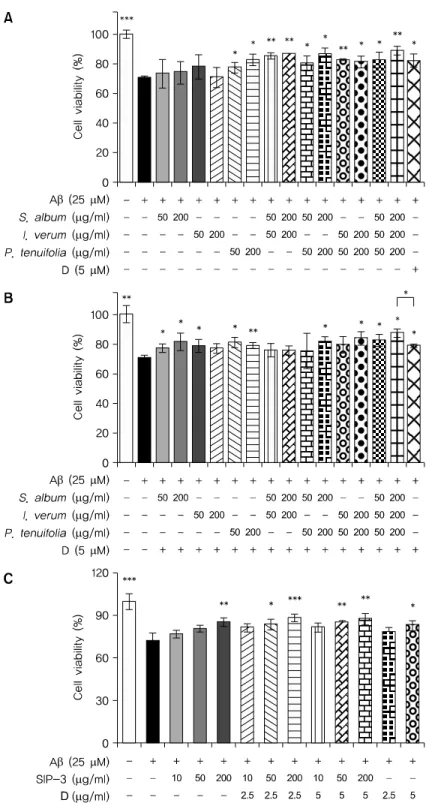
Fig. 2. Effects of SIP-3 on Aβ25-35-induced cell viability in SH-SY5Y cells. Cells were treated 25 μM of Aβ with each component (50 or 200 μg/ml) for 24h (A) and plus donepezil (B). Cells were treated 25 μM of Aβ with SIP-3 (50 or 200 μg/ml) plus donepezil for 24h (C). Cell viability was then determined by MTT assay. Values are presented as mean±SEM of four determinations.
***p<0.001, **p<0.01, *p<0.05 vs. Aβ alone.
S. album: Santalum album, P. tenuifolia: Polygala tenuifolia, I. verum: Illicium verum, D: donepezil.
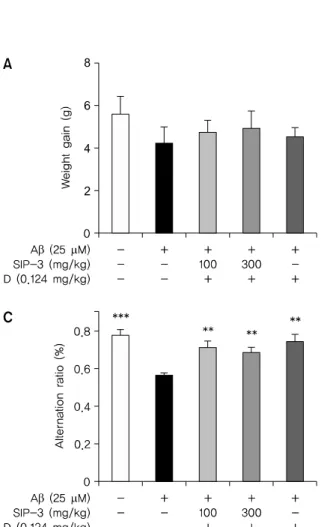
Fig. 3. Administration of SIP-3 improved the memory impairment of Aβ-induced mouse model. Total weight gain (A), total food intake (B), and Y-maze test (C). The data are expressed as mean±SEM with n=5 mice group. ***p<0.001, **p<0.01, *p<0.05 vs. control.
D: donepezil.
열 조각을 UCSC 데이터베이스(https://genome.ucsc.edu/) 에서 얻은 마우스 참조 게놈(reference genome) 서열 mm10 버전에 맞추어 정렬시켰다. 맵핑된 리드의 발현값 산출은 Cufflinks36)를 통해 수행되었다. 산출된 발현값으로 Cuffdiff37) 를 사용한 차등 발현 유전자(differentially expressed genes;
DEGs) 분석이 이루어졌다.
7. 통계학적 분석
통계는 Prism 5 (GraphPad software, San Diego, CA) 로 수행되었다. 실험 결과는 평균±표준편차(mean±standard error)로 표현하였고, 실험 결과에 대한 그룹 간의 통계적인 유의성은 Student’s t-test로 검증하였다. 통계적으로 유의 한 기준은 p-value가 0.05 미만인 값으로 간주하였다(*p<
0.05, **p<0.01, ***p<0.001).
III. 결과
제일 먼저 우리는 백단향, 대회향, 원지 추출물을 다양한 농도로 조합해보았고, 이를 Aβ로 처리한 SH-SY5Y 세포에 실험하여 세포생존율을 확인하였다. 한약재 단독 투여 결과 를 비교하면, 각 200 μg/ml 추출물 1:1:1 비율의 SIP-3 처리군은 도네페질 단독 처리군에 비해 세포생존율이 가장 유의하게 증가되었으며(p<0.01, Fig. 2A), 이는 한약재에 도네페질을 추가로 투여한 결과에서도 가장 높은 세포생존 율을 보였다(p<0.05, Fig. 2B). 또한, 도네페질을 2.5 μM 혹은 5 μM 농도와 200 μg/ml SIP-3 추출물과 병용 처리 하였을 때, SIP-3 추출물에 2.5 μM 낮은 농도의 도네페질 을 병용하여도 5 μM 도네페질 단독 투여군보다 우수한 효 능을 가지는 것을 관찰하였다(p<0.001, Fig. 2C). 결과적 으로 도네페질과 SIP-3 추출물의 병용 투여는 Aβ로 처리 한 SH-SY5Y 세포의 세포생존율을 증가시켰다.
동물 모델에서 도네페질과 SIP-3의 병용 효과를 검증하
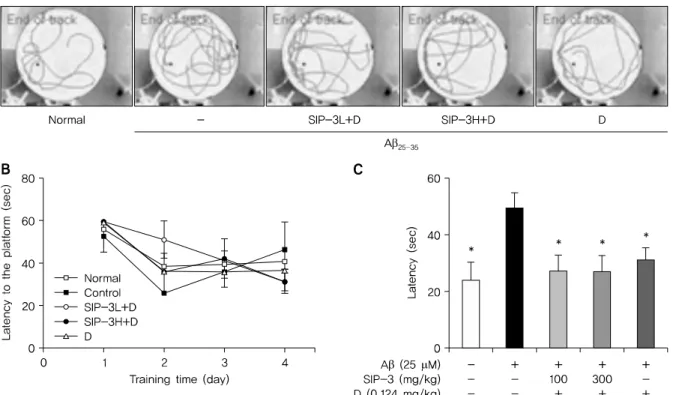
Fig. 4. SIP-3 improves cognitive deficits of Aβ-induced mouse model in water maze. Tracings of typical swim patterns in platform task (A). The 4 days training of Latency (sec) to reach visible-platform of Morris water maze (B). On the 5th day of the test Latency (sec) to reach visible-platform of Morris water maze (C). The data are expressed as mean±SEM with n=5 mice group. *p<0.05 vs. control.
D: donepezil.
기 위해, Aβ로 처리한 생쥐에게 0.124 mg/kg 도네페질과 100 mg/kg 또는 300 mg/kg SIP-3를 28일 동안 연속적으 로 경구 투여하였다. 체중 증가량과 일일 섭취량은 5개 군 사이에 유의한 차이가 없었다(Fig. 3A, 3B). 다음으로는 도 네페질과 SIP-3 병용 투여가 인지 저하를 완화시킬 수 있는 지를 실험하였다. Aβ로 처리한 생쥐에서는 자발적인 Y-미 로 교차 행동률이 유의하게 감소되었으며, 도네페질을 투여 한 군에서는 SIP-3의 유무와는 상관없이 Aβ에 의해 유발 된 교차 행동률 감소 현상이 유의하게 역전되었다(p<
0.01, Fig. 3C). 그러나 SIP-3 저농도군과 도네페질군, 또는 SIP-3 고농도군과 도네페질군 사이에서는 통계적으로 유의 한 차이가 나타나지 않았다.
수중미로 테스트를 통해서는 공간 학습과 기억을 조사하 였다. 실험은 4일 간의 훈련을 거친 이후 수행되었다. 대조 군의 잠복기(latency)가 크게 증가한 것에 비해, SIP-3 저농 도군과 SIP-3 고농도군 및 도네페질군의 잠복기는 정상군 에 가까운 수준으로 유의성 있게 감소한 것이 관찰되었다
(p<0.05, Fig. 4). Y-미로 실험 결과와 마찬가지로 SIP-3 저농도군과 도네페질군, 또는 SIP-3 고농도군과 도네페질 군 사이에는 유의한 차이가 없었다.
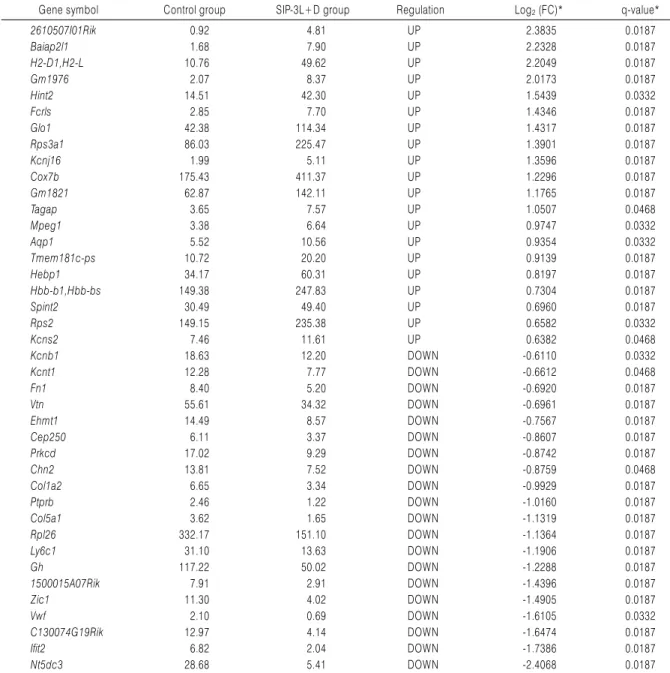
SIP-3 추출물과 도네페질의 병용 투여는 생체 내에서(in vivo) 부작용을 나타낼 가능성이 있다. 통계적으로 유의하지 않을지라도, 본 연구진은 SIP-3 추출물과 도네페질이 Aβ 로 처리된 생쥐의 뇌 기능에 효능을 나타내는 몇몇 양성 징 후를 관찰하였으며, RNA-seq 분석을 수행하였다. AD와 관 련될 가능성이 유력한 유전자 마커를 식별하기 위해 도네페 질군과 함께 SIP-3 저농도군을 선택하여 RNA-seq 데이터 를 결합했다. SIP-3 100 mg/kg 및 도네페질을 투여했을 때 질병 표현형(disease phenotype)으로서 Aβ 처리와 연 관된 상향조절(up-regulated) 또는 하향조절(down-regu- lated) 유전자는 벤다이어그램으로 나타내었으며 (Fig. 5), 대조군과 SIP-3 저농도군과 사이의 배수변화도(fold change;
FC)에 대하여 상향조절 상위 20개의 유전자 및 하향조절 상위 20개의 유전자를 Table 1에 제시하였다.
Fig. 5. RNA-Seq analyses of DEGs in the cerebral cortex of Aβ-induced mouse model. Venn diagram showing the numbers of upregulated (A) and downregulated (B) DEGs between groups. Statistically significant DEGs were defined with q-value <0.05 and [log2 (fold change)] >1.5 as the cut-off criteria.
D: donepezil.
FC 1.5배수의 차별 발현 기준으로, 442개의 상향조절 유 전자 중에서 SIP-3 및 도네페질의 병용 투여를 통해 155개 의 유전자가 질병 표현형에서 상향 조절되었다(Fig. 5A).
155개의 유전자 중에서 88개의 유전자는 SIP-3 및 도네페 질 병용 투여군, 그리고 도네페질 단독 투여군에서 공통적으 로 상향 조절되는 반면, 67개의 유전자는 SIP-3 및 도네페 질의 병용 투여군에서만 상향 조절되었다. 251개의 하향조 절 유전자 중에서는 SIP-3 및 도네페질의 병용 투여로 인해 85개의 유전자가 질병 표현형에서 하향 조절되었다(Fig. 5B).
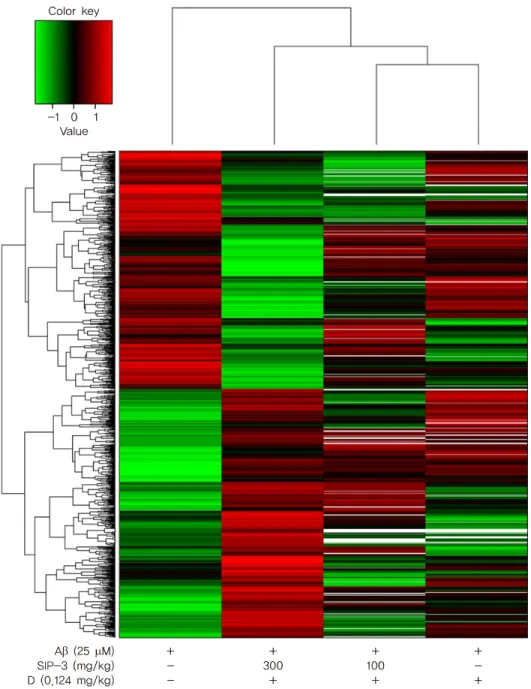
이들 유전자 중, SIP-3 및 도네페질 병용 투여, 그리고 도네 페질 단독 투여에 의해 공통적으로 51개의 유전자가 하향 조절되었다. SIP-3 및 도네페질의 병용 투여에 의해서만 하 향조절에 관련된 유전자는 34개였다. 도네페질 단독 투여보 다 SIP-3 및 도네페질의 병용 투여가 질병 표현형의 RNA 발현 수준을 더 분명하게 나타내는 것은 히트맵 분석(heat- map analysis)을 통해서도 확인할 수 있다(Fig. 6).
IV. 고찰
AD의 치료는 여전히 제한적이며, 따라서 증상의 악화를 막는 것이 가장 최선의 방법이다. AD는 여러 가지 원인에 인해 발생하기 때문에 다중 표적 치료가 대안으로 제시된다.
본 연구는 한약 복합 처방과 도네페질 약물의 병용요법을 통해 수행되었다38,39). 본 연구진은 선행 연구에서 SH-SY5Y 세포 실험을 통해 도네페질 단독요법에 비해 한약과 도네페
질의 병용요법시 더 우수한 세포생존율을 보이는 한약을 탐 색하고자, 50여 가지 한약 추출물을 각각 도네페질과 함께 SH-SY5Y 세포에 처리한 다음 Aβ 독성에 대해 스크리닝하 였다27).
그 결과를 바탕으로 하여 새로운 조합으로써 SIP-3 처방 을 제시하였다. 백단향은 혈관이완 작용을 통해 뇌로 가는 혈류를 증가시키며40), 백단향의 주요 생리활성 성분인 산탈 롤(santalol)은 신경이완제(neuroleptics)로 작용한다41-46). 대회향은 염증을 치료하기 위해 오래 전부터 사용되어 왔으 며47), 대회향의 주요 성분인 트랜스-아네톨(trans-anethole) 은 항산화 작용을 한다48-52). 원지는 한의학에서 건망증과 기 억력 저하를 치료하는 데 사용되며53), 최근에는 다양한 염증 성 뇌질환의 기능 장애에 처방되고 있다54).
본 연구를 통하여 우리는 한약 추출물을 여러 가지로 조 합하여 신경세포 보호 효과를 새로이 확인하였다. SIP-3 구 성 한약재에 대하여 단일 한약 추출물, 두 가지 또는 세 가지 한약 추출물의 조합을 각각 다양한 농도로 투여하여 관찰하 였고, 도네페질을 2.5 μM의 저농도, 5 μM의 고농도로 투 여한 결과도 함께 비교하였다. 저농도의 도네페질을 투여하 였을 때, 세 가지 한약 추출물인 SIP-3를 병용하는 것이 한 가지나 두 가지의 한약을 병용 투여하는 것보다 효과적임이 관찰되었다.
4주 동안 시행한 동물 실험 결과에서 체중 증가량과 일일 섭취량은 실험군들 간의 변화가 없었다. Y-미로 실험 및 SIP-3 저농도군, SIP-3 고농도군, 도네페질군은 단기 기억 및 인지 능력이 대조군보다 현저히 개선되었다. 이는 백단향 과 원지에 대해 실험한 연구와 유사한 결과이다55-57). 수중 미로 실험에서는 SIP-3 및 도네페질 병용 투여가 도네페질 단독 투여와 비해 유의한 차이를 나타내는 인지 개선 효과를 보이지는 않았으나, 정상군과 소폭 더 근접한 수준으로 회복 되었음을 관찰하였다.
도네페질은 최적화된 약물로 증명되었지만, 장기간의 투 여를 통해 약물의 효능이 유지되거나 향상되지 않는다. 현재 까지 한약 및 도네페질 병용요법에 대한 많은 연구가 선행적 으로 수행되어 병용요법의 효과를 확인할 수 있었다. 하지 만, 혼합물인 한약의 생체 내 분자적 작용 기전을 규명하기 위해서는 NGS 기술을 활용하여 유전자의 집단적 변화를 확 인하고, 한약의 구성 성분인 단일 물질과 유전자와의 관계를 분석할 필요가 있다. 지금까지 한의학 분야에서 한약과 도네
Table 1. Top 40 Aberrantly Expressed mRNA in RNA-Seq Analyses of DEGs
Gene symbol Control group SIP-3L+D group Regulation Log2 (FC)* q-value*
2610507I01Rik 0.92 4.81 UP 2.3835 0.0187
Baiap2l1 1.68 7.90 UP 2.2328 0.0187
H2-D1,H2-L 10.76 49.62 UP 2.2049 0.0187
Gm1976 2.07 8.37 UP 2.0173 0.0187
Hint2 14.51 42.30 UP 1.5439 0.0332
Fcrls 2.85 7.70 UP 1.4346 0.0187
Glo1 42.38 114.34 UP 1.4317 0.0187
Rps3a1 86.03 225.47 UP 1.3901 0.0187
Kcnj16 1.99 5.11 UP 1.3596 0.0187
Cox7b 175.43 411.37 UP 1.2296 0.0187
Gm1821 62.87 142.11 UP 1.1765 0.0187
Tagap 3.65 7.57 UP 1.0507 0.0468
Mpeg1 3.38 6.64 UP 0.9747 0.0332
Aqp1 5.52 10.56 UP 0.9354 0.0332
Tmem181c-ps 10.72 20.20 UP 0.9139 0.0187
Hebp1 34.17 60.31 UP 0.8197 0.0187
Hbb-b1,Hbb-bs 149.38 247.83 UP 0.7304 0.0187
Spint2 30.49 49.40 UP 0.6960 0.0187
Rps2 149.15 235.38 UP 0.6582 0.0332
Kcns2 7.46 11.61 UP 0.6382 0.0468
Kcnb1 18.63 12.20 DOWN -0.6110 0.0332
Kcnt1 12.28 7.77 DOWN -0.6612 0.0468
Fn1 8.40 5.20 DOWN -0.6920 0.0187
Vtn 55.61 34.32 DOWN -0.6961 0.0187
Ehmt1 14.49 8.57 DOWN -0.7567 0.0187
Cep250 6.11 3.37 DOWN -0.8607 0.0187
Prkcd 17.02 9.29 DOWN -0.8742 0.0187
Chn2 13.81 7.52 DOWN -0.8759 0.0468
Col1a2 6.65 3.34 DOWN -0.9929 0.0187
Ptprb 2.46 1.22 DOWN -1.0160 0.0187
Col5a1 3.62 1.65 DOWN -1.1319 0.0187
Rpl26 332.17 151.10 DOWN -1.1364 0.0187
Ly6c1 31.10 13.63 DOWN -1.1906 0.0187
Gh 117.22 50.02 DOWN -1.2288 0.0187
1500015A07Rik 7.91 2.91 DOWN -1.4396 0.0187
Zic1 11.30 4.02 DOWN -1.4905 0.0187
Vwf 2.10 0.69 DOWN -1.6105 0.0332
C130074G19Rik 12.97 4.14 DOWN -1.6474 0.0187
Ifit2 6.82 2.04 DOWN -1.7386 0.0187
Nt5dc3 28.68 5.41 DOWN -2.4068 0.0187
*Statistically significant genes were defined with [log2 (fold change)] >1.5 and q-value <0.05 as the cut-off criteria.
페질 병용요법에 대해 이러한 NGS 기술을 활용한 분석은 전무한 실정이다.
본 연구에서는 유의한 수준으로 차별 발현된(differen- tially expressed) mRNA 관련 유전자 정보를 활용하여, SIP-3 및 도네페질 병용요법의 분자적 기전을 예측하고자 하였다. 먼저, 차별발현 유전자들의 클러스터링과 집단 분석 을 수행하였으며, 특히 도네페질과 한약 병용 투여시 유의성
있게 변화하는(q-value<0.05) 42개 유전자의 문헌 분석을 수행하였다. 유전자 집단 분석과 문헌 조사 결과를 종합하였 을 때, 하향 조절된 RNA 중 prkcd 및 kcnb1 유전자가 AD 및 산화적 인산화와 관련되는 생물학적 경로와 연관성이 있 었다.
Prkcd (protein kinase C delta)는 학습과 기억에 중요 한 역할을 하는 PKC 효소와 관련이 있다. 뿐만 아니라 PKC
Fig. 6. Heatmap of the hierarchical cluster analysis of DEGs between samples.
Red: upregulated genes, Green: downregulated genes, D: donepezil.
효소는 AD의 발달에 중요한 역할을 한다. 기존의 연구를 통
해 prkcd 활성이 AD 인간의 뇌에서 감소되어 있는 것이
밝혀졌고58), 세포사멸(apoptosis)의 유도와 nrf2 (nuclear respiratory factor 2) 단백질을 매개로 하는 산화적 스트레 스에도 관여한다59,60). Nrf2 유전자가 결핍된 쥐의 뇌에서는 bace1 및 bace1-as 발현이 증가해 Aβ의 생성량이 증가하 였다61). 본 연구 결과에서 prkcd 발현량은 SIP-3 저농도군
이 대조군에 비해 감소한 것이 관찰되었고, 이는 본 연구 결 과와 부합되지 않는다.
Kcnb1 (K+ voltage-gated channel subfamily B mem- ber 1)은 산화 스트레스의 기전을 통해 포타슘 채널의 산화 적 변형을 일으켜 AD의 병리와 연관될 수 있다62). 보고에 따르면, 포타슘 채널의 산화는 AD의 사후 뇌에서 악화되었 으며 채널의 산화에 따른 주요 신호전달 단계 또한 AD 뇌에
서 강화되었다. 본 연구의 결과상 kcnb1 발현량은 SIP-3 저농도군이 대조군에 비해 감소하였으므로, 이를 통해 AD 에서 SIP-3 및 도네페질의 병용 효과를 미루어 짐작해볼 수 있다.
비록 SIP-3 및 도네페질 병용 투여를 통하여 도네페질 단독 투여보다 유의하게 우월한 효과를 얻지는 못 하였으나, NGS 분석을 통해 SIP-3 및 도네페질 병용 투여시 대뇌 피 질 유전자 군집이 도네페질 단독 투여와는 상당히 다른 것을 관찰하였다. 도네페질 단독 투여군에서는 유전자 집단 분석 에서 주로 세포 스트레스 관련 유전자 집단 변화가 관찰되었 고, SIP-3 및 도네페질 병용 투여군에서는 이온 수송 조절 관련 유전자들의 변화가 관찰되었다. 이는 AD의 원인 중 하 나로 제시되는 이온 불균형에 대해 SIP-3가 관여할 가능성 을 제시하고 있다.
SIP-3 추출물의 신경보호 특성에 더하여, SIP-3 및 도네 페질 병용 투여에 대한 NGS 결과는 AD의 원인 유전자를 탐색하는 실험적 측면에서 새로운 접근 방법을 제공한다. 그 러나 이러한 병용 치료의 효과에 대한 실험은 한 가지 유형 의 AD 모델을 통해서만 이루어졌으므로 본 결과는 주의해 서 해석해야 한다. SIP-3 처방과 도네페질의 병용 효과를 확인하려면 후속적인 연구가 필요할 것이다. 유전자 변형 생 쥐 모델 또는 녹아웃(knockout) 생쥐 모델을 이용한 동물 연구에서 더 장기적인 실험을 하게 된다면 더 명확한 결과를 얻을 수 있을 것이라 사료된다.
V. 결론
1. 백단향, 대회향, 원지 추출물을 다양한 농도로 조합해 보았고, 이를 Aβ로 처리한 SH-SY5Y 세포에 실험하여 세 포생존율을 확인하였다. 한약재 단독 투여 결과를 비교하면, 각 200 μg/ml 추출물 1:1:1 비율의 SIP-3 처리군은 도네 페질 단독 처리군에 비해 세포생존율이 가장 유의하게 증가 되었다. 결과적으로 도네페질과 SIP-3 추출물의 병용 투여 는 Aβ로 처리한 SH-SY5Y 세포의 세포생존율을 증가시켰 다.
2. 동물 모델에서 도네페질과 SIP-3의 병용 효과를 검증 하기 위해, Aβ로 처리한 생쥐에게 0.124 mg/kg 도네페질 과 100 mg/kg 또는 300 mg/kg SIP-3를 28일 동안 연속적 으로 경구 투여하였다. 도네페질과 SIP-3 병용 투여가 인지
저하를 완화시킬 수 있는지를 실험한 결과, 도네페질 및 SIP-3 병용 투여군을 대조군과 비교하였을 때에는 우수한 효능을 보이지만 도네페질 단독 처리군과 비교하였을 때는 통계적으로 유의한 차이를 보이지 않았다.
3. SIP-3 추출물과 도네페질이 Aβ로 처리된 생쥐의 뇌 기능 효능에 미치는 인자들을 살펴보기 위하여 RNA-seq 분석을 수행한 결과, SIP-3 및 도네페질의 병용 투여로 442 개의 상향조절 유전자 중 155개의 유전자가 질병 표현형에 서 상향 조절되었고, 251개의 하향조절 유전자 중에서는 85 개의 유전자가 질병 표현형에서 하향 조절되었으며, 히트맵 분석(heatmap analysis) 및 클러스터링 데이터는 SIP-3 및 도네페질 병용 투여가 도네페질 단독 투여보다 정상 표현형 에 더 가깝다는 것을 보여주었다.
REFERENCES
1. Mattson MP. Pathways towards and away from Alzhei- mer’s disease. Nature. 2004;430(7000):631-9.
2. Alzheimer’s Association. 2012 Alzheimer’s disease facts and figures. Alzheimer’s & Dementia. 2012;8(2):131-68.
3. Fang J, Wang L, Wu T, Yang C, Gao L, Cai H, Liu J, Fang S, Chen Y, Wang Q. Network pharmacology-based study on the mechanism of action for herbal medicines in Alz- heimer treatment. Journal of Ethnopharmacology. 2017;
196:281-92.
4. Rafii MS, Aisen PS. Advances in Alzheimer’s disease drug development. BMC Medicine. 2015;13(1):62.
5. Cavalli A, Bolognesi ML, Minarini A, Rosini M, Tumiatti V, Recanatini M, Melchiorre C. Multi-target-directed ligands to combat neurodegenerative diseases. Journal of Medi- cinal Chemistry. 2008;51(3):347-72.
6. Bartus RT. On neurodegenerative diseases, models, and treatment strategies: lessons learned and lessons for- gotten a generation following the cholinergic hypothesis.
Experimental Neurology. 2000;163(2):495-529.
7. Tabet N. Acetylcholinesterase inhibitors for Alzheimer’s disease: anti-inflammatories in acetylcholine clothing!
Age and Ageing. 2006;35(4):336-338.
8. Furey ML, Pietrini P, Haxby JV. Cholinergic enhancement and increased selectivity of perceptual processing dur- ing working memory. Science. 2000;290(5500):2315-9.
9. Ruske AC, White KG. Facilitation of memory performance by a novel muscarinic agonist in young and old rats.
Pharmacology Biochemistry and Behavior. 1999;63(4):
663-7.
10. Terry AV, Risbrough VB, Buccafusco JJ, Menzaghi, F.
Effects of (±)-4-{[2-(1-methyl-2-pyrrolidinyl) ethyl] thio}
phenol hydrochloride (SIB-1553A), a selective ligand for
nicotinic acetylcholine receptors, in tests of visual atten- tion and distractibility in rats and monkeys. Journal of Pharmacology and Experimental Therapeutics. 2002;301(1):
284-92.
11. Martorana A, Esposito Z, Koch G. Beyond the cholinergic hypothesis: do current drugs work in Alzheimer’s dis- ease? CNS Neuroscience & Therapeutics. 2010;16(4):
235-45.
12. Liu P, Kong M, Yuan S, Liu J, Wang P. History and experi- ence: a survey of traditional chinese medicine treatment for Alzheimer’s disease. Evidence-Based Complemen- tary and Alternative Medicine. 2014;2014:Article ID 642128.
13. Wu TY, Chen CP, Jinn TR. Traditional Chinese medicines and Alzheimer’s disease. Taiwanese Journal of Obstetrics and Gynecology. 2011;50(2):131-5.
14. Prvulovic D, Schneider B. Pharmacokinetic and pharma- codynamic evaluation of donepezil for the treatment of Alzheimer’s disease. Expert Opinion on Drug Metabolism
& Toxicology. 2014;10(7):1039-50.
15. Roe CM, Anderson MJ, Spivack B. Use of anticholinergic medications by older adults with dementia. Journal of the American Geriatrics Society. 2002;50(5):836-42.
16. Annweiler C, Beauchet O. Possibility of a new anti-alz- heimer’s disease pharmaceutical composition combin- ing memantine and vitamin D. Drugs & Aging. 2012;29(2):
81-91.
17. Annweiler C, Brugg B, Peyrin JM, Bartha R, Beauchet O.
Combination of memantine and vitamin D prevents axon degeneration induced by amyloid-beta and glutamate.
Neurobiology of Aging. 2014;35(2):331-5.
18. Gauthier S, Molinuevo JL. Benefits of combined chol- inesterase inhibitor and memantine treatment in moder- ate–severe Alzheimer’s disease. Alzheimer’s & Dementia.
2013;9(3):326-31.
19. Howard R, McShane R, Lindesay J, Ritchie C, Baldwin A, Barber R, Burns A, Dening T, Findlay D, Holmes C, Hughes A, Jacoby R, Jones R, Jones R, McKeith I, Macharouthu A, O'Brien J, Passmore P, Sheehan B, Juszczak E, Katona C, Hills R, Knapp M, Ballard C, Brown R, Banerjee S, Onions C, Griffin M, Adams J, Gray R, Johnson T, Bentham P, Phillips P. Donepezil and mem - antine for moderate-to-severe Alzheimer’s disease. New England Journal of Medicine. 2012;366(10):893-903.
20. Priyanka HP, Singh RV, Mishra M, ThyagaRajan S. Diverse age-related effects of Bacopa monnieri and donepezil in vitro on cytokine production, antioxidant enzyme activ- ities, and intracellular targets in splenocytes of F344 male rats. International Immunopharmacology. 2013;15(2):260- 74.
21. Gu C, Shen T, An H, Yuan C, Zhou J, Ye Q, Liu T, Wang X, Zhang T. Combined therapy of Di-Huang-Yi-Zhi with Do- nepezil in patients with Parkinson’s disease dementia.
Neuroscience Letters. 2015;606:13-7.
22. Wang Y, Sui Y, Yu H, Shen X, Chen S, Pei G, Zhao J, Ding
J. The combination of aricept with a traditional Chinese medicine formula, smart soup, may be a novel way to treat Alzheimer’s disease. Journal of Alzheimer’s Dis- ease. 2015;45(4):1185-95.
23. Maruyama M, et al. Benefits of combining donepezil plus traditional Japanese herbal medicine on cognition and brain perfusion in Alzheimer’s disease: a 12‐week ob- server‐blind, donepezil monotherapy controlled trial.
Journal of the American Geriatrics Society. 2006;54(5):
869-71.
24. Stein C, Hopfeld J, Lau H, Klein J. Effects of Ginkgo biloba extract EGb 761, donepezil and their combination on central cholinergic function in aged rats. Journal of Phar- macy & Pharmaceutical Sciences. 2015;18(4):634-46.
25. Wang SY, Liu JP, Ji WW, Chen WJ, Fu Q, Ma SP. Qifu-Yin at- tenuates AGEs-induced Alzheimer-like pathophysio- logical changes through the RAGE/NF-κB pathway.
Chinese Journal of Natural Medicines. 2014;12(12):920- 8.
26. Zhu CW, Livote EE, Scarmeas N, Albert M, Brandt J, Blacker D, Sano M, Stern Y. Long-term associations be- tween cholinesterase inhibitors and memantine use and health outcomes among patients with Alzheimer’s dis- ease. Alzheimer’s & Dementia. 2013;9(6):733-40.
27. Song SJ, Liu QF, Hong MH, Kim GW, Koo BS. In Vitro Screening of Traditional Medicinal Herbs Combined with Donepezil for Neuroprotective Effects in SH-SY5Y Cells.
Journal of Oriental Neuropsychiatry. 2019;30(3):199-207.
28. Maurice T, Lockhart BP, Privat A. Amnesia induced in mice by centrally administered β-amyloid peptides involves cholinergic dysfunction. Brain Research. 1996;706(2):
181-93.
29. Sheroziya M, Timofeev I. Global intracellular slow-wave dynamics of the thalamocortical system. Journal of Neuroscience. 2014;34(26):8875-93.
30. Melnikova T, Savonenko A, Wang Q, Liang X, Hand T, Wu L, Kaufmann WE, Vehmas A, Andreasson KI. Cycloxy- genase-2 activity promotes cognitive deficits but not in- creased amyloid burden in a model of Alzheimer’s dis- ease in a sex-dimorphic pattern. Neuroscience. 2006;
141(3):1149-62.
31. Melnikova T, Savonenko A, Wang Q, Liang X, Hand T, Wu L, Kaufmann WE, Vehmas A, Andreasson KI. Cycloxy- genase-2 activity promotes cognitive deficits but not in- creased amyloid burden in a model of Alzheimer’s dis- ease in a sex-dimorphic pattern. Neuroscience. 2006;
141(3):1149-62.
32. Anisman H. Dissociation of disinhibitory effects of sco- polamine: strain and task factors. Pharmacology Bioche- mistry and Behavior. 1975;3(4):613-8.
33. Bromley-Brits K, Deng Y, Song W. Morris water maze test for learning and memory deficits in Alzheimer’s disease model mice. Journal of Visualized Experiments. 2011;53:
e2920.
34. Martin M. Cutadapt removes adapter sequences from high-throughput sequencing reads. EMBnet Journal. 2011;
17(1):10-2.
35. Dobin A, Davis CA, Schlesinger F, Drenkow J, Zaleski C, Jha S, Batut P, Chaisson M, Gingeras TR. STAR: ultrafast universal RNA-seq aligner. Bioinformatics. 2013;29(1):
15-21.
36. Trapnell C, Williams B, Pertea G, Mortazavi A, Kwan G, Baren J, Salzberg S, Wold B, Pachter L. Transcript assem - bly and quantification by RNA-Seq reveals unannotated transcripts and isoform switching during cell differen- tiation. Nature Biotechnology. 2010;28(5):511-5.
37. Trapnell C, Hendrickson D, Sauvageau M, Goff L, Rinn J, Pachter L. Differential analysis of gene regulation at tran- script resolution with RNA-seq. Nature Biotechnology.
2013;31(1):46-53.
38. Liu QF, et al. Coriandrum sativum suppresses Aβ42-in- duced ROS increases, glial cell proliferation, and ERK activation. The American Journal of Chinese Medicine.
2016;44(7):1325-47.
39. Jeon S, Bose S, Hur J, Jun K, Kim YK, Cho KS, Koo BS.
A modified formulation of Chinese traditional medicine improves memory impairment and reduces Aβ level in the Tg-APPswe/PS1dE9 mouse model of Alzheimer’s disease. Journal of Ethnopharmacology. 2011;137(1):
783-9.
40. Guan YY, Luan X, Lu Q, Liu YR, Sun P, Zhao M, Chen HZ, Fang C. Natural products with antiangiogenic and anti- vasculogenic mimicry activity. Mini Reviews in Medicinal Chemistry. 2016;16(16):1290-302.
41. Okugawa H, Ueda R, Matsumoto K, Kawanishi K, Kato A.
Effect of α-santalol and β-santalol from sandalwood on the central nervous system in mice. Phytomedicine.
1995;2(2):119-26.
42. Burčul F, Blažević I, Radan M, Politeo O. Terpenes, phe- nylpropanoids, sulfur and other essential oil constituents as inhibitors of cholinesterases. Current Medicinal Che- mistry. 2018.
43. Marumoto S, Okuno Y, Miyazawa M. Inhibition of β- Secretase activity by monoterpenes, sesquiterpenes, and C13 norisoprenoids. Journal of Oleo Science. 2017;
66(8):851-5.
44. Putteeraj M, Lim WL, Teoh SL, Yahaya MF. Flavonoids and its neuroprotective effects on brain ischemia and neuro- degenerative diseases. Current Drug Targets. 2018;19(14):
1710-20.
45. Liu YM, Li ZY, Hu H, Xu SP, Chang Q, Liao YH, Liu XM.
Tenuifolin, a secondary saponin from hydrolysates of pol- ygalasaponins, counteracts the neurotoxicity induced by Aβ25–35 peptides in vitro and in vivo. Pharmacology Biochemistry and Behavior. 2015;128:14-22.
46. Guo C, Shen J, Meng Z, Yang X, Li F. Neuroprotective ef- fects of polygalacic acid on scopolamine-induced mem - ory deficits in mice. Phytomedicine. 2016;23(2):149-55.
47. Wang GW, Hu WT, Huang BK, Qin LP. Illicium verum: a re- view on its botany, traditional use, chemistry and phar- macology. Journal of Ethnopharmacology. 2011;136(1):
10-20.
48. Itoigawa M, Ito C, Tokuda H, Enjo F, Nishino H, Furukawa H. Cancer chemopreventive activity of phenylpropanoids and phytoquinoids from Illicium plants. Cancer Letters.
2004;214(2):165-9.
49. Padmashree A, Roopa N, Semwal AD, Sharma GK, Agathian G, Bawa AS. Star-anise (Illicium verum) and black caraway (Carum nigrum) as natural antioxidants.
Food Chemistry. 2007;104(1):59-66.
50. Yingming P, Ying L, Hengshan W, Min L. Antioxidant activ- ities of several Chinese medicine herbs. Food Chemistry.
2004;88(3):347-50.
51. Menichini F, Tundis R, Loizzo MR, Bonesi M, Marrelli M, Statti GA, Menichini F, Conforti F. Acetylcholinesterase and butyrylcholinesterase inhibition of ethanolic extract and monoterpenes from Pimpinella anisoides V Brig.
(Apiaceae). Fitoterapia. 2009;80(5):297-300.
52. Yan JH, Xiao XX, Huang KL. Component analysis of vola- tile oil from Illicium Verum Hook. Journal of Central South University of Technology. 2002;9(3):173-6.
53. Jagetia GC, Baliga MS. The evaluation of nitric oxide scavenging activity of certain Indian medicinal plants in vitro: a preliminary study. Journal of Medicinal Food.
2004;7(3):343-8.
54. Cheong MH, Lee SR, Yoo HS, Jeong JW, Kim GY, Kim WJ, Jung IC, Choi YH. Anti-inflammatory effects of Polygala tenuifolia root through inhibition of NF-κB activation in lipopolysaccharide-induced BV2 microglial cells. Journal of Ethnopharmacology. 2011;137(3):1402-8.
55. Jeon S, Hur J, Jeong HJ, Koo BS, Pak SC. SuHeXiang Wan essential oil alleviates amyloid beta induced memo- ry impairment through inhibition of tau protein phosphor- ylation in mice. The American Journal of Chinese Medi- cine. 2011;39(5):917-32.
56. Huang JN, Wang CY, Wang XL, Wu BZ, Gu XY, Liu WX, Gong LW, Xiao P, Li CH. Tenuigenin treatment improves behavioral Y-maze learning by enhancing synaptic plasti- city in mice. Behavioural Brain Research. 2013;246:111- 5.
57. Cai ZL, Wang CY, Gu XY, Wang NJ, Wang JJ, Liu WX, Xiao P, Li CH. Tenuigenin ameliorates learning and memory im - pairments induced by ovariectomy. Physiology & Be- havior. 2013;118:112-7.
58. Kikuchi M, Sekiya M, Hara N, Miyashita A, Kuwano R, Ikeuchi T, Iijima KM, Nakaya A. Disruption of a RAC1-cen- tred protein interaction network is associated with Alz- heimer’s disease pathology and causes age-dependent neurodegeneration. BioRxiv. 2019:713222.
59. Tseveleki V, Rubio R, Vamvakas SS, White J, Taoufik E, Petit E, Quackenbush J, Probert L. Comparative gene ex- pression analysis in mouse models for multiple sclerosis,
Alzheimer’s disease and stroke for identifying commonly regulated and disease-specific gene changes. Geno- mics. 2010;96(2):82-91.
60. Rudnitskaya EA, Kolosova NG, Stefanova NA. Impact of changes in neurotrophic supplementation on develop- ment of Alzheimer’s disease-like pathology in OXYS rats.
Biochemistry (Moscow). 2017;82(3):318-29.
61. Bahn G, Park JS, Yun UJ, Lee YJ, Choi Y, Park JS, Baek SH, Choi BY, Cho YS, Kim HK, Han J, Sul JH, Baik SH, Lim
J, Wakabayashi N, Bae SH, Han JW, Arumugam TV, Mattson MP, Jo DG. NRF2/ARE pathway negatively regu- lates BACE1 expression and ameliorates cognitive defi- cits in mouse Alzheimer’s models. Proceedings of the National Academy of Sciences. 2019;116(25):12516-23.
62. Wei Y, Shin MR, Sesti F. Oxidation of KCNB1 channels in the human brain and in mouse model of Alzheimer’s disease. Cell Death & Disease. 2018;9(8):Article number 820.