• 검색 결과가 없습니다.

The Effects of Various Sales Promotions on Sales Promotion Attitudes in Fashion Stores

N/A
N/A
Protected

Academic year: 2021

Share "The Effects of Various Sales Promotions on Sales Promotion Attitudes in Fashion Stores"

Copied!
9
0
0

로드 중.... (전체 텍스트 보기)

전체 글

(1)

I. Introduction

Traditionally, advertising and personal selling already occupied an important position. However, the more diverse consumers' taste is becoming, the less effective are advertising and personal selling. Thus sales promotion is the most remarkable means of promotional mix as it has many different aspects and tools. Sales promotion is that those marketing activities other than personal selling, advertising, and publicity. It stimulates consumer purchasing and dealer effectiveness, such as

displays, show and exhibits, demonstration, and various non-recurrent selling efforts not in the ordinary routine.

1)

Price reduction is commonly used and coupons are very versatile ways of offering a discount. Moreover, a free-sample campaign, free gift, trading stamps, arranging demonstrations or exhibitions, setting up competitions with attractive prizes are widely used.

Lotteria (which takes up the biggest fast-food market share in Korea) offered a free cell phone calling coupon ($4.00) when consumers buy a

$4.00 set menu, furthermore a free online game

The Effects of Various Sales Promotions on Sales Promotion Attitudes in Fashion Stores

Lee, Seung-Hee

*

․ Lee, Eun-Ok

Professor, Dept. of Clothing & Textiles, Sungshin Women's University

*

Master Student, Dept. of Clothing & Textiles, Sungshin Women's University

Abstract

This paper studied the effects of consumers' fashion item sales promotion attitude, depending on different sales promotions (monetary vs. non monetary) and sales promotion benefit timing (immediate vs. delayed) in fashion stores (high involvement product brand vs.

low involvement). Three hypotheses were developed. H1; Monetary promotion is more effective than non-monetary promotion in fashion stores. H2; Immediate benefit is more effective than delayed benefit for both monetary and non-monetary promotions in fashion stores. H3;

High-involvement fashion brand is more promotion elastic than low-involvement. Data were solicited from 300 female college student and 2x2x2 between subjects experiment were designed. The results found out that monetary sales promotion effect was more positive than non-monetary and H1 was supported. Furthermore immediate benefit method was more effective than delayed benefit and H2 was supported as well. Significant interaction between sales promotion type and benefit timing was obtained. However, brand involvement effect was not found to the sales promotion attitudes.

Key Words : Sales promotion, Promotion attitude, Promotion type, Benefit timing

(2)

coupon and cyber money is used for network -oriented consumers as a sales promotion.

2)

As promotion types are varied, the company needs to decide which type of promotion is effective based on their product characteristics.

Behavioral research on sales promotions has mainly focused on the demographics of deal- prone consumers

3)4)5)

and on the identification of personal traits such as coupon proneness or value consciousness.

6)78)

In addition, numerous empirical studies have found that price promotions change consumers' purchase decisions and that retailers use price promotions more frequently to boost store sales than other marketing tactics.

9)

However, price discounts have also received criticism which increase price sensitivity and destroy brand equity.

10)

As a result, many industry experts are calling for more effective and cost-efficient promotions that rely less on price.

11)

How different implementations of the sales promotion on different items affect consumers' perceptions of the promotion and their purchase decisions has been insufficiently studied.

In fashion industry, sales promotions are often used as well. Price discount is prevalent and free gift, mileage card, sweepstake, and 1+1 offer are also employed. Kim (2000)

12)

studied sales promotion effect in both department stores and retail stores. She found that excess sales promotions in fashion item conveyed negative effectiveness in both department stores and stores. Kim (2005)

13)

studied the effect of sales promotion in apparel firms on brand loyalty. She figured out that sales promotions, such as sample, free gift, and mileage program enhanced brand loyalty as well as affected brand switch, repeat purchase, and purchase acceleration. However, study on the effect of various sales promotions in fashion industry is rarely found. Therefore, the purpose of this study is to investigate in fashion

industry how the framing of different sales promotions influenced sales promotion attitudes.

Then this study could present specific sales promotion strategies for Korean fashion brands to maximize sales promotion effect.

II. The Review of Literature

1. Sales Promotion Effect

Previous studies have analyzed sales promotion effect as a one variable and mainly focused on coupon. Cotton and Babb (1978)

14)

investigated sales promotion effect depending on in-store specials, multi-item discount, and free gifts.

In-store specials occupy high value but it affects less purchase increase. Multi-item discount and free gift affects purchase and induced new consumers to increase purchase. Bawa and Shoemaker (1987)

15)

studied direct mail coupon effect. Dodson, Tybout & Sternthal (1987)

16)

revealed that coupon on the package had higher repeat purchase behavior than price sales promotion and coupon. A combination of price sales promotion and advertisement obtain higher purchase acceleration and repeat purchase as per Neslin, Henderson, & Quelch (1985).

17)

Pierre et al.

(2000)

18)

studied a benefit congruency framework

of sales promotion effectiveness. They found that

monetary and non-monetary promotions provide

consumers with different levels of three hedonic

benefits and three utilitarian benefits. Hedonic

benefits were value-expression, entertainment,

and exploration while utilitarian benefits include

savings, higher product quality, and improved

shopping convenience. As monetary promotions

delivered utilitarian benefits, sales promotion effect

could be maximized by using monetary promotions

for utilitarian products. The reverse was true as

(3)

well. Furthermore, for high-equity brands, monetary promotions were more effective for utilitarian products than for hedonic products.

Kim and Min (2005)

19)

examined different sales promotion effect depending on different sales promotion types in family restaurant. The structure of sales promotion tools was composed by three factors, characteristics of benefit (monetary vs non-monetary), time of benefit endorsement (immediate vs. delayed), and precondition for benefit (conditioned vs. un-conditioned). They analyzed that monetary, immediate-benefit sales promotion was the most effective. Yoon (2003)

20)

studied consumers' response to sales promotions in fashion SPA brands. Relations between four elements of sales promotion works and the brand equity presented that, the more activities of sales promotion were implemented, the higher brand equity grows. In particular, shopping bag and the internet home page give a grand effect on brand equity.

2. Type of sales promotion ; monetary vs non-monetary

Sawyer and Dickson (1984)

21)

classified types of sales promotions into price-off promotions and value-added promotions. Price off promotion included price discount, rebate and refund. Value -added promotions included sample, coupon, premium, contest, sweepstake, and frequent user incentives. The fact that monetary and non- monetary promotions provide different consumer benefits suggests that their effectiveness may depend on the congruence or the match with the product, consumer or purchase occasion. As numerous empirical studies have found that price promotions change consumers' purchase decisions and that retailers use price promotions more frequently to boost store sales. Thus, below hypothesis was developed.

H1; Monetary promotion is more effective than non-monetary promotion in fashion stores.

3. Timing of sales promotion benefit;

immediate vs delayed

Lee et al. (2000)

22)

classified sales promotion by benefit timing; immediate vs delayed. Immediate benefit is sample, coupon, price discount, bonus pack, and free gift. Delayed benefit is mailed coupon, mailed gift, rebate, and sweepstake.

Based on this classification, Lee & Kim (2005)

23)

studied the reward program effect and revealed immediate reward timing induced new customers more than delayed reward timing. Thus below hypothesis was developed.

H2; Immediate benefit is more effective than delayed benefit for both monetary and non- monetary promotions in fashion stores.

4. Brand Type High Involvement vs Low Involvement

Involvement is a person's perceived relevance of the object based on inherent needs, values, and interests (Zaichkowsky 1985).

24)

High Involvement products are products in which a consumer goes through a certain decision making process each time he or she buys it. This is because of the risk factor associated with the product in terms of its price or use. A low involvement product is one in which a consumer decide instantly or is not spending too much of time on deciding whether to buy it or not. Cho (2000)

25)

distinguish fashion item into high involvement and low involvement items.

High involvement items were formal suit, outerwear, wristwatch, jewelry, and handbag. Low involvement items were innerwear and casual wear including knit cardigan, T-shirts, and pants.

In this study, we used formal suit brand for high

involvement fashion brand and casual wear brand

(4)

for low involvement brand, following Cho (2000)'s classification. Chen, Monroe, & Lou (1998)

26)

studied price promotion messages on consumers' perceptions and purchase intentions and figured out that high involvement product (computer) was more promotion elastic than low involvement product (disk). However, there is no previous research to verify in the fashion item. Thus we developed H3 as follows;

H3; High-involvement fashion brand is more promotion elastic than low-involvement.

III. Method

1. Stimuli

To verify these hypotheses, 2 (brand involvement;

high vs low) x 2 (sales promotion type; monetary vs non-monetary) x 2 (benefit timing; immediate vs delayed) between-subjects experiment was designed. Prior to main study, a pretest was conducted to identify two brand groups in which 10 undergraduate students who attended a large university were asked to list up two brands; one represents high involvement and the other, low involvement. 'Time, Mine, System' for high involvement and 'Polham, Ask, Thursday Island' for low involvement were selected respectively.

<Table 1> Experiment Design and Experiment Group Size

High Involvement Low Involvement

Immediate Delayed Immediate Delayed

Monetary

10% discount now (N=37)

20% discount next time

(N=40)

10% discount now (N=34)

20% discount next time

(N=35) Non Monetary Free gift

(N=37)

Sweepstake (N=39)

Free gift (N=40)

Sweepstake (N=38) Thestimuli used in the experiments were a booklet that contains an introduction, the description of an imaginary scenario, and survey questions. The stimuli were manipulated to control each type of sales promotion (monetary vs. non-monetary), benefit timing (immediate vs. delayed), and brand involvement (high involvement vs. low involvement).

Students were given one of 8 types of stimuli and the number of students in each group was 34 ~ 40

<Table 1>.

2. Procedure

Inthe main study, 320 undergraduate female university students in Korea participated in a 2x2x2 between-subjects experiment and 300 observations were used for data analysis. We shuffled the booklets to randomly mix the eight controlled conditions. In a regular classroom setting, the introduction was given that the study would investigate how a consumer responds to a sales promotion. They then were asked to read the imaginary scenario in which they were to assume that they had just decided to purchase from a fashion store priced at $500.00 in high involvement brand or priced at $50.00 in low involvement brand. We used existing brand names to maximize the effect of sales promotion for this study.

Monetary promotion is 10% discount now or 20%

discount next time.Its design followed the current

(5)

market circumstance that next time usage discount offer provided bigger discount ratio than immediate use. Consumers should visit to buy one more time to achieve sales promotion benefit, retailers, therefore, could induce them to buy more. Non-monetary promotion was a gift or a sweepstake. To reduce individual's preference, a gift could be chosen one of system diary, key holder, and mug cup with a brand logo.

Sweepstake was devised in such a way that 1 Europe return air plane ticket for 1stprize winner, 2 laptops for 2nd prize winners, 10 MP3 players for 3rd prize winners. After reading a brief description about the scenario, subjects were asked to evaluate the promotion and indicate their sales promotion attitude and purchase intention. The experiment lasted about 20 minuets.

3. Instrument

Sales promotion attitude was checked by 'Attitude on the sales promotion' from Kim and Min (2005)

27)

research. 7-point scale (1 = being very unlikely and 7 = being very likely)

IV. Results

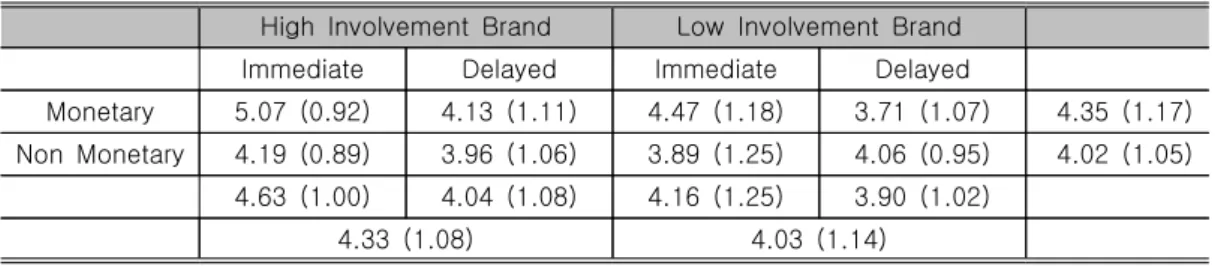
Table 2 presents the means and standard deviations of all measures by treatment conditions in the main study. Subjects indicated that these promotion situations were relatively common and

<Table 2> Cells Means Standard Deviations of Sales Promotion

High Involvement Brand Low Involvement Brand

Immediate Delayed Immediate Delayed

Monetary 5.07 (0.92) 4.13 (1.11) 4.47 (1.18) 3.71 (1.07) 4.35 (1.17) Non Monetary 4.19 (0.89) 3.96 (1.06) 3.89 (1.25) 4.06 (0.95) 4.02 (1.05)

4.63 (1.00) 4.04 (1.08) 4.16 (1.25) 3.90 (1.02)

4.33 (1.08) 4.03 (1.14)

we observed main or interaction effects across all treatments. As predicted, there was different sales promotion effect depending on different sales promotion method as shown in Table 2. Using Anova, there was significant effect with p<0.01 (F=5.811, df=1, p=0.000). High involvement brand, monetary, and immediate sales promotion (X=5.07) is the most preferable method and low involvement, monetary, and delayed is the lowest (X=3.71). For high involvement brands, immediate benefit (10% discount now and free gift) is more effective than delayed benefit.For non-monetary promotions, non-monetary and immediate benefit of low involvement product has the lowest means (X=3.89) and it could be explained that subjects did not want to receive gifts with a brand logo.

When the same gift was presented, consumers prefer gifts with branded with expensive brand logos.

A three-way ANOVA was used to verify hypotheses. Monetary promotion influenced promotion attitude more than non-monetary promotion. F(1.126)=6.658, p<0.01 and mean for monetary is 4.35 and non-monetary was 4.02.

Hence, hypothesis 1 was supported in fashion

item as well as previous studies in consumer

goods. We expected immediate benefit (X=4.40) to

play a larger role than delayed benefit (X=4.03)

and it was supported with F(1.126)=12.910,

p<0.01. Therefore, H2 Immediate benefit is more

effective than delayed benefit for both monetary

and non-monetary promotions. There was a brand

(6)

involvement effect on the significance of sales promotions (F1.126=5.972, p<0.05). Price reductions on the high involvement (X=4.33) was evaluated as more significant than those on the low involvement

<Table 3> Hypothesis Testing (ANOVA)

Variables Means d.f. MS F-Value Sig.

A. Involvement type   1 6.724 5.972** 0.015

High Involvement brand 4.33      

Low Involvement brand 4.03        

B. Sales Promotion type   1 7.500 6.658*** 0.010

Monetary 4.34      

Non Monetary 4.02        

C. Timing of SP benefit type   1 14.536 12.910*** 0.000

Immediate 4.40      

Delayed 4.03        

A x B   1 3.255 2.891* 0.090

A x C   1 1.601 1.422 0.234

B x C   1 12.766 11.337*** 0.001

A x B x C   1 0.231 0.206 0.651

Error   292      

*p<0.1, **p<0.05, ***p<0.01

4.08 4.58

3.98 4.07

2 3 4 5

High Low

Involvement A

T T I T U D E

Monetary Non Monetary

<Figure 1> Interaction between Sales Promotion Type and Brand Involvement

brand (X=4.03). Thus, hypothesis 3 was

supported; fashion brand involvement type

influenced sales promotion attitude.

(7)

3.93 4.78

4.01

4.03

2 3 4 5

Immediate Delayed

Benefit Timing A

T T I T U D E

Monetary Non Monetary

<Figure 2> Interaction between Sales Promotion Type and Benefit Timing

In addition, there was significant interaction effect between brand involvement and sales promotion type with F(1.126) = 2.891, p<0.1. As shown in Figure 1, monetary sales promotion was more effective than non-monetary in high involvement brand, while both promotion effects were similar in low involvement brand. It also matched many numerous studies that high brand equity brands or high price products were more sales promotion elastic.

Sales promotion type x benefit timing interaction was found significant with F(1.126) = 11.337, p<0.01. As shown in Figure 2, for monetary sales promotion, subjects perceived in immediate 10%

discount coupon as more significant (X=4.78) than those framed 20% discount next time (X=3.93).

Consumers understood next time 20% discount tactic was valid if they should come and buy more next time. Therefore, actual sales promotion benefit was not provided and would not be provided. That is why its means was lower than sweepstake (X=3.93). For non-monetary sales promotion, immediate free gift and sweepstake did not mark remarkable difference of sales promotion attitude.

V. Discussion and conclusion

This study carries significant meaningsin that it

studied the effectiveness of sales promotions

based on promotion types, benefit timing, and

involvement degree of sales promotions for

fashion items. Considering the fact that diverse

sales promotions are executed at fashion stores in

reality, we can say that it was a meaningful

empirical study to see which sales promotions are

more effective, depending on characteristics of

brands. As indicated by other previous studies,

monetary and immediate benefits are turned out to

be highly effective. However, different preference

on non-monetary benefits by involvement has

been observed. As for high-involvement fashion

items, subjects preferred immediate benefits (gifts)

to low-involvement fashion items as high-

involvement items have high awareness and

preference. It can be interpreted that gifts with a

brand logo can be used to communicate with the

brand and consumers feel that their value is

increased with the brand. On the contrary, the

results show that subjects preferred sweepstaketo

immediate gifts as for low-involvement brands.

(8)

From this, it can be said that marketers need to be careful in making and providing gifts with a low-involvement brand logo. It will be desirable for marketers to identify characteristics of their brands clearly and then select and implement appropriate sales promotions. This study has limitation in that, as it selected low-involvement and high- involvement brands preferred by female university students, one needs to be careful in applying the results of this study to all the other fashion brands.

Therefore, it will be worthwhile to study effective sales promotions for other various fashion brands, including missy brands, menswear, and childrens wear. Moreover, it will be meaningful to research sales promotions appropriate for individual consumer's propensity and characteristics in purchasing fashion items in the future.

References

1) American Marketing Association . (1960).

"Committee on definitions, Marketing definitions;

A Glossary of Marketing Terms, Chicago.

2) "New sales promotion at Lotteria", (2005, December 5). HanKook Ilbo , Retrieved April 5, 2006, from http://news.hankooki.com

3) Bawa, K. & Shoemaker, R. W. (1987). "The coupon prone-consumer: some findings based on purchase behavior across product classes".

Journal of Marketing, 51(4) , 99-110.

4) Blattberg, R. C., Buesing, T., Peacock, P., &

Sen, S. K. (1978). "Identifying the deal prone segment ". Journal of Marketing Research, 15 (August), 369-77.

5) Narasimhan, C. (1984). "A price discrimination theory of coupons". Marketing Science, 3 (2), 128-146.

6) Lichtenstein, D. R., Netemeyer, R. G., & Burton, S. (1995). "Assessing the domain specificity of

deal proneness: a field study". Journal of Consumer Research, 22 (December), 314-326.

7) Lichtenstein, D. R., Netemeyer, R. G., & Burton, S. (1990). "Distinguishing coupon proneness from the value consciousness: an acquisition transaction utility theory perspective". Journal of Marketing, 54, 54-67.

8) Mittal, B. (1994). "An integrated framework for relating diverse consumer characteristics to supermarket coupon redemption". Journal of Marketing Research, 31(November), 533-544.

9) Inman, J. & McAlister L. (1993). "A retailer promotion policy model considering promotion signal sensitivity". Marketing Science, 12 (Fall), 339-356.

10) Mela, C. F., Gupta, S., & Lehmann, D. R.

(1997). "The long-term impact of promotion and advertising on consumer brand choice".

Journal of Marketing Research, 34(May), 248-261.

11) Promotion Marketing Association of America, Inc. (1994). "winning with promotion power:

the reggie awards winners". Ravenswood, IL:

Dartnell Corporation.

12) Kim, S. H. (2000). "Sales promotion response and shopping orientation of apparel consumers, dissertation" . Seoul National University Mater's thesis.

13) Kim, M. J. (2005). "The effect on sales promotion in apparel firms on brand loyalty" . ChoongAng University Master's thesis.

14) Cotton, B .C. & Babb, E. M. (1978). "Consumer response to promotional deals". Journal of Marketing, 42(July), 109-113

15) Bawa, K. & Shoemaker, R. W. (1987). Ibid., 16) Dodson, J., Tybout, A., & Sternthal, B. (1987).

"Impacts of deals and deal retraction on brand switching". Journal of Marketing Research, 15, 72-81.

17) Neslin, S. A., Henderson, C., & Quelch, J

(9)

(1985). "Consumer promotions and the acceleration of product purchases". Marketing Science, 4(2), 147-165.

18) Pierre, C., Wansink, B., & Laurent, G. (2000).

"A congruency framework of sales promotion effectiveness". Journal of Marketing, 64:4 (October), 65-81.

19) Kim, J. Y. & Min, B. P. (2005). "Comparison of effectiveness between various sales promotions".

Management Research, 34 (2),445-469.

20) Yoon, I. J. (2003). "Study on consumer response to sales promotion of spa casual brands: focusing on advertising, special events, and VMD" . Ewha Women's University, Master's thesis.

21) Sawyer, A. G., & Dickson, P.R. (1984).

"Psychological perspectives on consumer response to sales promotion". in Research on Sales Promotion: Collected Papers, Katherine E Josz, ed. Cambridge MA: Marketing Science Institute, 47-62.

22) Lee, S. D., Park, S. J., Kim, J. Y., & Lee, H. J.

(2000). "Marketing from the perspective of corporate level". Seoul: Hakhyunsa.

23) Lee, S. K. & Kim, K. S. (2005). "The reward program effect: a strategic framework for acquiring new customers". Korea Marketing Journal, 7(2), 123-139.

24) Zaichkowsky, J. L. (1985) "Measuring the involvement construct". Journal of Consumer research, 12(December), 341-352.

25) Cho, E. Y. (2000). "Analysis of fitness factors and purchase intention of fashion items in internet shopping based on product classification by FCB GRID model" . Choongang University Master's thesis.

26) Chen, S. S., Monroe, K. B., & Lou, Y. C.

(1998). "The effects of framing price promotion messages on consumers' perceptions and purchase intentions". Journal of Retailing, 74 (3).

27) Kim, J. Y. & Min, B. P. (2005). Ibid.,

Received 2 May 2006, Accepted 29 June 2006.

수치

Table 2 presents the means and standard deviations of all measures by treatment conditions in the main study

참조

관련 문서

- The Flow Rate is not Sales (which was $514,405) because inventory is measured in the cost to purchase goods, not in the sales revenue that may be earned from the

§  Each effect creates two positive loops: One increases sales through market share gains, and one increases sales through expansion of the total size of the market.. Chapter

select item-name, color, size, sum(number) select item name, color, size, sum(number) from sales. group by

The purpose of this study was to investigate the effects of 8 weeks trampoline exercise on health promotion (health related fitness, blood lipid) in

• Today, we reveal why we believe EHang (NASDAQ: EH) is an elaborate stock promotion, built on largely fabricated revenues based on sham sales contracts with a customer who

Channel team management Direct Online enablement Partner Portal Access Deal registration. Webinars

sensitive files (DLP alert) Unusual logon access Ransomware Activity.

Hyundai and Kia, which together rank fifth in global car sales, are expecting a slowdown in sales growth to a combined 7.41- million vehicles partly also be- cause