Gallic acid, EtOH, LPS, Acetaminophen으로 유발된 마우스 대식세포 내 hydrogen peroxide 생성억제에 대한
애엽 물추출물의 영향 연구
박완수*
경원대학교 한의과대학 병리학교실
Effect of Water Extract from Artemisiae Argi Folium on Hydrogen Peroxide Production within Mouse Macrophage Raw 264.7 Cells
Treated with Gallic acid, EtOH, LPS, and Acetaminophen
Wan Su Park*
Department of Pathology, College of Oriental Medicine, Kyungwon University
The purpose of this study is to investigate the effect of water extract from Artemisiae Argi Folium (WAAF) on hydrogen peroxide production within mouse macrophage Raw 264.7 Cells treated with gallic acid, EtOH, LPS, and acetaminophen. WAAF (0~400 ug/mL) was treated with gallic acid, EtOH, LPS, acetaminophen. And the intracellular productions of hydrogen peroxide were measured by dihydrorhodamine 123 (DHR) assay. WAAF showed the restoration of the intracellular productions of hydrogen peroxide which were reduced by gallic acid, EtOH, LPS, and acetaminophen in Raw 264.7 Cells. WAAF could be supposed to have the immunological activity related with macrophage's oxidative burst.
Key words : macrophage, immuno activity, Artemisiae Argi Folium, hydrogen peroxide, gallic acid
* 교신저자 : 박완수, 경기도 성남시 수정구 경원대학교 한의과대학 병리학교실
․E-mail : [email protected], ․Tel : 031-750-8821
․접수 : 2008/10/23 ․수정 : 2008/11/10 ․채택 : 2008/12/04
서 론
애엽(Artemisiae Argi Folium)은 국화과에 속한 다년생 초본 황해쑥(Artemisia argyi L.)의 잎을 건조한 것으로, 여름에 꽃이 아 직 피지 않았을 때 채취하여 햇볕에서 말린 후 사용한다. 성미 (性味)는 따뜻하나 독이 약간 있고(溫有小毒) 맵고 쓴 것(辛苦)으 로 알려져 있다. 또한 산한지통(散寒止痛), 온경지혈(溫經止血)하 는 효능이 있어서 소복냉통(少腹冷痛), 월경부조, 궁냉불영(宮冷 不孕), 토혈(吐血), 뉵혈(衄血), 붕루경다(崩漏經多), 임신으로 인 한 하혈(下血) 등을 치료하는 것으로 알려져 있다1,2).
대식세포(大食細胞; macrophage)는 인체 면역체계에서 중요 한 역할을 하는 대표적인 세포이며 탐식세포(貪食細胞)라고도 한 다. 이 세포는 체내의 모든 조직에 분포하며 세균(bacteria), 바이
러스(virus) 등의 외부로부터 침입하는 병원체뿐만 아니라 암세 포, 혹은 노화하여 사멸되어가는 인체의 정상세포 등을 포식하고 소화하는 대형의 아메바성 식세포이다3-5). 류마티스성 관절염과 같은 자가면역질환에 대한 많은 연구 중 최근에 발표에 의하면 대식세포(macrophage)의 ROS 생성․배출이 류마티스 관절염 발생을 억제하는 등 자가면역질환의 발병을 억제하는 데 중요한 역할을 한다. 즉 대식세포에서 분출되는 ROS에 의하여 T cell 등 의 과도한 림프구 활성화를 막을 수 있다는 것이다. 이는 산화적 스트레스가 인체 내 염증반응을 촉발한다는 기존의 이론과 상반 되는 내용이기는 하지만 류마티스성 관절염과 같은 난치성 자가 면역질환의 새로운 치료법 개발과 관련해서 새로운 방향을 제시 하는 것이다.
본 연구에서는 gallic acid, EtOH, LPS, acetaminophen 등에 의해서 유발되는 마우스 대식세포 Raw 264.7 cell 내 hydrogen peroxide 생성저하에 대한 애엽 물추출물(WAAF)의 영향을 알아 보기 위하여 in vitro 실험을 수행하여 유의한 결과를 얻었기에
이에 보고하는 바이다.
재료 및 방법
1. 재료
1) 시약 및 기기
본 실험에 사용된 시약 중 Dimethyl Sulfoxide (DMSO), dihydrorhodamine 123 (DHR) 등은 Sigma사(ST. Louis, MO, USA)로부터 구입하여 사용하였다. 각 시약의 품질은 분석용 등 급 이상의 것으로 하여 사용하였다. 본 실험에 사용된 기기는 rotary vacuum evaporator (Eyela, Tokyo, Japan), freeze dryer (Eyela, Tokyo, Japan), deep freezer (Revco, NC, USA), microplate reader (Bio-Rad, CA, USA) 등이다.
2) 약재
본 실험에 사용된 약재 애엽(艾葉; Artemisiae Argi Folium)은 한국 서해안에서 채취하여 검정한 후 사용하였으며 검정된 약재 들은 경원대학교 한의과대학 병리학교실에 보관되었다.
2. 방법 1) 시료의 제조
애엽(Artemisiae Argi Folium) 50 g을 전기약탕기에 1차 증류 수 1,000 mL와 함께 넣은 뒤 150분 동안 가열, 추출하였다. 추출 액을 filter paper로 감압 여과한 뒤, 여과액을 rotary vacuum evaporator를 이용하여 농축하였다. 이 농축액을 동결건조기를 이용, 건조하여 6 g(수득률 12%)의 애엽 물추출물(Water Extract of Artemisiae Argi Folium; WAAF)을 얻어 시료로 사용하였다. 제 조된 시료의 번호는 'AA071011'이다.
2) Cell line
실험에 사용된 대식세포는 mouse macrophage(Raw 264.7 cell line)이며 한국세포주은행(KCLB, Korea)에서 구입하였다.
3) 세포 배양
Raw 264.7 cells은 37℃, 5% CO2 조건에서 10% FBS, penicillin (100 U/mL), streptomycin (100 ㎍/mL)이 첨가된 DMEM 배지로 배양되었다. Cells은 75 cm2 flask (Falcon, USA) 에서 충분히 증식된 후 배양 3일 간격으로 배양세포 표면을 phosphate buffered saline (Sigma, USA) 용액으로 씻어준 후 75 cm2 flask 당 3 mL의 0.25 % trypsin-EDTA용액을 넣고 실온에서 1분간 처리한 다음 trypsin용액을 버리고 37 ℃에서 5분간 보관 하여 세포를 탈착하여 계대 배양하였다. 탈착된 세포는 10 % FBS가 첨가된 DMEM 배양액 10 mL에 부유시킨 다음 새로운 배 양용기에 옮겨 1 : 2의 split ratio로 CO2 배양기(37℃, 5% CO2)에 서 배양하였다.
4) Dihydrorhodamine 123 (DHR) assay
세포내의 hydrogen peroxide(H2O2) 생성은 Roesler 등6-10)의 방법을 응용, dihydrorhodamine 123 (DHR) assay를 실시하여 측정하였다. DHR은 비형광이지만 세포 내에서 세포 내 hydrogen peroxide에 의하여 산화되어 녹색의 형광을 발현하는 물질인 rhodamine 123(R123)로 바뀌게 된다. 그러므로 여러 가
지 산화적 반응을 일으키는 물질들로 인해 mouse의 대식세포 내 에서 대량으로 발생하는 reactive oxygen species (ROS)의 수준 을 dihydrorhodamine 123 assay를 이용하여 측정할 수 있다. 본 실험에서는 gallic acid, EtOH, LPS, acetaminophen 등이 유발하 는 대식세포 내 hydrogen peroxide 생성억제에 대한 시료의 영 향를 측정하였다. 96 well plate에 1×10⁴ cells/well의 농도로 분 주되도록 1×10⁵ cells/mL의 cell을 100 ㎕씩 넣고 37℃, 5% CO2
incubator에서 24시간동안 배양한 후 배지를 버리고 배양세포 표 면을 phosphate buffered saline (PBS) 용액으로 씻어주었다. 시 료를 처리하기 전에 우선 DHR(10uM)이 담긴 배지를 30분간 각 well에 처리한 뒤 배지를 제거하였다. 배지에 녹인 시료(0, 10, 50, 100, 200, 400 ug/mL)와 독성물질들(gallic acid, EtOH, LPS, acetaminophen)을 각 well에 처리하고 24시간 동안 37℃, 5%
CO2 incubator에서 배양한 후 microplate reader(Bio-Rad, CA, USA)를 이용하여 490 nm에서 흡광도를 측정하였다.
3. 통계처리
실험성적은 평균치 ± 표준오차 (Mean ± S.D.)로 나타내었으 며, 대조군과 각 실험군과의 평균 차이는 Student t-test와 ANOVA test로 분석하여 P<0.05일 때 통계적으로 유의한 것으 로 판정하였다.
결 과
1. Gallic acid(GA)의 Raw 264.7 cell 내 hydrogen peroxide 생성 억제에 대한 WAAF 영향
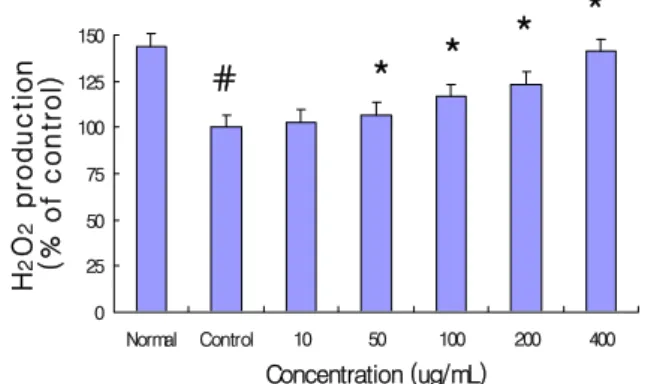
GA(200 uM)로 Raw 264.7 cell 내 hydrogen peroxide 생성 억제를 유발하고 WAAF(0, 10, 50, 100, 200, 400 μg/mL)를 함께 처리하여 24시간동안 배양한 결과 GA에 의한 세포내 hydrogen peroxide 생성억제를 50 ug/mL 이상의 농도에서 유의하게 (p<0.05) 회복시켰다(Fig. 1).
0 25 50 75 100 125 150
Normal Control 10 50 100 200 400
Concentration (ug/mL)
H2O2 production (% of control)
# * * * *
Fig. 1. Effect of WAAF on the intracellular production of hydrogen peroxide (H2O2) of Raw 264.7 cell treated with Gallic acid (GA; 200 uM). Cells were incubated with WAAF for 24 hr with GA. Results are represented as mean ± S.D. WAAF : Water extract of Artemisiae Argi Folium. Normal : Not treated with GA. Control : Treated with GA only. # represents P < 0.05 compared to the normal. * represents P < 0.05 compared to the control.
2. EtOH의 Raw 264.7 cell 내 hydrogen peroxide 생성억제에 대
한 WAAF 영향
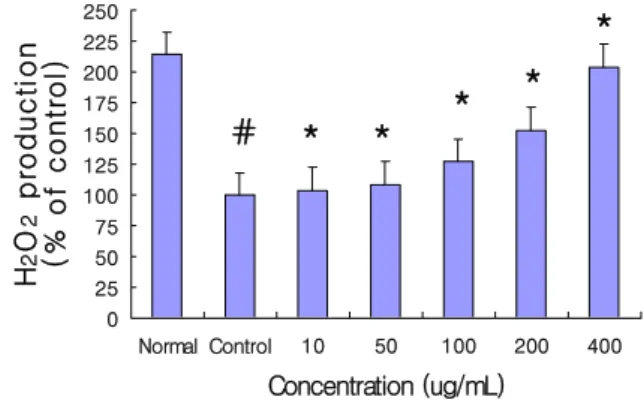
EtOH(200 uM)로 Raw 264.7 cell 내 hydrogen peroxide 생 성억제를 유발하고 WAAF(0, 10, 50, 100, 200, 400 μg/mL)를 함 께 처리하여 24시간동안 배양한 결과 EtOH에 의한 세포내 hydrogen peroxide 생성억제를 50 ug/mL 이상의 농도에서 유 의하게(p<0.05) 회복시켰다(Fig. 2).
0 25 50 75 100 125 150 175 200 225
Normal Control 10 50 100 200 400
Concentration (ug/mL) H2O2 production (% of control)
# * * * *
Fig. 2. Effect of WAAF on the intracellular production of hydrogen peroxide (H2O2) of Raw 264.7 cell treated with EtOH (200 uM). Cells were incubated with WAAF for 24 hr with EtOH. Results are represented as mean ± S.D. WAAF : Water extract of Artemisiae Argi Folium. Normal : Not treated with EtOH. Control : Treated with EtOH only. # represents P < 0.05 compared to the normal. * represents P < 0.05 compared to the control.
3. LPS의 Raw 264.7 cell 내 hydrogen peroxide 생성억제에 대한 WAAF 영향
LPS(2 ㎍/ml)로 Raw 264.7 cell 내 hydrogen peroxide 생성 억제를 유발하고 WAAF(0, 10, 50, 100, 200, 400 μg/mL)를 함께 처리하여 24시간동안 배양한 결과 LPS에 의한 세포내 hydrogen peroxide 생성억제를 50 ug/mL 이상의 농도에서 유의하게 (p<0.05) 회복시켰다(Fig. 3).
0 25 50 75 100 125 150 175 200 225 250
Normal Control 10 50 100 200 400
Concentration (ug/mL) H2O2 production (% of control)
# * * *
*
Fig. 3. Effect of WAAF on the intracellular production of hydrogen peroxide (H2O2) of Raw 264.7 cell treated with lipopolysaccharide (LPS 2 ㎍/ml). Cells were incubated with WAAF for 24 hr with LPS. Results are represented as mean ± S.D. WAAF : Water extract of Artemisiae Argi Folium.
Normal : Not treated with LPS. Control : Treated with LPS only. # represents P
< 0.05 compared to the normal. * represents P < 0.05 compared to the control.
4. AAP의 Raw 264.7 cell 내 hydrogen peroxide 생성억제에 대 한 WAAF 영향
Acetaminophen(AAP; 2 uM)으로 Raw 264.7 cell 내 hydrogen peroxide 생성억제를 유발하고 WAAF(0, 10, 50, 100,
200, 400 μg/mL)를 함께 처리하여 24시간동안 배양한 결과 AAP에 의한 세포내 hydrogen peroxide 생성억제를 10 ug/mL 이상의 농도에서 유의하게(p<0.05) 회복시켰다(Fig. 4).
0 25 50 75 100 125 150 175 200 225 250
Normal Control 10 50 100 200 400
Concentration (ug/mL) H2O2 production (% of control)
# * *
*
*
*
Fig. 4. Effect of WAAF on the intracellular production of hydrogen peroxide (H2O2) of Raw 264.7 cell treated with acetaminophen (AAP; 2 uM). Cells were incubated with WAAF for 24 hr with AAP. Results are represented as mean ± S.D. WAAF : Water extract of Artemisiae Argi Folium.
Normal : Not treated with AAP. Control : Treated with AAP only. # represents P
< 0.05 compared to the normal. * represents P < 0.05 compared to the control.
고 찰
애엽(Artemisiae Argi Folium)은 국화과에 속한 다년생 초본 황해쑥(Artemisia argyi L.)의 잎을 건조한 것으로, 여름에 꽃이 아 직 피지 않았을 때 채취하여 햇볕에서 말린 후 사용한다. 간(肝), 비(脾), 신(腎) 등으로 귀경(歸經)하며 산한지통(散寒止痛), 온경 지혈(溫經止血)하는 효능이 있어서 소복냉통(少腹冷痛), 월경부 조, 궁냉불영(宮冷不孕), 토혈(吐血), 뉵혈(衄血), 붕루경다(崩漏經 多), 임신으로 인한 하혈(下血), 그밖에 외용(外用)으로 피부가려 움증, 뜸치료로서 경락을 덥혀서 출혈을 멈추게 하는 작용으로 (溫經止血) 허한성(虛寒性) 출혈(出血)을 치료하는 것과1), 진해거 담평천(鎭咳祛痰平喘) 작용, 항혈액응고 작용, 면역증강 작용, 항 균 작용 등이2) 있는 것으로 알려져 있다. 최근에는 약리활성을 가진 플라보노이드의 일종인 Jaceosidin, 그리고 그 밖에 scopoletin, isoscopoletin, Arteminolides B․C․D, Eudesmanolides 등11-16)이 보고되어 있다.
최근에는 대식세포의 ROS 생성․배출이 류마티스 관절염 발생을 억제하는 등 자가면역질환의 발병을 억제하는 데 중요한 역할을 한다는 연구들17-19)이 보고되었다. 그러므로 다양한 독성 물질에 의한 대식세포의 ROS 생성억제는 자가면역질환의 유발 가능성을 높인다고 할 수 있다. 본 연구에서는 gallic acid, EtOH, LPS, acetaminophen 등에 의해서 발생되는 대식세포의 hydrogen peroxide 세포내 생성억제에 대하여 애엽 열수추출물 (WAAF)이 미치는 영향에 대해서 알아보았다.
GA(200 uM)로 Raw 264.7 cell 내 hydrogen peroxide 생성 억제를 유발하고 WAAF(0, 10, 50, 100, 200, 400 μg/mL)를 함께 처리하여 24시간동안 배양한 결과 GA에 의한 세포내 hydrogen peroxide 생성억제를 50 ug/mL 이상의 농도에서 유의하게 (p<0.05) 회복시켰다. 또한 EtOH(200 uM)로 Raw 264.7 cell 내
hydrogen peroxide 생성억제를 유발하고 WAAF(0, 10, 50, 100, 200, 400 μg/mL)를 함께 처리하여 24시간동안 배양한 결과 EtOH에 의한 세포내 hydrogen peroxide 생성억제를 50 ug/mL 이상의 농도에서 유의하게(p<0.05) 회복시켰다. LPS(2 ㎍/ml)로 Raw 264.7 cell 내 hydrogen peroxide 생성억제를 유발한 경우에 도 WAAF(0, 10, 50, 100, 200, 400 μg/mL)를 함께 처리하여 24시 간동안 배양한 결과 LPS에 의한 세포내 hydrogen peroxide 생 성억제를 50 ug/mL 이상의 농도에서 유의하게(p<0.05) 회복시 켰다. Acetaminophen(AAP; 2 uM)으로 Raw 264.7 cell 내 hydrogen peroxide 생성억제를 유발하고 WAAF(0, 10, 50, 100, 200, 400 μg/mL)를 함께 처리하여 24시간동안 배양한 결과 AAP에 의한 세포내 hydrogen peroxide 생성억제를 10 ug/mL 이상의 농도에서 유의하게(p<0.05) 회복시켰다.
이상의 결과를 요약하면 황해쑥(Artemisia argyi L.)을 기원으 로 하는 애엽(Artemisiae Argi Folium) 물추출물은 gallic acid, EtOH, LPS, acetaminophen 등에 의해서 유발되는 대식세포 내 의 hydrogen peroxide 생성감소를 유의하게 회복시키는 활성을 가지고 있으며 이러한 활성은 애엽물추출물이 대식세포의 활성 산소종 배출저하와 관련된 자가면역질환의 증상개선에 응용될 수 있음을 의미한다.
결 론
애엽 물추출물 WAAF는 GA(200 uM), EtOH(200 uM), LPS(2 ㎍/ml)로 유발된 mouse macrophage Raw 264.7 cell 내의 hydrogen peroxide 생성억제를 50 ug/mL 이상의 농도에서 유 의하게 회복, 세포내 활성산소종 생성을 증가시켰으며 AAP(2 uM)에 의한 대식세포내의 hydrogen peroxide 생성억제에 대해 서는 10 ug/mL 이상의 농도에서 유의한 회복을 나타내었다. 이 렇게 다양한 물질들에 의한 대식세포 내 활성산소종 생성억제를 애엽물추추출물이 회복시킨다는 것은 대식세포의 활성산소종 배 출로 개선될 수 있는 류마티스성 관절염과 같은 자가면역질환의 치료에 응용될 수 있음을 나타내는 것이다. 그러므로 앞으로 애 엽물추출물이 자가면역질환 증상개선에 미치는 영향에 대하여 보다 많은 연구가 필요한 것으로 사료된다.
감사의 글
본 연구는 2008년도 중소기업청과 경기도의 산학연공동기술 개발지원사업(과제번호 000269730108) 연구개발비 지원에 의하 여 수행된 연구결과로서 연구비 지원에 감사드립니다.
참고문헌
1. 전국한의과대학 공동교재편찬위원회. 본초학. 서울, 영림사, pp 405-407, 1991.
2. 김호철. 한약약리학. 서울, 집문당, pp 309-311, 2001.
3. Cao, H., Urban, J.F.Jr., Anderson, R.A. Cinnamon polyphenol
extract affects immune responses by regulating anti- and proinflammatory and glucose transporter gene expression in mouse macrophages. J Nutr. 138(5):833-840, 2008.
4. Ripoll, V.M., Meadows, N.A., Raggatt, L.J., Chang, M.K., Pettit, A.R., Cassady, A.I., Hume, D.A. Microphthalmia transcription factor regulates the expression of the novel osteoclast factor GPNMB. Gene. 413(1-2):32-41, 2008.
5. Suzuki, Y., Funakoshi, H., Machide, M., Matsumoto, K., Nakamura, T. Regulation of cell migration and cytokine production by HGF-like protein (HLP) / macrophage stimulating protein (MSP) in primary microglia. Biomed Res. 29(2):77-84, 2008.
6. Jirapongsananuruk, O., Malech, H.L., Kuhns, D.B., Niemela, J.E., Brown, M.R., Anderson-Cohen, M., Fleisher, T.A.
Diagnostic paradigm for evaluation of male patients with chronic granulomatous disease, based on the dihydrorhodamine 123 assay. J Allergy Clin Immunol.
111(2):374-379, 2003.
7. Richardson, M.P., Ayliffe, M.J., Helbert, M., Davies, E.G. A simple flow cytometry assay using dihydrorhodamine for the measurement of the neutrophil respiratory burst in whole blood: comparison with the quantitative nitrobluetetrazolium test. J Immunol Methods.
219(1-2):187-193, 1998.
8. Crow, J.P. Dichlorodihydrofluorescein and dihydrorhodamine 123 are sensitive indicators of peroxynitrite in vitro:
implications for intracellular measurement of reactive nitrogen and oxygen species. Nitric Oxide. 1(2):145-157, 1997.
9. van Pelt, L.J., van Zwieten, R., Weening, R.S., Roos, D., Verhoeven, A.J., Bolscher, B.G. Limitations on the use of dihydrorhodamine 123 for flow cytometric analysis of the neutrophil respiratory burst. J Immunol Methods.
191(2):187-196, 1996.
10. Roesler, J., Hecht, M., Freihorst, J., Lohmann-Matthes, M.L., Emmendörffer, A. Diagnosis of chronic granulomatous disease and of its mode of inheritance by dihydrorhodamine 123 and flow microcytofluorometry. Eur J Pediatr. 150(3):161-165, 1991.
11. Kim, M.J., Kim, D.H., Lee, K.W., Yoon, D.Y., Surh, Y.J.
Jaceosidin induces apoptosis in ras-transformed human breast epithelial cells through generation of reactive oxygen species. Ann N Y Acad Sci. 1095: 483-495, 2007.
12. Jeong, M.A., Lee, K.W., Yoon, D.Y., Lee, H.J. Jaceosidin, a pharmacologically active flavone derived from Artemisia argyi, inhibits phorbol-ester-induced upregulation of COX-2 and MMP-9 by blocking phosphorylation of ERK-1 and -2 in cultured human mammary epithelial cells. Ann N Y Acad Sci. 1095: 458-466, 2007.
13. Lee, H.G., Yu, K.A., Oh, W.K., Baeg, T.W., Oh, H.C., Ahn, J.S., Jang, W.C., Kim, J.W., Lim, J.S., Choe, Y.K., Yoon, D.Y.
Inhibitory effect of jaceosidin isolated from Artemisiaargyi on the function of E6 and E7 oncoproteins of HPV 16. J Ethnopharmacol. 98(3):339-343, 2005.
14. Adams, M., Efferth, T., Bauer, R. Activity-guided isolation of scopoletin and isoscopoletin, the inhibitory active principles towards CCRF-CEM leukaemia cells and multi-drug resistant CEM/ADR5000 cells, from Artemisia argyi. Planta Med. 72(9):862-864, 2006.
15. Lee, S.H., Kim, H.K., Seo, J.M., Kang, H.M., Kim, J.H., Son, K.H., Lee, H., Kwon, B.M., Shin, J., Seo, Y. Arteminolides B, C, and D, new inhibitors of farnesyl protein transferase from Artemisia argyi. J Org Chem. 67(22):7670-7675, 2002.
16. Tan, R., Jia, Z. Eudesmanolides and Other Constituents
from Artemisia argyi. Planta Med. 58(4):370-372, 1992.
17. Gelderman, K.A., Hultqvist, M., Pizzolla, A., Zhao, M., Nandakumar, K.S., Mattsson, R., Holmdahl, R. Macrophages suppress T cell responses and arthritis development in mice by producing reactive oxygen species. J Clin Invest.
117(10):3020-3028, 2007.
18. Hultqvist, M., Bäcklund, J., Bauer, K., Gelderman, K.A., Holmdahl, R. Lack of reactive oxygen species breaks T cell tolerance to collagen type II and allows development of arthritis in mice. J Immunol. 179(3):1431-1437, 2007.
19. Hultqvist, M., Olofsson, P., Holmberg, J., Bäckström, B.T., Tordsson, J., Holmdahl, R. Enhanced autoimmunity, arthritis, and encephalomyelitis in mice with a reduced oxidative burst due to a mutation in the Ncf1 gene. Proc Natl Acad Sci U S A. 101(34):12646-12651, 2004.