1. Introduction
Companies seeking consulting skills due to the difficulties in managing their workforce are choosing external experts to solve their problems. However, there are cases where the consulting is carried out successfully, but sometimes it fails as it fails to meet expectations. In case of failure, many resources such as time, cost, and personnel have already been dedicated and the operation of the company becomes difficult. As
such, consulting company's expertise and consulting company's brand are consulted before the contract. It is necessary to evaluate the expertise of the consulting firm on the premise that the consulting results are calculated satisfactorily. This is because the current difficulties of the current enterprise should be solved by soliciting the consulting firm and leading to the performance of the management being created. If the consulting work does not result in success, the enterprise may become bankrupt. In this study, we
A Study on the Effect of Branding of Consulting Company
Yong-Kuk Choi
1, Jung-Ryol Kim
2*, Sang-Bong Kim
21
Doctoral Student, Dept. Of Smart Convergence Consulting. Hansung University
2
Professor, Dept. Of Economics, Hansung University
컨설팅사 브랜드인지도가 미치는 효과에 관한 연구
최용국1, 김정렬2*, 김상봉2
1한성대학교 스마트융합컨설팅학과, 2한성대학교 경제학과
Abstract The purpose of this study is to investigate the effect of consulting firm’s professional consulting satisfaction on consulting satisfaction. The purpose of this study is to investigate the effect of consulting firm's brand awareness on consulting satisfaction. The results of this study suggest that consulting firms that have expertise in the field have a positive effect on the satisfaction of consulting and that the higher the brand awareness, the higher the consulting satisfaction. The better the brand awareness, the higher the reliability and the positive impact on the satisfaction of consulting, and the consulting firm including consultant suggests to improve the professional competence in the field.
Key Words : Consulting Company, Consulting satisfaction, Brand awareness, Expertise
요 약 본 연구는 컨설팅이 수행된 기업을 대상으로 컨설팅사 전문성이 컨설팅 만족도에 미치는 영향에 대하여 연구해보 고자 하였으며, 컨설팅사의 브랜드 인지도가 컨설팅 만족도에 조절력을 보여 차별화된 컨설팅 만족도를 달성하는 것에 대 해 알아보고자 하였다. 연구를 요약하면 컨설팅을 수행하며 해당 분야에 대한 전문성을 가진 컨설팅사는 컨설팅 만족도에 긍정적인 영향을 미치며 브랜드 인지도가 높을수록 컨설팅 만족도에 영향을 미치는 것으로 나타났다. 브랜드 인지도가 높 을수록 신뢰도가 형성되어 컨설팅 만족도에 긍정적인 영향을 미친다는 것을 확인하였고, 컨설턴트를 포함한 컨설팅사는 수행하려고 하는 분야에 대한 전문적인 역량을 향상시켜야 함을 시사하고 있다.
주제어 : 컨설팅 회사, 컨설팅 만족도, 브랜드 인지도, 전문성
*This paper was supported by the research fund of Hansung University in 2018
*Corresponding Author : Jung-Ryol Kim([email protected]) Received March 6, 2018
Accepted April 20, 2018
Revised April 6, 2018 Published April 28, 2018
investigate what part of the firm chooses a consulting company, whether the final result achieved the expected satisfaction, whether the consulting firm was considering brand recognition, I want to know.
In previous studies on consulting, consulting competency, top management, consultant service quality, consultant motivation for working, and financial performance were measured as independent variables, and consulting performance and reuse intention were measured. However, in this study, The purpose of this study is to examine the correlation between consulting firm's professionalism and consulting satisfaction by setting the control variable as to what kind of control the brand awareness of consulting company is. The consulting firm wants to clarify whether the consulting firm is highly satisfied with the consulting results because it is low in brand recognition but high in professionalism, or if the consulting firm's expertise is low but the brand recognition is high. This is a distinctive feature of this study and other prior studies. The purpose of this study is to investigate the effect of consulting firm's expertise on consulting satisfaction and the role of brand awareness as an empirical study.
2. Related Works
In regards to concept of consulting, Fritz Steele[1]
said a consultant who is responsible for the content, process, and structure of the assignment and who does not have the actual responsibility for carrying out the assignment to the person performing it helps the process, and Kubr[2] who said that consulting is an independent professional advisory service also said consulting defines the concept of a service that helps the achievement of the objectives pursued by the manager's organization. HaeKwang Jin[3] said independent professional services that help consultants with highly specialized expertise to find and solve problems in the management and technology of the
company and to achieve the goals that the company pursues by implementing change, Ik Sung Kim[4]
describes the concept of consulting as a total service activity that provides consultation or advice from a client on the basis of proprietary knowledge, information, and expertise. Respectively. Consulting is often referred to as management consulting because it often advises on management issues related to the company. For the concept of management consulting, the Institute of Management Consultants (United Kingdom) requires that independent and competent person study, analyze, and provide appropriate solutions to policy, organizational, procedural and methodological problems As well as helping them to perform these solutions.
2.1 Consulting Company Expertise
The consulting company's expertise is also important for the environment in which the consulting results can be derived. In consulting, the leadership of the project leader is also important. Kwak, Hong-ju[5]
demonstrates empirically that the expertise and managerial capacity of the consultant is a factor influencing the successful execution of the consulting project. Leadership refers to exerting influence on individuals or organizations to achieve their goals in a given situation. Leadership is defined as the formulation of corporate management goals, internal conflict resolution, catalyst for implementation, promotion of work, and the promotion of the sense of responsibility of the members. Therefore, the effect on the satisfaction of consulting is very big. Tannenbaum, Weschler, and Massarik[6] view leadership as "the power of individuals to exercise certain goals through communication processes under certain circumstances,"
Koons and O'donnell[7] Defines leadership as "to influence people to follow a common goal".
2.2 Consulting satisfaction
Definition of satisfaction is “having enough without
deficit” and customer satisfaction is a concept of core
marketing, and Oliver[8] argues ”the customer is satisfied if the customer is satisfied with the total psychological state generated by the combination of the incongruent expectation and the feeling that the consumer has had about the consumption experience, and if the customer reaches the positive disagreement beyond the agreement, the customer satisfaction becomes bigger customers are dissatisfied when they reach a state discrepancy”. This is called the expectancy disconfirmation paradigm. We can say that consulting satisfaction is the satisfaction of the service recipient.
2.3 Brand awareness
In regards to brand recognition, Percy & Rossiter[9]
said brand recognition is the ability of the consumer to identify the brand in different conditions, and it is related to the intensity of the brand intersection in consumer memory. Aaker[10] said brand awareness is the strength of a particular brand that exists in the consumer's mind, and categorized as recognition, recall, top of mind, dominant.
Keller, Kevin Lane[11] said brand awareness is recognition and recall, and recognition is the ability of a consumer to be confident that a particular brand has become a clue in a variety of purchasing situations and has experienced it in the past. When consumers form a brand awareness, the quality of the branded product is an important aspect and the consumer evaluates the brand according to their perceived quality. Regarding perceived quality, Garvin[12] says it is “subjective quality as felt by consumer” and Parasuraman, Zrithaml& Berry[13] said it is differences in consumers' perceptions and expectations about products. As such, depending on brand awareness, Aaker[14].
2.4 Differentiation from previous studies In previous studies on consulting, consulting competency, top management, consultant service quality, consultant motivation for working, and
financial performance were measured as independent variables, and consulting performance and reuse intention were measured. However, in this study, The purpose of this study is to examine the correlation between consulting firm's professionalism and consulting satisfaction by setting the control variable as to what kind of control the brand awareness of consulting company is. This is a distinctive feature of this study and other prior studies.
3. Research model and hypotheses
The purpose of this study is to investigate the effect of consulting firm's professionalism on the satisfaction of consulting satisfaction and secondly to investigate whether consulting firm brand awareness has influence on consulting satisfaction. As the endogenous variables of the consulting company expertise presented in this research model are around the characteristics as said by SungHwan Yoon[15], SuhJin Hwang[16], Lee Yoon-Won et all[17], YoungDae Cho[18], McLachlin RD[19], Boughton, P[20], HongJu Kwak[5], Hee-cheol Yang[21].
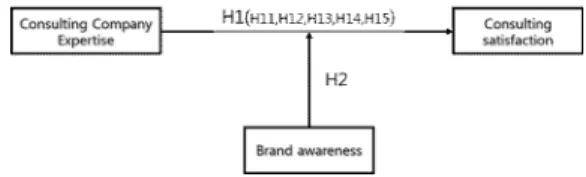
As Aaker[11] and Sang Min Lee[15] argued on the degree of brand awareness, we set the brand awareness of consulting firms as high and low as control variables Fig.1.
Fig. 1. Research model.
3.1 Research hypotheses
The purpose of this study is to analyze the effect of
consulting firm's professionalism on consulting
satisfaction. Therefore, we set the following research
hypothesis to verify the satisfaction of consulting
according to the professionalism of consulting
company.
H1. Consulting firm's expertise will affect consulting satisfaction in a positive direction.
H1-1. The quality of the consultant will affect the consulting satisfaction in the positive direction.
H1-2. Solution presentation ability will have a positive effect on consulting satisfaction.
H1-3. Expert knowledge will have a positive impact on consulting satisfaction.
H1-4. Communication will have a positive impact on consulting satisfaction.
H1-5. Project leadership will have a positive impact on consulting satisfaction.
H2. The consulting firm's brand image will play a role in controlling the impact of the consulting firm's expertise on consulting satisfaction.
3.2 Operational definition of variable and composition of questionnaire
In order to achieve the goal of this study, we set the hypotheses and set the independent variable as the consulting firm’s professionalism, consulting satisfaction as dependent variable, brand awareness as the controlled variable. For independent variables on consulting firm’s professionalism, per SungHwan Yoon[15], SuhJin Hwang[16], Won Yoon et all[17], YoungDae Cho[18], McLachlin RD[19], Boughton, P[20], HongJu Kwak[5], Hee-cheol Yang[21], we used consultant qualities, alternative presentation skills, expertise, communication, project leadership.
Regarding the controlled variable, brand awareness, Aaker[11] and Sang Min Lee[15] defined’The intensity of attitude toward a particular brand in the minds of customers'
All variables except the demographic characteristics and consulting status were measured using the Likert 5 - point scale. The questionnaire consisted of the independent variables, dependent variables, control variables, and the demographic characteristics. The questionnaire consisted of the research items and questionnaires used in the survey were composed of 5
items of expertise of consulting company, brand recognition of consulting company (high and low), 8 items of demographic characteristics (sex, agency, training, number of employees, industry, Consulting services).
4. Results and Discussion
In this study of the consulting firm's expertise, consulting satisfaction, brand awareness, statistical data needed for the empirical analysis was selected and collected through a questionnaire survey. The questionnaire was distributed randomly to 310 companies for SMEs who had received consulting services with them from June 10, 2016 to July 10, 2016.
277 (N = 277, 89% recovery) questionnaires were used,
which excludes 33 samples which were not available as
double data.The questionnaire consisted of
self-administered questionnaires, and all items were
constructed using the Likert 5 - point scale for
consistency of statistical processing. The validity of the
response of the sample group to each measurement
item was verified through the operational definition of
the variable and the study of the previous study. The
validity of the KMO and Bartlett test results were good
at KMO = .813, p = .000, and the commonality was
from .484 to a maximum of .687. The total variance
explained was two factors, and the five extracted initial
eigenvalues were 8.874, 3.359, 2,629, 2.113, 2,004,
respectively. The explanatory power of initial intrinsic
values was 30.263, 11,997, 9.389, 7.546, and 7.298,
respectively, and the cumulative percentage was
66.493%. The total cumulative percentage of the
rotational sum of squares is 66.493%, which is the same
as it was before the rotation. In order to verify the
reliability, Cronbach’α reliability analysis was
performed. As a result of the reliability analysis, it can
be judged that the reliability is verified if the
confidence coefficient is more than .600. Cronbach’α for
consulting firm's consultant qualities is 0.792,
Cronbach’α for alternative presenting ability is 0.824, Cronbach’α for 0.794 communication was 0.798 and Cronbach' α for project leadership was 0.786.
In terms of demographic characteristics, the male to female ratio was 90.60% (251) and the male to female ratio was 9.4% (26). The duration of employment under 10 years was 33.20% (92), 11-20 years at 35.4% (98), and 31.4% (87) for 21 years or more. The education level was 30% (83) for post-university, 32.9% (91) for university degree, and other 37.2% (103). The number of employees was 35.7% (99) for under 50, 31% (86 samples) for 51-100, and 33.2% (92 samples) 101 or more. By industry, 46.9% (130 samples) were manufacturing, and 53.1% (147 samples) were non-manufacturing. Most of the companies were listed on the list with 46.9% (130 samples) In terms of scale, 30.50% (95 samples) of annual sales less than 5 billion won, 35.9% (91 samples) of annual sales less than 10 billion won, and 33.6% (91 samples) of annual sales more than 10 billion won.. Technical metrics of the tool [Table 1].
Table 1. Technical metrics of the tool
Min Max M SD Skewness Kurtosis
A1 (Consultant competence)
1.00 5.00 3.718 1.0322 -.629 -.224
A2 (Solution presentation
skills)
1.00 5.00 3.794 .9987 -.457 -.554
A3 (Consultant expert
knowledge)
1.00 5.00 3.531 1.0303 -.343 -.627
A4
(Communication) 1.00 5.00 4.361 .8118 -1.446 2.331
A5
(Project leadership) 1.00 5.00 4.173 .8420 -1.144 1.639
4.1 Structural equation model
Professor James L. Arbuckle of the temple university, widely used until now, invented the Structural equation model, which is a model used for analysis of structural equation modeling (SEM) data in social science field. It is easy to use because it follows graphical user environment. It is one of the most widely used programs by applying the user-focused interface.
In order to construct the research model according to the research model in Section 3, the potential variables, the measurement variables, the error terms of the endogenous variables (11 ~ 15) and the error terms of the measurement variables (21 ~ 22) are as seen in Fig. 2.
Fig. 2. Structural equation model
4.2 Validity of the model
The factor analysis was conducted to examine the validity of the consulting firm's expertise. As a result of the factor analysis, the CR value for the consultant competence was 9.986, the CR value for Solution presentation skills was 7.843, the CR value for Consultant expert knowledge was 10.005, the CR value for communication skills was 10.278, and the CR value for project leadership was 10.855 Cronbach's alpha for the consultant competence was 0.792, Cronbach's alpha for the Solution presentation skills was 0.824, Cronbach's alpha for the Consultant expert knowledge was 0.794, Cronbach's alpha for the communication skills was 0.798, project leadership Cronbach 'α was 0.786 and the reliability was high. The correlation coefficient of the model, AVE&CR Table 2.
Table 2. The correlation coefficients of the model, AVE&CR
Consultant competence
Solution presentati on skills
Consultant expert knowledge
Communi cation
skills Project
leadership C.R. Cronbac h' α Consultant
competence 1.000 9.986 .792
Solution presentation
skills
.457 1.000 7.843 .824
Consultant expert knowledge
.604 .445 1.000 10.005 .794
Communicati on skills
.472 .418 .489 1.000 10.278 .798
Project
leadership .527 .456 .512 .698 1.000 10.855 .786
As shown in Table 3, the p value was less than 0.05, the χ2 value was 40.507, the df value was 5, and the TLI value of the consultant competence,Solution presentation skills, Consultant expert knowledge, communication skills, project leadership, 0.867. Since the CFI index value is 0.9 or more, the fitness of the research model can be considered to be acceptable and it can be said that the model validity is secured.
Validity of research model Table 3.
Table 3. Validity of the research model
ool χ2 df p Q CFI TLI
RMSEA
RMSEA 90%Ci
Research model 40.057 5 0 8.011 0.933 0.867 0.159 .116~.207
4.3 Common method bias
The common method bias is to separate the measurement method of research design. In other words, when the independent and dependent variables are measured in different ways, the variance of the measurement method becomes small because the source of the response is independent (Lee, H., 2106).
Table 4 shows the reductions in χ2 and DF during uncontrolled and controlled control due to the same method bias in this study. Analysis of common method bias Table 4.
Table 4. Common method bias analysis
χ2 DF △χ2 △DF p
Uncontrolled distribution due to
common method bias 184.12 199
Controlled distribution due to
common method bias 134.56 177 49.56 22 0.001
4.4 Test of research hypothesis
In this study, hypothesis testing was performed by confirming the path coefficients between variables that constitute the hypothesis. The results of the hypothesis testing in the final model in this study are as follows.
The proposed model fit was generally appropriate for ChiSquare 40.057 (degree of freedom = 5, p = .001), CMIN / DF = 8.001, TLI = 0.867, CFI = 0.933 and RMSEA = 0.519.
H1. Consulting Company Expertise will have a positive (+) impact on consulting satisfaction.
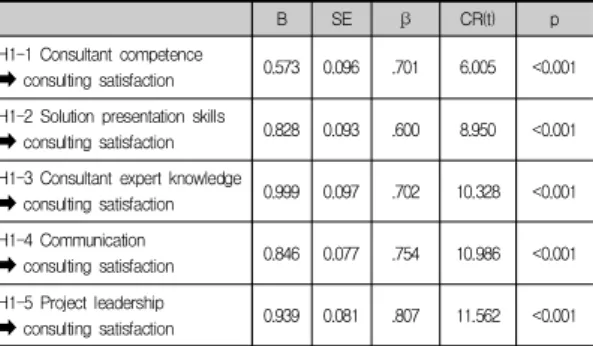
H1-1. The quality of consultants among consulting firms will affect the consulting satisfaction in a positive direction. The results of the test for .573, C.R. = 6.005, p = .000. The hypothesis was accepted with a 95% confidence level.
H1-2. Among the consulting firms, the ability to present alternatives will have a positive impact on the satisfaction level of consulting firms. The results of the test for .828 C.R. = 8.95, p = .000. The hypothesis was accepted with a 95% confidence level.
H1-3. Expertise among consulting firms will affect consulting satisfaction in a positive direction.
The result of the test for the coefficient is 0.999 C.R. = 10.328, p = .000. The hypothesis was accepted with a 95% confidence level.
H1-4. Communication among the consulting firm's specialists will affect the consulting satisfaction in a positive direction. The results of the test for .846 C.R. = 10.986, p = .000. The hypothesis was accepted with a 95% confidence level.
H1-5. Project leadership among consulting firms will have a positive impact on consulting satisfaction. The result of the test for the value of 0.939 C.R. = 11.562, p = .000. The hypothesis was accepted with a 95%
confidence level. Research model hypotheses testing Table 5.
Table 5. Research model test of hypotheses
B SE β CR(t) p
H1-1 Consultant competence
➡consulting satisfaction 0.573 0.096 .701 6.005 <0.001 H1-2 Solution presentation skills
➡consulting satisfaction 0.828 0.093 .600 8.950 <0.001 H1-3 Consultant expert knowledge
➡consulting satisfaction 0.999 0.097 .702 10.328 <0.001 H1-4 Communication
➡consulting satisfaction 0.846 0.077 .754 10.986 <0.001 H1-5 Project leadership
➡consulting satisfaction 0.939 0.081 .807 11.562 <0.001
4.5 Moderating effect test
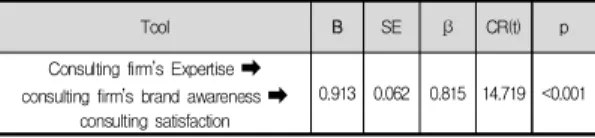
The results of the hypothesis H2, "The influence of the consulting firm's expertise on consulting satisfaction, The results of the control effect test are shown in Table 6.
Table 6. Moderating effect test results
Tool B SE β CR(t) p
Consulting firm’s Expertise➡ consulting firm’s brand awareness➡
consulting satisfaction
0.913 0.062 0.815 14.719 <0.001