Evaluation of Achyranthes japonica Ethanol Extraction on the Inhibition Effect of Hyluronidase and Lipoxygenase
Kyung-Soon Cho*
Department of Food Science & Nutrition, Tongmyong University, Busan 608-711, Korea Received July 20, 2015 /Revised November 5, 2015 /Accepted November 6, 2015
The 1, 1- diphenyl 2-picrylhyorazyl (DPPH) is a well-known radical and a trap (scavenger) for other radicals. Hyaluronidase (HAase) is an enzyme that depolymerizes the polysaccharide hyaluronic acid (HA) in the extracellular matrix of connective tissue. Lipoxygenase (LOX) enzyme was reported to convert the arachidonic, linoleic and other polyunsaturated fatty acid into biologically active metabo- lites involved in the inflammatory and immune responses. The purpose of the present study is to evaluate plant extracts as sources of natural antioxidants and to examine whether Achyranthes japonica having significant DPPH, HAase and LOX inhibitory activity. The inhibitory effect of HAase by A.
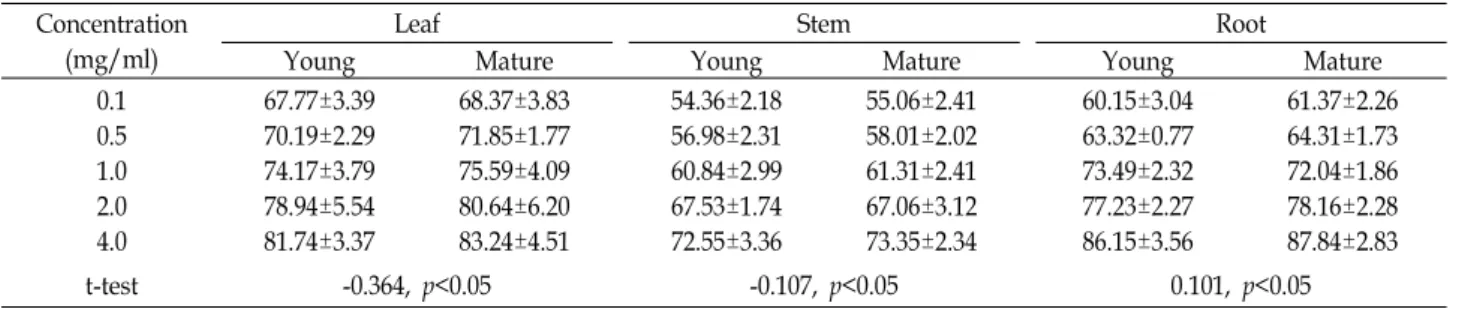
japonica was assayed using a Morgan microplate assay. The antioxidant activity of the A. japonica ex- tracts was measured on the basis of the scavenging activity of the stable 1, 1- diphenyl 2-pic- rylhyorazyl (DPPH) free radical. DPPH scavenging activity of matured roots of A. japonica was eval- uated at 4.0 mg/ml was 87.8% and that of young roots was 86.2% at same concentration. The roots of A. japonica showed maximum inhibition of HAase activity (IC
50= 27.7 μg/ml). The highest LOX inhibition was recorded in the root extract among three vegetative parts. Inhibition of HAase activity of roots may contribute towards the development of herbal medicines. Although percent inhibition of lipoxygenase by Achyranthes japonica for all young and matured groups for leaves, stems, and roots at different concentrations, there were not show a statistically significant difference (p<0.05).
Key words : 1, 1- diphenyl 2-picrylhyorazyl (DPPH), Achyranthes japonica, hyaluronidase, lipoxygenase
*Corresponding author
*Tel : +82-51-629-1717 , Fax : +82-51-629-1709
*E-mail : [email protected]
This is an Open-Access article distributed under the terms of the Creative Commons Attribution Non-Commercial License (http://creativecommons.org/licenses/by-nc/3.0) which permits unrestricted non-commercial use, distribution, and reproduction in any medium, provided the original work is properly cited.
Journal of Life Science 2015 Vol. 25. No. 12. 1370~1376 DOI : http://dx.doi.org/10.5352/JLS.2015.25.12.1370
Introduction
Antioxidants can be found naturally in plants and their compounds in food play an important role as a health pro- tecting factor [10]. Antioxidant scavenge free radicals are very important in inhibiting oxidative mechanisms that lead to degenerative some diseases. The 1, 1- diphenyl 2-pic- rylhyorazyl (DPPH) is a well-known radical and a trap (scavenger) for other radicals [4].
Hyaluronan (HA, also known as hyaluronic acid or hya- luronate) is one of the important matrix components of the ground substance of the subcutaneous tissues and plays im- portant roles in development, growth, and repair of tissues [26]. Hyaluronidase (HAase, EC.3.2.1.35) is an enzyme that depolymerizes the polysaccharide hyaluronic acid (HA) in the extracellular matrix of connective tissue. The enzyme is
found both in organs (testis, spleen, skin, eye, liver, kidney, uterus and placenta) and in body fluids (tears, blood and sperm) [6, 19].
Lipoxygenase (LOX) enzyme was reported to convert the arachidonic, linoleic and other polyunsaturated fatty acid in- to biologically active metabolites involved in the in- flammatory and immune responses [3]. 15-Lipoxygenases have been found in plants as well as in animal tissue.
Commercially obtainable 15-1ipoxygenase is isolated from soybeans as the type 1 isoenzyme. There is a good correla- tion between inhibitory activity towards the mammalian and the soybean-derived enzymes [16, 21].
46: 8.Achyranthes japonica (Miq.) Nakai (Amaranthaceae)
is a perennial plant growing to 1.0 m tall with thickened
roots. Stems are glabrous or slightly pubescent and shape
quadrangular and branched. Its nodes are dilated. The root
of the plant is used in the traditional medicine of Korea to
treat oedema, rheumatism, delayed menses and as a contra-
ceptive and abortifacient. The root contains triterpenoid sap-
onins and has been shown to have analgesic, antiallergic,
antiinflammatory, antispasmodic, diuretic, hypotensive, and
uterine stimulant properties. In addition, it contains proto-
catechuic acid, which has antioxidant properties, and also
inhibits the aggregation of platelets [23].
A. japonica is native of eastern and southeastern Asia in- cluding Korea and Japan. The plant contains several sub- stances which can be used medicinally. It is one of two spe- cies in the genus Achyranthes found in the United States (the other is A. aspera, an exotic species found in upland environ- ments of the Southeast coastal plain) [13]. A. japonica was first discovered in North America 30 years ago on the banks of Tug Fork of the Big Sandy River, Martin County, Kentucky [18].
Various antioxidant activity methods have been used to screen and compare the antioxidant in vegetables, fruits, tea, and wine. The purpose of the present study is to evaluate plant extracts as sources of natural antioxidants for DPPH and to examine whether the herbal medicine (A. japonica) having significant HAase and LOX inhibitory activity.
Materials and Methods
Sample extract
I divided the plants of A. japonica into three parts: leaves, stems, and roots. Each vegetative organism was divided two additional groups. One is young group and the other is ma- tured group. Each sample (100 g) of A. japonica was ground with pestles and liquid nitrogen at -70℃ and homogenized prior to beginning extraction experiments. The extraction solvent was ethanol. The sample was treated with ultra- sound at room temperature for a given duration. The ultra- sound extraction was carried out using an ultrasonic bath (5510, Branson, USA). The mixture was further stirred with a magnetic bar at 65°C for 2 hr. Extracted sample was filtered. The sample was evaporated to remove solvent un- der reduced pressure and controlled temperature by using rotary vacuum evaporator (N-1001S-W, Eyela, Tokyo, Japan). To get dry powder, samples placed in a low temper- ature vacuum chamber.
DPPH free radical
The antioxidant activity of the A. japonica extracts was measured on the basis of the scavenging activity of the stable 1, 1- diphenyl 2-picrylhyorazyl (DPPH) free radical accord- ing to the method described by Brand-Williams et al. [4]
with slight modifications. 1 ml of 0.1 mM DPPH solution in ethanol was mixed with 1 ml of plant extract solution of various concentrations (0.1, 1.0, 2.0 and 4.0 mg/ml). To determine the IC
50value of the active component, the techni-
que using 96-well microplates was employed [14]. DPPH was added to the solutions prepared with plant extracts and standard antioxidant substances and stirred. A solution of DPPH was prepared by dissolving 5 mg DPPH in 2 ml of ethanol, and the solution was kept in the dark at 4°C. A stock solution of the compounds was prepared at 1 mg/ml in DMSO. The stock solution was diluted to varying concen- trations in 96-well microplates. Then, 5 μl of ethanol DPPH solution (final concentration 300 μm) was added to each well. The plate was shaken to ensure thorough mixing before being wrapped with aluminum foil and placed into the dark.
After 30 min, the optical density (OD) of the solution was read using the UVmini-1240 Reader (Shimadzu, Kyoto, Japan) at the wavelength 517 nm. Absorbance changes are measured at 517 nm. Corresponding blank sample was pre- pared and L-Ascorbic acid (1.0 μg/ml) was used as reference standard (positive control). The inhibition % was calculated using the following formula.
Percentage inhibition was calculated using the following formula: % Inhibition = [1 - OD (DPPH + sample)/OD (DPPH)] ×100%.
A dose response curve was plotted to determine the IC
50values. IC
50is defined as the concentration sufficient to ob- tain 50% of a maximum scavenging capacity.
Hyaluronidase inhibition assay
The inhibitory effect of HAase by A. japonica was assayed using a Morgan microplate assay. HAase (Type I-S from bo- vine testis, Sigma-Aldrich Co., England) is dissolved in 0.1 M acetate buffer (pH 3.5) and mixed with extracts of A.
japonica. The resulting solution was applied to a microplate.
A negative control (0.1 M acetate buffer) to serve as a reagent blank was also applied to another wells with enzyme. The plate was put in water bath for 20 minutes at 30°C. 12.5 mM CaCl
2was added to the plate and incubated for 20 mi- nutes at 37°C.
HA (6 mg/ml) which was dissolved in a 0.1 M acetate
buffer was added to HAase complex solution and incubated
for 40 minutes at 37°C. 0.4 N NaOH and 0.4 M potassium
tetraborate were added to terminate the enzymatic reaction
for 3 minutes at 100°C. After cooling the mixture until room
temperature, 180 μl DMAB solution (0.04 g/5 ml p-dime-
thyaminobenzaldehyde, 100% 3.5 ml acetic acid, and 10 N
5.0 ml HCl) were added to each well and incubated for 20
minutes at 37°C. The color change was measured spec-
trophotometrically at a wavelength of 540 nm.
Table 1. Free radical scavenging effects of Achyranthes japonica at different concentrations Concentration
(mg/ml)
Leaf Stem Root
Young Mature Young Mature Young Mature
0.1 0.5 1.0 2.0 4.0
67.77±3.39 70.19±2.29 74.17±3.79 78.94±5.54 81.74±3.37
68.37±3.83 71.85±1.77 75.59±4.09 80.64±6.20 83.24±4.51
54.36±2.18 56.98±2.31 60.84±2.99 67.53±1.74 72.55±3.36
55.06±2.41 58.01±2.02 61.31±2.41 67.06±3.12 73.35±2.34
60.15±3.04 63.32±0.77 73.49±2.32 77.23±2.27 86.15±3.56
61.37±2.26 64.31±1.73 72.04±1.86 78.16±2.28 87.84±2.83
t-test -0.364, p<0.05 -0.107, p<0.05 0.101, p<0.05
Data represent the mean ± SD from three replicates.
HAase assay was validated by demonstrating that pure tannic acid (0.07 mg/ml Sigma-Aldrich Co., England) as a positive control, a known HAase inhibitor [7], gives 76-80%
enzyme inhibition [8]. All experiments were done in triplicate.
Lipoxygenase activity
Lipoxygenase (LOX) inhibitor Screening Assay Kit (Abnova, CA, USA) was used and measured the hydro- peroxides produced in the lipoxygenation using a purified LOX. Stock solutions of the tested samples 15-lipoxygenase standard (Abnova, CA, USA) were prepared by dissolving the extracts in ethanol or methanol. The reaction was ini- tiated by the addition of aliquots (90 μl) soybean LOX sol- utions (prepared in potassium phosphate buffer, pH 9.0) in a sufficient concentration to give an early measurable initial rate of reaction to 10 μl of arachidonic acid in phosphate buffer. The enzymatic reaction was performed in presence or absence of inhibitor and their kinetics were compared.
Quertin was used as positive control.
Nordihydroguaiaretic acid (NDGA) and Rutin used as negative control. Lo inhibition activity was determined us- ing a spectrophotometric method at 490 nm.
The concentration that gave 50% inhibition (IC
50) was cal- culated from the outline of the inhibition percentages as a function of the inhibitor concentration [1]. Aqueous extracts (IC
50≥ 100 μg/ml) were not taken in this study.
Statistical analysis
All the analysis were carried out in triplicate and the re- sults were expressed as the mean ±SD. Correlation co-effi- cient (R) to determine the relationship between two or more variables among Radical Scavenging activity tests were cal- culated using the SPSS software (Release 21.0). Regression analysis was used to calculate IC
50, defined as the concen- tration of inhibitor necessary for 50% inhibition of the en-
zyme reaction.
The percent inhibition was calculated as the decolouriza- tion percentage of the test sample using the following for- mula:
Inhibition % = (IA - As)/IA ×100
Where IA is the absorbance of the 100% initial and As is the absorbance of the sample. IA and As were the values which were subtracted the average absorbance of the blank wells.
Results
Table 1 was shown the antioxidant activities of the A.
japonica. Various concentrations of root extracts were higher than those of leaves and stem. DPPH scavenging activity of young leaves of A. japonica was evaluated at 4.0 mg/ml was 81.7% and that of matured leaves was 83.2% at same concentration. DPPH scavenging activity of young stems of A. japonica was evaluated at 4.0 mg/ml was 72.6% and that of matured stems was 73.4% at same concentration. DPPH scavenging activity of matured roots of A. japonica was eval- uated at 4.0 mg/ml was 87.8 and that of young roots was 86.2 at same concentration. The high antioxidant activity found on matured roots. The inhibitory activity of leaves (IC
50= 24.6 μg/ml) was at the same levels as that of L-ascor- bic acid (IC
5023.5 μg/ml), but stem and roots activities were lower than that of L-ascorbic acid (Fig. 3). The all young and matured groups for leaves, stems, and roots did not show a statistically significant difference (p<0.05).
The rates of HAase inhibition of the ethanol extracts were
dependent on concentrations (Table 2). Extractions at low
concentrations, < 1.0 mg/ml were not shown noticeable
HAase inhibition. High concentrations, > 1.0 mg/ml pro-
duced significant HAase inhibition. HAase inhibition of ma-
tured leaves was 30.2% at 4.0 mg/ml and matured stems
and roots was 37.2% and 42.1% at same concentration,
Fig. 1. The rate of hyaluronidase inhibitory of tannic acid (negative control) and relative inhibitory rate of ma- tured plants of Achyranthes japonica.
Fig. 2. The rate of lipoxygenase inhibitory of nordihydroguaia- retic acid (negative control) and relative inhibitory rate of Achyranthes japonica.
Table 2. Percent inhibition of hyaluronidase by Achyranthes japonica at different concentrations Concentration
(mg/ml)
Leaf Stem Root
Young Mature Young Mature Young Mature
0.1 0.5 1.0 2.0 4.0
16.60±4.20 18.67±2.04 20.47±3.93 24.80±0.93 28.13±1.78
17.34±4.38 21.01±4.21 23.24±3.10 26.53±1.59 30.18±2.31
26.53±1.16 28.03±2.88 29.43±1.94 32.93±1.33 34.43±3.21
28.14±2.17 29.01±2.82 32.51±1.29 35.33±4.15 37.17±2.08
28.87±2.04 31.17±1.61 34.80±0.52 37.83±2.46 40.30±1.02
30.08±2.15 32.12±1.93 37.27±1.27 45.19±3.31 51.40±4.73
t-test -0.632, p<0.05 -0.942, p<0.05 -1.021, p 0.05
Data represent the mean ± SD from three replicates.
Table 3. Percent inhibition of lipoxygenase by Achyranthes japonica at different concentrations Concentration
(mg/ml)
Leaf Stem Root
Young Mature Young Mature Young Mature
0.1 0.5 1.0 2.0 4.0
15.08±1.45 16.87±0.87 18.70±1.02 19.24±1.40 20.41±2.60
15.30±1.89 17.74±1.03 19.03±1.81 19.17±1.88 21.47±2.17
26.53±1.16 28.03±2.88 29.43±1.94 32.93±1.33 34.43±3.21
17.37±0.55 18.92±1.45 19.77±1.71 20.07±1.75 21.94±2.96
22.66±2.10 23.75±2.22 24.96±1.98 26.78±2.47 28.72±2.05
25.70±2.22 26.50±2.34 27.78±2.04 29.53±1.18 31.87±1.26
t-test -0.349, p<0.05 -1.438, p<0.05 -1.875, p<0.05
Data represent the mean ± SD from three replicates.
respectively. The all values of HAase inhibition of young leaves, stems, and roots were lower than those of matured vegetative organs. However, the all young and matured groups for leaves, stems, and roots did not show a statisti- cally significant difference (p<0.05). When the tannic acid used as a negative control, extracts for leaves of A. japonica were 29.6% inhibitory effects on the activation of HAase and that of stem and root were 21.6% and 46.7% (Fig. 1). The roots of A. japonica showed maximum inhibition of HAase activity (IC
50= 27.7 μg/ml) (Fig. 3).
Table 3 was shown the LOX activity of A. japonica extracts.
The highest LOX inhibition was recorded in the root extract among three vegetative parts. LOX inhibition of matured
leaves was 21.5% at 4.0 mg/ml and matured stems and roots were 21.9% and 31.9% at same concentration, respectively.
The values of LOX inhibition of young leaves and roots were
lower than those of matured vegetative organs. However,
the value (34.4%) of LOX inhibition of young stems was
higher than that (21.9%) of matured stems. When the NDGA
used as a negative control, extracts for leaves of A. japonica
were 16.2% inhibitory effects on the activation of LOX and
that of stem and root were 18.3% and 23.5% (Fig. 2). The
leaves of A. japonica showed maximum inhibition of LOX
activity (IC
50= 35.4 μg/ml) (Fig. 3). Although percent in-
hibition of lipoxygenase by Achyranthes japonica for all young
and matured groups for leaves, stems, and roots at different
Fig. 3. Inhibitory effects {IC50 (mg/ml)} on DPPH, haluronidase activity, and lipoxygenase by Achyranthes japonica at dif- ferent concentrations.
concentrations, there were not show a statistically significant difference (p<0.05).
Discussion
Herbal medicine is a major part of traditional medicine and has been used in medical practice since antiquity to cure human and other animal. About 60 to 85% of the pop- ulations of every country of the developing world rely on herbal or indigenous forms of medicine [22]. World health organization (WHO) notes that 74% of the plant derived medicines are used in modern medicine, in a way that their modern application directly correlates with their traditional use as herbal medicines by native cultures [11]. The herbal plant is a common element of ayurvedic, homeopathic, and naturopathic medicine [2].
Hwang et al. [8] reported that HAase inhibitory com- pounds extracted from the stem of Styrax japonica, Deutzia coreana, and Osmanthus insularis might be multifunctional and prevent the degradation of hyaluronic acid and HAase inhibitory rates (%) of three species of medicinal plant ex- tracts, S. japonica, D. coreana, and O. insularis were 57.3%, 53.5%, and 53.2%, respectively. The strongest inhibition of hyaluronidase was observed for extract from Lythri herba, with IC
50value 8.1 μg/ml [25]. The methanol extract of Clitoria ternatea L. showed significant hyaluronidase in- hibition with IC
50of 11.70 μg/ml [15].
The Cucumis sativus exhibited DPPH-free radical scaveng- ing activity, IC
50at a concentration of 14.73 μg/ml and also showed strong anti-hyaluronidase (p<0.001) activity, IC
50at a concentration of 20.98 μg/ml [20].
Kwon et al. [12] reported that roots of A. japonica showed relatively high antioxidant activities. In this study, DPPH values of A. japonica were slightly high (Table 1).
Camellia sinesis, Rhodiola rosea, and Koelreuteria henryi had notable significant inhibitory activities towards lipoxygenase [5]. These results show that these plants have some phy- tochemical constituents which may be active against the lip- oxygenase enzyme.
I have shown that 4.0 mg/ml weight of ethanol A. japonica extract has inhibitory effect of HAase, lipoxygenase and anti- oxidants for DPPH. Anti-hyaluronidase and anti-lip- oxygenase activity of chosen antioxidant-rich plant materials can support their traditional use in folk medicine [29]. Strong inhibition of both enzymes by extract from A. japonica makes this pharmacopeial plant material an interesting topic for further biological and phytochemical examination [27]. The root of A. japonica has been used in traditional medicine in Korea for the treatment of various diseases of joint and blood circulation [24]. Marcone et al. [17] reported that A. japonica has various physiological effects including the control of blood circulation, the removal of extravasated blood, and the inteneration of joint actions in humans and experimental ani- mals [23]. The roots of A. japonica contain various active chemical components such as phytoecdysteroid, saponin, polysaccharide, 20-hydroxyecdysone, and inokosterone and has also been demonstrated to exhibit the highest inhibitory effect against Clostridium difficile amongst various herb ex- tracts [9]. Although, A. japonica is classified as a herb that activates the blood flow and clears the stagnated blood, many studies will be required for the purification of active chemical groups from the crude extracts and to ascertain the mechanisms of action of these crude extracts [24].
Acknowledgement
This Research was supported by the Tongmyong University Research Grants 2015.
References
1. Akular, U. S. and Odhav, B. 2008. In vitro 5-Lipoxygenase inhibition of polyphenolic antioxidents from undomesti- cated plants of South Africa. J. Med. Plants Res. 2, 207-212.
2. Amit, S., Saraswati1, B., Kamalesh, U. and Kumud, U. 2013.
Formulation and evaluation of a novel herbal gel of Equisetum arvense extract. J. Pharm. Phytochem. 1, 80-86.
3. Azila, Y. and Don, M. M. 2012. Evaluation of Trametes lacti- nea extracts on the inhibition of hyaluronidase, lipoxygenase and xanthine oxidase. J. Phys. Sci. 23, 1-15.
4. Brand-Williams, W., Cuvelier, M. E. and Berset, C. 1995. Use of free radical method to evaluate antioxidant activity. Food
Sci. Technol. 28, 25-30.
5. Chen, C. H., Chan, H. C., Chu, Y. T., Ho, H. Y., Chen, P.
Y., Lee, T. H. and Lee, C. K. 2009. Antioxidant activity of some plant extracts towards xanthine oxidase, lipoxygenase and tyrosinase. Molecules 14, 2947-2958.
6. Duthie, E. S. and Chain, E. A. 1939. A mucolytic enzyme in testes extract. Nature 144, 977-978.
7. Girish, K. S. and Kemparaju, K. 2005. Inhibition of Naja naja venom hyaluronidase by plant derived bioactive compo- nents and polysaccharides. Biochemistry (Mosc) 70, 948-952.
8. Hwang, S. G., Yang, A., Kim, S. J., Kim, M. K., Kim, S. S., Oh, H. J., Lee, J. D., Lee, E. J., Nam, K. W. and Han, M.
D. 2014. Screening of hyaluronidase inhibitor in Korean me- dicinal plants. J. Life Sci. 24, 498-504.
9. Jung, S. M., Choi, S. I., Park, S. M. and Heo, T. R. 2007.
Antimicrobial effect of Achyranthes japonica Nakai extracts against Clostridium difficile. Kor. J. Food Sci. Technol. 39, 564-568.
10. Kedare, S. B. and Singh, R. P. 2011. Genesis and develop- ment of DPPH method of antioxidant assay. J. Food Sci.
Technol. 48, 412-422.
11. Kumar, V. and Parmar, N. S. 2003. Herbs: A potential source for the development of new pytomedicinals. The Pharma.
Review 1, 59-63.
12. Kwon, J. W., Lee, E. J., Kim, Y. C., Lee, H. S. and Kwon, T. O. 2008. Screening of antioxidant activity from medicinal plant extracts. Kor. J. Pharmacogn. 39, 155-163.
13. Ladd, D. and Thomas, J. R. 2015. Ecological checklist of the Missouri flora for floristic quality assessment. Phytoneuron 12, 1-274.
14. Lee, S. K., Zakaria, H. M., Cheng, H. S., Luyengi, L., Gamez, E. J. C., Mehta, R., Kinghorn A. D. and Pezzuto, J. M. 1998.
Evaluation of the antioxidant potential of natural products.
Combinat. Chem. High Througput Screen 1, 35-46.
15. Maity, N., Nema, N. K., Abedy, M. K., Sarkar, B. K. and Mukherjee, P. K. 2011. Exploring Tagetes erecta Linn flower for the elastase, hyaluronidase and MMP-1 inhibitory activity. J. Ethnopharmacol. 137, 1300-1305.
16. Mansuy, D., Cucurou, C., Biatry, B. and Battioni, J. P. 1988.
Soybean lipoxygenase-catalyzed oxidations by linoleic acid hydroperoxide: Different reducing substrates and de- hydrogenation of phenidone and BW755C. Biochem. Biophys.
Res. Commun. 151, 339-346.
17. Marcone, M. F., Jahaniaval, F., Aliee, H. and Kakuda, Y.
2003. Chemical characterization of Achyranthes bidentata
seed. Food Chem. 81, 7-12.
18. Menzel, E. J. and Farr, C. 1998. Hyaluronidase and its sub- strate hyaluronan: biochemistry, biological activities and therapeutic uses. Cancer Lett. 131, 3-11.
19. Medley, M. E., H., Bryan, H., MacGregor, J. and John. W.
Thieret. 1985. Achyranthes japonica (Miq.) Nakai (Amaranthaceae) in Kentucky and West Virginia: new to North America. Sida 11, 92-95.
20. Nema, N. K., Maity, N., Sarkar, B. and Mukherjee, P. K.
2011. Cucumis sativus fruit-potential antioxidant, anti-hya- luronidase, and anti-elastase agent. Arch. Dermatol. Res. 303, 247-252.
21. Nuhn, P., Bilge, A., K6hler, T., Lettau, H. and Schneider, R. 1991. Trends bei der entwicklung yon lipoxygenase- hemmern. Pharmazie 46, 81-88.
22. Oyetayo, V. O. 2008. Microbial load and antimicrobial prop- erty of two Nigerian herbal remedies. Afr. J. Trad. CAM.
5, 74-78.
23. Park, J. H., Kang, S. N., Shin, D., Hur, I. C., Kim, I. S. and Jin, S. K. 2013. Antioxidant activities of Achyranthes japonica Nakai extract and its application to the pork sausages.
Asian-Australas J. Anim. Sci. 26, 287-294.
24. Park, H. J., Lee, J. S., Hong, M. S., Kim, C. J., Kim, J. W., Lee, H. J. and Lim, S. 2004. The anti-nociceptive and anti-in- flammatory effect of Achyranthes japonica Nakai. Kor. J.
Orient. Med. 25, 8-14.
25. Piwowarski, J. P., Kiss, A. K. and Kozłowska-Wojciechowska, M. 2011. Anti-hyaluronidase and anti-elastase activity screening of tannin-rich plant materials used in traditional Polish medicine for external treatment of diseases with in- flammatory background. J. Ethnopharmacol. 137, 937-941.
26. Pogrel, M. A., Low, P. M. and Stern, R. 2003. Hyaluronan (hyaluronic acid) and its regulation in human saliva by hya- luronidase and its inhibitors. J. Oral Sci. 45, 85-91.
27. Son, K. H., Hwang, J. H., Lee, S. H., Park, J. H., Kang, S.
J., Chang, S. Y. and Lee, K. S.1999. Isolation and quantitative determination of 20-hydroxyecdysone from Achyranthis radix. Kor. J. Pharmacogn. 30, 335-339.
28. Sumantran, V. N., Kulkarni, A., Boddul, S., Chinchwade, T., Harsulkar, A., Patwardhan, B., Chopra, A. and Wagh, U. V. 2007. Chondroprotective potential of root extracts of Withania somnifera in osteoarthritis. J. Biosci. 32, 299-307.
29. Wichtl, M. 1994. Herbal Drug and Phytopharmaceuticals, pp.
188-191, Medpharm Scientific Publishers: Stuttgart, Ger- many.
초록:쇠무릎 에탄올 추출물의 DPPH, 히알루로니다아제 및 리폭시게나아제 저해 효과
조경순*
(동명대학교 식품영양학과)