Effects of Self-efficacy Beliefs on Industrial Accidents Associated with Manufacturing Companies
Dong-Hyun Park
*․Su-Jung Im
*․Soon-Young Choi
**
Dept. of Industrial Engineering, Inha University
안전효능감과 산업재해의 관계에 대한 분석 -제조업을 중심으로-
박 동 현
*․임 수 정
*․최 순 영
**
인하대학교 산업공학과
Abstract
본 논문에서는 자기효능감(Self-efficacy belief)과 산업재해의 관계에 대한 분석을 수행하였다. 먼저 연구의 예비 단계에서는 크게 세 그룹 즉, 현장의 작업자, 현장 및 안전관련 자문업체에 근무하는 안전 관리자, 그리고 산업안전 에 관계되는 정부기관 종사자 등을 대상으로 집중면접(Focus group interview)을 실시하였고, 이 집중면접의 결과 를 근거로 하여 연구의 본 단계에서 적용될 설문지를 개발하였다. 본 설문지는 산업안전, 산업안전교육프로그램의 평가, 산업안전교육을 향상시키기 위한 방법, 자기만족, 스트레스, 산업재해율, 그리고 인구사회학적요인관련 정보 등과 관련되는 효능감을 평가 하도록 설계되었고, 총 917명(현장작업자: 542명, 안전 관리자: 210명, 정부기관종사자:
165명)에게 설문조사를 시행하였다.
주요 결과를 정리하면 다음과 같다. 첫째, 작업자 그룹의 경우에 안전관련 효능감과 관련한 세 가지 요인(자기관 리, 사회적 지원, 환경관리)은 해당 회사의 산업재해율과 부(negative)의 상관관계를 갖는 것으로 나타났다. 둘째, 안 전효능감이 높은 현장 작업자는 낮은 현장작업자들과 비교하여 안전관련 수칙을 더 잘 지키고, 자기 인생에 대한 만족도가 더 높으며, 스트레스의 정도가 더 낮은 것으로 나타났다. 셋째, 안전관리자의 경우에 안전효능감은 안전교 육 프로그램의 효율성과 정(positive)의 상관관계를 그리고 해당회사의 산업재해율과는 부(negative)의 상관관계를 갖는 것으로 나타났다. 넷째, 정부기관 종사자의 경우에는 경력이 길고 높은 지위에 있을수록 산업안전관리관련 안 전효능감이 높은 것으로 나타났다.
Keywords : 산업안전, 자기효능감, 근로자, 안전관리자, 정부기관 종사자
1. Introduction 1.1 Background
Today, industrial accident has been one of major problems to be solved as well as productivity, quality and well-being in industry. In Korea, the number of injured workers were 95,806(number of
deaths of 2,242) in 2008 (KOSHA(Korea Occupational Safety & Health Agency), 2009) and the corresponding costs were 3.5 trillion Korean won(about 3 billion US dollars; MOL(Ministry of Labor), 2009). The occupational safety has still been one of major concerns to be solved in terms of Korean economy. This trend has been more specific in small and medium-sized industries.
The physical attributes associated with occupational
†교신저자: 박동현, 인천광역시 남구 용현 4동 인하대학교 산업공학과 2북 690 Tel: 032-860-8702, E-mail: [email protected]
2011년 1월 20일 접수; 2011년 3월 10일 수정본 접수; 2011년 3월 12일 게재확정
safety such as safety devices for prevention of industrial accidents have been well considered for the industries by Korean government.
However, personal attributes associated with occupational safety such as careless safety management, heedlessness of workers and so on should have been also considered in order to have an efficient management of industrial accidents.
Therefore, various personal attributes were studied in order to understand the effects of personal factors on occupational safety. A multidisciplinary approach was adopted to identify the relationship between personal attributes such as self-efficacy beliefs and industrial accidents in this study. According to Bandura(1986), human behavior was determined by mutual action of personal, environmental, and behavioral factors. Personal factors generally consisted of cognitive ability, vicarious learning ability, self-regulating ability, and self-reflecting ability. Here, self-reflection represented analysis of experience and process of thinking which included thinking about him(her)self, self-concept, self-esteem, and self-efficacy belief. He indicated that self-efficacy beliefs had the most effects on human behavior. The self-efficacy belief was associated with the selection of action, so that he or she could behave with much confidence. Also, people with higher self-efficacy beliefs usually made more effort for their work.
1.2 Previous Studies
The relationship between self-efficacy beliefs and human behavior has been studied in terms of various subjects such as education, organization, and health.
For instance, self-efficacy beliefs of students were closely associated with behavioral characteristics. On the basis of the study results for 1698 Korean students using Bandura’s scale(1986), self-efficacy beliefs for academic achievement & self-efficacy beliefs for self-regulated learning had positive correlations with the grades (r=0.46, r=0.47) while self-efficacy belief for self-regulation had negative correlation with delinquent behavior (r=-0.44) (Ahn, 1997).
This study is trying to understand the effects of self-efficacy beliefs regarding safety and other
personal attributes on human behavior and industrial accidents. Bandura(1997) defines “self-efficacy beliefs”
as the technique that someone can successfully conduct an essential operation to fulfill his/her needs.
He divided self-efficacy belief into three types such as self-regulatory efficacy, self-efficacy in enlisting social resources and self-efficacy for enlisting parental and community support. Therefore, self- efficacy belief regarding safety here can be defined as a firm belief for one’s capability to take care of occupational safety problem.
In this study, self-efficacy beliefs regarding occupational safety for workers, for safety managers, and for government officials were studied. According to Simard (1997), microscopic attributes such as characteristics of workers and management people in the same organization were major factors for safe behavior. Specifically, the most important one was the cooperative relationship between workers and management people. Adriessin (1978) also reported that safety behavior and leadership of management people was the most important factors to motivate a safety mind of worker. Group attributes of the organization (such as mass psychology, general environment for occupational safety) and personal attributes (such as perception for heavy workload) were closely related to actual accident rate (Hofmann
& Stetzer, 1996). From their results, characteristics of management people as well as of workers turned out to be the crucial factor for safe environment.
According to Hofmann et al. (1995), workers felt that management people had more interests in production rather than safety unless occupational safety was reminded periodically. Similarly, pressure for speeding up the production had some effects on industrial accidents (Wright, 1986). These studies showed that safety behavior of the workers was strongly associated with the safety behavior and the mind of management people.
In this study, focus group interview (Krueger, 1995) was conducted to analyze self-efficacy beliefs of three groups and consequently to have a conceptual framework for self-efficacy beliefs regarding the occupational safety. The FGI had a good flexibility to explore an unexpected issue that was not usually possible within structured questionnaire
sequences typical of mail-out surveys.
Specifically, indigenous approach (Kim & Berry, 1996) was used to understand the current situation of occupational safety in Korea. This method would help reviewing important concepts in terms of safety culture for Korean industrial society.
2. Methods
This study had two steps of analysis (preliminary, main). The qualitative analysis using FGI was conducted in the preliminary step while the relationship between self-efficacy beliefs and other factors in occupational safety was identified in the main step of the analysis. All the statistical analysis were done by SPSSWIN 12.0.
2.1 Preliminary analysis
The subjects for FGI were collected from industries (workers), safety consulting firms (safety consultants) and government offices (government officials). The total number of subjects in FGI was 30 and each group had 5 to 10 subjects. The academic background for worker group ranged from elementary to high school graduate. The rest of the subjects (safety consultants, government officials) had college degrees.
The main contents of FGI were 1) personal information (position, job description, career), 2) the most recent and memorable accidents experienced, 3) major factors for industrial accidents, 4) contents of efficient safety education, 5) impeding factors to occupational safety.
The FGI was conducted at the work place of each
group. An average time spent in each session was 1 and 1/2 hours. It was conducted by one of the main researchers of this study and recorded by student assistant.
Based on the problems identified, guidelines in terms of directions, methods, and contents of efficient safety education were suggested. More emphasis on specialized on–site safety education, higher safety management skills, higher interests of top management on safety education, more various and efficient methods of safety education, and more usage of prompt safety news were suggested for industries while reinforcement of more comprehensive safety management, safety education with more practical training and case studies, development of specialized education program with variety, and more stress on human relation for safety education were suggested for safety consulting firms.
2.2 Main analysis
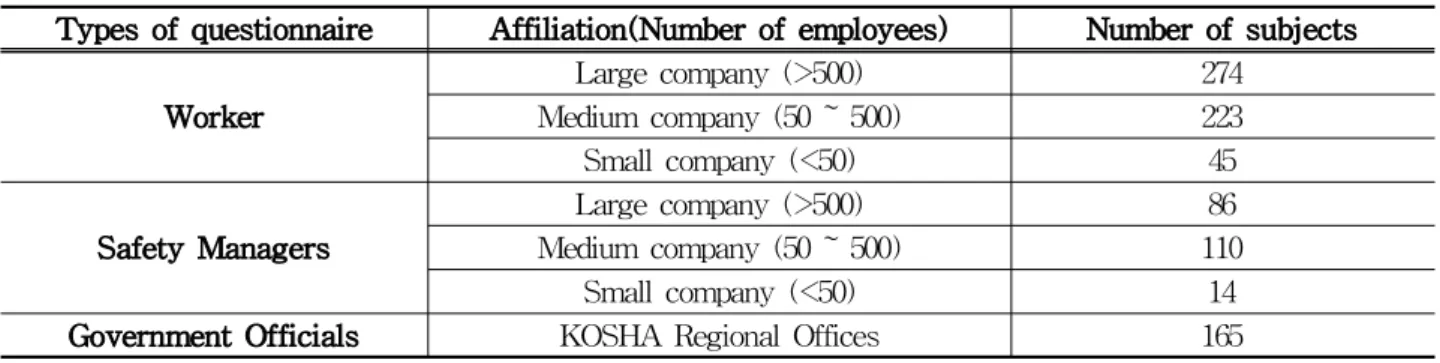
The quantitative analysis had a total of 917 subjects (workers: 542, safety managers: 210, government officials: 165)(Table 1). The numbers of worker subjects on the basis of company size were 211 (from large size company), 320 (from medium size company), 11 (from small size company). The criteria for company size were based on the total number of employees (>500: large, 50 ∼ 500: medium,
<50: small size company). There were 857 male and 60 female subjects. Their academic career ranged from elementary to college levels. The average age and work year were 35.6 years old and 9 years of work experience respectively.
Table 1. Number of subjects participated in this study
Types of questionnaire Affiliation(Number of employees) Number of subjects
Worker
Large company (>500) 274
Medium company (50 ~ 500) 223
Small company (<50) 45
Safety Managers
Large company (>500) 86
Medium company (50 ~ 500) 110
Small company (<50) 14
Government Officials KOSHA Regional Offices 165
The questionnaires based on major factors regarding the safety behavior identified during the FGI were developed in this study. The contents of the questionnaire for workers were personal characteristics (age, work experience, and marital status), self-efficacy beliefs (self-regulation, enlisting social support, and controlling the environment), behavioral characteristics (degree of safety enforcement, life satisfaction, psychological stress, and physiological stress), company characteristics (safety education, and preventional efficiency of industrial accidents), and number of industrial accidents (number of serious accidents, number of first aid type accidents, and relative incidence rates).
The contents for safety managers were personal characteristics (age, work experience, marital status, and number of safety education hours in charge), self-efficacy beliefs (safety education method, educational effects on workers, and educational effects on management people), behavioral characteristics (life satisfaction), company characteristics (safety mind of management people, safety education system, and preventional efficiency of industrial accidents), and evaluation of government policies (effects of deregulation). The contents for government officials were personal characteristics (age, work experience, position, and number of hours worked for occupational safety), self-efficacy beliefs (understanding of occupational safety, and administration of occupational safety), behavioral characteristics (life satisfaction), and evaluation of government policies (effects of deregulation).
Specifically, these questionnaires focused on the theory of Bandura (1997). Each questionnaire was designed to ask its own self-efficacy belief. First, there were three types of self-efficacy beliefs regarding occupational safety for the workers in this study. They were “self-regulation”, “enlisting social support”, and
“controlling the environment”. Second, self-efficacy beliefs for the safety managers consisted of beliefs regarding the implementation and the effectiveness of the educational programs. Third, self-efficacy beliefs for the government officials were “understanding of occupational safety” and “safety management”. The self-efficacy belief was measured by the five-point scales (from “not at all” to “very well”).
The questionnaire had several parts. The first part was personal information. There were age, work
experience for all participants, marital status for workers, position, number of hours in charge of safety education for safety managers, and position, work hours for safety administration for government officials. The second part was “life satisfaction” which had six questions. The question in this part had five point scales from “very unsatisfactory” to “very satisfactory” The third part was “safety mind” which had eight questions. They also had five-point scales from “not at all” to “very much so”. The fourth part was “stress” The question in this part was adopted from Cornell Medical Index (Cawte, 1972). The question in this part also had five point scales from
“not at all” to “very much so”. The rest part of the questionnaire had five point scales for the responses.
The questionnaire survey was conducted for three groups. The average time spent for the survey was 30 minutes. Specifically, survey for the workers was conducted during safety education class due to their strict working schedule in most cases.
3. Results
3.1 Reliability of the questionnaire
Table 2 summarized the questions for the self-efficacy beliefs and their coefficients of Cronbach alpha. They showed a reasonably good reliability in their questions.
The coefficients were 0.79 ~ 0.87 for the workers, 0.89 ~ 0.91 for the safety managers, and 0.88 for the government officials.
Specifically, coefficients for the questions regarding the safety mind were 0.57 for workers, 0.73 for the management people. The reliability coefficients for life satisfaction, psychological stress and physical stress were 0.79, 0.85, and 0.79, respectively.
3.2 Correlations between self-efficacy beliefs and other relevant variables
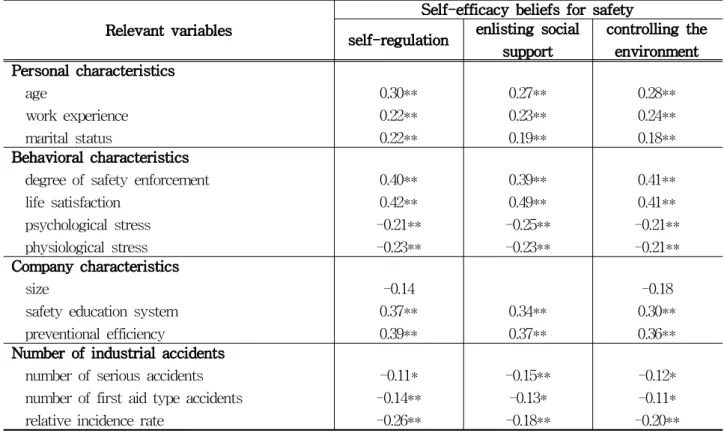
Table 3 summarized the correlations between self-efficacy beliefs for occupational safety and other variables.
The correlations between personal characteristics and self-efficacy beliefs for the workers were 0.27~0.30 for age, 0.22~0.24 for work experience and 0.18~ 0.22
Table 2. Reliabilities of the questions regarding the self-efficacy beliefs Types of questionnaire Major variables in terms of
self-efficacy beliefs
Reliabilities (Cronbach Alpha)
Workers self-regulation 0.79
enlisting social support 0.83
controlling the environment 0.87
Safety managers safety education method 0.91
educational effects on workers 0.88 educational effects on management people 0.89 Government officials understanding of occupational safety 0.88 administration of occupational safety 0.88
for marital status.
Specifically, married older workers with longer work experience had a higher self-efficacy belief regarding the safety. The correlation coefficients of behavioral characteristics of workers for self-efficacy beliefs were 0.39~0.41 for safety behavior, 0.41~0.49 for life satisfaction, -0.21~0.25 for psychological stress, and -0.21~0.23 for physical stress. It represented that workers with higher self-efficacy beliefs had better safety behavior and higher life satisfaction while they had lower psychological and physical stresses. The relationship between company characteristics and
self-efficacy beliefs for the workers also had positive correlations. The correlation coefficients were 0.30~
0.37 for safety education system and 0.36~0.39 for preventional efficiency of industrial accidents. The company with more systematic educational system and higher preventional efficiency of industrial accidents had the workers with higher self-efficacy beliefs for occupational safety. However, relationship between number of industrial accidents and self-efficacy beliefs for the workers had all negative correlations.
Table 3. Correlations between self-efficacy beliefs for safety and relevant variables (Workers)
Relevant variables
Self-efficacy beliefs for safety self-regulation enlisting social
support
controlling the environment Personal characteristics
age
work experience marital status
0.30**
0.22**
0.22**
0.27**
0.23**
0.19**
0.28**
0.24**
0.18**
Behavioral characteristics degree of safety enforcement life satisfaction
psychological stress physiological stress
0.40**
0.42**
-0.21**
-0.23**
0.39**
0.49**
-0.25**
-0.23**
0.41**
0.41**
-0.21**
-0.21**
Company characteristics size
safety education system preventional efficiency
-0.14 0.37**
0.39**
0.34**
0.37**
-0.18 0.30**
0.36**
Number of industrial accidents number of serious accidents number of first aid type accidents relative incidence rate
-0.11*
-0.14**
-0.26**
-0.15**
-0.13*
-0.18**
-0.12*
-0.11*
-0.20**
*: p<0.05, **: p<0.01
The correlation coefficients were -0.15~-0.11 for number of serious accidents, -0.14~-0.11 for number of first aid type accidents, and -0.26~-0.18 for relative incidence rate of industrial accidents. It represented that company with workers having higher self-efficacy beliefs had smaller number of industrial accidents. Finally, company size had negative correlations with self-efficacy belief regarding self-regulation and controlling the environment that were not significant.
Table 4 presented correlations between self- efficacy beliefs of safety managers and other relevant variables. Age and work experience had positive relationships with self-efficacy beliefs for the safety education method and the educational effects on workers (r=0.15~0.19). The number of hours for safety education in charge also had a correlation coefficient of 0.16 with the educational effects on management people.
However, position showed negative correlations with all types of self-efficacy beliefs of safety managers, (r=-0.14~-0.27). So, it could be concluded that older safety managers with longer experience had higher self-efficacy beliefs regarding the safety education method and the educational effects on workers. Also, safety managers in change of more hours of safety education had a higher self-efficacy belief regarding the educational effects on management people.
The life satisfaction as the behavioral characteristics had very positive correlations with self-efficacy beliefs (r=0.53~0.57). This represented that safety managers with higher self-efficacy beliefs regarding the safety education system and the educational effects had a higher life satisfaction. For the relationship with company characteristics, there were several significant correlations. Certain characteristics such as safety mind of management people (r=0.22~
0.24), safety education system (r=0.25~ 0.41), and preventional efficiency of industrial accidents (r=0.2 2~0.30) had strong positive correlations with the self-efficacy beliefs of safety managers. However, the number of serious accidents had negative correlations. Therefore, the company with safety managers having higher self-efficacy beliefs had management people with higher safety mind, more systematic safety education system and more effects
on preventional efficiency of industrial accidents. The company size had negative correlation with self- efficacy belief regarding self-regulation that was not significant. Finally for the self-efficacy beliefs of safety managers, safety managers with high self- efficacy beliefs said that deregulation regarding occupational safety and health had significant effects on incidence rate of industrial accidents.
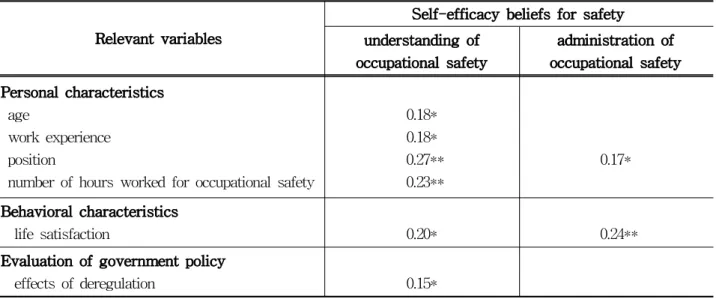
The correlations between self-efficacy beliefs of government officials and related variables were shown in table 5. All the variables in terms of personal characteristics had a positive relationship with the self-efficacy beliefs of government officials.
The correlations of self-efficacy beliefs with age, work experience, position, and number of hours worked for occupational safety were r=0.18, r=0.18, r=0.27, and r=0.23, respectively. Specifically, position had a correlation of 0.17 with the self-efficacy belief regarding the administration of occupational safety.
This represented that older and higher government officials with longer experience who usually had longer working hours for occupational safety had a higher self-efficacy belief regarding the understanding of occupational safety. Also, it could be concluded that government officials in higher position had a higher self-efficacy belief regarding the administration of occupational safety.
The life satisfaction had positive correlations (r=0.20~0.24) with various self-efficacy beliefs. So, it could be said that government officials with higher self-efficacy beliefs had a higher life satisfaction.
The effects of deregulation had a positive correlation (r=0.15) with the self-efficacy belief regarding the understanding of occupational safety.
The government officials with high self-efficacy belief regarding the understanding of occupational safety thought that deregulation by the government increased an industrial accident rate.
As shown in tables 4 and 5, safety managers and government officials showed different responses for the deregulation. The safety managers with high self-efficacy beliefs had a positive impression (negative correlations; deregulation decreased an accident rate) on the deregulation while the government officials had a negative impression on the deregulation (positive correlations; deregulation increased an accident rate).
However, general impression of both safety managers and government officials was negative (Table 6).
Specifically, government officials (85.8%) had a
more negative impression than that of safety managers (44.2%).
Table 4. Correlations between self-efficacy beliefs for safety and relevant variables (Safety Managers)
Relevant variables
Self-efficacy beliefs for safety
safety education method
educational effects on
workers
educational effects on management
people Personal characteristics
age
work experience position
number of hours for safety education in charge
0.16*
0.19**
-0.14*
0.15*
0.15*
-0.18**
0.24**
-0.27**
0.16*
Behavioral characteristics
life satisfaction 0.53** 0.55** 0.57**
Company characteristics size
safety mind of management people safety education system
preventional efficiency of industrial accidents number of serious accidents
0.24**
0.25**
0.22**
-0.30**
-0.17 0.21**
0.31**
0.29**
-0.27**
0.22**
0.41**
0.30**
-0.26**
Evaluation of government policy
effects of deregulation -0.20** -0.25** -0.31**
*: p<0.05, **: p<0.01
Table 5. Correlations between self-efficacy beliefs for safety and relevant variables (Government Officials)
Relevant variables
Self-efficacy beliefs for safety understanding of
occupational safety
administration of occupational safety Personal characteristics
age
work experience position
number of hours worked for occupational safety
0.18*
0.18*
0.27**
0.23**
0.17*
Behavioral characteristics
life satisfaction 0.20* 0.24**
Evaluation of government policy
effects of deregulation 0.15*
*: p<0.05, **: p<0.01
Table 6. Effects of deregulation on occupational safety based on frequency
Effects Safety manager Government official
decrease in industrial accident rate 42(20.5%) 13(7.7%)
no effects 72(35.3%) 11(6.5%)
increase in industrial accident rate 90(44.2%) 144(85.8%)
3.3 Factor analysis of self-efficacy beliefs and relevant variables
The factor analysis was conducted for each group (workers, safety managers, and government officials) with exploratory approach. Specifically, principal component analysis and varimax rotation were applied to obtain factor solutions. The criteria for the number of factors to be extracted were latent root criterion (eigenvalue greater than 1 was considered significant) and scree test. All the groups had two factors each by these criteria.
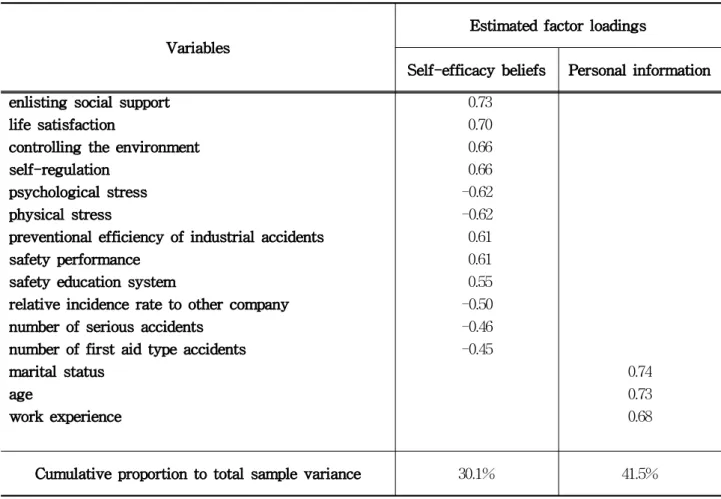
The results of factor analysis were summarized in tables 7 (workers), 8 (safety managers), and 9 (government officials). From the table 7, the first factor had very high factor loadings (0.66~0.73) with respect to the variables regarding the self-efficacy beliefs such as “enlisting social support”, “self-regulation”, and “controlling the environment”.
The first factor also had some variables such as
“life satisfaction”, “psychological stress”, “preventional efficiency of industrial accidents”, “safety performance”,
“safety education system”, “relative incidence rate to other company”, “number of serious accidents”, and
“number of first aid type accidents”. Specifically, variables regarding stresses and industrial accidents of the company had negative factor loadings. It represented that workers with higher self-efficacy beliefs had higher life-satisfaction, less stresses and better execution what they learned from the safety education. It also represented that company having the workers with higher self-efficacy belief had less accidents and better safety education. Therefore, the first factor could be named as “self-efficacy beliefs”
factor. The second factor (personal characteristics) consisted of marriage, age, and work experience.
These two factors explained 41.5% of variance (The percentages of variance for these two factors were 30.1% and 11.4%, respectively).
Table 8 summarized the results of factor analysis for self-efficacy beliefs of safety managers and other variables. The variables regarding the self-efficacy beliefs had high factor loadings (0.85~ 0.89) in the first factor. The other variables in this factor were
“life satisfaction”, “safety education system”, “effects of deregulation”, “preventional efficiency of safety education”, and “number of serious accidents”.
Specifically, “effects of deregulation” and “number of serious accidents” had negative factor loadings. It represented that safety managers with higher self-efficacy beliefs had higher life satisfaction and the company supervised by these managers had higher preventional efficiency and less serious accidents. Similar to the workers, the first and the second factors could be named as “self-efficacy beliefs” and “personal characteristics” respectively for the safety managers. These two factors explained 43.4% (28.2% by the first factor and 15.2% by the second factor) of variance.
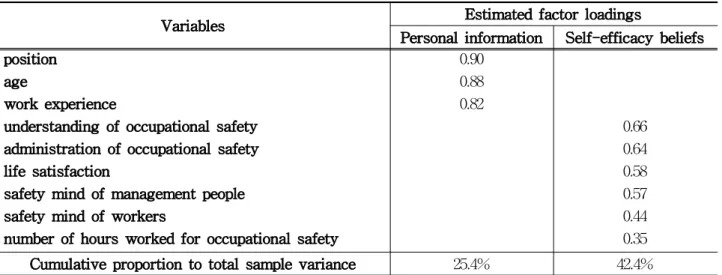
Table 9 showed the results of factor analysis for government officials. The first factor could be named as “personal characteristics” since position, age, work experience in this factor had relatively high factor loadings. The second factor consisted of self-efficacy beliefs (understanding and administration of occupational safety), safety mind of management people and workers, number of hours worked for occupational safety. All of these variables had positive factor loadings. It could be concluded that government officials with higher self-efficacy beliefs had higher life-satisfaction and better impression on the safety mind of management people and workers.
So it could be named as “self-efficacy beliefs”.
These two factors explained 42.4% (25.4% by the first factor and 17.0% by the second factor) of total variance.
Table 7. Factor analysis of self-efficacy beliefs and relevant variables (Workers)
Variables
Estimated factor loadings
Self-efficacy beliefs Personal information enlisting social support
life satisfaction
controlling the environment self-regulation
psychological stress physical stress
preventional efficiency of industrial accidents safety performance
safety education system
relative incidence rate to other company number of serious accidents
number of first aid type accidents marital status
age
work experience
0.73 0.70 0.66 0.66 -0.62 -0.62 0.61 0.61 0.55 -0.50 -0.46 -0.45
0.74 0.73 0.68
Cumulative proportion to total sample variance 30.1% 41.5%
Table 8. Factor analysis of self-efficacy beliefs and relevant variables (Safety managers)
Variables
Estimated factor loadings
Self-efficacy beliefs Personal information educational effects on management people
educational effects on workers safety education method life satisfaction
safety education system effects of deregulation
preventional efficiency of safety education number of serious accidents
work experience age
position
number of first aid type accidents
0.89 0.89 0.85 0.77 0.56 -0.50 0.45 -0.45
0.85 0.82 0.74 0.47
Cumulative proportion to total sample variance 28.2% 43.4%
Table 9. Factor analysis of self-efficacy beliefs and relevant variables (Government officials)
Variables Estimated factor loadings
Personal information Self-efficacy beliefs position
age
work experience
understanding of occupational safety administration of occupational safety life satisfaction
safety mind of management people safety mind of workers
number of hours worked for occupational safety
0.90 0.88 0.82
0.66 0.64 0.58 0.57 0.44 0.35
Cumulative proportion to total sample variance 25.4% 42.4%
4. Discussions & Conclusions
The self-efficacy beliefs of workers and safety managers were closely associated with industrial accidents on the basis of the results of the statistical analysis. The workers with higher self-efficacy beliefs regarding “self-regulation”, “enlisting social support”, and “controlling the environment” executed better what they had learned from the safety education. The company having workers with higher self-efficacy beliefs also had less industrial accidents.
Similarly, the company having safety managers with higher self-efficacy beliefs had more systematic safety education, more preventional efficiency, and less serious accidents. It represented that self- efficacy beliefs of workers and safety managers were associated with safety behavior and incidence rate of industrial accidents. It supported the results by Bandura(1997) that described the relationship between self-efficacy beliefs of individual and their behavior. This might also be related to the results (Stresser et al. 1981; Heinrich, 1980) that explained the relationship between industrial accidents and personal characteristics.
The FGI results in this study also showed the effects of self-efficacy beliefs on industrial accidents.
Actually, all the major causes for industrial accidents identified from the FGI had to do with the self-efficacy beliefs. They were safety mind, no usage or misusage of safety devices by workers, and
poor management skills of safety managers.
Therefore, it could be concluded that self-efficacy beliefs were closely associated with industrial accidents from the results based on qualitative and quantitative analysis of this study. In this respect, certain program improving self-efficacy beliefs should be developed to reduce the number of industrial accidents. Also, this safety education program would have improving productivity as well as reducing industrial accidents.
In order to develop an efficient program, we could refer to the FGI results of this study. This suggested specialized on-site education, efficient and various education, prompt report for industrial accidents, comprehensive safety management, practice oriented safety education, case studies, good human relationship between instructor and students in the safety education, and interests inducing contents in the safety education. These could be the starting point to develop the program.
This study had its own significance in the respect that it applied the concept of self-efficacy beliefs to the field of occupational safety and developed a tool to measure them. Specifically, FGI was conducted to provide a framework of self-efficacy beliefs. The qualitative analysis on the FGI results has been very useful to evaluate intrinsic concepts in safety culture of Korean industrial society. As Morgan(1993) pointed out, FGI was very useful to understand very complicated human behavior, and group effect from
FGI. It usually provided invaluable information that couldn’t be obtained from personal interview.
Actually, questionnaire regarding the self-efficacy beliefs based on the FGI results showed relatively high reliabilities. The questionnaire would be continuously revised on the basis of its cumulative results.
During the FGI, characteristics of safety managers, management people as well as workers were necessary to be evaluated as crucial factors of worker’s safety behavior. So, self-efficacy beliefs of these groups were analyzed in this study. It was also very unique in that it tried to have a comprehensive understanding for safety behavior in industry.
In this study, safety managers and government officials both with high self-efficacy beliefs had different impression on deregulation of safety law.
The main purpose of the deregulation was to enhance self-control and effectiveness of safety management. However, both safety managers and government officials had negative responses for the deregulation. In fact, they thought that deregulation increased the number of industrial accidents.
Specifically, government officials had more negative responses. However, safety managers with high self-efficacy beliefs showed somewhat contrary response. They thought that deregulation didn’t have to do with the changes in terms of the number of industrial accidents reported after deregulation.
Finally, main results of the study can be summarized as follows;
1) In the preliminary analysis, all the major causes for industrial accidents identified from the FGI had to do with the self-efficacy beliefs. They were safety mind, no usage or misusage of safety devices by workers, and poor management skills of safety managers.
2) The results of the main analysis indicated that the three subscales of self-efficacy beliefs for workers (self-regulation, enlisting social support, and controlling the environment) were negatively correlated with the company’s incidence rate of industrial accidents. Moreover, those workers with higher self-efficacy beliefs were more likely to follow safety procedures and had higher life-satisfaction and lower stress levels.
3) For safety managers, the self-efficacy beliefs were
positively correlated with better implementation and higher effectiveness of the educational programs and negatively correlated with their company’s accident rates.
4) All the variables in terms of personal characteristics such as age, work experience, position, and number of hours worked had a positive relationship with the self-efficacy beliefs of government officials. This represented that older and higher government officials with longer experience who usually had longer working hours for occupational safety had a higher self-efficacy belief regarding the understanding of occupational safety. Also, it could be concluded that government officials in higher position had a higher self-efficacy belief regarding the administration of occupational safety.
5) As the future study based on the results of this study can be suggested to enhance occupational safety as follows;
- Repeat the same study for more various types of industries
- Try to obtain more stable results regarding the relationship between occupational safety and self-efficacy belief
- Develop safety education program based on the relationship between occupational safety and self-efficacy belief for each types of industries
5. References
[1] Ahn, G..D., Hwang, J.G.., Kim, U., and Park, Y.S.,
“Cultural, psychological, and sociological factors of Korean youth, Research Monthly”, The Academy of Korean Studies (In Korean), 97(8) (1997).
[2] Andriessen, J.H., “Safe behavior and safety motivation.
Journal of Occupational Accident”, 1 (1978) : 363-376.
[3] Bandura, A, "Social foundations of thought and action:
A social theory", Englewood Cliff, NJ:Prentice- Hall, (1986).
[4] Bandura, A, "Self-efficacy: The exercise of control", New York: W.H. Freeman and Company, (1997).
[5] Cawte, J, "Cruel, poor and brutal nations", Honolulu:
University of Hawaii Press, (1972).
[6] Heinrich, H.W., Petersen, D., and Roos, N., "Industrial accident prevention. 5th ed.", New York:
McGraw-Hill, (1980).
[7] Hofmann, D.A. and Stetzer, A., "A cross-level investigation of factors influencing unsafe behaviors and accidents". Personnel Psychology, 49 (1996) : 307-339.
[8] Hofmann, D.A., Jacobs, R. and Landy, F.L., "High reliability process industries: Individual, micro, and macro organizational influences on safety performance", Journal of Safety Research, 26 (1995) : 131-149.
[9] Kim, U. and Berry, J.W., "Indigenous Psychologies:
Research and experience in cultural context", Newbury Park, CA: Sage Publication (1996).
[10] KOSHA, http://www.kosha.or.kr/bridge/menuId=553.
(1995).
[11] Krueger, R.A., "Focus groups: A practical guide for applied research", Newbury Park, CA: Sage Publication, (1994).
[12] MOL 2009. http://www.molab.go.kr/view.jsp/cate=
3&sec=2&smenu=2#axzz0lsoLZsxG. (2009).
[13] Lee, K.H., Choi, S.W., Park, D., Park, Y.S., and Kim, U., "Study on educational effects for industrial accidents", KOSHA (Korea Occupational Safety & Health Agency) (In Korean), (1997).
[14] Morgan, D.L. and Krueger, R.A., "When to use focus groups and why", Thousand Oaks, CA: Sage.
Publications, (1993).
[15] Park, D. and Lee, H.B., "Safety guidelines for mechanical injuries based on AHP", KOSHA (Korea Occupational Safety & Health Agency) (In Korean), (1986) [16] Salminen, S. and Tallberg, T., "Human errors in
fatal and serious occupational accidents in Finland", Ergonomics, 39(7) (1996) : 980-988.
[17] Simard, M., "Workgroups' propensity to comply with safety rules: The influence of micro-macro organizational factors", Ergonomics, 40(2) (1997) : 172-188.
[18] Stresser, M.K., Aron, J.E., and Bohn, R.C., "Fundamentals of safety education", New York: MacMillan, (1981).
[19] Wright, A., "Routine deaths: Fatal accidents in the oil industry", Sociological Review, 4 (1986) : 265-289.
저 자 소 개
박 동 현
인하대학교에서 학사를 취득하였 으며, 미국 University of Alabama 에서는 석사와 미국 Pennsylvania State University에서는 박사를 취 득하였다. 현재 인하대학교 산업공 학과에서 교수로 재직 중이며, 관 심분야는 인간공학이다.
주소: 인천광역시 남구 용현4동 인하대학교 산업공학과
임 수 정
현재 인하대학교 대학원 산업공 학과 재학 중
관심분야: 산업공학
주소: 인천광역시 남구 용현동 253 인하대학교 2북 668A
최 순 영
고려대학교 대학원 보건학 석사, 인하대학교 산업공학과 박사 취 득. 현재 인하대학교 의학과 박 사과정, 관심분야: 산업보건, 인 간공학
주소: 인천광역시 남구 용현동 4동 인하대학교 2북 668A