pISSN 1738-6640 eISSN 2234-4020 http://dx.doi.org/10.6114/jkood.2015.28.3.114
Case Report / 증례
한약과 압출 치료에 병행한 황련해독탕 약침의 여드름 치료 22례 임상 보고
김혜윤1)·홍석훈2)·박인해2)·신선호3)·권영미4) 1) 전주 피브로한의원
2) 원광대학교 한의과대학 안비인후피부과학 교실 3) 원광대학교 한의과대학 내과학 교실 4) 원광대학교 한의과대학 진단방사선과학 교실
Twenty-two Case of Acne Treated by Hwangryunhaedok-tang Pharmacopuncture Therapy Combined with Herbal Medicine and Extrusion
Hye-Yoon Kim
1)·Seok-Hoon Hong
2)·In-Hae Park
2)·Sun-Ho Shin
3)·Young-Mi Kwon
4)1) Jeonju Pibro Korean Medicine Clinic
2) Department of Ophthalmology, Otolaryngology and Dermatology of Korean Medicine, College of Korean Medicine, Won-kwang University
3) Department of Internal Medicine of Korean Medicine, College of Korean Medicine, Won-kwang University 4) Department of Diagnostic Radiology, College of Korean Medicine, Won-kwang University
Abstract
Objectives : The objective of this study was to evaluate the effect of Herbal medicine, extrusion and Hwangryunhaedok-tang Pharmacopuncture therapy for treating Sil-Yol(Excess heat) type acne.
Methods : Total of 22 patients with Sil-Yol(Excess heat) type acne were treated with the Herbal medicine(Chungsangbangpoong-tang, Yangkyuksanwha-tang, Hwalhyeolsano-tang, Galgeunhaegi-tang, Daeshiho- tang) and weekly Hwangryunhaedok-tang Pharmacopuncture & extrusion therpay. By the standardized photography before and after treatment, KASG and survey for patient`s satisfaction, we checked effect of Herbal medicine and Hwangryunhaedok-tang Pharmacopuncture therapy for treating acne.
ⓒ 2015 the Society of Korean Medicine Ophthalmology & Otolaryngology & Dermatology
This is an Open Access journal distributed under the terms of the Creative Commons Attribution Non-Commercial License (http://creativecommons.org/license/by-nc/3.0/) which permits unrestricted non-commercial use, distribution, and reproduction in any medium, provided the original work is properly cited.
Ⅰ. 서 론
여드름은 털피지샘단위(pilosebaceous unit)의 만성 염증질환으로 면포, 구진, 고름물집, 결절, 거짓낭 등 의 다양한 병변이 피지 분비가 많은 부위인 얼굴이나 목, 등, 어깨, 가슴에 호발한다1). 여드름의 형태는 심 상성 여드름, 화농성 여드름, 응괴성 여드름, 켈로이 드성 여드름, 전격성 여드름, 신생아 여드름, 월경 전 여드름, 스테로이드성 여드름이 있으며2), 심상성 여드 름이 가장 흔한 형태의 여드름으로서 일반적인 여드 름을 지칭한다3).
2005년 미국의 통계에 따르면 보통 여드름(심상성 여드름, acne vulgaris)은 피부과 내원 환자의 약 11.3%에 해당하는 가장 흔한 질환이다4). 여드름 중에 서도 특히 안면부에 발생하는 여드름은 환자에게 부 정적인 정신사회적 영향을 미쳐 삶의 질을 저하시킬 수 있다.
현대 의학에서 여드름의 치료는 다양한 방식으로 이루어지고 있다. 국소 치료제는 국소항생제, 국소 레 티노이드제 등이 있으며 등이 있으며 전신적인 치료 약제에는 경구용 isotretinoin과 minocycline 등의 항 생제 및 estrogen, glucocorticoids 등의 호르몬제가 있다5). 그 외 여드름 압출법, 피부 박피술(필링), 광선 치료, 광역동 치료 등이 여드름 치료를 위해 사용된다3).
한의학 문헌에서 여드름은 痤瘡, 面疱, 肺風粉刺 등 의 다양한 명칭으로 나타나며6), 병인병기적 측면에서 肺熱血熱型, 脾胃濕熱型, 熱毒熾盛型, 血瘀痰凝型, 陰 虛血熱型, 衝任不調型으로 크게 변증할 수 있다7). 여 드름 치료에 관한 국내 한의학계의 선행 연구 중 임 상 논문으로는 淸上防風湯8-10), 補中益氣湯11), 黃連解 毒湯12), 六味地黃湯13) 등의 내복약과 面疱散14), 古方 및 舍岩鍼15), 苦蔘 추출물을 함유한 화장수16), 자동미 세침17), 樺皮 추출물 복합제 화장품18) 등을 활용한 외 치요법의 효과를 보고한 연구가 있다. 실험 논문으로 는 淸上防風湯19), 升麻胃風湯20), 魚腥草21), 玄胡索22), 顚倒散23), 枇杷淸肺飮24), 如意金黃散25), 連翹敗毒散26), 硫黃27) 등을 이용한 연구가 있다. 이처럼 내복약, 외 용제, 침술 등 다양한 한의학적 방식을 시도한 여드름 치료 연구가 보고되었으나 아직 약침 요법을 응용한 여드름 치료 연구는 없었다.
최28)와 이29)의 임상 보고에 따르면 여드름을 주소 로 내원한 환자 중 70% 이상이 實熱型에 속하였다고 하였으며, 기존 여드름의 한의학 치료와 관련한 연구 도 대부분 實熱型 여드름에 사용되는 단미재 및 복합 처방과 관련되어 있다. 이에 저자는 여드름 치료에서 상당수를 차지하는 實熱型 여드름 환자에게 淸熱燥濕, 淸心除煩, 瀉火解毒 작용을 하며, 항염 효과를 가지는 황련해독탕 약침을 한약 치료 및 압출 치료와 병행하 여 적용 후 유의한 효과를 얻었기에 이를 보고하는 바이다.
Results : 1. In 22 patients who underwent the Herbal medicine, extrusion and Hwangryunhaedok-tang Pharmacopuncture therapy, there was an significant improvement in KASG. Mean value of KAGS before treatment is 3.59±0.80, mean value of KAGS after treatment is 1.95±65.
2. The responses to the survey for satisfaction revealed that 5 patients were very satisfied with their outcomes, 11 patients were satisfied, 5 patients were somewhat satisfied, 1 patient was dissatisfied.
Conclusion : In Korean medicine, Herbal medicine and Hwangryunhaedok-tang Pharmacopuncture therpay might be effective method for treating Sil-Yol(Excess heat) type acne.
Key words : Acne; Pharmacopuncture; Hwangryunhaedok-tang
Corresponding author : Kim Hye-yoon, Jeonju Pibro Korean Medicine Clinic, Ongoeulro 22, Jeonju city, Jeonbuk, South Korea.
(Tel : 063-276-7510, E-mail : [email protected])
∙
Recieved 2015/7/4∙
Revised 2015/8/2∙
Accepted 2015/8/9Ⅱ. 대상 및 방법
1. 대상
2013년 1월부터 2013년 12월까지 전주 피브로 한 의원에 여드름을 주소로 내원한 환자 중 다음의 조건 을 만족하는 22명의 환자를 대상으로 진료 기록을 후 향적 검토하였다.
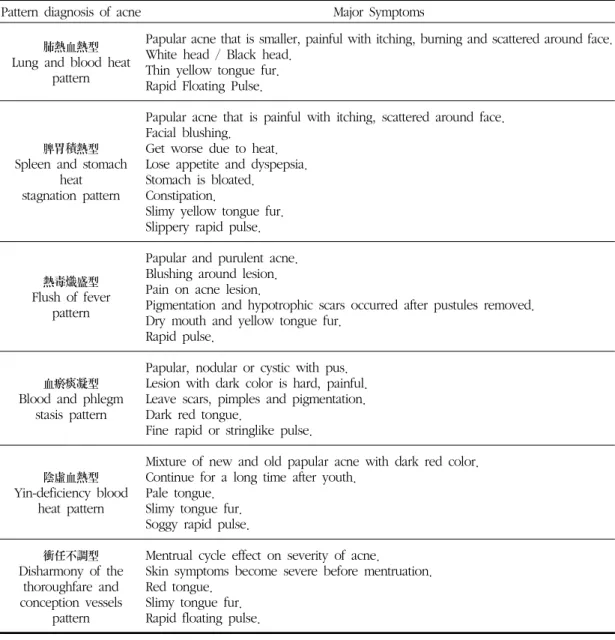
1) 내원한 환자의 여드름의 형태, 발병일, 현병력, 유 발요인, 호발 부위 및 소화, 대소변 상태, 맥진 등 望聞問切 후 《韓醫皮膚外科學》에 기재된 여드름 변증 분류7)(Table 1)에 따라 변증한 결과 實熱型 (肺熱血熱, 脾胃績熱, 熱毒熾盛)으로 분류되는 여드 름 환자
2) 치료 종결까지 주 1회 간격으로 꾸준히 내원한 환자 3) 본 임상 관찰의 의의와 절차에 대해 설명하여 충분 히 인지하고 임상 자료 사용 동의서를 작성한 환자 4) 여드름 외 질환으로 한약 혹은 양약을 복용 중이거
나 기타 치료를 받았던 환자를 제외하였다.
2. 치료 방법 1) 약물 치료
진찰 결과에 따라 淸上防風湯, 凉隔散火湯, 活血散 瘀湯, 葛根解肌湯, 大柴胡湯을 처방하였다. 모든 탕약 은 20첩을 120㏄씩 30포씩 전탕하였고, 치료 기간 동 안 매일 1일 3회, 1회 1포씩, 식후 1시간에 복용할 수 있도록 열흘 단위로 처방하였다. 각 처방의 약물 구성 은 아래와 같으며, 1첩 분량을 기준으로 기재하였다.
淸上防風湯, : 防風 4g, 白芷, 連翹, 桔梗, 黃芩, 川芎 3g, 荊芥, 梔子, 黃蓮, 枳殼, 薄荷 2g, 甘草 1g.
凉隔散火湯, : 生地黃, 忍冬藤, 連翹 8g, 梔子, 薄荷, 知母, 石膏, 荊芥, 防風 4g.
活血散瘀湯 : 大黃, 桃仁, 當歸尾, 赤芍藥 8g, 川芎, 蘇 木 6g, 牧丹皮, 瓜蔞仁, 枳殼 4g, 檳榔2g.
葛根解肌湯 : 葛根, 柴胡, 黃芩, 赤芍藥, 羌活, 石膏, 升麻, 白芷, 桔梗 4g, 甘草 2g, 生薑 6g, 大棗 4g.
大柴胡湯 : 柴胡 16g, 白芍藥, 黃芩 10g, 大黃 8g, 枳 實 6g, 半夏 4g, 生薑 6g, 大棗 4g.
2) 압출 및 약침 치료
안면 전체를 보릭 솜으로 닦은 후, 23G needle과 여드름 압출기를 사용하여 면포와 고름을 제거하였다.
이후 황련해독탕 약침 1㏄를 26G needle에 1㏄ 담은 후 여드름이 집중된 부위에 한 부위 당 0.1㏄ 정도씩 천자하여 나누어 주입하였다. 시술 후 스피루리나 모 델링(세라덤(주))을 안면부 전체에 도포하여 피부를 진정시켰다. 주 1회 내원하게 하여 상기 시술을 시행 하였다.
3. 평가 방법
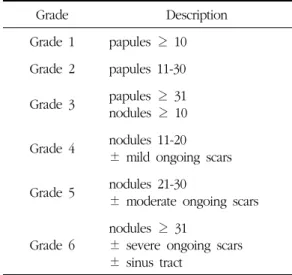
1) 임상 사진 및 KAGS를 통한 치료 효과 평가 치료 전후 촬영한 임상 사진 및 환자의 상태를 근 거로 하여 동일한 한의사 한 명이 한국형 여드름 중 증도 시스템(Korean Acne Grading System)28)에 따 라 평가하였다(Table 2).
2) 환자 만족도 평가
치료 후 환자들에게 설문지를 통하여 치료 효과에 대해 매우 만족, 만족, 보통, 불만족, 매우 불만족의 다섯 문항으로 주관적인 평가를 하게 하였다.
4. 통계 분석
시술 후 호전 유무를 확인하기 위해 SPSS Statistics 21.0을 이용하여 조사 결과를 통계 처리하 였다. Paired-samples t-test를 통해 치료 효과의 유의 성을 검정하였다. 통계 분석을 위한 유의 수준은 p-value<0.05에서 검정하였고 측정값은 평균값±표준 편차로 나타내었다.
Ⅲ. 결 과
1. 성별 및 연령별 분포
여드름 치료를 받은 총 22명의 환자 중 남성이 2 명, 여성이 22명이었다. 연령별 분포는 10-19세 11명, 20-29세 9명, 30-39세 2명으로 평균 연령은 21.45±
5.61세였다(Table 3).
Pattern diagnosis of acne Major Symptoms
肺熱血熱型 Lung and blood heat
pattern
Papular acne that is smaller, painful with itching, burning and scattered around face.
White head / Black head.
Thin yellow tongue fur.
Rapid Floating Pulse.
脾胃積熱型 Spleen and stomach
heat stagnation pattern
Papular acne that is painful with itching, scattered around face.
Facial blushing.
Get worse due to heat.
Lose appetite and dyspepsia.
Stomach is bloated.
Constipation.
Slimy yellow tongue fur.
Slippery rapid pulse.
熱毒熾盛型 Flush of fever
pattern
Papular and purulent acne.
Blushing around lesion.
Pain on acne lesion.
Pigmentation and hypotrophic scars occurred after pustules removed.
Dry mouth and yellow tongue fur.
Rapid pulse.
血瘀痰凝型 Blood and phlegm
stasis pattern
Papular, nodular or cystic with pus.
Lesion with dark color is hard, painful.
Leave scars, pimples and pigmentation.
Dark red tongue.
Fine rapid or stringlike pulse.
陰虛血熱型 Yin-deficiency blood
heat pattern
Mixture of new and old papular acne with dark red color.
Continue for a long time after youth.
Pale tongue.
Slimy tongue fur.
Soggy rapid pulse.
衝任不調型 Disharmony of the
thoroughfare and conception vessels
pattern
Mentrual cycle effect on severity of acne.
Skin symptoms become severe before mentruation.
Red tongue.
Slimy tongue fur.
Rapid floating pulse.
Table 1. Major Symptoms of Acne Following Each Pattern
2. 처방 분류
望聞問切한 변증 결과에 따라 치료 기간 동안 투약 되는 탕약 처방을 달리하였는데, 淸上防風湯 10명, 凉 隔散火湯 4명, 活血散瘀湯 4명, 葛根解肌湯 2명, 大柴 胡湯 2명 순으로 처방되었다.
Table 2. Korean Acne Grading System
Grade Description
Grade 1 papules ≥ 10 Grade 2 papules 11-30 Grade 3 papules ≥ 31 nodules ≥ 10 Grade 4 nodules 11-20
± mild ongoing scars Grade 5 nodules 21-30
± moderate ongoing scars
Grade 6
nodules ≥ 31
± severe ongoing scars
± sinus tract
Table 3. Sex and Age Distribution
Age / Sex Male Female Total
10-19 years old 0 11 11
20-29 1 8 9
30-39 1 1 2
Total 2 20 22
Table 4. Treatment Period
Period(weeks) Case
1-5 1
6-10 9
11-15 10
16-20 2
Total 22
3. 치료 기간
치료 시작부터 종결까지 기간을 관찰한 바 최단 5 주에서 최장 19주까지 분포하였다. 평균 치료 기간은 10.86±3.59주였다(Table 4).
4. 치료 효과
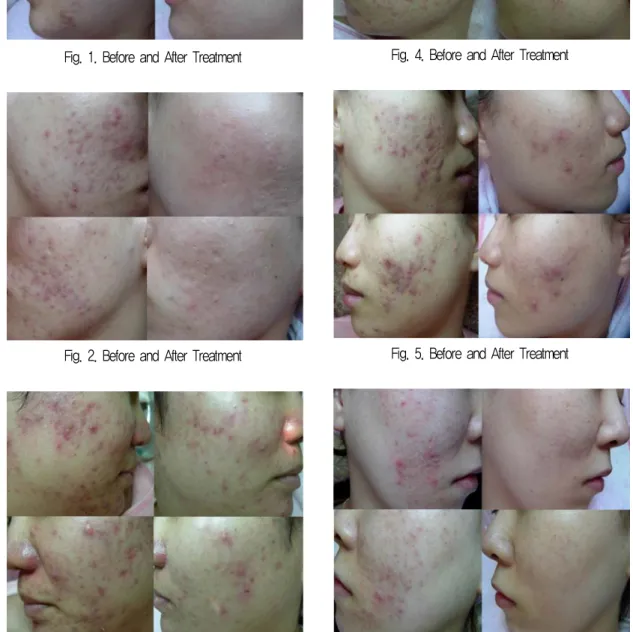
1) 임상 사진 및 KAGS를 통한 치료 효과 평가 임상 사진과 환자의 상태를 근거로 동일한 한의사 한 명이 평가한 KAGS 등급을 치료 전후 비교하였을 때 총 22명의 환자 모두 등급의 개선을 보였다. 치료 전 평균 KAGS 등급은 3.59±0.80였고 치료 후 평균 KAGS 등급은 1.95±65로 유의한 호전을 보였다 (p<0.001)(Table 5, Fig. 1-8).
성별에 따른 평균 KAGS 등급은 남성이 치료 전 4.0±0.0에서 치료 후 2.0±0.0으로 여성이 치료 전 3.55±0.83에서 치료 후 1.95±0.69로 감소하여, 모든 성별에서 유의한 감소를 보였다(p<0.001).
연령에 따른 평균 KAGS 등급은 10-19세 환자군이 치료 전 3.64±0.67에서 치료 후 2.09±0.79로 20-29 세 환자군이 치료 전 3.44±1.01에서 치료 후 1.78±
0.67로 30-30세 환자군이 치료 전 4.0±0.0에서 치료 후 2.0±0.0으로 감소하여, 모든 연령대에서 유의한 감소를 보였다(p<0.001).
치료 기간에 따른 평균 KAGS 등급은 1-5주 치료 환자군이 치료 전 4.0±0.0에서 치료 후 2.0±0.0으로 6-10주 치료 환자군이 치료 전 3.44±1.01에서 치료 후 2.1±0.57로 11-15주 치료 환자군이 치료 전 3.6±0.70에서 치료 후 2.1±0.57로 16-20주 치료 환 자군이 치료 전 4.0±0.0에서 치료 후 2.5±0.70으로 감소하여, 모든 치료 기간에서 유의한 감소를 보였다 (p<0.001)(Table 6).
2) 환자 만족도 평가
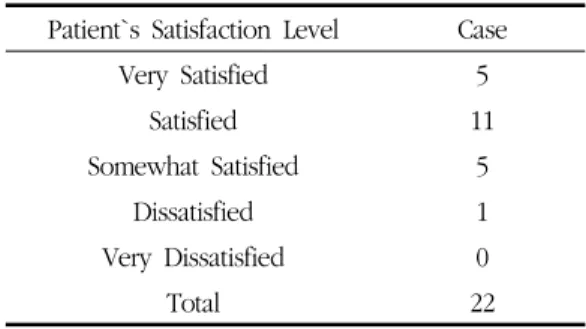
치료 종료 후 환자들에게 치료 효과에 대한 만족도 를 평가하도록 설문을 진행하였다. 총 22명 중 매우 만족 5명, 만족 11명, 보통 5명, 불만족 1명, 매우 불 만족 0명으로 각각 답하였다(Table 7).
Fig. 1. Before and After Treatment
Fig. 2. Before and After Treatment
Fig. 3. Before and After Treatment
Fig. 4. Before and After Treatment
Fig. 5. Before and After Treatment
Fig. 6. Before and After Treatment
Table 5. Change of KAGS Before and After Treatment
Name Sex Age Treatment period
(weeks)
KAGS
before treatment after treatment
K○○ F 18 6 3 1
K○○ M 36 12 4 2
K○○ F 20 6 5 2
K○○ F 31 11 4 2
K○○ F 26 9 3 2
K○○ F 16 10 3 2
K○○ F 25 18 4 3
K○○ F 21 11 2 1
K○○ F 17 14 4 2
P○○ F 19 11 3 2
A○○ F 19 5 4 2
O○○ F 17 11 4 2
O○○ F 19 9 5 3
Y○○ F 17 13 4 3
L○○ F 14 15 3 2
L○○ M 28 19 4 2
J○○ F 21 6 4 1
J○○ F 29 10 2 1
C○○ F 18 12 4 3
C○○ F 16 10 3 1
H○○ F 24 9 3 2
H○○ F 21 12 4 2
Mean Value 10.86±3.59 3.59±0.80 1.95±65
Mean value of KAGS
Before treatment After treatment
Sex Male 4.0±0.0 2.0±0.0
Female 3.55±0.83 1.95±0.69
Age (years old)
10-19 3.64±0.67 2.09±0.79
20-29 3.44±1.01 1.78±0.67
30-39 4.0±0.0 2.0±0.0
Treatment period (weeks)
1-5 4.0±0.0 2.0±0.0
6-10 3.44±1.01 2.1±0.57
11-15 3.6±0.70 2.1±0.57
16-20 4.0±0.0 2.5±0.70
Table 6. Mean Value of KAGS along to Sex, Age, Treatment Period
Table 7. Patient`s Satisfaction of Treatment Effect
Patient`s Satisfaction Level Case
Very Satisfied 5
Satisfied 11
Somewhat Satisfied 5
Dissatisfied 1
Very Dissatisfied 0
Total 22
Ⅳ. 고찰 및 결론
여드름은 털피지샘단위(pilosebaceous unit)의 만성 염증질환으로 면포, 구진, 농포, 결절 및 낭을 형성하 는 것을 특징으로 한다. 병인론적 측면에서 여드름은 모낭 벽의 이상각화, 호르몬의 변화와 피지분비의 증 가 및 Propionibacterium acnes 등의 여러 요인이 작 용하여 발생하는 것으로 알려져 있다31).
현대의학의 여드름 치료는 피지분비 조절, 털집과 다각질화 교정, P. acnes의 집락 수 감소와 염증 반응 억제를 기본 원칙으로 하며, 크게 국소 치료에 반응이 없는 여드름과 흉터를 남길 정도의 중증, 고증의 여드 름은 경구 치료제 투여에 의한 전신 치료가 이루어져 야 한다3). 국소 요법으로는 약용 비누, 각질용해제, Benzoyl peroxide, Retinoic anid, 국소 도포용 항생 제, 압출요법, 부신피질 호르몬의 병변 내 주사가 있 으며, 전신 요법으로는 항생제, 레티노이드, 호르몬제, Zinc sulfate 등이 사용된다32). 그 외 피부 박피술, 광 치료, 레이저 치료, 고주파 치료기, 냉동치료, 전기소 작술, 전기열분해술 등의 외과적 시술법도 여드름 치 료에 응용되고 있다.
한의학적인 관점에서 여드름은 痤瘡, 面疱, 肺風粉 刺 등이 현대적인 의미의 여드름과 가장 유사하다. 여 드름의 병인병기는 다양한 한의학 문헌에 기재되어 있는데, 정 등33)의 보고에서 여드름과 관련한 17편의 국내외 한의학 논문을 분석한 결과 크게 風熱型, 濕熱
型, 痰瘀型, 衝任不調型의 4가지 변증 유형으로 분류 한 바 있다. 여드름을 주소로 내원한 환자의 변증 분 류를 보고한 연구 중 최28)는 31명 중 약 71%인 22명 의 환자가 實熱型(肺熱血熱, 腸胃濕熱)에 해당하였다 고 보고한 바 있으며, 이29)는 54명 중 약 72.2%인 39 명의 환자가 實熱型((肺經風熱, 脾胃濕熱)에 속하였다 고 보고하였다.
여드름 치료에 관한 국내 한의학계의 임상 논문으 로는 淸上防風湯8-10), 補中益氣湯11), 黃連解毒湯12), 六 味地黃湯13) 등의 내복약과 面疱散14), 古方 및 舍岩鍼
15), 苦蔘 추출물을 함유한 화장수16), 자동미세침17), 樺 皮 추출물 복합제 화장품18) 등을 활용한 외치요법의 효과를 보고한 연구가 있다. 실험 논문으로는 淸上防 風湯19), 升麻胃風湯20), 魚腥草21), 玄胡索22), 顚倒散23), 枇杷淸肺飮24), 如意金黃散25), 連翹敗毒散26), 硫黃27) 등 을 이용한 연구가 있다. 상기 연구에 사용된 단미재와 처방 중 補中益氣湯, 六味地黃湯을 제외한 약물은 대 개 실증의 여드름에 적용 가능한 것이다. 이처럼 여드 름 환자 중 風熱, 血熱, 濕熱 등의 實熱型의 여드름 환자가 많은 수를 차지할 것으로 생각되며, 대부분의 한의학적 여드름 치료 연구도 實熱型 여드름에 집중 되어 있다.
황련해독탕은 《肘後備急方》34)에 처음 언급되었으 며, 淸火濕熱, 瀉火解毒의 대표적인 처방으로 황금, 황련, 황백, 치자로 구성되어 있다. 황금이 上焦의 肺 火를 瀉하고 황련이 中焦의 脾火를 瀉하며 황백이 下 焦의 腎火를 瀉하고 치자가 三焦의 火를 瀉하여 소변 으로 出하게 한다12). 이와 같은 작용을 통해 일체의 實熱火毒으로 인한 병증에 사용될 수 있다. 또한 현대 의학적인 관점에서 황련해독탕은 TNF-α, PGE2, IL-1β, IL-6 등 전염증성 사이토카인 생성을 억제시 킴으로써 항염 작용을 가지며35-39), 혈청 IgE 농도를 낮추어 항알레르기40-43) 작용을 하여 다양한 임상 분 야에 응용되고 있다.
황련해독탕 약침은 경락학설의 원리에 의해 황련해 독탕 구성약물을 달여서 나온 증류액을 모아 냉각시
킨 후 여과과정과 pH 조절과정 등을 거쳐 고압멸균 뒤 사용하는데, 유관한 혈위, 압통점 혹은 체표의 촉 진으로 얻어진 양성 반응점에 주입하여 자침과 약물 작용을 통하여 생체의 기능을 조정하고 병리상태를 개선시키는 데 사용한다44). 황련해독탕 약침을 응용한 연구 중 전염증성 사이토카인 생성 및 히스타민 방출 억제 작용과 혈중 IgE 농도의 강하 작용을 통한 한포 진45), 아토피 피부염46), 장미색 비강진47), 대상포진48) 지루성 피부염49) 등의 피부 질환 관련 연구가 다수 있 으나, 흔한 피부 질환 중 하나인 여드름에 적용된 예 는 보고된 바가 없었다. 이에 저자는 여드름이 발생한 부위에 황련해독탕 약침액을 주입하여 직접적인 항염 작용을 유도하는 동시에 한의학적 관점에서 實熱火毒 으로 변증 분류되는 여드름에 淸火濕熱, 瀉火解毒의 치료 효과를 확인하고자 하였다.
본 연구에서는 2013년 1월부터 2013년 12월까지 전주 피브로 한의원에 여드름을 주소로 내원한 환자 중 望聞問切을 통하여 實熱型으로 분류되는 여드름 환자 중 약물 치료와 황련해독탕 약침 치료를 시행한 22명의 환자의 진료 기록을 후향적으로 검토하여 치 료 효과를 관찰하였다.
변증 평가는 《韓醫皮膚外科學》의 여드름 변증 분 류를 토대로 이루어졌으며, 肺熱血熱型, 脾胃積熱型, 熱毒熾盛形을 實熱型 여드름으로 분류하였다. 肺熱血 熱型, 脾胃積熱形은 대개 안면부의 구진이 少數, 散在 한다. 肺熱血熱型은 흔히 심상성 여드름으로 분류되 고 脾胃積熱型은 주사형 여드름으로 분류되는데, 현 대 사회에서는 인스턴트 식품, 빵, 면 종류의 음식을 과다 섭취하여 脾胃積熱型 환자가 많은 수를 차지할 것으로 생각된다. 熱毒熾盛型은 구진과 농포가 중심 이 되며 농포 제거 후 흉터를 남기기 쉽고 舌苔黃燥, 脈數하다7). 三焦의 實火를 치료하는 황련해독탕은 이러한 제반 實熱證에 모두 적용 가능한 대표적인 방제이므로 實熱型 여드름의 변증을 세분화하지 않 고 모든 환자군에 황련해독탕 약침을 사용하여 치료 하였다.
변증 분류 후 風熱, 濕熱, 血熱 등에 적용할 수 있 는 淸上防風湯, 凉隔散火湯, 活血散瘀湯, 葛根解肌湯, 大柴胡湯을 환자의 제반 증상에 맞추어 처방하였으며, 주 1회씩 면포를 압출한 후 여드름이 집중된 부위에 황련해독탕 약침을 주입하였다. 치료 전과 치료 종결 후 촬영한 사진과 환자의 상태를 근거로 동일한 한 명의 한의사가 KAGS 평가 도구를 이용해 치료 전후 의 등급을 분류하였다. 또한 환자가 주관적으로 치료 효과에 대한 만족도를 평가하게 하였다.
KAGS 등급을 치료 전후 비교하였을 때 총 22명의 환자 모두 등급의 개선을 보였다. 치료 전 평균 KAGS 등급은 3.59±0.80였고 치료 후 평균 KAGS 등급은 1.95±65로 유의한 호전을 보였다. 또한 모든 성별, 연령별, 치료 기간에 따른 평균 KAGS 등급도 유의한 호전을 보였다. 환자의 만족도 평가에서는 총 22명 중 약 72.7%에 해당하는 16명이 치료 효과에 매우 만족 및 만족으로 답하여 비교적 높은 만족도를 보였다. 보통과 불만족에 각각 5명과 1명이 답하였으 며, 매우 불만족하다고 답한 환자는 없었다. 위와 같 은 결과를 고려할 때 한약 치료 및 압출 치료에 병행 한 황련해독탕 약침 치료가 여드름 환자 중 다수를 차지하는 實熱型 여드름에 효과가 있을 것으로 생각 된다.
다만 황련해독탕 약침 외 다른 한방 치료를 적용한 기존의 여드름 증례보고와 환자군의 수, 총 치료 기 간, 치료 시작 시점에서 환자군의 나이, 성별, 여드름 의 중증도, 변증분류 등이 다른 관계로 치료 효과의 직접적인 비교가 어려운 점에서 아쉬움이 남는다. 또 한 한약 및 압출 치료 등 다른 병행치료의 영향성을 배제하지 못하여 황련해독탕 약침 단독의 치료 효과 를 확인하지 못한 점에서 한계가 있었다. 황련해독탕 약침을 여드름 치료에 보다 적극적으로 활용하기 위 하여 향후 대조군 설정을 통한 실험 연구 및 임상 보 고가 필요할 것으로 사료된다.
References
1. Korean Dermatological Association. Dermatology.
5th. Seoul:RMGP. 2008;446.
2. Jung JY, Ha CM. Primary Care of Skin Disease. 1st. Chungbuk:MDWORLD. 2006;
391.
3. Joo HA. A Literature Study about Comparison of Eastern-Western Medicine on the Acne. Dept. of Korean Medicine, Graduate School of Wonkwang University, Korea.
4. Tosti A, Padova MD, Beer K. Acne Scar-Classification and treatment. Seoul:Gabon Medical Book, Inc. 2010:21.
5. Cunliffe WJ, can de Kerkhof, Caputo R, Cavicchini S, Cooper A, Fyarand OL, et al.
Roaccutane treatment guidelines:results of an international survey. Dermatology. 1997;194:
351-7.
6. Kim CH. The Bibliographical Studies on the Acne. The Kyung Hee University Oriental Med J. 1984;7(1):1-8.
7. Text of Traditional Korean Dermatology &
Surgery. Busan:Sunwoo. 2007;488-9.
8. Lim JH, Oh EY, Jee SY. A Clinical Report about the Effect of Chungsangbangpungtang on Acne. J Korean Med Ophthalmol Otolaryngol Dermatol. 2003;16(2):177-8.
9. Hwang-Bo M, Hwang SY, Cho WJ, Jee SY, Lee SK. Three Cases of Acne. J Korean Med Ophthalmol Otolaryngol Dermatol. 2006;19(3):
215-23.
10. Kim JH, Yoo DY. A Case Report of Acne Vulgaris Patient Treated with Cheongsang- bangpungtang. Thesis Collention of Daejeon
University, Institute of Korean Medicine.
2013;22(1):185-91.
11. Lee JA, Hong SU. A Clinical Study about the Effect of Bojoongikki-tang on Acne. J Korean Med Ophthalmol Otolaryngol Dermatol. 2008;
21(2):191-7.
12. Oh CS, Kim MS, Kim I, Kim HY, Park SI, Choi SI, et al. Acne Treatment Case with Hwangryeonhaedok-tang. J Korean Med Ophthalmol Otolaryngol Dermatol. 2009;22(3):
228-36.
13. Lee YS, Yoon JY, Han JK, Kim YH. A Case Study about the Effect of Yukmijihwangtang Gamibang and comedon extraction on Male Acne. Thesis Collention of Daejeon University, Institute of Korean Medicine.
2011;20(1):119-25.
14. Kim JS, Kim GJ. The Clinical Observation of 8 Cases of Acnes Disease. J of Korean Med Ophthalmology Otolaryngology Dermatol.
2001;14(1):66-75.
15. Kim HY, Sung EJ, Yun CS, Yun C, An MS, Kim HY, et al. One Case Report of Inflammatory Acne Treated wit the Ko-Bang and the Sa-Am Acupuncture. J Korean Med Ophthalmol Otolaryngol Dermatol. 2008;21(3):
226-34.
16. Baek SC, Jo EH, Menderel M, Park MC.
Effect of Sophorae Radix-Skin Lotion on Acne. J Korean Med Ophthalmol Otolaryngol Dermatol. 2011;24(1):111-20.
17. Seong EJ, Jo EH, Park MC. A Clinical Report on the Acne Treatment with AMTS. J Korean Med Ophthalmol Otolaryngol Dermatol.
2010;23(3):236-46.
18. Park SY, Na CS, Jeong WC, Lee JC. A
Clinical Study for Effect of Herbal Cosmetics Containing Cortex Betulae Platyphyllae Extract Complex on Acne. J Korean Med Ophthalmol Otolaryngol Dermatol. 2013;26(3):1-19.
19. Hong SH, Roh SS. The Study on the Effect of Chungsangbangpungtang and Lonicerae Flos, Coicis Semen(CBTLC) on Acnes. J Korean Med Ophthalmol Otolaryngol Dermatol.
2002;15(1):315-35.
20. Seo HS. Stidoes on the Effects of Gami- Shengmayuipung-tang on Acnes. J Korean Oriental Med. 2005;26(1):134-47.
21. Jeon OD, Seo HS. The Effects of Houttuyniae Herba Extract on the Activity of Anti- bacteria, Anti-inflammation and Acti-oxidation.
J of Korean Institutue of Herbal- Acupuncture. 2008;11(1):119-25.
22. Lee JR, Park SJ, Kim YW, Cho IJ, Byun SH, Kim SC. Comparison of Antimicrobial Effects of Corydalis Tuber and Processed Corydalis Tuber against Propionibacterium acnes. J Korean Med Ophthalmol Otolaryngol Dermatol.
2011;24(3):17-26.
23. Choi KH, Seo HS. The Effects of Jeondo-san on Anti-Inflammation and Anti-Propioni- bacterium Acnes. J Korean Med Ophthalmol Otolaryngol Dermatol. 2007;20(2):89-101.
24. Yim HS, Chae BY. The Experimental Study of Gagambipachungpe-Eum on Acne. J Korean Med Ophthalmol Otolaryngol Dermatol.
2000;13(1):1-21.
25. Yoo JG, Seo HS. The Effects of Yeoui- geumhwang-san on Anti-Inflammation and Anti-Propionibacterium Acnes. J Korean Med Ophthalmol Otolaryngol Dermatol. 2007;23 (2):77-88.
26. Kim SB, Kim KJ. Effect of the Addition Temperament Drugs of Yeongyopaedock-san on Acne in the State of Inflammation. J Korean Med Ophthalmol Otolaryngol Dermatol. 2002;15(1):50-62.
27. Lee SY, Seo HS. The Effects of Sulfur extract on Anti-Inflammation and Anti-Propioni- bacterium Acnes. J Korean Med Ophthalmol Otolaryngol Dermatol.. 2007;20(2):68-76.
28. Choi IH. A Clinical Study of Recurrent Acne in the Oriental Medicine. J Korean Med Ophthalmol Otolaryngol Dermatol. 2000;13 (2):140-51.
29. Rhee SH. The Clinical Classification as Identify of Symptoms about 54 Cases of Patients with Acne. J of Korean Med Institute of Dermatology & Aesthetics.
2005;1(1):114-26.
30. Sung KJ, Rho YS, Choi EH, Oh JJ, Lee JH, Kim SW, et al. Korean Acne Grading System.
Korean J of Dermatol. 2004;42(10):1241-7.
31. Park YK, An SK, Lee SH. Common Skin Disease. 1st. Seoul;KOMB. 1993:59-72.
32. Kang WH. Atlas of Skin Disease. 2nd.
Seoul:Hanmi Medical Publishing Co. 2006:
205-8.
33. Jeong WY, Hong EG, Shin JH, Kim YB, Nam HJ, Kim KS, et al. A Study on the Major Symptoms by Each Pattern of Acne Vulgaris. J Korean Med Ophthalmol Otolaryngol Dermatol. 2014;27(4);76-86.
34. Gehong. ZhouhoubeiJifang. Shanghai:People`s Health Publishing. 1996:34.
35. Lee JA, Ha HK, Jung DY, Lee HY, Lee JK, Huang DS, et al. Comparative Study of 25 Herbal Formulas on Anti-Inflammatory Effect.
The J of Oriental Obstetrics&Gynecology.
2010;23(3):101-11.
36. Yang HJ, Joo HA, Back SC, Park JS, Hong SH. Anti-inflammatory Effects of Hwang- nyeonhaedok-tang and Fermented Hwang- nyeonhaedok-tang. J Korean Med Ophthalmol Otolaryngol Dermatol. 2011;24(2):1-15.
37. Ki HP, Jang SI, Yun YG. Ameliorative Effects of Hwangnyeonhaedok-tang on Atopic Dermatitis. J of the Korean Med Society for the Herbal Foumula Study. 2013;21(1):80-90.
38. Kim JH, Shin HK. Analysis of Biological Experiments on the Anti-inflammatory and Antipyretic Effects of Hwangryeon- haedok-tang. The J of Korean Oriental Med.
2012;33(4):26-36.
39. Cho JY, Kim YJ, Kim EJ, Lee SD, Kim KS.
The Effects of Hwangryunhaedok-tang Phar- macopunture by the Anti-InflammatoryAction of Suppression of iNOS Produntion on Mice with Allergin Rhinitis. The J of Korean Acupuncture & Moxibustion Society. 2012;
29(1):89-101.
40. Kim BA, Yang JC, Park CI. Effect of Hwangryunhaedok-tang Extracts on DNCB- induced Allergic Contact Dermatitis. Kor. J.
Herbology. 2009;24(2):1-5.
41. Lee KH, Shin YW, Kim DH. Effect of Hwangryunhaedoktang on Contact Hyper- sensitivity and Passive Cutaneous Hypoer- sensitivity in Mice. J of Applied Pharma- cology. 2004;12(2):129-32.
42. Kim HM. Antiallegy Drugs from Oriental Medicines. International J of Oriental Med.
2000;1(1):1-7.
43. Kang YH, Kim JT, Kim SA. The Effects of
Hangryunhaedocktang on Allerfic Contact Dermatitis Based on the Morphological Changes in Epidermal Damage in Mice.
Korean J. Orient. Int. Med. 2004;25(3):508-17.
44. Korean Acupuncture and Moxibustion Society.
The Acupunture and Moxibustion. v3.
Seoul;Jipmoon. 1994:1457.
45. Shin SH, Yun JM, Heo JE, Ko WS, Yoon HJ.
A Case Study on Steroid Rebound Phenomenon after Steroids Treatment for Pompholy. J Korean Med Ophthalmol Otolaryngol Dermatol. 2014;27(3):155-61.
46. Lee DJ, Kwon K, Sun SH, Seo HS. Koposi`s Varicelliform Eruption in Atopic Dermatitis Treated with Korean Medicine. J of Pharmacopuncture. 2014;17(2):80-3.
47. Jung MY, Kim MJ, Kim DS, Park YH, Kim JH, Park SY, et al. Pityrasis Rosea: Report of 1 Case Treated by Oriental Medicine. J Korean Med Ophthalmol Otolaryngol Dermatol. 2007;20(3):268-75.
48. Huh YS, Park SE, Kim CH, Han D. Two Cases of Herpes Zoster, treated with Hwangryunhaedoktang Herbal Acupuncture. J Korean Med Ophthalmol Otolaryngol Dermatol. 2007;20(2):240-6.
49. Hong CH. Two cases of Seborrheic Dermatitis Treated by Hwangryunhaedok-tang Pharma- copunture Therapy. J Korean Med Ophthalmol Otolaryngol Dermatol. 2012;25(2):
68-75.