팔당댐과 서울시를 거쳐 한반도 중부를 동에서 서로 통과 해 경기만으로 유입되는 한국의 주요 하천이다. 한강의 여 러 지류 중 팔당호를 포함한 한강 하류는 서울 및 수도권 https://doi.org/10.11626/KJEB.2020.38.2.299
서 론
한강은 북한강과 남한강이 합류하여 본류를 형성하며,
Original article
2012년 한강 서울통과 구간의 식물플랑크톤 군집 특성
이연수, 김태희, 이만덕, 기장서*
상명대학교 생명과학과
Phytoplankton community in the Seoul passage section of the Han River in 2012
Yeon-Su Lee, Taehee Kim, Man-Duck Lee and Jang-Seu Ki*
Department of Life Science, Sangmyung University, Seoul 03016, Republic of Korea
Korean J. Environ. Biol.
38(2) : 299-307(2020) ISSN 1226-9999(print) ISSN 2287-7851(online)
* Corresponding author Jang-Seu Ki
Tel. 02-2287-5449 E-mail. [email protected]
Received: 25 May 2020 Revised: 12 June 2020
Revision accepted: 12 June 2020
Abstract: This study reported on the phytoplankton community and seasonal chan ges in the Seoul passage section and downstream in the Han River in 2012. Field samples were collected monthly from the upper(Paldang), middle(Cheongdam), and down- stream(Seongsan) areas of the Seoul passage section. Water temperature, DO, pH, and conductivity were measured at each station. All environmental factors measured were recorded similarly at the three stations. The water temperature ranged from 2 to 30°C and the dissolved oxygen ranged from 4.8 to 9.1mg L-1, showing typical patterns of temperate regions. The phytoplankton cell concentrations ranged from 990cells mL-1 (Paldang, December) to 2.9×10⁴ cells mL-1 (Seongsan, March), and the chlorophyll-a content showed similar patterns to the cell numbers. The phytoplankton community was comprised of 75 genera and 95 species, including 37 diatoms, 29 Chlorophyta, 11 cyanobacteria, and two dinoflagellates. The number of species that appeared season- ally varied greatly, from nine species(Paldang, May) to 35 species (Cheongdam, Dece- mber). Diatoms were the most dominant in all stations and seasons, except in sum- mer. In contrast, chlorophytes and cyanobacteria showed sporadic high numbers in the summer and fall seasons. Four diatoms Stephanodiscus hantzschii f. tenuis, S. hantz
schii, Fragilaria sp., and Aulacoseira spp., a chlorophyte Actinastrum hantzschii, and a cyanobacterium Microcystis sp. were each present in proportions greater than 10%. This study provides fundamental data from phytoplankton communities and environmental factors in the Han River for understanding water quality for long-term environmental monitoring.
Keywords: Han River, phytoplankton, monitoring, diatom, Aulacoseira
지역의 상수원으로써 그 가치와 관심이 매우 높으며, 수자 원의 높은 활용도에 따른 안전한 수질관리가 요구된다. 따 라서, 한강에 대한 물리, 화학, 지질, 생물학적 연구가 지속 적으로 진행되어 왔다(Kim and Kim 1990; Han et al. 1995;
Jeong et al. 2003; Park and Jheong 2003; Kim et al. 2005; Suh
et al. 2005, 2007; Kwon et al. 2006).
한강에 대한 연구는 팔당호를 포함한 중·상류 지역과 하류로 구분되어 진행되어 왔다. 중·상류 지역의 초기 연 구에서는 팔당호 식물플랑크톤의 분류 및 군집 결과가 보 고되었으며(Lee 1986), 1990년대는 일차생산, 지표종, 군 집 구조의 변화 및 수질과의 상관성 분석 결과가 보고되 었다(Kim and Kim 1990; Han et al. 1995, 2002; Kim 1996, 1998). 한강 하류의 경우, 1965년 분류학적 연구를 시작 으로(Chung
et al. 1965), 1970
년대에는 기수역 식물성플 랑크톤 연구, 종조성, 군집 분포, 환경요인과의 관계 등 다 양한 보고가 이루어졌다(Kim 1972; Shim and Choi 1978).1980년대에는 연구가 거의 진행되지 않았으며, 1990년 대 이후에는 군집 분포, 오염 지표종, 대발생 특징 등 다양 한 연구가 수행되었다(Yoo and Lim 1990; Lee and Chang 1997; Kim et al. 1998; Jeong et al. 2003). 이후, 팔당호 및 한 강 하류의 식물플랑크톤과 관련하여, 과거로부터 현재까 지 장기간의 식물플랑크톤 군집 발생 변화에 대한 총괄적 인 고찰이 이루어졌다(Park and Jheong 2003; Lee and Jung 2004). 뒤이어 군집 변화와 수질과의 상관관계, 발생 현 황과 특성, 우점종 변화 등의 연구가 이루어졌다(Kim et
al. 2005; Suh et al. 2005, 2007; Kwon et al. 2006; Kim et al.
2009; Kim et al. 2012).
최근 지구온난화 및 이상기후로 인한 한강 수계의 유 량과 유속의 변화에 따른, 식물플랑크톤 군집구조의 변동 과 유해 남조류의 대량발생이 꾸준하게 보고되고 있다. 식 물플랑크톤은 수질 변화에 민감하게 반응하는 생물지표 로 널리 활용되어 왔으므로(Harper 1992; Kim 1996), 이들 의 군집을 비교 분석하여 생태계 변동을 파악할 수 있다. 실제로, 팔당댐에서 과거 거의 출현하지 않았던 담수 와 편모조류
Peridinium sp.
의 출현이 보고되었으며(Kim et al.2012; Korea Environment Corporation 2012), 남조류 세포 수 500cells mL-1이상을 기준으로, 조류주의보가 2008년 에 36일간 발령되었다(Kim et al. 2009). 또한, 2004년부터 2011년까지 4대강 주요 지점의 엽록소-a 농도를 분석한 결과, 2010년 이후 전 수계에서 조류 발생량이 감소한 것 으로 나타났다. 1980년 이후 식물플랑크톤의 모니터링 결
과가 꾸준하게 보고되었지만, 2010년 이후 식물플랑크톤 군집의 계절별 천이 양상과 우점종의 변화에 관한 연구결 과 보고가 미비한 실정이다. 장기적 기후변화에 따른 한강 식물플랑크톤의 변동을 파악하고 수자원의 효율적인 활 용을 위해 정기적인 모니터링 자료의 구축이 필요하다.
본 연구에서는 2012년 3월부터 12월까지 한강 하류 서 울통과 구간의 3개 정점에서 총 10회에 걸쳐 샘플링을 실 시한 후 식물플랑크톤 현존량, 군집구조와 우점종의 변화 를 분석하였다.
재료 및 방법
1. 조사지점 및 조사기간
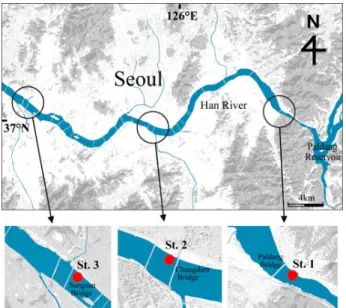
본 연구는 2012년 3월부터 12월까지 팔당댐 방류지점에 서 성산대교까지의 현장 환경요인과 식물플랑크톤을 월 1 회 분석하였다. 한강 서울통과 지점을 상중하로 구분하여, 팔당댐 방류지점(팔당대교, 정점1), 청담대교 지점(정점2) 과 성산대교 지점(정점3)을 대상으로 실시하였다(Fig. 1).
2. 환경요인 분석
환경요인 분석을 위해 수온, pH, 전기 전도도, 용존 산소 (dissolved oxygen; DO)는 현장에서 YSI 556 MPS(Xylem
Fig. 1. Sampling sites(St. 1, Paldang Bridge; St. 2, Chungdam Bridge; St. 3, Sungsan Bridge) in the Seoul passage section of the Han River, Korea.
Inc., Yellow Springs, OH)로 측정하였다. 총 질소(total nitrogen; TN)와 총 인(total phosphate; TP) 자료는 정부 물환경연구시스템(http://water.nier.go.kr)에 공개된 한강 자료를 이용하였다.
엽록소-a는 현장에서 표층수 300mL를 여과한 What- man GF/F 필터(0.7μm pore size, 142mm diameter, What- man International Ltd., Maidstone, England)를 실험실로 가 져온 후, 90% 아세톤 10mL을 넣어 냉암 조건하에서 24시 간 추출하였다. 이후 상온에서 500
g
로 15분 원심분리하 여 부유물을 제거하였다. 분광광도계(DU730, Beckman, Fullerton, CA)를 이용하여 750nm의 파장값으로 추출에 사용한 아세톤의 탁도를 측정한 후, 추출 샘플 상등액의 흡광도를 663nm, 645nm, 630nm 파장값으로 측정하여 엽 록소 양을 계산하였다(WEF and APHA 2005).3. 식물플랑크톤 분석
식물플랑크톤 정성시료와 정량시료는 현장에서 20L 통 을 이용하여 표층수를 채집하였고, 현장에서 각각 300mL 폴리에틸렌 병에 넣은 후 루골 용액과 글루타르알데히드 로 최종농도 1%가 되도록 고정하여 실험실로 운반하였다. 운반된 시료는 암조건에서 24시간 정치 후 상등액을 조 심스럽게 제거하여 농축하였다. 1/10로 희석한 농축 시료 1mL를 플랑크톤 계수판(HMA-S6117, Matsunami Glass, Osaka, Japan)을 사용해 정량적으로 분석하였다. 광학현미 경(Axioskop, Carl Zeiss, Jena, Germany) 200~400배율에서 단위체적당 세포 수(cells mL-1)를 3회 반복 계수하였고, 평균값을 구하였다. 정성분석은 농축된 시료를 슬라이드 글라스 위에 놓고 광학현미경(Axioskop, Carl Zeiss, Jena, Germany) 400~1,000배율에서 검경·동정하였고, 동정하 기 어려운 와편모조류 속에 대해서는 형광현미경(Axio imager A2, Zeiss, Germany)을 이용하여 세부적으로 관찰 하였다. 종은 한국담수조류도감을 참고하여 동정하였다 (Chung 1993).
결과 및 고찰
1. 물리 . 화학적 환경요인의 변화
한강 서울 통과구간의 상·중·하류의 물리·화학적 환경 요인들을 조사하였다(Fig. 2). 수온은 정점1에서 2~29°C,
정점2는 2~29°C, 정점3에서는 3~30°C의 범위를 나타냈 다. 연중 수온은 전형적인 온대지역의 수온 분포를 보였 다. 용존산소(DO)는 수온처럼 계절적인 변화를 하였지만, 그 패턴은 수온과 반대 경향으로 변화하였다. pH는 정점1 에서 6.6~8.9 pH, 정점2는 6.8~8.1 pH, 정점3은 5.6~7.3 pH 의 범위를 보여주었다. 전기전도도(electrical conductivity) 측정 결과, 정점1은 13~186μS cm-1, 정점2는 14~207 μS cm-1, 정점3은 144~250μS cm-1의 범위였다. 평균 전기 전도도는 정점1 130μS cm-1, 정점2 137μS cm-1으로 정점3 이 202μS cm-1로 다른 두 곳보다 1.5배 높게 조사되었다.
총 질소(TN)는 정점1에서 1.80~2.75mg L-1, 정점2는 1.69~2.69 mg L-1, 정점3은 2.35~3.95mg L-1의 범위였다 (Fig. 2). 총 인(TP)에서 정점1은 0.019~0.113mg L-1, 정점 2는 0.027~0.103mg L-1, 정점3은 0.079~0.182mg L-1의 범 위를 보여주었다(Fig. 2). TN은 기존의 연구결과와 비슷한 양상을 보이지만(Kwon et al. 2006; Suh et al. 2007), TP는 확연한 차이를 보였다. TN과 TP는 성산대교가 높은 값을 보였으며, 이는 성산대교가 하류에 위치하고 있어 상류 및 도심으로부터 유기물의 유입에 의한 것으로 추측된다.
2. 식물플랑크톤 현존량 및 엽록소-a의 변화
식물플랑크톤 현존량 측정 결과, 정점1은 9.9×10²~ 1.4×10⁴ cells mL-1, 정점2에서는 1.8×10³~1.4×10⁴ cells mL-1, 정점3에서는 1.8×10³~2.9×10⁴ cells mL-1의 범위 였다(Fig. 3). 특히 정점3에서는 다른 정점들보다 봄철에 2 배 정도 높은 값이며, 일반적인 수화 발생 기준인 5.0×10³ cells mL-1를 상회하였다(Horne and Goldman 1994; Jeong
et al. 2003).
식물플랑크톤의 월별 현존량은 3월 달에는 모 든 정점에서 높은 밀도를 보였으며, 4월 달에 급격히 낮아 지면서 12월까지 감소하는 경향을 보였다.각 조사지점의 엽록소-a는 식물플랑크톤 현존량과 비 슷한 패턴을 보였다(Fig. 3). 전반적으로 3월 달부터 12월 달까지 낮아지는 추세이며, 정점1과 정점3은 각각 10월 과 8월에 2.84μg L-1, 3.74μg L-1로 상승하다가 다시 감소 하였다. 이 결과는 기존 자료와 같은 양상으로 파악되었다 (Kwon et al. 2006; Suh et al. 2007).
3. 식물플랑크톤의 종조성 및 변화
본 연구에서 식물플랑크톤 총 75속 95종으로 규조류 37 종, 녹조류 29종, 황조류 4종, 시누라조류 2종, 황록조류 1
종, 접합조강류 5종, 남조류 11종, 유글레나류 2종, 와편모 조류 2종, 은편모조류 1종, 원시홍조류 1종을 검출하였다. 월별 출현 종수는 9~35종으로 큰 변화폭을 가지고 있었 다. 평균적으로 봄철에 15종으로 가장 적은 출현 종수를 보였으며, 겨울철에는 27종으로 다른 계절보다 더 많고 다 양한 종이 출현하였다. 월별로 보면 5월에 평균 10종으로 적은 종이 출현했지만, 11월은 평균 29종으로 다른 월들보 다 많은 출현 종수를 보이고 있다. 정점별로는 평균 21~23 종으로 큰 차이가 나타나지 않았다.
주요 분류군으로 규조류는 7~21종으로 가장 큰 변화 폭이었고, Stephanodiscus hantzschii f. tenuis, S. hantzschii,
Achnanthes sp., Amphora sp., Cymatopleura sp., Cymbella spp., Gomphonema sp., Gyrosigma sp., Navicula sp., Neidium sp., Nitzschia holsatica
등을 포함하여 37종이 출현했다. 녹조 류는 0~13종의 종수를 보였으며, Ankistrodesmus sp., Chla mydomonas sp., Coelastrum sp., Dimorphococcus lunatus, Elakatothrix sp.
등을 포함하여 29종이 출현했다. 와편모 조류는 0~2종, 황조류, 시누라조류, 황록조류, 접합조강류, 유글레나류 그리고, 은편모조류는 0~4종이 월별로 출 현하였다. 남조류는 0~4종으로 낮은 변화폭을 보여주었 지만,
Anabaena flosaquae, Anabaena sp., Aphanocapsa sp., Chroococcus sp., Dactylococcopsis sp., Gloeotrichia pisum,
그리 고Pseudoanabaena sp.
등을 포함하여 11종으로 파악되었 으며, 기존 연구와 비교할 때(Suh et al. 2007), 남조류의 출 현 종 수가 증가하였다. 남조류는 강우가 있다해도 20°C 이상이 지속되면 기하급수적으로 성장하는데(Suh et al.2005), 2012년에는 수온이 5월(정점1)부터 9월까지 20°C 이상 유지되어, 남조류가 대발생을 일으키면서 분류군이 다양해졌을 가능성이 있다. 이 외에 인과 질소의 농도에 따라 생장이나 종의 구성이 결정될 수 있기에(Kyung et al.
1997), 총 인과 총 질소의 영향도 배제할 수가 없다.
4. 식물플랑크톤의 군집변화
2012년 한강하류 식물플랑크톤 군집 변화를 분석하였 으며, 전체적으로 규조류가 모든 달에 가장 높은 우점률을 Fig. 2. Seasonal changes in water temperature(A), dissolved oxygen(B), pH(C), electrical conductivity(D), total nitrogen(E), and total phos- phorus(F) in the Han River recorded in 2012.
Water temp.(°C)Electrical conductivity(μS cm-1 )
Month Month Month
DO(mg L-1 )TN(mg L-1) TP(mg L-1)pH
(A) (B) (C)
(D) (E) (F)
St. 1 St. 2 St. 3
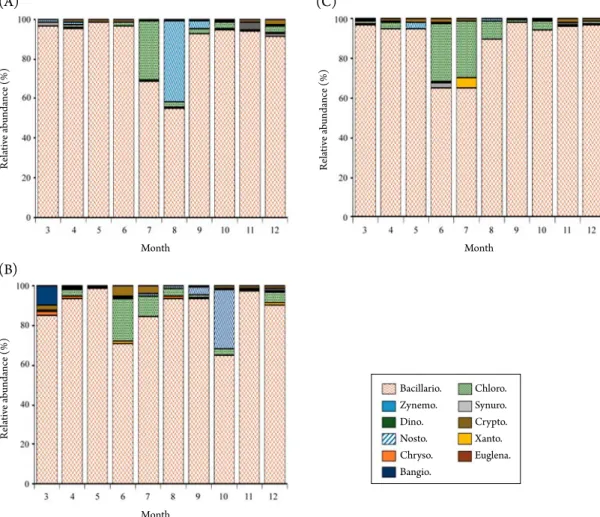
Fig. 4. Relative abundance and seasonal variations in phytoplankton at three sampling sites in the Han River in 2012. St. 1(A), St. 2(B), St.
3(C). Abbreviations: Bacillario., Bacillariophyta; Zynemo., Zynemophyceae; Dino., Dinophyceae; Nosto., Nostocaceae; Chryso., Chrysophy- ceae; Bangio., Bangiophyceae; Chloro., Chlorophyta; Synuro., Synurophyceae; Crypto., Cryptomonadaceae; Xanto., Xantophyceae; Eugle- na.; Euglenaceae.
Month
Month
Month
Bacillario. Chloro.
Zynemo. Synuro.
Dino. Crypto.
Nosto. Xanto.
Chryso. Euglena.
Bangio.
Relative abundance(%)Relative abundance(%) Relative abundance(%)
(A) (C)
(B)
Chl-a(μg L-1) Cells(cells mL-1 )
(A) (B)
Fig. 3. Seasonal variations in cell counts(A) and chlorophyll-a content(B) at three sampling sites in the Han River in 2012.
Month Month
St. 1 St. 2 St. 3
St. 1 St. 2 St. 3
보였다(Fig. 4). 녹조류와 남조류는 전반적으로 6~10월에 다른 월들보다 높은 우점률을 보였다.
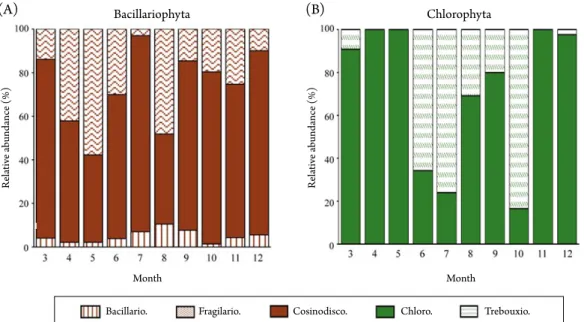
식물플랑크톤의 군집변화를 문 이하의 분류 단위로 볼 때, 규조류 내에서 Coscinodiscophyceae가 8월을 제외하 고 나머지 달에서 최고로 우점을 하였다. Fragilariophyceae 는 두 번째로 우점하였고 3~5월에 증가한 뒤 7월까지 감 소 후 8월에 재우점하는 양상을 보였다. Bacillariophyceae 는 규조류 내에서 가장 작은 우점률을 보였다(Fig. 5). 녹 조류는 규조류 다음으로 우점을 하는 문으로 이들 내 존 재하는 두 개의 강인 Chlorophycea와 Trebouxiophyceae가 월별로 상이하게 우점하였다. Chlorophyceae는 6, 7, 10월 을 제외하고 우점했으며, Trebouxiophyceae는 6, 7, 10월에 Chlorophyceae보다 우점했다(Fig. 5). 서로 다른 생태적 지 위를 가지면 종 간 경쟁을 완화할 수 있으며(Alley 1982), Chlorophycea와 Trebouxiophyceae는 특정한 생태적 지위 를 가져 서로 다른 월에 우점 하는 것으로 생각된다.
5. 우점종 변화
한강에 서식하는 식물플랑크톤 중 월별로 10% 이상 비 율로 우점적으로 출현하는 종은 8종(규조류 6종, 녹조류 1종, 남조류 1종)이였다(Fig. 6). 봄철에는
Stephanodiscus
hantzschii f. tenuis
와S. hantzschii
이고, 여름철에는Aula coseira sp.
와Fragilaria sp.
였다. 가을에는Aulacoseira sp.
이고, 겨울철에는S. hantzschii f. tenuis
우점하여 규조류에 속한 종들이 전반적으로 우점을 하였으나, 여름철에는 녹조류 와 남조류가 제 2우점군으로 관찰되었다.규조류에서는
S. hantzschii f. tenuis, S. hantzschii, Fragilaria
sp., Aulacoseira spp.가 우점종으로 나타났다. S. hantzschii f.tenuis
는 3월부터 6월까지 감소하다가 9월부터 12월까지 증가하였다. S. hantzschii는 3월에 최고로 우점하여 8월까 지 감소한 뒤, 9월부터 12월까지는 증가하는 경향을 보였 다. Fragilaria sp.는 3월부터 5월까지 증가하고 6월부터 7월 까지 감소하다가 8월에 최고로 우점한 이후 감소하였다. 이 시기에 출현하는Fragilaria sp.
는 다른 시기에 비해 커 다란 세포를 가지고 있었다. Aulacoseira spp.는 종의 상대 적인 크기에 따라 우점 양상의 차이를 보였다. 중간 크기 의Aulacoseira sp.
는 7월, 작은 크기의Aulacoseira sp.
는 11월, 큰 크기의Aulacoseira sp.
는 9월에 최고로 우점했다.녹조류에선
Actinastrum hantzschii
가 우점종으로 나타 났으며, 7월에 최고로 우점하여 6월에서 10월사이에 분 포했다. A. hantzschii는 Trebouxiophyceae에 속하는 종으 로 녹조류가 전체 식물플랑크톤 군집 내에서 증가할 땐 Trebouxiophyceae가 녹조류 군집 내에서 우점했다(Fig.Relative abundance(%) Relative abundance(%)
Month
Bacillariophyta Chlorophyta
Month
Fig. 5. Seasonal variations in two dominant phyla Bacillariophyta(A) and Chlorophyta(B) at three sampling sites in the Han River in 2012.
Abbreviations: Bacillario., Bacillariophyceae; Cosinodisco., Cosinodiscophyceae; Fragilario., Fragilariophyceae; Chloro., Chlorophyceae; Tre- bouxio.,Trebouxiophyceae.
(A) (B)
Bacillario. Fragilario. Cosinodisco. Chloro. Trebouxio.
4~6). 때문에 한강 하류의 Trebouxiophyceae는 녹조류 군 집 내에서 단기간에 증가할 수 있는 능력이 있는 것으로 생각된다.
남조류는 8월과 10월에 주로 출현하며(Fig. 4), 이 중
Microcystis sp.
가 남조류 분류군 내에서 우점종으로 나타났다(Fig. 5).
6. 한강 모니터링의 의의
식물플랑크톤은 오염 지표종으로서 수질오염의 척도로
서 사용될 수 있고(Yoo and Lim 1990; Harper 1992; Kong
2002), 한강 하류는 담수역과 기수역으로 이루어져 해수
가 혼합되는 장소로 생태적 중요성을 가진다. 한강 하류의 종조성 및 현존량은 지속적으로 변화해 왔으며(Lee and Jung 2004), 본 연구에서는 녹조류와 남조류의 종 다양성 증가를 확인하였다. 남조류는 주요한 오염 지표종으로서 조류경보제와 직접적인 관련이 있다는 점에서 이러한 변 화는 중요하다(Park et al. 2011). 남조류의 출현양은 하류 에 위치한 St. 3에서 적었으며(Fig. 4), 향후 지속적인 하류 지역의 남조류 모니터닝이 필요하다. 한강의 상수원으로 서 가치, 생태학적 중요성 및 지속적인 변화는 한강 하류 지역의 장기 모니터링 필요성을 보여준다. 본 연구를 통해 한강 서울통과 구간의 정밀조사가 이루어졌으며, 식물플 랑크톤 종조성, 계절별 군집구조, 우점종의 변화를 파악하 였고, 환경요인을 기록하였다. 2012년의 한강 하류지역 모 니터닝 결과는 장기 모니터링을 위한 기초 데이터로 활용 할 수 있을 것이다.
적 요
한강은 서울 및 수도권 지역의 수자원으로 다양하게 이 용되고 있어 지속적인 모니터링과 관리가 필요하다. 본 연 구는 2012년도 한강 하류의 식물플랑크톤 군집구조와 계 절별 변화를 규명하였다. 현장시료는 서울통과 구간의 상 류(팔당대교), 중류(청담대교), 하류(성산대교)에서 월 1회 채집하였으며, 현장에서 수온, 용존산소, pH, 전도도 를 측정하였다. 환경요인은 3개 정점에서 유사한 값으로 조사되었으며, 수온은 2~30°C 범위이고 DO는 4.8~19.1 mg L-1로 온대지역의 전형적인 패턴을 보였다. 식물플랑 크톤 수는 990 cells mL-1(팔당대교, 12월)~2.9×10⁴ cells mL-1(성산, 3월)의 변동이었고, 엽록소는 0.6μg L-1(팔당 대교, 12월)~10.3μg L-1(성산, 3월)로 세포수와 같은 양상 을 보였다. 조사된 식물플랑크톤 군집은 규조류 37종, 녹 조류 29종, 남조류 11종, 와편모조류 2종 등 총 75속 95종 이었다. 계절별 최저 출현은 9종(5월, 팔당대교)에서 최 고 35종(12월, 청담)으로 변화폭이 컸다. 봄철(3~5월) 에 평균 15종으로 적은 출현종수를 보였으며, 겨울철(12 월)에 평균 27종으로 다른 계절보다는 다양한 출현 종수 를 보였다. 규조류는 여름철을 제외하고 모든 정점과 계 Fig. 6. Relative abundance and seasonal variations in dominant
phytoplankton(>10%) at three sampling sites in the Han River in 2012.
Relative abundance(%)
Stephanodiscus hantzchii f. tenuis
Stephanodiscus hantzchii
Aulacoseira sp.(M)
Aulacoseira sp.(S)
Aulacoseira sp.(L)
Fragilaria sp.(L)
Actinastrum hantzchii
Microcystis sp.
BacillariophyceaeChlorophyceaeNostocaceae
Relative abundance(%)
Month
Month
Month
절에서 가장 우점하였다. 반면 녹조류와 남조류는 여름철 과 가을철에 산발적으로 높은 우점률을 나타냈지만, 제 1 우점군은 아니었다. 출현빈도 10% 이상 되는 종으로, 규 조류는
Aulacoseira granulate, Cyclotella sp., Stephanodiscus hantzschii
이며, 녹조류는Actinastrum hantzschii
이고, 남조 류는Microcystis sp.
였다. 본 연구는 2012년 한강 하류의 식 물플랑크톤 군집 변화 및 현존량, 우점종의 변화를 분석한 것으로, 향후 진행될 연구들과 환경변화에 따른 한강의 수 질 및 식물플랑크톤 군집 변화를 이해하기 위한 좋은 기초 자료가 될 것이다.사 사
이 논문은 2020년도 정부(미래창조과학부)의 재원으 로 한국연구재단의 지원을 받아 수행된 기초연구사업 (No. 2020R1A2C2013373)과 바이오·의료기술개발사업 (2016R1D1A1A09920198)의 지원을 받아 수행된 연구임.
R
EFER
ENCESAlley TR. 1982. Competition theory, evolution, and the concept of an ecological niche. Acta Biotheor. 31:165-179.
Chung J. 1993. Illustrations of the Korean Freshwater Algae.
Academy, Seoul. p. 496.
Chung YH, JH Shim and MJ Lee. 1965. A study on the microflo- ra of the Han River. I. The phytoplankton and the effect of the marine water in the lower course of the Han River. Korean J.
Bot. 8:7-29.
Han MS, YY Auh and SS Hong. 2002. Ecological studies on Pal’tang river-reservoir system in Korea. 4. Dynamics on in- organic nutrients, POM and phytoplankton succession in the lower stream Kyungan. Korean J. Limnol. 35:1-9.
Han MS, YY Auh, JK Ryu, KI Yoo and YK Choi. 1995. Ecological studies on Pal’tang River-Reservoir System in Korea 2.
Changes in phytoplankton community structure. Korean J.
Limnol. 28:335-344.
Harper D. 1992. Eutrophication of Freshwater. Principles, Prob- lems and Restoration. Chapman & Hall, London. p. 327.
Horne AJ and CR Goldman. 1994. Limnology. McGraw-Hill, Inc., New York. p. 576.
Jeong SW, JH Lee and JS Yu. 2003. Environmental studies of the lower part of the Han River V. Blooming characteristics of
phytoplankton communities. Algae 18:255-262.
Kim DS and BC Kim. 1990. Primary productivity in Lake Paldang.
Korean J. Limnol. 23:167-179.
Kim JK. 1972. Taxonomy on the phytoplankton of the lower course of the Han River in summer season and its indication to sea water. Korean J. Limnol. 5:31-42.
Kim JK, SH Lee, HH Bang and SO Hwang. 2009. Characteristics of algae occurrence in Lake Paldang. J. Korean Soc. Environ.
Eng. 31:325-331.
Kim JM, MS Han, WH Jheong and JD Park. 2005. Correlation between phytoplankton dynamics and water quality in Pal- dang Reservoir. Korean J. Ecol. Environ. 38:217-224.
Kim YJ. 1996. Ecological study of phytoplankton community and trophic states using indicators in lake Paltang. Korean J. Lim- nol. 29:323-345.
Kim YJ. 1998. Ecological characteristics of phytoplankton com- munity in lake Paltang Dam. Korean J. Limnol. 31:225-234.
Kim YJ, MW Kim and SJ Kim. 1998. Ecological characteristics of phytoplankton community in the mid-and downstream of the Han River. Algae 13:331.
Kim YJ, MK Kim and SD Lee. 2012. Identification of autumn phytoplankton in the lakes of Han River system. J. Wet. Res.
14:429-438.
Kong DS. 2002. Necessity and approach of establishing biolog- ical water quality standards. Korean J. Environ. Biol. 20:38- 49.
Korea Environment Corporation. 2012. Domestic algae outbreak status. pp. 65-96. In: Algae Reduction Technology to Improve Aquatic Safety. Korea Environment Corporation. Incheon, Korea.
Kwon OY, SW Jung and JH Lee. 2006. Environmental studies in the lower part of the Han River VIII. Physicochemical factors contributing to variation of phytoplankton communities. Ko- rean J. Ecol. Environ. 39:340-351.
Kyung JC and JK Shin. 1997. Dynamics of inorganic N P nutrient and planktonic algae during summer and winter in down- stream of the Naktong River. Korean J. Limnol. 31:67-75.
Lee JH and M Chang. 1997. Environmental studies of the lower of Han river II. phytoplankton dynamics. Korean J. Limnol.
30:193-202.
Lee JH and SW Jung. 2004. Environmental studies in the lower part of the Han River-VII. Long term variations and prospect of the phytoplankton community. Algae 19:321-327.
Lee K. 1986. Vertical distribution of phytoplankton in the Paldang Dam Reservior. J. Plant Biol. 29:117-127.
Park HK and WH Jheong. 2003. Long-term changes of algal growth in Lake Paldang. J. Korean Soc. Water Environ.
19:673-684.
Park HK, HB Kim, JJ Lee, JA Lee, HJ Lee, JH Park, JK Seo and JS Moon. 2011. Investigation of criterion on harmful algae alert system using correlation between cell numbers and cellular microcystins content of Korean toxic cyanobacteria. J.
Korean Soc. Water Environ. 274:491-498.
Shim JH and JK Choi. 1978. Structural and functional changes in planktonic algal communities of the Han River. J. Oceanol.
Soc. Korea 13:31-41.
Suh MY, BH Kim and KS Bae. 2007. Fluctuation of environmental factors and dynamics of phytoplankton communities in low- er part of the Han river. Korean J. Ecol. Environ. 40:395-402.
Suh MY, BH Kim, KS Bae and MS Han. 2005. Annual fluctuation (2000-2003) of water quality and cyanobacterial abundance in the lower part of Han -River. Korean J. Ecol. Environ.
38:181-187.
WEF and APHA. 2005. Standard Methods for the Examination of Water and Wastewater. American Public Health Association:
Washington, DC, USA.
Yoo KI and BJ Lim. 1990. On the phytoplankton community and water pollution indication in the lower Han River system. Ko- rean J. Limnol. 23:267-277.