Print ISSN: 2288-4637 / Online ISSN 2288-4645 doi:10.13106/jafeb.2021.vol8.no5.0727
Factors Affecting Women Micro and Small-Sized Enterprises’ Success: A Case Study in Jordan
Lubna Mohammad THAHER
1, Nor Mohd RADIEAH
2, Wan Hasan WAN NORHANIZA
3Received: January 30, 2021 Revised: April 05, 2021 Accepted: April 15, 2021
Abstract
Over the past decades, the Jordanian government has made great efforts to help poor women start small businesses by providing microcredit and facilitating financial services. Although in Jordan almost hundreds of thousands of women have the ability to contribute more fully to their economy, they are reluctant to do so. Women’s participation in economic activities in 2016 was only 13.2%, while the unemployment rate for Jordanian women was 24.1%. The decline in women’s participation in small business management has gradually become an important issue following the trial of more than 13,000 Jordanian women for non-payment of their micro-loans. This study aims to identify the factors that hinder Jordanian women from achieving job stability. In this qualitative study, a semi-structured interview method with sixteen open-ended questions was used to collect relevant data. A purposeful sampling method is also used to select participants.
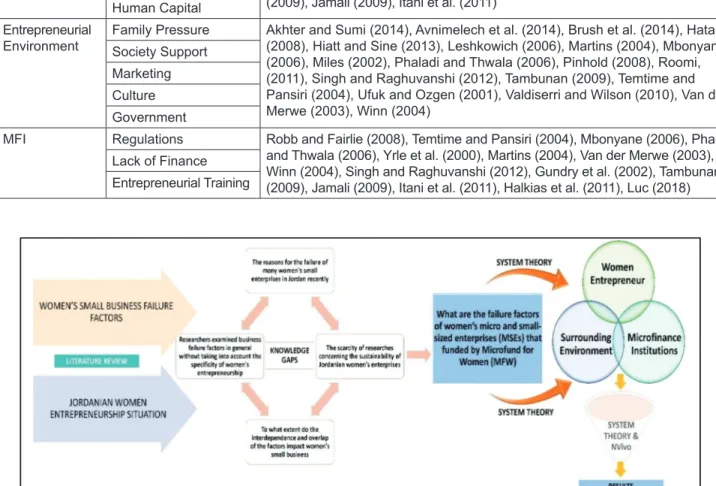
To analyze the data, this study used NVivo 11 software as a method. Using System Theory, this study showed that women’s failure depends on three factors: women entrepreneurs, the environment around women entrepreneurs, and micro-financial institutions. Findings of this study suggest that strengthen women’s entrepreneurship sustainability and minimize the risk of failure should be done through integrated strategies include these three domains.
Keywords: Women’s MSEs, Failure Factors, Women’s Entrepreneurship, Sustainability, Jordan JEL Classification Code: L21, L26, M21
et al., 2015). Recently, special attention has been paid to the role of women entrepreneurs in creating economic growth in developing countries and improving people’s condition (Elenurm & Vaino, 2011). A woman entrepreneur refers to a woman who organizes and manages a business (Pandian
& Jesurajan, 2011). There has been little research on the challenges faced by women entrepreneurs, especially in the Middle East. Paying attention to the socio-cultural and political environment and their impact on the performance and success of women entrepreneurs in different countries and societies is important (Javadian & Singh, 2012).
Investing women’s business performance is one of the most effective tools for increasing equality between women and men and promoting women in society. Investing in special programs for women can have a significant impact on the country’s economic development. Targeted action not only can bridge the gap between men and women, but eliminate discriminatory aspects of economic and social policies, programs and practices preventing women from fully participating in the economy.
It is worth noting that small businesses play a pivotal role in the economies of the world, and therefore, understanding
1
First Author and Corresponding Author. Ph.D. Student, Centre for Global Sustainability Studies (CGSS), Universiti Sains Malaysia, Malaysia [Postal Address: Alsalheen mosque St, Marka Al-Jnoubeah, Amman, 11120, Jordan] Email: [email protected]
2
Senior Lecturer, Centre for Global Sustainability Studies (CGSS), Universiti Sains Malaysia, Malaysia. Email: [email protected]
3
Senior Lecturer, Centre for Islamic Development Management Studies (ISDEV), Universiti Sains Malaysia, Malaysia.
Email: [email protected]
© Copyright: The Author(s)
This is an Open Access article distributed under the terms of the Creative Commons Attribution Non-Commercial License (https://creativecommons.org/licenses/by-nc/4.0/) which permits unrestricted non-commercial use, distribution, and reproduction in any medium, provided the original work is properly cited.