Abstract
BACKGROUND: The productivity and quality of blueberry ( Vaccinium ashei Reade) greatly depend on the number of fruits in a plant. Especially, fruit set more than appropriate number negatively affects productivity and marketability due to the increased number of small fruits and delayed harvest time. This study was conducted to investigate proper timing and concentration for applying chemical blossom thinners such as ammonium thiosulfate (ATS) and UREA.
METHODS AND RESULTS: ATS at 1.25% and 1.50%, and UREA at 6% and 8% were applied in four developmental stages, bud swell, pink bud, full bloom and petal fall. Fruit thinning rate was calculated based on the number of fruits harvested divided by that of flowers before applying blossom thinners. Ratios of leaf to flower and leaf to fruit were calculated based on the number of fully developed leaves in 25 days after full blossom divided by that of flowers or fruits, respectively. Chemical injury of leaves was investigated by calculating the
number of leaves with chemical injury divided by the total number of leaves. Fruit thinning rates were 48% and 66%
for UREA treatments at 6% and 8%, respectively, and 49% and 62% for ATS treatments at 1.25% and 1.50%, respectively, in the full bloom stage. In the petal fall stage, fruit thinning rates were 18% and 24% for UREA treatments at 6% and 8%, respectively, and 49% and 35%
for ATS treatments at 1.25% and 1.50%, respectively.
Leaf to fruit ratio (L/FR) increased by 109% and 188%
compared to leaf to flower ratio in ATS treatments at 1.25% and 1.50%, respectively, and L/FR increased 93 and 196% in UREA treatments at 6% and 8%, respectively, in the full bloom stage. In the petal fall stage, leaf to fruit ratio increased by 60% to 100% in ATS treatments, but did not significantly differ from the control in UREA treatments. Fruit harvest was delayed in all treatments of all developmental stages except for 1.5%
ATS and 6% UREA treatments at the petal fall stage, whose fruit harvest was two or three days faster than the control.
CONCLUSION: The application of ATS and UREA for blossom thinning should be in the petal fall and full bloom stages for early and late harvest, respectively. Considering chemical injury, integrated harvesting and fruit size, however, it is appropriate to apply ATS at 1.5% in the petal
*Corresponding author: Hong-Lim Kim Phone: +82-55-864-1505; Fax: +82-55-864-1508;
E-mail: [email protected]
Korean J Environ Agric. 2020;39(4):360-367. Korean Online ISSN: 2233-4173
Published online 2020 November 30. https://doi.org/10.5338/KJEA.2020.39.4.43 Print ISSN: 1225-3537
‘브라이트웰’래빗아이 블루베리의 Ammonium thiosulfate와 UREA처리에 따른 적화와 과실생장 효과
김홍림
*, 이목희, 이하경, 정경호, 이한철
농촌진흥청 국립원예특작과학원 남해출장소
Effects of ATS and UREA on Flower Thinning and Fruit Growth in ‘Brightwell’
Rabbiteye Blueberry
Hong Lim Kim
*, Mock-hee Lee, Ha-Kyoung Lee, Kyeong-Ho Chung and Han-Cheol Rhee (Namhae Branch, National Institute of Horticultural and Herbal Science, Rural Development Administration, Namhae 52430, Korea)
Received: 19 October 2020/ Revised: 20 November 2020/ Accepted: 23 November 2020 Copyright ⓒ 2020 The Korean Society of Environmental Agriculture
This is an Open-Access article distributed under the terms of the Creative Commons Attribution Non-Commercial License (http://creativecommons.org/licenses/by-nc/3.0) which permits unrestricted non-commercial use, distribution, and reproduction in any medium, provided the original work is properly cited.
ORCID Hong-Lim Kim
https://orcid.org/0000-0001-9136-1327
360
Research Article Open Access
fall stage to increase fruit productivity and quality in blueberry.
Key words: ATS, Brightwell, Rabbiteye Blueberry, Thinning, UREA
서 론
블루베리 등 과수의 착과량 조절은 수세안정, 품질개선 그 리고 집약수확 을 가능하게 하기 때문에 과원관리의 중요한 작업으로 인식되고 있다[1-3].
블루베리의 화아분화는 단일조건에서 당해 년도 형성되어 발달한 가지에 일어난다[4]. 꽃눈(Inflorescence bud)은 가 지 선단에서 아래로 발달하여 꽃눈이 끝나는 부분부터 아래 로 잎눈이 발생한다[5]. 꽃눈에 형성된 꽃수는 가지 선단으로 부터 멀어질수록 적어지고, 과실 발달 역시 선단 아래로 순차 적으로 발달한다. 따라서 이와 같은 블루베리의 결과습성은 첫 수확에서 마무리까지 약 30-40일의 긴 기간이 소요된다.
한편 착과량 증가는 동화산물 경쟁으로 생장 억제와 함께 소 과 비율을 높이고[6], 낮은 엽과비로 과실의 유기화합물 증대 에도 부정적 영향을 준다[7, 8]. 결국 블루베리의 시장성과 생 산성을 위해 큰 과일을 짧은 기간 동안 집약적으로 수확할 수 있도록 착과량을 조절하는 기술이 필요하다 할 수 있다.
착과량을 조절하는 방법은 크게 인력 및 적화제 이용으로 구분할 수 있다. 인력을 이용한 착과량 조절은 처리시기와 환 경에 따른 제한을 받지 않아 높은 재현성을 갖는 장점을 가지 고 있지만, 생산성 측면에서 소규모 농장에 국한되는 단점을 가지고 있다[9]. 적화자재를 통한 착과량 조절은 대표적으로 생장조절물질을 이용한 방법들이 일부 잠재성이 확인된 바 있으나, 환경과 생태에 미치는 영향 때문에 범용적 적용에 한계 를 가지고 있다[10-15]. 한편 Ammonium thiosulfate (ATS), Sulfcarbamide, Endothall, Pelargonic acid 그리고 Hydrogen cyanamide 등과 같은 무기자재 역시 다양한 과종에서 검토 되고 있다[16-20]. 그러나 이중 Endothall, Pelargonic acid 그리고 Sulfcarbamide 등의 자재는 재현성이 낮다는 평가가 보고되고 있다[21]. 반면 ATS와 UREA은 환경과 농가 그리 고 소비자에게 안전한 무기 화합물로서, 품종과 과종 그리고 처리방식에 따라 차이가 있지만 높은 수준의 적화효과가 확 인되고 있다[19, 22-25].
국내 블루베리 재배현장은 전통적인 관행농과 친환경 등 다
양한 작형이 적용되고 있어 현장성이 높은 범용적 착과량 조절 기술이 요구되고 있다.
따라서 본 연구는 이와 같은 조건에 부합한 ATS와 UREA 의 처리시기와 수준을 구명하여 농가현장에 활용하고자 수행 하였다.
재료 및 방법
본 연구는 국립원예특작과학원 남해출장소에서 2019년에 수행하였다. 시험에 적용한 블루베리는 수관 용적이 약 6 m
3인 재식 9년차 래빗아이 블루베리(Vaccinium ashei Reade)
‘Brightwell’이다. 꽃눈 발달단계 구분은 육안관찰을 통해 전체 수관의 꽃눈이 각 단계의 70%에 도달한 시점으로 구분하였다.
적화제 종류와 처리수준은 무처리를 포함하여 Ammonium thiosulfate (ATS) 1.25%, 1.5%와 UREA 6%, 8%로 처리하 였다. 적화처리 시기는 Bud swell, Pink bud, Full bloom 그리고 Petal fall 등 4단계로 구분하였으며, 처리시기별 기상 조건은 자동기상관측기(Campbell scientific, LTD, USA)를 이용하였으며 그 내용은 Table 1과 같다.
적화제의 처리는 10리터 용기의 소형 분무기를 이용하여 오전 중 수관 전체가 고르게 접촉되도록 충분히 살포하였고, 과실 특성조사를 위한 결과지는 과실 발달 조사용과 누적수 확량 조사용으로 구분하여 선정하였다.
적화율은 적화제 처리 전 꽃수를 바탕으로 수확한 과실수 로 계산하였다. 엽화비와 엽과비는 엽이 충분히 발달한 만개 후 25일 조사한 엽수를 바탕으로 적화제 처리 전 꽃수와 수 확한 과실수를 바탕으로 계산하였다. 엽의 약해 발생률은 적 화제 처리 후 약해 흔적이 있는 엽의 비율로 계산하였으며, 이때 약해의 정도는 고려하지 않았다.
적화제 처리에 따른 과실 발달은 만개 25일부터 77일까지 7~10일 간격으로 버니어캘리퍼스를 이용하여 조사하였다(만 개 77일 이후에는 수확과실 발생으로 통계적 평가가 불가했 다). 누적 수확량은 만개 66일부터 112일까지 4~8일 간격으 로 수확하여 조사하였다.
과실 품질 중 가용성 고형물 함량은 과실 100 g을 착즙 후 굴절당도계(PR-32 α, Atago, Bellevue, WA, USA)를 이용 하여 측정하였고, 산함량은 과즙 10 ml에 증류수 40 ml를 첨 가하여 end point를 pH 8.20으로 설정하여 0.1 N NaOH로 적정하였으며, 이때 소요된 0.1 N NaOH 투여량을 구연산으 로 환산하여 표기하였다. 실험디자인은 완전임의배치 5반복
Date Bud swell Pink bud Full bloom Petal fall
3/18 4/2 4/22 5/3
Temperature ( ℃) 6.9 ~ 8.5 7.9 ~ 8.7 19.3 ~ 20.5 18.6 ~ 20.1
Relative humidity (%) 63 ~ 68 44 ~ 56 62 ~ 68 27 ~ 38
wind speed (km/h) 2.9 ~ 3.6 4.0 ~ 5.8 3.6 ~ 4.3 2.9 ~ 4.0
- Campbell Scientific AWS (2019.3.18. ~ 5.3.)
Table 1. Temperature, humidity and wind speed in treatment timing
으로 실시하였다.
시험결과의 통계분석은 SAS 통계패키지(SAS Institute, ver. 9.2, USA)를 이용해 분산분석을 실시했으며, 처리간 유 의성 검정은 던칸의 다중검정법(P=0.05)을 이용했다.
결과 및 고찰
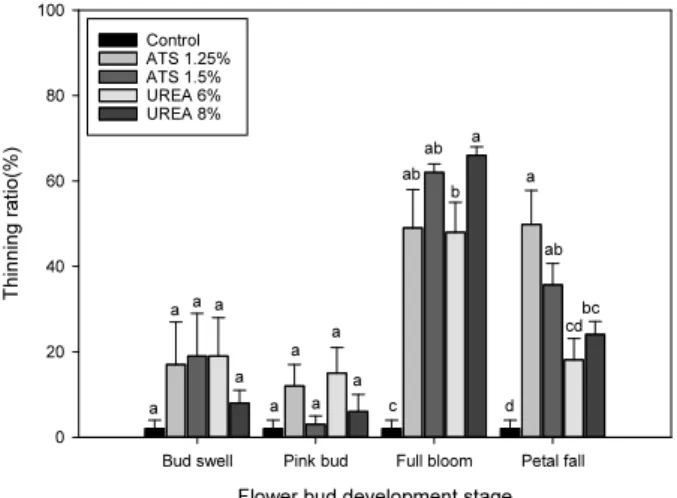
래빗아이 블루베리 ‘브라이트웰’ 품종의 꽃눈 발달 단계별 ATS와 UREA의 적화효과는 Fig. 1과 같다. 꽃눈 발달 초기 단계인 bud swell과 pink bud 단계에서는 처리에 따라 최 대 20%내외 적화효과를 나타냈으나, 무처리와의 통계적 유의 차는 없었다. 그러나 full bloom과 petal fall단계에서는 처리 간 유의차가 뚜렷하였다. full bloom 단계의 적화율은 UREA 6과 8%처리가 각각 48%와 66%를 나타냈으며, ATS 1.25와 1.5%처리가 각각 49%와 62%를 나타내 가장 적화율이 높은 시기였다. petal fall단계에서는 UREA 6%와 8%처리가 각 각 18%와 24%를 나타냈으며, ATS 1.25%와 1.5%처리가 각 각 49%와 35%를 나타내 full bloom 단계에 비해 다소 적화 율은 낮지만 bud swell과 pink bud에 비해 적화효과가 높 았다. 특히 full bloom단계와 달리 ATS처리에서 더 높은 적 화율을 나타냈다.
블루베리 암술의 꽃가루 유효수분기간은 개화 후 6~8일까 지 이다[26-29]. ATS와 UREA와 같은 가성(Caustic)자재는 암술대를 포함한 생식기관의 화학적 태움을 통해 불임과 낙
화를 유도한다[12, 20, 22, 23]. bud swell과 pink bud 단 계의 최대 20% 미만의 낮은 적화율은 생식기관의 미성숙과 꽃잎에 가려진 미개방성 때문으로 판단된다. 또한 petal fall 단계의 낮은 적화율은 처리시기의 중요성뿐 만 아니라, ATS 와 UREA같은 가성 자재는 수정되어 착과된 과실의 적과제 로써 적합하지 않다는 것을 확인해 주었다.
Flower bud development stage Bud swell Pink bud Full bloom Petal fall
Thinning ratio(%)
0 20 40 60 80 100
Control ATS 1.25%
ATS 1.5%
UREA 6%
UREA 8%
ab a a ab
ab b
cdbc
a a a a
a a
a a
a
a
c d
Fig. 1. The thinning effect of ATS and UREA in flower bud development stage of ‘Brightwell’ rabbiteye blueberry.
Bars labeled with same letter are not significantly different by the Duncan’s multiple range test ( P = 0.05). Vertical bars indicate standard error of the means.
Fig. 2. The thinning effect of ATS and UREA in flower bud development stage on L/FL and L/FR of ‘Brightwell’ rabbiteye blueberry. L/FL, Leaf to flower ratio; L/FR, Leaf to fruit ratio.
Vertical bars indicate standard error of the means.
적화 처리 전 엽화비와 꽃눈 발달 단계별 적화 처리 후 엽과 비는 Fig. 2와 같다. 무처리구의 엽과비는 1.84%로 엽화비 대 비 약 14%증가하여 생장 중 자연낙화 및 낙과가 미미함을 알 수 있었다. 꽃눈 발달 단계별 가장 적화효과가 컸던 full bloom 단계에서는 ATS 1.25%와 1.5%처리가 각각 109와 188%로, UREA 6과 8%처리에서는 각각 93%와 196%로 엽 비율이 증가하여, 자재의 종류보다는 처리농도에 따른 차이가 뚜렷하 였다. 한편 petal fall 단계에서는 ATS처리가 60~100%정도 의 엽 비율 증가를 나타냈으나, UREA는 처리효과가 매우 미 미하여 농도보다는 자재에 따른 차이를 분명히 하였다.
한편 착과량 조절 목적은 엽에 대한 과실비율을 낮춰 품질 과 생산성을 높이는데 있고 이를 위한 블루베리 엽과비는 2.5 이상이 되어야 한다고 알려져 있다[9, 30]. 그러나 본 처리는 시기와 농도에 따라 엽 비율의 증가가 가능하다는 것을 확인 시켜 주었으나, 단일한 처리를 통한 기대 엽과비 확보는 일정 부분 한계를 가지고 있다는 것 역시 확인시켜 주었다. 따라서 기대 엽과비 충족을 위해 필요에 따라 적화제 처리 후 적과작 업이 동반 되어야 한다고 본다.
적화제 처리에 따른 약해 발생현상과 발생량은 Figs. 3과 4와 같다. 약제에 따라 Fig. 3과 같이 부분적인 잎 뒤틀림과 끝이 타는 현상 그리고 착과된 과실에 노출되었을 때 과경부 의 크라운 성장이 멈추는 현상 등을 확인할 수 있었다. 이와 같은 약해 발생량은 full bloom 단계의 UREA 8%처리가 약 38%의 발생량을 나타내 가장 높았다. UREA 6%와 ATS 처리는 농도 간 유의차이 없이 약 10~15% 이내의 발생량을 나타냈다. 한편 petal fall 단계는 ATS 1.25%처리가 상대적
으로 높았으나, full bloom 단계와 비교하여 모든 처리가 5% 이내로 매우 낮은 수준이었다.
이상의 결과로 ATS는 full bloom에서 petal fall 단계까 지 적화효과를 기대할 수 있지만, UREA는 full bloom 단계 로 제한됨을 확인할 수 있었다. ATS와 UREA는 강력한 산 화제이나 소성을 위해서는 적정한 상대수분이 요구된다[31].
블루베리의 꽃눈 발달단계는 지역과 품종에 따라 다르지만 일반적으로 한국에서의 full bloom 단계는 4월 하순에서 5
Fig. 4. Incidence rate of leaf phytotoxicity caused by ATS and UREA treatment. Bars labeled with same letter are not significantly different by the Duncan’s multiple range test ( P = 0.05). Vertical bars indicate standard error of the means.
Fig. 3. Symptom of leaf and fruit phytotoxicity caused by ATS and UREA treatment. A,
crinkled leaves by ATS treatment; B, dry urea dust in UREA treatment; C, burned leaves
and shoots by UREA treatment; D, fruit crown disorder by ATS treatment in Petal fall stage.
월 초순에 진행되며, petal fall 단계는 5월 중하순에 진행된 다. 본 처리가 진행되었던 시기의 기상환경은 full bloom 단 계가 petal fall 단계보다 온도가 낮고 습도가 높은 조건이었 다(Table 1). 따라서 full bloom 단계의 높은 적화효과는 미 수정된 꽃눈의 비율이 낮고, 산화제의 소성효과를 발현하는데 유리한 조건이었기 때문으로 판단되며, 이는 full bloom 단 계의 약해 발생량에서도 확인할 수 있었다.
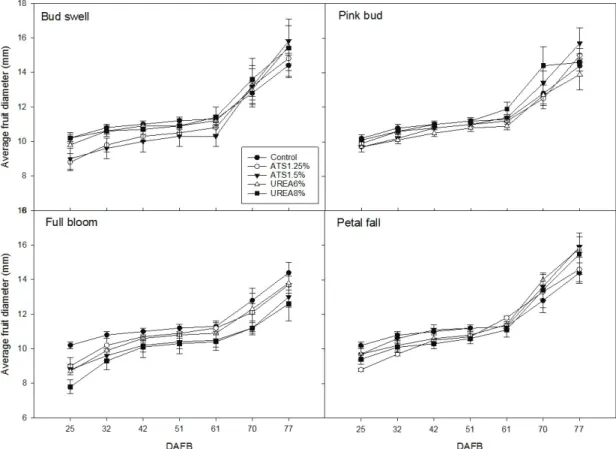
꽃눈 발달 단계별 적화제 처리가 과실 발달에 미치는 영향 은 Fig. 5와 같다. 모든 처리에서 과실 크기는 만개 후 60일 전 후로 급속한 생장을 나타냈다. 각 처리별 적화처리 결과가 엽 과비와 경향이 달라 과실 발달 특성을 적화효과로 특정할 수 없으나, full bloom과 Petal fall 단계에서는 무처리와 비교하 여 과실 발달이 각각 늦거나 빠른 경향을 확인할 수 있었다.
full bloom 단계의 모든 적화제 처리에 따른 과일크기는 만개 25일과 77일 기준 각각 무처리 대비 13~31%와 5~14%
적은 수준으로 과실 발달 초기와 후기 모두 과실 생장 속도가 늦는 경향이 뚜렷하였다. 반면 Petal fall 단계에서의 적화제 처리는 과실 발달 초기인 만개 후 25일 모든 처리구가 무처 리 과실 10.2 mm와 비교하여 5~15% 낮은 수준이었으나, 만개 후 77에서는 14.4 mm의 무처리 과실 대비 2~10% 높 은 수준을 나타냈다. 이와 같은 특징적인 과실 발달 경향은 Full bloom 단계의 적화처리 대상이 먼저 발달한 꽃이었다
면, Petal fall 단계에서는 늦게 발달한 꽃이 대상이기 때문으 로 판단된다. 이와 같은 경향은 누적 수확량에서도 비슷한 경 향이었다.
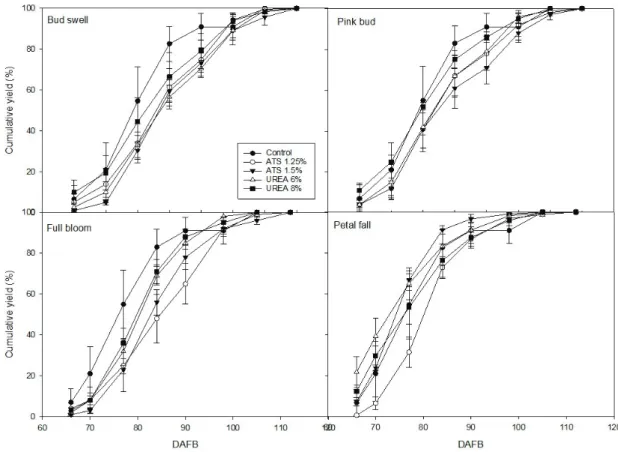
처리별 누적 수확량 변화는 bud swell과 pink bud 그리 고 full bloom 단계와 petal fall 단계로 구분되었다. 수확 생산성을 고려한 경제성 있는 누적수확량 80%시점에서 bud swell과 pink bud 그리고 full bloom 단계의 적화제 처리 는 무처리에 비해 각각 4~9일, 2~8일 그리고 4~11일 정도 숙기가 지연되는 경향이었다. 특히 full bloom 단계에서의 ATS 1.25%처리는 무처리 대비 약 11일 가량 숙기가 늦어지는 경향을 나타냈다. 반면 petal fall 단계에서는 자재의 종류와 농도에 대한 경향은 나타나지 않았으나, 앞선 3단계의 누적수 확량 패턴과 달리 수확 20%시점에서는 ATS 1.25%처리를 제 외한 모든 처리가 무처리 보다 높은 누적량을 나타냈으며, 수 확 80%시점에서는 무처리와 비교하여 ATS 1.25%와 UREA 8%는 약 1~4일 늦었지만, ATS 1.5%와 UREA 6%는 약 2~3일 빠른 결과를 나타냈다.
꽃눈 발달 단계별 적화제 처리에 따른 16 mm 이상의 과 실크기 분포는 Table 1과 같다. bud swell과 pink bud 단 계의 처리에서는 무처리구와 통계적 유의차 없이 60~70%내 외의 분포를 나타냈다. full bloom 단계에서는 ATS 1.25%
처리가 61.7%로 적화처리구 중에서는 가장 높은 수준이었으
Fig. 5. The thinning effect of ATS and UREA in flower bud development stage on fruit development of
‘Brightwell’ rabbiteye blueberry. DAFB stands for acronym of ‘Days After Full Bloom’. Vertical bars
indicate standard error of the means.
Fig. 6. The thinning effect of ATS and UREA in flower bud development stage on cumulative percent yield of ‘Brightwell’ rabbiteye blueberry. DAFB stands for acronym of ‘Days After Full Bloom’. Vertical bars indicate standard error of the means.
Control Bud swell Pink bud Full bloom Petal fall
70.4a
z70.4a 70.4a 70.4a
ATS 1.25% 61.3a 67.5a 61.7ab 49.7b
ATS 1.50% 64.8a 69.0a 59.2ab 74.6a
UREA 6% 66.4a 61.3a 48.1b 65.2a
UREA 8% 64.0a 70.3a 57.2ab 71.9a
z
Mean separation within columns by the Duncan’s multiple range test at P = 0.05.
Table 2. The thinning effect of ATS and UREA in flower bud development stage on over 16mm berry size distribution of ‘Brightwell’ rabbiteye blueberry
Soluble solids content (°Brix) Titratable acidity (%)
Bud swell Pink bud Full bloom Petal fall Bud swell Pink bud Full bloom Petal fall
Control 14.2a
z14.2a 14.2a 14.2a 0.46a 0.46a 0.46a 0.46a
ATS 1.25% 15.0a 14.4a 15.4a 15.0a 0.41b 0.40b 0.42b 0.42abc
ATS 1.50% 14.5a 14.2a 15.2a 15.0a 0.43ab 0.39b 0.42b 0.43ab
UREA 6% 15.0a 14.7a 14.6a 14.7a 0.43ab 0.40b 0.38c 0.37c
UREA 8% 13.6a 13.4a 14.8a 14.8a 0.39b 0.45a 0.42bc 0.38bc
z