• 검색 결과가 없습니다.

Time-Dependent Increase in Medial Meniscus Extrusion after Medial Meniscus Posterior Root Tear Analyzed by Using Magnetic Resonance Imaging

N/A
N/A
Protected

Academic year: 2021

Share "Time-Dependent Increase in Medial Meniscus Extrusion after Medial Meniscus Posterior Root Tear Analyzed by Using Magnetic Resonance Imaging"

Copied!
6
0
0

로드 중.... (전체 텍스트 보기)

전체 글

(1)

Introduction

The posterior root of the medial meniscus (MM) can serve as an anchor to the bone for the meniscus; it prevents excessive loading and tensile stress during knee motion and load bearing

1)

. Medial meniscus posterior root tear (MMPRT) is defined either as a complete radial tear that is located within 9 mm of the MM

posterior insertion or bony avulsions of the root attachment

2,3)

. MMPRT can occur especially in middle­aged or older female patients after a single episode of a popping sensation during light daily activities, such as squatting and going up or down stairs

4)

. MMPRT effectively results in increased intra­articular pressure on the medial compartment of the knee during joint loading, which ultimately can lead to the development of arthritis

5)

.

MM extrusion (MME) is a frequent finding on magnetic reso­

nance imaging (MRI) in patients with an MMPRT. MME is the result of considerable disruption of the circumferential collagen fibers, which causes the loss of ability to resist hoop strain

6)

. MME is also associated with femorotibial joint space narrowing

7)

, severity of osteoarthritis (OA) as reflected by the radiographic Kellgren–Lawrence grade

8,9)

, and degenerative joint disease

10)

. MME of ≥3 mm is considered abnormal pathologic extrusion correlated with the severity of chondral lesions in the medial compartment

11)

. Furumatsu et al.

12)

found that MME increased

Time­Dependent Increase in Medial Meniscus

Extrusion after Medial Meniscus Posterior Root Tear Analyzed by Using Magnetic Resonance Imaging

Yoshiki Okazaki, MD, Takayuki Furumatsu, MD, PhD, Yasunori Shimamura, MD, PhD, Kenta Saiga, MD, PhD, Hideki Ohashi, MD, Takahiko Uchino, MD, Yusuke Kamatsuki, MD, Yuki Okazaki, MD, and

Toshifumi Ozaki, MD, PhD

Department of Orthopaedic Surgery, Okayama University Graduate School, Okayama, Japan

Purpose: Medial meniscus posterior root tear (MMPRT) causes progression of medial meniscus extrusion (MME). This study aims to calculate the progression rate of MME based on findings in two preoperative magnetic resonance imaging (MRI) scans and determine the associated factors.

Materials and Methods: We retrospectively reviewed 33 patients (27 females and 6 males; mean age, 60 years) who underwent MRI twice, at a mean interval of 48 days. We measured the medial meniscus body width, medial joint space width (MJSW), and MME. The MME progression rate was derived from regression analysis of the increase in MME (ΔMME) between the two MRI scans. In addition, the correlations of the MME increase rate with age, body mass index, femorotibial angle, and MJSW were evaluated.

Results: The mean MME increased from 3.4 mm to 4.5 mm (p<0.001). A good correlation was observed between ΔMME and the interval of MRI scans (R2=0.621), and the MME progression rate was 0.020 mm per day. A moderate correlation was observed between the MME increase rate and the MJSW (R2=0.432).

Conclusions: The MME progression rate was rapid in MMPRT and narrowing of the MJSW was associated with the progression of MME.

Level of Evidence: V, Cross­sectional study

Keywords: Medial meniscus, Root tear, Extrusion, Magnetic resonance imaging, Risk factors pISSN 2234-0726 · eISSN 2234-2451

Knee Surgery & Related Research

Received September 21, 2018; Revised January 1, 2019;

Accepted February 7, 2019

Correspondence to: Takayuki Furumatsu, MD, PhD

Department of Orthopaedic Surgery, Okayama University Graduate School, 2­5­1 Shikata­cho, Kita­ku, Okayama 700­8558, Japan Tel: +81­86­235­7273, Fax: +81­86­223­9727

E­mail: [email protected]­u.ac.jp

120

This is an Open Access article distributed under the terms of the Creative Commons Attribution Non­Commercial License (http://creativecommons.org/licenses/by­nc/4.0/) which permits unrestricted non­commercial use, distribution, and reproduction in any medium, provided the original work is properly cited.

Copyright © 2019 KOREAN KNEE SOCIETY

www.jksrr.org

(2)

progressively within 12 months after the onset of symptomatic MMPRT. They also reported that the extent of MME was corre­

lated with the duration of a symptomatic MMPRT after a painful popping event and a good correlation was observed between the MME measurement and the duration from injury to MRI exami­

nation

13)

. However, these studies were not longitudinal studies based on serial MRI examinations of the same patients. There­

fore, the understanding of the time­dependent increase of MME in the same patient remains unclear.

To the best of our knowledge, this is the first study to analyze the MME increase in MMPRT patients who underwent MRI twice before surgery. We aimed to investigate the correlation be­

tween the MME increase and the time interval of MRI examina­

tions to identify the progression speed of MME, and determine the factors associated with rapid progression of MME among the four factors including age, body mass index (BMI), femorotibial angle (FTA), and medial joint space narrowing. Our hypotheses were as follows: (1) the MME increase would positively correlate with the interval between the first and second MRI examinations and (2) the four abovementioned factors would be associated with rapid progression of MME.

Materials and Methods

1. Study Subjects

From December 2014 to March 2018, 71 patients at Okayama University Hospital were found to possibly have MMPRT accord­

ing to characteristic MRI findings (ghost/cleft/radial tear signs

of the MM posterior root within 9 mm from the attachment, and the giraffe neck sign

14)

). Of those, we excluded patients with Kellgren–Lawrence grade 3 or higher OA or Outerbridge grade 3 or higher cartilage degeneration. Thus, 40 patients were initially enrolled in the study. We conducted second MRI in them to ex­

amine cartilage lesions and bone edema just before surgery. The Institutional Review Board of Okayama University (no. 1857) approved this study, and written informed consent was obtained from all patients before the second MRI. Later, we excluded patients without a memory of painful popping event, because MMPRTs without the event were associated with more severe de­

generative changes in the articular cartilage than those with the event

4)

. Patients with a history of previous meniscal surgery were also excluded. Ultimately, 33 patients were included in this study (Fig. 1). Medical records and preoperative standing radiographs were reviewed retrospectively to examine age, sex, height, body weight, BMI, and FTA. Patient demographics are shown in Table 1.

2. MRI-based Measurements

MRI was performed using Achieva 1.5 T (Philips, Amsterdam, The Netherlands) with a knee coil. Standard sequences included sagittal (repetition time [TR]/echo time [TE]: 742/18), coronal (TR/TE: 637/18), and axial (TR/TE: 499/18) T2­weighted fast­

field echo with a 20° flip angle. Slice thickness was 3 mm with a 0.6­mm gap. Field of view was 16 or 17 cm with an acquisition matrix size of 205×256 (or 200×368)

15)

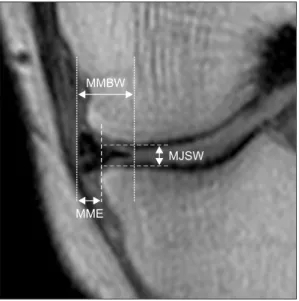
. The MM body width (MMBW), medial joint space width (MJSW), and MME were as­

sessed on the coronal plane showing maximal meniscal extrusion (Fig. 2). MMBW was measured from the inner margin to the outer margin of the MM. MME was defined as the distance be­

tween the medial edge of the tibial plateau and the outer margin

Table 1. Demographic and Clinical Characteristics

Characteristic Value

No. of patients/knees 33/33

Sex, male/female 6/27

Age (yr) 59.8±9.7 (35–74)

Height (m) 1.58±0.07 (1.46–1.75)

Body weight (kg) 69.9±15.6 (51–112)

Body mass index (kg/m2) 27.9±5.1 (23.0–44.3)

Femorotibial angle (°) 177.8±1.9 (174–181)

Duration from injury to first MRI (day) 45.4±59.3 (1–197) Interval between first and second MRIs (day) 47.8±40.1 (2–155) Values are presented as number only or mean±standard deviation (range).

MRI: magnetic resonance imaging.

Second MRI

before arthroscopic surgery (n=40) First MRI suggesting the presence of MMPRT (n=71)

Final analysis (n=33)

Additional exclusion (n=7)

Without a memory of painful popping event (n=5)

Previous meniscal surgery (n=2) Exclusion criteria (n=31)

Kellgren Lawrence grade >3 (n=16) Cartilage damage

(Outerbridge grade >3) (n=10) Refused participation (n=5)

Fig. 1. Flow chart detailing the study protocol. MRI: magnetic resonance imaging, MMPRT: medial meniscus posterior root tear.

(3)

of the MM

16)

. Osteophytes were excluded in the determination of the tibial margin. The MJSW was measured as the minimum distance between the femoral and tibial margins. To validate the MRI measurements, we assessed inter­observer and intra­

observer reliabilities using the intraclass correlation coefficient (ICC). Four orthopedic surgeons (Yo.O., T.U., Y.K., and Yu.O.) retrospectively examined the MRI scans in a blinded manner.

The ICC was calculated for each MRI parameter using two­way, random, single measures with absolute agreement.

In addition, we calculated the increase of MME (ΔMME) be­

tween the first and second MRI examinations and performed linear regression analysis to assess the correlation of ΔMME with the interval of MRI examinations. We defined the best­fit regression coefficient as the MME progression speed. The MME increase rate was also calculated as ΔMME divided by the inter­

val of MRI examinations. The correlations of MME increase rate with age, BMI, FTA, and MJSW were also evaluated.

3. Statistical Analysis

The changes in MRI measurements between the first and sec­

ond MRI scans were evaluated using the Wilcoxon signed­rank test. Data are presented as mean±standard deviation. Significance was set at p<0.05. Power and statistical analyses were performed using EZR (Saitama Medical Center, Saitama, Japan), which is a

graphical user interface for R (R Foundation for Statistical Com­

puting, Vienna, Austria). Sample size was estimated for a mini­

mal statistical power of 80% (α=0.05). Linear regression analysis was used to evaluate Pearson’s correlation coefficient. A good correlation was represented by R

2

≥0.60; moderate correlation, by

R2

≥0.40; and poor correlation, by R

2

<0.40.

Results

On MRI­based measurements, MMBW and MJSW showed no significant differences between the first and second MRI ex­

aminations (p=0.066 and 0.260, respectively; Table 2). The mean MME significantly increased from 3.4±1.1 mm to 4.5±1.1 mm between the two MRI examinations. The values of inter­observer and intra­observer reliabilities were excellent (ICC≥0.91) for all MRI measurements. A good correlation was observed between ΔMME and the time interval of MRI (R

2

=0.621). The regression analysis was calculated as follows: ΔMME (mm)=0.020 (mm/

Fig. 2. Magnetic resonance imaging (MRI)­based measurements of the medial meniscus body width (MMBW), medial joint space width (MJSW), and medial meniscus extrusion (MME) (left knee). The mea­

surement was performed on the coronal plane image showing maximal MME. The vertical lines show the inner and outer borders of the medial meniscus. A vertical dashed line denotes the tibial medial margin. The MJSW was measured as the minimum distance between the femoral and tibial margins (the horizontal dashed lines).

Table 2. Mean Differences between the First and Second MRI Examinations

Variable First MRI Second MRI p­value

MMBW (mm) 8.7±1.2 9.2±1.4 0.066

MJSW (mm) 3.8±0.4 3.7±0.5 0.260

MME (mm) 3.4±1.1 4.5±1.1 <0.001*

Values are presented as mean±standard deviation.

MRI: magnetic resonance imaging, MMBW: medial meniscus body width, MJSW: medial joint space width, MME: medial meniscus extrusion.

*Significance was determined with use of Wilcoxon signed­rank test (p<

0.05).

0 4

2

MRI interval (days) 0

MME(mm)

150

30 60 90 120

Fig. 3. Correlation between the increase in medial meniscus extrusion (ΔMME) and the time interval of magnetic resonance imaging (MRI) scans, with a Pearson’s correlation coefficient (R2=0.621). The regression equation was linear: ΔMME (mm)=0.020 (mm/day)×MRI interval (day).

(4)

day)×MRI interval (day) (Fig. 3).

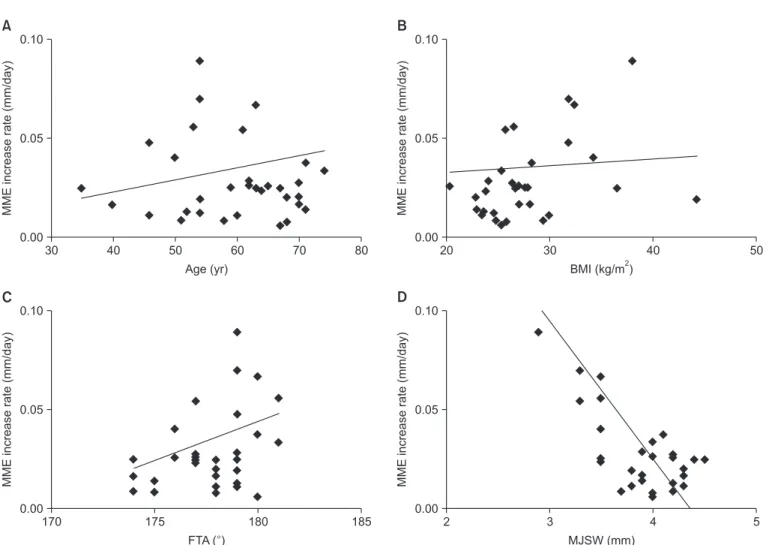
Fig. 4 presents the results of linear regression analysis for corre­

lations of the MME increase rate with age, BMI, FTA, and MJSW.

Little correlation was seen between the MME increase rate and age, BMI, and FTA (R

2

=0.019, 0.001, and 0.031, respectively; Fig.

4A–C). On the other hand, a moderate inverse correlation was observed between the MME increase rate and MJSW (R

2

=0.432;

Fig. 4D).

Discussion

The important findings of this study were that the MME in­

crease correlated with the time interval of MRI and that the nar­

rowing of MJSW was associated with the MME increase rate. In addition, the time­dependent MME increase rate was estimated to be 0.020 mm per day, which is much faster than that in OA knees (0.040 mm per year) on the basis of a cohort study data

from the Osteoarthritis Initiative

17)

. Several studies have reported that MME is associated with the progression of symptomatic OA and spontaneous osteonecrosis of the knee (SONK)

8,18,19)

. In this regard, the rapid MME increase may explain why MMPRT leads to advanced OA and SONK during short­term symptomatic pe­

riods

1,3,5)

.

Previous studies showed that the extent of MME highly cor­

related with the degree of joint space narrowing

7)

, but no studies

have analyzed the correlation between the MME increase rate

and MJSW. The 1­year change in MJSW had been explored by

using slight flexion radiographs of OA knees with only medial

joint space narrowing: the narrowing of the MJSW in OA knees

was as rapid as that of non­OA knees, with an annual rate of <0.2

mm

20)

. Similarly, in this study, there was no significant change in

the MJSW between the first and second MRI examinations in

MMPRT knees, and the mean reduction of MJSW was only 0.1

mm. On the other hand, the novel finding of this study was the

Fig. 4. The regression lines of the medial meniscus extrusion (MME) increase rate in relation to the age, body mass index (BMI), femorotibial angle (FTA), and medial joint space width (MJSW). Scatter plots of the correlation between the MME increase rate and age (R2=0.019; A), BMI (R2=0.001; B), FTA (R2=0.031; C), and MJSW (R2=0.432; D).

(5)

presence of direct correlation between narrowing of the MJSW and the MME increase rate. Narrowing of MJSW is considered as one of the indicators of MME progression in the natural course after the onset of an MMPRT. We infer from the results of this study that an MJSW of <3.5 mm may be a risk factor for rapid progression of MME due to femorotibial cartilage loss and ad­

vanced structural OA: all knees with an MJSN of <3.5 mm were found to have an MME increase rate of >0.05 mm per day (Fig.

4D).

The clinical results of conservative treatment for MMPRT have been described to be satisfactory with early diagnosis and ap­

propriate protocols

21,22)

. However, Kwak et al.

23)

reported that the high meniscal extrusion rate was the main poor prognostic factor of conservative treatment for MMPRT. It is conceivable that early surgical repair could be recommended for MMPRT patients with large meniscal extrusion. A meta­analysis reported that MMPRT repair resulted in significant improvements of the postoperative clinical subjective scores compared with the preoperative ones, although meniscal extrusion was not completely reduced

24)

. In contrast, Chung et al.

25)

demonstrated that, decreased meniscal extrusion was associated with more favorable clinical and ra­

diological mid­term outcomes after pullout repair of MMPRTs.

Therefore, we think surgeons should perform early treatment for MMPRT to prevent a deleterious effect on the outcomes, consid­

ering that the extent of MME can increase by 1 mm in 50 days in the presence of an MMPRT.

There were several limitations to this study. First, the MRI ex­

aminations were performed at different intervals (from the onset of MMPRT to the first MRI and from the first MRI to the second MRI). Second, we calculated the MME increase rate using only linear regression analysis. In actuality, MME is more likely to show a curvilinear increase to some extent because the MME progression might reach the plateau in the chronic period from the onset of an MMPRT. However, to avoid including patients with chronic MMPRT, we excluded patients who did not have a painful popping event and degenerative changes in the cartilage and meniscus. Third, we evaluated the MRI­based MME under non­weight bearing conditions, hence the increase in MME might have been underestimated. MRI multiplanar reconstruc­

tion using thin slices under loading condition would provide a large amount of data on the MME progression and meniscal movement. Finally, our study had a retrospective design and a small sample size. Further studies with large sample sizes will be required to evaluate the effect of MME progression on the symp­

tomatic course of MMPRT.

The clinical significance of this study is the evaluation of the

MME increase rate; this information may help surgeons to select between conservative and operative treatment for MMPRTs. In addition, the MRI­based measurement of MJSW may be useful to determine the timing of surgery to address the concerns of further progression of MME and cartilage damage.

Conclusions

This study demonstrated that the MME increase in MMPRT knees correlated with the time interval of MRI scans after the onset of MMPRT, and the MME increase rate was estimated to be 0.020 mm per day. The narrowing of MJSW was an associated factor in the rapid increase of MME, indicating that the measure­

ment of MJSW may be useful to predict further progression of MME.

Conflict of Interest

No potential conflict of interest relevant to this article was re­

ported.

Acknowledgments

We thank Dr. Shinichi Miyazawa for his clinical support.

References

1. Bhatia S, LaPrade CM, Ellman MB, LaPrade RF. Menis­

cal root tears: significance, diagnosis, and treatment. Am J Sports Med. 2014;42:3016­30.

2. LaPrade CM, Ellman MB, Rasmussen MT, James EW, Wi­

jdicks CA, Engebretsen L, LaPrade RF. Anatomy of the an­

terior root attachments of the medial and lateral menisci: a quantitative analysis. Am J Sports Med. 2014;42:2386­92.

3. LaPrade CM, James EW, Cram TR, Feagin JA, Engebretsen L, LaPrade RF. Meniscal root tears: a classification system based on tear morphology. Am J Sports Med. 2015;43:363­9.

4. Bae JH, Paik NH, Park GW, Yoon JR, Chae DJ, Kwon JH, Kim JI, Nha KW. Predictive value of painful popping for a posterior root tear of the medial meniscus in middle­aged to older Asian patients. Arthroscopy. 2013;29:545­9.

5. Cinque ME, Chahla J, Moatshe G, Faucett SC, Krych AJ, LaPrade RF. Meniscal root tears: a silent epidemic. Br J Sports Med. 2018;52:872­6.

6. Hajek PC, Gylys­Morin VM, Baker LL, Sartoris DJ, Haghighi

P, Resnick D. The high signal intensity meniscus of the knee.

(6)

Magnetic resonance evaluation and in vivo correlation. In­

vest Radiol. 1987;22:883­90.

7. Bloecker K, Guermazi A, Wirth W, Benichou O, Kwoh CK, Hunter DJ, Englund M, Resch H, Eckstein F; OAI investiga­

tors. Tibial coverage, meniscus position, size and damage in knees discordant for joint space narrowing ­ data from the Osteoarthritis Initiative. Osteoarthritis Cartilage. 2013;21:

419­27.

8. Lee DH, Lee BS, Kim JM, Yang KS, Cha EJ, Park JH, Bin SI.

Predictors of degenerative medial meniscus extrusion: radial component and knee osteoarthritis. Knee Surg Sports Trau­

matol Arthrosc. 2011;19:222­9.

9. Kawaguchi K, Enokida M, Otsuki R, Teshima R. Ultrasono­

graphic evaluation of medial radial displacement of the me­

dial meniscus in knee osteoarthritis. Arthritis Rheum. 2012;

64:173­80.

10. Stehling C, Souza RB, Hellio Le Graverand MP, Wyman BT, Li X, Majumdar S, Link TM. Loading of the knee during 3.0T MRI is associated with significantly increased medial meniscus extrusion in mild and moderate osteoarthritis. Eur J Radiol. 2012;81:1839­45.

11. Choi CJ, Choi YJ, Lee JJ, Choi CH. Magnetic resonance im­

aging evidence of meniscal extrusion in medial meniscus posterior root tear. Arthroscopy. 2010;26:1602­6.

12. Furumatsu T, Kodama Y, Kamatsuki Y, Hino T, Okazaki Y, Ozaki T. Meniscal extrusion progresses shortly after the me­

dial meniscus posterior root tear. Knee Surg Relat Res. 2017;

29:295­301.

13. Furumatsu T, Kamatsuki Y, Fujii M, Kodama Y, Okazaki Y, Masuda S, Ozaki T. Medial meniscus extrusion correlates with disease duration of the sudden symptomatic medial meniscus posterior root tear. Orthop Traumatol Surg Res.

2017;103:1179­82.

14. Furumatsu T, Fujii M, Kodama Y, Ozaki T. A giraffe neck sign of the medial meniscus: a characteristic finding of the medial meniscus posterior root tear on magnetic resonance imaging. J Orthop Sci. 2017;22:731­6.

15. Masuda S, Furumatsu T, Okazaki Y, Kodama Y, Hino T, Ka­

matsuki Y, Miyazawa S, Ozaki T. Medial meniscus posterior root tear induces pathological posterior extrusion of the me­

niscus in the knee­flexed position: an open magnetic reso­

nance imaging analysis. Orthop Traumatol Surg Res. 2018;

104:485­9.

16. Furumatsu T, Kodama Y, Kamatsuki Y, Hino T, Ozaki T.

Arthroscopic repair of the medial meniscus radial/oblique

tear prevents the progression of meniscal extrusion in mildly osteoarthritic knees. Acta Med Okayama. 2017;71:413­8.

17. Bruns K, Svensson F, Turkiewicz A, Wirth W, Guermazi A, Eckstein F, Englund M. Meniscus body position and its change over four years in asymptomatic adults: a cohort study using data from the Osteoarthritis Initiative (OAI).

BMC Musculoskelet Disord. 2014;15:32.

18. Berthiaume MJ, Raynauld JP, Martel­Pelletier J, Labonté F, Beaudoin G, Bloch DA, Choquette D, Haraoui B, Altman RD, Hochberg M, Meyer JM, Cline GA, Pelletier JP. Menis­

cal tear and extrusion are strongly associated with progres­

sion of symptomatic knee osteoarthritis as assessed by quan­

titative magnetic resonance imaging. Ann Rheum Dis. 2005;

64:556­63.

19. Gale DR, Chaisson CE, Totterman SM, Schwartz RK, Gale ME, Felson D. Meniscal subluxation: association with osteo­

arthritis and joint space narrowing. Osteoarthritis Cartilage.

1999;7:526­32.

20. Benichou OD, Hunter DJ, Nelson DR, Guermazi A, Eckstein F, Kwoh K, Myers SL, Wirth W, Duryea J; Osteoarthritis Ini­

tiative Investigators. One­year change in radiographic joint space width in patients with unilateral joint space narrow­

ing: data from the Osteoarthritis Initiative. Arthritis Care Res (Hoboken). 2010;62:924­31.

21. Lim HC, Bae JH, Wang JH, Seok CW, Kim MK. Non­opera­

tive treatment of degenerative posterior root tear of the me­

dial meniscus. Knee Surg Sports Traumatol Arthrosc. 2010;

18:535­9.

22. Neogi DS, Kumar A, Rijal L, Yadav CS, Jaiman A, Nag HL.

Role of nonoperative treatment in managing degenerative tears of the medial meniscus posterior root. J Orthop Trau­

matol. 2013;14:193­9.

23. Kwak YH, Lee S, Lee MC, Han HS. Large meniscus extru­

sion ratio is a poor prognostic factor of conservative treat­

ment for medial meniscus posterior root tear. Knee Surg Sports Traumatol Arthrosc. 2018;26:781­6.

24. Chung KS, Ha JK, Ra HJ, Kim JG. A meta­analysis of clinical and radiographic outcomes of posterior horn medial me­

niscus root repairs. Knee Surg Sports Traumatol Arthrosc.

2016;24:1455­68.

25. Chung KS, Ha JK, Ra HJ, Nam GW, Kim JG. Pullout fixation

of posterior medial meniscus root tears: correlation between

meniscus extrusion and midterm clinical results. Am J

Sports Med. 2017;45:42­9.

수치

Fig. 1. Flow chart detailing the study protocol. MRI: magnetic resonance  imaging, MMPRT: medial meniscus posterior root tear.
Table 2. Mean Differences between the First and Second MRI  Examinations
Fig. 4 presents the results of linear regression analysis for corre­

참조

관련 문서

Consequently, Zr-Cu binary alloys have the potential to be used as biomaterials with nullifying magnetic properties for magnetic resonance imaging diagnosis and

The third was combination of levator palpebrae, superior rectus, inferior oblique muscle weakness(n=5) and the fourth was the third group plus medial rectus

Postoperative Postoperative Postoperative Postoperative Magnetic Magnetic Magnetic Magnetic resonance resonance resonance image resonance image image image shows

This study aimed to evaluate the site and extent of injury, injury mechanism, player position, and the reinjury incidence in the hamstring by using magnetic

Analysis of body characteristics on olive flounder ( Paralichthys oilvaceus ) fed on the extruded and moist pellets (body weight, body length, body height and body width) · ·

Simultaneous Measurements of the Wake Flow of a Circular Cylinder with a Flexible Film and Its Motions using

Moreover, a battery imaging technique to visualize the current distribution pattern using a magnetic field induced at batteries under external current load has

Fig. 34 The consist of magnetic and non-magnetic fractions of the 60min precipitate.. 자착물의 함량은 Fig. 35 The distribution of magnetic and non-magnetic fractions of