JKSCI
Location Trigger System for the Application of Context-Awareness based Location services
1)
Yon-Sik Lee*, Min-Seok Jang*
*Professor, School of Computer Information and Communication Engineering, Kunsan National University, Kunsan, Korea
[Abstract]
Recent research has been actively carried out on systems that want to optimize resource utilization by analyzing the intended behavior and pattern of behavior of objects (users, consumers). A service system that applies information about an object's location or behavior must include a location trigger processing system for tracking an object's real-time location.
In this paper, we analyze design problems for the implementation of a context-awareness based location trigger system, and present system models based on analysis details. For this purpose, this paper introduces the concept of location trigger for intelligent location tracking techniques about moving situations of objects, and suggests a mobile agent system with active rules that can perform monitoring and appropriate actions based on sensing information and location context information, and uses them to design and implement the location trigger system for context-awareness based location services. The proposed system is verified by implementing location trigger processing scenarios and trigger service and action service protocols. In addition, through experiments on mobile agents with active rules, it is suggested that the proposed system can optimize the role and function of the application system by using rules appropriate to the service characteristics and that it is scalable and effective for location-based service systems.
This paper is a preliminary study for the establishment of an optimization system for utilizing resources (equipment, power, manpower, etc.) through the active characteristics of systems such as real-time remote autonomous control and exception handling over consumption patterns and behavior changes of power users. The proposed system can be used in system configurations that induce optimization of resource utilization through intelligent warning and action based on location of objects, and can be effectively applied to the development of various location service systems.
▸Key words: Location trigger system, Mobile agent, Context-awareness based location service, Sensor network middleware
[요 약]
본 논문은 지능형 위치추적을 위한 위치트리거와 이동에이전트 시스템 기술을 적용하여, 상황인식 기반 위치서비스를 위한 위치트리거 시스템을 설계 및 구현한다. 또한, 트리거 및 조치 서비스 프로토콜 구현과 능동규칙 탑재 이동에이전트에 대한 실험을 통하여, 제안 시스템이 상황인식 기반 위치서비스의 특성에 따른 시스템 최적화 및 위치 기반 서비스 응용들에 대한 확장성과 유효성이 있음을 검증한다.
제안 시스템은 전력 사용자의 소비 패턴 및 행위 변화에 대한 시스템의 능동적 특성을 통한 자원 활용의 최적화 시스템 구축을 위한 예비 연구로써, 객체 위치 기반의 지능적 경고와 조치를 통한 환경 및 자원 활용 최적화와 다양한 위치서비스 응용 시스템 구축에 효과적으로 적용할 수 있다.
▸주제어: 위치트리거 시스템, 이동에이전트, 상황인식 기반 위치서비스, 센서 네트워크 미들웨어
∙First Author: Yon-Sik Lee, Corresponding Author: Min-Seok Jang
*Yon-Sik Lee ([email protected]), School of Computer Information and Communication Engineering, Kunsan National University, Jeonbuk, Korea
*Min-Seok Jang ([email protected]), School of Computer Information and Communication Engineering, Kunsan National University, Jeonbuk, Korea
∙Received: 2019. 08. 06, Revised: 2019. 09. 23, Accepted: 2019. 09. 24.
Copyright ⓒ 2019 The Korea Society of Computer and Information http://www.ksci.re.kr pISSN:1598-849X | eISSN:2383-9945
I. Introduction
A variety of studies have recently been conducted on context-awareness application systems that use contextual information, such as users' physical environments, status and retention information, in a given space [15,17,18].
Context-based systems that need to collect and apply information about the behavior of objects require a location trigger system and an intelligent location tracking system [17,18].
This paper designs and implements the main components necessary to develop the context-awareness based location service system. A context-awareness based location service system is a technology that creates communication load with the server to identify the location of objects and execute arbitrary actions. In order to reduce server and communication load within a given space, this paper utilizes distributed control system in mobile agent middleware environment, and uses it to design and implement context-awareness based location trigger processing system. It is a suggestion of how to secure the activeness and autonomy of the system by directly collecting stream information of mobile objects using the mobile agent embedded in the terminal sensor node and taking appropriate actions through triggering on location context information and the active rules. For this purpose, this paper introduces the concept of location trigger for intelligent location tracking techniques for moving situations (starting, arriving, passing, stopping, etc.) of objects, and a mobile agent system that can perform monitoring and appropriate actions based on sensing information and location context information in any time and space.
This paper is part of the research to implement the application of context-awareness service of mobile agent-based object location in small area where sensor network environment is established, thus establishing optimization system of resource
(equipment, power, manpower, etc.) utilization. The proposed system will be used as a fundamental study for the establishment of a context-based optimization system for resource utilization through real-time location monitoring of objects, intelligent alerting and dynamic adjustment etc.
II. Related works
Recently, research has been actively conducted on the analysis and application technologies of the location tracking and behavior patterns of objects in order to enhance the utilization of facilities and resources in the indoor environment.
Various methods such as image detection using neural networks [1], smartphone sensor-based location detection and estimation [2,3], Bluetooth-based location estimation [4], sensor network system-based active tracking method [5].
and RFID system [6] were carried out to determine the location or existence of the object. While various studies like these have been conducted, they require separate hardware and have a characteristic disadvantage of complex communication protocols.
The Wi-Fi positioning system [7] has the problem of
increasing error range depending on obstacles or
distances, and how to use the Wi-Fi RSSI-based UWB
characteristics [7,8] can accurately identify objects
but interfere with other radio communication
systems. BLE-based Beacon Technology [9,10,11] can
solve problems affected by the environment through
simple implementations and low cost, but requires
convergence with other technologies when accurate
indoor positioning and precision measurements are
required. Location-tracking technology indoors is
reduced in system performance due to NLOS (Non
Line of Sight) or radio interference [6,11]. Studies
such as the efficient node placement [12], virtual AP
and Kalman filter-based algorithms [13] and
TOA-based technologies [14] are underway to address
these problems.
These existing studies require separate hardware, have characteristic shortcomings such as complicated communication protocols, and require convergence with other technologies that can play a supporting role due to low accuracy as a single technology. In addition, existing location measures and estimation methods are also subject to the user's physical environment, but also to the contextual environment, so a study of active intelligent location tracking systems based on context-awareness is also required.
III. Main Components of Location Trigger System
The location trigger system uses the mobile agent to send location information to the location server, and it sets and processes location triggers according to user and spatial characteristics [17,18]. The location server retrieves the User_ID and Area_DB and performs the required controls through the rule execution function of the management server or mobility agent when an event occurs.
This chapter introduces mobile agents with active rules and describes the key components and processes for processing location triggers.
1. Mobile agent with active rules
In this paper, a mobile agent with active rules is introduced for flexible structure that can operate dynamically according to various applications and needs of sensor network. The mobile agent acquires and transfers its sensor data while migrating between the sink and terminal sensor nodes, and performs active actions according to events. The mobile agent uses sensor data tables (with data collection time, current node number, number of data transfers, sensing data from previous node, sensing data from current node, etc.) that store and manage the characteristics of the sensor network for generating events through
migration and thresholds. To execute the event occurrence and action by the threshold, the mobile agent first starts migration from the sink node. It migrates with information made in a single string, such as the sensing data of the previous and current node, the threshold, and the count to unconditionally transfer acquisition data to the sink node. As the mobile agent moves with these data in one string, it acquires and transmits sensor values with serial communication, performs actions given as events occur, and can also updates the data and adds additional information.
2. Location trigger processing
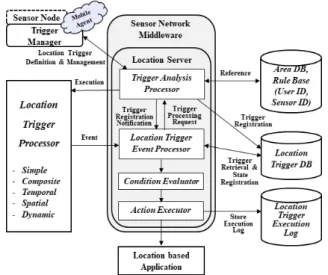
In a sensor network middleware environment that supports flexible linkage of a moving agent system and a location trigger system, Location Server and Location Trigger Processor work together to support location-based applications by processing location triggers. The following Fig. 1 shows the processing flow of location trigger system.
Fig. 1. Processing flow of location trigger system
The key components of the location trigger system are as follows.
- The Trigger Analysis Processor: It analyzes the
triggers by referring to the Area_DB and Rule Base
with User_ID and Sensr_ID, and, if necessary,
modifies the Area_DB and Rule Base.
- The Location Trigger Processor: It executes the location trigger and asynchronously transmits the detected events to the Location Trigger Event Processor.
- The Location Trigger Event Processor: It monitors the events and compares them to the location trigger DB. If a suitable trigger is detected, it is executed through the Action Executor.
- The Action Executor: It performs actions related to the triggered event and stores the results of processing in the Location Trigger Execution Log.
The Location Trigger Processor works with the Active Rule Manager to independently perform the process of event detection, condition assessment and action execution, and the location trigger processing scenario is as follows [18].
First, when the Trigger Manager sends a message for location trigger setup to the Trigger Analysis Processor using the location information collected, the Trigger Analysis Processor executes the Location Trigger Processor through its function and role. Then, when the Location Server sends a message for location trigger initialization to the Trigger Manager, the Trigger Manager examines the triggering User_ID and sends a message for location trigger event to the Location Server when it detects a location trigger event on the User_ID through the sensor node. The Location Server then executes the active rule for the event and sends a message for location trigger stop to the Trigger Manager via the mobile agent.
IV. context-awareness based Location Trigger System
1. System Configuration
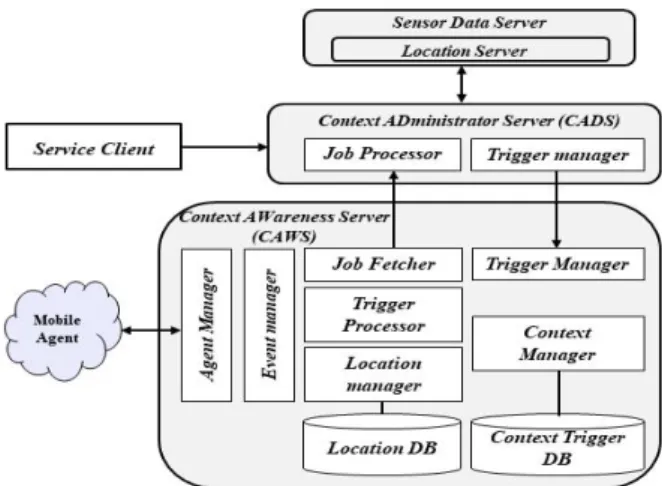
The context-awareness based location trigger system [18], which works with the location trigger model, consists of context-awareness Server,
Context ADministrator Server, Mobile Agent, and Service Client, whose main functions are as follows.
- The Context AWareness Server (CAWS) perform triggering related to the location and situation of objects.
- The Context ADministrator Server (CADS) operates and manages the overall details of the location trigger service (profile management, service request transmission, situation-related information request processing, and so on).
- The Mobile Agents collect and transmit sensor information and execute rules if necessary.
- The Service Client requests context-awareness service th the CADS and receives related information.
- Location Server operates and manages area, user, and sensor-related information and context-related rules used in service platforms.
CAWS and CADS are key components of the system that work in conjunction with other components to provide location-based application services, and Fig. 2 shows their relationship with other components.
Fig. 2. Relationship of CAWS and CADS with other components
The basic services required by the use of a context-awareness based location trigger system are as follows.
- Service Subscription Service
- Content Service
- Trigger Service - Action Service - Settings Service
- Event Notification Service
In this paper, the TCP/IP protocol consisting of request and response packets is applied for implementation of the trigger service and the action service that serves as the main role of the proposed system among the above services.
2. Location trigger service protocols 2.1 Trigger Service
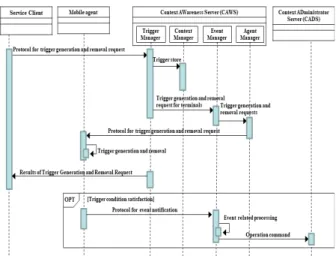
- Trigger Request Message(CADS -> CAWS): A message for CADS to request a trigger from CAWS, and the structure of packet is defined separately by the Header and Body. The Header is set in length and data type, and the Body in variable size.
Trigger related requests use HTTP's GET format to specify packet parameters. Body specification for trigger generation request is created by setting the required data into parameters, and specification for trigger removal request uses trigger ID as a parameter, and removal is automatically removed after the drive period.
- Trigger Response Message(CAWS -> CADS): A message for CAWS to respond to a trigger request from CADS, and the packet structure is the same as the trigger request message. Body contents are set to specify parameters for responding to trigger generation, removal, and information requests.
Body specification returns the corresponding trigger ID and processing result as parameters when responding to a generation and removal request, and if the response to an information request, set the trigger ID, processing result, location, event, action, request terminal ID, and trigger list as parameters.
The following Fig. 3 shows the flow of processing for trigger requests and response messages in the proposed system.
Fig. 3. flow of processing for trigger requests and response messages
2.2 Action Services
- Action Request Message(CAWS -> CADS): The same packet structure as the trigger service is used as a message to request action from CADS on triggers generated by CAWS. Body specification for action request is used by setting the required data into parameters.
- Action response message(CADS -> CAWS): As a message for the response of CADS to action requests from CAWS, Body specifications within the packet use code values that indicate the results of the processing of success and errors.
As above, in this paper, using the role and function of location services based on the context-awareness based location trigger system consisting mainly of CADS and CAWS [18], the adequacy and applicability of the proposed system can be verified by implementing a request-response protocol for the trigger and action services.
V. Experiments and results
1. Experiments on location trigger processing
In order to apply location services using location
trigger system, the real-time movement
coordinates, the speed of movement, and the
distance of movement of mobile objects were
implemented by experimenting with the coordinate values of objects first. In a small sensor network environment based on mobile agent middleware, the application of location services of objects using IP addresses is underway by applying the method of implementing coordinate values.
The experiment using coordinate values employed by TI Corporation's MSP430 (10k RAM, 48k Flash) to use the 2420 platform for IEEE 802.15.4 and the TinyOS-based wireless sensor network development environment. And for program development and data collection tests, development convenience was ensured by communicating with PC using USB.
The following Fig. 4 shows the experimental results monitored for the real-time moving coordinates, moving speed, and moving distance of an object, using the coordinate values of the object.
a) Terminal node location input monitoring
b) Real-time object movement coordinates monitoring
c) Real-time object speed monitoring
d) Real-time object movement monitoring Fig. 4. Monitoring object location using coordinate values
Based on the above location-trigger processing techniques using coordinate values, We want to implement a method for deploying terminal sensor nodes on the basis of IP addresses, data collection and actions for location triggers through mobile agents, and through them, we want to implement a
location service application based on the moving situation information of objects (users).
2. Experiments on migration and rule execution of mobile agent with active rules
Migration and rule execution experiments of mobile agents with active rules used Odroid W and U3 models that could be mounted on Ubuntu or Android. Sink nodes and DB were tested by using two PCs, including WiFi Module, and placing five sensor nodes consisting of Arduino and sensor modules. Ubuntu 14.04 was uploaded to each module to implement the operation of each sensor node, then used the Python language and TCP/IP serial communication, and simulated using the Putty tool in Window 7 to check the status of each node and check the data acquisition and processing.
The experiment is about migration of mobile agents and whether active rules (limited transmission based on acquired data) are implemented, and the active rules used are as follows.
c_data = ser.readline() ; if ( count == 2 ) then
Send curr_data to sink node ; count = 0 ;
else
diff_data = abs(curr_data - prev_data) ; if ( diff_data > Threshold )
then
Send curr_data to sink node ; count = 0 ;
else
count = count + 1 ; Migration to next node ;
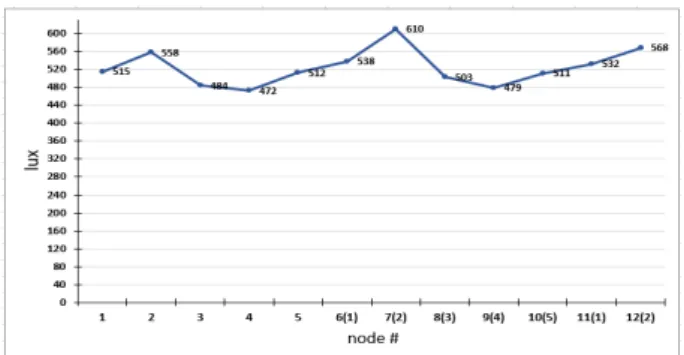
The following Fig. 5 shows the data stored in DB
after transferring all sensing data to the sink node
without implementing active rules, as the mobile
agent migrating the five terminal sensor nodes
sequentially and repeatedly from node #1.
Fig. 5.
curr_datafrom sequential migration of the mobile agent and acquisition by sensor node
Fig. 6 and Fig. 7 show the contents of the database of curr_data that the mobile agent with active rules has sent to the sink node after executing a given active rule, moving all the terminal nodes sequentially and repeatedly. Fig. 6 is the result of applying only threshold to active rules, and Fig. 7 is the result of applying the threshold and count values.
Fig. 6. Results of execution of active rules applied with
thresholdFig. 7. Results of execution of active rules with
thresholdand
countAfter the experiment of execution of active rules with threshold and count, the information held by the mobile agent on each node is shown in Table 1.
(It is a result of experiments with actual sensor data measurements, so the acquisition data varies with the measurement time.)
node No. prev-
data curr_
data threshold
(lux) count