• 검색 결과가 없습니다.

Comparison of New Infant Chest Compression Methods: Simulation Study on Randomization Using Manikin

N/A
N/A
Protected

Academic year: 2021

Share "Comparison of New Infant Chest Compression Methods: Simulation Study on Randomization Using Manikin"

Copied!
7
0
0

로드 중.... (전체 텍스트 보기)

전체 글

(1)

Comparison of New Infant Chest Compression Methods: Simulation Study on Randomization Using Manikin

1)

Seong-Woo Yun*

Abstract

In this paper, we propose a the effects of new chest compressions in the implementation of chest compressions during infant cardiopulmonary resuscitation, and to provide basic data for high-quality CPR. On March 12, 2019, the research target used the SPSS 22.0 Version as an experimental study using randomized cross-design of 30 emergency medical services students who completed BLS Health Care-provider. The study also showed significant differences in chest depth and average rate of pressure(34.61±1.29, 39.40±1.08, <0.001, 105.46±4.23, 107±3.84, <0.001) depending on chest compressions. There was also a significant difference in the convenience and degree of pain of chest compressions(<0.001). In addition, new chest compressions appeared close to vertical and showed statistically significant differences(p<.001). Based on the results of this study, we can see that the accuracy of the new chest compressions during infant cardiopulmonary resuscitation is increased, and the depth of chest compressions is improved, improving the quality index of chest compressions.

However, it will be necessary to further study the use of the new chest compressions to identify the potential for clinical use.

▸Keyword: Infant CPR, Compression position, Cardiopulmonary resuscitation, Quality of chest compression, Cardiac arrest.

I. Introduction

Cardiac arrest is a series of conditions that occur when a heartbeat stops, regardless of the cause[1]. The incidence of cardiac arrest in infants and children is about 70 per 100,000 people, and the incidence is low compared to adults, and about 30% of infant cardiac arrest in less than 12 months[2]. However, the survival and recovery rate of infants are lower than those of children and adolescents[2]. Infants are less mental and physically mature than adults, impulsive, and more easily exposed to accidents than adults[3]. In addition, the ability to defend or cope with risk situations is less than

adults [3,4]. Cardiopulmonary resuscitation(CPR), which is the only technique in the event of a cardiac arrest, adequately maintains Coronary Perfusion Pressure and Cerebral Blood Flow. If blood supply is stopped due to cardiac arrest, the high-quality chest compressions can provide blood circulation to the brain, heart, and lungs to prevent tissue necrosis and improve patient survival[5,6].

For adults, for good cardiopulmonary resuscitation, one's palm is placed in the middle of the chest or in the lower half of the dressing bone, and the other palm is superimposed on it and the chest is pressed vertically

∙First Author: Seong-Woo Yun, Corresponding Author: Seong-Woo Yun

*Seong-Woo Yun ([email protected]), Dept. of Emergency Medical Service, Namseoul University

∙Received: 2019. 04. 11, Revised: 2019. 04. 24, Accepted: 2019. 04. 24.

(2)

using the recoil of both hands and waist [7,8]. Also, minimize chest compressions, compress the chest to a depth of at least 5 cm and a depth of less than 6 cm, and compress the chest at 100-120 revolutions per minute[7,8]. On the other hand, for infants, chest compression is achieved by using two fingers, just below the imaginary line connecting the two papillae and the chest bones, with two fingers vertically, at a rate of 100-120 per minute at a depth of about 4 cm, Compresses 1/3 of the thickness[8,9]. When two or more rescuers are present, chest compression with two thumbs is recommended[10]. However, the index finger and middle finger by using the two-finger compression method have anatomically different length and shape[11], affecting their posture, pain and fatigue, It may be difficult to press it to a depth of about 4 cm recommended by the American Heart Association. In the previous study, the two-finger chest compression method failed to reach a depth of about 3 cm[12], and half of the chest compressions were shallow, indicating that chest compression was not effective[13]. In cardiopulmonary resuscitation, a moderate depth of chest compression can produce about 25-50% of the normal cardiac output, thereby providing blood flow to the brain and heart tissue[14,15]. In particular, cardiopulmonary resuscitation in infants is similar to that of adults, but rapid cardiopulmonary resuscitation with adequate chest compressions is important because the cause of cardiac arrest is more likely to be caused by respiration[16]. In this study, comparing the effectiveness of two-finger chest compressions with the new chest compressions using conventional indexes and middle fingers, and find out the usefulness of appropriate and effective chest compressions.

II. Methodology

1. Study design

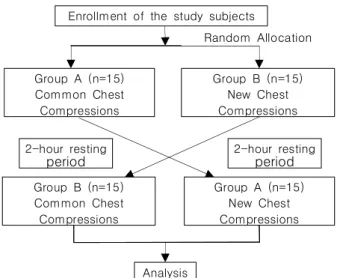
This study was a randomized crossover design study to compare the general chest compressions and the new chest compressions during infant CPR. The study design is shown in Figure 1.

Enrollment of the study subjects

Group A (n=15) Common Chest

Compressions

Analysis

Group B (n=15) New Chest Compressions

2-hour resting

period 2-hour resting

period Group B (n=15)

Common Chest Compressions

Group A (n=15) New Chest Compressions Random Allocation

Fig. 1. Research design

2. Study Object

For the selection criteria, preliminary experiments were performed prior to this experiment and the number of subjects was selected using G * Power (Ver. 3.1).

Effective Size was calculated as 80% power at the 0.05 level, and a total of 26 subjects were needed, 13 of them in the experimental group and 13 in the control group.

The subjects of this study were 32 patients who completed the BLS Health Care-Provider course in the American Heart Association (AHA) and the Korean Association of Cardiopulmonary Resuscitation (KACPR).

complained finger pain during the experiment, the final 30 were used in the experiment. In addition, the subjects who understood the purpose of this study and agreed to participate through written consent were selected for the experiment.

3. Study Protocol

The study subjects were informed about the purpose and process of the study before participating in the study.

One of the number plates prepared according to the sample number of the experimental group was selected.

Odd numbers were used for general chest compressions,

and even numbers were used for new chest

compressions. Each group was 15. Subjects underwent

chest compressions for 2 minutes using the assigned

method and were allowed to rest for 2 hours to minimize

fatigue of previous chest compressions after chest

compressions. After resting, the chest pressure was

changed and the chest pressure was applied again for 2

minutes. All subjects were did the chest compressions

using both methods. To avoid errors in the experiment,

(3)

the subject was prevented from seeing the monitor screen during chest compression and did not explain any of the experiments.

4. Data Collection and Tool 4.1 Survey Tool

The general characteristics(age, height, weight, education) and the convenience of chest compression, ease of artificial respiration, and pain level which felt by subjects were recorded in a self-report form when the chest pressure was applied. After each chest compression finished, to measure scores from 1 to 10, the Visual Analogue Scale was used. The convenience for chest compression was rated as 1 point for "very uncomfortable"

and 10 points for "very convenient". The ease of artificial respiration was indicated by 1 point for "very difficult", 10 points for "very easy", and the degree of pain of the finger at the time of chest compression is indicated from 1 point to 10 points at both ends of the line.

4.2 Chest compressions method

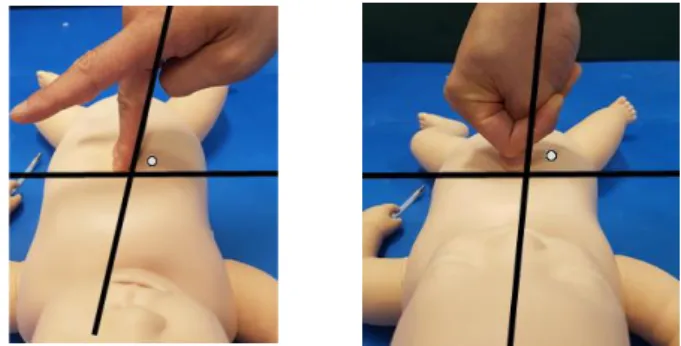
A common chest compression method is vertically pressing over the existing fingers (second and third fingers)[Fig. 2]. The new chest compression method is a method in which the thumb is surrounded by the index finger and the third node of the middle finger supports the back of the thumb and presses with the tip of the thumb[Fig. 3].

Fig. 2. Common Chest Compressions

Fig. 3. New Chest Compressions

4.3 Quality of Chest Compression

For this experiment, experiments were conducted with Laerdal Resusci Baby QCPR Manikin (Laerdal Medical, Stavanger, Norway) and data were used to measure the depth and velocity of chest compression through the average of 2-minute chest compressions[Figure 4].

Fig. 4. Laerdal Resusci Baby QCPR Manikin

4.4 Angle according to chest compressions

During chest compression, To measure the angle of the fingers and manikin chest when chest was pressed, a digital video camera (Sony, HDR-CX405) used for shot. The point at which the chest was depressed during the second cycle of each chest compression was captured and photographed to measure the angle. The angles were drawn on a line parallel to the chest of the manikin, the fingers and straight lines were drawn, and then the inner angle measured by these two lines was measured[Figure 5].

Fig. 5. Angle according chest compressions

5. Data Analysis

The collected data were analyzed using SPSS Ver. 22.0 for Win statistics program. The collected data were analyzed using SPSS Ver. 22.0 for Win statistics program.

Patients' age, height(cm), body weight(kg), ease of use,

and pain level were determined by mean and standard

deviation. The comparisons between the two control

groups (mean compression depth, mean compression rate)

were made using the Paired t-test test. The significance

level of all analyzes was set at 0.05.

(4)

III. Results

1. General characteristics of subjects

Mean age was 24.36±2.13 years, mean height was 169.53 ± 8.39 cm, and mean weight was 63.36±11.32 kg.

All participants had undergone CPR training[Table 1].

Characteristics N(%)/M±SD

Age(year) 24.36±2.13

Height(cm) 169.53±8.39

Weight(kg) 63.36±11.32

Education CPR 30(100.0)

Table 1. General characteristics of the subjects

2. Comparison of general chest compressions and new chest compressions

Table 2 shows the results of measuring and comparing the quality of chest compressions after performing general chest compressions and new chest compressions.

The depth of chest compressions was significantly deeper than that of normal chest compressions(p<.001), and the mean chest compressions speed also showed statistically significant differences(p<.001).

Characteristics CCC NCC t  p

Mean

depth, mm 34.61±1.29 39.40±1.08 -17.09 <0.001 Chest

Compression rate, min

105.46±4.23 107±3.84 -6.728 <0.001

CCC: Common Chest Compressions NCC: New Chest Compressions

Table 2. Comparison of quality of new chest compressions with common chest compressions

3. Comparison of the ease of use, ease of artificial respiration, and degree of pain for common chest compression and new chest compression methods As a result of comparing convenience according to chest compression method, new chest compressions (8.66±1.32) were more convenient than general chest compressions (4.46±0.50) (p <.001). In addition, the new chest compression method (4.33±1.26) showed less pain than the normal chest compression (8.20±1.24) (p <.001).

There was no statistically significant difference in ease of artificial respiration (p <.0269) [Table 3].

Characteristics CCC NCC t  p

Convenience of chest compressions

4.46±0.50 8.66±1.32 -15.389 <0.001

Ease of

ventilation 6.16±1.20 6.40±0.81 -1.126 0.269 Degree

of pain 8.20±1.24 4.33±1.26 9.032 <0.001 CCC: Common Chest Compressions

NCC: New Chest Compressions

Table 3. Comparison of the convenience, ease of ventilation, and degree of pain of common chest compressions and new chest compressions

4. Comparison the angle of general chest pressure and new chest pressure

Table 4 shows the difference in angles according to each method when pressing the chest. The new chest compressions(86.72±2.18) were closer to the vertical than the normal chest compressions(82.14±1.97) and showed statistically significant differences(p<.001).

Characteristics CCC NCC t  p

Inner angle during chest compressions

82.14±1.97 86.72±2.18 -8.885 <0.001

CCC: Common Chest Compressions NCC: New Chest Compressions

Table 4. Comparison of angles between normal chest compressions and new chest compressions

5. Preference of chest compression method The new chest compression method was applied in 22 cases (73.3%) and the general case was in 8 cases (26.7%), the new chest compression method was found to have higher preference[Table 5].

Characteristics CCC NCC

Perference 8(26.7%) 22(73.3%)

CCC: Common Chest Compressions NCC: New Chest Compressions

Table 5. Preference of chest compressions

IV. Discussion

Currently, CPR emphasizes the importance of chest

compressions in the order of chest compression - airway

maintenance - artificial respiration, compressing the heart

(5)

through chest compression and circulating blood throughout the body. High quality cardiopulmonary resuscitation refers to the proper depth and speed of chest compressions, complete relaxation of the chest, and minimization of interruption of the chest compression[6-8]. In addition, when cardiac arrest occurs, cardiopulmonary resuscitation by the first witness can be performed promptly to increase the survival rate of the patient[7,8].

As a result of this study, the results of questionnaire survey on the preference of the rescuer for the chest compressions were as follows. 22(73.3%) were new chest compressions, and 8(26.7%) were common chest compressions. The results of the new chest compressions showed higher preference. This may be due to the fact that the new chest compression method is effective in relieving the pain of the fingers during infant CPR and that the chest compression can be performed in a more convenient and stable posture. As such, the researcher tries to say about the reasons and favorable results of the new chest compression method. First, in this study, comparing the quality of chest compressions, the mean depth of chest compressions was significantly higher than that of general chest compressions(p<.001). This is due to the difference in the length of the anatomically different fingers when using both the conventional index finger and the stop finger, and it is difficult to support a stable posture due to the folding of the fingers. Because of this, a new chest compression method that surrounds with one index finger, the third finger of the stop finger supports the back of the thumb, and the tip of the thumb is pushed to the tip of the thumb. Therefore, it can be concluded that these results are shown. However, because of the different anatomical features of humans[11], occasionally the thumb may be too short, or it may be a difficult posture depending on the length of the fingernail. There was a significant difference in chest compression mean velocity(p<.001), this suggests that both groups are close to the recommended rate of 100-120 chest compressions per minute recommended by the American Heart Association, and each difference is thought to be meaningless. The American Heart Association recommends that adults, children, and infants should practice vertical pressure on chest compression[8]. During each chest compression, in order to determine whether the vertical compression was successful, the internal angle was measured, the new

chest compression method was 86.72±2.18°, general chest compression method was 82.14±1.97°, the new chest compression method was close to vertical and statistically significant difference(p<.001). In the case of a general two-finger compression method, since the finger is long and thin compared to the thumb, the finger can be bent and difficult to press it vertically. On the contrary, the new chest compression method is relatively short compared to other fingers, and it is possible to consistently maintain proper strength and depth when pressing with thick thumb, resulting in close to vertical.

As a result of comparing convenience according to chest compression method, new chest compressions(8.66±1.32) were more convenient than general chest compressions(4.46±0.50)(p <.001). Also, the degree of pain was significantly lower in the new chest compressions(4.33±1.26) than in the general chest compressions (8.20±1.24)(p <.001). Experiments on other chest compressions using both thumbs also indicated that most rescuers felt pain in the fingers, wrists, and arms in general chest compressions and that pain was reduced when the two thumb chest compressions were performed[17]. This results in a new chest compression method as shown in this study, which helps to keep the chest compression position stable. It is thought that the pain relief d rescuer would have felt more convenient through the supported posture, which was less impacted on chest compression and relaxation. Also, there is a difference between the objects, so it is difficult to make an accurate comparison. In the case of an adult chest compression using a silicone pad, it was found that the posture of the chest was kept stable, and the shock absorbing buffer function alleviated the pain and improved the quality of the chest compression[18]. In an infant's cardiac arrest, insufficient chest compressions can block the supply of adequate blood flow to the heart and brain and cause a decrease in the rate of resuscitation[19,20].

It is thought that the new chest compressions are less

forceful than general chest compressions and can be

applied in a stable posture. However, this study is a

simulated virtual study using manikin, not actual clinical

practice, and may be different from actual infant cardiac

situation. Therefore, in order to apply it to actual clinical

practice, further studies to be carried out in various

environments will be needed to complement this study.

(6)

Ⅴ. Conclusions

As a result of this study, when do the chest compressions during CPR, using a new chest compression method, pain and fatigue were reduced and convenience increased. As a result, it was found that the chest compression average depth, speed, and angle of pressure improved, and the quality index of chest compression improved. However, additional studies on new chest compressions are needed to confirm the possibility of practical use in clinical practice.

REFERENCES

[1] I. Jacobs, V. Nadkarni, J. Bahr, RA. Berg, JE. Billi, L.

Bossaert, “Cardiac arrest and cardiopulmonary resuscitation outcome report: update and simplification of the Utstein templates for resuscitation registries,”

Resuscitation, Vol. 110, No. 21, pp. 233-249, November 2004.

[2] I. K. Chang, Y. S. Ro, S. D. Shin, K. J. Song, J. H. Park, S. Y. Kong, “Association of dispatcher-assisted bystander cardiopulmonary resuscitation with survival outcomes after pediatric out-of-hospital cardiac arrest by community property value,” Resuscitation, Vol. 132, pp.

120-126, November 2018.

[3] I. O. Kim, and H. J. Park, “A survey on knowledge, experience and educational need child care teacher on infant health managent,” Journmal of Korea Open Association for Early Childhood Education, Vol. 17, No.

5, pp. 99-120, October 2012.

[4] S. G. Rho, “A study on the basic emergency treatment awareness level of kindergarten teacher,” Journmal of Korea Institue of Fire Sci, Vol. 21, No. 2, pp. 105-110, June 2007.

[5] M. Graham, and Schultz, “Emergency medical services response to cardiac arrest,” Prehospital Emergency Care, Vol. 1, No. 1, pp. 142-151, January 2012.

[6] G. Yoshikazu, F. Akira, G. Yumiko, “Relationship between emergency medical services response time and bystander intervention in patients with out-of-hospital cardiac arrest,” Journal of the American Heart Association, Vol.

7, No. 9, pp. 1-19, April 2018.

[7] American Heart Association(AHA), "Guidelines 2000 for Cardiopulmonary Resuscitation and Emergency Cardiovascular care," American Heart Association, Vol.

102, No. 8, pp. 136-139, August 2000.

[8] American Heart Association(AHA), "Guidelines 2005 for Cardiopulmonary Resuscitation and Emergency Cardiovascular care. American Heart Association, Vol.

112, No. 24, August 2005.

[9] K. M. Cho, S. C. Han, S. H. Lee, “Comparison of two infant chest compression techniques during simulated newborn cardiopulmonary resuscitation performed by asingle rescuer: A randomized, crossover multicenter trial,” Cardiology Journal, Vol. 21, No. 4, pp. 249-263, April 2018.

[10] S. Jacek, K. Mariusz, S. Adam, R. Jerzy, S. Lukasz,

“The quality of a newly developed infant chest compression method applied by paramedics,”

Kardiologia Polska, Vol. 75, No. 6, pp. 589-595, Mar 2017.

[11] J. Manning, A. Churchill, M. peters, “The effects of sex, ethnicity, and sexual orientation on self-measured digit ratio.”, Archives of Sexual Behavior, Vol. 36, No. 2, pp. 223-233, April 2007.

[12] S. Jacek, S. Lukasz, AG. Cristian, “Randomized comparison of two-thumb vs. two-finger chest compression during infant resuscitation performed by paramedics,” Resuscitation, Vol. 106, No. 1, pp. 34, September 2017.

[13] PK. Houri, LR. Frank, JJ. Menegazzi, “A randomized, controlled trial of two-thumb vs two-finger chest compression in a swine infant model of cardiac arrest,”

Prehospital Emergency, Vol. 1, No. 2, pp. 65-67 September 1998.

[14] BS. Abella, N. Sandbo, P. Vassilatos, JP. Alvarado, N.

O’Heam, HN. Wigder, “Chest compression rates during cardiopulmonary resuscitation are suboptime:

aprospective study during in-hospital cardiac arrest,”

Circulation, Vol. 293, No. 3, pp. 428-434, November 2005.

[15] KB. Kern, "Cardiopulmonary resuscitation without ventilation," Crit Care Med, Vol. 28, No. 11, pp. 186-189, August 2000.

[16] DJ. Harrington, CW. Redman, M. Moulden, CE.

Greenwood, “The long-term outcome in surviving infants with Apgar zero at 10 minutes: a systematic review of the literature and hospital-based cohort,”

Am J Obstet Gynecol, Vol. 196, No. 5, pp. 463-465, May 2017.

[17] JL. Pelleqrino, D. Boqumil, JL. Epstein, RV. Burke,

“Two-thumb-encircling advantageous for lay responder infant CPR: a randomised manikin study,”

Arch Dis Child, archdischild-2018-314893, July 2018.

[18] S. W. Yun, “The effect of using a assistant pad when

doing chest compression during cardiopulmonary

(7)

resuscitation,” The Korea Society of Computer an Information, Vol. 22, No. 2, pp. 105-110, Feb 2017.

[19] J. W. Park, J. Y. Jung, J. H. Kim, Y. H. Kwak, D. K.

Kim, “A Novel Infant Chest Compression Assist Device Using a Palm Rather Than Fingers: A Randomized Crossover Trial,” Prehospital Emergency Care, Vol. 23, No. 1, pp. 74-82, August 2018.

[20] C. W. Kim, J. H. Oh, “Effect of metronome guidance on infant cardiopulmonary resuscitation,” European Journal of pediatrics, Mar 8. doi: 10.1007/s00431-019- 03357-0. 2019.

Authors

Seong-woo Yun received the B.S., M.S.

degrees in department of emergency

medical service from Kongju National

University Korea in 2009 and 2011

respectively and Ph. D. degree in Health

Science from Chosun National University,

Korea, in 2014. Dr. Yun joined the Department of Chonnam

National University Hospital, gwangju in 2009. He is

currently a Professor in the Department of emergency

medical service, Namseoul University. He is interested in

CPR. simulation experiment, and prehospital treatment.

수치

Fig.  1.  Research  design
Fig.  3.  New  Chest  Compressions

참조

관련 문서

첫째, UTAUT모형을 이용하여 스마트폰 어플리케이션의 구매에 대해 검정한 결과 독립변수들 (성과기대, 예상노력, 사회적 영향, 유희적 가치,

1 John Owen, Justification by Faith Alone, in The Works of John Owen, ed. John Bolt, trans. Scott Clark, &#34;Do This and Live: Christ's Active Obedience as the

This study confirmed that the characteristics of cyberspace, hypermedia and multi-sensory experience of new media in the fourth industrial revolution era can

Third, based on the above results, this study concluded that the competitiveness of the agricultural product distribution industry in uncertain business

Therefore, this study speculated on block building toys that can enhance spatial sense in infants based on the development of creativity and sociability

This dissertation is composed of 6 chapters. ChapterⅠ deals with the purpose and the methods of this study. ChapterⅡ refers the methods and the problems of

That is, the dry powder of the sludge wastes, generated during the decommissioning of nuclear power plants, were compacted, and a study, focused on

From the results of this study, we concluded that two different sized graft materials have positive effects on new bone formation.. Additionally, smaller