• 검색 결과가 없습니다.

Optimal Design of 3D Printer based Piezo-driven Vertical Micro-positioning Stage

N/A
N/A
Protected

Academic year: 2021

Share "Optimal Design of 3D Printer based Piezo-driven Vertical Micro-positioning Stage"

Copied!
8
0
0

로드 중.... (전체 텍스트 보기)

전체 글

(1)

Optimal Design of 3D Printer based Piezo-driven Vertical Micro-positioning Stage

김 정 현

Jung Hyun Kim

Abstract This paper presents the development of a 3D printer based piezo-driven vertical micro-positioning stage. The stage consists of two flexure bridge structures which amplify and transfer the horizontal motion of the piezo-element into vertical motion of the end-effector. The stage is fabricated with ABS material using a precision 3D printer. This enables a one-body design eliminating the need for assembly, and significantly increases the freedom in design while shortening fabrication time. The design of the stage was optimized using response surface analysis method. Experimental results are presented which demonstrate 100nm stepping in the vertical out-of-plane direction. The results demonstrate the future possibilities of applying 3D printers and ABS material in fabricating linear driven motion stages.

Keywords 3D printer, piezo, motion stage, flexure hinge, flexure, motion control, ABS

Received : Oct. 29. 2016; Revised : Jan. 12. 2017; Accepted : Feb. 20. 2017

※This research was supported by Kyungsung University Research Grants in 2016

Corresponding author: Mechatronics Engineering, Kyungsung University, 48434. 309, Suyeong-ro, Nam-gu, Busan, Republic of Korea (dwellnom@

ksu.ac.kr)

CopyrightⓒKROS

1. Introduction

Many measurement and fabrication processes in state- of-the-art semiconductor manufacturing and nano-technology require motion control with near nanometer precision. At the same time, 3D printing is emerging as a game changer in many manufacturing areas such as aero-space, optics among many others. This paper presents a novel effort to develop a piezo-driven linear motion stage using 3D printing technology, which can possibly greatly decrease the cost and simplify the process of building stages.

Piezo-driven linear motion stages can perform various

motions ranging from 1 to 6 degree-of-freedom depending on various design factors such as number of actuators used, the degree of motion amplification, etc. Previous work on 1 degree-of-freedom motion stages include in- quiries into parallel mechanisms and monolithic structures

[1,2]

, bridge-type flex hinges

[3]

, 3D bridge type hinges

[4]

, tilt tables using half-bridges

[5]

and etc. Further work on 2, 3 & 6 degree-of-freedom has also been done

[6,7,8,15]

.

Recently, due to the advancement in 3D printer tech-

nology and its many advantages, 3D printing is gaining

much interest not only in technology but also in general

society. Advantages include simplified manufacturing pro-

cesses, one body manufacturing eliminating the need for

assembly, various materials and etc. As a result, governments

in United States, United Kingdom, China and many other

countries are leading various R&D efforts

[9]

, while

(2)

Fig. 1. Diagram of vertical micropositioning stage

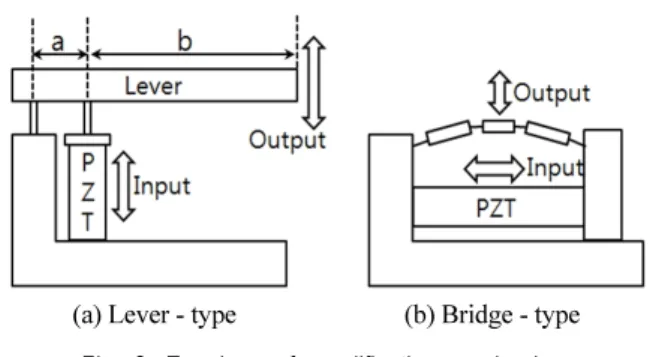
Fig. 2. Topology of amplification mechanism

industries such as automotive, aerospace, medicine, robotics, art, education and etc. are pursuing research into applying this emerging technology.

3D printers enable rapid prototyping of virtual 3D models drastically shortening design and fabrication time and is shown to increase the accuracy of design op- timization

[10]

. In die casting, Kim et.al

[11]

has developed a novel rapid tooling process where a wax pattern fabricated with a 3D printer is used. In motion stages, Jung et.al

[12]

developed a micro-positioning stage using 3D printer.

This paper presents a 3D printer fabricated vertical-type piezo-driven linear motion stage employing two types of flexible bridge typed hinges (Fig. 1). Unlike previous stages which mostly use aluminum

[4,5]

, we use ABS (Acrylonitrile - Butadiene - Styrene copolymer). Compared to previous materials, the stage structure exhibits sig- nificantly less structural stress which allows for more freedom of design. Furthermore, the required force to actuate the motion stage decreases. This relaxes power requirements for the piezoelectric element. Using a 3D printer, we simplified the manufacturing process, lowered costs and with ABS material created a more efficient stage.

2. Flexible Bridge-type Hinge

2.1 Motion Amplification Structure

In general, when designing a flexure stage two types of motion amplification structures are employed: the lever type shown in Fig. 2-(a) and the bridge type shown in Fig. 2-(b). The lever type allows for a large ampli- fication ratio (b/a) that is proportional to the length of the structure. However, the structural stress also increases proportionally. This renders the need for stronger materials.

Overall, the lever-type is more appropriate for in-plane motion amplification. The bridge-type has a smaller symmetric form-factor allowing for a denser design and has better vibrational characteristics making it better for out-of-plane motion structures. In this paper, we are implementing out-of-plane motion, therefore, the bridge- type hinge is employed.

2.2 Bridge-type Flexure Hinge

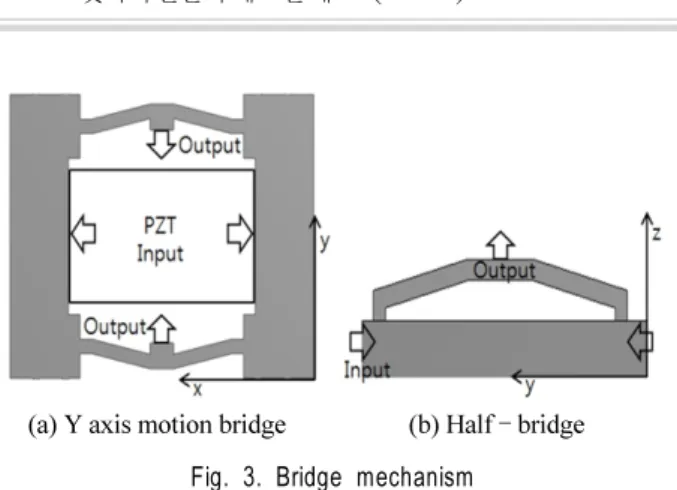
Two types of flexure hinges have been designed. First, as shown in Fig. 3-(a), the bridge transforms the x-axis motion of the piezo-element into y-axis motion. Second, as shown in Fig. 3-(b), a half-bridge transforms the y-axis bridge motion into z-axis motion.

These two bridges have been used to design a dense

structure which can transform x-axis motion into z-axis

motion. Furthermore, stress concentration is avoided by

avoiding a notch type hinge. Although this can lead

decreased flexibility, it is beneficial for performance with

regards to stress.

(3)

(a) Y axis motion bridge (b) Half – bridge Fig. 3. Bridge mechanism

Fig. 4. Kinematic model of bridge-type amplification mechanism 2.3 Amplification structure of Bridge-type

Flexure Hinge

A kinematic model of bridge-type amplification mech- anism can be expressed as Figure 4. Defining the velocity of point A and B,

V

A

  ∂x ∂t (1)

V

B

  ∂y ∂t (2)

Where ∂x is the displacement of the piezo-element and ∂y is the displacement of the bridge. Expressing equations (1) and (2) as an amplification ratio

V

A

  ∂x ∂t

(3)

V

B

  ∂y ∂t e (4)

Where ∂x is the displacement of the piezo-element and ∂y is the displacement of the bridge. Expressing equations (3) and (4) as an amplification ratio,

D

amp

  ∂x ∂y   ∂x∂t ∂y∂t   V

A

V

B

(5)

Defining O (Figure 4) as the instantaneous center of rotation of rigid body AB, as the instantaneous angular

velocity, velocity of A and B can be expressed as,

V

A

 ω・l

x

(6)

V

B

 ω・l

y

(7)

Expressing (6) and (7) as amplification ratio, the following equation is obtained,

D

amp

  ω・l

x

ω・l

y

  l

x

l

y

 cotα (8)

It is evident from the above equation that determines the amplification ratio, therefore is the critical design factor.

3. Design Optimization and Simulation

3.1 Design Optimization

The optimization method employed in this paper is Response surface analysis. For Design of Experiment (DOE) the Central Composite Design (CCD) was used.

The design factor used is  (Fig. 4) of the Bridge-type flexure hinge, which has been shown to have a critical effect on the amplification ratio of the motion am- plification structure.

Design variables θ

, θ

(Fig. 5) which correspond to

(4)

(b) Half bridge Fig. 5. Optimization Factor

Force 4200 N

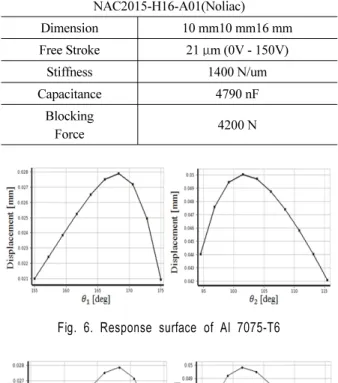
Fig. 6. Response surface of Al 7075-T6

Fig. 7. Response surface of ABS

Table 2. Optimization result

Parameters Al 7075-T6 ABS

Displacement [mm] 0.0498 0.0496

Stress [MPa] 135.79 4.36

the critical design factor  (Eq. 8) for each bridge structure are chosen as the optimization variables. Optimization is divided into a two-step process where θ

of the bridge moving in the y-axis is optimized first, then θ

of the bridge moving in the z-axis is

optimized next. The range of variables θ

, θ

are set to,

°  θ

 ° (9)

°  θ

 ° (10)

Where the maximum of θ

and the minimum of θ

were each set near angles that render a flat bridge structure. The minimum of θ

and the maximum of θ

were set heuristically so that the total range would be approximately 20 degrees. The output variable is the maximum displacement of the stage structure. The input value is set at 20 μm according to the specification of the piezo-element to be used in the experiment (Table 1).

3.2 Simulation

Fig. 6 and Fig. 7 show the response surface analysis for the variables θ

, θ

where the results are almost identical for both Al 7075-T6 and ABS. Both materials

have a motion amplification ratio of 4.0. Also for both materials, the maximum displacement for θ

occurs between 165° and 170° and for θ

occurs between 100°

and 105°. Based on these simulation results, the values chosen for θ

, θ

are 168.1 and 101.0 respectively for designing the motion stage.

Table 2 shows the results of the response surface

analysis. Although the displacements for Al 7075-T6 and

ABS are almost identical, note that the stress level of

(5)

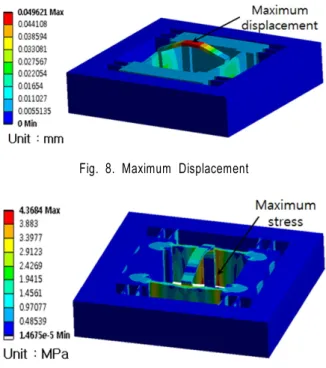
Fig. 8. Maximum Displacement

Fig. 9. Maximum Stress

Fig. 10. Image of 3D printed Motion Stage (ABS material)

Fig. 11. Microscope used for displacement measurement the ABS is approximately 31 times lower. The yield

stress for Al 7075-T6 and ABS are respectively 570 MPa, 40 MPa. Therefore, the simulation results for stress are each 4.1 vs 9 times smaller than the yield stress for Al 7075-T6 and ABS. This shows that ABS material com- pared to Al 7075-T6 is less restricted due to stress in designing flexure structures.

Fig. 8 and Fig. 9 each show the maximum displacement and maximum stress simulation results for the ABS material.

4. Experimental Results

4.1 Experiment Description

Based on the optimization results presented in Section 3, a Vertical micro-positioning stage has been fabricated using a 3D printer with ABS material. The stage is shown in Fig. 10. The 3D printer used is the Projet® 5000(3D Systems), which uses the MJM (Multi-Jet Modeling) method. MJM method sprays a photopolymer resin and wax from the printer head followed by a UV light which

hardens the structure in layers. This 3D printer has maximum fabrication volume of this device is 550 × 393

× 300 mm, 0.025-0.05 mm precision, 375× 375 × 790 DPI (xyz) in HD mode, a minimum layer thickness of 32 μm. This resolution is sufficient to manufacture our motion stage.

The measurement of the vertical motion was performed using an interference microscope as shown in Figure 11.

In order to measure vertical motion, the method developed by Kim et. al

[13,14]

was employed. The measurement method measures the movement of interference fringes using a CCD camera to estimate the vertical motion of the motion stage. Fig. 12 shows the flow diagram of the measurement process which is implemented in Labview.

First, the fringe image model 

(x, y) is defined. As

the stage moves, the image of the stage I(x, y) is obtained.

(6)

Voltage [V]

Piezo [µm]

End Effector [ μm]

Amplification Ratio

5 0.98 3.90 3.98

10 2.12 8.54 4.03

15 3.33 13.4 4.07

20 4.55 18.71 4.11

25 5.79 23.76 4.10

30 7.00 28.74 4.11

35 8.12 33.47 4.12

40 9.21 37.85 4.11

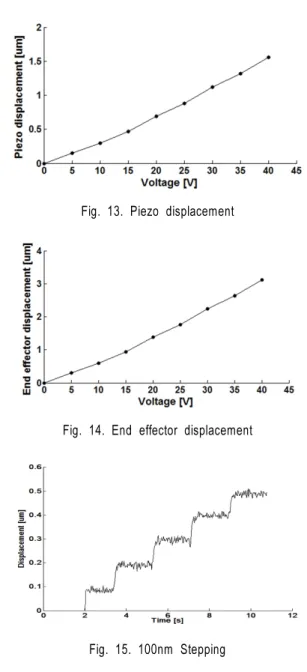
Fig. 13. Piezo displacement

Fig. 14. End effector displacement

Fig. 15. 100nm Stepping The model is found in the image using the correlation

function,

ruv 

Ixy

 I

∑M

x uyv

  M

i

∑IxyM

i

x  uy v  I・ M

i

(11)

and the position  

 

 of the model is found where,

r 

 

  max (12)

Further details of the measurement method can be found in the literature

[13]

.

4.2 Experiment Results

The input voltage to the piezo-element was varied from 0 to 40 V in 9 steps while the displacement of the end-effector, i.e. the half bridge, was measured. The ex- perimental results are shown in Table 3. Amplification ratio is approximately 4 which agree with the simulation results. Fig. 13 plots the applied input voltage vs piezo-

element displacement while Fig. 14 plots input voltage vs end effecter displacement.

In order to test the performance of the motion stage, 100 nm step inputs were applied to the stage (see Fig.

15). Measurement noise in the interference microscope

is currently approximately 10 nanometers which attribute

to the noise at each step. Furthermore, a gradual drift

can also be seen at each step. It is thought that in the

future improving the CCD camera performance and

introducing further feedback control can improve motion

control performance. Utilizing the motion measurement

(7)

driven vertical micro-positioning stage fabricated with a 3D printer using ABS material. Two bridge structures were constructed which amplified and transferred the horizontal motion of the piezo-element into vertical motion of the end-effector. It was shown that the use of 3D printed ABS material for creating flexure motion stages has less restriction on stress compared to traditional material. Compared to previous materials, the stage structure exhibits significantly less structural stress which allows for more freedom of design. Furthermore, the required force to actuate the motion stage decreases which relaxes power requirements for the piezoelectric element. Overall, we have the demonstrated the future possibilities of applying 3D printers and ABS material in fabricating linear driven motion stages. Due to the many advantages of 3D printing technology, various motion stage designs having multiple degrees-of-freedom and larger motion amplification should be possible.

References

[1] B.H. Kang, J.T.Y. Wen, N.G. Dagalakis, and J.J.

Gorman, “Analysis and Design of Parallel Mechanisms With Flexure Joints,” IEEE Transactions On Robotics, vol. 21, no. 6, pp. 1179-1185, 2005.

[2] S.B. Choi, S.S. Han, and Y.S. Lee, “Fine Motion Control of a Moving Stage using a Piezo-actuator Associated with a Displacement Amplifier,” Smart Mater. Struct., vol. 14, no. 1, pp. 222-230, 2005.

[3] H.W. Ma, S.M. Yao, L.Q. Wang, Z. Zhong, “Analysis of the displacement amplification ratio of bridge-type flexure hinge,”Sensors and Actuators, A 132, pp. 730-736, 2006.

[4] J.H. Kim, S.H. Kim, and Y.K. Kwak, ” Development and optimization of 3-D bridge-type hinge mechanisms,”

Hinges,” Nanotechnology, vol. 10, no. 4, pp.394-398 , 1999.

[7] T.F. Lu, D.C. Handley, Y.K. Yong, and C. Eales, “A Three-DOF Compliant Micro-motion Stage with Flexure Hinges,” Ind. Robot, vol. 31, no 4, pp. 355-361, 2004.

[8] K. Hu, J.H. Kim, J. Schmiedeler, and C.H. Menq,

“Design, Implementation, and Control of a Six-Axis Compliant Stage,” Rev. Sci. Instrum., vol. 79, paper no.

025105, 2008.

[9] K.H. Kwak and S.W. Park, “Global 3D Printer Industry Technology Trends Analysis,” J. of the KSME, vol. 53, no. 10, pp. 58-64, 2013.

[10] J.H. Rho, S.K. Jeng, M.H. Kwak, and D.H. Lee, “Rapid Prototyping with Vehicle Modeling Function and 3D Printer,” Proc. of KSAE Annual Conference, pp. 2541-2544, 2009.

[11] H.C. Kim, S. Lee, and S.H. Lee, “Rapid Tooling Technology for Producing Functional Prototypes using Ceramic Shell Investment Casting and Patterns Produced Directly from ThermoJet 3D printer,” J. Kor. Soc. Precis.

Eng., vol. 23, no. 8, pp. 203-210, 2006.

[12] H.J. Jung and J.H. Kim, “Fabrication of Piezo-Driven Micro-positioning Stage using 3D printer,” J. of KSPE, vol. 31, no. 3, pp. 277-283, 2014.

[13] Jung H. Kim and C.-H. Menq, “Visually Servoed 3-D Alignment of Multiple Objects with Sub-nanometer Precision,” IEEE Trans. on Nanotechnology, vol. 7, no.3, May 2008

[14] Jung H. Kim,” Emulation of Anti ‐alias Filtering in Vision Based Motion Mmeasurement,” Journal of Korea Robotics Society, vol. 6, no. 1, pp. 18-26.

[15] C.W. Park, J.B. Lee, B.S. Kim, J.S. Park, H.G. Sung,”

The Development of High Precision Manipulator and Micro Gripper,” Journal of Korea Robotics Society, vol.

2, no. 1, pp. 64-70

(8)

2008 ~ 2010 미 Lam Research Corp. 근무

2010 ~ 현재 경성대학교 메카트로닉스공학과에서 교수로 근무

관심분야: 정밀계측, Fault Detection Diagnosis

수치

Fig. 1. Diagram of vertical micropositioning stage
Fig. 4. Kinematic model of bridge-type amplification mechanism 2.3  Amplification  structure  of  Bridge-type
Fig. 7. Response surface of ABS
Fig. 9. Maximum Stress
+2

참조

관련 문서

_____ culture appears to be attractive (도시의) to the

【판결요지】[1] [다수의견] 동일인의 소유에 속하는 토지 및 그 지상 건물에 관하여 공동저 당권이 설정된 후 그 지상 건물이 철거되고 새로 건물이 신축된 경우에는

MEMS is a research area dealing with the design, fabrication and application of micro-sensors and micro-actuators used for micro optical, bio, communication and

After first field tests, we expect electric passenger drones or eVTOL aircraft (short for electric vertical take-off and landing) to start providing commercial mobility

The “Asset Allocation” portfolio assumes the following weights: 25% in the S&P 500, 10% in the Russell 2000, 15% in the MSCI EAFE, 5% in the MSCI EME, 25% in the

1 John Owen, Justification by Faith Alone, in The Works of John Owen, ed. John Bolt, trans. Scott Clark, "Do This and Live: Christ's Active Obedience as the

The set-up of the printer was performed according to the installation guide provided in the printer user’s manual. The driver supplied with the printer was used.

To this end, prior studies of the type of value, design paradigm and design value were considered, and three types of design value (practical value,