• 검색 결과가 없습니다.

A Study on the Awareness of Teachers and Students of Teaching and Learning Methods by Instructional Situation -Focusing on the 'Stimulus and Reaction' Unit-

N/A
N/A
Protected

Academic year: 2021

Share "A Study on the Awareness of Teachers and Students of Teaching and Learning Methods by Instructional Situation -Focusing on the 'Stimulus and Reaction' Unit-"

Copied!
16
0
0

로드 중.... (전체 텍스트 보기)

전체 글

(1)

A Study on the Awareness of Teachers and Students of Teaching and Learning Methods by Instructional Situation

-Focusing on the ‘Stimulus and Reaction’Unit-

Kyoung-Hee Seo∙Jong-kyung Sonn

1

∙Soo-min Lim

1

∙Jae-Hoon Jeng

1

Ha-Young Song

2

∙Tae-Sang Lee

3

∙Hyonyong Lee

1

∙Youngshin Kim

1

*

Abstract: The purpose of this study was to compare the differences between science teachers' preference and their students' awareness for teaching and learning methods according to classroom circumstance, with a focus on the

‘Stimulus and Reaction’ subject unit in middle school. A survey was given to teachers and students that concentrated mainly on the 8 grade ‘stimulus and reaction’ unit, it was followed by interviews with 5 students to and in the interpretation of the findings. The questionnaire participants consisted of 192 science teachers and 331 8

th

grade students. Lecturing was the teaching method which was most favored by teachers and mainly recognized by students followed by questioning, educational software and film/video. We could see difference of recognition between teachers and students from this result in application, review and attitude area. The teaching methods applied by teachers and recognized by students depended on the instructional situation. In addition, it was revealed that teachers were applying various teaching methods to classroom situations.

Key words: instructional situation, teaching method, stimulus and reaction unit

Seobyun Middle School∙

1

Kyungpook National University∙

2

Seobu High School∙

3

Sangji University

Ⅰ. NEED AND PURPOSE

What is education? According to Kwon (2004), it is “an act of teaching” . How does one teach?

It is difficult to answer this question. ‘How’here refers to a teaching method and research on teaching methods is among the most critical concerns in the school and in the education field (Ye & Huh, 2000). Park (1997) stated that what is referred to as an excellent teaching and learning method creates and arranges circumstantial conditions in a class to help learners seek necessary activities and familiarize learners with them.

One of the most interesting areas in science education may be how to teach science. Amidst a growing emphasis on teaching methods in science education, Woo et al. (1994) noted that it is important to nurture science teachers who are capable of conducting teaching and learning activities with their acquired knowledge of science teaching methods and principles.

An act of teaching by a teacher is an intended mechanism used to lead to learning and includes the following two acts: a logical act that refers to an intellectual act such as thinking and reasoning related to a study course and a strategic act that refers to the initial planning and teaching methods of a teacher during class (Pasley et al., 2004). The act of teaching puts emphasis on the reciprocal relationship between a teacher and a student in the course of teaching by stressing the intended aspect of teaching.

Moreover, in determining the suitability of a certain method for a particular class, the following factors should be taken into consideration: the context of the teaching conditions (time and place), learning capability, interest, number of students, prior experience, capabilities and inclination of the teacher, and the functions and knowledge or attitudes to be emphasized by the teacher (translated by Kwon, 1994; 2001). Han & Yoon (2005) also defined a teaching method as a search for ways to

*Corresponding author: Youngshin Kim ([email protected])

**Received on 15 March 2010, Accepted on 26 May 2010

(2)

efficiently deliver what the learner should be taught and they added that the selection of teaching and learning methods should require consideration of class circumstances such as the knowledge, functions and learner attitude.

According to the learner's level and the characteristics of the content to be taught, the selection of appropriate teaching and learning methods should be arranged (Cho, 2006; Hong et al., 2002). In addition, for the efficient delivery of class lessons, it is important for diverse teaching and learning methods to be sought (translated by Park et al., 2006). The actual activities that are used in teaching and learning a science subject should complement the characteristics of the science subject and its theories. Accordingly, a wide range of teaching and learning methods is essential (Han & Kim, 2003). Trowbridge et al. (2000) also noted that having a wide range of knowledge of teaching methods is very critical in class planning for the effective delivery of lessons under numerous class circumstances. And they defined classroom circumstance as instructional environment to be considered absolutely during having class by teachers and classified classroom circumstance intended by teachers for 8 domains; knowledge, appreciation, application, demonstration, review, individual difference, attitude and method.

For an excellent science class it is important for teachers to understand learners' multiple characteristics such as cognitive, affective, individual properties and so on that are appropriate to the goals and contents of learning for class circumstances (Hong et al., 2002; Park, 1997; Trowbridge et al., 2000; Woo et al., 1994).

Therefore we need to consider multiple classified domains in order to study class circumstance in school.

Researches on science teaching and learning methods used in Korea so far have focused on the effects of particular teaching and learning methods (Lee & Yoo, 2003; Chung & Lee, 2004;

Jeong et al., 2004) or on the teaching and learning methods that are used for a particular

subject area such as ethics in science (Moon &

Kim, 2003; Choi & Cho, 2003; Sadler et al., 2006). However, there is a shortage of research on the types of teaching and learning methods that are used according to teaching circumstances such as teacher emphasized knowledge, attitudes, norms and the learner's learning capabilities (Hong et al. 2002). Moreover There is little research concerning about relation between teachers' preference for teaching and learning methods by class circumstance and how their students think about teaching and learning methods that teachers had.

Accordingly, this study analyzed the preferences of the teachers and the students, who took part, for teaching and learning methods according to class circumstances, with a focus on the 8th grade Stimulus and Reaction subject unit because of having concrete activities suggested by biology textbooks (Jeon et al., 2003; Kang et al., 2004; Shim et al., 2004). This study investigated the following specific issues:

first, the difference between science teachers' preferences and students' awareness for teaching and learning methods by class circumstances;

and second, diverse range of teaching and learning methods preferred by teachers. From this study, the teaching and learning methods that teachers adopt in various teaching and learning circumstances were analyzed.

Ⅱ. RESEARCH METHODS USED

1. Samples

1) Science teachers

A total of 192 teachers responded to a survey

on their preferred teaching and learning

methods according to class circumstances; 47

were male and 145 were female. In terms of the

length of their teaching experience, 49 had 5

years of experience or less, 61 had 6-10 years of

experience, 25 had 11-15 years of experience, 25

had 16-20 years of experience, and 32 had 21 or

more years of experience. Fifty-one of the

(3)

teachers majored in physics, 50 in chemistry, 54 in biology and 37 in earth science.

2) Students

The 10 schools were selected from among those where the surveyed teachers had taught. One 8

th

-grade class from each of the selected schools was chosen as a sample. A total of 354 students were chosen as research subjects. However, only the responses of 331 students were analyzed, because the responses of the 23 other students were redundant or incomplete. Among the middle-grade students who were surveyed, 139 were male and 192 were female.

2. Questionnaires

To analyze the preferences of the teachers and the students' awareness for teaching and learning methods according to class circumstances, 2 types of questionnaires were developed: one for teachers and the other for students. The questionnaires presented a total of 27 items from 7 different class circumstances related to the ‘Stimulus and Reaction’subject unit, alongside 20 types of teaching and learning methods as examples. The class circumstances were modified to complement actual class conditions in Korea that followed the translation of the items and the teaching and learning methods that Trowbridge et al. (2000) suggested.

Trowbridge et al, (2000) presented a total of 29 items in 8 specific areas of class circumstances:

5 for knowledge, 6 for appreciation, 3 for application, 5 for demonstration, 3 for review, 3 for individual differences, 2 for methods and 2 for attitudes.

The following 20 types of teaching and learning methods were included in the questionnaire as teaching and learning methods:

assessment, film/video, problem solving, chalkboards/marker board, game, projects, debate/dispute solution, inquiry/design, questioning, demonstrations, internet, reading, discussion, laboratory report, simulations,

educational software, lecture, field trip, oral report and role play. The questionnaire listed 27 specific items that could be appropriate for each class circumstance with 20 examples of teaching and learning methods. The teacher respondents were asked to select 3 types of teaching and learning methods that they had used or that they preferred to use under the same circumstance as that in each given item, in no particular order while the student respondents were asked to select 3 types of teaching and learning method that their teachers' had used.

To check if the items that pertained to class circumstances suited specific areas of class circumstances, the validity of the contents was reviewed by a professor who majored in curriculum pedagogy, a Ph.D. student and 5 teachers. The validity of the questionnaire was rated 0.88.

3. Data collection and analysis methods

The data for this study was collected through traditional means and e mail from December, 2008 to March, 2009. A total of 300 questionnaires for teachers were distributed and 194 of them were collected. Of the 194 questionnaires that were, 192 were analyzed and 2 were disregarded due to incomplete responses. As for the questionnaires for students, a total of 354 were collected, 331 of which were analyzed and 23 were not due to redundant or incomplete responses. Six students were interviewed but only the responses from 5 of them were analyzed because those of the excluded student were accidentally deleted while they were being recorded.

To investigate the teaching and learning

methods used by science teachers, the teaching

and learning methods that the teachers

preferred and the students' awareness about

their teachers' teaching and learning methods

were compared. To investigate the difference

between the teaching and learning methods that

were used according to the characteristics of the

(4)

teachers, such teaching and learning methods were compared based on the teachers' gender, length of experience and college major. To see if there were differences in the use of teaching and learning methods according to specific class circumstances, the teaching and learning methods that the teachers and the students selected according to each of the following 7 domains of class circumstances (Trowbridge et al., 2000) were analyzed and compared except methods domain: knowledge, appreciation, application, demonstration, review, individual difference and attitude. Moreover, the frequency of the individual teacher's use of the teaching and learning methods was analyzed.

A multiple response analysis was carried out using SPSS 14.0K for Windows. As three teaching and learning methods were selected for each item in the questionnaire, the number of items to be responded to (N) had to be adjusted.

For example, the analysis of the teaching and learning methods for all the items showed that 192 teachers chose 3 teaching and learning methods for each 27 items, which was expressed in the following equation: 192 teachers × 27 items × 3 = 15,552. The number of respondents had to be modified, however, to be able to analyze how many of the 192 teachers responded to the questionnaire, since one individual teacher chose 3 teaching and learning methods.

Accordingly, the number of respondents (N) was as follows: N = 192 × 27 = 5,184, which means a total of 192 teachers responded to 27 items, as shown in the equation N = 192 × 27 = 5,184. One teacher chose 3 teaching and learning methods for each item, but there was no overlap in the selections. Non-response and other such cases were excluded from the analysis. As was the case for the teachers, the number of respondents had to be modified with respect to the students. The number of respondents (N) was 8,937, computed as follows: 331 students × 27 items = 8,937, because a total of 331 students choose 3 teaching and learning methods for all the 27 items.

For the analysis of the results of the students'

questionnaires, semi structured interviews with 6 students were conducted to find complementation.

Only the responses of 5 students were analyzed, as those of the excluded student were deleted while they were being recorded. The interview was comprised of 4 types of questions: first, the reason for the predominance of lectures in the responses of the students for the class circumstances; second, the reason for the predominance of the chalkboard/marker board use in the response of the students; third, the reason for the differences between the teachers' responses for the attitude area and their responses for the other areas, even though the students' responses were still predominantly lectures; and fourth, the reason for the differences in the teachers' responses for the review area and their responses for the other areas of class circumstances, even though the students' responses were still predominantly lectures. The interviews with the students were used to determine why the students answered differently in the cases when their responses differed from those of the teachers.

Ⅲ. RESULTS AND DISCUSSION

1. Analysis by preference of teachers and awareness of students

The objective of this study was to compare the

differences between science teachers' preferred

teaching and learning and students' awareness

about their science teachers' teaching and

learning methods, with a focus on the 'Stimulus

and Reaction' subject unit in middle school. The

results of the analysis were as follows. The

degrees of preference of the teachers and

students' awareness for all the items in

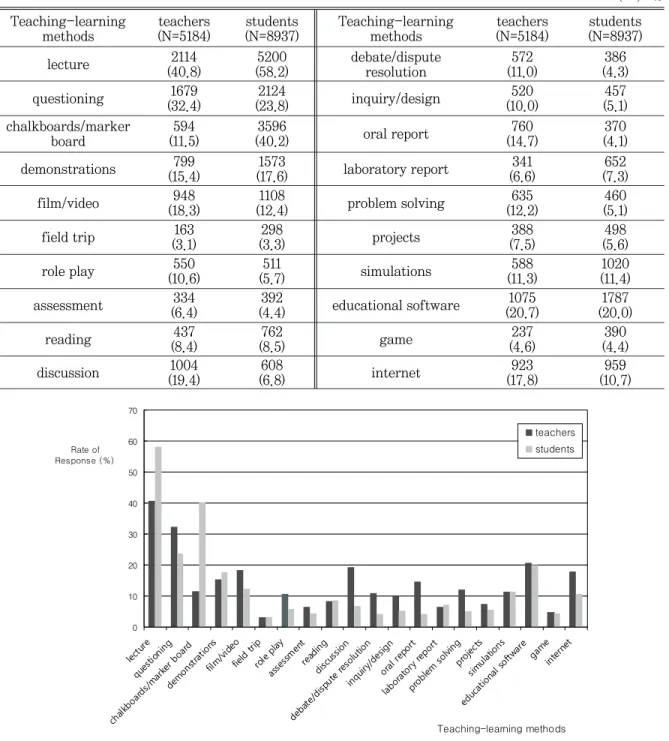
questionnaires were first analyzed. Table 1 and

Figure 1 show the results of the analysis, as

follows: among the teachers, lectures topped the

list, accounting for 40.8% of the responses,

followed by questioning, at 32.4%, educational

software at 20.7%, discussion at 19.4%,

(5)

film/video at 18.3% and internet at 17.8%.

As for the students, lectures topped the list, accounting for 58.2%, followed by chalkboards

/marker board at 40.2%, questioning at 23.8%, educational software at 20.0%, demonstrations at 17.6% and film/video at 12.4%.

Teaching-learning

methods teachers

(N=5184) students

(N=8937) Teaching-learning

methods teachers

(N=5184) students (N=8937)

lecture 2114

(40.8) 5200

(58.2) debate/dispute

resolution 572

(11.0) 386

(4.3)

questioning 1679

(32.4) 2124

(23.8) inquiry/design 520

(10.0) 457

(5.1) chalkboards/marker

board 594

(11.5) 3596

(40.2) oral report 760

(14.7) 370

(4.1) demonstrations 799

(15.4) 1573

(17.6) laboratory report 341

(6.6) 652

(7.3)

film/video 948

(18.3) 1108

(12.4) problem solving 635

(12.2) 460

(5.1)

field trip 163

(3.1) 298

(3.3) projects 388

(7.5) 498

(5.6)

role play 550

(10.6) 511

(5.7) simulations 588

(11.3) 1020

(11.4)

assessment 334

(6.4) 392

(4.4) educational software 1075

(20.7) 1787

(20.0)

reading 437

(8.4) 762

(8.5) game 237

(4.6) 390

(4.4)

discussion 1004

(19.4) 608

(6.8) internet 923

(17.8) 959

(10.7) Table 1

The results of the analysis of the preferred teaching and learning methods for the teachers and awareness

of teachers' class for the students ( ) : %

Fig. 1 The most frequently used teaching and learning methods for the teachers and awareness of the

students about teachers' teaching and learning methods

(6)

It appears that lectures were the most frequently used teaching and learning methods for the teachers and awareness of the students about teacher's teaching and learning methods, followed by questioning, educational software and film/video, in that order. The results show that the teaching and learning methods that the teachers and the students recognized generally hardly differed.

What was noteworthy was that the students showed a high response of 40.2% for chalkboards /marker board, whereas the teachers showed an 11.5% response for the same category. Moreover, discussion was the teachers' fourth most preferred method, accounting for 19.4%, whereas the students showed a relatively low 6.8% response rate for the same method. This was assumed to have been due to the teachers' recognition of chalkboards as a class teaching tool, whereas the students preferred it mainly as a teaching and learning method that teachers use to explain something. The following interviews illustrates in detail the students' opinions on this matter.

Teacher: There appear to be lots of chalkboards responses. Please give details on how the teacher used a chalkboard.

Student A: The teacher seemed to write the name of the subject unit or something important, and some equations or a summary of them.

Student B: I think a teacher explains while writing a few things on a chalkboard instead of just giving explanations verbally, so I marked chalkboard in the questionnaire.

Student C: I thought it seemed similar to lectures. The teacher brings materials and posts them on the board while giving explanations or what I mean is the teacher writes things on the board and we take notes on them.

Student D: The teacher writes things on the

board with a lot of summaries and I think it seems convenient.

As Trowbridge et al. (2000) stated, the response of the students indicated the frequent use of a chalkboard in science classes. The teachers write important points on the board and give explanations to the students while standing in front of the board, which shows the teachers' effective use of a chalkboard in class.

2. Analysis by class circumstances

To examine what teaching and learning methods were preferred according to class circumstances, the teachers' preferred and students' recognized teaching and learning methods were analyzed for the following 7 categories of class circumstances: application, appreciation, attitude, demonstration, individual difference, knowledge and review.

1) Analysis of the knowledge area

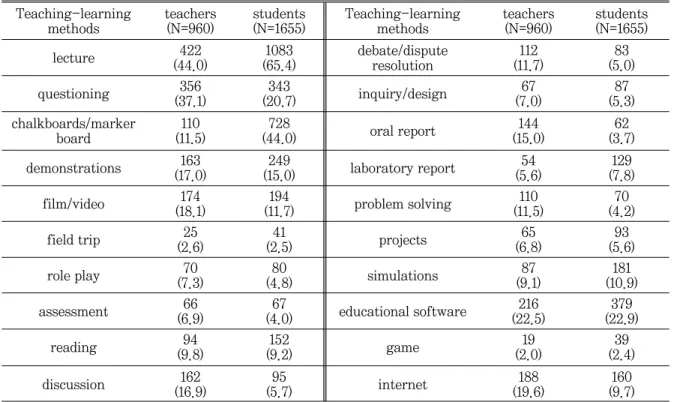
Table 2 shows the results of the analysis of the teachers' preferred teaching and learning methods and students' awareness about teachers' teaching and learning methods for the knowledge category. Among the teachers' responses for the knowledge area, lecture topped the list at 44.0%, followed by questioning at 37.1%, educational software at 22.5%, internet at 19.6%, film/video at 18.1 %, and demonstrations at 17.0%. As for the students' responses for the knowledge category, lecture topped the list at 65.4%, followed by chalkboards/marker board at 44.0%, educational software at 22.9%, questioning at 20.7%, demonstrations at 15.0%

and film/video at 11.7%. In summary, in the knowledge category, lecture topped the teachers' list of preference and students' list of awareness, followed by questioning, educational software, demonstrations and film/video.

2) Analysis of the appreciation area

Table 3 shows the results of the analysis of the

(7)

teachers' preferred teaching and learning methods and students' awareness about teachers' teaching and learning methods for the appreciation category. Among the teachers' responses for the appreciation category, lecture topped the list at 40.8%, followed by questioning at 31.0%, film/video at 29.3%, internet at 26.0%

and discussion at 25.2%. Among the students' responses, lecture placed highest at 61.6%, followed by chalkboards/marker board at 36.6%, questioning at 23.1%, educational software at 20.5 % and film/video at 16.6%.

Thus, for the appreciation category, lecture topped the teachers' and the students' responses, followed by questioning and film/video. Internet and discussion placed higher among the teachers' responses at 26.0% and 25.2%, respectively, but placed somewhat lower among the students' responses at 11.9% and 7.3%, respectively.

3) Analysis of the application area

Table 4 shows the results of the analysis of the teachers' preferred teaching and learning methods and students' awareness about teachers' teaching and learning methods for the application category. Among the teachers' responses for the application category, questioning topped the list at 50.7%, followed by lecture at 50.5%, oral report at 24.0%, educational software at 23.1% and discussion at 20.5%. Among the students' responses for the application category, lecture placed highest at 58.6%, followed by chalkboards/marker board at 51.1%, questioning at 32.1%, educational software at 18.5% and demonstrations at 16.4%.

The results clearly show that there were slight differences in the ranks of the responses of the teachers and the students, though both groups ranked lecture, questioning and educational software higher. What was noteworthy was that Table 2

The results of the analysis of the teachers' preferred teaching and learning methods and students' awareness about teachers' teaching and learning methods for the knowledge category ( ) : %

Teaching-learning

methods teachers

(N=960) students

(N=1655) Teaching-learning

methods teachers

(N=960) students (N=1655)

lecture 422

(44.0) 1083

(65.4) debate/dispute

resolution 112

(11.7) 83

(5.0)

questioning 356

(37.1) 343

(20.7) inquiry/design 67

(7.0) 87

(5.3) chalkboards/marker

board 110

(11.5) 728

(44.0) oral report 144

(15.0) 62

(3.7) demonstrations 163

(17.0) 249

(15.0) laboratory report 54

(5.6) 129

(7.8)

film/video 174

(18.1) 194

(11.7) problem solving 110

(11.5) 70

(4.2)

field trip 25

(2.6) 41

(2.5) projects 65

(6.8) 93

(5.6)

role play 70

(7.3) 80

(4.8) simulations 87

(9.1) 181

(10.9)

assessment 66

(6.9) 67

(4.0) educational software 216

(22.5) 379

(22.9)

reading 94

(9.8) 152

(9.2) game 19

(2.0) 39

(2.4)

discussion 162

(16.9) 95

(5.7) internet 188

(19.6) 160

(9.7)

(8)

Table 3

The results of the analysis of the teachers' preferred teaching and learning methods and students' awareness about teachers' teaching and learning methods for the appreciation category ( ) : %

Teaching-learning

methods teachers

(N=1152) students

(N=1986) Teaching-learning

methods teachers

(N=1152) students (N=1986)

lecture 470

(40.8) 1223

(61.6) debate/dispute

resolution 167

(14.5) 87

(4.4)

questioning 357

(31.0) 458

(23.1) inquiry/design 75

(6.5) 97

(4.9) chalkboards/marker

board 94

(8.2) 726

(36.6) oral report 150

(13.0) 84

(4.2) demonstrations 61

(5.3) 233

(11.7) laboratory report 30

(2.6) 136

(6.8)

film/video 338

(29.3) 330

(16.6) problem solving 144

(12.5) 97

(4.9)

field trip 13

(1.1) 45

(2.3) projects 104

(9.0) 125

(6.3)

role play 109

(9.5) 103

(5.2) simulations 135

(11.7) 279

(14.0)

assessment 35

(3.0) 74

(3.7) educational software 212

(18.4) 408

(20.5)

reading 170

(14.8) 187

(9.4) game 11

(1.0) 43

(2.2)

discussion 290

(25.2) 145

(7.3) internet 299

(26.0) 237

(11.9) Table 4

The results of the analysis of the teachers' preferred teaching and learning methods and students' awareness about teachers' teaching and learning methods for the application category ( ) : %

Teaching-learning

methods teachers

(N=576) students

(N=993) Teaching-learning

methods teachers

(N=576) students (N=993)

lecture 291

(50.5) 582

(58.6) debate/dispute

resolution 27

(4.7) 19

(1.9)

questioning 292

(50.7) 319

(32.1) inquiry/design 20

(3.5) 45

(4.5) chalkboards/marker

board 108

(18.8) 507

(51.1) oral report 138

(24.0) 50

(5.0)

demonstrations 46

(8.0) 163

(16.4) laboratory report 20

(3.5) 60

(6.0)

film/video 108

(18.8) 85

(8.6) problem solving 45

(7.8) 63

(6.3)

field trip 13

(2.3) 51

(5.1) projects 28

(4.9) 49

(4.9)

role play 34

(5.9) 46

(4.6) simulations 52

(9.0) 102

(10.3)

assessment 21

(3.6) 49

(4.9) educational software 133

(23.1) 184

(18.5)

reading 40

(6.9) 88

(8.9) game 4

(0.7) 12

(1.2)

discussion 118

(20.5) 58

(5.8) internet 98

(17.0) 91

(9.2)

(9)

the teachers quoted discussion as being their most frequently used method at 20.5%, whereas the students quoted it at a low 5.8%. Moreover, the students stated that their teachers frequently used demonstration, with a response rate of 16.4%, whereas the teachers responded with a low 8.0%. Difference of recognition between teachers and students from this result are similar with studies that teachers believed of having students centered lessons in their class but actually are not, teacher-centered lesson (Brown & Melear, 2006; Simmons et al., 1999).

Thus it seems that preference of teachers for teaching and learning always have not coincided with their application in a real class.

4) Analysis of the demonstration area

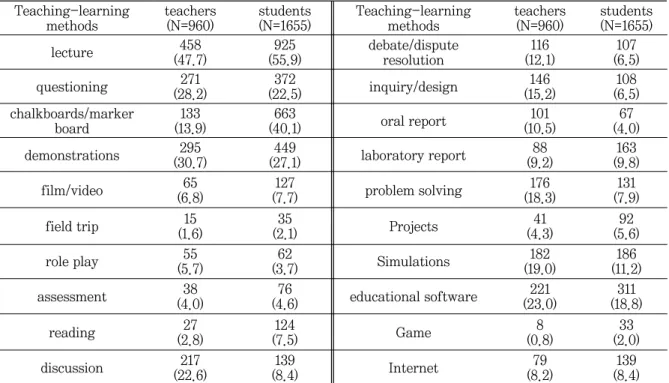
Table 5 shows the results of the analysis of the teachers' preferred teaching and learning methods and students' awareness about teachers' teaching and learning methods for the demonstration category. Among the teachers'

responses for the demonstration category, lecture topped the list at 47.7%, followed by demonstrations at 30.7%, questioning at 28.2%, educational software at 23.0% and discussion at 22.6%. As for the students' responses, lecture topped the list at 55.9%, followed by chalkboards/marker board use at 40.1%, demonstrations at 27.1%, questioning at 22.5%

and educational software at 18.8%. Thus, in the demonstration category, the teachers and the students preferred lectures most, followed by questioning, demonstrations and educational software, in that order.

5) Analysis of the review area

Table 6 shows the results of the analysis of the teachers' preferred teaching and learning methods and students' awareness about teachers' teaching and learning methods for the review category. Among the teachers' responses for the review category, role play topped the list at 31.9%, followed by game at 26.6%, demonstrations Table 5

TThe results of the analysis of the teachers' preferred teaching and learning methods and students' awareness about teachers' teaching and learning methods for the demonstration category ( ) : %

Teaching-learning

methods teachers

(N=960) students

(N=1655) Teaching-learning

methods teachers

(N=960) students (N=1655)

lecture 458

(47.7) 925

(55.9) debate/dispute

resolution 116

(12.1) 107

(6.5)

questioning 271

(28.2) 372

(22.5) inquiry/design 146

(15.2) 108

(6.5) chalkboards/marker

board 133

(13.9) 663

(40.1) oral report 101

(10.5) 67

(4.0) demonstrations 295

(30.7) 449

(27.1) laboratory report 88

(9.2) 163

(9.8)

film/video 65

(6.8) 127

(7.7) problem solving 176

(18.3) 131

(7.9)

field trip 15

(1.6) 35

(2.1) Projects 41

(4.3) 92

(5.6)

role play 55

(5.7) 62

(3.7) Simulations 182

(19.0) 186

(11.2)

assessment 38

(4.0) 76

(4.6) educational software 221

(23.0) 311

(18.8)

reading 27

(2.8) 124

(7.5) Game 8

(0.8) 33

(2.0)

discussion 217

(22.6) 139

(8.4) Internet 79

(8.2) 139

(8.4)

(10)

at 24.5%, questioning at 22.7%, lecture at 22.6%

and educational software at 19.3%. As for the students' responses, lecture topped the list at 39.6%, followed by chalkboards /marker board at 28.7%, demonstrations at 22.3%, educational software at 20.0%, game at 19.8% and questioning at 18.1%.

For the review category, the teachers and the students ranked game, demonstrations, educational software, lecture and questioning higher. The teachers ranked role play (31.9%) and game (26.6%) higher for this category but lower for other categories. Among the students, however, lecture was still the most highly ranked. The following interviews explain why lecture was still the highest ranked for the review category.

Teacher: For the review category, the form of lecture was the most highly ranked.

What do you refer to as lecture by

the teacher during reviews?

Student A: The teacher presents the questions asked in the previous class using a PowerPoint presentation, or asks the class questions with corresponding answers.

Student B: Um... just on lectures... the teacher writes on the board what we learned in the previous lesson and asks questions, and makes one more explanation to the class when the questions are answered poorly.

Student C: It seems that the teacher gave more lectures to summarize what we learned, since we kept forgetting what we had learned.

Teacher: Then what kinds of methods did the teachers use during reviews?

Student C: They asked questions or wrote on the board.

Teacher: What kind of method did you think

Table 6

The results of the analysis of the teachers' preferred teaching and learning methods and students' awareness about teachers' teaching and learning methods for the review category ( ) : %

Teaching-learning

methods teachers

(N=576) students

(N=993) Teaching-learning

methods teachers

(N=576) students (N=993)

lecture 130

(22.6) 393

(39.6) debate/dispute

resolution 44

(7.6) 30

(3.0)

questioning 131

(22.7) 180

(18.1) inquiry/design 40

(6.9) 35

(3.5) chalkboards/marker

board 46

(8.0) 285

(28.7) oral report 66

(11.5) 38

(3.8) demonstrations 141

(24.5) 221

(22.3) laboratory report 32

(5.6) 66

(6.6)

film/video 90

(15.6) 163

(16.4) problem solving 45

(7.8) 29

(2.9)

field trip 74

(12.8) 75

(7.6) projects 47

(8.2) 59

(5.9)

role play 184

(31.9) 117

(11.8) simulations 74

(12.8) 135

(13.6)

assessment 71

(12.3) 37

(3.7) educational software 111

(19.3) 199

(20.0)

reading 14

(2.4) 52

(5.2) game 153

(26.6) 197

(19.8)

discussion 46

(8.0) 57

(5.7) internet 87

(15.1) 169

(17.0)

(11)

this was?

Student C: I thought it was lecturing.

Student D: I thought it was good….writing on the board while summarizing the lessons to help me understand them.

Teacher: Why did you think this method was lecturing during a review?

Student D: Because the teacher talked while reviewing the lessons with us.

In the students' interview, role play appeared to be the teachers' most preferred method, but it was not mentioned in the students' responses. From this, it seems that teachers recognize role play as an appropriate teaching and learning method but it has little application in a real class. Moreover, the reason why the students rated lectures highest was that they regarded a teacher oriented class as lecture, because they had difficulty in differentiating lecture from questioning.

6) Analysis of the individual differences area Table 7 shows the results of the analysis of the teachers' preferred teaching and learning methods and students' awareness about teachers' teaching and learning methods for the individual differences category. Among the teachers' responses for the individual differences category, lecture topped the list at 43.8%, followed by questioning at 32.5%, internet at 27.3%, educational software at 26.0% and film/video at 25.9%. As for the students' responses for this category, lecture topped the list at 59.4%, followed by chalkboards/marker board at 44.1%, questioning at 30.6%, educational software at 20.8%, internet at 12.8% and film/video at 12.7%.

Thus, for the individual difference category, the teachers' and students' preferred teaching and learning methods were similar, as follows:

lecture, questioning, educational software, internet and film/video.

Table 7

The results of the analysis of the teachers' preferred teaching and learning methods and students' awareness about teachers' teaching and learning methods for the individual differences category ( ) : %

Teaching-learning

methods teachers

(N=576) students

(N=993) Teaching-learning

methods teachers

(N=576) students (N=993)

lecture 252

(43.8) 590

(59.4) debate/dispute

resolution 20

(3.5) 24

(2.4)

questioning 187

(32.5) 304

(30.6) inquiry/design 12

(2.1) 30

(3.0) chalkboards/marker

board 84

(14.6) 438

(44.1) oral report 93

(16.1) 43

(4.3)

demonstrations 33

(5.7) 93

(9.4) laboratory report 8

(1.4) 26

(2.6)

film/video 149

(25.9) 126

(12.7) problem solving 35

(6.1) 36

(3.6)

field trip 4

(0.7) 26

(2.6) projects 57

(9.9) 59

(5.9)

role play 65

(11.3) 67

(6.7) simulations 39

(6.8) 89

(9.0)

assessment 72

(12.5) 43

(4.3) educational software 150

(26.0) 207

(20.8)

reading 71

(12.3) 108

(10.9) game 40

(6.9) 59

(5.9)

discussion 81

(14.1) 49

(4.9) internet 157

(27.3) 127

(12.8)

(12)

7) Analysis of the attitude area

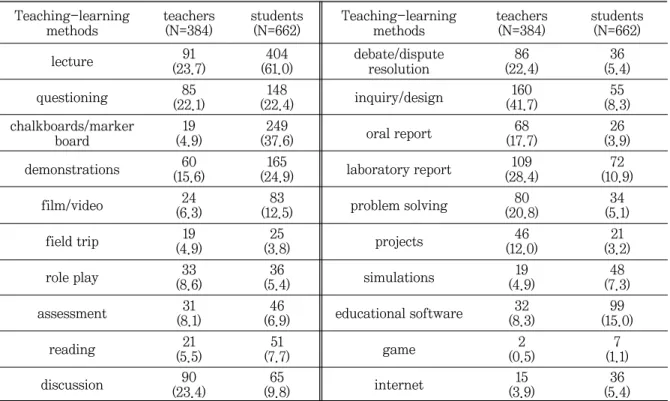
Table 8 shows the results of the analysis of the teachers' preferred teaching and learning methods and students' awareness about teachers' teaching and learning methods for the attitude category. Among the teachers' responses for the attitude category, inquiry/design topped the list at 41.7%, followed by laboratory report at 28.4%, lecture at 23.7%, discussion at 23.4% and debate/dispute resolution at 22.4%. As for the students' responses for this category, lecture topped the list at 61.0%, followed by chalkboards /marker board at 37.6%, demonstrations at 24.9%, questioning at 22.4% and educational software at 15.0%.

The teachers' and the students' responses for the attitude area differed significantly. The teachers rated inquiry/design, laboratory report and debate/dispute resolution highest, unlike the other categories. The students, however, ranked lecture, chalkboards/marker board and

questioning highest, in that order. Maybe teachers have might think multiple activities for students to study 8

th

grade Stimulus and Reaction subject unit having concrete activities suggested by biology textbooks (Jeon et al., 2003; Kang et al., 2004; Shim et al., 2004) but, their students have not agreed with their teachers' response. The reasons why there are difference of cognitions between teachers and students about attitude area are showed by following interviews.

The following interview fully explain the significant difference between the teachers' and students' responses for the attitude category.

Teacher: In what kind of class do you think it is designed for you to develop a scientific attitude?

Please explain how the teacher ran the class, with examples.

Student A: Um... I think there was an

Table 8

The results of the analysis of the teachers' preferred teaching and learning methods and students' awareness about teachers' teaching and learning methods for the attitude category ( ) : %

Teaching-learning

methods teachers

(N=384) students

(N=662) Teaching-learning

methods teachers

(N=384) students (N=662)

lecture 91

(23.7) 404

(61.0) debate/dispute

resolution 86

(22.4) 36

(5.4)

questioning 85

(22.1) 148

(22.4) inquiry/design 160

(41.7) 55

(8.3) chalkboards/marker

board 19

(4.9) 249

(37.6) oral report 68

(17.7) 26

(3.9) demonstrations 60

(15.6) 165

(24.9) laboratory report 109

(28.4) 72

(10.9)

film/video 24

(6.3) 83

(12.5) problem solving 80

(20.8) 34

(5.1)

field trip 19

(4.9) 25

(3.8) projects 46

(12.0) 21

(3.2)

role play 33

(8.6) 36

(5.4) simulations 19

(4.9) 48

(7.3)

assessment 31

(8.1) 46

(6.9) educational software 32

(8.3) 99

(15.0)

reading 21

(5.5) 51

(7.7) game 2

(0.5) 7

(1.1)

discussion 90

(23.4) 65

(9.8) internet 15

(3.9) 36

(5.4)

(13)

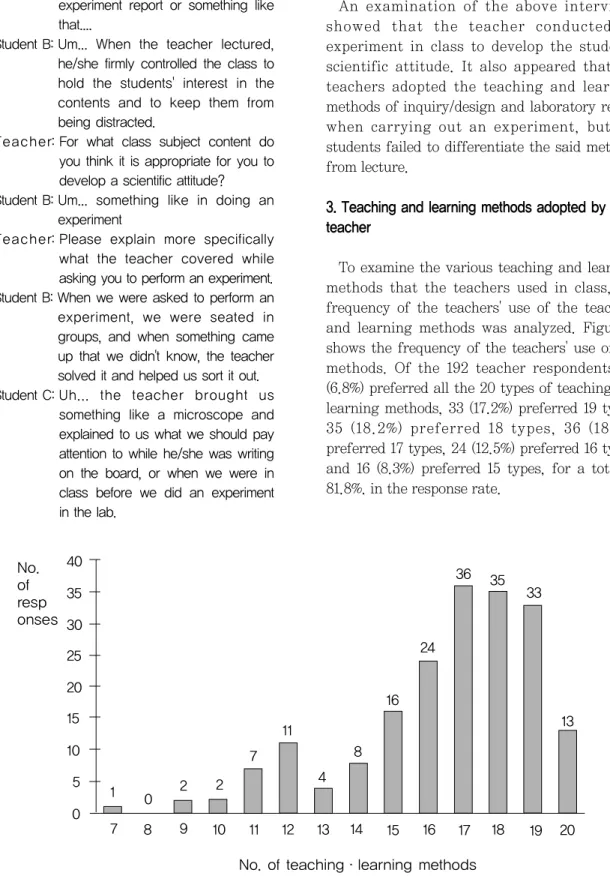
Fig. 2 The frequency of the teachers' use of the teaching∙learning methods experiment report or something like

that....

Student B: Um... When the teacher lectured, he/she firmly controlled the class to hold the students' interest in the contents and to keep them from being distracted.

Teacher: For what class subject content do you think it is appropriate for you to develop a scientific attitude?

Student B: Um... something like in doing an experiment

Teacher: Please explain more specifically what the teacher covered while asking you to perform an experiment.

Student B: When we were asked to perform an experiment, we were seated in groups, and when something came up that we didn't know, the teacher solved it and helped us sort it out.

Student C: Uh... the teacher brought us something like a microscope and explained to us what we should pay attention to while he/she was writing on the board, or when we were in class before we did an experiment in the lab.

An examination of the above interviews showed that the teacher conducted an experiment in class to develop the students' scientific attitude. It also appeared that the teachers adopted the teaching and learning methods of inquiry/design and laboratory report when carrying out an experiment, but the students failed to differentiate the said methods from lecture.

3. Teaching and learning methods adopted by each teacher

To examine the various teaching and learning

methods that the teachers used in class, the

frequency of the teachers' use of the teaching

and learning methods was analyzed. Figure 2

shows the frequency of the teachers' use of the

methods. Of the 192 teacher respondents, 13

(6.8%) preferred all the 20 types of teaching and

learning methods, 33 (17.2%) preferred 19 types,

35 (18.2%) preferred 18 types, 36 (18.8%)

preferred 17 types, 24 (12.5%) preferred 16 types,

and 16 (8.3%) preferred 15 types, for a total of

81.8%. in the response rate.

(14)

4. DISCUSSION

The results show that most of the teachers not only knew various methods of teaching and learning, but also made efforts to apply them in class. Moreover, their preferred science teaching and learning methods varied according to the class circumstances. The study of Hong & Jeong (2003) presented the following teaching and learning methods that may be applied to STS education: problem solving, simulations, role play, debate/dispute resolution, discussion, collaborative learning and social activities.

Sadler et al. (2006) stated that the following methods are used to teach social science and ethical topics in a science class: discussion, role- play, debate/dispute resolution and volunteering projects. Choi & Cho (2003) stated that discussion, collaborative learning and role-play are effective methods of teaching and learning ethics in science. Moon & Kim (2003) suggested debate/dispute resolution, investigation, role-play, a mock trial and discussion as appropriate for teaching bioethics.

However, we see difference of recognition between teachers and students from this result in application, review and attitude area.

Therefore it appears that recognitions of teachers for teaching and learning always have not coincided with their application in a real class (Brown & Melear, 2006; Simmons et al., 1999).

For the categories of knowledge, appreciation, application, demonstration and individual differences the teachers' preferred teaching and learning methods were lecture, questioning, educational software, debate/dispute resolution and film/video. It appeared that they preferred inquiry/design and laboratory report for the attitude category and role play and game for the review category. It was noted that this study examined the teachers' preferred teaching and learning and the students' awareness about teachers' teaching and learning methods according to class circumstances, with a focus on

the “Stimulus and Reaction”subject unit, and therefore, it has limitations in its interpretation beyond this unit. Moreover, the effectiveness of the preferred teaching and learning methods must be verified.

Ⅳ. CONCLUSION AND SUGGESTIONS

This study aimed to examine the differences in the teachers' preferred teaching and learning methods and students' awareness about teachers' teaching and learning methods according to class circumstances. Towards this end, the teachers' preferred teaching and learning methods and students' awareness about teachers' teaching and learning methods for all the items were analyzed alongside their preferred teaching and learning methods according to class circumstances as well as the frequency of their use of such teaching and learning methods. The results are summarized as follows.

First, lecture was the teachers' most preferred method and the method that the students most often experienced in class, followed by questioning, educational software and film /video.

Second, the teachers' preferred teaching and learning methods and the students' awareness about teachers' teaching and learning methods according to the class circumstances differed.

The preferred teaching and learning methods for the attitude and review categories differed from those for the other categories. As for the attitude category, it appeared that the teachers preferred inquiry/design and laboratory report to equip their students with a scientific attitude whereas the students gave lecture a high priority. As for the review category, the teachers preferred role play and game, whereas the students gave role play a low priority. This seems to have been due to the teachers' perception of role play as an effective teaching and learning method when reviewing the previous lesson, but it had little application in an actual class.

Finally, the teachers appeared to adopt a wide

range of teaching and learning methods in class.

(15)

More than 80% of the teacher respondents identified 15 to 20 types of methods out of the 20 types of methods as those that they use in class.

This implies that most of the teachers are aware of various teaching and learning methods and made efforts to apply them in class. These results show that it is necessary to examine the degree of effectiveness of the frequently used teaching and learning methods in enhancing students' understanding of class lessons.

Reference

Borich, G. D. (2006). Effective teaching.

(Park, S. B., Bu, J., Seol, Y. H., Lee, M. J., Cho, J. Y. trans.). Seoul: Sungwonsa. (original work published 2004).

Brown, S. L., & Melear, C. T. (2006).

Investigation of secondary science teachers' beliefs and practices after authentic inquiry based experiences. Journal of Research in Science Teaching, 43(9), 938-962.

Cho, S. J. (2006). Curriculum education and teaching∙ learning methodology. Seoul:

Yangseowon.

Choi, K. H., & Cho, H. H. (2003). Ethical teaching/learning methods of science. Journal of the Korean Association for Research in Science Education, 23(2), 131-143.

Chung, Y. L., & Lee, J. Y. (2004). The effects of instruction using mind map in middle school science class. Journal of the Korean association for research in science education, 24(5), 805-813.

Cole, P. G., & Chan, L. K. S. (1987). The principles and practical lesson. New Jersey.

Prentice Hall, Kwon, N. W. translator(1994).

Seoul: Sungwonsa.

Han, B. K., & Yoon, G. G. (2005). Educational methology. Seoul: Taeyoung Press.

Han, T. M., & Kim, Y. M. (2003). How to ICT Study of science curriculum teaching∙learning methods and materials development using ICT.

Korea education & research information service, Research report RR 2003-4.

Hyman, R. T. (1994). Way of teaching(2th Ed.)

New Jersey. Prentice Hall, Kwon, Nak won translator(2001). Teaching methology. Wonmisa.

Hong, M. Y., Jeong, E. Y., & Maeng, H. J.

(2002). Study of science curriculum teaching∙

learning methods and materials development in elementary school. Korea institute for curriculum and evaluation, Research report RRC 2002-18.

Hong, M. Y., & Jeong, E. Y. (2003). Study of science curriculum teaching∙learning methods and example materials development in middle school. Korea institute for curriculum and evaluation. Research report RRI 2003-5.

Jeon, M. S., Kang, S. J., & Yeau, S. H. (2003).

The effectiveness of web based learning materials for teaching science on the sense and reaction to stimuli in middle school. The Korean Journal of Biology Education, 31(3), 191-202.

Jeong, J. W., Moon, B. C., Jung, J. G., & Lee, M. Y. (2004). The effects of learning using information communication technology (ICT) in earth history and crust movement units of science textbook for eighth graders. Journal of the Korean Association for Research in Science Education, 24(6), 1094-1105.

Kang, J. S., Rim, R. N., & P, K. H. (2004). An analysis of the system on biology I textbook of Korean high school by the 7

th

curriculum.

Journal of Science Education in Chonbuk National University, 29, 83-97.

Kwon, N. W. (2004). A study on the identification of criteria for classifying the teaching method. Korea Association for Learners Centered Curriculum & Instruction, 4(2), 21-31.

Lee, Y. M., & Yoo, J. M. (2003). Effect of gender grouping on cooperative learning in middle school science. Journal of the Korean Earth Science Society, 24(3), 141-149.

Moon, K. W., & Kim, Y. S. (2003). Analysis of bioethical Issues and their instructional methods in science and biology textbooks of 7th to 12th grades in the 7th science curriculum, The Korean Journal of Biological Education, 31(3), 257-264.

Park, S. I. (1997). Theory and practice of

(16)

teaching∙ learning methods Ⅰ . Seoul:

Kyoyookkwahaksa .

Pasley, J. D., Weiss, I.R., Shimkus, E. S., &

Smith, P. S. (2004). Looking inside the classroom : Science teaching in the United States. Science Educator, 13(1), 1-12.

Sadler, T. D., Amirshokoohi, A., Kazempour, M., & Allspaw, K. M. (2006). Socioscience and ethics in science classroom : Teacher perspectives and strategies. Journal of Research in Science Teaching, 43(3), 353-376.

Shim, K. C., Kang, Y. S., Shin, J. B., & Kim, H. S. (2004). An analysis of learning contents in the life science textbooks under the 7

th

curriculum: On the unit of stimuli and response.

The Korean Journal of Biology Education, 32(2), 114-123.

Simmons, P. E., Emory, A., Carter, T., Coker, T., Finnegan, B., Crockett, D., Richardson, L.,

Yager, R., Craven, J., Tillotson, J., Brunkhorst, H., Twiest, M., Hossain, K., Gallagher, J., Duggan Hass, D., Parker, J., Cajas, F., Alshannag, Q., McGlamery, S., Krockover, J., Adams, P., Spector, B., LaPorta, T., James, B., Rearden, K., & Labuda, K. (1999). Beginning teachers: Beliefs and classroom action. Journal of Research in Science Teaching, 36(8), 930-954.

Trowbridge, L. W., Bybee, R. W., & Powell, J.

C. (2000). Teaching secondary school science : Strategies for developing scientific literacy. New Jersey. Prentice-Hall, Inc.

Woo, J. O., Lee, K. H., & Lee, H. R. (1994). A study of the goals on science pedagogy. Journal of the Korean Association for Research in Science Education, 14(2), 159-169.

Ye, S. J., & Huh, Y. B. (2000). Educational Methods and Educational Technology. Seoul:

Hongik Publishers.

수치

Fig. 1  The most frequently used teaching and learning methods for  the teachers and awareness of  the students about  teachers' teaching and learning  methods
Table 4 shows the results of the analysis of the teachers' preferred teaching and learning methods and students' awareness about teachers' teaching  and  learning  methods  for  the application category
Table 5 shows the results of the analysis of the teachers' preferred teaching and learning methods and students' awareness about teachers' teaching  and  learning  methods  for  the demonstration category
Table 8 shows the results of the analysis of the teachers' preferred teaching and learning methods and students' awareness about teachers' teaching and learning methods for the attitude category
+2

참조

관련 문서

The purpose of this study is to analyze the interest and self-confidence of middle school students in learning English grammar and to examine the

proficiency level, they enjoyed English flipped learning. Based on the study findings teaching implications in order to improve English flipped instruction for middle

Furthermore, if desirable teachers' images and teaching methods that American, English cultures have like as this study showed are added to English education

Finally, on how to improve English education for special classes in high schools, it was found that communication-oriented teaching methods and direct

The purpose of this study was to examine Korean EFL middle school students and teachers' perceptions about learning and teaching English punctuation and

The aim of this study is to identify some effective actual culture teaching methods or techniques through analyzing the cultural contents and materials of

The purpose of this study is to investigate the middle school students' motivation, self-confidence and attitude toward English learning in a team-teaching

Secondary beginning teachers' views of scientific inquiry: with the view of Hands-on, Minds-on, and Hearts-on.. Introducing teaching STEAM as a practical