48(3) : 219∼ 225 (2017)
219
블루베리 듀크 추출물의 예쁜꼬마선충 내의 항산화 효과
김준형1·안창완1·김영지1·노윤정1·김수진1·정성엽2·정도연2·황인현1·김대근1*
1우석대학교 약학대학, 2발효미생물산업진흥원
Anti-oxidative Effect of Blueberry Duke Extract in Caenorhabditis elegans
Jun Hyeong Kim1, Chang Wan An1, Yeong Jee Kim1, Yun Jeong Noh1, Su Jin Kim1, Seong-Yeop Jeong2, Do-Youn Jeong2, In Hyun Hwang1 and Dae Keun Kim1*
1College of Pharmacy, Woosuk University, Jeonju, Jeonbuk 55338, South Korea
2Microbial Institute for Fermentation Industry (MIFI), Sunchang, Jeonbuk 56048, South Korea
Abstract − We investigated the anti-oxidative effect of the blueberry duke (Vaccinium corymbosum L., Ericaceae) ethanol extract in Caenorhabditis elegans model. The ethanol extract of blueberry duke showed relatively significant DPPH radical scavenging and superoxide quenching activities. To prove antioxidant activity of the extract, we checked the activities of super- oxide dismutase (SOD), catalase, intracellular ROS, and oxidative stress tolerance in C. elegans. In addition, to verify if the increased stress tolerance of C. elegans by treating with the extract was due to regulation of stress-response genes, we checked SOD-3 expression using a transgenic strain. As a consequence, the blueberry duke ethanol extract increased SOD and catalase activities of C. elegans, and reduced intracellular ROS accumulation in a dose-dependent manner. Besides, blueberry duke eth- anol extract-treated CF1553 worms showed higher SOD-3::GFP intensity.
Keywords − Vaccinium corymbosum L., Caenorhabditis elegans, Anti-oxidative effect, SOD, ROS
생체 내의 미토콘드리아에서 에너지 생산을 위한 호흡 대 사과정 중 일부 산소는 반응성이 높은 활성산소종(reactive oxygen species, ROS)으로 생성된다. 이 활성산소종은 hydroxyl radical(·OH), superoxide radical(·O2−), peroxyl radical(·RO2) 등과 같은 전자가 쌍을 이루지 못한 free radical 과 singlet oxygen(1O2), hydrogen peroxide(H2O2) 등이 있 으며, 이들은 주변 세포에 많은 악영향을 끼치는 것으로 알 려져 있다.1-3)이러한 활성산소종의 생성을 억제하거나 생성 된 활성산소종을 소거하기 위한 항산화 물질로서는 vitamin C, E, glutathinone, uric acid, carotenoid 및 flavonoid 등과 같은 천연물과 tert-butylhydroxytoluene(BHT), tert-butylhy- droxyanisol(BHA) 등과 같은 합성 항산화제가 있으며, 생체 내의 방어기전으로 superoxide dismutase(SOD), glutathione peroxidase, catalase 등의 효소가 존재한다.2,4,5) 인체의 방어 기전은 산화적 스트레스로부터 보호하는데 중요한 역할을
하고 있으나 불완전하여 건강을 유지하기 위해서는 외부에 서 공급되는 vitamin C, E, carotenoid, polyphenol과 같은 항산화제의 공급이 필요하다.3,6) 몇 종의 합성 항산화제들이 사용되고 있으나 보다 부작용이 적을 것으로 판단되는 천 연물 유래의 항산화제 개발이 필요한 실정이다.7,8)
본 연구에서는 저자 등이 블루베리 듀크(Vaccinium corymbosum L., Ericaceae)의 주정 추출물의 항산화 효능을 예쁜꼬마선충(Caenorhabditis elegans) model system을 이용 하여 확인해 보고자 실험을 실시하였다. 블루베리 듀크 추출 물을 제조하고 이 추출물의 DPPH free radical 및 superoxide 소거능을 측정한 후에 예쁜꼬마선충 내의 항산화 효소인 superoxide dismutase(SOD)와 catalase의 활성에 미치는 영 향과 선충 세포 내의 활성산소종의 축적 억제 능력을 측정 하였다. 또한 juglone으로 유도된 oxidative stress에 대한 저 항능력을 확인하고 이와 관련된 기전 중의 하나로 선충 내 의 oxidative stress 저항 단백질의 증가여부를 확인하기 위 하여 SOD-3을 포함한 형질전환 선충 CF1553을 이용하여 SOD 발현 증가 여부를 실험하여 몇 가지 지견을 얻었기에
*교신저자(E-mail):[email protected] (Tel): +82-63-290-1574
이를 보고하고자 한다.
재료 및 방법
실험재료 − 본 실험에 사용한 블루베리 듀크는 2017년에 순창군에서 재배한 것을 (재)발효미생물산업진흥원의 정성 엽 박사가 검증한 후 실험에 사용하였으며, 표준품은 우석 대학교 약학대학 생약표본실에 보관하고 있다(WS-17-004).
추출 − 블루베리 듀크 50 g을 주정으로 가끔 진탕하면서 50oC에서 6시간씩 2회 추출하였다. 그 추출액을 동결 건조 하여 주정엑스 약 33.32 g을 얻었으며 이 주정엑스를 실험 에 사용하였다.
DPPH free radical 소거활성 측정9)− 96 well plate에 ethanol로 용해한 시료를 각 농도 별로 조제한 용액에 13 µM의 1,1-diphenyl-2-picrylhydrazyl(DPPH)을 일정량씩 가 하였다. 10초간 진탕한 후 25oC에서 30분간 방치한 후 microplate reader를 이용하여 520 nm에서 흡광도를 측정하 였다. 대조약물은 L-ascorbic acid를 사용하였다. 항산화 효 과는 시료를 첨가하지 않은 대조군의 흡광도와 비교하였다.
각 시료에 대한 DPPH radical 소거작용을 3회 반복하여 측 정하였다.
Superoxide 억제 활성10,11)− Riboflavin 유래 Superoxide 억제 활성은 ethanol을 이용하여 농도별로 조제한 시료 50 µL에 2.6 µM Riboflavin, 3 mM Methionine, 75 µM NBT, 0.1 mM EDTA, PBS(pH 7.4)로 이루어진 반응혼합물 250 µL을 첨가하여 5,500 lux, 20±1oC의 light box에 넣고 5분마 다 자리를 임의로 바꾸어 주면서 15분 동안 방치한 후 microplate reader를 이용하여 560 nm에서 흡광도를 측정하 였다.
예쁜꼬마선충의 배양11)− 예쁜꼬마선충(Caenorhabditis elegans, wild type)과 Escherichia coli OP50은 차동석교수 (우석대학교 한약학과)로부터 제공받은 것을 사용하였으며, Escherichia coli OP50을 도말한 nematode growth medium (NGM) agar plate에서 배양하였다(20oC). 시료는 DMSO를 용매로 한 stock solution 상태로 멸균된 NGM plate(50oC) 에 첨가되었으며, 최종 DMSO 농도는 모든 상태에서 0.1%
(v/v)를 유지하였다.
선충 체내의 항산화 효소(SOD, catalase) 활성 측정12,13)− 성장 단계가 동일한 N2 선충을 각각의 농도별 plate에서 배 양하였다(EDZ 250, 500 µg/mL). 성체가 된 후 4일째에 선 충을 모아 M9 buffer로 3회 세척 후 분쇄하여 효소활성 측 정에 사용하였다(homogenization buffer: 10 mM Tris-HCl, 150 mM NaCl, 0.1 mM EDTA, pH 7.5). SOD 활성은 Ibrahim 등의 방법을 응용하여 측정하였다. 먼저 10 mM phosphate buffer(pH 8.0)를 용매로 반응혼합물(1.6 mM xanthine과 0.48 mM NBT) 0.49 mL를 만든 뒤 sample 10
µL와 37oC에서 5분간 pre-incubation시켰다. 그 후 xanthine oxidase 1 mL(0.05 U/mL)을 첨가하고 37oC에서 20분 동안 incubation시킨 다음 69 mM SDS로 반응을 멈추고 570 nm 에서 흡광도를 측정하였다. Catalase activity는 Aebi의 방법 을 응용하여 25 mM H2O2에 시료 50 µL(EDZ 250, 500 µg/
mL)를 3분 동안 반응시키고 240 nm에서 흡광도를 측정하 였다.
선충 세포 내 활성산소종(ROS) 분석14)− 세포 내 활성 산소종은 2',7'-dichlorodihydro fluorescein diacetate(H2DCF- DA)를 사용하여 측정하였다. 성장 단계가 동일한 N2 선충 을 각각 농도별로 plate에서 배양하였다. 성체가 된 후 4일 째 50 µM juglone을 함유한 M9 buffer에 넣고 2시간 노출 시킨 뒤 96 well plate에 담긴 50 µL M9 buffer에 5마리씩 옮겼다. 마지막으로 25 µM H2DCF-DA 50µL를 첨가한 뒤 여기 485 nm, 방출 535 nm에서 흡광도를 각각 측정하였다.
Oxidative stress 저항성 평가15)− 성장 단계가 동일한 선충을 각각의 농도별 plate에서 배양하였다(EDZ 250, 500 µg/mL). Oxidative stress에 의한 내성은 기존 방법을 약간 변형하여 평가하였으며, 성체가 된 후 7일째에 일시적으로 선충을 1 mM juglone이 함유된 M9 buffer가 담긴 96 well plate에 옮기고 시간 별로 생존율을 확인하였다.
형질전환 선충 내 SOD-3::GFP 형광 측정 − 형질 전환 된 선충으로 SOD-3::GFP를 포함한 CF1553을 농도별로 투 여된 배지에 배양하였다. 성체가 된 후 4일째에 사용하였으 며, 선충은 sodium azide(2%)로 마취시켰고 GFP 발현은 형 광 실체 현미경(Olympus, Japan)으로 관찰하였다. 발현강도 를 정량, 분석하기 위해 현미경을 이용한 사진 촬영과 ImageJ 소프트웨어를 사용하여 분석하였다. 모든 실험은 3회 반복 하였다.
통계 분석 − 통계 자료의 값은 평균값±표준오차(mean±
S.E.M.)로 표시하였다. 그룹 간의 통계적 유의성 검정은 Student’s t-test를 통해서 분석하였고 선충의 연속적인 생존 도는 Log-rank test 분석 방법을 이용하였다. p값은 *p<0.05,
**p<0.01, ***p<0.001일 때 유의성이 있는 것으로 간주하 였다.
결 과
DPPH radical 소거능 − 블루베리 듀크 추출물의 DPPH radical 소거 효과는 Fig. 1에 나타난 바와 같이 IC50 값이 134.8µg/mL로 대조군인 비타민 C(IC50; 11.6µg/mL)보다는 낮았으나 농도 의존적으로 DPPH free radical 소거 효과를 나타냈다(Fig. 1).
Superoxide 소거 활성 − 시료와 대조군의 NBT의 환원 정도를 비교하는 riboflavin 유래 superoxide quenching 활성 에서는 블루베리 듀크 추출물의 IC50(224.0µg/mL) 값이 비
타민 C의 IC50(20.2µg/mL) 값보다는 낮았지만 농도 의존적 으로 superoxide 소거 활성을 나타냈다(Fig. 2).
항산화 효소 SOD 및 catalase 활성증가 효능 − Xanthine 을 기질로 xanthine oxidase의 효소반응 과정 중에 생성되는 superoxide anion을 활용하여 SOD의 활성을 측정하였다. Fig.
3A에서 나타난 바와 같이 선충의 블루베리 듀크 추출물 투 여군은 SOD의 활성을 농도 의존적으로 증가시켰으며, 블 루베리 주정 추출물 500 µg/mL 투여군은 대조군과 비교하 여 SOD 활성을 약 9.97% 정도 증가시켰다(*p<0.05). 강력 한 반응성을 가진 활성 산소종인 hydrogen peroxide를 체내 에서 대사시키는 catalase의 활성은 Fig. 3B에서 나타난 바 와 같이 블루베리 듀크 추출물 500 µg/mL 투여군이 대조군 에 비해 catalase 활성을 약 28% 정도 증가시켰다(***p<
0.001)(Fig. 3).
활성 산소종(ROS) 감소 효능 − 블루베리 주정추출물의 농도별 세포 내 활성산소종의 감소 효능을 알아보기 위해 H2DCF-DA와 선충 내부의 활성산소종을 반응시켜 형광을 관찰하였다. 활성산소종 형광의 감소 폭은 대조군과 비교하 여 블루베리 듀크 추출물 500 µg/mL 투여군에서 약 14.27%
(**p<0.01)로 관찰되고, 활성산소종을 감소시키는 것으로 확 인되었다(Fig. 4).
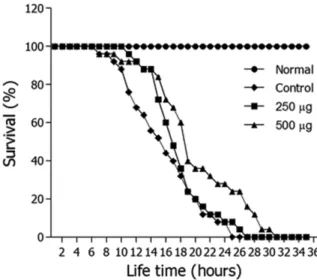
Oxidative stress 저항성 증가 효능 − 블루베리 듀크 추 출물이 선충의 스트레스 저항성에 미치는 영향은 산화적 스 트레스 조건에서 선충의 생존율을 확인하였다. 선충에 산화 적 스트레스를 유도하기 위해서 1 mM juglone이 함유된 M9 buffer가 담긴 96 well plate에서 배양한 대조군 선충의 최고 생존시간은 25시간이었으나, 블루베리 듀크 추출물 250, 500 µg/mL 농도에서 각각 생존시간을 27, 31시간으로 증가시켰 Fig. 1. DPPH radical scavenging effect of the ethanol extract
of blueberry duke.
Fig. 2. Riboflavin-originated superoxide quenching activity of the ethanol extract of blueberry duke.
Fig. 3. Effect of the ethanol extract of blueberry duke on the stress resistance proteins of wild type N2 nematodes. (A) The enzy- matic reaction of xanthine with xanthine oxidase was used to generate •O2− and the SOD activity was estimated spectrophoto- metrically through formazan formation by NBT reduction. SOD activity was expressed as a percentage of the scavenged amount per control. (B) Catalase activity was calculated from the concentration of residual H2O2, as determined by a spectrophotometric method. Catalase activity was expressed in U/mg protein. Data are expressed as the mean±S.E.M. of three independent experiments (N=3). Differences compared to the control were considered significant at *p<0.05, **p<0.01 and ***p<0.001 by one-way ANOVA.
다. 대조군의 평균 생존시간이 15.88±0.9시간었으나 500 µg/
mL 농도 처리군은 평균 생존 시간을 20.08±1.2시간으로 26.44%의 생존 시간을 향상시켰다(**p<0.01)(Fig. 5, Table I).
형질 전환 선충 내 SOD-3의 발현 증가 효능 − 선충 내 에서 oxidative stress에 저항하기 위한 단백질의 증가여부를 확인하기 위해서 SOD 발현 유전자의 증가 여부를 확인하 였다. SOD-3을 포함한 형질 전환 선충 CF1553을 사용하여 실험한 결과 블루베리 듀크 추출물을 투여한 선충군이 처 리되지 않은 선충군에 비해 상당히 높은 SOD-3::GFP 발현 율(18.12%, ***p<0.001)을 보여주었다(Fig. 6).
고 찰
블루베리 듀크 주정 추출물은 DPPH radical과, superoxide 소거활성시험에서 농도의존적으로 강한 항산화 활성을 보 여 주었다. 이러한 결과는 블루베리의 주성분으로 알려진 anthocyanin 성분을 비롯한 polyphenol성 화합물들에 의한 효능으로 생각되며 보고된 블부베리 추출물과 anthocyanin 성분의 항산화 효능들과 잘 부합되는 결과로 판단된다.16-19) 예쁜꼬마선충 내의 항산화 효소인 SOD 및 catalase의 활성 Fig. 4. Effect of the ethanol extract of blueberry duke on the intracellular ROS accumulation of wild-type N2 nematodes. The worms were incubated with 50µM juglone for 2 h, and subsequently treated with the fluorescent probe H2-DCF-DA. Intracellular ROS accumulation was quantified spectrometrically at excitation 485 nm and emission 535 nm. Plates were read 30 min for 120 min. Data are expressed as the mean±S.E.M. of three independent experiments (N=3). Differences compared to the control were considered significant at *p<0.05, and **p<0.01 by one-way ANOVA.
Fig. 5. Effect of the ethanol extract of blueberry duke on the oxidative stress tolerance of wild-type N2 nematodes. For the oxidative stress assays, worms were transferred to 96-well plate containing 1 mM of juglone liquid culture, and then their viability was scored. Statistical difference between the curves was analyzed by log-rank test. All experiments were done in triplicates.
Table I. Effect of the ethanol extract of blueberry duke on the oxidative stress tolerance of wild-type N2 nematodes Stress
condition Concentration Mean lifespan (h)
Maximum lifespan (h)
Change in mean lifespan (%)
Log-rank test 1 mM
Juglone
Control 250µg/mL 500µg/mL
15.88±0.9 17.84±0.7 20.08±1.2
25 27 31
- 12.34 26.44
-
**p<0.01-
Mean lifespan presented as mean±S.E.M. data. Change in mean lifespan compared with control group (%). Statistical significance
of the difference between survival curves was determined by log-rank test using the Kaplan-Meier survival analysis. Differences
compared to the control were considered significant at
**p<0.01
을 확인해 본 결과 블루베리 주정 추출물은 농도 의존적으 로 SOD 및 catalase의 활성을 높이는 것으로 확인되어 활 성산소종에 의해 야기되는 산화적 스트레스로부터 방어하 는 기전에 도움이 될 것으로 생각된다.20,21) 또한 선충에 블 루베리 듀크 추출물을 처리하고 산화적 스트레스를 야기시 키기 위해 juglone을 투여한 후 선충 세포 내 활성산소종 수 치의 변화를 확인한 결과 농도 의존적으로 강한 활성산소 종 축적 억제 효능을 보여 주었다. 이와 관련하여 juglone으 로 oxidative stress를 발생시킨 선충의 oxidative stress에 대 한 저항능력을 확인한 결과 블루베리 듀크 추출물 처리군 이 oxidative stress 조건하에서 대조군과 비교하여 생존율이 농도 의존적으로 크게 증가하였다. 이를 확인할 수 있는 기 전 중의 하나로써, 형질전환된 선충의 하나인 GFP-fused transgenic strain CL2070을 이용하여 juglone으로 처리한 oxidative stress 저항성 확인실험에서 저항성을 나타내는 지 표인자인 SOD-3::GFP 형광 발현율을 살펴 본 결과 형광 발 현율이 농도 의존적으로 증가됨이 관찰되어 oxidative stress 에 저항하는 단백질의 발현이 상당히 증가되었음을 확인되 었다. 인체 내의 활성산소종은 주로 미토콘드리아에서 생성 되며, 스트레스 및 세포 손상 등에 의해서도 생성되어 체내 의 항산화제를 소멸시켜 oxidative stress를 야기하며, 노화 를 비롯한 각종 암 발생 및 염증 생성 등에 관련성이 있다 고 보고되어 있다.22,23) 블루베리와 관련된 연구로 블루베리 구성성분 중 pterostilbene의 항산화 경로를 통한 염증으로 부터 각막 상피세포를 보호하는 효능, 블루베리의 diethyl- nitrosamine으로 처리된 흰쥐의 간경변 및 산화적 스트레스
를 억제하는 효능 및 블루베리 anthocyanin 추출물의 acrylamide 유도된 산화적 스트레스에 대한 보호효과 등에 관한 보고 등은 이와 같은 내용과 잘 부합되는 결과로 사료
된다.24-26) 따라서 블루베리 듀크 추출물이 체내의 SOD나
catalase 등의 항산화 효소의 활성을 증가시키고, 활성산소 종의 축적을 억제하며 oxidative stress에 대한 저항력을 높 여 주는 효능은 노화나 수명연장 및 암이나 염증성 질환 등 의 예방 및 치료 등에 긍정적인 영향을 줄 수 있을 것으로 추측된다. 앞으로 활성물질 분리와 단일 물질 수준에서의 항산화 활성 및 기전 확인이 필요할 것으로 사료된다.
결 론
블루베리 듀크 주정 추출물은 DPPH radical과, superoxide 소거활성 시험에서 강한 항산화력을 보여 주었으며, 예쁜꼬 마선충 내의 항산화 효소인 SOD 및 catalase의 활성이 추 출물 투여에 의해 농도 의존적으로 높아졌다. 또한 선충 세 포 내의 ROS의 발생량은 블루베리 추출물 투여군에서 농 도의존적으로 감소하는 효과를 보여 주었으며, juglone을 이 용하여 oxidative stress를 측정한 결과 생존율이 농도 의존 적으로 증가하는 것을 확인하였다. 이와 관련하여 예쁜꼬마 선충의 mutant인 GFP-fused transgenic strain CL2070을 이 용한 oxidative stress 저항성을 확인한 결과 oxidative stress 에 저항성이 있는 단백질의 발현이 증가되었음을 형광발현 정도를 측정하여 확인하였다. 이러한 결과로 볼 때 블루베 리 듀크 추출물은 항산화 및 이와 관련된 질병의 예방 및 Fig. 6. Effect of the ethanol extract of blueberry duke on the expression of SOD-3 was determined using transgenic nematodes.
Mean GFP intensity of CF1553 mutant was represented as mean±S.E.M. of values from 25 to 30 animals per each experiment. The GFP intensity was quantified using image software by determining average pixel intensity. Images of SOD-3::GFP expression of CF1553 worm in the presence or absence of the ethanol extract of blueberry duke. Data are expressed as the mean±standard devi- ation of three independent experiments (N=3). Differences compared to the control were considered significant at ***p<0.001 by one-way ANOVA.
치료를 위한 자원으로서의 가치가 충분히 있을 것으로 사 료된다.
사 사
본 연구는 2017년 향토건강식품명품화사업(Healthy Local Food Branding Project of the Rural Resources Complex Industrialization Support Program)의 지원에 의해 이루어졌 으며 이에 감사드립니다.
인용문헌
1. Su, S. and Wink, M. (2015) Natural lignans from Arctium lappa as antiaging agents in Caenorhabditis elegans. Phy- tochemistry 117: 340-350.
2. Lim, S.-M. (2010) Resistance to reactive oxygen species and antioxidant activities of some strains of lactic acid bacteria from the mustard leaf kimchi. Korean J. Microbiol. 46: 375- 382.
3. den Endea, W. V., Pesheva, D. and Garab, L. D. (2011) Dis- ease prevention by natural antioxidants and prebiotics acting as ROS scavengers in the gastrointestinal tract. Trends in Food Sci. Technol. 22: 689-697.
4. Sohal, R. S., Agarwal, A., Agarwal, S. and Orr, W. C. (1995) Simultaneous overexpression of copper- and zinc-containing superoxide dismutase and catalase retards age-related oxi- dative damage and increases metabolic potential in Dro- sophila melanogaster. J. Biol. Chem. 270: 15671-15674.
5. Scandalios, J. G. (2005) Oxidative stress: molecular per- ception and transduction of signals triggering antioxidant gene defenses. Braz. J. Med. Biol. Res. 38: 995-1014.
6. Kim, A. R., Park, S. A., Ha, J. H. and Park, S. N. (2013) Antioxidative, and inhibitory activities on melanogenesis of Vitex negundo L. leaf extract. Korean J. Microbiol. Bio- technol. 41: 135-144.
7. Branen, A. L. (1975) Toxicological and biochemistry of butylated hydroxyanisole and butylated hydroxytoluene. J.
Am. Oil Chem. Soc. 52: 59-63.
8. Shin, T. S., Kang, H. S., Kim, S. K., Lee, K. W. and Cho, B. W. (1999) Effect of natural and synthetic antioxidants on pH, POV, fatty acids composition and overall acceptability of cooked ground pork. J. Agri. Tech. & Dev. Inst. 3: 1-9.
9. Yoshida, T., Mori, K., Hatano, T., Okumura, T., Uehara, I., Komagoe, K., Fujita, Y. and Okuda, T. (1989) Studies on inhibition mechanism of autooxidation by tannins and fla- vonoids. V: Radical scavenging effects of tannins and related polyphenols on 1,1-diphenyl-2-picrylhydrazyl radical. Chem.
Pharm. Bull. 37: 1919-1921.
10. Ginnopolitis, C. N. and Ries, S. K. (1977) Superoxide dis- mutase. I. Occurrence in higher plants. Plant Physiol. 59:
309-314.
11. Brenner, S. (1974) The genetics of Caenorhabditis elegans.
Genetics 77: 71-94.
12. Mekheimer, R. A., Sayed, A. A. and Ahmed, E. A. (2012) Novel 1,2,4-triazolo[1,5-a]pyridines and their fused ring sys- tems attenuate oxidative stress and prolong lifespan of Caenorhabditis elegans. J. Med. Chem. 55: 4169-4177.
13. Aebi, H. (1984) Catalase in vitro. Method. Enzymol. 105:
121-126.
14. Kim, H. N., Seo, H. W., Kim, B. S., Lim H. J., Lee, H, N., Park, J. S., Yoon, Y. J., Oh, J. W., Oh, M. J., Kwon, J., Oh, C. H., Cha, D. S. and Jeon, H. (2015) Lindera obtusiloba extends lifespan of Caenorhabditis elegans. Nat. Prod. Sci.
21: 128-133.
15. Lee, E. Y., Shim, Y. H., Chitwood, D. J., Hwang, S. B., Lee, J. and Paik, Y. K. (2005) Cholesterol-producing transgenic Caenorhabditis elegans lives longer due to newly acquired enhanced stress resistance. Biochem. Biophys. Res. Commun.
328: 929-936.
16. Kalt, W., Ryan, D. A., Duy, J. C., Prior, R. L., Ehlenfeldt, M. K. and Vander Kloet, S. P. (2001) Interspecific variation in anthocyanins, phenolics, and antioxidant capacity among genotypes of highbush and lowbush blueberries (Vaccinium section cyanococcus spp.). J. Agric. Food Chem. 49: 4761- 4767.
17. Lee, M.-K., Kim, H.-W., Lee, S.-H., Kim, Y. J., Jang, H.-H., Jung, H.-A., Hwang, Y.-J., Choe, J.-S. and Kim J.-B. (2016) Compositions and contents anthocyanins in blueberry (Vac- cinium corymboum L.) varieties. Korean J. Environ. Agric.
35: 184-190.
18. Basu, P. and Maier, C. (2016) In vitro antioxidant activities and polyphenol contents of seven commercially available fruits. Pharmacognosy Res. 8: 258-264.
19. Huang, W., Zhu, Y., Li, C., Sui, Z. and Min, W. (2016) Effect of blueberry anthocyanins malvidin and glycosides on the antioxidant properties in endothelial cells. Oxid. Med. Cell Longev. doi:10.1155/2016/1591803.
20. Liu, L., Zuo, Z., Lu, S., Liu, A. and Liu, X. (2017) Naringin attenuates diabetic retinopathy by inhibiting inflammation, oxidative stress and NF-κB activation in vivo and in vitro.
Iran J. Basic Med. Sci. 20: 813-821.
21. Ganesan, K., Sukalingam, K. and Xu, B. Solanum trilobatum L. ameliorate thioacetamide-induced oxidative stress and hepatic damage in albino rats. Antioxidants (Basel). doi:
10.3390/antiox6030068.
22. Farías, J. G., Molina, V. M., Carrasco, R. A., Zepeda, A. B., Figueroa, E., Letelier, P. and Castillo, R. L. (2017) Anti- oxidant therapeutic strategies for cardiovascular conditions associated with oxidative stress. Nutrients doi:10.3390/
nu9090966.
23. Sonane, M., Moin, N. and Satish, A. (2017) The role of anti- oxidants in attenuation of Caenorhabditis elegans lethality on exposure to TiO2 and ZnO nanoparticles. Chemosphere 187:
240-247.
24. Li, J., Deng, R., Hua, X., Zhang, L., Lu, F., Coursey, T.
G., Pflugfelder, S. C. and Li, D. Q. (2016) Blueberry com- ponent pterostilbene protects corneal epithelial cells from inflammation via anti-oxidative pathway. Sci. Rep. 6: 19408.
doi:10.1038/srep19408.
25. Bingül, İ., Başaran-Küçükgergin, C., Tekkeşin, M. S., Olgaç, V., Doğru-Abbasoğlu, S. and Uysal, M. (2013) Effect of blue- berry pretreatment on diethylnitrosamine-induced oxidative
stress and liver injury in rats. Environ. Toxicol. Pharmacol.
36: 529-538.
26. Zhao, M., Wang, P., Zhu, Y., Liu, X., Hu, X. and Chen, F.
(2015) The chemoprotection of a blueberry anthocyanin extract against the acrylamide-induced oxidative stress in mitochondria: unequivocal evidence in mice liver. Food Funct. 6: 3006-3012.
(2017. 9. 5 접수; 2017. 9. 11 심사; 2017. 9. 15 게재확정)