ORIGINAL ARTICLES Open Access
Influence of Job-seeking Stress on Perimenstrual Symptoms of Female College Students in Health and Non-health related Majors:
Mediating Effects of Stress Coping Styles
Moon, So-Hyun
1· Park, Mi Kyoung
21Associate Professor, Department of Nursing, College of Medicine, Chosun University, Gwangju
2Director, Department of Nursing, Hansarang Hospital, Mokpo, Korea
Purpose: To determine effects of job-seeking stress on perimenstrual symptoms of female college students with health and non-health related majors and mediating effects of stress coping styles. Methods: Data were collected from 189 female college students who were juniors or seniors. This study was conducted using questionnaires on job-seeking stress, perimenstrual symptoms, and stress coping styles. Data analysis included descriptive statistics, Pearson correlation analysis, and multiple regression analysis using SPSS, version 23.0. Mediation analysis was performed according to the Baron and Kenny method and Sobel test. Results: Job-seeking stress was significantly and positively correlated with perimenstrual symptoms in non-health college students. Passive stress coping styles demonstrated a complete mediating effect on the relationship between job-seeking stress and perimenstrual symp- toms of those with non-health related majors (β=0.31, p=.002). Such effect was significant (Sobel test; Z=2.06, p=.039). Conclusion: Effects of job-seeking stress on perimenstrual symptoms were mediated by passive stress cop- ing styles of non-health related major students. Based on findings of this study, effective stress cope strategies should be developed considering characteristics of majors to manage perimenstrual symptoms of female college students with high job-seeking stress.
Key Words: Employment, Psychological stress, Adaptation, Menstruation
Corresponding author: Park, Mi Kyoung
Mokpo Hansarang Hospital, 335 Baengnyeon-daero, Mokpo 58664, Korea.
Tel: +82-61-280-5535, Fax: +82-61-280-5541, E-mail: [email protected] - This study was supported by research fund from Chosun University, 2017.
Received: May 28, 2018 / Revised: Aug 3, 2018 / Accepted: Aug 29, 2018
This is an open access article distributed under the terms of the Creative Commons Attribution Non-Commercial License (http://creativecommons.org/licenses/
by-nc/3.0), which permits unrestricted non-commercial use, distribution, and reproduction in any medium, provided the original work is properly cited.
INTRODUCTION
Perimenstrual symptoms are defined as those which oc- cur before and after menstruation, and those that are char- acterized by the cyclic occurrence of physical, behavioral, and psychological symptoms. Although scholars have dif- ferent opinions on these definitions, they mostly agree that they are symptoms which develop during the luteal men- strual cycle and disappear within a few days of menstru- ation [1].
Typical physical symptoms are bloating, breast swel- ling and tenderness, headache, weight gain, nausea and sweating, and psychological symptoms such as restless- ness, irritability, and anger. It is also an important wom-
en’s health problem that needs to be addressed in the early stages because it adversely affects self-confidence, social relations, and school attendance [2]. When the symptoms get worse, they may cause harmful effects for a woman, such as child abuse and committing suicide [3].
The occurrence of symptoms in Korean females, though controversial, shows that the college student group (ages 19~29 years) has a higher frequency of symptoms than in the childbearing women group [4]. 98% of female college students experienced perimenstrual symptoms [5] and all female college students experienced more than one dis- comfort during the menstrual cycle [6]. Perimenstrual symptoms are a health problem that require continuous management by female college students. For effective men-
strual symptom management, it is important to know its cause and to find appropriate interventions.
According to the 2017 employment trend, it appears that the youth unemployment rate is 9.4%, the highest af- ter the IMF crisis [7]. The difficulty of getting a job and years of being between jobs give college graduates high levels of stress. In addition, finding a job is their major con- cern [8]. Stresses from hunting for a job cause physical ill- nesses such as stomach problems, headaches, coronary ar- tery disease, and mental illnesses such as depression, anxi- ety, and schizophrenia. This situation could result in stu- dents committing suicide. Therefore, effective care must be taken [9].
It is evident that students of humanities majors are un- der the highest levels of stress, whereas health majors are under the lowest levels of stress [10,11]. It was reported that senior female students with depression, from low-in- come families, and who experience irregular menstrual in- tervals were under the highest levels of stress when look- ing for a job [11-13]. In particular, for female college stu- dents sensitive to stress and in crisis situations, job-seek- ing stress harms their body’s stability and activates the adrenal medulla of the sympathetic nervous system in the early period of menstruation. This results in the worsen- ing of symptoms in the perimenstrual period [12,14]. After identifying the relationship between menstruation-related symptoms, which are crucial to women’s health, and job- seeking stresses with academic majors of female college students, effective intervention measures should be ap- plied depending on the degree of stress.
Coping with stress is the most effective way of relieving stress by selecting the method that best suits each situation [15]. It was found that all choices were effective for stress relief [16]. However, research has suggested that when stresses are not adequately coped with, they give rise to negative effects on both physical and psychological con- ditions; therefore, effective strategies to manage stresses are crucial [15]. So far, in Korea the correlations between job-seeking stresses and perimenstrual symptoms, and their effective interventions have not been investigated enough. Further study in this field is urgently required.
Thus, in this study, the correlations of the job-seeking stresses and perimenstrual symptoms of female college students in different academic majors, as well as the medi- ating effect of stress coping styles will be investigated.
Finally, according to previous studies related to correla- tions between stresses and perimenstrual symptoms, data showed that female college students with higher stress levels experienced stronger perimenstrual symptoms and menstrual pains [5,12,17]. In previous studies, female col-
lege students under stress or in a negative psyche were vulnerable to perimenstrual symptoms or their symptoms easily became worse [18]. In this manner, though reports on correlations between stresses and perimenstrual symp- toms were established [12], they continue to be limited.
Particularly, related to job-seeking, studies on job-seeking stresses and perimenstrual symptoms of students across dif- ferent grades and academic majors have not been reported yet. In addition, students in health-related majors are health- care workers, most of whom are engaged in healthcare after graduation, and can influence the healthcare improvement of participants. Students in non-health-related majors need to be aware of individual stress coping strategies in differ- ent learning environments and employment situations.
Therefore the objective of this study was to evaluate the mediating effects of stress coping styles in the relationship between job-seeking stress and perimenstrual symptoms in female college students. Specifically, our study had four purposes: (a) to identify the differences in perimenstrual symptoms according to general characteristics of female college students in health and non-health related majors;
(b) to measure the levels of job-seeking stress, stress cop- ing styles, and perimenstrual symptoms in female college students with health and non-health related majors; (c) to investigate the relationships among job-seeking stress, stress coping styles and perimenstrual symptoms of fe- male college students in health and non-health related ma- jors; and (d) to verify mediating effects of stress coping styles in relation to job-seeking stresses and female college students’ perimenstrual symptoms.
METHODS 1. Design
This was a descriptive cross-sectional study that intend- ed to examine the mediating effects of stress coping styles between job-seeking stresses and perimenstrual symp- toms of female college students in health and non-health related majors.
2. Participants and Sample Size
Participants were female junior and senior students from J and G province. Convenience sampling was adopted, and the number of participants required was 77 when us- ing G*Power version 3.0.1 in multiple regression analysis with a significance level (⍺) of .05, medium effect size of .15, a statistical power (1-β) of .80, with three predictors (job-seeking stress, active, and passive stress coping styles).
As about a 10% attrition rate was predicted, a total of 189 participants were recruited, 90 from health majors and 99 from non-health majors.
3. Ethical Considerations
The study was approved by the **University Institu- tional Review Board (Approval no. 2-1041055-AB-N-01- 2017-0045). Before starting data collection, participants were given a full explanation of the purpose and methods of the study, and those willing to participate voluntarily were asked to sign the Research participation consent form. Personal information was not included, and ano- nymity and confidentiality were ensured.
4. Instruments
1) Job-seeking stressThe instrument for job-seeking stress, based on the Cor- nell Medical Index (CMI) [19], modified by Hwang [20], was utilized. This self-reporting instrument included 72 items and consisted of 4 subscales expressing job-seeking stress: academic stresses, character-related stresses, school environment, and family environment. A 3-point Likert scale was used and higher values indicated higher levels of job-seeking stress. Cronbach’s ⍺ for this scale was .97 in the original study. In this study, Cronbach’s ⍺ was .95.
2) Stress coping styles
The 62-item questionnaire modified by Lee & Kim [21]
and based on Lazarus and Folkman’s revised stress coping device scale [16], was used to evaluate stress coping styles.
The active stress coping subscale has 27 items, and the pas- sive stress coping subscale has 35 items. Items were scored on a 4-point Likert scale. The higher the score was, the greater the use of stress coping strategies. Cronbach’s ⍺ in the original study was .90. Cronbach’s ⍺ in this study was .93 for the full scale, and .92 and .87 for active coping and passive coping subscales, respectively.
3) Perimenstrual symptoms questionnaire
This questionnaire consisted of the 28 items; nineteen from Abraham’s Menstrual Symptomatology Question- naire [22], 9 menstrual pain-related questions from Ches- ney’s Menstrual Symptom Questionnaire [23], which were revised by Moon [24]. Items were scored on a 4-point Likert scale. Higher scores on the perimenstrual symp- toms instrument reflected a higher level of perimenstrual symptoms. Cronbach’s ⍺ in the original study was .92, and it was .90 in the present study.
5. Procedure
Participants were junior and senior female students from 2 universities from J and G province. Data were col- lected between October and November 2017. Researchers obtained permission to access participants from course directors. Research assistants visited participants in a class- room after class. They could withdraw from the study at any time. Questionnaires with a repetitive response pat- tern in at least 90% of the items, indicating haphazard completion, were excluded. A total of 205 questionnaires were distributed with an explanation of the research aims and how to fill in the sheet. After excluding questionnaires based on the above, 189 were used for the final analyses.
For each participant, about 20 minutes were given to com- plete the questionnaire and all participants received small gifts as compensation.
6. Data Analysis
SPSS/WIN 23.0 was used for statistical analysis. De- scriptive analyses were reported as counts (percentages) or means (standard deviation). Data were checked for normality. To test the hypothesis regarding the differences of perimenstrual symptoms with respect to the general characteristics of health and non-health departments, in- dependent student t-tests or one-way analysis of variance (ANOVA), and a post-hoc analysis using the Scheffé test was performed. Pearson correlation coefficients were cal- culated to study the association among measurement vari- ables. The mediating effects of stress coping styles were verified by Baron and Kenny’s procedure [25], which uses simple and multiple regression analysis, and finally, the significance of mediating effects was tested by the Sobel test. The significance level was held at 0.05 (two-tailed).
RESULTS
1. Levels of Perimenstrual Symptoms according to General Characteristics of the Health and Non- health Department Female Students
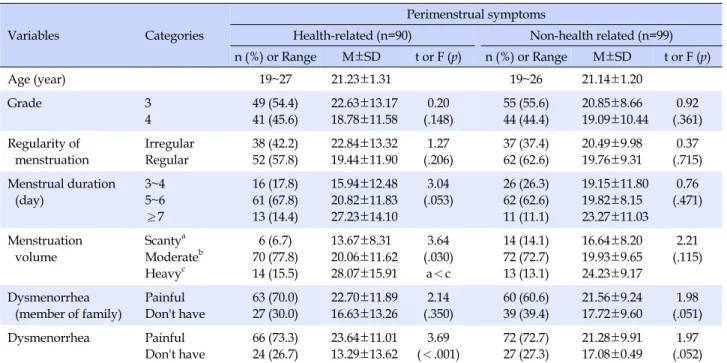
The health department student’s average age was 21.2±
1.31 years. Forty-nine students (54.4%) were juniors and seniors made up 41 students (45.6%). 57.8% of them had regular menstruation intervals; those with a menstruation period of five or six days were 61 (67.8%) of students and 70 (77.8%) students answered that their menstruation amount was moderate. Sixty-three (70.0%) of them re- sponded that their menstrual pain was related to family
Table 1. Perimenstrual Symptoms according to General Characteristics of the Participants (N=189)
Variables Categories
Perimenstrual symptoms
Health-related (n=90) Non-health related (n=99) n (%) or Range M±SD t or F (p) n (%) or Range M±SD t or F (p)
Age (year) 19~27 21.23±1.31 19~26 21.14±1.20
Grade 3
4
49 (54.4) 41 (45.6)
22.63±13.17 18.78±11.58
0.20 (.148)
55 (55.6) 44 (44.4)
20.85±8.66 19.09±10.44
0.92 (.361) Regularity of
menstruation
Irregular Regular
38 (42.2) 52 (57.8)
22.84±13.32 19.44±11.90
1.27 (.206)
37 (37.4) 62 (62.6)
20.49±9.98 19.76±9.31
0.37 (.715) Menstrual duration
(day)
3~4 5~6
≥7
16 (17.8) 61 (67.8) 13 (14.4)
15.94±12.48 20.82±11.83 27.23±14.10
3.04 (.053)
26 (26.3) 62 (62.6) 11 (11.1)
19.15±11.80 19.82±8.15 23.27±11.03
0.76 (.471)
Menstruation volume
Scantya Moderateb Heavyc
6 (6.7) 70 (77.8) 14 (15.5)
13.67±8.31 20.06±11.62 28.07±15.91
3.64 (.030)
a<c
14 (14.1) 72 (72.7) 13 (13.1)
16.64±8.20 19.93±9.65 24.23±9.17
2.21 (.115)
Dysmenorrhea (member of family)
Painful Don't have
63 (70.0) 27 (30.0)
22.70±11.89 16.63±13.26
2.14 (.350)
60 (60.6) 39 (39.4)
21.56±9.24 17.72±9.60
1.98 (.051)
Dysmenorrhea Painful
Don't have
66 (73.3) 24 (26.7)
23.64±11.01 13.29±13.62
3.69 (<.001)
72 (72.7) 27 (27.3)
21.28±9.91 17.08±0.49
1.97 (.052)
Table 2. Degree of Perimenstrual Symptoms and Research Variables (N=189)
Variables Health-related (n=90) Non-health related (n=99)
M±SD Range M±SD Range
Job seeking stress 102.03±20.21 72~151 111.44±23.31 75~184
Stress coping style
Active stress coping style Passive stress coping style
148.07±23.66 64.83±12.39 83.24±13.32
86~198 31~91 53~115
142.07±24.55 62.30±12.91 80.06±13.83
73~208 29~97 44~113
Perimenstrual symptoms 20.88±12.56 1~60 20.03±9.52 3~44
background, but sixty-six of them (73.3%) stated that they experienced menstrual pain.
The non-health department students’ average age was 21.14±1.20 years; 55 students (55.6%) were juniors and 44 were seniors. Sixty-two of them had regular menstruation intervals, and sixty-two (62.6%) of them had a five or six-day menstruation period. More than half of them, 72 (72.7%) stated that their menstruation amount was mo- derate. Sixty (60.6%) of them answered that their level of pain was related to their family background, though sev- enty-two (72.7%) of them said they only underwent men- struation pains.
The analysis of symptoms according to general char- acteristics showed that in the health department group, the amount of menstruation and the existence of dys- menorrhea were significantly related to perimenstrual symptoms. Specifically, those with a higher amount of menstruation (F=3.64, p=.030) and those with dysmenor- rhea (t=3.69, p<.001) had statistically significant symp-
toms respectively (Table 1).
2. Mean Scores among Measurement Variables
The health department students’ job-seeking stress lev- el was 102.03±20.21, and the stress coping style was 148.07±23.66 on the respective scales. The average of each sub- category was 64.83±12.39 points for active stress coping style, and 83.24±13.32 points for passive stress coping style. The perimenstrual symptoms were 20.88±12.56. On the other hand, those of non-health department students were 111.44±23.31, 142.07±24.55, 62.30±12.91, 80.06±13.83 and 20.03±9.52 respectively (Table 2).
3. Correlations among Measurement Variables
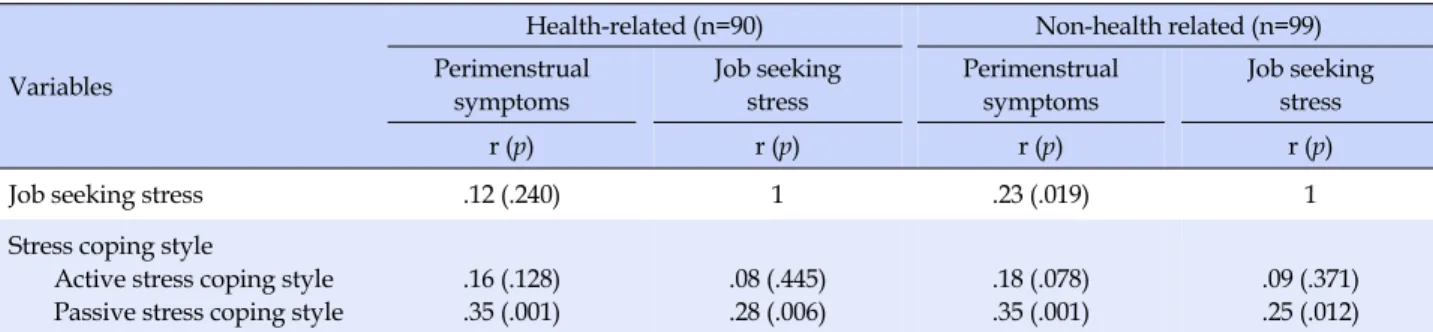
For health related majors’ female students, the relation- ship between perimenstrual symptoms and passive stress coping style was statistically significant (r=.35, p=.001). InTable 3. Correlation among the Major Variables (N=189)
Variables
Health-related (n=90) Non-health related (n=99) Perimenstrual
symptoms
Job seeking stress
Perimenstrual symptoms
Job seeking stress
r (p) r (p) r (p) r (p)
Job seeking stress .12 (.240) 1 .23 (.019) 1
Stress coping style
Active stress coping style Passive stress coping style
.16 (.128) .35 (.001)
.08 (.445) .28 (.006)
.18 (.078) .35 (.001)
.09 (.371) .25 (.012)
Table 4. Mediating Effect of Passive Stress Coping Style on the Relationship between Job Seeking Stress and Perimenstrual Symptoms in the Non-health Department
Variables β(p) Adjusted R2 F p
1. JSS → PSCS .25 (<.001) .06 6.62 .012
2. JSS→ PERIMS .23 (.048) .06 5.66 .019
3. Step 1
PSCS → PERIMS .31 (.002)
Step 2
JSS → PERIMS .16 (.110) .14 8.06 .001
JSS=job seeking stress; PSCS=passive stress coping style; PERIMS=perimenstrual symptoms.
non-health related majors, significant correlations between perimenstrual symptoms and job-seeking stress (r=.23, p=
.019), and between perimenstrual symptoms and passive stress coping style (r=.35, p=.001) were observed. There were significant correlations between job-seeking stress and passive stress coping style (r=.25, p=.012) (Table 3).
4. Mediating Effect of Stress Coping Style on the Relationship between Job-seeking Stress and Perimenstrual Symptoms
In order to see significant mediating effects in the rela- tion between job-seeking stress and perimenstrual symp- toms, stepwise regression analysis was applied to data of non-health department students, who had significant cor- relations between their job-seeking stress and perimen- strual symptoms.
To identify if passive stress coping style mediates the correlation between non-health department students’ job- seeking stress and their perimenstrual symptoms, three kinds of regression analyses were conducted. In the first step, independent variables should be significantly related to parameters, and independent variables to dependent ones in the second step. Finally, in the third step, parame- ters should be significantly related to dependent variables, but the effects of independent variables should be larger in the second than those in the third step. When parameters
are controlled in the third equation, if the influence of in- dependent variables to dependent variables is not signi- ficant, it is a complete mediation; but if not, it is a partial mediation [26].
The results of mediating effects of passive stress coping style between job-seeking stress and perimenstrual symp- toms are as follows: in the regression analysis to verify the effects of the first step independent variable, that is job- seeking stress, to parameter, that is, passive stress coping style, the standardized regression coefficient β was .25 and was statistically significant (p<.001). The influence of the independent variable, that is job-seeking stress, on the de- pendent variable, that is perimenstrual symptoms, β was .23 and was statistically significant (p=.048).
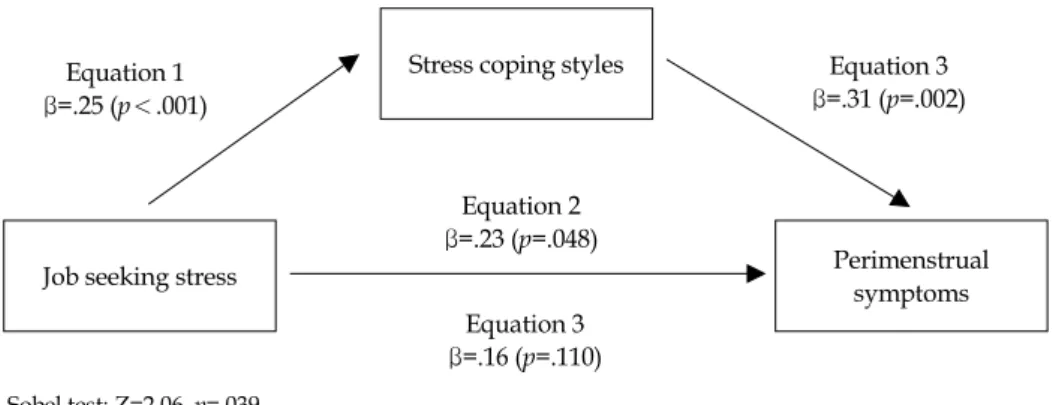
Finally, the influence of the parameter, that is passive stress coping style, on dependent variables, when the in- dependent variable was under control, appeared to be β (.31) and was statistically significant (p=.002). In this, as the job-seeking stress β (.16) is smaller than β (.23) from the second step and not statistically significant, it can be said that complete mediating effects of passive stress coping style exist. The Sobel test was conducted to assess the sig- nificance of mediating effects of stress coping style, and the results confirmed that mediating effects of stress coping style between job-seeking stress and perimenstrual symp- toms were significant (Z=2.06, p=.039) (Table 4) (Figure 1).
Equation 1 β=.25 (p<.001)
Equation 3 β=.31 (p=.002)
Equation 2 β=.23 (p=.048)
Equation 3 β=.16 (p=.110) Sobel test: Z=2.06, p=.039
Perimenstrual symptoms Stress coping styles
Job seeking stress
Figure 1. Mediating effect of stress coping styles on the relationship between job seeking stress and perimenstrual symptoms.
DISCUSSION
Recently in Korea, with the economic depression and increase in unemployment rate, job-seeking stress among college graduates is emerging. Thus, this study aimed to deal with the significance of mediating effects of stress coping styles between job-seeking stress and perimen- strual symptoms of female junior and senior college stu- dents. The results of the study were as follows.
With respect to the differences of perimenstrual symp- toms according to general characteristics of health and non- health department students, results showed that health department students’ menstruation amount and dysme- norrhea were statistically significantly different. A pre- vious study [5,12,17] on female college students was sim- ilar to this research, in large quantity and more severe pain. However, there are no previous studies comparing the two academic majors (health and non-health). There- fore, for precise contrasts between the two, further studies are necessary.
Recent studies suggested that female college students felt physical discomfort during the perimenstrual period rather than negative emotions [27]. In this study too, more than half of those from both majors had undergone pains during the menstruation period. In the comparison of fe- male nursing college students and non-nursing course students, 87% of nursing college students and 89% of non- nursing students [27] experienced pains and discomfort during menstruation. In general, 72.8% answered the same [12], supporting the results of this study. Consequently, it was confirmed that most female college students accept that pain, which is physical discomfort among the peri- menstrual symptoms, is the biggest concern. In order to ef- fectively manage this, it is suggested that pharmacological and non-pharmacological interventions should be con- ducted for female students exposed to job-seeking stresses
to relieve their perimenstrual symptoms.
In the study of job-seeking stress, stress coping style and perimenstrual symptoms of health and non-health de- partment female students, those of the health department showed lower job-seeking stress but a higher level of stress coping style and perimenstrual symptoms. A previous study [10,11] agreed with this one showing that health de- partment students’ job-seeking stress was the lowest and those of non-health department was the highest. This was interpreted as job-seeking stress of college students de- pends on possibilities of employment. Health department students know their post-college careers before entrance but those of non-health departments face difficulty in find- ing jobs and experience severe stress in tough competi- tion. It seems that career counseling and proper career guidance for job-seeking according to students’ majors would lessen their stress level.
Regarding stress coping strategies, the study showed that students in the health department have more stress coping style than their counterparts. This means that health department students, having stable employment oppor- tunities, with lower levels of stress, can utilize more effec- tive strategies. College students with higher job-seeking stress use less stress coping strategies [11] and female col- lege students with higher stress use passive styles rather than active ones. The result coincides with this study [12].
Everyone, no matter whether they use it or not, has his/her own way of coping with stress, and the efforts to manage stress are effective strategies [14,16]. It is expected that fe- male college students will be able to improve their com- petence to maximize various and effective stress coping styles, thereby pursuing a better quality of life.
On the other hand, it was proven that health depart- ment students experienced more perimenstrual symptoms than non-health department students. In comparisons be- tween nursing college students and others, nursing majors
also experienced more perimenstrual symptoms [27] which coincided with this study. It seems that for health majors, who have much knowledge of health and recognize peri- menstrual symptoms better, the gap between the two groups is great. In order to effectively carry out manage- ment of perimenstrual symptoms, it is suggested that ba- sic education and management programs should be pro- vided to non-health female college students, who lack the educational opportunities to recognize and prevent men- strual symptoms.
Results of the correlations between job-seeking stress, stress coping style, and perimenstrual symptoms of fe- male college students (health and non-health related ma- jors) coincided with past research, which showed that the more passive stress coping style used, the more the symp- toms occurred [28]. In non-health groups only, on the other hand, it showed significant correlations between job-seeking stress and level of perimenstrual symptoms, which coincided with the research that higher academic and career stress of college students brought about more severe menstrual symptoms [18]. Due to the lack of studies on job-seeking stress and perimenstrual symptoms in health and non-health related majors, it is not easy to com- paratively analyze with other research results, which show that students with higher level job-seeking stress are more vulnerable to negative mental health and physical symp- toms [29]. Although the perception of the perimenstrual symptoms was higher in the health-related students than non-health related students, the degree of job-seeking stress was relatively low, suggesting that there is no statistically significant relationship between job-seeking stress and peri- menstrual symptoms. Therefore, it is recommended to re- peat the study.
The intervention effects of passive stress coping style between job-seeking stress and perimenstrual symptoms in the non-health department group were supported. Thus, in the non-health group, when female students undergo job-seeking stress, with the help of effective stress coping styles, their symptoms turn out to be different. The results of this study indicate that non-health department students who experience a lot of stress due to the burden of employ- ment due to low employment rate compared to the health- department student can exacerbate menstrual symptoms by using stress coping styles. The mediating effect of pas- sive stress coping was supported in the relationship be- tween the job-seeking stress of the non-health department students and perimenstrual symptoms. This suggests that when the non-health-related college students experience job stress, effective stress coping serves as a mediating var- iable in menstrual symptoms. In conclusion, this study
suggests that non-medical college students who experi- ence a lot of stress due to the burden of employment due to low employment rates, compared to the health depart- ment, may exacerbate the symptoms of menstruation by coping with stress.
Emotional alleviation, a passive stress coping style, was used more by non-health department students than the others and health department students more actively cop- ed with stress ending up with fewer mental health symp- toms [30]. The results of her study and this one showed similarity at this point. Though Lazarus and Folkman [16]
analyzed that there are not good or bad coping devices but various stress management strategies that are effective, better passive coping styles would result in a higher level of perimenstrual symptoms.
So far, it is concluded that participants’ gender and grades could influence their stresses. Though their stresses are high, the results could be dependent upon how in- dividuals recognize and cope with them. In conclusion, female college students’ job-seeking stress, through the mediation of passive stress coping style, influences peri- menstrual symptoms. This means that stress coping me- thods are vital to those symptoms. Thus, it is seriously required to provide stress coping training for female col- lege students with severe perimenstrual symptoms and job-seeking stresses.
Much research on stress and mental health, and stress and menstruation has been released, and this study shows that though female college students are facing severe job-seeking stresses, the stress levels are different based on their majors. Moreover, it is significant that college stu- dents identified the differences in physical symptoms associated with menstruation, which is an important in- dex of women’s health by the way of coping with stress.
CONCLUSION
In this study, the job-seeking stress of female students in the health-related students was lower than the other group, but their stress coping style levels and perimen- strual symptoms were higher. It was shown that correla- tions between perimenstrual symptoms and related fac- tors in both groups, between passive stress coping styles and perimenstrual symptoms, were statistically signifi- cant, but so was the relationship between job-seeking stress and perimenstrual symptoms in non-health group only. It has been shown that in the non-health group stu- dents, the mediating effects between job-seeking stresses and perimenstrual symptoms are related to their improp- er use of stress coping styles.
Not only by testing correlations between job-seeking stresses and perimenstrual symptoms, but also by check- ing mediating roles of stress coping styles, this study has meaningfully shown relations between parameters. It would be useful to provide basic materials for developing a perimenstrual symptom management program through stress coping styles mediation. In addition, academic ma- jors and grades should be regarded as job-seeking-stress worsening factors. It is necessary to prepare an appro- priate intervention plan for the personal situation consid- ering functional stress coping methods in the management of female college students’ perimenstrual symptoms. In this study, the relations between job-seeking stresses and perimenstrual symptoms were tested. As parameters, the effects of stress coping styles were checked. However, as the prevention and management program was not men- tioned, we suggest the development and application of ef- fective nursing interventions that promote effective stress coping.
Conflict of Interest
The authors declared no conflict of interest
ORCID
Moon, So-Hyun https://orcid.org/0000-0001-5106-3210 Park, Mi Kyoung https://orcid.org/0000-0002-1517-1369
REFERENCES
1. Ryu A, Kim TH. Premenstrual syndrome: A mini review. Ma- turitas. 2015;82(4):436-440.
https://doi.org/10.1016/j.maturitas.2015.08.010
2. Sahin S, Ozdemir K, Unsal A. Evaluation of premenstrual syn- drome and quality of life in university students. The Journal of Pakistan Medical Association. 2014;64(8):915-922.
3. Women's health nursing subject study meeting. Women's Health Nursing I. Seoul: Soomoonsa Press; 2016. p. 286.
4. Kim MJ, Kim SM, Kim JM, Park JL, Park HR, Yoon JH, et al.
Study on severity and types of premenstrual syndrome ac- cording to age groups of fertile woman. Journal of the Nursing Academic Association of Ewha Womans University. 2010;44:
59-71.
5. Lim H, Park Y. Differences in dietary intake and life-style of fe- male college students in Seoul with and without premenstrual syndrome. Journal of Korean Society of Menopause. 2010;16 (3):153-161.
6. Mahesh A, Tirmizi SZA, Sanwer Ali S. Frequency and asso- ciated factors of premenstrual syndrome in medical college girls. Medical Channel. 2011;17(1):34-38.
7. Statistics Korea. Economically active population survey in Au- gust 2017 [Internet]. Daejeon: Employment statistics division social statistics bureau; 2017. [cited 2018 February 2]. Available from:
http://kostat.go.kr/portal/korea/kor_nw/2/3/1/index.board
?bmode=read&bSeq=&aSeq=363042&pageNo=3&rowNum=
10&navCount=10&currPg=&sTarget=title&sTxt=
8. Park MJ, Kim JH, Jung MS. A qualitative study on the stress of university students for preparing employment. Korea Journal of Counseling. 2009;10(1):417-435.
9. Lee IS, Cho JY. Employment stress, physical health, and men- tal health among college students. Journal of the Korean Data Analysis Society. 2011;13(2):745-758.
10. Byun EK, Yoon SJ, Kim KH. The factors influencing on em- ployment stress of university students. Korean Journal of Occupational Health Nursing. 2014;23(3):146-153.
https://doi.org/10.5807/kjohn.2014.23.3.146
11. Cho S, Jeon GS. Influencing factors of job-seeking stress among Korean college students in west south area. Korean Journal of Stress Research. 2015;23(2):79-89.
https://doi.org/10.17547/kjsr.2015.23.2.79
12. Moon SH, Cho HH. Job seeking stress, stress coping styles, and perimenstrual symptoms in female college students. Journal of the Korean Data Analysis Society. 2014;16(4):2261-2272.
13. Sachs BD, Ni JR, Caron MG. Sex differences in response to chronic mild stress and congenital serotonin deficiency. Psy- choneuroendocrinology. 2014;40:123-129.
https://doi.org/10.1016/j.psyneuen.2013.11.008
14. Laux L, Vossel G. Theoretical and methodological issues in ach- ievement-related stress and anxiety research. In: Krohne HW, Laux L, Editors. Series in Clinical & Community Psychology:
Achievement, Stress, & Anxiety, New York: Hemisphere; 1982.
p. 3-18.
15. Yun WS. The impact of college students' job-seeking stress on depression and suicidal ideation: Based on Agnew's general strain theory. Journal of Korean Public Police and Security Studies. 2016;13(1):95-118.
16. Lazarus RS, Folkman S. Stress, appraisal, and coping. NY:
Springer; 1984. 445 p.
17. Rajkumari R, Keithellakpam S, Thiyam J, Devi NM. Relation- ship between psychosocial stress and menstrual function-re- lated abnormalities among the female undergraduate medical students. Journal of Evolution of Medical and Dental Sciences.
2017;6(38):3103-3107.
https://doi.org/10.14260/jemds/2017/669
18. Kim MJ, Kim SY, Kim JH, Lee MA, Lee SG, Whang SY, et al.
Relationship between stress and menstrual pattern in female college students in Seoul. Journal of the Nursing Academic Association of Ewha Womans University. 2007;41:99-118.
19. Shepherd M, Cooper B, Brown AC, Kalton GM. Psychiatric ill-
ness in general practice. London: Oxford University Press;
1966. 220 p.
20. Hwang SW. A study on employment stress of university stu- dents [master's thesis]. Busan: Donga University; 1998. 56 p.
21. Lee CH, Kim JH. Relations of perceived stress, cognitive set, and coping behaviors to depression: A focus on freshmen's stress experiences. Korean Journal of Counseling and Psychotherapy.
1988;1(1):24-45.
22. Abraham GE. Premenstrual tension. Current Problems in Ob- stetrics and Gynecology. 1980;3(12):1-39.
23. Chesney MA, Tasto DL. The Development of the menstrual symptom questionnaire. Behaviour Research and Therapy.
1975;13(4):237-244.
https://doi.org/10.1016/0005-7967(75)90028-5
24. Moon SH, Cho HH. Relationship among perfectionism, body image, interpersonal relationship, and perimenstrual symp- toms of college women. Journal of The Korean Data Analysis Society. 2013;15(3):1403-1414.
25. Baron RM, Kenny DA. The moderator-mediator variable dis- tinction in social psychological research: Conceptual, strategic, and statistical considerations. Journal of Personality and Social Psychology. 1986:51(6);1173-1182.
https://doi.org/10.1037/0022-3514.51.6.1173
26. Bennett JA. Mediator and moderator variables in nursing research: Conceptual and statistical differences. Research in Nursing & Health. 2000;23(5):415-420.
https://doi.org/10.1002/1098-240X(200010)23:5<415::AID-N UR8>3.0.CO;2-H
27. Choi HS, Lee ED, Ahn HY. Relationships among premenstrual syndrome, perfection and anxiety among the college student.
Korean Journal of Women Health Nursing. 2013;19(4):265- 274. https://doi.org/10.4069/kjwhn.2013.19.4.265
28. Cha C, Nam SJ. Premenstrual symptom clusters and women's coping style in Korea: Happy healthy 20s application study.
Journal of Psychosomatic Obstetrics & Gynecology. 2016;37(3):
91-100. https://doi.org/10.3109/0167482X.2016.1157159 29. Chae CK, Kim TG. Determinants of employment status of uni-
versity (college) graduates youth. The Journal of Vocational Education Research. 2009;28(2):89-107.
30. Yu EY. Relationships between stress-coping schemes and men- tal health for health department and non-health department college students. The Journal of the Korea Contents Associ- ation. 2009;9(12):718-729.
https://doi.org/10.5392/JKCA.2009.9.12.718
Summary Statement
■
What is already known about this topic?There is evidence that women with PMS (premenstrual symptoms) experience more daily stress and more traumatic life stress.
■
What this paper adds?In the non-health group students who had high job-seeking stress, the relationship between job- seeking stress and perimenstrual symptoms was mediated by stress coping styles.
■
Implications for practice, education and/or policyTo manage perimenstrual symptoms of female college students with high job stress, it is necessary to build effective strategies to functionally cope with stress.