Journal of the Korean Chemical Society 2010, Vol. 54, No. 5
Printed in the Republic of Korea DOI 10.5012/jkcs.2010.54.5.533
-533-
요약. 활성탄소를 가지고 수용액으로부터 전이금속이온을 제거 능력에 대해 시험했다. 탄소의 물리적, 화학적 그리고 액체- 상 흡착 특징은 다음의 기준 절차로 수행하였다. Ni(II), Cu(II) 그리고 Fe(III)이온의 제거 연구는 흡착물질의 양, 금속이온 용 액의 pH, 배치 모드에서 시간을 다양하게 하여 시도되었다. 평균 흡착 데이터는 Freundlich와 Langmuir로 맞춰졌고 등온 상수 는 계산되었다. 다른 세가지 금속 이온의 평균 시간은 결정되었다. pH는 흡착에 있어서 중요한 역할을 하는 것을 발견했다. 이 과정은 흡열반응이었고, 열역학 인자는 계산되었다. 흡착 연구는 이온교환 메커니즘이 작용되는 것을 나타내고 있다.
주제어: 활성탄소, 흡착, pH, 탈착, 금속 이온 제거
ABSTRACT. An activated carbon was tested for its ability to remove transition metal ions from aqueous solutions. Physical, chemi- cal and liquid-phase adsorption characterizations of the carbon were done following standard procedures. Studies on the removal of Ni(II), Cu(II) and Fe(III) ions were attempted by varying adsorbate dose, pH of the metal ion solution and time in batch mode.
The equilibrium adsorption data were fitted with Freundlich and Langmuir and the isotherm constants were evaluated, equilibrium time of the different three metal ions were determined. pH was found to have a significant role to play in the adsorption. The pro- cesses were endothermic and the thermodynamic parameters were evaluated. Desorption studies indicate that ion-exchange mecha- nism is operating.
Keywords: Activated carbon, Adsorption, pH, Desorption, Metal ions removal
활성탄소를 이용한 수용액으로부터의 Ni(II), Cu(II) 그리고 Fe(III) 이온의 흡착
H. A. Hanafi†,‡ and H. S. Hassan*
Hot Laboratories Center, Atomic Energy Authority, P.N., 13759, Abu Zabal, Egypt
†Cyclotron project, Nuclear Research Center, Atomic Energy Authority, Abu Zabal, Egypt
‡Faculty of Humanity Sciences and Science-Al-Quwayiyah-Shaqra University-KSA (접수 2010. 4. 8; 수정 2010. 7. 12; 게재확정 2010. 7. 27)
Sorption of Ni(II), Cu(II) and Fe(III) ions from Aqueous Solutions Using Activated Carbon
H. A. Hanafi†,‡ and H. S. Hassan*
Hot Laboratories Center, Atomic Energy Authority, P.N., 13759, Abu Zabal, Egypt *E-mail: [email protected]
†Cyclotron project, Nuclear Research Center, Atomic Energy Authority, Abu Zabal, Egypt
‡Faculty of Humanity Sciences and Science-Al-Quwayiyah-Shaqra University-KSA (Received April 8, 2010; Revised July 12, 2010; Accepted July 27, 2010)
INTRODUCTION
The removal of metal contaminants from effluent streams has the advantage of reducing the cost of waste disposal. In most cases, the treatment of waste water gives rise to secon- dary effluents. Efficiency of such process can be improv- ed by recycling treated water and/or metal recovery. General methods applied to the removal of metals include ion ex- change or adsorption, precipitation, floatation, evaporation and membrane processes. By using ion exchange and adsorp- tion most of the water can be recycled without the need for further treatment. In some cases, the metal can also be re- covered in a useful form.
A variety of materials have been investigated for the re- moval of metals from metallurgical effluents. Conventional activated carbons are extensively used in water treatment for removal of colour, odour and organic contaminants. These carbonaceous materials posses the potential for removal of inorganic species from effluent streams.1 2
Activated carbons are of high porosity, high surface area materials and are prepared from readily available carbona- ceous precursors. These precursors are normally exposed to a number of different activation methods in an effort to achi- eve an activated carbon with the most favorable properties for a particular application. The texture of activated carbons may be adopted to suit the situation by adequate choice of
534 H. A. Hanafi and H. S. Hassan
Journal of the Korean Chemical Society the activation procedure. The nature and concentration of
the surface functional groups may be modified by suitable thermal or chemical post-treatments. Introduction of oxygen- containing groups not only improves the cationic uptake capacity of the precursor but it also makes the surface more hydrophilic amenable to wetting.2,3
It has been shown that, for adsorption of inorganic com- pounds on activated carbons from aqueous solutions, the chemical nature of the adsorbent determined by the amount and the nature of the surface complexes has in general more influence than the surface area and porosity of adsorbent.
Removal of metals by conventional activated carbons has been studied by a number of authors. In general, ordinary activated carbons posses large surface areas but have a re- latively low capacity for metal ions.3 Modified activated carbons have been examined as alternatives to conventional polymeric ion exchange resins.
Wastewater containing heavy metal pollutants cause direct toxicity, both to human and other living organisms due to their presence beyond specified limits. The main goal today is to adopt appropriate methods and to develop suitable tech- niques either to prevent metal pollution or to reduce it to very low levels. Nickel is largely present in the wastewaters of electroplating, motor vehicle and aircraft industries.1 Acute nickel(II) poisoning causes dizziness, head ache, nausea and vomiting, chest pain, dry cough and shortness of breathe, rapid respiration, cyanosis and extreme weakness.2 World Health Organization, WHO has suggested that the maximum amount of nickel in drinking water should be 0.1 mg/L.3 But in many electroplating effluent water it is as high4 as 50 mg/L. Human body requires about 2 mg/L of copper but prolonged oral administration of excessive quan- tities of copper may result in lever damage and chronic poisoning and gastro- intestinal catarrh.5 Copper is also toxic to aquatic organisms even at very small concentrations.6 It is found in sizeable amounts in the liquid effluent streams of printed circuit board plants7 and other effluents. Iron(III) is also toxic at higher concentrations. It is desirable, there- fore, to undertake investigations on the removal of these metal ions from water. Among the various cleanup methods available for metal ions removal, namely, electrolytic reduc- tion, precipitation, oxidation, ultra filtration, ion exchange, adsorption, etc, adsorption (especially, activated carbon ad- sorption) appears to have the least adverse effects. It includes a broad range of carbonaceous materials at a high degree of porosity and large surface area8 and finds use for the re- moval of toxic, biodegradable and non-biodegradable sub- stances from wastewaters. It is attractive as it can treat wastewater to acceptable quality suitable for reuse.
The removal efficiency of a commercial activated carbon (M/s. Loba Company, Mumbai) towards nickel(II), copper(II) and iron(III) was attempted in the present study. The effects of adsorbate dose, pH, time and temperature were studied.
EXPERIMENTAL Adsorbent.
The granular activated carbon was ground and the portion retained between 150 and 250 µm sieves was used for study.
The adsorbent was named as CC.
Characterization of CC.
Physicochemical characteristics such as, moisture content, density, volatile matter content, total ash content, water solu- bles, acid extractable content and pH were determined follow- ing standard procedures.9 Boehm titrations were perfor- med to find out the amounts of surface functional groups.10 Liquid phase adsorption characterizations were done follow- ing the method of Maria J. Martin et al.11 The infrared spec- trum was recorded in an Impart - 420, Nicolet spectrometer.
BET surface area of the sample was measured using nitrogen adsorption isotherms.
Surface characterization of prepared sorbents.
Iodine number
For the test with iodine, a stock solution is made with 2.7 g of iodine and 4.1 g of KI in 1 L distilled water. The adsor- bent sample is dried for a minimum of 3 h in electric drying oven at 110 oC, and then 1.0 g of dried adsorbent is weighted on analytical balance produced by Bosch (Germany), hav- ing maximum sensitivity of 10-4 g and accuracy of ±0.01%.
The sample is transferred into a dry, glass-stoppered, 250-mL Erlenmeryer flask. A 10-mL volume of 5% HCl is added to the flask and stirred until the adsorbent is wetted.
After allowing the flask to cool at room temperature, 100 mL of standardized 0.1 N iodine solution is added to the flask.
The flask is immediately stoppered and agitated vigorously for 30 sec.
The mixture is filtered by gravity immediately after the 30 sec. shaking period through a Whatmann filter paper. The first 20 to 30 mL is discarded and the rest are collected in a clean beaker. The residue on the filter paper must not be rinsed. The filtrate is stirred in a beaker with a rod, and 50 mL of filtrate is pipetted into 250 mL Erlenmeryer flask. The 50 mL is titrated with standardized 0.01 N sodium thiosul- fate solutions until the yellow color has almost disappear- ed. Approximately 2 mL of starch solution is added and the titration continued until the blue indicator color just dis-
2010, Vol. 54, No. 5 Printed in the Republic of Korea DOI 10.5012/jkcs.2010.54.5.533
요약. 활성탄소를 가지고 수용액으로부터 전이금속이온을 제거 능력에 대해 시험했다. 탄소의 물리적, 화학적 그리고 액체- 상 흡착 특징은 다음의 기준 절차로 수행하였다. Ni(II), Cu(II) 그리고 Fe(III)이온의 제거 연구는 흡착물질의 양, 금속이온 용 액의 pH, 배치 모드에서 시간을 다양하게 하여 시도되었다. 평균 흡착 데이터는 Freundlich와 Langmuir로 맞춰졌고 등온 상수 는 계산되었다. 다른 세가지 금속 이온의 평균 시간은 결정되었다. pH는 흡착에 있어서 중요한 역할을 하는 것을 발견했다. 이 과정은 흡열반응이었고, 열역학 인자는 계산되었다. 흡착 연구는 이온교환 메커니즘이 작용되는 것을 나타내고 있다.
주제어: 활성탄소, 흡착, pH, 탈착, 금속 이온 제거
ABSTRACT. An activated carbon was tested for its ability to remove transition metal ions from aqueous solutions. Physical, chemi- cal and liquid-phase adsorption characterizations of the carbon were done following standard procedures. Studies on the removal of Ni(II), Cu(II) and Fe(III) ions were attempted by varying adsorbate dose, pH of the metal ion solution and time in batch mode.
The equilibrium adsorption data were fitted with Freundlich and Langmuir and the isotherm constants were evaluated, equilibrium time of the different three metal ions were determined. pH was found to have a significant role to play in the adsorption. The pro- cesses were endothermic and the thermodynamic parameters were evaluated. Desorption studies indicate that ion-exchange mecha- nism is operating.
Keywords: Activated carbon, Adsorption, pH, Desorption, Metal ions removal
활성탄소를 이용한 수용액으로부터의 Ni(II), Cu(II) 그리고 Fe(III) 이온의 흡착
H. A. Hanafi†,‡ and H. S. Hassan*
Hot Laboratories Center, Atomic Energy Authority, P.N., 13759, Abu Zabal, Egypt
†Cyclotron project, Nuclear Research Center, Atomic Energy Authority, Abu Zabal, Egypt
‡Faculty of Humanity Sciences and Science-Al-Quwayiyah-Shaqra University-KSA (접수 2010. 4. 8; 수정 2010. 7. 12; 게재확정 2010. 7. 27)
Sorption of Ni(II), Cu(II) and Fe(III) ions from Aqueous Solutions Using Activated Carbon
H. A. Hanafi†,‡ and H. S. Hassan*
Hot Laboratories Center, Atomic Energy Authority, P.N., 13759, Abu Zabal, Egypt *E-mail: [email protected]
†Cyclotron project, Nuclear Research Center, Atomic Energy Authority, Abu Zabal, Egypt
‡Faculty of Humanity Sciences and Science-Al-Quwayiyah-Shaqra University-KSA (Received April 8, 2010; Revised July 12, 2010; Accepted July 27, 2010)
INTRODUCTION
The removal of metal contaminants from effluent streams has the advantage of reducing the cost of waste disposal. In most cases, the treatment of waste water gives rise to secon- dary effluents. Efficiency of such process can be improv- ed by recycling treated water and/or metal recovery. General methods applied to the removal of metals include ion ex- change or adsorption, precipitation, floatation, evaporation and membrane processes. By using ion exchange and adsorp- tion most of the water can be recycled without the need for further treatment. In some cases, the metal can also be re- covered in a useful form.
A variety of materials have been investigated for the re- moval of metals from metallurgical effluents. Conventional activated carbons are extensively used in water treatment for removal of colour, odour and organic contaminants. These carbonaceous materials posses the potential for removal of inorganic species from effluent streams.1 2
Activated carbons are of high porosity, high surface area materials and are prepared from readily available carbona- ceous precursors. These precursors are normally exposed to a number of different activation methods in an effort to achi- eve an activated carbon with the most favorable properties for a particular application. The texture of activated carbons may be adopted to suit the situation by adequate choice of
the activation procedure. The nature and concentration of the surface functional groups may be modified by suitable thermal or chemical post-treatments. Introduction of oxygen- containing groups not only improves the cationic uptake capacity of the precursor but it also makes the surface more hydrophilic amenable to wetting.2,3
It has been shown that, for adsorption of inorganic com- pounds on activated carbons from aqueous solutions, the chemical nature of the adsorbent determined by the amount and the nature of the surface complexes has in general more influence than the surface area and porosity of adsorbent.
Removal of metals by conventional activated carbons has been studied by a number of authors. In general, ordinary activated carbons posses large surface areas but have a re- latively low capacity for metal ions.3 Modified activated carbons have been examined as alternatives to conventional polymeric ion exchange resins.
Wastewater containing heavy metal pollutants cause direct toxicity, both to human and other living organisms due to their presence beyond specified limits. The main goal today is to adopt appropriate methods and to develop suitable tech- niques either to prevent metal pollution or to reduce it to very low levels. Nickel is largely present in the wastewaters of electroplating, motor vehicle and aircraft industries.1 Acute nickel(II) poisoning causes dizziness, head ache, nausea and vomiting, chest pain, dry cough and shortness of breathe, rapid respiration, cyanosis and extreme weakness.2 World Health Organization, WHO has suggested that the maximum amount of nickel in drinking water should be 0.1 mg/L.3 But in many electroplating effluent water it is as high4 as 50 mg/L. Human body requires about 2 mg/L of copper but prolonged oral administration of excessive quan- tities of copper may result in lever damage and chronic poisoning and gastro- intestinal catarrh.5 Copper is also toxic to aquatic organisms even at very small concentrations.6 It is found in sizeable amounts in the liquid effluent streams of printed circuit board plants7 and other effluents. Iron(III) is also toxic at higher concentrations. It is desirable, there- fore, to undertake investigations on the removal of these metal ions from water. Among the various cleanup methods available for metal ions removal, namely, electrolytic reduc- tion, precipitation, oxidation, ultra filtration, ion exchange, adsorption, etc, adsorption (especially, activated carbon ad- sorption) appears to have the least adverse effects. It includes a broad range of carbonaceous materials at a high degree of porosity and large surface area8 and finds use for the re- moval of toxic, biodegradable and non-biodegradable sub- stances from wastewaters. It is attractive as it can treat wastewater to acceptable quality suitable for reuse.
The removal efficiency of a commercial activated carbon (M/s. Loba Company, Mumbai) towards nickel(II), copper(II) and iron(III) was attempted in the present study. The effects of adsorbate dose, pH, time and temperature were studied.
EXPERIMENTAL Adsorbent.
The granular activated carbon was ground and the portion retained between 150 and 250 µm sieves was used for study.
The adsorbent was named as CC.
Characterization of CC.
Physicochemical characteristics such as, moisture content, density, volatile matter content, total ash content, water solu- bles, acid extractable content and pH were determined follow- ing standard procedures.9 Boehm titrations were perfor- med to find out the amounts of surface functional groups.10 Liquid phase adsorption characterizations were done follow- ing the method of Maria J. Martin et al.11 The infrared spec- trum was recorded in an Impart - 420, Nicolet spectrometer.
BET surface area of the sample was measured using nitrogen adsorption isotherms.
Surface characterization of prepared sorbents.
Iodine number
For the test with iodine, a stock solution is made with 2.7 g of iodine and 4.1 g of KI in 1 L distilled water. The adsor- bent sample is dried for a minimum of 3 h in electric drying oven at 110 oC, and then 1.0 g of dried adsorbent is weighted on analytical balance produced by Bosch (Germany), hav- ing maximum sensitivity of 10-4 g and accuracy of ±0.01%.
The sample is transferred into a dry, glass-stoppered, 250-mL Erlenmeryer flask. A 10-mL volume of 5% HCl is added to the flask and stirred until the adsorbent is wetted.
After allowing the flask to cool at room temperature, 100 mL of standardized 0.1 N iodine solution is added to the flask.
The flask is immediately stoppered and agitated vigorously for 30 sec.
The mixture is filtered by gravity immediately after the 30 sec. shaking period through a Whatmann filter paper. The first 20 to 30 mL is discarded and the rest are collected in a clean beaker. The residue on the filter paper must not be rinsed. The filtrate is stirred in a beaker with a rod, and 50 mL of filtrate is pipetted into 250 mL Erlenmeryer flask. The 50 mL is titrated with standardized 0.01 N sodium thiosul- fate solutions until the yellow color has almost disappear- ed. Approximately 2 mL of starch solution is added and the titration continued until the blue indicator color just dis-
활성탄소를 이용한 수용액으로부터의 Ni(II), Cu(II) 그리고 Fe(III) 이온의 흡착 535
2010, Vol. 54, No. 5
appears, the volume of sodium thiosulfate used is recorded.
Phenol and phenol number
A sample, 12.5 mL, of phenol (100 mg/L) is introduced into 100 mL Erlenmeryer flask. The adsorbent to be tested, 0.03 gm, is added and the flask shaken for 48 h at 25 oC.
This procedure is repeated for several other concentrations of phenol. The adsorbent-phenol mixture is filtered through a 15 cm No.5 Whatmann filter paper under gravity, allowing all the solution to filter, and the concentration of phenol is determined by using UV-spectrophotometer at λmax = 271 nm.
The results so obtained provide the distribution of phenol at particular initial ratios of adsorbents masses to phenol concentration and volume. In doing so, one may construct an adsorption isotherm.
Analysis of metal ions
All the metals were estimated following a suitable colori- metric method. Nickel(II) was estimated by the dimethyl- glyoxime method,12 copper(II) and iron(III) by the thiocy- anate methods.13,14
Isotherm procedure
Prior to isotherm studies, minimum contact times for ad- sorption equilibria to become established were estimated.
Each experiment comprised three replicate 100 mL glasses stopper bottles containing appropriate amount of adsorbent and 50 mL of adsorbate solutions of selected concentrations.
Control flasks without the adsorbents are also prepared si- multaneously. Mixtures were maintained in a rotary shaker (orbitek) at constant temperature (30, 45 or 60 oC). After the attainment of equilibrium the contents of each flask were filtered through Whatmann (No.41) filter paper, with the first 10 mL discarded. The filtered samples were then analyz- ed for unadsorbed metal ions. The equilibrium adsorption data were then fitted to Freundlich and Langmuir isotherms equations:
Freundlich qe= KF Ce(1/n)
Langmuir qe= KL Ce /(1+b Ce)= qm bCe/(1+b Ce)
where qe is the adsorption capacity in mg/g; Ce is the equilibrium concentration of adsorbate (mg/L); KF and n are Freundlich constants; KL and b are Langmuir constants;
qm isthe Langmuir monolayer adsorption capacity.
pH variation studies
In order to find out the optimum pH for maximum removal
of adsorbate, experiments were carried out with solutions of same metal ion concentration but adjusted to different initial pH values (with HNO3 or NaOH). Measurements were carried out below which chemical precipitation of metal hydroxides do not occur. These values have been estimated to be 7.8 for Ni(OH)2; 2.5 for Fe(OH)3; and 7.5 for Cu(OH)2.
Desorption Studies
Some desorption experiments were also conducted in order to explore the feasibility of recovering both the ad- sorbed species and the adsorbent and to elucidate the nature of adsorption processes. They were carried out as follows.
After adsorption experiments using the selected adsorbent and adsorbate doses, the adsorbate loaded adsorbents were separated and washed gently with several portions of distilled water to remove any unadsorbed species. The samples were then air-dried and agitated with 0.1M solutions of HCl, AcOH or water for a period of 10 hours and the amounts of desorbed species were determined in the usual way.
RESULTS AND DISCUSSION Characterization of the adsorbent Iodine number
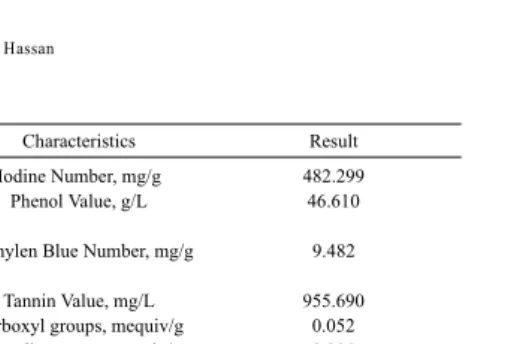
The iodine number is the number of mg iodine adsorbed by 1 g sorbent. Silica gels formed as a result of action of alkali leaching of the biomass followed its acid precipitation, show a good capacity of removing iodine which is shown in Table 1, these adsorbents uptake iodine in amounts somewhat lower than the N2. It should be remarked that the iodine ad- sorption seems suitable also to estimate approximately the surface area of silica equally as well as activated carbon.
Silica gels under the prescribed conditions posses a reason- able surface area mostly contained within micropores and mesopores, with a low contribution micro porosity which recommends them for purification and separation processes involving medium size molecules in addition to cationic species.
Phenolics removal capacity
Phenol number is the mass of adsorbent required to reduce the concentration of phenol/L water from 0.1 to 0.01 ppm.
Phenolic compounds present one of the most frequent pollu- tants encountered in surface water and water streams. Their presence in minute amounts impart characteristic objection- able (undesirable) taste and odour.
A 100 mL of standard concentration for either phenol or p- nitro phenol compound was selected as 100 ppm (100 mg/L) mixed with constant weights of adsorbents and the observed
536 H. A. Hanafi and H. S. Hassan
Journal of the Korean Chemical Society Table 1. Characteristics of Activated Carbon
Characteristics Result Characteristics Result
Proximate Analysis, % Iodine Number, mg/g 482.299
Moisture 1.6454 Phenol Value, g/L 46.610
Ash 16.7338
Volatile matter 3.9360 Methylen Blue Number, mg/g 9.482
Fixed carbon 77.6848
Particle size,µm 150 - 250 Tannin Value, mg/L 955.690
Surface area (N2-BET), m2/g 503.1523 Carboxyl groups, mequiv/g 0.052
Apparent density, g/mL 0.7421 Phenolic groups, mequiv/g 0.205
Water solubles, % 1.8239 Lactonic groups, mequiv/g 0.163
Acid-extractable content, % 10.1276 Acidic groups, mequiv/g 0.420
pH 9.42 Basic groups, mequiv/g 0.452
3000 2000 1000
Wavenumbers (cm-1)
80 75 70 65 60 55 50 45
Transmittance (%)
Fig. 1. FT-IR spectrum of CC.
Ni Cu Fe
0 50 100 150 200 250
Shaking time (min.)
100 80 60 40 20 0
Transmittance (%)
Fig. 2. Effect of Shaking time on sorption of Ni+2, Cu+2 and Fe+3 ions.
percent removals of are shown in Table 1.
It is generally observed that:- Removal of phenol appear to be less feasible than p-nitro phenol under same experi- mental conditions (initial phenolic concentration, adsorbent weight, temperature, contact time , and volume of aqueous solution).
The parameters evaluated are listed in Table 1.
Table 1. reveals that the carbon under study is of high sur- face area and that it has quite good amounts of micro and mesopores as well. Apart from having the desired textural characteristics of a good adsorbent, the carbon was also found to have quite good amounts of surface groups like carboxyl, phenolic, lactonic and basic groups. The presence of these groups is also evident from the FT-IR spectrum of the carbon (Fig. 1). the IR spectra showed characteristic peaks of car- boxylic acid. The peaks corresponding to carboxyl groups of frequency in the region 2954 cm-1. There are small humps around 1705 - 1647 cm-1 characteristic of thee carbonyl group of carboxylic acid. In addition to this, other characteristic peaks related to OH group of the carboxyl group are observ- ed at 1760, and 1125 cm-1 and lactones appear at 1160 -
1370 cm-1 and 1675 - 1790 cm-1 and C-H (stretching) appear at 2613 cm-1.
Effect of shaking time on adsorption of different metal ions The effect of shaking time on the adsorption of metals ions are shown in Fig. 2, the adsorption equilibrium takes place within 15 min. for Ni+2 onto CC with sorption medium molarity 0.01 M HCl (i.e. fast kinetic) compared to equili- brium steady state conditions for Cu+2 and Fe+3 onto sorbent RS-5 (equilibrium time takes place after 60 min. in case of Fe+3 with the same sorption medium.
Adsorption Isotherms: Adsorption Models
The assumptions associated with the Langmuir isotherm are well known;15 Adsorption can not proceed beyond a monolayer coverage and all adsorption sites are equivalent.
The Freundlich model, on the other hand, assumes a hetero- geneous adsorption surface with sites that have different energies of adsorption and are not equally available. For
appears, the volume of sodium thiosulfate used is recorded.
Phenol and phenol number
A sample, 12.5 mL, of phenol (100 mg/L) is introduced into 100 mL Erlenmeryer flask. The adsorbent to be tested, 0.03 gm, is added and the flask shaken for 48 h at 25 oC.
This procedure is repeated for several other concentrations of phenol. The adsorbent-phenol mixture is filtered through a 15 cm No.5 Whatmann filter paper under gravity, allowing all the solution to filter, and the concentration of phenol is determined by using UV-spectrophotometer at λmax = 271 nm.
The results so obtained provide the distribution of phenol at particular initial ratios of adsorbents masses to phenol concentration and volume. In doing so, one may construct an adsorption isotherm.
Analysis of metal ions
All the metals were estimated following a suitable colori- metric method. Nickel(II) was estimated by the dimethyl- glyoxime method,12 copper(II) and iron(III) by the thiocy- anate methods.13,14
Isotherm procedure
Prior to isotherm studies, minimum contact times for ad- sorption equilibria to become established were estimated.
Each experiment comprised three replicate 100 mL glasses stopper bottles containing appropriate amount of adsorbent and 50 mL of adsorbate solutions of selected concentrations.
Control flasks without the adsorbents are also prepared si- multaneously. Mixtures were maintained in a rotary shaker (orbitek) at constant temperature (30, 45 or 60 oC). After the attainment of equilibrium the contents of each flask were filtered through Whatmann (No.41) filter paper, with the first 10 mL discarded. The filtered samples were then analyz- ed for unadsorbed metal ions. The equilibrium adsorption data were then fitted to Freundlich and Langmuir isotherms equations:
Freundlich qe= KF Ce(1/n)
Langmuir qe= KL Ce /(1+b Ce)= qm bCe/(1+b Ce)
where qe is the adsorption capacity in mg/g; Ce is the equilibrium concentration of adsorbate (mg/L); KF and n are Freundlich constants; KL and b are Langmuir constants;
qm isthe Langmuir monolayer adsorption capacity.
pH variation studies
In order to find out the optimum pH for maximum removal
of adsorbate, experiments were carried out with solutions of same metal ion concentration but adjusted to different initial pH values (with HNO3 or NaOH). Measurements were carried out below which chemical precipitation of metal hydroxides do not occur. These values have been estimated to be 7.8 for Ni(OH)2; 2.5 for Fe(OH)3; and 7.5 for Cu(OH)2.
Desorption Studies
Some desorption experiments were also conducted in order to explore the feasibility of recovering both the ad- sorbed species and the adsorbent and to elucidate the nature of adsorption processes. They were carried out as follows.
After adsorption experiments using the selected adsorbent and adsorbate doses, the adsorbate loaded adsorbents were separated and washed gently with several portions of distilled water to remove any unadsorbed species. The samples were then air-dried and agitated with 0.1M solutions of HCl, AcOH or water for a period of 10 hours and the amounts of desorbed species were determined in the usual way.
RESULTS AND DISCUSSION Characterization of the adsorbent Iodine number
The iodine number is the number of mg iodine adsorbed by 1 g sorbent. Silica gels formed as a result of action of alkali leaching of the biomass followed its acid precipitation, show a good capacity of removing iodine which is shown in Table 1, these adsorbents uptake iodine in amounts somewhat lower than the N2. It should be remarked that the iodine ad- sorption seems suitable also to estimate approximately the surface area of silica equally as well as activated carbon.
Silica gels under the prescribed conditions posses a reason- able surface area mostly contained within micropores and mesopores, with a low contribution micro porosity which recommends them for purification and separation processes involving medium size molecules in addition to cationic species.
Phenolics removal capacity
Phenol number is the mass of adsorbent required to reduce the concentration of phenol/L water from 0.1 to 0.01 ppm.
Phenolic compounds present one of the most frequent pollu- tants encountered in surface water and water streams. Their presence in minute amounts impart characteristic objection- able (undesirable) taste and odour.
A 100 mL of standard concentration for either phenol or p- nitro phenol compound was selected as 100 ppm (100 mg/L) mixed with constant weights of adsorbents and the observed
Table 1. Characteristics of Activated Carbon
Characteristics Result Characteristics Result
Proximate Analysis, % Iodine Number, mg/g 482.299
Moisture 1.6454 Phenol Value, g/L 46.610
Ash 16.7338
Volatile matter 3.9360 Methylen Blue Number, mg/g 9.482
Fixed carbon 77.6848
Particle size,µm 150 - 250 Tannin Value, mg/L 955.690
Surface area (N2-BET), m2/g 503.1523 Carboxyl groups, mequiv/g 0.052
Apparent density, g/mL 0.7421 Phenolic groups, mequiv/g 0.205
Water solubles, % 1.8239 Lactonic groups, mequiv/g 0.163
Acid-extractable content, % 10.1276 Acidic groups, mequiv/g 0.420
pH 9.42 Basic groups, mequiv/g 0.452
3000 2000 1000
Wavenumbers (cm-1)
80 75 70 65 60 55 50 45
Transmittance (%)
Fig. 1. FT-IR spectrum of CC.
Ni Cu Fe
0 50 100 150 200 250
Shaking time (min.)
100 80 60 40 20 0
Transmittance (%)
Fig. 2. Effect of Shaking time on sorption of Ni+2, Cu+2 and Fe+3 ions.
percent removals of are shown in Table 1.
It is generally observed that:- Removal of phenol appear to be less feasible than p-nitro phenol under same experi- mental conditions (initial phenolic concentration, adsorbent weight, temperature, contact time , and volume of aqueous solution).
The parameters evaluated are listed in Table 1.
Table 1. reveals that the carbon under study is of high sur- face area and that it has quite good amounts of micro and mesopores as well. Apart from having the desired textural characteristics of a good adsorbent, the carbon was also found to have quite good amounts of surface groups like carboxyl, phenolic, lactonic and basic groups. The presence of these groups is also evident from the FT-IR spectrum of the carbon (Fig. 1). the IR spectra showed characteristic peaks of car- boxylic acid. The peaks corresponding to carboxyl groups of frequency in the region 2954 cm-1. There are small humps around 1705 - 1647 cm-1 characteristic of thee carbonyl group of carboxylic acid. In addition to this, other characteristic peaks related to OH group of the carboxyl group are observ- ed at 1760, and 1125 cm-1 and lactones appear at 1160 -
1370 cm-1 and 1675 - 1790 cm-1 and C-H (stretching) appear at 2613 cm-1.
Effect of shaking time on adsorption of different metal ions The effect of shaking time on the adsorption of metals ions are shown in Fig. 2, the adsorption equilibrium takes place within 15 min. for Ni+2 onto CC with sorption medium molarity 0.01 M HCl (i.e. fast kinetic) compared to equili- brium steady state conditions for Cu+2 and Fe+3 onto sorbent RS-5 (equilibrium time takes place after 60 min. in case of Fe+3 with the same sorption medium.
Adsorption Isotherms: Adsorption Models
The assumptions associated with the Langmuir isotherm are well known;15 Adsorption can not proceed beyond a monolayer coverage and all adsorption sites are equivalent.
The Freundlich model, on the other hand, assumes a hetero- geneous adsorption surface with sites that have different energies of adsorption and are not equally available. For
활성탄소를 이용한 수용액으로부터의 Ni(II), Cu(II) 그리고 Fe(III) 이온의 흡착 537
2010, Vol. 54, No. 5
Table 2. Isotherm parameters for the adsorption of metal ions on CC
Metal ion Model
Model Parameters Kf
1/n n r2
mmol/g mg/g
Ni (II) 0.3869 1.4173 0.5065 1.9743 0.9589
Cu(II) Freundlich 0.4977 4.2362 0.2285 4.3764 0.9918
Fe(III) 0.2171 6.6024 0.1517 6.5920 0.9715
Metal ion Model Model Parameters
KL b qm r2
Ni (II) 0.5272 0.4110 1.2827 0.9849
Cu(II) Langmuir 1.8132 2.4509 0.7398 0.9876
Fe(III) 5.6017 26.2230 0.2136 0.9260
Fe+3
Ni+2
Cu+2
50 100 150 200 250 300
Ce
Ce/Qe
50 45 40 35 30 25 20 15 10 5
Fe+3
Cu+2
Ni+2
Fig. 3. Langmuir adsorption plot for the adsorption of Cu(II), Ni(II) and Fe(II) ions on activated carbon.
Ni+2
Cu+2
Fe+3
2.1 2.2 2.3 2.4 2.5 2.6 2.7 2.8 2.9
log Ce
log qe
2.8 2.7 2.6 2.5 2.4 2.3 2.2
Fe+3
Cu+2
Ni+2
Fig. 4. Freudlich Adsorption isotherms of Ni+2, Cu+2 and Fe+3 ions on activated carbon.
each and every individual adsorption system, the data were fitted to the two isotherm equations and the results are given in Table 2 and Figs. 3 and 4 and [Conditions: adsorbent dose
0.1 g/50 mL of adsorbate solution; initial concentration of metal ion solutions, Ci = 15 - 100 mg/L for Ni; 20 - 100 mg/L for Cu and 15 - 80 mg/L for Fe(III)]. All the curves were of L type under Giles classification.16
According to Treybal17 it has been shown using mathe- matical equations that n values between 0 and 1 represent beneficial adsorption. Indeed, the n values found for all the adsorption systems fall in this range. The Langmuir constant b is a measure of adsorption intensity and the parameter qm
is a measure of adsorption capacity. Adsorption capacity of the adsorbents toward metal ions decrease in the order Ni(II), Cu(II), Fe(III) [values in Table 2], whereas the adsorption intensity decrease in the opposite order. The b values found indicate stronger interaction forces between carbon surface and Fe(III) ions compared to Ni(II) and Cu(II), in agreement with the higher ionic potential of Fe(III). The b values deter- mined are further used to calculate the dimensionless separa- tion factor, RL,18,19 defined as RL = 1/(1 + bCi) where Ci is the initial solute concentration. The magnitude of RL value gives an idea about the nature of adsorption equilibrium: the pro- cess is non-spontaneous when RL is greater than one; favor- able when RL lies between 0 and 1; and irreversible when RL is zero. In all the systems studied, RL values were com- prised between 0 and 1 (values not listed) indicating favor- able adsorption of all the metal ions on the activated carbon.
Effect of pH
The effects of pH in external solutions on adsorption ex- tent are presented in Fig. 5 (adsorbent doses: 0.1 g/50 mL, Ci= 50 mg/L).
For the three metal cations (Ni2+, Cu2+ and Fe3+) increase in solution pH through out the range studied resulted in increased adsorption. This trend is in agreement with the fact that the metal ions are adsorbed by ion- exchange mecha-
538 H. A. Hanafi and H. S. Hassan
Journal of the Korean Chemical Society
0 1 2 3 4 5 6 7 8 9
log Ce
Adsorption (%)
60
50
40
30
20
Fig. 5. Adsorption of metals on CC: Effect of pH.
1 2 3 4 5 6
Ce (mmoles/L)
q (mmoles/g)
1.2 1.0 0.8 0.6 0.4 0.2
Fig. 6. Effect of temperature: Adsorption of Ni(II) on activated car- bon.
nism. As the solution pH is lowered, concentration of H+
ions will increase proportionally which will effectively com- pete with metal cations for active adsorption sites on carbon surface, thereby reducing the available sites for metal cations.
Effect of Temperature
The equilibrium studies for all the systems were con- ducted at two more temperatures in addition to room tem- perature (30 oC), namely 45 and 60 oC in Fig. 6. For all the systems increase in temperature resulted in greater adsorp- tion. A representative graph for showing the effect of tempera- ture is shown in Fig. 3 for the Ni (II)-CC system.
The increased adsorption at higher temperatures can be due to one or more of the following reasons. Acceleration of some originally slow step(s)23 creation of some new activa- tion sites on the adsorbent surface24 and decrease in the size of the adsorbing species.25 This could well occur due to pro- gressive desolvation of the adsorbing ion as the solution tem- perature increases.
Thermodynamic parameters such as Gibbs’s free energy
change (∆G), enthalpy change (∆H) and entropy change (∆S) were calculated using the following expressions:
(1)
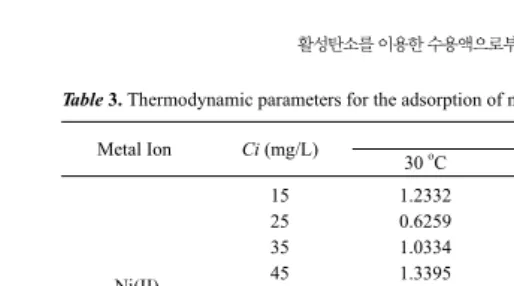
Where KC is the equilibrium constant for the distribution of metal ions between the liquid and solid phases; Cae is the solid phase metal ion concentration, mg/L; Ce is the liquid phase metal ion concentration, mg/L; T is absolute tem- perature, oK and R the gas constant. Equation (1) was used to construct Van’t Hoff plots and ∆H and ∆S were calcu- lated from the slope and intercept of the Van’t Hoff plot, respectively. Thermodynamic parameters evaluated for vari- ed metal ion concentrations are listed in Table 3.
The ∆G values obtained for most CC-metal ion systems were positive indicating that CC is less effective in remov- ing metal ions from aqueous solutions. The positive values of ∆H obtained for all the processes are further conforma- tions that they are endothermic, which is an indication of strong interaction between the adsorbate and the adsorbent.
The positive values of ∆S suggest increased randomness at the solid-liquid interface during the adsorption of metal ions.
The adsorbed solvent (water) molecules, which are displaced by the adsorbated species, gain more translational entropy than is lost by the adsorbate ions. Furthermore, before the adsorption process takes place the adsorbate ions are heavily solvated (the system is more ordered) and this order is lost when the ions are adsorbed on the surface, due to the re- lease of solvated water molecules.
Desorption Studies
Attempts were made to regenerate the adsorbed metal ions with water, 0.1 M acetic acid and 0.1 M hydrochloric acid as regenerating agents. The results are presented in Table 4.
These results indicate that the metal ions are adsorbed by ion-exchange mechanism by the surface groups present on the carbon surface.
CONCLUSION
The work described has shown that the activated carbon under study can be successfully used for the adsorptive re- moval of metal ions from solution. The carbon possessed good textural and chemical properties. The three parameter
Table 2. Isotherm parameters for the adsorption of metal ions on CC
Metal ion Model
Model Parameters Kf
1/n n r2
mmol/g mg/g
Ni (II) 0.3869 1.4173 0.5065 1.9743 0.9589
Cu(II) Freundlich 0.4977 4.2362 0.2285 4.3764 0.9918
Fe(III) 0.2171 6.6024 0.1517 6.5920 0.9715
Metal ion Model Model Parameters
KL b qm r2
Ni (II) 0.5272 0.4110 1.2827 0.9849
Cu(II) Langmuir 1.8132 2.4509 0.7398 0.9876
Fe(III) 5.6017 26.2230 0.2136 0.9260
Fe+3
Ni+2
Cu+2
50 100 150 200 250 300
Ce
Ce/Qe
50 45 40 35 30 25 20 15 10 5
Fe+3
Cu+2
Ni+2
Fig. 3. Langmuir adsorption plot for the adsorption of Cu(II), Ni(II) and Fe(II) ions on activated carbon.
Ni+2
Cu+2
Fe+3
2.1 2.2 2.3 2.4 2.5 2.6 2.7 2.8 2.9
log Ce
log qe
2.8 2.7 2.6 2.5 2.4 2.3 2.2
Fe+3
Cu+2
Ni+2
Fig. 4. Freudlich Adsorption isotherms of Ni+2, Cu+2 and Fe+3 ions on activated carbon.
each and every individual adsorption system, the data were fitted to the two isotherm equations and the results are given in Table 2 and Figs. 3 and 4 and [Conditions: adsorbent dose
0.1 g/50 mL of adsorbate solution; initial concentration of metal ion solutions, Ci = 15 - 100 mg/L for Ni; 20 - 100 mg/L for Cu and 15 - 80 mg/L for Fe(III)]. All the curves were of L type under Giles classification.16
According to Treybal17 it has been shown using mathe- matical equations that n values between 0 and 1 represent beneficial adsorption. Indeed, the n values found for all the adsorption systems fall in this range. The Langmuir constant b is a measure of adsorption intensity and the parameter qm
is a measure of adsorption capacity. Adsorption capacity of the adsorbents toward metal ions decrease in the order Ni(II), Cu(II), Fe(III) [values in Table 2], whereas the adsorption intensity decrease in the opposite order. The b values found indicate stronger interaction forces between carbon surface and Fe(III) ions compared to Ni(II) and Cu(II), in agreement with the higher ionic potential of Fe(III). The b values deter- mined are further used to calculate the dimensionless separa- tion factor, RL,18,19 defined as RL = 1/(1 + bCi) where Ci is the initial solute concentration. The magnitude of RL value gives an idea about the nature of adsorption equilibrium: the pro- cess is non-spontaneous when RL is greater than one; favor- able when RL lies between 0 and 1; and irreversible when RL is zero. In all the systems studied, RL values were com- prised between 0 and 1 (values not listed) indicating favor- able adsorption of all the metal ions on the activated carbon.
Effect of pH
The effects of pH in external solutions on adsorption ex- tent are presented in Fig. 5 (adsorbent doses: 0.1 g/50 mL, Ci= 50 mg/L).
For the three metal cations (Ni2+, Cu2+ and Fe3+) increase in solution pH through out the range studied resulted in increased adsorption. This trend is in agreement with the fact that the metal ions are adsorbed by ion- exchange mecha-
0 1 2 3 4 5 6 7 8 9
log Ce
Adsorption (%)
60
50
40
30
20
Fig. 5. Adsorption of metals on CC: Effect of pH.
1 2 3 4 5 6
Ce (mmoles/L)
q (mmoles/g)
1.2 1.0 0.8 0.6 0.4 0.2
Fig. 6. Effect of temperature: Adsorption of Ni(II) on activated car- bon.
nism. As the solution pH is lowered, concentration of H+
ions will increase proportionally which will effectively com- pete with metal cations for active adsorption sites on carbon surface, thereby reducing the available sites for metal cations.
Effect of Temperature
The equilibrium studies for all the systems were con- ducted at two more temperatures in addition to room tem- perature (30 oC), namely 45 and 60 oC in Fig. 6. For all the systems increase in temperature resulted in greater adsorp- tion. A representative graph for showing the effect of tempera- ture is shown in Fig. 3 for the Ni (II)-CC system.
The increased adsorption at higher temperatures can be due to one or more of the following reasons. Acceleration of some originally slow step(s)23 creation of some new activa- tion sites on the adsorbent surface24 and decrease in the size of the adsorbing species.25 This could well occur due to pro- gressive desolvation of the adsorbing ion as the solution tem- perature increases.
Thermodynamic parameters such as Gibbs’s free energy
change (∆G), enthalpy change (∆H) and entropy change (∆S) were calculated using the following expressions:
(1)
Where KC is the equilibrium constant for the distribution of metal ions between the liquid and solid phases; Cae is the solid phase metal ion concentration, mg/L; Ce is the liquid phase metal ion concentration, mg/L; T is absolute tem- perature, oK and R the gas constant. Equation (1) was used to construct Van’t Hoff plots and ∆H and ∆S were calcu- lated from the slope and intercept of the Van’t Hoff plot, respectively. Thermodynamic parameters evaluated for vari- ed metal ion concentrations are listed in Table 3.
The ∆G values obtained for most CC-metal ion systems were positive indicating that CC is less effective in remov- ing metal ions from aqueous solutions. The positive values of ∆H obtained for all the processes are further conforma- tions that they are endothermic, which is an indication of strong interaction between the adsorbate and the adsorbent.
The positive values of ∆S suggest increased randomness at the solid-liquid interface during the adsorption of metal ions.
The adsorbed solvent (water) molecules, which are displaced by the adsorbated species, gain more translational entropy than is lost by the adsorbate ions. Furthermore, before the adsorption process takes place the adsorbate ions are heavily solvated (the system is more ordered) and this order is lost when the ions are adsorbed on the surface, due to the re- lease of solvated water molecules.
Desorption Studies
Attempts were made to regenerate the adsorbed metal ions with water, 0.1 M acetic acid and 0.1 M hydrochloric acid as regenerating agents. The results are presented in Table 4.
These results indicate that the metal ions are adsorbed by ion-exchange mechanism by the surface groups present on the carbon surface.
CONCLUSION
The work described has shown that the activated carbon under study can be successfully used for the adsorptive re- moval of metal ions from solution. The carbon possessed good textural and chemical properties. The three parameter