서 론
청소년기는 아동기에서 성인기로 넘어가는 과도적인 시기이며[1], 신체적 성장뿐만 아니라 인지, 정서 사회적 측면에서 급격한 변화와 성장을 경험하는 시기이다. 이러한 청소년기는 일상생활에서 학업, 교우관계 등에서 많은 스트레스를 받음으로써 우울감을 경험할 가능 성이 크다. 또한 청소년기에 있어서 우울은 불안 또는 분노 등의 증상 을 동반하게 되는데, 이는 급격한 변화로 인한 정서적 불안정과 더불 어 가정 및 사회적 요인으로 인한 스트레스 때문이라고 할 수 있다[2].
특히 청소년기의 스트레스 중 학업과 관련된 스트레스는 우울감과 같 은 부정적인 정서를 유발할 수 있으며, 이는 곧 자살충동의 위험을 높 인다는 결과가 보고되고 있다[3,4]. 이처럼 청소년은 이성적 판단보 다는 정서적 요인이 행동에 더 큰 영향을 미치고, 상대적으로 성인보 다 미성숙한 상태이기 때문에 이러한 우울감과 정서적 불안정은 자살 과 관련되어 충동적인 행동으로 이어질 수 있기에 주의 깊은 관심이 필요하다[1,2].
청소년기의 우울감은 스트레스에서 기인하는 것이 크며, 다른 나라 와 비교하였을 때 한국 청소년들이 가장 높은 빈도로 스트레스를 경
부모의 학력수준과 우울감 사이의 연관성:
제14기(2018년) 청소년건강행태조사 자료를 이용하여
강평모·윤채연·김예지·김재현 단국대학교 보건과학대학 보건행정학과
Association between Educational Level of Parents and Adolescent Depression Feeling: Based on 14th Korean Youth Health Behavior Survey
Pyung Mo Kang, Chae Yeon Yoon, Ye Ji Kim, Jae-Hyun Kim
Department of Health Administration, Dankook University College of Health Science, Cheonan, Korea
Background: This study aimed to demonstrate the association between the education level of parents and adolescent depression feeling.
Methods: We used the chi-square test and the multiple logistic regression model to analyze the data of the “Korean Youth Health Behavior Survey in 2018” (n=43,220) conducted by the Korea Centers for Disease Control and Prevention.
Results: As a result of the analysis, a group whose parents’ education level is ‘above the university graduation (including the graduation of the college)’ had statistically significant experience of depression than a group whose parents’ education level is ‘high school graduation.’
Conclusion: When preparing a policy on adolescent depression feeling, we need to consider the association between the education level of parents and adolescent depression feeling. Especially, a higher level of education of parents needs attention and management to foster positive mental health rather than excessive academic pressure, especially in the parent-child relationship of the same gender.
Keywords: Education level of parents; Depression feeling; Gender; Grade
Correspondence to: Jae-Hyun Kim
Department of Health Administration, Dankook University College of Health Science, 119 Dandae-ro, Dongnam-gu, Cheonan 31116, Korea
Tel: +82-41-550-1472, Fax: +82-41-559-7934, E-mail: [email protected]
Received: September 4, 2019, Revised: October 1, 2019, Accepted after revision: October 22, 2019
© Korean Academy of Health Policy and Management
◯
㏄This is an open-access article distributed under the terms of the Creative Commons Attribution Non-Commercial License (http://creativecommons.org/licenses/by-nc/4.0) which permits unrestricted non-commercial use,
distribution, and reproduction in any medium, provided the original work is properly cited.
험하였다. 주요 원인은 학업문제로, 청소년 학업스트레스가 높을수 록 청소년 우울감의 수준이 높아졌다[5,6]. 한국의 청소년들이 학업 수준에 지나치게 집착하게 된 현상은 사회환경의 변화에서부터 야기 되었다. 1970년대까지 급속히 사회가 발전하고 새로운 직업구조가 생겨남에 따라 역량을 갖춘 사람들이 계층 상승의 경험을 하게 되었 다. 1980–1990년대는 사회계층이 더욱 구조화되었고, 보다 나은 직업 을 갖기 위한 경쟁은 더욱 심화되었으며, 이는 높은 학력을 성취하려 는 노력으로 이어지게 되었다[7]. 따라서 학력이 사회경제적 지위를 이끈다는 변화된 사회상을 경험한 부모세대의 교육에 대한 관심이 증 대되었다[8,9]. 실제로 2012년과 2016년 통계청 자료에 따르면 부모 의 자녀 교육수준 기대 정도는 부모의 교육수준이 높을수록 더 높은 수준의 학업성취도를 원하는 비중이 훨씬 컸던 것을 보면[10,11], 사 회경제적 지위가 높은 부모일수록 청소년기의 학력에 기대가 큼을 알 수 있고 더 높은 수준의 학업성취도를 요구하며 이는 학업 압박으로 이어져 스트레스를 가중시켜 우울감과 연관이 있음을 시사한다.
2017년 우리나라 청소년 4명 중 1명이 일상생활을 중단할 정도로 우울감을 느낀 적이 있었으며, 남학생은 20.3%, 여학생은 30.3%로 나 타났고, 고등학생은 26.4%, 중학생은 23.5%로 나타났다. 그 중 우리나 라의 청소년은 학업스트레스로 인한 부담, 학교적응문제 등이 우울 감의 큰 부분을 차지하고 있다[12]. 이러한 우울감은 단순한 상황적인 측면에서의 기분이 우울한 것을 의미하는 것을 넘어서 의학적인 측면 에서도 권태, 비관주의, 부정적인 기분을 의미할 수 있으며[13], 우울 감이 심각한 경우 ‘자살’이라는 결과를 초래하기도 한다[14]. 또한 세 계보건기구에 따르면 전 세계 10대 청소년의 질병 및 장애 원인과 관 계한 요인 중 1위가 우울감인 것으로 나타났으며, 이러한 우울감은 전 세계적으로 증가하고 있으며, 정신질환 중 가장 높은 유병률을 보이 고 있다[15]. 우울감으로 인한 대표적인 정신질환인 우울증을 비롯한 정신질환을 앓고 있는 질환자 중 절반 이상은 14세 무렵에 첫 증세가 발현하는 것으로 나타나 우울감에 취약하며 우울감을 느끼는 비중이 급격히 증가하는 청소년기는 매우 중요한 시기이므로, 청소년의 정 신건강에 보다 주의 깊은 관심을 가질 필요가 있음을 시사한다 [16,17].
현재까지 부모의 사회경제적 지위에 따른 청소년 학업성취도, 스트 레스, 자살 등의 많은 선행연구가 시행되었으나 부모의 사회경제적 지위 중 특정 변인, 즉 부모 학력에 따른 청소년 우울감 경험 여부에 대 한 연구는 시행된 바 없다. 따라서 학력 및 학업성취도의 중요성이 커 지면서 이러한 사회문화적 상황하에서 부모의 교육수준과 청소년 우 울감 사이에 어떠한 연관성이 있는지 연구해 보고자 한다. 또한 청소 년들의 우울감 예방 및 정신건강증진을 위한 정책 및 계획수립 시에 어느 집단에 중점적인 교육 및 관리를 실시하여야 하는지 고려하는
데 도움이 되고자 한다.
방 법
1. 연구자료
본 연구는 부모의 교육수준과 청소년 우울감 사이의 연관성을 알아 보고자 교육부, 보건복지부, 질병관리본부에서 시행하는 제14차 (2018) 청소년건강행태온라인조사의 원시 자료를 사용한 2차 자료분 석 연구이다. 청소년건강행태온라인조사는 국민건강증진법 제19조 를 근거로 2005년부터 매년 실시하였으며, 우리나라 청소년의 행태 와 관련하여 대표성을 가지는 자료이다. 조사참여자는 모집단 층화, 표본배분, 표본추출의 단계로 추출되었으며 전국 중학교 400개교, 고 등학교 400개교, 총 800개교의 62,823명을 대상으로 조사하였다. 그 중 60,040명이 조사에 참여하여 학생 수 기준으로 95.6%의 참여율을 나타냈다. 조사내용은 신체활동, 식생활 등 15개 영역의 103개 문항 으로 구성되어 있으며, 설문문항 및 지표는 교육과학기술부, 보건복 지부, 질병관리본부 및 국내외 자료 및 영역별 전문가 자문위원회를 통해 개발되었다. 조사방법은 익명성 자기기입식 온라인 조사방법으 로, 인터넷이 가능한 컴퓨터실에서 표본 학생들에게 1인 1대의 컴퓨 터를 배정하고 무작위로 자리를 배치하여 조사를 진행하였다.
본 연구에서는 제14기(2018년) 청소년건강행태온라인조사 항목 중 아버지/어머니 학력, 아버지/어머니와 동거 여부, 학업성적, 성별, 학년, 최근 7일 동안 근력강화 일수, 경제상태, 도시규모, 주관적 건강 인지, 평생 음주경험, 평생 흡연경험에 대한 무응답과 변수당 결측값 을 제외한 43,220명의 응답자가 분석에 사용되었다.
2. 변수
1) 독립변수: 부모 (아버지/어머니)의 교육수준
“아버지/어머니의 학력은 어떻게 됩니까?”라는 문항에 “중학교 졸 업 이하,” “고등학교 졸업,” “대학교 졸업 이상(전문대 졸업 포함),”
“잘 모름” 중 1가지를 선택하는 자기기입식 설문으로 조사되었다. 본 연구에서는 잘 모름, 무응답은 분석에서 제외하였다.
2) 종속변수: 우울감(슬픔, 절망감 경험)
우울감(슬픔, 절망감 경험)은 “최근 12개월 동안, 2주 내내 일상생 활을 중단할 정도로 슬프거나 절망감을 느낀 적이 있었습니까?”라는 문항에 “최근 12개월 동안 없다,” “최근 12개월 동안 있다” 중 1가지를 선택하는 자기기입식 설문으로 조사되었다.
3) 보정변수
(1) 사회인구학적 변수
성별, 학년, 학업성적, 경제적 상태, 부모(아버지/어머니) 동거 여부 변수를 사용하였으며, 성별은 “남자,” “여자”로 학년은 “중학교 1학 년”부터 “고등학교 3학년”까지 6개로 분류하였다. 학업성적과 경제 적 상태는 “상,” “중상,” “중,” “중하,” “하”로 분류하였다. 부모와의 동 거 여부에 대해서는 “예,” “아니오”로 분류하였다.
(2) 건강행태 및 상태 변수
신체활동, 주관적 건강인지, 흡연, 음주의 변수를 사용하였으며 신 체활동은 “최근 7일 동안 없다,” “주 1일,” “주 2일,” “주 3일,” “주 4일,”
“주 5일 이상” 6개로 분류하였으며, 주관적 건강인지는 “매우 건강한 편이다,” “건강한 편이다,” “보통이다,” “건강하지 못한 편이다,” “매 우 건강하지 못한 편이다” 5개로 분류하였다. 흡연과 음주는 평생 경 험 여부에 대해서만 “있다,” “없다”로 분류하였다.
3. 통계적 분석
우리나라 청소년을 대상으로 부모의 교육수준과 우울감 사이의 연 관성을 알아보기 위하여 카이제곱검정과 다중로지스틱 회귀분석을 사용하였다. 대표성을 반영하기 위해서 층화 변수, 집락 변수, 표준 가 중치를 사용하여 정보량을 고정하고 통계적 유의성은
p-value ≤0.05
으로 검정하였다. 통계분석에는 SAS ver. 9.4 (SAS Institute Inc., Cary, NC, USA)를 사용하였다.
결 과
1. 참여대상자의 일반적 특성
본 연구는 제14차(2018년) 청소년건강행태온라인조사에 참여한 43,220명을 대상으로 진행하였으며, 부모의 교육수준과 우울감 사이 의 연관성을 분석하였다. 아버지의 교육수준에서 중학교 졸업 이하 782명은 전체 43,220명 중 1.8%이고, 이 중 우울감을 경험한 청소년의 비중은 234명(2.0%)이었다. 고등학교 졸업은 13,001명으로 전체 대 상 중 30.1%이었으며, 이 중 우울감을 경험한 청소년의 비중은 30.3%
였다. 대학교 졸업 이상(전문대 졸업 포함)은 전체 대상 중 29,437명 (68.1%)으로, 이 중 우울감을 겪은 청소년의 비중은 8,020명(67.8%)이 었다. 어머니의 교육수준에서는 중학교 졸업 이하 634명은 전체 43,220명 중 1.5%이고, 이 중 우울감을 경험한 청소년의 비중은 195명 (1.6%)였다. 고등학교 졸업은 15,209명으로 전체 대상 중 35.2%이었 으며, 이 중 우울감을 경험한 청소년의 비중은 35.4%이었다. 대학교 졸업 이상(전문대 졸업 포함)은 전체 대상 중 27,377명으로 63.3%이 며, 이 중 우울감을 겪은 청소년의 비중은 7,448명으로 62.9%이었다 (Table 1).
Characteristic
Total The experience of sadness and depression the last 12 mo
p-value
Yes No
No. (%) Weighted
% No. (%) Weighted
% No. (%) Weighted
%
Education level of father 0.3945
≤Junior school graduation 782 (1.8) 1.7 234 (2.0) 29.9 548 (1.7) 70.1
High school graduation 13,001 (30.1) 29.3 3,582 (30.3) 27.6 9,419 (30.0) 72.4
≥University graduation (including the graduation of the college)
29,437 (68.1) 69.0 8,020 (67.8) 27.4 21,417 (68.2) 72.6
Education level of mother 0.3535
≤Junior high school graduation 634 (1.5) 1.4 195 (1.6) 29.9 439 (1.4) 70.1
High school graduation 15,209 (35.2) 34.8 4,193 (35.4) 27.7 11,016 (35.1) 72.3
≥University graduation (including the graduation of the college)
27,377 (63.3) 63.8 7,448 (62.9) 27.4 19,929 (63.5) 72.6
Cohabit with father <0.0001
Yes 39,965 (92.5) 92.7 10,683 (90.3) 26.9 29,282 (93.3) 73.1
No 3,255 (7.5) 7.3 1,153 (9.7) 35.3 2,102 (6.7) 64.7
Cohabit with mother <0.0001
Yes 41,968 (97.1) 97.3 11,383 (96.2) 27.3 30,585 (97.5) 72.7
No 1,252 (2.9) 2.7 453 (3.8) 36.7 799 (2.5) 63.3
(Continued to the next page)
Table1 1. General characteristics of subjects included for analysis
Characteristic
Total The experience of sadness and depression the last 12 mo
p-value
Yes No
No. (%) Weighted
% No. (%) Weighted
% No. (%) Weighted
%
Scholastic achievement <0.0001
High 6,635 (15.4) 15.0 1,508 (12.7) 22.7 5,127 (16.3) 77.3
High-intermediate 12,055 (27.9) 27.6 2,926 (24.7) 24.5 9,129 (29.1) 75.5
Middle 12,494 (28.9) 29.2 3,349 (28.3) 27.0 9,145 (29.1) 73.0
Low-intermediate 8,650 (20.0) 20.2 2,784 (23.5) 32.2 5,866 (18.7) 67.8
Low 3,386 (7.8) 8.1 1,269 (10.7) 37.1 2,117 (6.7) 62.9
Gender <0.0001
Male 21,522 (49.8) 51.0 4,508 (38.1) 21.4 17,014 (54.2) 78.6
Female 21,698 (50.2) 49.0 7,328 (61.9) 33.8 14,370 (45.8) 66.2
Grade <0.0001
1st in middle school 6,065 (14.0) 12.5 1,336 (11.3) 22.1 4,729 (15.1) 77.9
2nd in middle school 6,796 (15.7) 14.8 1,791 (15.1) 25.9 5,005 (15.9) 74.1
3rd in middle school 7,304 (16.9) 16.1 2,077 (17.5) 28.5 5,227 (16.7) 71.5
1st in high school 7,004 (16.2) 16.5 1,868 (15.8) 26.9 5,136 (16.4) 73.1
2nd in high school 7,771 (18.0) 18.8 2,235 (18.9) 28.9 5,536 (17.6) 71.1
3rd in high school 8,280 (19.2) 21.4 2,529 (21.4) 30.3 5,751 (18.3) 69.7
Physical activity 0.0017
None 20,753 (48.0) 48.5 5,902 (49.9) 28.5 14,851 (47.3) 71.5
1 time (/wk) 7,322 (16.9) 16.7 1,924 (16.3) 26.3 5,398 (17.2) 73.7
2 times (/wk) 5,026 (11.6) 11.5 1,315 (11.1) 26.3 3,711 (11.8) 73.7
3 times (/wk) 3,674 (8.5) 8.5 984 (8.3) 26.6 2,690 (8.6) 73.4
4 times (/wk) 1,773 (4.1) 4.1 492 (4.2) 28.3 1,281 (4.1) 71.7
≥5 times (/wk) 4,672 (10.8) 10.7 1,219 (10.3) 26.5 3,453 (11.0) 73.5
Economic status <0.0001
High 5,211 (12.1) 12.1 1,282 (10.8) 24.8 3,929 (12.5) 75.2
High-intermediate 14,243 (33.0) 33.2 3,624 (30.6) 25.6 10,619 (33.8) 74.4
Middle 19,146 (44.3 44.1 5,171 (43.7) 27.3 13,975 (44.5) 72.7
Low-intermediate 3,970 (9.2) 9.1 1,456 (12.3) 36.3 2,514 (8.0) 63.7
Low 650 (1.5) 1.5 303 (2.6) 46.3 347 (1.1) 53.7
City size 0.7956
Metropolis 19,747 (45.7) 43.8 5,334 (45.1) 27.3 14,413 (45.9) 72.7
Small and medium-sized cities 20,596 (47.7) 50.8 5,703 (48.2) 27.6 14,893 (47.5) 72.4
County 2,877 (6.7) 5.5 799 (6.8) 28.1 2,078 (6.6) 71.9
Self-rated health <0.0001
Very good 12,434 (28.8) 28.3 2,256 (19.1) 18.4 10,178 (32.4) 81.6
Good 19,121 (44.2) 44.1 4,817 (40.7) 25.0 14,304 (45.6) 75.0
Normal 8,881 (20.5) 21.0 3,300 (27.9) 36.8 5,581 (17.8) 63.2
Bad 2,609 (6.0) 6.2 1,356 (11.5) 52.8 1,253 (4.0) 47.2
Worst 175 (0.4) 0.4 107 (0.9) 60.7 68 (0.2) 39.3
Alcohol status <0.0001
Yes 18,108 (41.9) 42.8 6,162 (52.1) 34.0 11,946 (38.1) 66.0
No 25,112 (58.1) 57.2 5,674 (47.9) 22.7 19,438 (61.9) 77.3
Smoking status <0.0001
Yes 5,975 (13.8) 14.5 2,150 (18.2) 35.3 3,825 (12.2) 64.7
No 37,245 (86.2) 85.5 9,686 (81.8) 26.2 27,559 (87.8) 73.8
Total 43,220 (100.0) 100.0 11,836 (27.4) 31,384 (72.6)
Table1 1. Continued
2. 부모 교육수준과 우울감 사이의 연관성
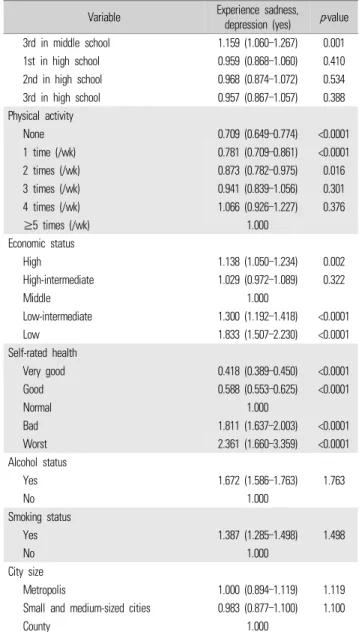
아버지 교육수준이 고등학교 졸업 집단에 비하여 중학교 졸업 이하 집단일 경우, 청소년 우울감 경험 사이의 통계적으로 유의한 연관성 은 없었다. 반면, 아버지 교육수준이 고등학교 졸업 집단에 비하여 대 학교 졸업 이상(전문대학교 졸업 포함) 집단에서는 우울감 경험 여부 가 1.116배(odds ratio [OR], 1.116; 95% confidence interval [CI], 1.048 –1.190) 통계적으로 유의하게 높았다.
어머니 교육수준이 고등학교 졸업 집단에 비하여 중학교 졸업 이하 집단일 경우, 청소년 우울감 경험 사이의 통계적으로 유의한 연관성 은 없었다. 반면, 어머니 교육수준이 고등학교 졸업 집단에 비하여 대 학교 졸업 이상(전문대학교 졸업 포함) 집단에서는 우울감 경험 여부 가 1.104배(OR, 1.104; 95% CI, 1.040–1.171) 통계적으로 유의하게 높 았다(Table 2).
3. 성별, 경제상태, 학년에 따른 부모 교육수준과 우울감 사이의 연관성
먼저 청소년 성별을 기준으로 층화 분석하였을 때, 남성 청소년과 여성 청소년 두 집단 모두에서 아버지 교육수준과 어머니 교육수준이 고등학교 졸업 집단에 비해 중학교 졸업 이하 집단일 경우 청소년 우 울감 경험 사이의 통계적으로 유의한 연관성은 없었다. 반면, 아버지 교육수준이 고등학교 졸업 집단에 비하여 대학교 졸업 이상(전문대 학교 졸업 포함) 집단일 경우 여성 청소년에서는 통계적 연관성은 없 었지만, 남성 청소년에서는 우울감 경험 여부가 1.234배(OR, 1.234;
Variable Experience sadness,
depression (yes) p-value Education level of father
≤Junior high school graduation 0.955 (0.785–1.161) 0.642
High school graduation 1.000
≥University graduation (including the graduation of the college)
1.116 (1.048–1.190) 0.001
Education level of mother
≤Junior high school graduation 0.957 (0.778–1.177) 0.676
High school graduation 1.000
≥University graduation (including the graduation of the college)
1.104 (1.040–1.171) 0.001
Cohabit with father
Yes 1.000
No 1.177 (1.075–1.288) 0.000
Cohabit with mother
Yes 1.000
No 1.191 (1.035–1.371) 0.015
Scholastic achievement
High 1.000
High-intermediate 1.029 (0.947–1.119) 0.496
Middle 1.135 (1.045–1.233) 0.003
Low-intermediate 1.302 (1.186–1.430) <0.0001
Low 1.466 (1.309–1.642) <0.0001
Gender
Male 1.000
Female 2.100 (1.975–2.233) <0.0001
Grade
1st in middle school 1.000
2nd in middle school 1.088 (0.984–1.203) 0.098
(Continued to the next page)
Table 2. Association between education level of parents and
adolescent depression feelingVariable Experience sadness,
depression (yes) p-value
3rd in middle school 1.159 (1.060–1.267) 0.001
1st in high school 0.959 (0.868–1.060) 0.410
2nd in high school 0.968 (0.874–1.072) 0.534
3rd in high school 0.957 (0.867–1.057) 0.388
Physical activity
None 0.709 (0.649–0.774) <0.0001
1 time (/wk) 0.781 (0.709–0.861) <0.0001
2 times (/wk) 0.873 (0.782–0.975) 0.016
3 times (/wk) 0.941 (0.839–1.056) 0.301
4 times (/wk) 1.066 (0.926–1.227) 0.376
≥5 times (/wk) 1.000
Economic status
High 1.138 (1.050–1.234) 0.002
High-intermediate 1.029 (0.972–1.089) 0.322
Middle 1.000
Low-intermediate 1.300 (1.192–1.418) <0.0001
Low 1.833 (1.507–2.230) <0.0001
Self-rated health
Very good 0.418 (0.389–0.450) <0.0001
Good 0.588 (0.553–0.625) <0.0001
Normal 1.000
Bad 1.811 (1.637–2.003) <0.0001
Worst 2.361 (1.660–3.359) <0.0001
Alcohol status
Yes 1.672 (1.586–1.763) 1.763
No 1.000
Smoking status
Yes 1.387 (1.285–1.498) 1.498
No 1.000
City size
Metropolis 1.000 (0.894–1.119) 1.119
Small and medium-sized cities 0.983 (0.877–1.100) 1.100
County 1.000
Values are presented as odds ratio (95% confidence interval). Adjusted for socioeconomic factors and health status and risk factors.
Table 2.
Continued95% CI, 1.109–1.372) 통계적으로 유의하게 높았다. 또한 어머니 교육 수준에서는 고등학교 졸업 집단에 비하여 대학교 졸업 이상(전문대 학교 졸업 포함) 집단일 경우 남성 청소년에서는 통계적으로 유의한 연관성은 없었지만, 여성 청소년에서는 우울감 경험 여부가 1.121배 (OR, 1.121; 95% CI, 1.036–1.213) 통계적으로 유의하게 높았다.
경제상태 1그룹(중 이상)과 경제상태 2그룹(중하 이하)으로 층화 분석하였을 때, 경제상태 2그룹의 경우에는 아버지 교육수준과 어머 니 교육수준이 고등학교 졸업 집단에 비해 중학교 졸업 이하 집단과 대학교 졸업 이상(전문대학교 졸업 포함) 집단 모두에서 청소년 우울 감 사이의 통계적으로 유의한 연관성은 없었다. 또한 경제상태 1그룹 (중 이상)의 경우에도 아버지 교육수준과 어머니 교육수준이 고등학 교 졸업 집단에 비해 중학교 졸업 이하 집단일 경우 통계적으로 유의 한 연관성은 없었다. 반면, 경제상태 1그룹(중 이상)의 경우에는 아버 지 교육수준이 고등학교 졸업 집단에 비해 대학교 졸업 이상(전문대 학교 졸업 포함) 집단일 경우 청소년 우울감 경험 여부가 1.122배(OR, 1.122; 95% CI, 1.046–1.203) 통계적으로 유의하게 높았다. 또한 어머 니 교육수준이 고등학교 졸업 집단에 비해 대학교 졸업 이상(전문대 학교 졸업 포함) 집단일 경우 청소년 우울감 경험 여부가 1.110배(OR, 1.110; 95% CI, 1.042–1.182) 통계적으로 유의하게 높았다.
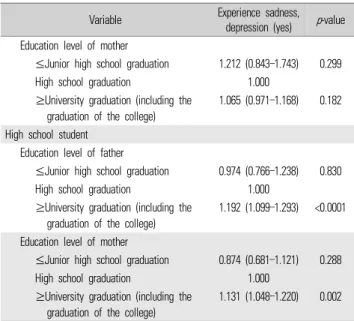
학년을 기준으로 중학생과 고등학생으로 층화 분석하였을 때, 중학 생 청소년 집단의 경우 아버지 교육수준과 어머니 교육수준과 청소년 우울감 경험 사이의 통계적 유의한 연관성은 없었다. 또한 고등학생 청소년 집단의 경우에는 아버지 교육수준과 어머니 교육수준이 고등 학교 졸업 집단에 비하여 중학교 졸업 이하 집단일 경우 청소년 우울 감 경험 사이의 연관성은 통계적으로 유의한 연관성은 없었다. 반면, 아버지 교육수준과 어머니 교육수준이 고등학교 졸업 집단에 비하여 대학교 졸업 이상(전문대학교 졸업 포함) 집단일 경우 청소년 우울감 경험 여부가 각각 아버지 교육수준은 1.192배(OR, 1.192; 95% CI, 1.099–1.293) 통계적으로 유의하게 높았고, 어머니 교육수준의 경우 1.131배(OR, 1.131; 95% CI, 1.048–1.220) 통계적으로 유의하게 높았 다(Table 3).
고 찰
본 연구의 결과는 부모의 사회경제적 지위가 높을수록 청소년 우울 에 큰 영향을 끼친다는 선행연구와 한국에서의 학력이 단순히 지식의 척도를 넘어 개인의 사회적 계층과 모든 삶의 지표로 작용하여 취업 기회나 임금, 사회적 지위, 인맥 모든 면에서 영향을 준다는 연구와 일
Variable Experience sadness,
depression (yes) p-value Male
Education level of father
≤Junior high school graduation 0.930 (0.690–1.253) 0.632
High school graduation 1.000
≥University graduation (including the graduation of the college)
1.234 (1.109–1.372) 0.000
Education level of mother
≤Junior high school graduation 0.926 (0.656–1.307) 0.661
High school graduation 1.000
≥University graduation (including the graduation of the college)
1.084 (0.991–1.187) 0.078
Female
Education level of father
≤Junior high school graduation 0.990 (0.762–1.285) 0.937
High school graduation 1.000
≥University graduation (including the graduation of the college)
1.035 (0.954–1.123) 0.403
Education level of mother
≤Junior high school graduation 0.968 (0.735–1.276) 0.818
High school graduation 1.000
≥University graduation (including the graduation of the college)
1.121 (1.036–1.213) 0.005
≥Middle of economic status Education level of father
≤Junior high school graduation 1.107 (0.870–1.408) 0.410
High school graduation 1.000
≥University graduation (including the graduation of the college)
1.122 (1.046–1.203) 0.001
Education level of mother
≤Junior high school graduation 1.043 (0.798–1.363) 0.759
High school graduation 1.000
≥University graduation (including the graduation of the college)
1.110 (1.042–1.182) 0.001
≤Low-intermediate of economic status Education level of father
≤Junior high school graduation 0.747 (0.524–1.064) 0.106
High school graduation 1.000
≥University graduation (including the graduation of the college)
1.082 (0.921–1.270) 0.337
Education level of mother
≤Junior high school graduation 0.857 (0.596–1.233) 0.406
High school graduation 1.000
≥University graduation (including the graduation of the college)
1.067 (0.905–1.259) 0.438
Middle school student Education level of father
≤Junior high school graduation 0.960 (0.681–1.354) 0.816
High school graduation 1.000
≥University graduation (including the graduation of the college)
1.005 (0.908–1.113) 0.926
(Continued to the next page)
Table 3.
Association between the level of parental education and adolescent depression by gender, economic status, and grade치한다고 볼 수 있다[18,19]. 또한 교육수준이 높을수록 자녀, 즉 청소 년에게 더 많은 영향을 주는 것은 부모세대에서의 경험이 사회적 지 위를 유지하려는 사회문화적 분위기가 조성되고[20], 지위 획득에 있 어 학력의 중요성을 알고 있는 부모세대의 투자로 이어져, 특히 학력 이 높을수록 자녀에게 사교육의 팽배로 나타나며[9], 학력이 높은 부 모들이 많이 거주하는 지역에서의 청소년들이 학업스트레스를 많이 겪어 학업 압박으로 인한 우울감을 겪고 있다는 선행연구의 결과와 일치한다[21].
이러한 학업스트레스 등의 요인들에서 기인한 청소년의 우울은 나 아가 무력감, 자살기도 등을 포함하는 정신병적 상태까지 이를 수 있 고, 집중력 감퇴와 현실 부정 등의 사고장애를 불러올 수 있다[22]. 또 한 청소년 우울은 정서장애와 높은 관련을 맺고 있고[23], 이 같은 청 소년의 우울은 발달기에 있어 평생 영향을 미칠 수 있고 나아가 자살 생각의 주된 요인이 되며[24], 청소년 우울을 경험한 사람의 우울 재 발확률이 60% 가까이 되는 점을 미루어 보아[25], 청소년 우울에 대해 서 세분화된 계층으로 나누어 향후 지속적인 종단연구를 진행할 필요 성이 있다고 생각된다.
본 연구의 결과가 성별과 경제상태가 양호한 고등학생 군에서 부모 의 높은 교육수준과 우울감 사이의 통계적으로 유의한 연관성이 있었 던 것과 관련하여 한국의 전통적인 교육사회는 어머니의 영향, 즉 모 자교육사회의 영향이 컸음에도 불구하고 본 연구에서는 기존과 달리 동성 간의 영향력이 강하게 작용하였다. 이 결과는 다음과 같이 해석
해볼 수 있다. 우리나라는 과거 전통사회에서 남자가 집안을 이끄는 부자 중심의 가족이고 부자관계가 가족의 기본 구성으로 가족들의 관 계도 결정짓는 핵심 요소였다[26]. 따라서 아버지는 아들에게 가장으 로서의 중요성을 주입시켰고, 이는 아들에게 부담을 줌으로써 실제 아버지의 영향이 딸과 비교해 아들의 성장과 발달에 영향을 미친다는 선행연구의 결과와 일치한다[27]. 따라서 이는 아버지의 관심이 아들 에게 더 많은 학업 압박으로 이어져 심리적 부담을 통해 우울감에 강 한 영향을 줄 수 있음을 의미한다. 또한 여성 청소년의 경우 가정환경 에 예민하게 반응하고 가족 내 어머니와 딸의 관계가 다른 관계에 비 해 가장 영향력이 강하다는 선행연구와 관련하여 보았을 때[28], 딸을 향한 어머니의 강압적 양육태도는 여성 청소년에게 우울감을 경험하 는 빈도를 높일 수 있음을 의미한다. 이 같은 결과는 부-자 관계나 모- 녀 관계 같은 동성의 부모-자녀 관계의 영향이 이성의 부모-자녀 관계 의 영향보다 더욱 강력하다는 선행연구와 일치하며, 이는 부모 교육 수준이 높은 집단이 동성 간의 청소년에게 더욱 영향력을 줄 수 있음 을 시사한다[9,29].
경제상태가 양호한 그룹에서 경제상태 수준이 높은 집단이 낮은 집 단에 비해 자녀의 학업에 더 많은 관심을 지니고 관여하며, 더 많은 학 습지원을 한다는 선행연구와 일치하며[30-33], 이를 통해 보면 생계 가 보장된 사회계층에서 높은 수준에서의 교육수준과 소득수준의 부 모들은 청소년 자녀들의 학업성취도에 지나친 관심을 표하며 지대한 학업 압박을 가하는 등의 행위를 통해 자녀의 스트레스가 가중되어 우울감의 위험을 증가시킬 수 있음을 시사함으로 청소년들의 우울감 관리에 있어 지나친 관심보다는 적정 수준의 관심으로써 다가서는 관 리가 필요하다고 생각된다[19].
학년과 관련된 결과와 관련하여 청소년기 중 중학생과는 달리 본격 적인 입시경쟁에 뛰어들게 되는 시작점인 고등학생 시기에는 학력이 높은 부모일수록 자녀 교육수준에 대한 기대가 높아진다. 따라서 자 녀, 즉 청소년이 좋은 직업과 높은 학력수준을 갖는 것을 원하는 것이 부모에게 있어서 중요한 요인이라고 보고한 통계청 분석과도 일치하 며[10], 이러한 학업에 대한 기대는 청소년에게 중요한 과업임에는 분 명하지만 전반적 삶에 있어 지나친 학업스트레스는 우울에 영향을 미 치며[34], 또한 이 시기의 청소년은 정서적, 정신적, 신체적 스트레스 를 실감하게 되고 위협받기 때문에 부모의 압력에 있어 더 상대적으 로 우울감을 느낀다는 선행연구에 근거하여[35-40], 중학생보다 고 등학생의 학업스트레스가 가중되어 더 많은 우울감을 느낀다는 것에 맥락을 같이 한다[41,42]. 따라서 중요한 시기임에는 분명하지만 적 정 수준의 관심이 청소년에게 긍정적일 수 있음을 시사하는 바이다.
본 연구에는 다음과 같은 제한점이 있다. 첫째, 본 연구에는 제14차 (2018년) 청소년건강행태온라인조사 자료를 사용하여 진행된 횡단
Variable Experience sadness,
depression (yes) p-value Education level of mother
≤Junior high school graduation 1.212 (0.843–1.743) 0.299
High school graduation 1.000
≥University graduation (including the graduation of the college)
1.065 (0.971–1.168) 0.182
High school student Education level of father
≤Junior high school graduation 0.974 (0.766–1.238) 0.830
High school graduation 1.000
≥University graduation (including the graduation of the college)
1.192 (1.099–1.293) <0.0001
Education level of mother
≤Junior high school graduation 0.874 (0.681–1.121) 0.288
High school graduation 1.000
≥University graduation (including the graduation of the college)
1.131 (1.048–1.220) 0.002
Values are presented as odds ratio (95% confidence interval). Adjusted for socioeconomic factors and health status and risk factors.
Table 3. Continued
면적인 연구이다. 따라서 변수들 사이의 인과관계를 파악하기 어려 울 수 있다. 따라서 고등학생이 더 높은 우울감을 보이는 것에 대한 결 과를 참고하여 청소년 개인의 학년이 증가함에 따라 높은 우울감을 겪는지에 대한 향후 종단적 연구를 통한 보완이 필요하다. 둘째, 자기 기입식 설문조사 자료를 변수로 이용하였기 때문에 조사자들의 회귀 편견(recall bias)으로 인한 영향이 결과에 작용했을 가능성이 있다. 이 러한 제한점에도 불구하고 본 연구는 우리나라 청소년을 대표할 수 있는 청소년건강행태온라인조사 자료를 활용하여 대규모 표본을 이 용하였으므로 결과를 일반화할 수 있다는 장점이 있다. 또한 부모 교 육수준이라는 세부적인 요인에 따른 청소년 우울감 경험 사이의 연관 성을 파악할 수 있었고, 성별에 따른 층화 분석을 통해 동성인 부모와 자녀 간의 우울감 유병에 큰 영향이 존재함을 확인할 수 있었다. 또한 경제상태와 학년 등의 층화 분석을 추가 실시하여 부모 교육수준과 청소년 우울감 사이의 연관성에 대한 다양한 양상을 확인할 수 있었 던 것에 상당한 의미가 있다.
본 연구는 청소년건강행태온라인조사를 통해서 부모의 교육수준 과 청소년 우울감 사이의 연관성을 파악하기 위한 연구이다. 결과적 으로 부모의 교육수준이 높을수록 청소년 우울감 사이의 연관성이 높 다는 결과를 파악할 수 있었다. 따라서 부모 교육수준이 높은 집단의 경우 지나친 관심으로 인한 학업 압박보다는 적정 수준의 관심과 관 리가 필요할 것이며, 특히 부모와 자녀 간의 성별이 같을 경우 영향이 크고, 경제상태가 양호할 경우와 고등학생일 경우에 부모 교육수준 이 높을수록 청소년 우울감 사이의 연관성이 높으므로 위 집단에 적 극적인 관리가 필요할 것으로 보인다.
ORCID
Pyung Mo Kang: https://orcid.org/0000-0002-2319-0295;
Chae Yeon Yoon: https://orcid.org/0000-0002-0234-4072;
Ye Ji Kim: https://orcid.org/0000-0002-3676-7241;
Jae-Hyun Kim: https://orcid.org/0000-0002-3531-489X
REFERENCES
1. Shin MS, Park KB, Oh KJ. The effect of depression and impulsivity on adolescent suicidal behavior. Korean J Clin Psychol 1991;10(1):
286-297.
2. Kim SI, Jung YC. The relationship between adolescents’ depression
tendency and their home environment. Stud Korean Youth 2001;12(1):5-27.
3. Shin HK. The relationship of academic stress, negative affectivity, alexithymia, and perceived parenting behavior to somatization in adolescents. Korean J Clin Psychol 2002;21(1):171-187.
4. Yoon MS, Cho HJ, Lee HH. Effects of study stress and peer attach- ment on adolescent’s depression: the mediating effects of internet us- age and alcohol use. Soc Sci Res 2009;25(2):131-156.
5. Choi IJ, Lee GB, Lee HN. Korea youth index V: a comparative study on youth health (comparison of Korea, the United States, Japan and China). Sejong: National Youth Policy Institute; 2010.
6. Jo AM. The mediating of social support in the relationship between adolescent’s stress and academic achievement. Korean J Educ Res 2005;43(3):137-155.
7. Park CN, Do JS. The effects of parent’s socio-economic status on aca- demic achievement. Soc Welf Policy 2005;(22):281-303.
8. Seon HY, Oh JH. Mediating effects of academic self-efficacy in rela- tions of academic achievement pressure of parents and academic stress: focused on elementary school students and middle school students. Asian J Educ 2013;14(1):197-212. DOI: https://do- i.org/10.15753/aje.2013.14.1.008.
9. Kim HK, Moon YH. Parent and wife’s educational level and the rate of return of education. Korean J Public Financ 2006;21(1):1-22.
10. Korean Statistical Information Service. Social survey. Daejeon:
Statistics Korea; 2016.
11. Korean Statistical Information Service. Social survey. Daejeon:
Statistics Korea; 2012.
12. Korean Statistical Information Service. Social survey. Daejeon:
Statistics Korea; 2018.
13. Gray H. Work and depression in economic organizations: the need for action. Dev Learn Organ 2008;22(3):9-11. DOI: https://do- i.org/10.1108/14777280810861758.
14. Jeon HG, Sim JM, Lee KC. An empirical analysis of effects of depres- sion on suicidal ideation of Korean adults: emphasis on 2008-2012 KNHANES dataset. J Korea Contents Assoc 2015;15(7):264-281.
DOI: https://doi.org/10.5392/jkca.2015.15.07.264.
15. Christensen K, Doblhammer G, Rau R, Vaupel JW. Ageing pop- ulations: the challenges ahead. Lancet 2009;374(9696):1196-1208.
DOI: https://doi.org/10.1016/S0140-6736(09)61460-4.
16. Hankin BL, Abramson LY. Development of gender differences in depression: an elaborated cognitive vulnerability-transactional stress theory. Psychol Bull 2001;127:773-796. DOI: https://do- i.org/10.1037/0033-2909.127.6.773.
17. World Health Organization. Health for the world’s adolescents.
Geneva: World Health Organization; 2014.
18. Reinherz HZ, Giaconia RM, Hauf AM, Wasserman MS, Paradis AD.
General and specific childhood risk factors for depression and drug disorders by early adulthood. J Am Acad Child Adolesc Psychiatry 2000;39(2):223-231. DOI: https://doi.org/10.1097/00004583 -200002000-00023.
19. Woo KH, Ahn JK, Hwang SS. The study of intergenerational trans- fer of education and income. J Econ Financ Educ 2010;19(3):121-150.
20. Song S. Effects of SES, psychological environments, stress coping method on high school student's stress in Choen-buk. J Korean Home Manag Assoc 2000;18(3):171-187.
21. Hwang YJ. The determinants of perceived academic stress as experi- enced by high school students. Stud Korean Youth 2008;19(3):85-114.
22. American Psychiatric Association. Diagnostic and statistical man- ual of mental disorders: DSM-IV. 4th ed. Washington (DC):
American Psychiatric Association; 1994.
23. Lee E. Construction of a structural model about male and female adolescents’ alienation, depression, and suicidal thoughts. J Korean Acad Nurs 2007;37(4):576-585. DOI: https://doi.org/10.4040/
jkan.2007.37.4.576.
24. Kim HS. Verification of the relationship between adolescents stress, self efficacy, depression and suicidal ideation. Stud Korean Youth 2009;20(1):203-225.
25. Evans DL, Andrews LW. If your adolescent has depression or bipo- lar disorder: an essential resource for parents. New York (NY):
Oxford University Press; 2005.
26. Suh SH. A theoretical review on the studies of father-son relationships. Korean Acad Fam Soc Work 2007;12(1):105-125.
27. Biller HB, Davids A. A parent-child relations, personality develop- ment, and psychopathology. In: Davids A, editor. Issues in abnor- mal child psychology. Monterey (CA): Brooks-Cole Pub. Co.; 1973.
pp. 48-76.
28. Kim HI, Doh HS, Chee YK. The effects of parental psychological control, dysfunctional perfectionism, and self-conscious emotions on depression in adolescents. Korean J Child Stud 2011;32(4):15-36.
DOI: https://doi.org/10.5723/kjcs.2011.32.4.15.
29. Isley SL, O'Neil R, Clatfelter D, Parke RD. Parent and child ex- pressed affect and children’s social competence: modeling direct and indirect pathways. Dev Psychol 1999;35(2):547-560. DOI:
https://doi.org/10.1037/0012-1649.35.2.547.
30. Choo SY, Lim SM. The relationship between family structure and high school students academic achievements: the mediating effects of parental income and parental involvement, and the moderating effect of student’s procrastination. Korean J Educ Psychol 2007;21(3):497-512.
31. Han M. The effect of parental learning involvement on the career maturity of middle school students: focused on the mediating effects of self-efficacy [master’s thesis]. Suwon: Ajou University; 2013.
32. Jo JH. The influence of parental academic expectation and learning involvement on the psychological well-being of adolescents [master’s thesis]. Seoul: Sahmyook University; 2015.
33. Joung OS, Kim YH. Effects of parental involvement in education &
academic motivation of early adolescents on the quality of friendship. J Fam Relat 2008;13(2):1-36.
34. Hwang MH. Exploring the taxonomy of academic achievement problems. Korea J Couns 2009;10(1):561-581. DOI: https://do- i.org/10.15703/kjc.10.1.200903.561.
35. Kang YJ. The study on the psychological growth environment and depression of the middle and high school seniors. J Living Sci 2001;7:109-117.
36. Lee EH. The mental health of senior high school students and its predictors. J Ment Health Soc Work 2003;15(6):52-76.
37. Kim SJ. Effects of aroma therapy on exam syndromes and fatigue in grade 12 students preparing for college entrance exams. J Korean Acad Fundam Nurs 2004;11(3):344-352.
38. Koo JG. The relationship between school related psychosocial char- acteristics and mental health. Korean J Youth Stud 2004;11(2):
217-239.
39. Choi IJ. The influence of cultural uniqueness of parent-children re- lationship on adolescent’s mental health: parent-adolescent affec- tive bonding. Korean J Couns Psychother 2005;17(4):1059-1076.
40. Kim AH, Yoon CH, Kim LJ. An analysis of ecological factors affect- ing school-life satisfactions of general high-school boys. Stud Korean Youth 2010;21(2):177-201.
41. Choi ES. A study on the relationships between psychological envi- ronment and stress of elementary school children. CNU J Educ Stud 1999;20(1):157-178.
42. Kim MK. The effect of secondary school students’ academic stress on depression: the moderating effect of distress tolerance [master’s thesis]. Seoul: Konkuk University; 2016.