Effects of Coal Fly Ash as a Bulking Agent under Co-composting with Swine Manure and Saw Dust
Chang Hoon Lee, Seong Jin Park*, Myung Sook Kim, Sun Kang Yun, and Yeon Kyu Sonn Soil and Fertilizer Division, NAAS, RDA, Wanju, 565-851, South Korea
(Received: September 29 2014, Revised: October 20 2014, Accepted: October 20 2014)
The coal fly ash (CFA) may be utilized as an extender for organic waste composting at the same time fully expected to solve all industrial waste disposal and sawdust tribe. The main objective in this study was to evaluate the effect of CFA addition as a bulking agent for swine manure composting. To determine the suitable addition rate of CFA as a bulking agent, 0, 10, 20 and 30% of saw dust were mixed with 30, 20, 10 and 0% of coal fly ash, respectively. Compost quality for swine manure composting was to evaluate temperature, pH, C/N ratio, and phytotoxicity as germination index. Stability of compost increased with increasing levels of CFA as bulking agent during swine manure composting due to the high alkaline materials including CFA. C to N ratio in treatment added CFA was higher than that of the control without CFA. After finishing composting, germination index of lettuce and cabbage in swine manure compost added 10% of CFA was similar to the control, all the heavy metal contents were far below the stipulated standard for organic farming.
These results indicated tahr coal fly ash as bulking agents might be alternative materials to save saw dust and apply industrial products for swine manure composting.
Key words: Coal fly ash, Bulking agent, Composting, Phytotoxicity, Swine manure
Germination index of lettuce and cabbage in swine manure compost piles made from the different mixing ratio of coal fly ash and saw dust as bulking agent (30%) after 35 days composting.
1)
*Corresponding author : Phone: +82632382452, Fax: +85632383822, E-mail: [email protected]
§Acknowledgement: This study was supported by National Academy Agricultural Science research project (PJ:0085692014), Rural Development Administration, Republic of Korea.
Introduction
As the demand of meat increased in Korea, the number of pigs grew continuously and rapidly from 2,853 thousand head in 1985 up to 9,382 thousand head in 2006 (MAF, 1985 &
2007). Statistical data showed that the national gross amount of discharged swine waste in 2004 was about 142 thousand Mg day-1, accounting for 55.5% of total dairy waste. Production of large quantities of waste could cause foul odors and adverse effluvia, eutrophication in waterways, insect and microbial contamination of ground water (Imbeah, 1998). Various research have been conducted to stabilize swine manure by using environmentally feasible methods. In that sense, composting has been suggested as a relatively simple, cost-effective, and environmentally friendly technology that could stabilize animal manure (Barrington et al., 2002; Epstein, 1997). However, high moisture content in swine manure could be restriction for composting, bulking agents in composting of swine manure might be required for effective aerobic biodegradation in composting process under aerobic condition.
Bulking agents for composting process have used straw, sawdust, and other municipal solid wastes (Barrington et al., 2002; Imbeah, 1998; Tiquia and Tam, 1998). Among them, sawdust has suggested an appropriate bulking agent to control the capability of absorbing moisture and pHs for the composting of swine manure and to retain high ammonia and maintain porosity (Bhamidimarri and Pandey, 1996; Imbeah, 1998). Unfortunately, insufficient supply of sawdust and the expensive price have raised the total costs in composting.
Therefore, it needs to develop the low-cost bulking agents that could control moisture content related to the compost heap.
Coal fly ash were produced approximately 3.7 million tons in Korea in 1997, and this production could reach 6 million tons by the year 2010 (Cha et al., 1999). The commercial use of coal fly ash as a fertilizer in crop production is uncommon in most countries. However, as an alternative of saw dust, coal fly ash has been proved positive effects as bulking agent for composting in many researches. For example, coal fly ash can be used for replacement of lime materials to control pH during composting (Nakasaki et al., 1993; Wong et al., 2009).
Also, Beaver (1995) demonstrated that coal fly ash did not inhibit biological activity for composting and enhanced the nutrient value of the final product. If coal fly ash make an enough utilization as a bulking agent on composting of organic wastes, it would be expected to solve lack of sawdust as well
as a disposal of industrial waste.
In this study, coal fly ash was tested for the potential as bulking agent in swine manure composting. Chemical properties for composting process were investigated to evaluate the efficiency of biodegradation the quality of compost and the phytotocixity for application of the producted compost after composting.
Materials and Methods
Optimum mixing ratios of coal fly ash Swine manure was obtained from a large scale of pig feeding farm in Jinju, the southern part of south Korea. The corrected swine manure has very high moisture content (ca. 76%, wt wt-1), and needs to determinate the mixing ratio between coal fly ash and swine manure. A coal fly ash was collected from the thermal power plant located at Hadong in southern Korea, which has high alkaline pH (12) and high T-C concentration (ca. 17%) with very low moisture content (ca. 4.3%).
To determine the optimum mixing ratio of the selected swine manure and coal fly ash as bulking agent for compost heap. The manure was mixed with 0-50% of coal fly ash on total 500g weight scale, and then the moisture content of the mixture was quantified at 105°C for 4 hrs. The moisture contents for swine manure composting maintained \average 51% by mixing 30% of coal fly ash. The suitable addition of coal fly ash as a bulking agent was below 30% to control the moisture in swine manure composting.
Swine manure composting The collected swine manure (70%) was manually mixed with bulking agents (30%) on the fresh weight base, and composted inner greenhouse. Mixtures were composted by the static pile composting system in ca.
1.7m-3size of wood box (1.2m´1.2m´1.2m) with outer covering of 10 cm thick of styrofoam to preserve heap temperature. Air was blown from the base of the pile through the holes of 3 PVC tubes, 1.2 m in length and 12 cm in diameter. The timer was set for 20 minutes ventilation, everyday. Moisture levels of the piles were controlled during the bio-oxidative phases of composting by taking representative samples from the complete depth of material and from six homogeneous adjusted sites of the pile. Inner temperature of the pile was taken at daily interval using thermometers inserted at the mid part (30-40cm) of the pile. Pile was over turned 5 times (every week interval up to 35 active composting days) during 50 days of composting.
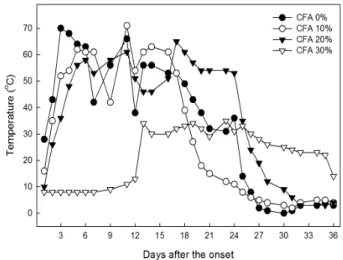
Fig. 1. Changes of temperature in swine manure compost piles made from the different mixing ratio of coal fly ash as bulking agent and saw dust during composting.
Sampling and sample analysis The representative samples were obtained to analyze the chemical properties from compost piles after mixed manually. Samples were dried at room temperature and ground with a Wiley mill (0.25 mm mesh).
Moisture contents were calculated from the weight loss at 105°C. The compost samples were analyzed for pH and electrical conductivity (EC) (1:10 wt v-1, sample:water extract) using a pH and an electrical conductivity probe; total nitrogen by Kjeldahl digestion; total carbon by TOC analyzer, respectively;
heavy metals by ICP-OES (inductively coupled plasma-optical emission spectrophotometer, Perkin Elmer Model OPTIMA 4300DV) after a ternary solution (HNO3:H2SO4 :HClO4, 10:1:4 volume/volume) digestion.
Phytotoxicity of compost Seed germination index is a more direct indicator for compost maturity since it directly tests whether the compost in end-point is inhibitory to plant or not. To determine the stability of compost after composting, lettuce and chinese cabbage was selected as a target plant.
The germination test on seeds of lettuce and cabbage was applied to compost extracts in water (1:10 wt v-1). Treatments were evaluated by counting the number of germinated seeds on filter-papers in Petridishes with 10 ml extract, and measuring the length of roots. There were calculated by a germination index (GI) that was determined according to the following formula (Zucconi et al., 1981):
Germination index (GI, %) =
Seed germination (%)ⅹroot length of treatment
ⅹ100 Seed germination (%)ⅹroot length of control
Statistics Chemical and physical properties and germination data were analyzed by analysis of variance (ANOVA) in SAS (version 9.2). A least significance difference (LSD) was used to separate mean effects when the appropriate F-test was significant (p=0.05).
Results and Discussion
Composting of swine manure The temperature in CFA 0% as control (mixture of 30% swine manure and 70%
sawdust) reached rapidly up to 70°C after piling and entered the thermophilic phase for ca. 18 days of composting, which indicated quick establishment of microbial activities in the composting pile (Fig. 1). Then, temperature in the CFA 0%
slowed down with the lapse of composting, the temperature
peak points dropped slowly down to near atmospheric temperature (3-4°C) after 26 composting days, but then scarcely changed with continues turning. In comparison, mixing ratio of coal fly ash was shown the decrease of temperature in composting pile during composting (Fig. 1). The temperature of CFA 30%
in the composting pile did not rise for initial 13 composting days, thereafter, slightly rose up to maximum 34°C and maintained this temperature by ca. 35 composting days.
Thermo-philic phase of CFA 10% (mixture of 20% saw dust and 10% coal fly ash continued for only 18 days, while in case of the control, it lasted for 20 days. In comparison, the thermo-philic phase of CFA 20% (mixture of 10% sawdust and 20% coal fly ash) was continued by ca. 24 days of composting, which is longer time than in the control.
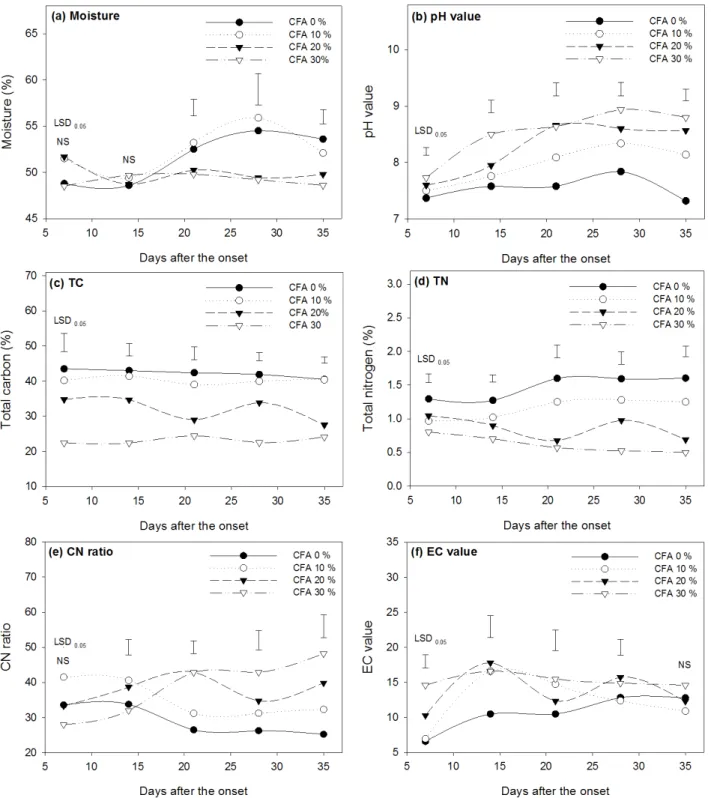
The change of pH is used as a criterion to roughly estimate the maturity of compost and a neutral pH was suggested to be optimal for the composting process (Gage, 2003). In this treatment, the mixture pile maintained at the neutral pH range (7.2-8.0) during whole composting day (Fig. 2), and this pH improvement could enhance the decomposition efficiency of swine manure. In composting, the pH level drops somewhat during the early stages (i.e., down to 5.0) because of organic acid formation. In general, addition of lime to raise the pH to
>7.0 promoted faster degradation by microbes and then could shorten composting day (Nakasaki et al., 1993; Wong et al., 2009). In our study, initial pH in CFA 0% was ca. 7.3 (Fig.
2(b)). It was increased the initial pHs with the addition of coal fly ash due to the high alkaline including coal fly ash. The pHs in mixture of swine manure and coal fly ash slightly increased with composting progress, which is an indication of stabilized material (Sesay et al., 1979), and had substantially
Fig. 2. Changes of moisture, pH, TC, TN, CN ration and EC value in swine manure compost piles made from the different mixing ratio of coal fly ash as bulking agent and saw dust during composting.
alkalinized up to maximum pH 8.6 (Fig. 2(b)), which might slightly improved microbial decomposition of organic matters on the latter part of composting.
Carbon to nitrogen ratio is one of the important factors affecting compost quality (Golueke, 1977; Michel et al., 1996).
Mineralization of the organic matter coupled with increase in nitrogen content resulting from the loss of dry weight led to the decreasing C/N ratios (Bernal et al., 1998; Sellami et al.,
2008). C/N ratios was a decreasing tendency in all treatments throughout the whole composting period due to the changes of TC and TN contents (Fig. 2(c), (d)). In this study, total carbon concentrations decreased continuously during the composting process irrespective with the treatments, but total nitrogen increased due to nutrients concentration caused by the strong degradation of the labile organic-C compounds, which reduced the weight of the composting mass (Fig. 2(d)). A high CN
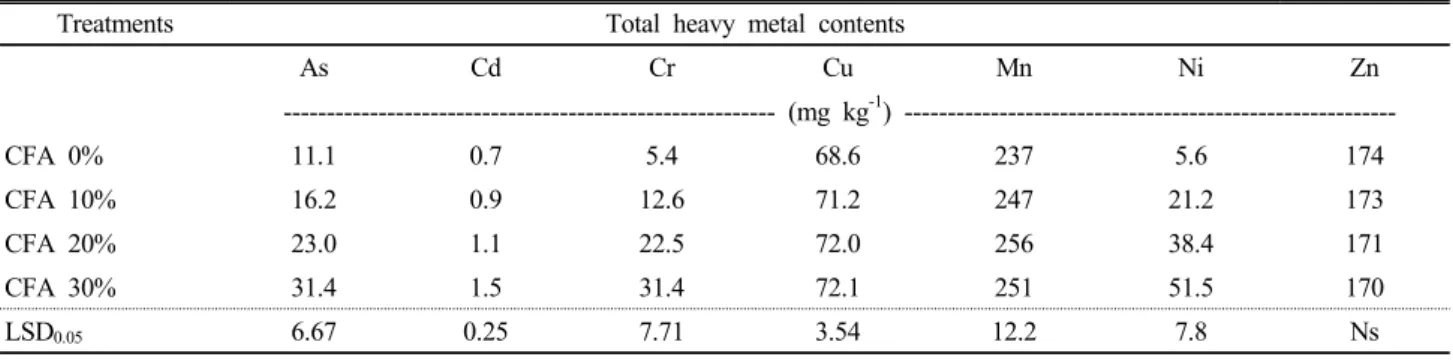
Table 1. Heavy metal contents in swine manure compost piles made from the different mixing ratio of coal fly ash and saw dust as bulking agent (30%) after 35 days for composting.
Treatments Total heavy metal contents
As Cd Cr Cu Mn Ni Zn
--- (mg kg-1) ---
CFA 0% 11.1 0.7 5.4 68.6 237 5.6 174
CFA 10% 16.2 0.9 12.6 71.2 247 21.2 173
CFA 20% 23.0 1.1 22.5 72.0 256 38.4 171
CFA 30% 31.4 1.5 31.4 72.1 251 51.5 170
LSD0.05 6.67 0.25 7.71 3.54 12.2 7.8 Ns
※ Hg, Pb : trace
Fig. 3. Germination index of lettuce and cabbage in swine manure compost piles made from the different mixing ratio of coal fly ash as bulking agent and saw dust after 35 days composting.
ratio in the composting pile at the earlier stage means that organic substrate for biodegradation was sufficient. However, addition of coal fly ash in the composting pile was resulted from inhibition of microbial activities with environmental condition like pH values (Fig. 2(b)). After 35 days of composting, CN ratio in all treatments were ranged from 30 to 35 and was not apparently different between treatments.
Addition of coal fly ash significantly increased EC value at initial stage of composting and up to maximum 20.0 d S m-1 in CFA 30% (Fig. 2(f)), which might be caused by formation of calcium carbonate during aerobic decomposition (Levi-Minzi et al., 1986) and formation of ammonium carbonate during anaerobic decomposition (Georgacakis et al., 1982). Also, there were a high content of inorganic nitrogen in swine manure and high concentration of inorganic nutrients (i.e., Ca, K, Si and etc.) in coal fly ash. Therefore, it might need to evaluate the salt sensitivity to crop root for utilizing coal fly ash as bulking agent in swine manure composting.
Phytotoxixity of compost Compost maturity can be also evaluated by biological methods involving seed germination, root length, and germination index (Zucconi, et al., 1981), since immature composts may contain phytotoxic substances (Kirchmann and Widen, 1994). Immature compost maintains high decomposition activity, which may delay crop growth due to nitrogen starvation, anaerobic conditions and phytotoxicity of NH3, and some organic acids (Mathur et al., 1993; Fang et al., 1999). Also, Volatile organic acids such as acetic, propionic, butyric and isobutyric acids, may be possible inhibitors of seed germination and root elongation (Zucconi et al., 1985;
Epstein, 1997).
Compost maturity and stability are key factors during application of composting process. The seed germination index (GI) of lettuce and cabbage in the CFA 0% after 35th composting
day was 85 and 110, respectively (Fig. 3). The compost added coal fly ash might be safe to plant. Germination index of lettuce was shown the decreased tendency with increasing a mixing ratio of coal fly ash. However, GI of CFA 10% was significantly different to that of CFA 0%. Expecially, GI of cabbage was similar between all treatments (Fig. 3). It suggested that compost over 50 of GI value is applicable for agricultural utilization (Jimenez et al., 1989) and over GI value 80 matured (Tiquia et al., 1996; Zucconi et al., 1981). Heavy metals contents in compost was sightly increased with mixing ratio of coal fly ash including high amount of all heavy metals (Table 1). Nonetheless, even at 30% coal fly ash amendment, all the heavy metal contents were far below the stipulated standard for organic farming (NAAS, 2000). Therefore, the heavy metal contents in all the treatments should not pose a problem as organic fertilizers and coal fly ash could be alternative materials to save quantity of sawdust for swine manure composting.
Conclusion
The coal fly ash (CFA) was evaluated potential utilization as bulking agent by adding for organic waste composting with sawdust. Addition of CFA delayed composting with increasing the mixing ratio of CFA due to the high alkaline materials and EC value, which might be resulted from the deficient biodegradation.
However, addition of the 10% fly ash in organic waste composting resulted no difference compared to the 30% sawdust compost and was not affected phytotoxicity to the seed germination of lettuce and cabbage. Conclusively, the addition of fly ash to the composting of swine manure could be a reasonable alternative to save sawdust consumption and apply industrial products in swine manure composting. It would consider to reduce contents of heavy metal for soil safety.
References
Barrington, S., D. Choiniere., M. Trigui., and W. Knight. 2002.
Effect of carbon source on compost nitrogen and carbon losses.
Bioresour. Technol. 83:189-194.
Beaver, T. 1995. Adding coal ash to the composting mix.
Biocycle. pp.88-89.
Bernal, M.P., C. Paredes., M. A. Sanchez-Monedero., and J.
Cegarra. 1998. Maturity and stability parameters of composts prepared with a wide range of organic wastes. Bioresour.
Technol. 63:91-99.
Bhamidimarri, S.M.R., and S.P. Pandey. 1996. Aerobic thermophilic composting of piggery solid wastes. Water Sci. Technol.
33:89-94.
Cha, D.W., H.S. Lee., and J.H. Jung. 1999. Production and composition of the power plant coal ash in Korea. In: Proc.
Agricultural Utilization of Fly Ash Symposium. Gyeongsang National University, Jinju, pp. 1-23 (in Korean with English summary).
Epstein, E., G.B. Willson. W.D. Burge., D.C. Mullen., and N.K.
Enkiri. 1997. A forced aeration system for composting of wastewater sludge. J. Wat. Contr. Fed. 48:688-694.
Fang, M., J.W.C. Wong., K.K. Ma., and M.H. Wong. 1999.
Co-composting of sewage sludge and coal fly ash: nutrient transformations. Bioresour. Technol. 67:19-24.
Gage, J. 2003. Checklist for odor management at compost facilities.
Biocycle. 44:42-47.
Georgacakis, D., D.M. Sievrs., and E.L. Iannotti. 1982. Buffer stability in manure digesters. Agric. Wastes. 4:427-441.
Golueke, C.G. 1977. Biological reclamation of organic wastes.
Rodale Press, Emmans, PA, USA.
Imbeah, M. 1998. Composting piggery waste: A review. Bioresour.
Technol. 63:197-203.
Jimenez, I.E. and V.P. Garcia. 1989. Evaluation of city refuse maturity: A review. Biol. Wastes 27:115-149.
Kirchmann, H., and P. Widen. 1994. Seperately coolected organic household wastes. Swedish J. Agric. Res. 24:3-12.
Levi-Minzi, R., R. Riffaldi., and A. Saviozzi. 1986. Organic matter and nutrients in fresh and mature farmyard manure.
Agric. Wastes.16:225-236.
MAF. 1986-2007. Statistical research annual report of agriculture and forestry. Ministry of Agriculture and Forestry. Seoul.
Korea.
Mathur,S.P., G. Owen., H. Dinel., and M. Schnitzer. 1993.
Determination of compost biomaturity: I. Literature review.
Biol. Agri. Hort. 10:65-85.
Michel, F.C., L.J. Forney., A.J.F. Huang., S. Drew., M. Czuprenski., J.D. Lindeberg., and C.A. Reddy. 1996. Effects of turning frequency, leaves to grass mix ratio and windrow vs. pile configuration on the composting of yard trimmings. Compost Sci. Util. 4:26-43.
NAAS (National Academy of Agricultural Science). 2000.
Investigation of heavy metal contents in soil. Rural Development Administration. Korea.
Nakasaki, K., H. Yaguchi., Y. Sasaki., and H. Kubota. 1993.
Effects of pH control on composting of garbage. Waste Manage. Res. 11:117-125.
Sellami, F., R. Jarboui., S. Hachicha., K. Medhioub., and E.
Ammar. 2008. Co-composting of oil exhausted olive-cake, poultry manure and industrial residues of agro-food activity for soil amendment. Bioresour. Technol. 99:1177-1188.
Sesay, A. A., K. Lasaridi., and A. Inoko. 1979. Controlled composting of paper pulp slidge using the aerated static pile method. Compost Sci. Util. 5:82-96.
Tiquia, S.M., N.F.Y. Tam., and J.J. Hodgkiss. 1996. Effects of composting on phytotoxicity of spent pig-manure sawdust litter. Environ. Pollut. 93:249-256.
Tiquia, S. M., and N.F.Y. Tam. 1998. Elimination of phytotoxicity during co-composting of spent pig-manure sawdust litter and pig sludge. Bioresour. Technol. 65:43-49.
Wong, J.W.C., S.O. Fung., and A. Selvam. 2009. Coal fly ash and lime addition enhances the rate and efficiency of decomposition of food waste during composting. Bioresour. Technol. 100:
3324-3331.
Zucconi, F., A. Pera., M. Forte., and M. Bertoldi. 1981. Evaluating toxicity of immature compost. Biocycle. 22:54-57.
Zucconi, F., A. Monaco., M. Forte., and M. de Bertoldi. 1985.
Phytotoxins during the stabilization of organic matter. In Composting of agricultural and other wastes. Ed. J. K. R.
Gasser. Elsevier Applied Science Publ. London, pp. 73-85.