Cadmium and lead concentrations in the roots of medicinal plants and their cultivation soils.
Soils Roots of medicinal plants
Cd Pb Cd Pb
Min 0.000 0.0 Min 0.0 0.2
Median 0.000 7.8 Median 0.2 0.5
Max 0.397 188.5 Max 1.2 3.7
Ave 0.007 10.5 Ave 0.2 0.6
Criteria S 4.000 200.0 Criteria A 0.3 5.0
Criteria B 0.2 2.0
Criteria S: Standard limit registered in Soil Conservation Act 2015, Korea
Criteria A: Standard limit for medicinal plant in Pharmaceutical Affairs Act 2010, Korea Criteria B: Standard limit for root vegetable (fresh weight) in Food Sanitation Act 2011, Korea
Distribution of Cd and Pb Accumulated in Medicinal Plant Roots and Their Cultivation Soils
Byoung-Hwan Seo, Hyuck Soo Kim
1, Jun-Sik Bae, Won-Il Kim
1, Chang-Ho Hong
2, and Kwon-Rae Kim*
Department of Agronomy and Medicinal Plant Resources, Gyeongnam National University of Science and Technology, Jinju 660-758, Korea
1
Chemical Safety Division, National Academy of Agricultural Science, Wanju 565-851, Korea
2
Department of Life Science and Environmental Biochemistry, Pusan National University, Miryang 627-706, Korea
(Received: June 17 2015, Revised: August 10 2015, Accepted: August 13 2015)
In general, plant roots accumulate more heavy metals than the above ground organs such as leaf, stem, and fruit. This implies that root medicinal plants would be an issue with excessive heavy metal accumulation.
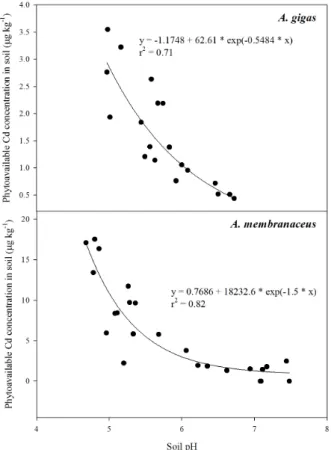
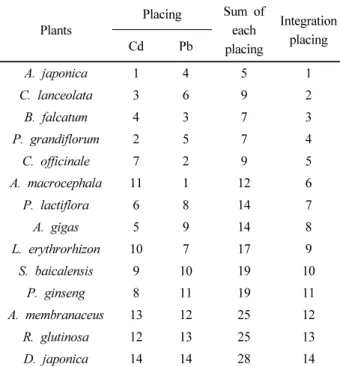
Therefore, the current study was carried out to investigate the distribution of heavy metal (focused on Cd and Pb) concentrations in soils and medicinal plant roots grown in different region of Korea. Total 293 samples for each soil and plant were collected along the national wide. Soil pH, total and phytoavailable metal concentrations (1 M NH 4 NO 3 extracted) in soils were determined and heavy metal concentrations in root of the medicinal plants were analyzed. Heavy metal concentrations of the soil samples studied were not exceeded standard limits legislated in ‘Soil Environmental Conservation Act’, except 2 samples for Cu. However, substantial amount of Cd was accumulated in medicinal plant roots with 29% samples exceeding the standard limit legislated in ‘Pharmaceutical Affairs Act’ while all plant samples were lower than the standard limit value for Pb. Also the current study demonstrated that cadmium concentrations in the roots were governed by the phytoavailable Cd in soils, which decreased as soil pH increased. From this result, application of heavy metal immobilization technique using a pH change-induced immobilizing agents can be suggested for safer root medicinal plant production.
Key words: Contamination, Food safety, Heavy metal, Phytoavailability
1)
*Corresponding author : Phone: +82557513223, Fax: +82557513229, E-mail: [email protected]
§
Acknowledgement : This study was carried out with the support of “Research Program for Agricultural Science & Technology
Development (Project No. PJ00982801)”, National Academy of Agricultural Science, Rural Development Administration, Republic of
Korea and this work was also supported by Gyeongnam National University of Science and Technology Grant in 2014.
Table 1. Number of medicinal plant collected.
Species No. Species No.
A. gigas 20 R. glutinosa 32
C. lanceolata 33 C. officinale 15 A. macrocephala 12 A. membranaceus 26
B. falcatum 3 P. ginseng 30
A. japonica 5 D. japonica 31
P. lactiflora 10 S. baicalensis 5 L. erythrorhizon 3 P. grandiflorum 68
Introduction
오늘날 국민의 삶이 윤택해지고, 건강에 대한 사회적 관 심이 높아지면서 약용작물에 대한 선호도가 나날이 증가하 고 있다. 특히, 약용작물이 전통 한약재로 사용될 뿐만 아니 라 나물용 채소, 기능성 식품 및 화장품 소재로 이용되면서 약용작물 관련 산업은 2000년 이후 매년 급성장하고 있는 추세이다. Kim (2013)에 따르면 우리나라 약용작물 재배면 적은 2000년 9,936 ha에서 2010년 14,423 ha로 매년 4.2%
증가하였고, 생산액은 2000년 2,932억원에서 2010년 8,106 억 원으로 매년 12% 증가하였다. 이와 같이 약용작물은 부 가가치가 높은 작물로써 농가의 소득증대를 목적으로 재배 가 확산되고 있으며, 소득증대를 위해서는 생산량의 증대와 더불어 생산된 약용작물의 효능 및 안전성이 확보되어야 한다.
이로 인해 최근 약용작물 산업의 발전과 더불어 발생하 는 주요관심 사항은 약용작물의 안전성 문제이다. 약용작물 은 일부 중금속이 미량으로 존재할 경우 약리작용으로 나타 나나 중금속 농도가 높은 토양에서 재배되는 약용작물의 경 우 인체 건강에 위협 요인이 될 수 있다. 최근 언론에서는 한약재 복용 후 복통을 호소한 남성의 혈중 납 농도가 기준 치 8 ug dL
-1의 7배나 넘는 56.96 ug dL
-1로 검출된 사례가 보도되기도 하였다 (KNN, 2013.03.12; KNN, 2013.04.17).
중금속에 오염된 약용작물의 위해성 문제는 크게 수입산과 국내산으로 구분 지어 접근할 필요가 있다. 수입산의 경우, 특히 중국산 한약재에서 다량의 중금속이 검출된 사례가 여 러 차례 보고되었는데 (Lee et al., 2010; Yim et al., 2009), 이는 수입 및 유통 과정에서 차단해야 하는 문제이다. 국내 산 약용작물도 중금속 기준치 이상의 약용작물을 유통과정 에서 검사하여 유통을 차단하는 방법을 이용할 수 있다. 그 러나 이와 같은 사후 조치보다는 생산단계에서 중금속에 오 염된 약용작물 생산을 최소화 하는 방법을 먼저 강구해 보 아야 할 것이다.
그 동안 우리나라는 쌀, 옥수수, 대두, 파, 무, 배추, 팥, 감자, 고구마, 시금치 등과 같은 주요 작물을 대상으로 재배 토양으로부터의 중금속 전이실태 조사 연구가 활발히 진행 되었다 (Lee et al., 2012; MFDS, 2006; Park et al., 2009).
그 예로 식품의약품안전처 (MFDS, 2006)는 휴·폐광산 인근 에서 재배되는 농산물의 중금속 오염실태 파악과 합리적인 농산물 중금속 허용기준을 설정하기 위한 기초자료를 생산 할 목적으로 전국 폐광산 인근에서 재배되고 있는 농산물 2,594점을 채취하여 중금속 (Cd, Cu, Hg, Pb) 및 비소 (As) 를 분석하였고, 이들 결과를 재배토양 중 중금속 함량과 비 교하여 각 작물 별 중금속 전이율을 제시하였다.
현재 우리나라 약용식물 자원은 1,253종으로 알려져 있 으며, 그 중 당귀를 비롯하여 약 35종 정도가 주로 재배되
고 있다 (KFRI, 2009). 하지만 아직까지 우리나라에서 재배 되는 약용작물 종류별 중금속 축적농도에 대한 기초자료는 부족한 실정이다. 국외 선행 연구에서 패랭이꽃 (Dianthus chinensis), 민들레 (Taraxacum mongolicum) 등을 포함한 일부 약용작물이 카드뮴을 포함한 중금속을 다량 흡수할 수 있는 능력을 지닌 것으로 보고되고 있어 (Lai and Chen, 2005; Masarovičová et al., 2010; Wei et al., 2008), 우리 나라도 현재 재배되는 약용작물에 대한 중금속 전이실태 조 사가 이뤄져야 할 것으로 판단된다. 특히 토양 내 중금속이 작물의 지상부보다 뿌리에 더 많이 축적될 수 있기 때문에 약용작물 중에서도 뿌리를 주로 이용하는 작물에 대한 연구 가 우선적으로 진행되어야 한다.
본 연구는 전국 약용작물 재배 농가를 대상으로 토양 중 중금속 함량과 작물의 중금속 축적 농도를 조사하여 약용작 물 안전성 확보를 위한 약용작물의 중금속 전이 실태 파악 을 목적으로 진행하였다.
Materials and Methods
시료채취 전라북도를 제외한 7개 도내 약용작물 재배지
역을 대상으로 총 14작물 293점의 약용작물 및 재배토양을
2013년 7월부터 10월 사이에 채취하였다. 토양 시료는 약용
작물 재배 지역 표토 (0-20 cm)를 채취하였고, 각 토양을 채
취한 자리에서 재배되고 있는 약용작물 뿌리를 5-10개 확보
하여 하나의 식물 시료로 조제하였다. 채취한 약용작물의 종
류는 당귀 (Angelica gigas), 더덕 (Codonopsis lanceolata),
백출 (Atractylodes macrocephala), 시호 (Bupleurum falcatum),
우슬 (Achyranthes japonica), 작약 (Paeonia lactiflora), 지
치 (Lithospermum erythrorhizon), 지황 (Rehmannia glutinosa),
천궁 (Cnidium officinale), 황금 (Scutellaria baicalensis), 인
삼 (Panax ginseng), 마 (Dioscorea japonica), 황기 (Astragalus
membranaceus), 길경 (Platycodon grandiflorum)으로 약용
작물 별 채취한 시료 수는 Table 1과 같다. 토양 시료는 풍
건 후 2 mm체로 걸러 분석에 이용하였고, 약용작물 뿌리
시료는 세척솔을 이용하여 수돗물로 세척 후 증류수로 2회
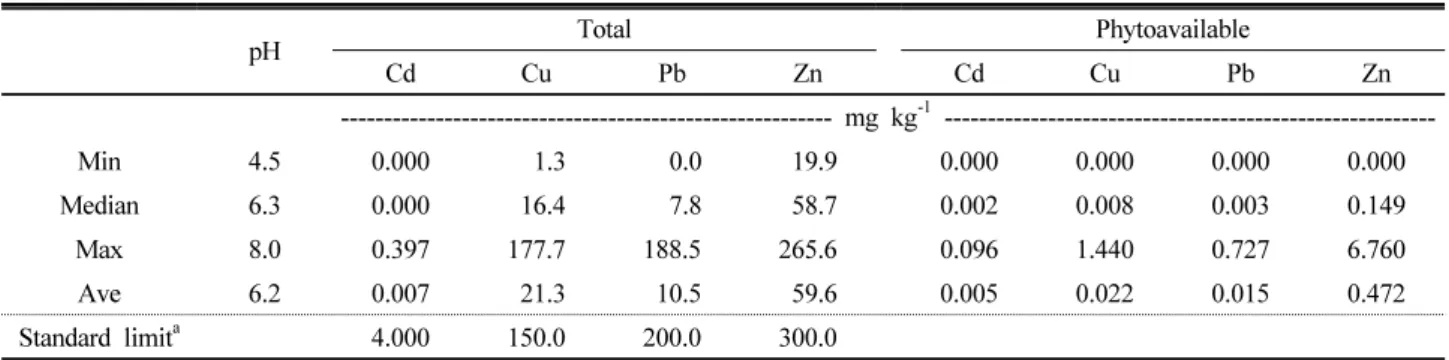
Table 2. Soil pH and heavy metal concentrations in the soils collected for this study.
pH Total Phytoavailable
Cd Cu Pb Zn Cd Cu Pb Zn
--- mg kg
-1---
Min 4.5 0.000 1.3 0.0 19.9 0.000 0.000 0.000 0.000
Median 6.3 0.000 16.4 7.8 58.7 0.002 0.008 0.003 0.149
Max 8.0 0.397 177.7 188.5 265.6 0.096 1.440 0.727 6.760
Ave 6.2 0.007 21.3 10.5 59.6 0.005 0.022 0.015 0.472
Standard limit
a4.000 150.0 200.0 300.0
a