고 Isoflavone 콩나물이 만성 에탄올 투여 흰쥐의 지질대사에 미치는 영향
김광옥†․이혜성
경북대학교 식품영양학과, 장수생활과학연구소
Effects of Isoflavone ⁃ Rich Bean Sprout on the Lipid Metabolism of the Ethanol ⁃ Treated Rats
Kwang⁃Ok Kim† and Hye⁃Sung Lee
Dept. of Food Science and Nutrition, Center for Beautiful Aging, Kyungpook National University, Daegu 702-701, Korea
Abstract
The present study evaluated the effects of isoflavone⁃rich bean sprout on the lipid metabolism in ethanol⁃
treated rats. Fifty male Sprague⁃Dawley rats were randomly divided into five groups: normal control, alcohol control, low soybean sprout+ethanol (low SS), high soybean sprout+ethanol (high SS) and isoflavone extract
+ethanol (IE). They were fed experimental diets based on Lieber⁃DeCarli liquid diet for 40 days. Body weight, food intake and feed efficiency ratio (FER) of ethanol⁃treated groups were significantly suppressed compared with that of the normal control group. Among the ethanol⁃treated groups, high SS group showed in significant increase in the body weight, food intake and FER. Supplementation of isoflavone⁃rich soybean sprout powder or isoflavone extract significantly decreased plasma triglyceride (TG), total cholesterol (TC), atherogenic index (AI) and increased the ratio of HDL⁃cholesterol to TC. Supplements also significantly decreased total lipid, TG and TC in liver tissue compared with that of alcohol control. There was a significant decrease in hepatic lipid peroxidation products in IE group compared with other ethanol⁃treated groups. This results suggest that supplementation of isoflavone⁃rich bean sprout powder may exert beneficial effects on lipid metabolism in chronically alcohol⁃treated animals by improving lipid profiles in plasma and liver tissues.
Key words: isoflavone, soybean sprout, ethanol, lipid metabolism
†Corresponding author. E-mail: [email protected]
†Phone: 82-53-950-6231, Fax: 82-53-950-6229
서 론
과량의 알코올을 만성적으로 섭취하게 되면 NADH/
NAD+비율이 높아지고 이로 인한 glycerol phosphate의 증 가와 지방합성 효소인 diacyglycerol acyltransferase 및 phosphatidate phosphohydrolase의 활성이 높아짐으로써 지방산 합성이 촉진되고 혈액 중 지질농도가 높아지며 알코 올성 지방간이 발달하는 것으로 알려져 있다(1-3).
에탄올에 의한 간조직의 손상은 에탄올 대사과정에서 microsomal membrane의 free radical 형성이 촉진되거나 (4-7), 간세포의 산화환원 항상성이 변화하여(8-10) 알코올 대사 중간 생성물인 아세트알데히드가 축적되어 독성학적 영향을 미치기 때문으로 알려져 있다(11). 이에 대한 방어는 superoxide dismutase(SOD), catalase(CAT), gluthathione peroxidase(GPx) 등의 항산화 효소계와 비타민 C, E 등과 같은 항산화물질에 의하여 이루어지며 에탄올은 이들을 감 소시킴으로써 조직의 산화적 스트레스를 증가시키는 것으
로 보고되고 있다(12).
간세포의 항산화능을 높이면 간질환의 진행이 억제되므 로(13) 비타민 A, E 혹은 비타민 C를 충분히 섭취하는 것은 항산화능을 높이고 과산화 지질의 생성을 막아 알콜로 인한 산화적 스트레스를 낮추는데 도움이 된다고 보고되고 있다 (14-16). 따라서, 만성적인 에탄올의 섭취로 인한 독성을 예 방하거나 유해 상태를 개선하기 위해서는 에탄올의 침해를 받기 쉬운 조직의 산화적 스트레스를 줄이는 것이 중요하다 고 알려져 있다(17).
최근 항산화 영양소 이외에도 항산화성을 나타내는 phy- tochemical과 이들의 생리활성에 관한 관심이 고조되고 있 으며 특히 주목받고 있는 물질이 isoflavone이다. Isoflavone 은 콩류에 다량 함유되어 있는 phytoestrogen으로서 유방암, 전립선암, 폐경기 여성의 골다공증을 예방하고(18,19) 심혈 관계 질환의 상태를 개선한다는 보고가 있으며(19-21) 이러 한 isoflavone의 생리활성 기능들 중 일부는 이 물질의 항산 화능에 의한 것으로 알려져 있다. 특히 isoflavone 중 daid-
zein과 genistein은 in vitro에서 뿐 아니라 인간에서도 뛰어 난 항산화능을 보이고(22,23) 산화적 손상을 억제함으로써 암과 심혈관계 질환을 예방하며(24,25) 혈관내피세포의 산 화적 스트레스를 감소시켜 관상동맥질환 위험을 줄이는 것 으로 보고되었다(26).
본 연구실에서는 선행 연구로 isoflavone 함량이 풍부한 기능성 콩나물 개발을 위하여 국내 나물콩 66품종과 이들로 재배한 콩나물의 식이섬유 및 isoflavone 함량을 분석한 바 있다(27,28). 그 결과 콩에서 콩나물로 발아되는 과정에서 식이섬유는 평균 1.16배, isoflavone은 평균 1.41배 증가함을 알 수 있었다. 이들 중 특히 소호콩나물은 isoflavone 함량이 3343.8 mg/kg으로 다른 콩나물들의 평균인 1898.3 mg/kg의 1.76배에 달하였으므로 이를 고 isoflavone 콩나물로 선정하 였다.
콩나물은 한국인 다소비 부식 7위, 채소류 3위(29)에 이를 정도로 많이 상용되는 식품재료이나 이의 생리 작용에 관한 연구는 거의 이루어져 있지 않다. 콩나물은 식이섬유와 원료 콩에서 유래하는 isoflavone 등의 기능성 물질이 풍부하게 함유되어 있으므로 유익한 생리활성을 나타낼 가능성이 높 다고 본다.
본 연구에서는 콩나물이 숙취해소용 음식의 재료로서 많 이 사용된다는 점에서 선행연구에서 선별한 isoflavone 함량 이 높은 소호콩나물의 투여가 만성 알코올 섭취 동물의 지질 대사에 미치는 영향을 조사하고자 하였다.
재료 및 방법
실험동물 및 식이
실험동물은 3주령된 Sprague-Dawley종 수컷 흰쥐 50마 리(Central Lab animal, Korea)를 환경이 조절된 사육실(기 온 20±2oC, 습도 55±1%, 12 hr dark/light cycle)에서 평균 체중이 180 g이 될 때까지 2주간 pellet형 고형사료(Jeil ani- mal feed Co., Korea)로 사육한 다음 난괴법으로 10마리씩 5군으로 나누었다. 실험군의 분류는 (1) 정상 대조군 (2) 알 코올 대조군 (3) 알코올+콩나물 분말 2.37% 첨가군(low SS) (4) 알코올+콩나물 분말 11.78% 첨가군(high SS) (5) 알코올+isoflavone 추출물 0.10% 첨가군(IE)이다. 실험식 이는 Lieber-Decarli 액체식이를 일부 수정한 조성을 가진 식이로서, 에탄올이 5%(w/v)수준으로 첨가되었고 1 mL당 1 kcal를 공급하며 에탄올로부터 공급되는 열량은 총 열량의 36%에 해당하였다. 이 액체식이는 에탄올 자체의 독성효과 를 영양불량에 의한 영향과 분리하여 평가할 수 있도록 충분 한 영양공급을 할 뿐만 아니라 에탄올을 충분히 투여할 수 있는 에탄올 표준식이다. Isoflavone의 함량은 선행 연구(30) 에서 체중 kg당 3~30 mg 정도의 isoflavone 첨가가 효과 있었음을 감안하여, 하루 평균 사료 섭취량을 70 mL로 추정 할 때 low SS군의 isoflavone 섭취량은 1일 3.79 mg/kg
body weight(BW), high SS군은 19.01 mg/kg BW, 0.2%
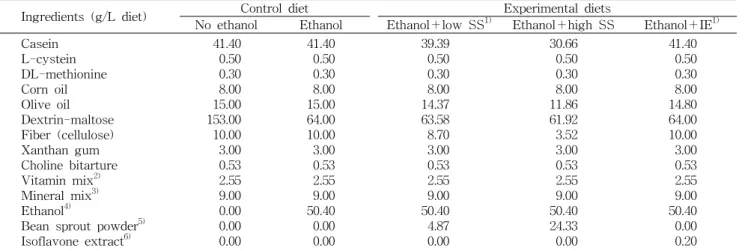
IE군은 19.01 mg/kg BW의 수준으로 설정하였으며 모든 실 험식은 열량영양소들의 비율을 동일하게 하여 isocaloric di- et가 되도록 하였다. 실험의 결과가 콩나물 isoflavone에 의 한 효과인지 콩나물의 다른 성분에 의한 효과인지를 살펴보 기 위하여 high SS군의 isoflavone 함량과 IE군의 iso- flavone 함량을 동량으로 정하였다. 본 실험에 사용한 콩나 물 분말 시료는 본 연구실의 선행연구인 66품종 나물콩과 콩나물의 isoflavone 분석(27)의 결과에서 isoflavone 함량이 가장 높은 것으로 나타난 소호콩나물을 재배하여 50oC에서 12시간동안 열풍 건조 후 분말화하였다. Isoflavone 추출물 은 (주)Bioland(Seoul, Korea)에서 제공한 “이소본 40”으로 total isoflavone의 함량이 40.9%인 대두 isoflavone 추출물 을 사용하였다. 실험식의 구성성분은 Table 1과 같으며, 식 이 섭취량은 매일, 체중은 1주일 간격으로 측정하였으며 총 실험식의 공급기간은 40일이었다.
채혈 및 조직의 채취
희생전 12시간 절식시킨 후 1% ketamin hydrochloride 용액을 0.2 mL/100 g BW로 복강내 주사하여 마취시켜 개복 하고 heparin(100 units/mL) 처리가 된 주사기로 복부 대정 맥에서 혈액을 채취하였다. 혈액은 3000 rpm에서 20분간 원 심분리하여 혈장을 분리하여 -70oC의 deep freezer에 냉동 보관하였다. 혈액채취 후 간과 신장조직을 적출하여 생리식 염수에 3회 헹군 후 거즈로 수분을 제거하고 칭량하였다.
혈장 지질 농도의 측정
혈장 중성지방(Tryglyceride; TG)은 Muller방법(31)에 준한 효소법에 의한 kit(아산제약, 한국)를 사용하여 550 nm 에서 그 흡광도를 측정하여 정량하였으며 혈장 총 콜레스테 롤(total cholesterol; TC)은 Richmond방법(32)에 준한 효소 법에 의한 kit(아산제약, 한국)를 사용하여 500 nm에서 흡광 도를 측정하여 정량하였다. HDL-cholesterol(HDL-chol)은 Finley방법(33)에 준한 효소법에 의한 kit(아산제약, 한국)를 사용하여 혈청내 HDL-chol을 제외한 콜레스테롤을 침전시 켜 제거한 후 상층액을 검체로 하여 500 nm에서 그 흡광도 를 측정하여 정량하였다. 동맥경화지수(atherogenic index, AI)는 측정된 TC와 HDL-chol로부터 산출하였다.
간조직 중 지질 농도의 측정
간조직 중 총 지질은 Folch방법(34)에 의해 추출하였다.
간조직 1 g을 취하여 20배 부피의 chloroform : methanol (2:1, V/V) 용매와 함께 homogenizer(PT 1200C, Kinematica AG, Switzerland)로 마쇄한 후 분액깔대기로 분리시킨 지질 분획을 nitrogen gas하에 건조한 후 칭량하였다. 중성지방과 콜레스테롤 측정은 Sale(35)의 수정된 방법으로 측정용 효 소시액에 유화제로 0.5% Triton X-100과 3 mM Sodium cholate를 혼합하여 발색시 일어나는 탁도(turbidity)를 제거
Table 1. Composition of experimental liquid diets
Ingredients (g/L diet) Control diet Experimental diets
No ethanol Ethanol Ethanol+low SS1) Ethanol+high SS Ethanol+IE1) Casein
L-cystein DL-methionine Corn oil Olive oil Dextrin-maltose Fiber (cellulose) Xanthan gum Choline bitarture Vitamin mix2) Mineral mix3) Ethanol4)
Bean sprout powder5) Isoflavone extract6)
41.40 0.50 0.30 8.00 15.00 153.00 10.00 3.00 0.53 2.55 9.00 0.00 0.00 0.00
41.40 0.50 0.30 8.00 15.00 64.00 10.00 3.00 0.53 2.55 9.00 50.40 0.00 0.00
39.39 0.50 0.30 8.00 14.37 63.58 8.70 3.00 0.53 2.55 9.00 50.40 4.87 0.00
30.66 0.50 0.30 8.00 11.86 61.92 3.52 3.00 0.53 2.55 9.00 50.40 24.33 0.00
41.40 0.50 0.30 8.00 14.80 64.00 10.00 3.00 0.53 2.55 9.00 50.40 0.00 0.20
1)SS: soybean sprout, IE: isoflavone extract.
2)AIN-76 vitamin mix (g/kg mix): thiamin․HCl 0.6, riboflavin 0.6, pyridoxine HCl 0.7, nicotinic acid 3, D-calcium pantothenate 1.6, folic acid 0.2, cyanocobalamin 0.001, retinyl palmitate 0.8 (500,000 IU/g), DL-α-tocopheryl acetate 20 (2501 IU/g), cholecalciferol 0.0025, menaquinone 0.005, sucrose to make 1 kg.
3)AIN-76 mineral mix (g/kg mix): calcium phosphate dibasic 500, sodium chloride 74, potassium citrate monohydrate 220, potassium sulfate 52, magnesium oxide 24, manganous carbohydrate 3.5, ferric citrate 6, zinc carbonate 1.6, cupric carbonate 0.3, potassium iodate 0.01, sodium selenite 0.01, chromium potassium sulfate 0.55, sucrose to make 1 kg.
4)Ethanol: 95%.
5)Composition of bean sprout powder (%): protein 41.41, dietary fiber 26.63, fat 12.89, carbohydrate 8.54, ash 6.25, moisture 4.28, total isoflavone 3343.8 μg/g.
6)Isovone 40 (Product No. HF-2002-038, Bioland Inc., Seoul, Korea) contains 40.9% of total pure isoflavone which consists of 36.9%
total aglycone type (22% daidzein, 11.7% glycitein, 6.39% genistein) and 4% total glycoside type.
한 후 중성지방은 550 nm, 콜레스테롤은 500 nm에서 각각 흡광도를 측정하였다.
지질과산화물의 측정
혈장의 thiobarbituric acid-reactive substances(TBARS) 측정은 Taladgis방법(36)에 의하였다. Tetramethoxypropane 을 가수분해하여 조제한 malondialdehyde(MDA) 표준용액 을 혈장과 동일한 조건에서 반응시켜 535 nm에서 흡광도를 측정하여 TBA-MDA chromopore의 표준곡선을 얻고 이 곡 선으로부터 TBARS의 양을 산출하였다. 간과 신장조직 중 TBARS 측정은 Uchiyama와 Mihara의 방법(37)에 의하였 으며 520 nm와 535 nm에서 흡광도를 측정하여 두 가지 흡광 도의 차이로부터 TBARS의 양을 조직 wet weight g당 함량 으로 계산하였다.
효소원의 조제
간조직을 각 간엽에서 고르게 일정량(2 g)을 취하여 1 g당 5배의 0.25 M sucrose 용액을 가하고 빙냉 상태에서 glass teflon homogenizer(Glascol, 099C K44, USA)로 균질화한 후 600×g에서 10분간 원심 분리하여 상층액을 취하였다.
이를 다시 10,000×g에서 20분간 원심분리하여 mitochon- dria 분획을 얻었다. 그리고 그 상층액은 다시 105,000×g에 서 1시간 동안 ultracentrifuge(Beckman, Optima TLX-120) 하여 cytosol 분획과 microsome 분획을 분리하였다.
Mitochondria 분획은 0.25 M sucrose 용액에 현탁시켜 cat-
alase(CAT)의 활성도 측정에 사용하고, cytosol 분획은 glu- tathione peroxidase(GPx)와 superoxide dismutase(SOD) 의 활성 측정에 사용하였다.
간조직 중 항산화 효소 활성도 측정
SOD 활성도는 알칼리 상태에서 pyrogallol의 자동산화에 의한 발색을 이용한 Marklund 방법(38)으로 측정하였다. 10 mM EDTA를 포함한 50 mM Tris HCl buffer(pH 8.6) 2.8 mL에 효소원 0.1 mL와 15 mM의 pyrogallol 0.1 mL을 넣고 25oC에서 10분간 incubation시킨 후 1 N HCl 0.1 mL을 넣어 반응을 종결시키고, 420 nm에서 흡광도를 측정하였다. 효소 활성도의 단위는 효소원을 넣지 않고 반응시킨 15 mM py- rogallol용액의 자동산화를 50% 억제하는데 필요한 cyto- solic protein에 대한 SOD unit의 양으로 하였다.
GPx 활성도는 Paglia와 Valentine의 방법(39)에 따라 산 화형 glutathione(GSSG)이 glutathione reductase와 NADPH 에 의하여 환원될 때 NADPH의 흡광도가 감소하는 정도를 측정하였다. 즉 0.1 M Tris-HCl(pH 7.2) buffer 2.6 mL에 30 mM 환원형 glutathione 용액 0.1 mL, 6 mM NADPH 용액0.1 mL 및 25 μM H2O2 0.1 mL을 순서대로 첨가하여 25oC에서 5분간 preincubation 시켰다. 여기에 효소원 0.1 mL을 혼합하여 25oC에서 5분간 incubation시킨 후 340 nm 에서 흡광도 변화를 측정하였다. GPx 활성의 1단위는 cyto- solic protein 1 mg당 1분간 산화된 NADPH의 nmol로 나타 내었다.
Table 2. Effects of supplementation of bean sprout and soy isoflavone extract on growth and FER of alcohol⁃treated rats
Group Initial body
weight (g)
Final body weight (g)
Body weight gain (g/40 days)
Food intake
(g/day) FER2)
Normal control Alcohol control Low SS High SS IE
173.71±1.651)NS 173.62±1.62ns 175.90±1.09 175.81±1.89 176.68±1.50
357.62±4.40A 286.12±5.54Cb 274.2±5.54Cb 315.87±5.63Ba 223.00±5.16Dc
183.62±4.39A 112.00±5.63Cb 99.11±6.26Cb 138.70±4.60Ba 76.36±4.32Dc
85.38±1.03A 67.88±0.95Cb 68.13±0.85Cb 71.38±0.91Ba 64.50±0.76Dc
0.046±0.001A 0.031±0.002Cb 0.027±0.002Cb 0.039±0.002Ba 0.027±0.001Cb SS: soybean sprout, IE: isoflavone extract.
1)Mean±SE (n=8). 2)FER: feed efficiency ratio (weight gain, g/feed intake, g).
Different capital superscripts in the same column indicate significant difference (p<0.05) among 5 groups by Duncan's multiple comparison test. Different small superscripts in the same column indicate significant difference (p<0.05) among 4 alcohol groups by Duncan's multiple comparison test.
NSNot significantly different among 5 groups (p<0.05). nsNot significantly different among 4 alcohol groups (p<0.05).
CAT 활성도는 Aebi의 방법(40)으로 측정하였다. 50 mM potassium phosphate buffer(KH2PO4: NaH2PO4=1:1.55, pH 7.0) 2.89 mL에 기질인 30 mM H2O2 0.1 mL을 넣어 25oC 에서 5분간 incubation시켰다. 반응 후 240 nm에서 흡광도를 측정하고 이 반응액에 효소원 10 μL를 가하여 3.0 mL이 되 게 한 후 25oC에서 5분간 반응시킨 뒤 240 nm에서 흡광도를 측정하였다. H2O2의 흡광도 변화와 몰흡광계수로부터 H2O2
의 농도를 구한 다음 감소된 H2O2 nmol/min/mg protein으 로 효소 활성도를 계산하였다.
간조직의 mitochondria와 cytosol 분획의 단백질 함량은 bovine serum albumin을 표준물질로 하여 Bradford방법 (41)에 의해 정량하였다.
자료의 통계처리
실험 결과는 SPSS package program(version 12.0)을 이 용하여 평균±표준오차로 나타내었으며 각 군의 평균치간 의 차이에 대한 유의성은 one-way ANOVA(analysis of variance)와 Duncan's multiple comparison test에 의해 p<0.05 수준에서 검증하였다.
결과 및 고찰
체중증가량, 식이섭취량, 식이효율 및 장기중량
실험식을 40일간 투여한 후 측정한 실험동물의 체중증가 량, 식이섭취량 및 식이효율은 Table 2와 같다. 체중증가량 은 정상 대조군(183.62±4.39 g)이 가장 높았으며, 알코올 투 여군들 중에서는 high SS군(138.70±4.60 g)이 유의하게 높 은 값을 보였으며, IE군(76.36±4.32 g)은 유의하게 낮은 값 을 보였다. 1일 평균 식이섭취량은 체중증가량과 같은 경향 을 보여 정상 대조군(85.38±1.03 g)의 1일 평균 식이섭취량 이 가장 많았고 알코올 투여군 중에서는 high SS군(71.38
±0.91 g)이 가장 많았으며 IE군(64.50±0.76 g)이 가장 적었 다. 식이효율은 정상 대조군(0.046±0.001)이 가장 높았으며 알코올 투여군들은 모두 정상 대조군에 비해 유의하게 낮은 값을 보였으나 high SS군(0.039±0.002)은 알코올 투여군들
중에서 유의하게 높은 값을 보였다. 알코올 투여군들의 식이 효율이 정상 대조군에 비해 낮은 것은 동일한 열량의 식이를 급여했을 때 알코올 함유 식이를 받은 쥐들의 체중증가율이 낮았다는 Reinus 등의 연구결과(42)와 일치한다. 이는 알코 올 중독의 경우 알코올이 간과 소화관 점막에 손상을 일으켜 영양소의 소화, 흡수율을 떨어뜨리고 영양소 배설을 증가시 키며 뼈와 장기의 이화작용, 알코올과 지방대사의 비정상적 상호작용을 일으키고(43) 장기간의 알코올 섭취는 ATP를 생성하지 않고 열발생 반응만을 일으키는 것이 원인이 될 수 있다(44). 알코올 중독 현상이 심해질수록 식품에 대한 섭취 욕구가 낮아져 식품 섭취량이 감소되고 식이효율이 낮 아지는 것으로 보고되고 있다(45). 따라서 식품 섭취량이 가 장 많고 식이효율이 높게 나타난 high SS군의 경우 알코올 중독 현상이 가장 경미할 것으로 유추할 수 있다. 그러나 IE군의 경우 식이섭취량과 체중증가량이 가장 낮게 나타났 으나 식이효율이 알코올 대조군이나 low SS군에 비해 유의 한 차이가 나지 않았다. 이와 같은 결과는 isoflavone 추출물 특유의 냄새가 식욕을 저하시킨 것에 기인하는 것으로 추정 된다.
장기 중량에 미치는 영향은 Table 3과 같다. 알코올 투여 군들의 체중 100 g당 상대적인 간무게는 정상 대조군 (2.46±0.11 g/100 g BW)에 비해 유의적으로 높게 나타났으 며 알코올 투여군들 사이에 유의적 차이는 없었다. 그러나 콩나물 분말군(low SS, high SS)이나 이소플라본 추출물 투여군(IE)의 체중 100 g당 상대적인 간무게는 알코올 대조 군(2.75±0.14 g/100 g BW)에 비해 낮은 경향을 보였다. 알 코올 투여 동물에서 체중대비 상대적인 간무게가 높은 것은 간세포질에서의 중성지질, cholesteryl ester, 단백질, 수분 함량 등의 증가에 기인하는 것으로 알려져 있다(46,47). 첨가 물 투여기간이 보다 장기간에 걸쳐 이루어질 때 간비대 억제 효과는 보다 뚜렷하게 나타날 가능성이 있다고 본다. 체중대 비 상대적인 신장무게는 모든 군들 사이에서 차이가 없었다.
혈장 지질 농도에 미치는 영향
혈장 지질 농도에 미치는 영향은 Table 4와 같다. TG는
Table 4. Effect of supplementation of bean sprout and soy isoflavone extract on plasma lipid concentrations of alcohol⁃treated
rats (mg/dL)
Group Triglyceride Total cholesterol HDL-cholesterol HDL-C/Total-C (%)2) AI3) Normal control
Alcohol control Low SS High SS IE
41.24±2.421)BC 51.61±4.21Aa 38.15±1.85BCbc 33.52±2.29BCc 43.05±2.37Bb
129.82±11.46B 190.74±31.94Aa 115.43±11.91Bb 91.17±11.99Dd 98.52±11.22Cc
51.66±2.64A 41.91±3.86ABab 43.70±5.53ABab 55.35±6.49Aa 35.92±3.66Bb
39.85±1.87B 23.88±2.63Cc 36.71±1.63Bb 65.27±6.20Aa 37.12±4.21Bb
1.55±0.13B 3.52±0.43Aa 1.77±0.13Bb 0.67±0.22Cc 1.95±0.33Bb SS: soybean sprout, IE: isoflavone extract.
1)Mean±SE (n=8).
2)HDL-C/Total C (%): (HDL-cholesterol / Total cholesterol)×100.
3)AI: Atherogenic index=(total-cholesterol-HDL-cholesterol) / HDL-cholesterol.
Different capital superscripts in the same column indicate significant difference (p<0.05) among 5 groups by Duncan's multiple comparison test. Different small superscripts in the same column indicate significant difference (p<0.05) among 4 alcohol groups by Duncan's multiple comparison test.
Table 3. Effects of supplementation of bean sprout and soy isoflavone extract on organ weight of alcohol⁃treated rats
Group Liver weight
(g/100 g BW)
Kidney weight (g/100 g BW) Normal control
Alcohol control Low SS High SS IE
2.46±0.111)B 2.75±0.14Ans 2.63±0.06A 2.67±0.13A 2.63±0.15A
0.63±0.04NS 0.62±0.03ns 0.65±0.03 0.65±0.02 0.64±0.03 SS: soybean sprout, IE: isoflavone extract.
1)Mean±SE (n=8).
Different capital superscripts in the same column indicate sig- nificant difference (p<0.05) among 5 groups by Duncan's mul- tiple comparison test. Different small superscripts in the same column indicate significant difference (p<0.05) among 4 alcohol groups by Duncan's multiple comparison test.
NSNot significantly different among 5 groups (p<0.05).
nsNot significantly different among 4 alcohol groups (p<0.05).
알코올 대조군(51.61±4.21 mg/dL)이 정상 대조군(41.24±
2.42 mg/dL)에 비해 유의적으로 높았다. 콩나물 분말 투여군 (low SS-38.15±1.85 mg/dL, high SS-33.52±2.29 mg/dL) 과 IE군(43.05±2.37 mg/dL)은 알코올 대조군에 비해 유의 하게 낮은 TG 수준을 나타내었으며, 콩나물 분말 투여는 isoflavone 추출물 투여에 비해 TG가 감소되는 경향을 보였 다. 이와 같은 결과는 콩나물 분말 투여가 isoflavone 단독 투여보다 혈중 TG를 감소시키는데 더 효과적임을 의미하며 이는 식이섬유 등 콩나물의 다른 여러 성분이 복합적으로 영향을 미친 것으로 추정된다.
TC의 경우 알코올 대조군(190.74±31.94 mg/dL)은 정상 대조군(129.82±11.46 mg/dL)에 비해 유의적으로 높은 수준 을 보였다. 그러나, high SS군(91.17±11.99 mg/dL)과 IE군 (98.52±11.22 mg/dL)은 알코올 투여군임에도 불구하고 정 상 대조군보다도 유의적으로 낮은 콜레스테롤 수준을 나타 내었다.
HDL-chol은 정상 대조군(51.66±2.64 mg/dL)과 알코올 투여군들 사이에 뚜렷한 차이를 보이지 않았다. TC가 감소 할 경우 HDL-chol도 감소하므로 TC에서 HDL-chol의 차지 하는 비율(%)을 살펴보았다. 정상 대조군(39.85±1.87%)에
비해 알코올 대조군(23.88±2.63%)은 이 비율이 유의적으로 낮았으며 low SS군(36.71±1.63%)과 IE군(37.12±4.21%)은 정상 대조군과 비슷한 수준이었으며 high SS군(65.27±
6.20%)은 모든 군에 비해 유의하게 높았다. 동맥경화지수 (AI)는 알코올 대조군(3.52±0.43)이 정상대조군(1.55±0.13) 과 다른 알코올 투여군들에 비해 유의적으로 높았으며 알코 올 투여군들 중 low SS, IE군은 알코올 대조군에 비해 유의 적으로 낮았으며 high SS군(0.67±0.22)은 유의적으로 가장 낮은 값을 보였다.
위와 같은 결과는 phytoestrogen의 투여방법에 따라 혈중 TC 수준이 9.3~22.0%, LDL-콜레스테롤이 11.3~12.9%, TG가 10.5% 감소되는 것으로 보고한 Anderson 등의 연구 (48)와 그 경향이 일치한다. LDL receptor가 결핍된 쥐에게 isoflavone을 섭취시키면 LDL 분해가 증가되고 LDL re- ceptor의 활성이 증가한다는 Sirtori와 Lavati의 연구(49)는 본 연구에서 나타난 고 isoflavone 콩나물 및 isoflavone 추출 물의 투여에 의한 중성지방과 콜레스테롤 농도 감소 효과를 나타내는 기전의 일부를 제공한다고 볼 수 있다.
High SS군과 IE군을 비교해 볼 때 이소플라본 함량이 같 으나 high SS군의 지질저하 효과가 더 우수하게 나타난 것 은 콩나물 분말은 isoflavone 뿐 아니라 대두 단백질, 식이섬 유 등의 복합적인 작용으로 더욱 뛰어난 혈중지질 개선효과 를 나타내었을 가능성을 추정해 볼 수 있다.
간조직의 지질함량에 미치는 영향
간조직의 지질함량에 미치는 영향은 Table 5와 같다. 간 조직 중 총 지질함량은 모든 알코올 투여군이 정상 대조군 (51.03±4.03 mg/g)에 비해 유의적으로 높았다. 그러나, 알 코올 투여군들 중에서 high SS군(56.05±2.15 mg/g)과 IE군 (59.57±2.03 mg/g)은 알코올 대조군에 비해 유의적인 감소 를 보였다. 간의 TG와 TC 함량은 알코올 대조군(38.98±
2.07, 30.18±3.50 mg/g)이 정상 대조군(29.61±0.35, 20.72±
0.89 mg/g)에 비해 유의적으로 높았으며 콩나물 분말이나 이소플라본 추출물 투여군은 모두 알코올 대조군에 비해 유 의하게 낮은 값을 보였다.
Table 5. Effects of supplementation of bean sprout and soy isoflavone extract on hepatic lipid concentrations of alcohol
⁃treated rats (mg/g)
Group Total lipid Triglyceride Total cholesterol Normal control
Alcohol control Low SS High SS IE
51.03±4.031)C 64.02±1.98ABa 65.12±2.74Aa 56.05±2.15BCb 59.57±2.03ABb
29.61±0.35B 38.98±2.07Aa 30.00±0.32Bb 29.78±0.55Bb 30.61±0.29Bb
20.72±0.89B 30.18±3.50Aa 20.87±0.96Bb 20.58±0.49Bb 20.87±0.58Bb SS: soybean sprout, IE: isoflavone extract.
1)Mean±SE (n=8).
Different capital superscripts in the same column indicate sig- nificant difference (p<0.05) among 5 groups by Duncan's mul- tiple comparison test. Different small superscripts in the same column indicate significant difference (p<0.05) among 4 alcohol groups by Duncan's multiple comparison test.
이는 고지방 식이를 공급하며 사료 중의 카제인을 대두 단백질로 치환한 Lee와 Koh(50)의 실험에서 대두 단백질의 4주, 8주간의 공급이 간의 총 지질, 총 콜레스테롤, 중성지방 을 유의적으로 감소시켰다는 결과와 일치한다. Anila와 Vijayalakshmi의 연구(51)에서 flavonoid류는 NADH의 공 급을 감소시킴으로써 NADH/NAD+비를 낮추어 NADH/
NAD+비 증가에 의한 glycerol phosphate, diacyglycerol acyltransferase 및 phosphatidate phosphohydrolase의 활성 도를 감소시켜 간의 지방산 합성을 감소시켰으며, Seo 등의 연구(52)에서는 감귤피에 많이 함유되어 있는 flavonoid류 의 일종인 naringin이 에탄올을 투여한 쥐 간조직의 항산화 방어 시스템 뿐 아니라 에탄올 대사와 지질 대사에도 효과가 있는 것으로 보고되었다. Sirtori와 Lavati(49)는 isoflavone 이 LDL receptor의 결합 능력을 향상시켜 LDL의 분해를 촉진하여 간의 콜레스테롤 수준을 저하하는 것으로 보고하 였다. 콩나물에 풍부한 아미노산인 aspartate는 미토콘드리 아 막의 malate-aspartate shuttle에서 oxaloacetate를 거쳐 malate로 되는 과정에서 NADH/NAD+비를 감소(53)시켜 간조직의 지방산 합성을 감소시켰음이 보고되었다(54). 본 연구에서 high SS군의 간조직 중 총 지질, TG, TC의 값이 IE군보다 낮은 것은 콩나물의 isoflavone뿐만 아니라 aspar- tate도 간조직 지질 함량 개선효과를 나타내었음을 추정해 볼 수 있다.
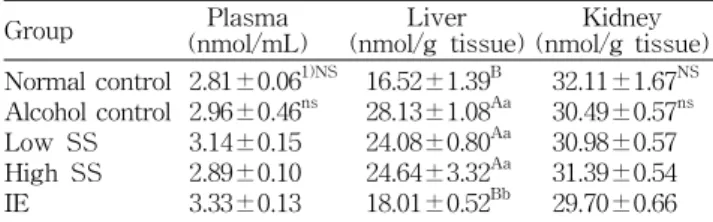
혈장과 조직 중 지질과산화물의 농도에 미치는 영향 혈장과 간, 신장조직의 지질과산화물 농도에 미치는 영향 은 Table 6과 같다. 혈장과 신장조직의 지질과산화물 수준은 모든 군들 간의 유의한 차이가 나타나지 않았다. 그러나 간 조직 중 지질과산화물의 양은 정상 대조군(16.52±1.39 nmol/g tissue)에 비해 알코올 대조군(28.13±1.08 nmol/g tissue)이 유의적으로 높았다. 알코올 투여군들에서 콩나물 분말 투여군들은 알코올 대조군과 유의적인 차이가 없었으 나, IE군(18.01±0.52 nmol/g tissue)은 정상 대조군과 비슷 한 값으로 다른 알코올 투여군에 비하여 유의적으로 낮은
Table 6. Effects of supplementation of bean sprout and soy isoflavone extract on the levels of TBA⁃reactive substances in plasma, liver, and kidney of alcohol⁃treated rats
Group Plasma
(nmol/mL) Liver
(nmol/g tissue) Kidney (nmol/g tissue) Normal control
Alcohol control Low SS High SS IE
2.81±0.061)NS 2.96±0.46ns 3.14±0.15 2.89±0.10 3.33±0.13
16.52±1.39B 28.13±1.08Aa 24.08±0.80Aa 24.64±3.32Aa 18.01±0.52Bb
32.11±1.67NS 30.49±0.57ns 30.98±0.57 31.39±0.54 29.70±0.66 SS: soybean sprout, IE: isoflavone extract.
1)Mean±SE (n=8).
Different capital superscripts in the same column indicate sig- nificant difference (p<0.05) among 5 groups by Duncan's mul- tiple comparison test. Different small superscripts in the same column indicate significant difference (p<0.05) among 4 alcohol groups by Duncan's multiple comparison test.
NSNot significantly different among 5 groups (p<0.05).
nsNot significantly different among 4 alcohol groups (p<0.05).
값을 보여 isoflavone 추출물 투여가 간조직 중의 지질과산 화 방지에 효과가 있는 것으로 나타났다.
만성적인 알코올 섭취는 활성 산소종을 증가시켜 미토콘 드리아의 단백질을 불활성화하고 미토콘드리아의 구조와 기능이 저해되는 것으로 보고되었다(55). 또한 알코올 대사 과정에서 생성되는 유리 라디칼은 지질과산화반응을 촉진 시켜 간조직을 손상시킬 수 있으며(56), 지질과산화에 의해 생성된 항원이 알코올성 간 질환과 관련된 면역반응을 일으 켜(57,58) 간 질환을 유발할 수 있는 것으로 보고되고 있다.
따라서 알코올성 간 질환의 원인의 일부가 지질과산화에 의 한 것으로 볼 때 이를 방지하기 위해서는 항산화 메커니즘이 필요하다고 볼 수 있다. 이를 뒷받침하는 자료로서 iso- flavone의 섭취가 SOD의 생성을 촉진하고(59) lecithin의 산 화를 저해하여 세포손상을 줄이며(60), flavonoid류와 iso- flavone들이 간 마이크로솜의 지질과산화를 억제하여 간의 산화적 손상을 감소시킨다는 연구 보고(61)가 있다. 본 연구 에서 IE군의 간조직 TBARS값이 알코올 대조군에 비해 유 의하게 낮았고 정상대조군과는 유사한 수준을 보였다. 콩나 물 분말 투여군들이 통계적으로 유의하지는 않으나 간조직 TBARS수준을 낮추는 경향을 보임으로써 isoflavone이 간 조직의 산화적 손상을 낮추는데 기여할 가능성을 보인다.
간조직 중 항산화 효소 활성에 미치는 영향
간조직 중 항산화 효소 활성에 미치는 영향은 Table 7과 같다. 간조직 중 SOD 활성도는 알코올 투여군들의 값이 정 상대조군(1.27±0.06 unit/mg protein)의 값에 비해 유의적 으로 높았으며 콩나물 분말(low SS-1.48±0.04 unit/mg protein, high SS-1.53±0.04 unit/mg protein)이나 iso- flavone 추출물 투여군(1.55±0.03 unit/mg protein)은 알코 올 대조군(1.70±0.02 unit/mg protein)에 비해 유의적으로 낮은 수준을 보였다. CAT 활성도도 SOD와 비슷한 양상을 보였으나 IE군(0.66±0.52 nmol/min/mg protein)이 다른 알 코올군들과 정상대조군(0.89±0.09 nmol/min/mg protein)
Table 7. Effects of supplementation of bean sprout and soy isoflavone extract on antioxidant enzyme activities in liver tissues of alcohol⁃treated rats
Group SOD1)
(unit/mg protein)
CAT2) (nmol/min /mg protein)
GPx3) (nmol/min /mg protein) Normal control
Alcohol control Low SS High SS IE
1.27±0.064)C 1.70±0.02Aa 1.48±0.04Bb 1.53±0.04Bb 1.55±0.03Bb
0.89±0.09B 1.03±0.07Aa 1.10±0.54Aa 1.02±0.32ABa 0.66±0.52Cb
9.94±0.25A 8.73±0.37Bb 9.68±0.14Aa 8.89±0.26Bb 8.72±0.33Bb SS: soybean sprout, IE: isoflavone extract.
1)SOD: superoxide dismutase. 2)CAT: catalase.
3)GPx: glutathione peroxidase. 4)Mean±SE (n=8).
Different capital superscripts in the same column indicate sig- nificant difference (p<0.05) among 5 groups by Duncan's mul- tiple comparison test. Different small superscripts in the same column indicate significant difference (p<0.05) among 4 alcohol groups by Duncan's multiple comparison test.
보다도 낮은 수준을 나타내었다. GPx 활성도는 정상대조군 (9.94±0.25 nmol/min/mg protein)에 비하여 알코올 대조군 (8.73±0.37 nmol/min/mg protein)의 값이 유의적으로 낮았 고 high SS군(8.89±0.26 nmol/min/mg protein)과 IE군 (8.72±0.33 nmol/min/mg protein)의 값은 알코올 대조군과 같은 수준이었으며 low SS군(9.68±0.14 nmol/min/mg protein)만이 유의적으로 높은 값이었다.
동물에게 에탄올을 섭취하게 하면 SOD 활성이 높아지는 데(62) 이는 ADH(alcohol dehydrogenase)에 의해 다량 생 성되는 NADH 또는 superoxide 음이온을 비롯한 활성 산소 들이 SOD의 유전자 발현을 유도하기 때문이며(63) 항산화 제가 존재하는 경우에는 SOD활성의 증가가 감소했다(64) 는 연구보고가 있다. 본 연구의 결과에서 알코올 투여군은 정상 대조군에 비해 유의하게 높은 SOD활성을 보였으나 콩 나물 분말이나 isoflavone 추출물 투여군의 SOD활성은 알 코올 대조군에 비해 감소했는데 이는 isoflavone의 항산화작 용에 의한 것으로 추정해 볼 수 있다.
만성적인 에탄올 섭취시 CAT의 활성이 높아지는 것으로 보고되고 있는데(65,66) 이는 CAT가 과산화수소 생성계에 서 알코올을 산화시키는 기능을 가지며, ADH와 함께 활성 이 증가하기 때문인 것으로 알려져 있다. 본 연구의 결과에 서 CAT 활성이 IE군에서 유의적으로 낮은 수준을 보인 것 은 isoflavone이 알코올 섭취상태에서 CAT의 활성도를 낮 추는 효과가 있음을 시사하나 그 메카니즘에 대해서는 분명 하지 않다.
알코올 섭취시 GSH-Px는 acetaldehyde와 결합하거나 알 코올로 인하여 GSH가 감소하기 때문에 GSH-Px의 활성이 저하되는 것으로 보고되어 있다(67). Liber-DeCarli 액체식 이를 8주 또는 3주간 흰쥐에게 공급했을 때 GSH-Px가 감소 하였다는 보고(68,69)와 식이 열량의 36%를 에탄올로 6주 공급한 흰쥐의 GSH-Px의 활성이 유의적으로 감소하였다 는 보고(66)가 이를 뒷받침한다. 본 연구의 결과 GSH-Px
활성은 알코올 투여군이 정상 대조군에 비해 다소 감소하였 으며, 알코올 투여군 중에서는 low SS군이 정상대조군과 유사한 높은 값을 보였다. 이상의 결과로부터 isoflavone 투 여가 알코올 투여 동물의 항산화 효소계에 일관성있는 영향 을 보이기보다는 효소의 종류별로 미치는 효과가 차이가 있 는 것으로 추정된다.
요 약
본 연구는 고 isoflavone 콩나물이 만성 에탄올 섭취 동물 에서 지질대사와 항산화 효소계에 미치는 영향을 살펴보고 기능성 식품으로서의 가능성을 알아보기 위하여 수행되었 다. 실험동물은 SD계 수컷쥐를 사용하였으며 40일간 Lieber- DeCarli 액체식이를 일부 변형한 실험식을 공급하여 고 iso- flavone 콩나물과 isoflavone 추출물이 에탄올 투여 흰쥐의 지질대사와 항산화효소계에 미치는 영향을 조사하여 다음 과 같은 결과를 얻었다. High SS군은 알코올 대조군에 비하 여 체중증가량, 식이섭취량 및 식이효율이 모두 증가되었으 나, low SS군과 IE군은 전반적으로 체중증가량, 식이섭취량 및 식이효율이 알코올 대조군보다 낮았다. 고 isoflavone 콩 나물과 대두 isoflavone 추출물은 알코올 투여시 증가된 혈 장 TG, TC, AI를 낮추었고, HDL-chol/TC의 비를 높였으며 간조직의 총 지질량, TG, TC 수준을 낮추었다. Isoflavone 추출물은 간조직의 TBARS 수준을 유의하게 낮추었으나 간 조직 항산화효소 활성도를 증가시키지는 않았으므로 iso- flavone의 항산화기전에 대한 연구가 필요할 것으로 보인다.
이상의 결과로부터 고 isoflavone 콩나물과 isoflavone 추출 물은 혈장과 간조직의 지질 농도와 지질과산화를 낮추며 일 부 항산화 효소계에 긍정적인 효과를 미치는 것으로 보인다.
문 헌
1. Jaeschke H, Gores GJ, Cederbaum AI, Hinson JA, Pessayre D, Lemasters JJ. 2002. Mechanisms of hepatotoxicity.
Toxicological Sciences 65: 166-176.
2. Lieber CS. 1994. Alcohol and the liver. Gastro 106: 1085- 1105.
3. Cha YS, Sachan DS. 1994. Opposite effects of dietary satu- rated and unsaturated fatty acids on ethanol-pharmacoki- netics, triglycerides and carnitines. J Am Coll Nutr 13:
338-343.
4. Boveries A, Fraga CG, Varsavsky AI, Koch OR. 1983.
Increased chemiluminescence and superoxide production in the liver of chronically ethanol treated rats. Arch Biochem
Biophys 227: 534-541.
5. Shaw S, Jayatilleke E, Lieber CS. 1984. The effect of chron- ic alcohol feeding on lipid peroxidation in microsomes: lack of relationship to hydroxyl radical generation. Biochem
Biophys Res Commun 118: 233-238.
6. DiLuzio NR, Hartma AD. 1967. Role of lipid peroxidation in the pathogenesis of ethanol-induced fatty liver. Fed
Proc 26: 1436-1442.
7. Knecht KT, Adechi Y, Bradford BU, Iimuro Y, Kadiiska M, Qun-hui X, Thurman RG. 1995. Free radical adducts in the bile of rats treated chronically with intragastric alco- hol: inhibition by destruction of Kupffer cells. Molecular
Pharmacology 47: 1028-1034.
8. DiLuzio NR, Hartman AD. 1967. Role of lipid peroxidation in the pathogenesis of ethanol-induced fatty liver. Fed
Proc 26: 1436-1442.
9. Sies H. 1985. Introductory remarks. In Oxidative stress.
Academic Press, London. p 1-8.
10. Bunout D. 1999. Nutritional and metabolic effects of alco- holism: their relationship with alcoholic liver disease.
Nutrition 15: 583-589.
11. Tabakoff B, Gelpke CC. 1975. Alcohol and aldehyde metab- olism in brain. Adv Exp Med Biol 56: 141-164.
12. Stadtman ER. 2006. Protein oxidation and aging. Free
Radic Res 40: 1250-1258.
13. Loguercio C, Federico A. 2003. Oxidative stress in viral and alcoholic hepatitis. Free Radic Biol Med 34: 1-10.
14. Suresh MV, Sreeranjit Kumar CV, Lal JJ, Indira M. 1999.
Impact of massive ascorbic acid supplementation on alcohol induced oxidative stress in guinea pigs. Toxicology Letters 104: 221-229.
15. McDonough KH. 2003. Antioxidant nutrients and alcohol.
Toxicology 189: 89-97.
16. Leo MA, Lieber CS. 1999. Alcohol, vitamin A, and beta- carotene: adverse interactions, including hepatotoxicity and carcinogenicity. Am J Clin Nutr 69: 1071-1085.
17. Das SK. Vasudevan DM. 2007. Alcohol-induced oxidative stress. Life Sciences 81: 177-187.
18. Messina M, Perky V, Setchell KDR, Barnes S. 1994. Soy intake and cancer risk. A review of invitro and in vivo data.
Nutr Cancer 21: 113-131.
19. Kwoon TW, Song YS, Hong JH, Moon GS, Kim JI, Hong JH. 1998. Current research on the bioactive functions of soyfoods in Korea. Korea Soybean Digest 15: 1-12.
20. Anderson JW, Johnstone BM, Cook-Newell ME. 1995.
Meta-analysis of the effects of soy protein intake on serum lipids. New Engl J Med 333: 276-282.
21. Messina M. 1995. Modern applications for an ancient bean:
soybeans and the prevention and treatment of chronic disease. J Nutr 125: 567S-569S.
22. Kulling SE, Honig DM, Metzler M. 2001. Oxidative metabo- lism of the soy isoflavones daidzein and genistein in hu- mans in vitro and in vivo. J Agric Food Chem 49:
3024-3033.
23. Mitchell JH, Gardner PT, McPhail DB, Morrice PC, Collins AR, Duthie GG. 1998. Antioxidant efficacy of phytoes- trogens in chemical and biological model systems Arch
Biochem Biophys 360: 142-148.
24. Toda S, Shirataki Y. 1999. Inhibitory effects of isoflavones on lipid peroxidation by reactive oxygen species. Phytother
Res 13: 163-165.
25. Torel J, Cillard J, Cillard P. 1986. Antioxidant activity of flavonoids and reactivity with peroxy radical. Phytochemistry 25: 383-385.
26. Wang W, Goodman MT. 1999. Antioxidant property of di- etary phenolic agents in human LDL-oxidation ex vivo model: interaction of protein binding activity. Nutr Res 19:
191-202.
27. Kim YH, Hwang YH, Lee HS. 2003. Analysis of isoflavones for 66 varieties of sprout beans and bean sprouts. Kor J
Food Sci 35: 568-575.
28. Lee KA, Cho YA, Hwang YH, Lee HS. 2003. Analysis of dietary fiber of 66 Korean varieties of sprout and bean
sprouts. Nutraceuticals & Food 8: 173-178.
29. Mistry of health and welfare. 2002. Report on 2001 national health and nutrition survey.
30. Shim JY. 2003. Effect of soybean isoflavone on the metabo- lism of diabetic rats. MS Thesis. Kyungpook National University.
31. Muller PH. 1977. A fully enzymatic triglyceride deter- mination. J Clin Chem Clin Biochem 15: 457-464.
32. Richmond W. 1976. Use of cholesterol oxidase for assay of total and free cholesterol in serum continuous flow analysis. Clin Chem 22: 1579-1588.
33. Finley PR, Schifman RB, Williams RJ, Luchti DA. 1978.
Cholesterol in high-density lipoprotein: Use of mg2+
/dextran sulfate in its measurement. Clin Chem 24: 931- 933.
34. Folch JM, Lees M, Stanley GHS. 1957. A simple method for the isolation and purification of total lipids from animal tissue. J Bio Chem 226: 497-509.
35. Sale F, Marchesini S, Fishman PH, Berra B. 1984. A sensi- tive enzymatic assay for determination of cholesterol in lip- id extracts. Anal Biochem 142: 347-350.
36. Taladgis BG, Pearson AM, Duan LR. 1964. Chemistry of the 2-thiobarbituric acid test for determination of oxidation rancidity in foods. J Sci Food Agri 15: 602-607.
37. Uchiyama M, Mihara M. 1978. Determination of ma- londialdehyde precursor in tissue by TBA test. Anal
Biochem 86: 271-278.
38. Marklund S, Marklund G. 1974. Involvement of the super- oxide anion radical in the autoxidation of pyrogallol and a covenient assay for superoxide dismutase. Eur J Biochem 47: 469-474.
39. Paglia PE, Valentine WN. 1967. Studies on quantitative and qualitative characterization of erythrocyte glutathione peroxidase. Lab Clin Med 70: 158-169.
40. Aebi H. 1974. Catalase in Method of Enzymatic Analysis.
Academic Press, New York. Vol 2, p 673-684.
41. Bradford MM. 1976. A rapid and sensitive method for the quantitation of microgram quantities of protein utilizing the principle of protein-dye binding. Anal Biochem 72: 248-254.
42. Reinus KF, Heymsfield SB, Wiskind R, Casper K, Calambos JT. 1989. Ethanol: Relative fuel value and meta- bolic effects in vivo. Metabolism 38: 125-135.
43. Charles H, Halsted MD. 2004. Nutrition and alcoholic liver disease. Semin Liver Dis 24: 289-304.
44. Lieber CS. 1991. Perspectives: Do alcohol calories count?
Am J Clin Nutr 54: 976-982.
45. Feinman L, Lieber CS. 1992. Nutrition: Medical problems of alcoholism. In Medical and nutrition complications of
alcoholism.
Lieber Mechanismand management.
p 515-530.46. Linder MC. 1991. Nutrition and metabolism of fats. In
Nutritional biochemistry and metabolism with clinical applications. 2nd ed. Linder MC, ed. Elasevier, New York,
Amsterdam, Oxford. p 79-83.47. Lieber CS. 1985. Alcohol and the liver. Metabolism of etha- nol metabolic effects and pathogenesis of injury. Acta Med
Sand (suppl) 703: 11-55.
48. Anderson JW, Johnstone BM, Cook-Newell ME. 1995.
Meta-analysis of the effects of soy protein intake on serum lipids. N Engl J Med 333: 276-282.
49. Sirtori CR, Lavati MR. 1995. Soy and cholesterol reduction:
Clinical experience. J Nutr 125: 598S-605S.
50. Lee YS, Koh JS. 1994. Effects of dietary soy protein and calcium on blood and tissue lipids in rats fed fat - enriched diet. Korean J Nutrition 27: 3-11.
51. Anila L, Vijayalakshmi NR. 2002. Flavonoids from Emblica
officinalis and Mongifera indica-effectiveness for dyslipide-
mia. J Ethnopharmacol 79: 81-87.52. Seo HJ, Jeong KS, Lee MK, Park YB, Jung UJ, Kim HJ, Choi MS. 2003. Role of naringin supplement in regulation of lipid and ethanol metabolism in rats. Life Sciences 73:
933-946.
53. Leninger AL. 1979. Biochemistry. 2nd eds. Worth Publisher Inc., NY, USA. p 533-536.
54. Park YC, Park SC. 1995. Reduction of oxidative stress by aspartate in the ethanol-perfused rat liver tissues. Korean
J Biochem 27: 165-169.
55. Bailey SM, Cunningham CC. 2002. Contribution of mi- tochondria to oxidative stress associated with alcoholic liv- er disease. Free Radic Biol Med 32: 11-16.
56. Rouach H, Clement M, Ofanelli MT, Janvier B, Nordmann J, Nordmann R. 1983. Hepatic lipid peroxidation and mi- tochondrial susceptibility to peroxidative attacks during ethanol inhalation and withdrawal. Biochim Biophys Acta 753: 439-444.
57. Albano E. 2002. Free radical mechanisms in immune re- actions associated with alcoholic liver disease. Free Radic
Biol Med 32: 110-114.
58. Mottaran E, Stewart SF, Rolla R, Vay D, Cipriani V, Moretti M, Vidali M, Sarto M, Rigamonti C, Day CP, Albano E.
2002. Lipid peroxidation contributes to immune reactions associated with alcoholic liver disease. Free Radic Biol
Med 32: 38-45.
59. Paradkar PN, Blum PS, Berhow MA, Baumann H, Kuo SM.
2004. Dietary isoflavones suppress endotoxin-induced in- flammatory reaction in liver and intestine. Cancer Lett 215:
21-28.
60. Toda S, Shirataki T. 1999. Inhibitory effects of isoflavones on lipid peroxidation by reactive oxygen species. Phytother
Res 13: 163-165.
61. Rodriguez RJ, Miranda CL, Stevens JF, Deinzer ML, Buhler DR. 2001. Influence of prenylated and non-prenylated fla- vonoids on liver microsomal lipid peroxidation and oxida- tive injury in rat hepatocytes. Food Chem Toxicol 39:
437-445.
62. Chen LH, Huang CY, Osio Y. 1996. Large doses of ethanol and activities of liver-enzymes which detoxify reative oxy- gen species: effect of antioxidants. Biochem Archives 12:
95-104.
63. Koop DR. 1992. Oxidative and reductive metabolism by cy- tochrome P450 2E1. FASEB J 6: 724-730.
64. Koch O, Farre S, De Leo ME, Palozza P, Palazzotti B, Borrelo S, Palombini G, Cravero A, Galeotti T. 2000.
Regulation of manganese superoxide dismutase (MnSOD) in chronic experimental alcoholism: effects of vitamin E-supplemented and -deficient diets. Alcohol and Alcoholism 35: 159-163.
65. Antonenkov VD, Panchenko LF. 1988. Effect of chronic ethanol treatment under partial catalase inhibition on the activity of enzymes related to peroxide metabolism in rat liver and heart. Int J Biochem 20: 823-828.
66. Oh SI, Kim CI, Chun HJ, Park SC. 1998. Chronic ethanol consumption affects glutathione status in rat liver. J
Nutrition 128: 758-763.
67. Schisler NJ, Singh SM. 1989. Effect of ethanol in vivo on enzymes which detoxify oxygen free radicals. Free Radic
Biol Med 7: 117-123.
68. Morton S, Mitchell MC. 1985. Effects of chronic ethanol feeding on glutathione turnover in the rat. Biochem
Pharmacol 34: 1559-1563.
69. Chung KH, Cho SH, Sin EN, Choi KH, Choi YS. 1988.
Effects of alcohol consumption and fat content in diet on chemical composition and morphology of liver in rat.
Korean J Nutrition 21: 154-162.
(2007년 9월 10일 접수; 2007년 11월 17일 채택)