A study on Real-Time Implementation of Robust Control for Horizontal Articulated Arm with Eight Axis
노연 후 콩
1
, 김준홍2
, 이희섭3
Hoo-Cong Nguyen
1, Jun-Hong Kim
2, Hee-Seop Lee
3<Abstract>
In this paper, we describe a new approach to perform real-time implementation of an robust controller for robotic manipulator based on digital signal processors in this paper. The Texas Instruments DSPs chips are used in implementing real-time adaptive control algorithms to provide enhanced motion control performance for dual-arm robotic manipulators. In the proposed scheme, adaptation laws are derived from model reference adaptive control principle based on the improved direct Lyapunov method. The proposed adaptive controller consists of an adaptive feed-forward and feedback controller and time-varying auxiliary controller elements.
The proposed control scheme is simple in structure, fast in computation, and suitable for real-time control. Moreover, this scheme does not require any accurate dynamic modeling, nor values of manipulator parameters and payload. Performance of the proposed adaptive controller is illustrated by simulation and experimental results for robot manipulator consisting of dual arm with eight degrees of freedom at the joint space and cartesian space.
Keywords: Robust Control, 8 Axis Robot, Real Time Control, Real-Time Implementation
1. 정회원, 주저자 (주)미쉐린타이어 베트남 1. Deptr, Michelin Tire co., Ltd.
E-mail : [email protected]
2. 정회원, 교신저자 S&T 중공업 2. Corresponding Author, S&T Dynamics co., Ltd
3. 정회원, 교신저자 두산인프라코어 3. Corresponding Author, Dosaninfracore co., Ltd
1. INTRODUCTION
This paper describes a new approach to the design of adaptive control system and real-time implementation using digital signal processors for robotic manipulators to achieve the improvement of speedness, repeating precision, and tracking performance at the joint and cartesian space. Digital signal processors (DSP's) are special purpose microprocessors that are particularly suitable for intensive numerical computations involving sums and products of variables. Digital versions of most advanced control algorithms can be defined as sums and products of measured variables, thus can naturally be implemented by DSP's. DSPs allow straightforward implementation of advanced control algorithms that result in improved system control. Single and/or multiple axis control systems can be controlled by a single DSP.
Adaptive and optimal multivariable control methods can track system parameter variations.
Dual control, learning, neural networks, genetic algorithms and Fuzzy Logic control methodologies are all among the digital controllers implementable by a DSP (N. Sadegh et al., 1990; Z. Ma et al., 1995). In addition, DSP's are as fast in computation as most 32-bit microprocessors and yet at a fraction of their prices. These features make them a viable computational tool for digital implementation of advanced controllers. High performance DSPs with increased levels of integration for functional modules have become the dominant solution for digital control systems. Today's DSPs with performance levels ranging from 5 to 5400 MIPS are on the market with price tags as low as $3 (P. Bhatti et al., 1997; T. H. Akkermans et al., 2001). In order to develop a digital servo controller one must carefully consider the effect of the sample-and-hold operation, the sampling frequency, the computational delay, and that of the quantization error on the stability of a closed-loop system (S. A. Bortoff, 1994).
Moreover, one must also consider the effect of disturbances on the transient variation of the tracking error as well as its steady-state value (F. Mehdian et al., 1995; S. H. Han et al., 1996).
2. DYNAMIC MODELING
The dynamic model of a manipulator-plus-payload is derived and the tracking control problem is stated in this section.
Let us consider a nonredundant joint robotic manipulator in which the n×1 generalized
joint torque vector τ(t) is related to the n×1 generalized joint coordinate vector q(t) by
the following nonlinear dynamic equation of motion
(1)
where is the n×n symmetric positive-definite inertia matrix, is the n×1 coriolis and centrifugal torque vector, and is the n×1 gravitational loading vector.
Equation (1) describes the manipulator dynamics without any payload. Now, let the n×1 vector X represent the end-effector position and orientation coordinates in a fixed task-related cartesian frame of reference. The cartesian position, velocity, and acceleration vectors of the end-effector are related to the joint variables by
∅
(2)
where Φ(q) is the n×1 vector representing the forward kinematics and J(q) = [∂Φ(q)/∂
q] is the n×n Jacobian matrix of the manipulator Let us now consider payload in the manipulator dynamics. Suppose that the manipulator end-effector is firmly grasping a payload represented by the point mass ∆
. For the payload to move with acceleration
in the gravity field, the end-effector must apply the n×1 force vector given by
∆
(3)
where g is the n×1 gravitational acceleration vector. The end-effector requires the additional joint torque
(4)
where superscript T denotes transposition. Hence, the total joint torque vector can be obtained by combining equations (1) and (4) as
(5)
Substituting equations (2) and (3) into equation (5) yields
∆
(6)
Equation (6) shows explicity the effect of payload mass ∆
on the manipulator dynamics. This equation can be written as
∆
∆
∆
(7)
where the modified inertia matrix ∆
is symmetric and positive-definite. Equation (7) constitutes a nonlinear mathematical model of the manipulator-plus-payload dynamics.
3. ROBUST CONTROL SCHEME
The manipulator control problem is to develop a control scheme which ensures that the joint angle vector tracks any desired reference trajectory
where
is an n×1 vector of arbitrary time functions. It is reasonable to assume that these functions are twice differentiable, that is, desired angular velocity
and angular acceleration
exist and are directly available without requiring further differentiation of
. It is desirable for the manipulator control system to achieve trajectory tracking irrespective of payload mass ∆
.
The controllers designed by the classical linear control scheme are effective in fine motion control of the manipulator in the neighborhood of a nominal operating point
. During the gross motion of the manipulator, operating point
and consequently the linearized model parameters vary substantially with time.
Thus it is essential to adapt the gains of the feedforward, feedback, and PI
controllers to varying operating points and payloads so as to ensure stability and
trajectory tracking by the total control laws. The required adaptation laws are
developed in this section.
∆
∆
∆
(8)
where
and
are n×n matrices whose elements are highly nonlinear functions ∆
and . In order to cope with changes in operating point, the controller gains are varied with the change of external working condition.
This yields the adaptive control law
(9)
where
are feedforward time-varying adaptive gains, and
and
are the feedback adaptive gains, and
is a time-varying control signal corresponding to the nominal operating point term, generated by a feedback controller driven by position tracking error E(t) defined as
.
The gains of adaptive control low in equation (9) are defined as follows:
(10)
(11)
(12)
(13)
Where
and
are positive and zero/positive
scalar adaptation gains, which are chosen by the designer to reflect the relative
significance of position and velocity errors and .
4. SIMULATION AND EXPERIMENT
4.1 Simulation
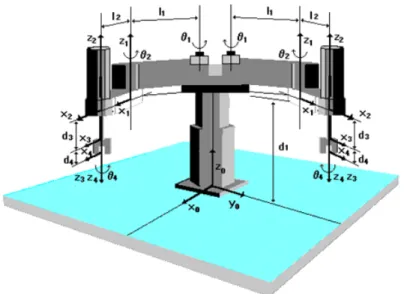
This section represents the simulation results of the position and velocity control of a four-link robotic manipulator by the proposed adaptive control algorithm, as shown in Fig.1, and discusses the advantages of using joint controller based-on DSPs for motion control of a dual-arm robot. The adaptive scheme developed in this paper will be applied to the control of a dual-arm robot with eighth axes. Fig.1 represents link coordinates of the dual-arm robot.
Fig.1. The Coordinates ftame of robotic arm with 8 axis
Mass of link(kg) Length of link(kg) Inertia of link(kg) Gear ratio of link
m1 15.0067 I1 0.35 I1 0.1538 r1 1/100
m2 8.994 I2 0.3 I2 0.0674 r2 1/80
m3 3.0 I3 0.175 I3 0.045 r3 1/200
m4 1.0 I4 0.007 I4 0.0016 r4 1/75
m5 15.067 I5 0.35 I5 0.1538 r5 1/100
m6 8.994 I6 0.3 I6 0.0674 r6 1/80
m7 3.0 I7 0.175 I7 0.045 r7 1/200
m8 1.0 I8 0.007 I8 0.0016 r8 1/75
Table 1 Link parameters
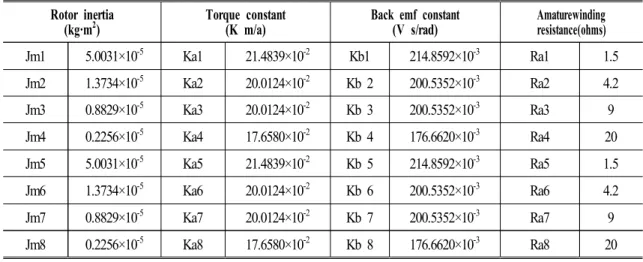
Rotor inertia (kg·m
2)
Torque constant (K m/a)
Back emf constant (V s/rad)
Amaturewinding resistance(ohms)
Jm1 5.0031×10
-5Ka1 21.4839×10
-2Kb1 214.8592×10
-3Ra1 1.5
Jm2 1.3734×10
-5Ka2 20.0124×10
-2Kb 2 200.5352×10
-3Ra2 4.2
Jm3 0.8829×10
-5Ka3 20.0124×10
-2Kb 3 200.5352×10
-3Ra3 9
Jm4 0.2256×10
-5Ka4 17.6580×10
-2Kb 4 176.6620×10
-3Ra4 20
Jm5 5.0031×10
-5Ka5 21.4839×10
-2Kb 5 214.8592×10
-3Ra5 1.5 Jm6 1.3734×10
-5Ka6 20.0124×10
-2Kb 6 200.5352×10
-3Ra6 4.2
Jm7 0.8829×10
-5Ka7 20.0124×10
-2Kb 7 200.5352×10
-3Ra7 9
Jm8 0.2256×10
-5Ka8 17.6580×10
-2Kb 8 176.6620×10
-3Ra8 20
Table 2 Motor parameters
4.2 Experiment
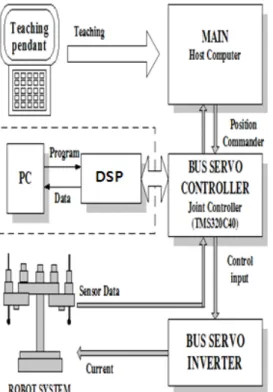
The performance test of the proposed adaptive controller has been performed for the dual-arm robot at the joint space and cartesian space. At the cartesian space, it has been tested for the peg-in-hole tasks, repeating precision tasks, and trajectory tracking for B-shaped reference trajector. At the joint space, it has been tested for the trajectory tracking of angular position and velocity for a dual-arm robot made in Samsung Electronics Company in Korea. Fig. 4 represents the schematic diagram of control system of dual-arm robot. And Fig. 5 represents the block diagram of the interface between the PC, DSP, and dual-arm robot.
The performance test in the joint space is performed to evaluate the position
and velocity control performance of the four joints under the condition of
payload variation, inertia parameter uncertainty, and change of reference
trajectory.
Fig. 4. The block diagram of the interface between
the PC. DSP, and dual-arm robot. Fig. 5. The schematic diagram control system of dual-arm robot.
Fig. 6. (a)-(d) Experimental results for the position and velocity tracking of robust controller at the first joint with 3kg payload.
5. CONCLUSIONS
A new adaptive digital control scheme is described in this paper using DSP(TMS320C80) for robotic manipulators. The adaptation laws are derived from the direct adaptive technique using the improved Lyapunov second method. The simulation and experimental results show that the proposed DSP-adaptive controller is robust to the payload variation, inertia parameter uncertainty, and change of reference trajectory. This adaptive controller has been found to be suitable to the real-time control of robot system. A novel feature of the proposed scheme is the utilization of an adaptive feedforward controller, an adaptive feedback controller, and a PI type time-varying control signal to the nominal operating point which result in improved tracking performance. Another attractive feature of this control scheme is that, to generate the control action, it neither requires a complex mathematical model of the manipulator dynamics nor any knowledge of the manipulator parameters and payload. The control scheme uses only the information contained in the actual and reference trajectories which are directly available. Futhermore, the adaptation laws generate the controller gains by means of simple arithmetic operations. Hence, the calculation control action is extremely simple and fast. These features are suitable for implementation of on-line real-time control for robotic manipulators with a high sampling rate, particularly when all physical parameters of the manipulator cannot be measured accurately and the mass of the payload can vary substantially.
The proposed DSP-based adaptive controllers have several advantages over the analog
control and the micro-computer based control. This allows instructions and data to be
simultaneously fetched for processing. Moreover, most of the DSP instructions, including
multiplications, are performed in one instruction cycle. The DSP tremendously increase
speed of the controller and reduce computational delay, which allows for faster sampling
operation. It is illustrated that DSPs can be used for the implementation of complex
digital control algorithms, such as our adaptive control for robot systems.
REFERENCES