The Effects of Employees’ Person-Environment Fit in the Foodservice Industry on Organization Citizenship Behavior, Organizational Commitment and Turnover Intent
Hyo Sun Jung and Hye Hyun Yoon†
Dept. of Culinary Science and Foodservice Management, Kyung Hee University, Seoul 130-701, Korea
Abstracts
The purpose of this study is to assess the associations among person–environment fit, organizational citizenship behavior, organizational commitment and turnover intent in the foodservice industry. The study was administered to 306 Korean employees. The results indicated a positive relationship between person–environment fit, employees’ organizational citizenship behavior and organizational commitment. However, person–environment fit did not have a significant, direct impact on their turnover intent. Thus, this study found an indirect influence via organizational citizenship behavior and organizational commitment. In addition, organizational citizenship behavior and organizational commitment were negatively associated with employees’ intention to leave the organization. Limitations and future research directions are also discussed.
Key words: Person–environment fit, organizational citizenship behavior, organizational commitment, turnover intent, deluxe hotel.
†Corresponding author : Hye Hyun Yoon, Tel: 82-2-961-9403, Fax: 82-2-964-2537. E-mail: [email protected]
Introduction
Why does a foodservice employee leave? This study focu- sed on foodservice industries by using person–environment fit as the independent variable. Person–environment fit can be conceptualized in a variety of ways, the match between an indi- vidual and his/her job, group, supervisor, vocation or organi- zation (Kristof-Brown AL 1996). From a psychological pers- pective, person–environment fit influences employee behavior (Oh et al 2013). Certainly, empirical research has demonstra- ted several positive outcomes of employees’ person–environ- ment fit, including enhanced job satisfaction (Kilic et al 2011) and commitment (Kristof-Brown et al 2005, Ostroff et al 2005, Iplik et al 2011). In other words, employees’ person–environ- ment fit elicits favorable attitudes and gives employees positive motivation toward their organization or job. For instance, Sil- verthorne C(2004) indicated that the degree of fit between a person and the organizational environment is related both to productivity and to employee turnover. In addition, person–
environment fit can guide the development of strategic human resource management and create consistent messages that are shared by all managers in the company (Werbel & DeMarie 2005). In this sense, numerous researchers believe a good fit between the person and organization is important (Yang et al
2008). In particular, due to the job characteristics of the food- service industry, such as irregular holidays and working hours, low income, and the required high level of concentration, its employee turnover rates are high (Murry-Gibbons & Gibbons 2007). It has been proposed that examining employees’ person –environment fit will provide a very meaningful point for efforts to decrease their turnover rates. Moreover, the food- service industry is highly labor-intensive compared to other industries; therefore, it has been suggested that companies in the industry need to seek measures to enhance employees’
potential and organizational performance using the “fit theory”
(Iplik et al 2011). Despite its importance, research that has examined foodservice companies in relation to the effectiveness of employees’ person–environment fit remains very rare. While there is a lack of scholarly research on person–environment fit in the hospitality industry and Kilic et al(2011) indicated that person–environment fit (person–organization fit, person –job fit) positively influenced on job attitudes of foodservice managers. Most relevant research studies, however, have looked at the effects of the quality of employees or organizations on organizational performance, as such, comprehensive studies on the effects of organization–environment or person–environ- ment fit on organizational performance have been lacking.
Thus far, studies of employees’ person–environment fit (in- cluding person–organization, person–job, person–group and person–super- visor) have focused on public sector (Liu et al 2010), general company (Greguras & Diefendorff 2009, Tak
JK 2011) and service firm (Jing & Juan-juan 2010). Some studies have examined hotels (Kilic et al 2011) and restaurants (Vogel & Feldman 2009). However, most of them classified sub-factors of person–environment fit into person–organiza- tion, person–job, person–group, person–vocation and person –supervisor fit and simply examined the relationship between each sub–factor and em- ployee attitudes, organic research of effects of person–environment fit on job attitudes is virtually nonexistent.
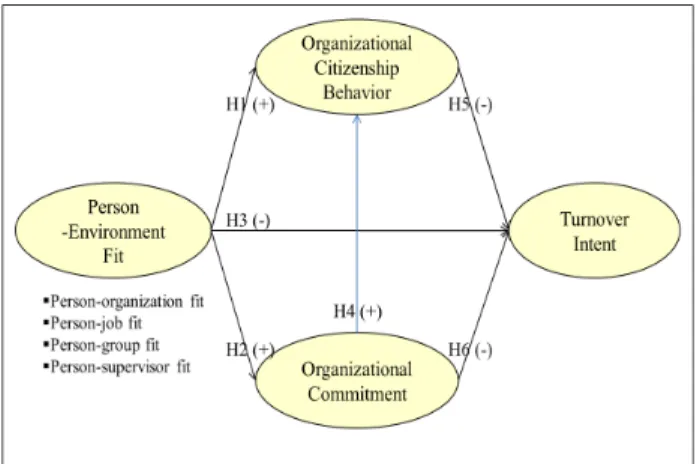
Thus, the purpose of this study is to assess several pro- posed relationships that have not been fully explored in the foodservice industry. A path model highlighting associations among employees’ person–environment fit, organizational citi- zenship behavior, organizational commitment and turnover intent in foodservice industry will be tested (Fig. 1) to eluci- date the impact of person–environment fit on employees’
attitudes.
Literature Review and Conceptual Model
1. Relationship between Person–Environment Fit and Organizational Citizenship Behavior
Organizational studies have suggested that the person– environment fit improves performance for an organization.
Zhuang & Lin (2005) noted that employees who thought their values fit with their organization’s environment were more likely to have favorable relationships with their superiors and colleagues than those who did not. Cable & DeRue (2002) indicated that person–job fit influences job–related perfor- mance such as job satisfaction and work satisfaction, whereas person–organization fit has significant effects on organization
Fig. 1. A proposed model.
–related performance such as organizational citizenship beha- vior and organizational identification.
∙H1: Person–environment fit will exert a positive influence on organizational citizenship behavior.
2. Relationship between Person–Environment Fit and Organizational Commitment
Kristof-Brown et al (1996) claimed that employees’ person –environment fit leads employees to commit to the organi- zation by improving job satisfaction. Cable & Edwards (2004) suggested that value congruence influences employee outcomes both directly and indirectly through psychological need ful- fillment. Kristof-Brown et al (2005) noted that the relationship between employees and their environment to be significantly positive related to organizational commitment and employees who perceive themselves to fit with their organizations likely develop bonds with organizations (Cable & DeRue 2002). Saks
& Ashforth (1997) suggested that the person–organization fit to be negatively related to intentions to quit and turnover after employees were hires: thus, employees who have a strong posi- tive connection with organizational environment are much less likely to consider leaving intent.
∙H2: Person–environment fit will exert a positive influence on organizational commitment.
3. Relationship between Person–Environment Fit and Turnover Intent
Kristof-Brown et al (2002) also asserted that person–envi- ronment fit including person–organization, person–group, and person–job fit significantly affected their turnover intent and Choi & Yoo (2005) that person–environment fit (e.g., person –job, person–supervisorand person–organization) negatively influenced their turnover intent and in particular person–job fit had the greatest influence and Choi & Yoo(2005) that person–environment fit (eg., person–job, person–supervisor, and person–organization) negatively influenced their turnover intent and in particular person–job fit had the greatest in- fluence.
∙H3: Person–environment fit will exert a negative influence on turnover intent.
4. Relationship between Organizational Commitment and Organizational Citizenship Behavior
Regarding studies on employees’ organizational commitment
and organizational citizenship behavior, Meyer et al (2002) noted that employees’ organizational commitment positively affects organizational citizenship behavior. Also, Cropanzano et al (2003) argued that employees’ organizational citizenship behavior is due to high organization commitment. Cohen A (2006) also indicated that higher commitment leads emplo- yees’ organizational citizenship behavior and Bove et al (2009) also indicated in their study of service workers that higher organizational commitment increases organizational citizenship behavior.
∙H4: Organizational commitment will exert a positive influ- ence on organizational citizenship behavior.
5. Relationship between Organizational Citizenship Behavior, Organizational Commitment and Turnover Intent
The organization behavior and management literatures su- pport the employees’ attitudes(e.g., OCB and OC)–turnover intent relationship. Hom & Griffeth (1995) supported that turnover intent negatively correlated with employees’ organi- zational citizenship behaviors, Aryee & Chay (2001) indicated that the negative associations between organizational citizen- ship and turnover intent; Coyne & Ong (2007) reported that employees’ organizational citizenship behavior has a great im- pact on their turnover intent. Chen CF (2006) demonstrated that an employee’s recognition of their organization’s commit- ment is associated with lower turnover intent and Chang et al (2007) showed that normative organizational commitment nega- tively correlates with organizational turnover intention most strongly and affective occupational commitment negatively correlates with occupational turnover intention most strongly.
Yi et al (2011) supported that the commitment of employees as organization has negative associations with their turnover intent.
∙H5: Organizational citizenship behavior will exert a negative influence on turnover intent.
∙H6: Organizational commitment will exert a negative influ- ence on turnover intent.
Research Methodology
1. Sample and Data Collection
The data used for this study were collected from employees in foodservice industry in Seoul in 2012. Food and beverage employees working in full service hotels in Seoul, Republic of
Korea comprised the population for this study. These are pro- perties with more than 250 bedrooms (such as Lotte, Marriott, Inter–continental, Hilton and Hyatt) that provide a compre- hensive range of services such as restaurants, banquet and fit- ness facilities. Once the hotel’s head of human resources ma- nagement gave permission, employees were provided with a voluntary survey and were asked by the researcher to complete it. A pilot test of 50 employees was conducted to ensure the scales’ reliability. Some terms that had become indigestible as going through the translation process were modified on the basis of the results of the pilot test. Pilot test was performed through interview with 40 employees and 10 managers. It ca- rried out questionnaire survey by offering illustrative question- naire to employees and simultaneously got opinion about sentence with abnormal context and a little difficulty for being understood. In-depth interview was performed targeting 10 managers who have been in office for more than 15 years.
Through this, the general discussion on questionnaire items was progressed. After the initial item pool was finalized, a review was conducted with hospitality professors and human resource managers. The completed questionnaires were sealed in envelopes to protect employee anonymity and collected by the researcher two weeks later. Of the 500 questionnaires dis- tributed, 465 were returned over the two-week period (93.00
%). Of 465 surveys collected, 159 responses were deleted, either those participants were disqualified (n=55) or respon- dents did not complete the survey (n=104). After elimination, 306 questionnaires with an effective response rate of 61.20%
were coded and analyzed.
2. Instrument Development
The measures in this study can be grouped into four cate- gories: person–environment fit, organizational citizenship be- havior, organizational commitment, turnover intent (Appendix A). The survey instrument used to measure employees’ person –environment fit, organizational citizenship behavior, orga- nizational commitment and turnover intent included a 7-point scale: “How much do you agree or disagree with these state- ments?” (1: strongly disagree to 7: strongly agree). Kristof- Brown et al (2005) defined person–environment fit as the
“compatibility between an individual and a work environment that occurs when their characteristics are well matched.” To measure employees’ perceptions of PEF, this study adapted Cable & DeRue (2002), Ahmad KZ (2010) and Tak JK (2011)’s
multi-item scales. Each person–environment fit item was mea- sured using these 20 items. Organ DW (1997) defined organi- zational citizenship behavior as “maintenance and enhancement of the social and psychological context that supports task performance.” OCB was measured by five items based on Williams & Anderson (1991), Dick et al (2008) and Guang- ling & Diefendorff (2011). Mowday et al (1979) defined orga- nizational commitment as “employees’ identification with and acceptance of their organizational goals and values, their willingness to exert considerable effort on behalf of the orga- nization and their desire to maintain organizational member- ship.” OC was measured by five items developed by Meyer
& Allen (1991) to measure affective commitment. Mowday et al (1982) defined turnover intent as “possibility of or intention to leave an organization: it is usually the penultimate step of voluntary turnover.” Respondent turnover intent was also mea- sured using five items as developed by Hom & Griffeth (1991).
Analysis Method
The collected data were analyzed using the AMOS program (V 5.0). Following Anderson & Gerbing’s (1988) two–step approach, a CFA was first undertaken to assess the fit of the four–factor model, which was comprised of person–environ- ment fit, organizational citizenship behavior, organizational commitment, and turnover intent. CFA is used to determine the validity of the factor structure of measurement variables;
it is carried out before examining the causality of a developed theoretical model. And a structural equation model (SEM) was used to test the validity of the proposed model and hypothe- ses.
Results
1. Profile of the Sample
The mean age of the participants was 32.50 years old; 42.1
% were 20 to 29 years of age and slightly over half of the respondents (51.9%) were male. Most employees (81.0%) had a community college or university degree. With regard to mon- thly income level, 49.4% had incomes of less than US $2,000, 38.9% had incomes of US $2,001∼4,000, 11.8% had incomes of over US $4,001. They had been working for an average of 7.35 years in their current company. The majority of them were
full-time employees (91.8%) and their primary job positions were cook (54.5%), server (38.5%) and hostess (7.0%).
2. Measurement Model
First, to find the factor structure of the four-construct of person-environment fit, we examined the formation of first-and second-order CFA model (Rindskopf & Rose 1988). Further- more, this study provides additional evidences to confirm vali- dity where we compared the four-first-order factor model and one second-order factor with four first-order model. The results as shown in Table 1, reveal that the second-order person-envi- ronment fit models are best fit, χ2 = 355.26; df = 163; χ2/df
= 2.18; GFI = .90; CFI = .97. Table 2 shows the results of CFA of the theorized four-factor model (person–environment fit, organizational citizenship behavior, organizational commit- ment and turnover intent). As shown in Table 3, all standar- dized factor loadings exceeded .70 and each indicator t-value exceeded 8.00 (p<.001) (Anderson & Gerbing 1988). The Cronbach’s alpha (.86 to .96) and CCR (.85 to .91) of each measurement scale exceeded the minimum requirement of .70, indicating its internal consistency and unidimensionality to co- rresponding construct, respectively. In addition, all AVE (PEF
= .61, OCB = .79, OC = .68, TI = .76) exceeded the reco- mmended .50 threshold (Fornell & Larcker 1981). Discriminant validity was evident as the variance extracted estimates, ranging from .61 to .79, exceeded all squared correlations for each pair of constructs, ranging from .01 to .44. Confirmatory mea- surement models demonstrated the soundness of measurement properties (χ2 = 353.33; df = 143; GFI = .90; CFI = .96). Also, 306 sample sizes in this study seem to be enough adequate for performing CFA analysis based on Westland (2010). Knowing the sensitive of the χ2 likelihood ratio test to the sample size and various model assumptions (Bentler & Bonett 1980). These include the RMSEA, with values below .05 considered to re- flect good model fit; CFI with values greater than .90 consi- dered to reflect good fit; and the χ2/df with values less than 2.5 considered to reflect good model fit.
3. Structural Equation Model
SEM was conducted to test Hypotheses 1 through 5. The value of the normed Chi–square was 2.50 and showed that the model fit the data well (χ2 = 358.41; df = 143; GFI = .90;
CFI = .96). Fig. 2 presents the standardized path coefficients and associated t-values for all relationships in the structural model. Hypothesis 1 suggested that, as employees’ person–
Table 1. Comparison of measurement models for person-environment fit
Factor χ2 df ∆χ2 χ2/df GFI CFI RMSEA AIC
One factor 2,464.05 170 14.49 .44 .63 .21 2,544.05
Four first-order factor 361.43 161 2,105.62*
∆df=9 2.24 .89 .96 .06 459.43
One second-order factor with
four first-order factor 355.26 163 7.69*
∆df=2 2.18 .90 .97 .06 447.74
* p<.05.
Table 2. Confirmatory factor analysis and reliability analysis
Construct(Cronbach’s alpha) Standardized factor loadings t-Value Item-to-total correlation CCR AVE Person–environment fit
(.86)
.85 .61
POF .81 fixed .72
PJF .80 14.49*** .71
PGF .75 13.66*** .70
PSF .76 13.79*** .70
Organizational citizenship behavior (.96)
.91 .79
OCB1 .88 fixed .84
OCB2 .93 25.43*** .89
OCB3 .94 25.92*** .90
OCB4 .88 22.38*** .89
OCB5 .84 20.42*** .85
Organizational commitment (.91)
.85 .68
OC1 .78 fixed .73
OC2 .82 15.43*** .77
OC3 .87 16.79*** .83
OC4 .81 15.19*** .79
OC5 .85 16.15*** .83
Turnover intent (.94)
.88 .76
TI1 .85 fixed .82
TI2 .89 20.42*** .84
TI3 .93 22.52*** .89
TI4 .90 21.32*** .88
TI5 .85 19.25*** .84
*** p<.001; POF = person – organization fit; PJF = person – job fit; PGF = person – group fit; PSF = person – supervisor fit.
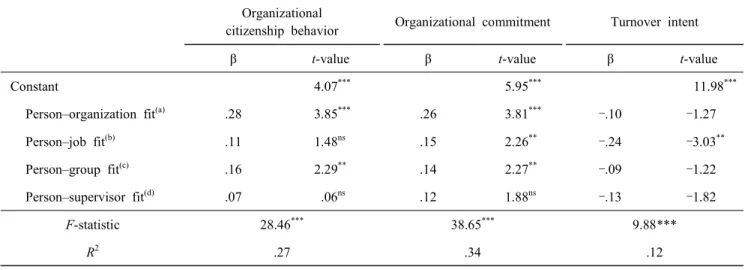
Table 3. The effects of person-environment fit on organizational citizenship behavior, organizational commitment and turnover intent
Organizational
citizenship behavior Organizational commitment Turnover intent
β t-value β t-value β t-value
Constant 4.07*** 5.95*** 11.98***
Person–organization fit(a) .28 3.85*** .26 3.81*** ‒.10 ‒1.27
Person–job fit(b) .11 1.48ns .15 2.26** ‒.24 ‒3.03**
Person–group fit(c) .16 2.29** .14 2.27** ‒.09 ‒1.22
Person–supervisor fit(d) .07 .06ns .12 1.88ns ‒.13 ‒1.82
F-statistic 28.46*** 38.65*** 9.88***
R2 .27 .34 .12
** p<0.05, *** p<0.001, ns not significant.
environment fit increases, so does employees’ organizational citizenship behavior. Hypothesis 1 was supported(β = .35; p<.
001). This result indicated that as employees’ person–envi- ronment fit increased, it became more important in increasing organizational citizenship behavior. In order to understand the relationship between employees’ person–environment fit and organizational citizenship behavior, this study examined the effect of each measurement item for person–organization fit, person–job fit, person–group fit and person–supervisor fit on organizational citizenship behavior, organizational commit- ment and turnover intent using multiple regression analyses.
Table 4 shows the effects of employees’ person–environment fit constructs on organizational citizenship behavior. In more
Fig. 2. Structural equation model with estimates.
detail, person–organization fit (H1a, β = .28) and person–
group fit (H1c, β = .16) significantly affected employees’ or- ganizational citizenship behavior whereas person–job fit (β = .11) and person–supervisor fit (β = .07) did not. Hypothesis 2 proposed that, as employees’ person–environment fit inc- reases, employees’ level of organizational commitment also increases. Hypothesis 2 was suppor- ted (β = .59). In more detail, person–organization fit (H2a, β = .26), person–job fit (H2b, β = .15), and person–group fit (H2c, β = .14)—among employees’ person–environment fit factors–significantly affected employees’ organizational co- mmitment whereas person–supervisor fit (β = .12) did not. In Hypothesis 3, we predicted the influence of employees’ person–environment fit on turnover intent. Contrary to our expecta- tions, the relationship was not significant. Therefore, Hypothesis 3 was not supported (β = .04). But, multiple regression results, person–job fit (H3b, β = —.24) significantly negative affected employees’ turnover intent. Hypotheses 4 was supported (β=
.20). As expected, employees’ organizational commitment signi- ficantly affected organizational citizenship behavior. Hypothe- ses 5 and 6 predicted that, as organizational citizenship beha- vior and organizational commitment increase, turn- over intent decreases. Therefore, Hypotheses 5 (β = .21) and 6 (β = .46) were supported. Considering Hypotheses 3, 4, 5 and 6, despite the non–significant direct linkage between employees’ person –environment fit and turnover intent, em- ployees’ person–
environment fit indirectly influenced turnover intent through
organizational citizenship behavior and organizational commit- ment.
Discussion
This study found that foodservice employees’ person–envi- ronment fit had a significant, positive effect on organizational citizenship behavior. These findings support previous work (Zhuang & Lin 2005, Kristof-Brown et al 2005), Yek & OK 2011), which demonstrated that any inconsistency between individual and organizational environment values improves organizational outcomes such as increased organizational citi- zenship behavior. As employees’ person–environment fit increases, so does their organizational commitment. As previous research has confirmed (Kristof-Brown AL 1996, Cable & De Rue 2002, Choi & Yoo 2005, Greguras & Diefendorff 2009), an employees’ person–environment fit, which creates an em- ployee’s high commitment to organization. Regarding the non –significant relationship between employees’ person–envi- ronment fit and turnover intent, the results should be inter- preted with caution. Although these findings did not corres- pond with those of previous work (Saks & Ashforth 1997, Kristof-Brown et al 2002, Lyons & O’Brien 2006, Tak JK 2011), which identified the direct effect of employees’ person –environment fit on turnover intent, this study found an indi- rect influence via employees’ organizational citizenship behavior and organizational commitment. As such, simply ensuring the recognition of person–environment fit may not be enough to reduce employees’ turnover intent. However, person–environ- ment fit could reduce employees’ turnover intent when they practiced organizational citizenship behavior and commitment.
Consequently, we found that person–environment fit affects turnover intent through the mediator of organizational citizen- ship behavior and organizational commitment. In other words, foodservice employees who believe that their values fit their organization’s environment tend to engage in more organiza- tional citizenship behaviors and organizational commitment, thereby their turnover intent is reduced. It is not that their turnover intent becomes stronger because they do not fit with their organization’s environment but that due to person–envi- ronment fit their positive behaviors increase, their level of commitment to their organization intensifies and therefore their turnover intent decreases. This is partially consistent with Liu et al (2010) insofar as the influence of person–environment fit
on turnover intent is completely mediated by job satisfaction.
As for the link between organizational commitment and orga- nizational citizenship behavior, the influence of organizational commitment on organizational citizenship behavior was signi- ficant. This finding supported previous work (Meyer et al 2002, Cropanzano et al 2003, Cohen A 2006, Bove et al 2009), which suggested that employees’ organizational commitment leads to high citizenship behavior. Also, as for the link between orga- nizational citizenship behavior, organizational commitment and turnover intent, the influence of organizational citizenship beha- vior and organizational commitment on turnover intent was ne- gatively significant. This finding supported earlier work (Aryee
& Chay 2001, Coyne & Ong 2007, Chang et al 2007, Yi et al 2011), which employees’ organizational citizenship behavior and organizational commitment reduce their turnover intent.
This study identified a causal relation of employees’ person –environment fit, organizational citizenship behavior, organi- zational commitment and turnover intent. In particular, thus far most studies to date have focused only on a certain factor among person–environment fit elements. In contrast, this study defined person–organization fit, person–job fit, person–group fit and person–supervisor fit as sub–factors of person–environment fit and explored the influence of each factor on effect variables related with job attitudes. The reason is that organizational members may change their behaviors in accordance with their organization’s culture and values, their job and department, and their fit with their superiors.
To understand the relationship between person–environment fit, organizational citizenship behavior, organizational commit- ment and turnover intent, this study examined the effect of four factors on person–environment fit. Each level of the person–
environment fit factors demonstrated that employees’ organi- zational citizenship behavior has a significant relationship with person–organization fit, and person–group fit, although not with person–job fit, and person–supervisor fit. This means that when values of an individual’s organization and those of his or her group (i.e., department) coincide, the employees’
organizational citizenship behaviors improve, where as his or her fit with job or superiors does not significantly affect his or her organizational citizenship behaviors. In other words, food- service employees are more likely to demonstrate organizational citizenship behaviors when they recognize that the values of their organization or group correspond to their own values than when they do not. Moreover, sub–factors of person–environ-
ment fit that affect employees’ commitment to their organization turned out to be person–organization fit, person–job fit, and person–group fit, person–supervisor fit did not significantly influence their commitment to their organization. Based on the above result, person–organization fit and person–group fit are the most important variables in employees’ organizational citizenship behaviors and commitment to their organization, and therefore managers should match their employees’ values to those of their organization and department. Accordingly, recruitment of employees should be centered on the depart- ment and the organization that hires them and candidates who fit well with the department and the organization should be.
This suggests that in the food and beverage (F & B) business and where employees are assigned affects their extra–role behaviors and commitment. This result is useful for under- standing employees’ attitudes and behaviors in foodservice industries. Furthermore, person–environment fit was found to affect employees’ commitment to their organization more than it did their organizational citizenship behaviors. This means that employees’ commitment to their job or organization is more greatly influenced by person–environment fit than by their organizational citizenship behaviors, a representative form of extra–role behaviors and suggests that improvement of per- son–environment fit on a company level may induce employees’
commitment. Also, employees’ organizational commitment was found to influence their turnover intent more than organization citizenship behaviors did. This means that, due to the charac- teristics of jobs, such as excessive tasks being imposed on employees and their being on duty during holidays, their orga- nizational commitment expressed by their loyalty toward and affection for their company has a more important influence than organizational citizenship behaviors in determining their turnover intent. Therefore, it is determined that, in order to reduce employees’ turnover intent, devising institutional mea- sures is urgent, including welfare policies that can induce loyalty toward or affection for their organization, enhancement of leadership that can encourage team spirit, and establishment of a reward system that actively motivates them.
Despite its implications, several limitations of the study need to be discussed. First, the sample consists of employees at deluxe hotels in the Seoul metropolitan area. Therefore, the generalizability of the results may be limited to the employees in certain categories. Accordingly, subsequent studies might conduct comparative analyses of hotels and other parts of the
foodservice industries. This study emphasized the importance of employees’ person–environment fit in foodservice company.
However, the results did not support the proposed direct effect of employees’ person–environment fit and turnover intent.
Therefore, future research should assess crucial factors that are mediating variables between employees’ person–environment fit and turnover intent. Further, this study measured OCB and OC with unidimensional constructs, not multidimensional con- structs; therefore, future research is necessary to seek measures to evaluate more precisely employees’ OCB and OC using more variables. Questionnaires were administered as translations from the original literature, and not all the items may be app- ropriate for Korean situations. To reduce relevant errors, this study performed translations and used the questionnaires after conducting a pilot test to sort out items that might not be easily understood by the respondents; however, this factor still may act as a limitation.
Appendix A
1. Person-environment fit
PJF1: My abilities perfectly match what my job demands PJF2: I have skill and ability suitable for performing this job PJF3: My skills perfectly match what my job demands PJF4: My personal likes match perfectly what my job demands PJF5: There is a good fit between my job and me
POF1: I really fit this organization
POF2: I feel that my personal values are a good fit with this organization
POF3: My values match those of current employees in this organization
POF4: I have affections and affinity for this organization POF5: This organization has the same values as I do with regard
to concern for others
PGF1: Working with other people in my group is one of the best parts of this job
PGF2: I get along well with the people I work with on a day- to-day basis
PGF3: There is not mush conflict among the members of my group
PGF4: If I had more free time, I would enjoy spending more time with my co-workers socially
PGF5: There are some people I work with I try to avoid when possible®
PSF1: I have characteristics in common with my supervisor PSF2: My supervisor and I are similar in terms of our attitude
and values
PSF3: I do not mind working my hardest for my supervisor PSF4: My supervisor and I see thing in the same way PSF5: I am willing to apply extra efforts, beyond those nor-
mally required to meet my supervisor’s work goals 2. Organizational citizenship behavior
OCB1: I give my time to help employees with work-related problems
OCB2: I share my knowledge and expertise with other em- ployees
OCB3: I am always ready to help or lend a helping hand to other staffs around me
OCB4: I support employees who have problems at work OCB5: I talk to other employees before taking actions that
might affect them
3. Organizational commitment
OC1: I really feel as if this organization’s problems are my own
OC2: This organization has a great deal of personal meaning for me
OC3: I would be very happy to spend the rest of my time with this organization
OC4: I feel like part of the family at this organization OC5: My organization meets my major needs well
4. Turnover intent
TI1: I am currently seriously considering leaving my current job to work at another company
TI2: I sometimes feel compelled to quit my job in my current workplace
TI3: I will probably look for a new job in the next year TI4: Within the next 6 months, I would rate the likelihood of
leaving my present job as high
TI5: I will quit this company if the given condition gets even a little worse than now
References
Ahmad KZ (2010) Person–environment fit: a critical review of the previous studies and a proposal for future research.
Inter J Psych Stu 2: 71-78.
Anderson JC, Gerbing DW (1988) Structural equation modeling in practice: a review and recommended two-step approach.
Psych Bull 103: 411-423.
Aryee S, Chay YW (2001) Workplace justice, citizenship be- havior and turnover intentions in a union context: exami- ning the mediating role of perceived union support and union instrumentality. J App Psych 86: 154-160.
Bentler PM, Bonett DG (1980) Significance tests and good- ness-of-fit in the analysis of covariance structures. Psych Bull 88: 588-606.
Bove LL, Pervan SJ, Beatty SE, Shiu E (2009) Service worker role in encouraging customer organizational citizenship be- haviors. J Bus Res 62: 698-705.
Cable DM, DeRue DS (2002) The convergent and discrimi- nant validity of subjective fit perceptions. J App Psych 87:
875-884.
Cable DM, Edwards JR (2004) Complementary and supple- mentary fit: a theoretical and empirical integration. J App Psych 89: 822-834.
Chang HT, Chi NW, Miao MC (2007) Testing the relation- ship between three-component organizational/occupational commitment and organizational/occupational turnover inten- tion using a non-recursive model. J Voca Beha 70: 352- 368.
Chen CF (2006) Job satisfaction, organizational commitment, and flight attendants’ turnover intentions: a note. J Air Tran Man 12: 274-276.
Choi M, Yoo T (2005) The effects of person–organization fit, person–job and person–supervisor fit on organizational co- mmitment, job satisfaction, and turnover intention: the focus on interaction effects among three types of fit. Korean J Indu Organ Psych 18: 139-162.
Cohen A (2006) The relationship between multiple commit- ments and organizational citizenship behavior in Arab and Jewish culture. J Voca Beha 69: 105-118.
Coyne I, Ong T (2007) Organizational citizenship behaviour and turnover intention: a crosscultural study. The Inter J Hum Res Man 18: 1085-1097.
Cropanzano R, Rupp DE, Byrne ZS (2003) The relationship of emotional exhaustion to work attitudes, job performance and organizational citizenship behaviors. J App Psych 88:
160-169.
Dick RV, Knippenberg DV, Kerschreiter R, Hertel G, Wieseke J (2008). Interactive effects of work group and organiza-
tional identification on job satisfaction and extra-role beha- vior. J Voca Beha 72: 388-399.
Fornell C, Larcker DF (1981) Evaluating structural equation models with unobservable variables and measurement error.
J Mark Res 18: 39-50.
Greguras GJ, Diefendorff JM (2009) Different fits satisfy diffe- rent needs: linking person–environment fit to employee commitment and performance using self–determination theory. J App Psych 94: 465-477.
Guangling W (2011) The study on relationship between em- ployees’ sense of organizational justice and organizational citizenship behavior in private enterprises. Energy Pro 5:
2030-2034.
Hom PW, Griffeth RW (1991) Structural equations modeling a test of turnover theory: cross–sectional and longitudinal analyses. J App Psych 76: 350-366.
Iplik FN, Kilic KC, Yalcin A (2011) The simultaneous effects of person-organization and person-job fit on Turkish hotel managers. Inter J Cont Hosp Man 23: 644-661.
Jing LI, Juan-juan F (2010) The influence of person–super- visor fit on organizational citizenship behavior: a case of service industry. 2010 17th International Conference on Management Science and Engineering. Nov. 24-26, 1812- 1816.
Kilic KC, Iplik FN, Yalcin A (2011) The simultaneous effects of person–organization fit and person–job fit on Turkish hotel managers. Inter J Cont Hosp Man 23: 644-661.
Kristof-Brown AL (1996) Person–organization fit: an integra- tive review of its conceptualizations, measurement and im- plication. Pers Psych 49: 1-49.
Kristof-Brown AL, Zimmerman RD, Johnson EC (2005) Con- sequences of individuals’ fit at work: a meta-analysis of person– job, person–organization, person–group and per- son–supervisor fit. Pers Psych 58: 281-342.
Kristof-Brown AL, Jansen KL, Colbert AE (2002) A policy– capturing study of the simultaneous effects of fit with jobs, groups and organizations. J App Psych 87: 985-993.
Liu B, Liu J, Hu J (2010) Person–organization fit, job satis- faction and turnover intent: an empirical study in the Chi- nese public sector. Soc Beha Pers 38: 615-626.
Lyons HZ, O’Brien KM (2006) The role of person–environ- ment fit in the job satisfaction and tenure intentions of African American employees. J Coun Psych 53: 387-396.
Meyer JP, Allen NJ (1991) A three-component conceptuali-
zation of organizational commitment: Some methodological considerations. Hum Res Man Rev 1: 61-98.
Mowday R, Porter L, Steer R (1979) The measurement of organizational commitment. J Voca Beha 14:224-237.
Mowday R, Porter L, Steers R (1982) The measurement of organizational linkage: The psychology of commitment, absenteeism and turnover. Academic Press, NY. p 55.
Murray-Gibbons R, Gibbons C (2007) Occupational stress in the chef profession. Inter J Cont Hosp Man 19: 32-42.
Oh IS, Guay RP, Kim KH, Harold CM, Lee JH, Heo CG, Shin KH (2013) Fit happens globally: a meta-analytic com- parison of the relationships of person-environment fit di- mensions with work attitudes and performance across East Asia, Europe and North America. Per Psych 1: 1-54.
Organ DW (1997) Organizational citizenship behavior: it’s construct clean–up time. Human Per 10: 85-97.
Ostroff C, Shin, Y, Kinicki AJ (2005) Multiple perspectives of congruence: relationships between values congruence and employee attitudes. J Organ Beha 26: 591-623.
Rindskopf D, Rose T (1988) Some theory and applications of confirmatory second-order factor analysis. Multi Beha Res 23: 51-67.
Saks AM, Ashforth BE (1997) A longitudinal investigation of the relationships between job information sources, applicant perceptions of fit and work outcomes. Per Psych 50: 395- 426.
Silverthorne C (2004) The impact of organizational culture and person–organization fit on organizational commitment and job satisfaction in Taiwan. The Leader and Org Devel J 25: 592-599.
Tak JK (2011) Relationships between various person–envi- ronment fit types and employee withdrawal behaviors: a longitudinal study. J Voca Beha 78: 315-320.
Vogel RM, Feldman DC (2009) Integrating the levels of person –environment fit: the role of vocational fit and group fit.
J Voca Beha 75: 68-81.
Werbel JD, DeMarie SM (2005) Aligning strategic human resource management and person-environment fit. Human Res Man Rev 15: 247-262.
Williams LJ, Anderson SE (1991) Job satisfaction and organi- zational commitment as predictors of organizational citizen- ship and in–role behavior. J Man 17: 601-617.
Yang LQ, Levine EL, Smith MA, Ispas D, Rossi ME (2008) Person–environment fit or person plus environment: a meta
–analysis of studies using polynomial regression analysis.
Human Res Man Rev 18: 311-321.
Zhuang AJ, Lin HY (2005) The influence of person–environ- ment on work attitude and behavior. Taiwan Man J 5:
123-148.
접 수:
최종수정:
채 택:
2013년 10월 31일 2013년 12월 30일 2013년 12월 31일