A Study on experiential consumption and development of the customized cosmetics on female university students in their 20s
-Preliminary Study-
Ha-yeon Lee1, Hyun-young Ju1, Gyu-ri Kim2*
1Undergraduate student, Dept. Department of Beauty and Cosmetic Science, Eulji University,
2Professor, Dept. Department of Beauty and Cosmetic Science, Eulji University
20대 여대생의 맞춤형화장품 체험소비 및 발전방향 연구
이하연1, 주현영1, 김규리2*
1을지대학교 미용화장품과학과 학부생, 2을지대학교 미용화장품과학과 교수
Abstract To find out the a Study on experiential consumption and development of the customized cosmetics on female university students in their 20s, this study conducted sampling using probability sampling from cosmetics major students in S City from September 1 to October 30, 2020. In this study, a study model was designed for a total of 30 people and studied as an Experience-Consume Experimentation. First, the result of the pre-purchase survey revealed that skincare cosmetics had the highest percentage for being selected by 30 people for “the preferred cosmetic type per the perception regarding customized cosmetics.” Second, the result of the pre-purchase survey revealed that 11 people answered skincare cosmetics, 1 person answered shade cosmetics, and 2 people answered fragrance products (perfume, diffusers, etc.) for “the experience type for customized cosmetics.” Third, the result of the post-purchase survey revealed that 29 people are willing to recommend the products, while 1 person is not. For the appropriateness of the price, 23 people answered yes; 7 people answered no. for the characteristics of the experience, 24 people (80%) answered that they selected ingredients according to their skin type; 9 people answered that the price is cheap considering they received 1:1 consultation;
18 people answered that they made a choice per their preferences (skin type) rather than per brands;
3 people answered that their self-esteem is stronger as if they received personal care. Therefore, customized cosmetics are expected to increase the attractiveness and purchase rate of female students in their twenties given that 'Human Touch,' genetic analysis, and 'hyper-customization technology,' which requires new development of customized cosmetics experience consumption for female college students in their 20s.
Key Words : Customized cosmetics, Type of customized cosmetics, Experiential consumption, Women in their twenties
요 약 본 연구는 여대생의 맞춤형화장품 체험소비 및 발전방향을 알아보기 위해 2020년 9월 1일부터 10월 30일까지 S시의 뷰티·화장품 전공자를 대상으로 확률 표본 추출법(Probability Samplin)과 총 30명을 대상으로 연구 모형을 설계하 여 체험소비방법으로 연구하였다. 첫째, 구매 전 설문조사 결과로 ‘맞춤형화장품의 인식에 따라 선호하는 사용 종류’는 기초 화장품 30명으로 가장 높게 나타났다. 둘째, 구매 전 설문조사 결과로 ‘맞춤형 화장품 체험 경험 유형’은 기초화장 품 11명, 색조화장품 1명, 방향용제품(향수디퓨저등) 2명 등으로 나타났다. 셋째, 구매 후 설문조사 결과로 ‘추천 의향 여부’ 는 있다 29명, 없다 1명으로 나타났다. 넷째, 구매 후 설문조사 결과로 ‘체험 특징’은 ‘피부타입에 맞게 성분 선택’을 한 점 24명,
‘1:1 상담대비 가격이 저렴‘한 점 9명, ’화장품 브랜드를 중시하기보다 내 기호(피부)에 맞는 화장품 선택‘을 한 점 18명,
‘퍼스널 케어를 받은 것처럼 자존감이 높아졌다’라로 말한 내용이 3명으로 나타났다. 따라서 맞춤형화장품은 개인 맞춤형 화장품의 장점과 동시에 개인 자존감과 심리적 행복감을 높일 수 있는 ‘휴먼터치’와 ‘피부 유전자 분석’ 등을 융복합으로 발전함과 동시에, 20대 여대생에게 맞는 맞춤형화장품 체험소비 방법 등을 더욱 새롭게 개발되어야 한다고 사료된다.
주제어 : 맞춤형화장품, 맞춤형화장품 유형, 체험소비, 20대 여대생,
*This research was supported by 2020 eulji University Innovation Support Project grant funded’
*Corresponding Author : Gyu-ri Kim([email protected])
Received November 8, 2020 Revised December 11, 2020 Accepted December 20, 2020 Published December 28, 2020
1. Introduction
1.1 The Necessity of Research
In 2020, the global economy stopped due to the pandemic, COVID-19 caused by the coronavirus; the recession has now become a 'problem for all countries.' As the number of confirmed COVID-19 case increases, huge social changes such as social distancing, business site closures, and school closures has occurred [1].
Among them, regarding the beauty and cosmetics industry, the number of cosmetic road shops that led to the glorious period of mid-priced and low-priced Korean cosmetics since the 2000s showed a steady increase to 4,934 until 2016.
However, as the decreasing pace continued to be accelerated from 2017, per the franchise business information system provided by Fair Trade Commission[2], the number of offline stores of The Face Shop, a representative road shop store, decreased from 1,056 in 2017 to 598 in 2019, and Missha's store number also decreased from 695 to 550. Tony Moly's road shop decreased from 679 to 517; Etude House also experienced a decrease from 435 to 393, during the same period. This decline is expected to be accelerated further because of COVID-19 in 2020 [3]. Also, despite COVID-19, the cosmetics export market is growing and expected to be growing due to the rise in national recognition thanks to South Korea's response to COVID-19. However, the domestic cosmetics market has shrunk.
Currently, Korean cosmetics are highly dependent on exports to China. However, cosmetics companies need to discover prospective countries to export outside of the Sinosphere; continuously research and develop customized K-beauty cosmetics following global cosmetics changes [4]. Moreover, developing methods to produce customized cosmetic formulation and researching on how to improve customized production methods that utilize user preferences and profiles, as well as external
factors, are needed. Various technologies and differentiation systems also are created to provide prints of formulations that can be used in the future in retail stores such as cosmetics stores and pharmacies. Also, software for customized formulation should be under a cosmetic manufacturing kit so that they can be used at home or for business purposes [5].
The purpose of the "customized cosmetics system," which South Korea introduced in 2020 for the first time in the world, is to create new jobs, improve convergence technology, and pioneer new markets. This system was introduced as a project to satisfy the various needs of consumers and to promote technological development in the cosmetics industry [6]. The first method, the on-site blending method, subdivides the existing cosmetic production process that produces finished products at the factory and produces or manufactures basic products or functional materials and/or additives individually at the factory. At this time, the consumer can select his or her desired functional material. Additives are added per the consumer's preference and skin condition and selected functional materials and additives are mixed with basic products to meet the consumer's diverse needs and enable each individual to purchase cosmetics that suit him or her. After checking the skin condition, the professional counselor mixes the production [7]. The second is the make-in-factory-and-delivery method. In this method, a professional counselor directly goes to where the consumer wants and decides the ingredients and fragrance after skin consultation.
Then the product is delivered after the manufacturing process in the factory. Third, the 'Do It Yourself' method goes with a set, in which the consumer selects a base (3 types) and a booster cartridge (5 types). Clinique's products are currently on the market. The fourth is a device-type method, in other words, a mobile-based skin evaluation algorithm. After
analyzing 13 skin genes and 13 health genes with a genetic analysis kit, consumers receive the product after consultation. Other products include '3D (three-dimensional) printing customized mask pack', a customized cosmetic product such as a mask pack made for individual consumers. However, it is difficult to supply exclusive 3D mask printers to consumers at retailers due to the printers' high price [8, 9].
Also, unlike overseas cosmetics-related institutions, various types[10] of domestic customized cosmetics are not that great to satisfy the needs of general consumers. Among them, legal and institutional regulations also pose a problem, and customized cosmetics made on-site by consumers or sellers causes various problems, such as several safety issues. Also, awareness of domestic consumers is not great[11, 12, 13].
In this vein, the purpose of this study is to investigate how customized cosmetics affect the purchasing and attractiveness of female students in their 20s [14, 15].
2. Research Methods
2.1 Research Subjects
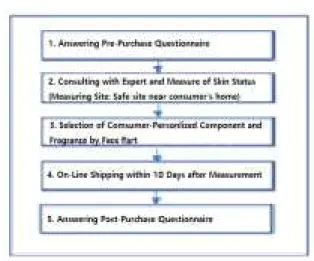
To find out the satisfaction of experiential consumption and development of the customized cosmetics on female university students in their 20s, This questionnaire was prepared by referring to this preceding study[16, 17, 18]. This study conducted sampling using probability sampling from cosmetics major students in S City from September 1 to October 30, 2020. The number of the subject was 30 in total (college student of S University: 29, 96.7%; graduate: 1, 3.3%); the experiment was conducted according to the research design model below.
2.2 Research Tools
This research used a questionnaire regarding
customized cosmetics pre-purchase. The questionnaire consists of the following categories: consideration factors for purchase, expectation factors for purchase, influence factors for purchase, preferred product type, experience types.
2.2.1 Items of Customized Cosmetics Pre-Purchase Questionnaire
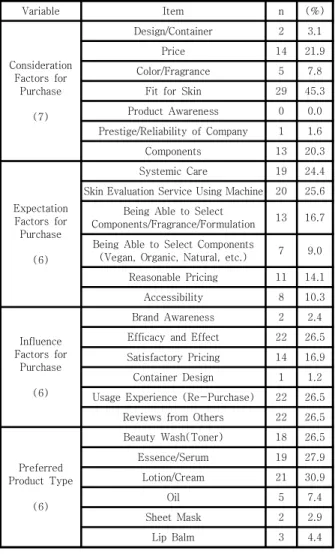
Table 1 presents the analysis results of the survey that allowed multiple responses of customized cosmetics pre-purchase questionnaire results. The frequency analysis results are as follows.
Regarding the factors that affect the purchase of cosmetics, 5 peopled selected brand awareness; 0 people selected efficacy and effect;
10 people selected container design; 12 people selected usage experience (re-purchase); 0 people selected reviews from others. For motives of usage, 2 people answered “I was just curious.”
20 people had purchase intention, while 2 people had not. 8 people were not sure if they want to purchase the product. For the reason of purchase intention, 20 people answered that they can get the product that suits their skin status, after a diagnosis. For the reason for not purchasing, 1 person answered that because she does not know well about customized cosmetics;
Fig. 1. Research Design Model for Customized Cosmetics Study
3 people answered that the reliability is not yet verified; 6 people answered that they are already satisfied with current products; 2 people answered that the customized products are more expensive than general products.
Variable Item n (%)
Consideration Factors for
Purchase (7)
Design/Container 2 3.1
Price 14 21.9
Color/Fragrance 5 7.8
Fit for Skin 29 45.3
Product Awareness 0 0.0
Prestige/Reliability of Company 1 1.6
Components 13 20.3
Expectation Factors for Purchase
(6)
Systemic Care 19 24.4
Skin Evaluation Service Using Machine 20 25.6 Being Able to Select
Components/Fragrance/Formulation 13 16.7 Being Able to Select Components
(Vegan, Organic, Natural, etc.) 7 9.0 Reasonable Pricing 11 14.1
Accessibility 8 10.3
Influence Factors for
Purchase (6)
Brand Awareness 2 2.4
Efficacy and Effect 22 26.5 Satisfactory Pricing 14 16.9
Container Design 1 1.2
Usage Experience (Re-Purchase) 22 26.5 Reviews from Others 22 26.5
Preferred Product Type
(6)
Beauty Wash(Toner) 18 26.5
Essence/Serum 19 27.9
Lotion/Cream 21 30.9
Oil 5 7.4
Sheet Mask 2 2.9
Lip Balm 3 4.4
Table 1. Question Lists for Customized Cosmetics Pre-Purchase Questionnaire
For expectation factors for purchase, 19 answered counselor taking charge of me and systemic care; 20 answered skin evaluation service using a machine; 13 answered being able to select components, fragrance, and formulation; 7 answered options like vegan, organic, and natural; 11 answered reasonable pricing (the price difference to general cosmetics is below 30%); 8 answered accessibility (whether the product can be bought on-site or in the
web-site, and the number of shops where the participants can purchase the product). For influence factors for purchase, 2 answered brand awareness; 22 answered efficacy and effect; 14 answered satisfactory pricing; 1 answered container design; 22 answered usage experience (re-purchase); 22 answered reviews from others.
For the purchasing site factors, 29 answered convenience; 2 answered that where they can get an explanation from a counselor; 9 answered adequate pricing; 6 answered good service (samples or coupons); 2 answered others.
2.2.2 The Relationship Between Skin Trouble Experience and Purchasing Intention
This research used questionnaire as its survey tool.
Item Purchasing Intention
Total
Yes No Don’t Know
Experien ce of
Skin Trouble
Yes 12(70.6) 1(5.9) 4
(23.5) 17 (100) Sometimes I go
through skin troubles (Stemmed from
stress and hormones)
8(61.5) 1(7.7) 4
(30.8) 13 (100)
Table 2. Relationship Frequency of Experience of Skin Trouble and Purchasing Intention(%)
For the experience of skin trouble, 17 answered yes; 13 answered that sometimes they go through skin troubles (stemmed from stress and hormones).
Value df Asymp. Sig.
(2-sided)
Exact Sig.
(2-sided)
Exact Sig.
(1-sided) Point Probabili
ty Pearson
Chi-Sqaure .271a 2 .873 .843 Likelihood
Ratio .270 2 .873 .843
Fisher’s Exact
Test .597 .843
Linear-by-Line
ar Association.244b 1 .621 .686 .387 .147 N of Valid
Cases 30
A. 4 cells (66.7%) have expected count less than 5. The minimum expected count is 3.33.
B. The standardized statistic is .494.
Table 3. Chi-Square Tests
2.2.3 Customized Cosmetics Pre-Purchase Questionnaire Items
Table 4 presents the analysis results of the survey that allowed multiple responses of customized cosmetics post-purchase questionnaire results. The frequency analysis results are as follows. For improvement needed areas, 1 answered hygiene; 11 answered downward adjustment of price; 0 answered upward adjustment of price as well as service quality; 6 answered expertise of guider; 17 answered possibility of change in results per measurement environment; 13 answered diversification of product types. For influence factors for purchasing, 30 answered whether the components fit to their skin is important; 9 answered whether the fragrance is palatable for them is important; 8 answered that they prefer best value products than high-end products; 0 answered that product design is more important than component customization suitable for skin;
1 answered that brand of product is more important than component customization suitable for skin. For the reason of unsatisfaction, 7 answered high price; 0 answered unkind service from the employee; 9 answered short shelf-life; 2 answered that there was no big difference from general products; 13 answered they are not unsatisfied; 0 answered others. For experience features, 24 answered that selecting ingredients according to their skin type; 9 answered cheap price considering 1:1 consultation offered; 18 answered choosing per their preferences (skin type) than per brand; 3 answered they had stronger self-esteem as if they received personal care; 0 answered there was no big difference from general products and others. For a person to recommend, 14 answered their parents;
21 answered their friends; 1 answered others.
For improvement needed areas, 1 answered hygiene; 11 answered downward adjustment of price; 0 answered upward adjustment of price; 0 answered service quality; 6 answered expertise of
guider; 17 answered possibility of change in results per measurement environment; 13 answered diversification of product types. For influence factors for purchasing, 30 answered that whether the components fit to their skin is important; 9 answered that whether the fragrance is palatable for them is important; 8 answered that they prefer best value products than high-end products; 0 answered that product design is more important than component customization suitable for skin; 1 answered that brand of product is more important than component customization suitable for skin. For the reason of unsatisfaction, 7 answered high price; 0 answered unkind service from the employee; 9 answered short shelf-life; 13 answered they are not unsatisfied. For experience features, 24 answered that selecting ingredients according to their skin type; 9 answered that cheap price considering 1:1 consultation is offered; 18 answered choosing per their preferences (skin type) rather than per brand; 3 answered stronger self-esteem as if they received personal care; 0 answered no big difference from general products. For a person to recommend, 14 answered their parents; 21 answered their friends; 1 answered others.
Variable Item Freq. Rate
(%) Recommendation
Intention
Yes 29 96.7
No 1 3.3
Adequacy of Pricing
Yes 23 76.7
No 7 23.3
Appropriate Price Range
< 10,000 won 0 0.0
10,000 to 20,000 won 9 90.0
20,000 to 30,000 won 1 10.0
over 40,000 won 0 0.0
Table 4. Frequency Analysis Results for General Questions
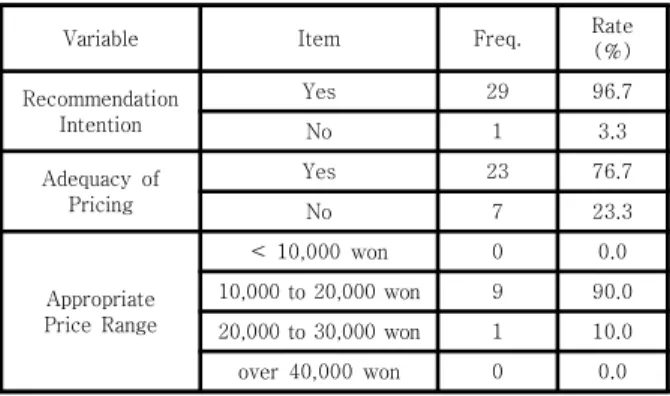
For recommendation intention, 29 answered yes; 1 answered no. For adequacy of pricing, 23 answered yes; 7 answered no. For appropriate price range, 0 answered less than 10,000 won; 9
answered 10,000 to 20,000 won; 1 answered 20,000 to 30,000 won; 0 answered more than 40,000 won.
2.3 Data Analysis
The techniques used in the analysis of this study data are as follows. First, frequency analysis was used to grasp the general characteristics of participants. Second, frequency analysis and descriptive statistical analysis were used to find out the cosmetics purchasing behavior and the development direction of customized cosmetics.
Third, a cross-tabulation analysis was used to understand the relationship between skin trouble experience and purchasing intention. Fourth, an independent t-test was used to find out the difference in satisfaction, depending on whether the price was appropriate or not. Fifth, Pearson's Correlation Analysis was conducted to understand the relationship between expectations such as the attractiveness of customized cosmetics. The statistical analyses in this study were conducted through the SPSSWIN 21.0 program, and the significance level was set to p<.05.
3. Research Results
3.1 Awareness Survey using Customized Cosmetics Post-Purchase Questionnaire for Female College Students in Their 20s.
3.1.1 Customized Cosmetics Pre-Purchase Questionnaire Items
First, for consideration factors for purchase, 2 (3.1%) answered design/container; 14 (21.9%) answered price; 5 (7.8%) answered color/fragrance;
29 (45.3%) answered fit for skin; 1 (1.6%) answered prestige/reliability of company; 13 (20.3%) answered components. For expectation factors for purchase, 19 (24.4%) answered counselor taking charge of me and systemic care; 20 (25.6%) answered skin evaluation service using a machine; 13 (16.7%) answered being able to
select components, fragrance, and formulation; 7 (9%) answered options like vegan, organic, and natural; 11 (14.1%) answered reasonable pricing (the price difference to general cosmetics is below 30%); 8 (10.3%) answered accessibility (whether the product can be bought on-site or in the web-site, and the number of shops where the participants can purchase the product). This shows that expert counseling and systematic care, as well as skin diagnosis services using devices, have the largest share among the differentiating factors between customized cosmetics and general cosmetics. The abovementioned factors are considered to be important factors to increase the purchase rate compared to general cosmetics.
For influence factors for purchase, 2 (2.4%) answered brand awareness; 22 (26.5%) answered efficacy and effect; 14 (16.9%) answered satisfactory pricing; 1 (1.2%) answered container design; 22 (26.5%) answered usage experience (re-purchase); 22 (26.5%) answered reviews from others. This is considered to be that because customized cosmetics brands are less popular, consumers purchase customized cosmetics in consideration of different user reviews rather than brand awareness.
For expectation factors for purchase, skincare cosmetics had the highest percentage for being selected by 30 people (57.7%) for “the preferred cosmetic type per the perception regarding customized cosmetics.” 10 (19.2%) answered shade cosmetics; 4 (7.7%) answered UV protection cosmetics; 8 (15.4%) answered functional products such as whitening and wrinkle improvement cosmetics. Regarding purchasing customized cosmetics, it was expected that female college students in their 20s would have a high preference for shade cosmetics, but female college students also preferred skincare cosmetics as well as general cosmetics. More efforts should be put into research in the future to develop customized
shade cosmetics for the 20s.
11 people (68.8%) answered skincare cosmetics, 1 person (6.3%) answered shade cosmetics, 2 people (12.5%) answered fragrance products (perfume, diffusers, etc.), 1 person (6.3%) answered 3D sheet mask, and 1 person answered skin gene products for “the experience type for customized cosmetics.” This is the result of poor recognition and dissemination of customized cosmetics. Differentiation strategies for the popularization of customized cosmetics should be developed.
Fifth, as a result of analyzing the relationship between skin trouble experience and purchase intention by cross-tabulation analysis on the awareness level before purchasing customized cosmetics, the null hypothesis that there is no relationship cannot be rejected under the significance level of 0.05 (χ2=0.597, p>0.05). In other words, there was no relationship between skin trouble experience and purchase intention.
The analysis result of the difference in purchasing decision between general cosmetics and customized cosmetics revealed through the perception level survey before purchasing customized cosmetics is as follows. It is believed that rather than the brand recognition that is important in general cosmetics, it is necessary to develop a strategy of “securing unique data of hyper-customization” that allows users to select ingredients and fragrances that suit customers through a “customization” strategy.
3.1.2 Customized Cosmetics Post-Purchase Questionnaire Items
According to the Table 5, for recommendation intention, 29 (96.7%) answered yes; 1 (3.3%) answered no. For adequacy of pricing, 23 (76.7%) answered yes; 7 (23.3%) answered no. For the appropriate price range, 9 answered 10,000 to 20,000 won, which got the highest votes; 1 answered 20,000 to 30,000 won. This is because satisfaction was high after purchasing
customized cosmetics, but the reason why the price is considered high in terms of price-appropriateness is that the respondents do not participate in social and economic activities.
For improvement needed areas, 17 (60.7%) answered the possibility of change in results per measurement environment; 13 (46.4%) answered diversification of product types; 6 (21.4%) answered expertise of guider. To develop and research customized cosmetics in the future, to improve the diversity and popularity of customized cosmetics products, the development of customized cosmetics experts should be continuously improved and the government should actively support them.
For influence factors for purchasing, 30 (100%) answered whether the components fit to their skin is important; 9 (30%) answered whether the fragrance is palatable for them is important; 8 (26.7%) answered that they prefer best value products than high-end products. For influence factors for purchasing, selecting fitting components for consumers’ skin type is important. It is necessary to develop ingredients that can be differentiated and safer than existing and limited types of ingredients.
For the reason of unsatisfaction, 7 (25.9%) answered high price; 9 (33.3%) answered short shelf-life; 2 (7.4%) answered that there was no big difference from general products; 13 (48.1%) answered they are not unsatisfied. Since ingredients that are good for the skin are included, the content of cosmetics is small considering the price and the shelf life is short, which are considered to be the cause of low satisfaction post-purchase in the value evaluation that girls in their 20s consider the most important.
For experience features, 24 (80%) answered that selecting ingredients according to their skin type; 9 (30%) answered cheap price considering 1:1 consultation offered; 18 (60%) answered making a choice per their preferences (skin type)
Variable Item Frequency Rate(%)
Improvement Needed
Areas
Hygiene 1 3.6
Downward adjustment of price 11 39.3
Upward adjustment of price 0 0.0
Service Quality 0 0.0
Expertise of Guider 6 21.4
Possibility of Change in Results Per Measurement Environment 17 60.7
Diversification of Product Types 13 46.4
Influence Factors for Purchasing
Whether the components fit to my skin is important 30 100.0 Whether the fragrance is palatable for me is important 9 30.0
I prefer best value products than high-end products 8 26.7 Product design is more important than component customization suitable for skin 0 0.0 Brand of product is more important than component customization suitable for skin 1 3.3
Reason of Unsatisfaction
High price 7 25.9
Unkind service from employee 0 0.0
Short shelf life 9 33.3
No big difference from general products 2 7.4
Not unsatisfied 13 48.1
Preferred Cosmetic Type
Skincare products 30 100.0
Shade cosmetics products 3 10.0
Body care products 5 16.7
Fragrance products 13 43.3
Soap products 8 26.7
Experience Features
Selecteing ingredients according to my skin type 24 80.0 Chip price considering 1:1 consultation is offered 9 30.0 Making a choice per my preferences (skin type) rather than per brand 18 60.0 Stronger self-esteem as if I received personal care 3 10.0
No big difference from general products 0 0.0
Person to Recommend
Parents 14 46.7
Friends 21 70.0
Table 5. Customized Cosmetics post-Purchase Questionnaire Items
Price Adequacy N Mean Std. Deviation Std. Error Mean
Post-Experience Satisfaction Yes 23 4.4348 .58977 .12298
No 7 4.4286 .53452 .20203
Repurchase Intention Yes 23 3.8261 .57621 .12015
No 7 3.7143 .48795 .18443
Adequate Pricing Yes 3 2.0000 .00000 .00000
No 7 2.1429 .37796 .14286
Continuous Use Yes 23 3.8261 .71682 .14947
No 7 4.0000 1.00000 .37796
Purchasing Intention Regardless of Pricing Yes 23 2.5217 1.03877 .21660
No 7 2.4286 .78680 .29738
Sharing Degree Yes 23 4.1304 .54808 .11428
No 7 4.4286 .78680 .29738
SNS Sharing Intention Yes 23 3.6087 1.03305 .21541
No 7 3.5714 .53452 .20203
Gifting Intention Yes 23 4.0000 1.12815 .23524
No 7 4.5714 .78680 .29738
Table 6. Group Statistics
than per brand; 3 (10%) answered they had stronger self-esteem as if they received personal care; 0 (0%) answered there was no big difference from general products and others. For a person to recommend, 14 (46.7%) answered their parents; 21 (70%) answered their friends.
Customized cosmetics have the advantages of personalized cosmetics, and at the same time, consumers can choose the fragrance. Therefore, it is considered that intangible services that can increase self-esteem through personal happiness care and personalized skin care should be
developed and researched.
4. Discussion and Suggestions
This study provided several implications to investigate the effect on purchasing satisfaction and development direction regarding female college students' customized cosmetics.
First, for the pre-purchase survey result, skincare cosmetics had the highest percentage for being selected by 30 people (57.7%) for “the
Levene’s Test for
Equality of Variances t-test for Equality of Means
F Sig. t df Sig.
(2-tailed) Mean Difference
Std. Error Difference
95% Confidence Interval of the
Difference
Lower Upper
Post-Experienc e Satisfaction
Equal variances
assumed .403 .531 .025 28 .980 .00621 .24966 -.50520 .51763
Equal variances not
assumed .026 10.863 .980 .00621 .23651 -.51516 .52758
Repurchase Intention
Equal variances
assumed .024 .879 .464 28 .646 .11180 .24107 -.38201 .60562
Equal variances not
assumed .508 11.604 .621 .11180 .22011 -.36960 .59321
Adequate Pricing
Equal variances
assumed 2.304 .168 -.632 8 .545 -.14286 .22588 -.66373 .37802
Equal variances not
assumed -1.000 6.000 .356 -.14286 .14286 -.49242 .20670
Continuous Use
Equal variances
assumed 2.886 .100 -.512 28 .612 -.17391 .33935 -.86904 .52121
Equal variances not
assumed -.428 7.970 .680 -.17391 .40645 -1.11179 .76396
Purchasing Intention Regardless of
Pricing
Equal variances
assumed .389 .538 .218 28 .829 .09317 .42743 -.78239 .96872
Equal variances not
assumed .253 13.053 .804 .09317 .36790 -.70131 .88764
Sharing Degree
Equal variances
assumed 2.806 .105 -1.137 28 .265 -.29814 .26210 -.83503 .23876
Equal variances not
assumed -.936 7.856 .377 -.29814 .31858 -1.03514 .43886
SNS Sharing Intention
Equal variances
assumed 1.740 .198 .091 28 .928 .03727 .40945 -.80146 .87599
Equal variances not
assumed .126 20.256 .901 .03727 .29532 -.57827 .65280
Gifting Intention
Equal variances
assumed .058 .811 -1.244 28 .224 -.57143 .45941 -1.51248 .36962
Equal variances not
assumed -1.507 14.328 .154 -.57143 .37917 -1.38293 .24007
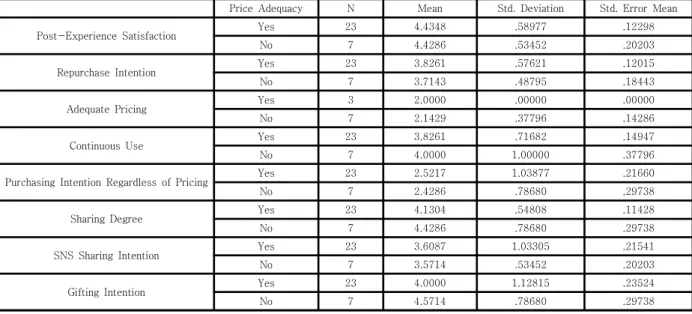
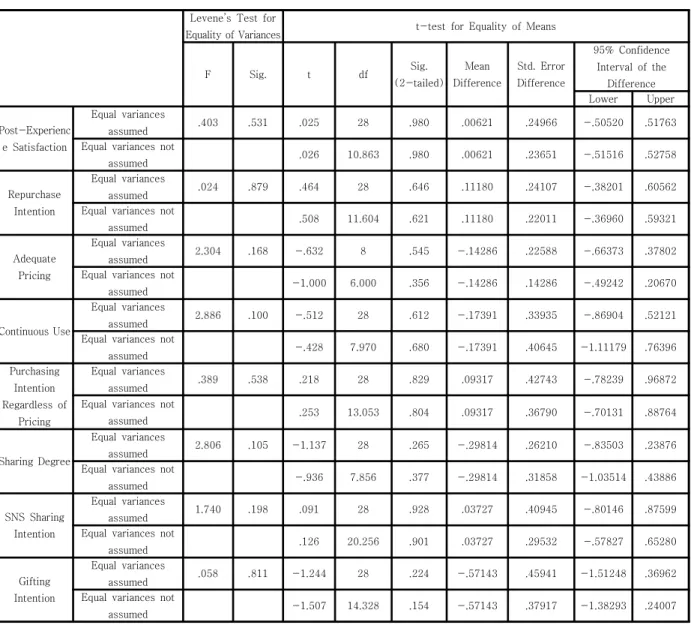
Post-Experience Satisfaction, Repurchase Intention, Adequate Pricing, Continuous Use, Purchasing Intention Regardless of Pricing, Sharing Degree, SNS Sharing Intention, and Gifting Intention were not significant at the 0.5 level as a result of t-test to see if they differ according to price adequacy(Table 7).
Table 7. Independent Samples Test
preferred cosmetic type per the perception regarding customized cosmetics.” Regarding purchasing customized cosmetics, it was expected that female college students in their 20s would have a high preference for shade cosmetics, but female college students also preferred skincare cosmetics as well as general cosmetics. More efforts should be put into research in the future to develop customized shade cosmetics for the 20s.
Second, for the pre-purchase survey result, 11 people (68.8%) answered skincare cosmetics, 1 person (6.3%) answered shade cosmetics, 2 people (12.5%) answered fragrance products (perfume, diffusers, etc.), 1 person (6.3%) answered 3D sheet mask, and 1 person answered skin gene products for “the experience type for customized cosmetics.” This is the result of poor recognition and dissemination of customized cosmetics. Differentiation strategies for the popularization of customized cosmetics should be developed.
Third, for post-purchase survey results, regarding recommendation intention, 29 (96.7%) answered yes; 1 (3.3%) answered no. For adequacy of pricing, 23 (76.7%) answered yes; 7 (23.3%) answered no. For the appropriate price range, 9 (90%) answered 10,000 to 20,000 won, which got the highest votes; 1 (10%) answered 20,000 to 30,000 won. This is because satisfaction was high after purchasing customized cosmetics, but the price is considered high in terms of price-appropriateness. That is why the most popular answer for the appropriate price range was 10,000 to 20,000 won (9, 9%).
Fourth, for post-purchase survey result, regarding experience features, 24 (80%) answered that selecting ingredients according to their skin type; 9 (30%) answered cheap price considering 1:1 consultation offered; 18 (60%) answered making a choice per their preferences (skin type) than per brand; 3 (10%) answered they had stronger self-esteem as if they received personal
care. I would like to suggest the following.
First, since the subject of this study was local university students, this study has invalidity: it is difficult to generalize the results to nationwide college students.
Second, regarding customized cosmetics, the relationship between various factors was considered; with the convergence of scientific technology and psychological factors in the future, this study would be able to provide an academic base for other studies.
Third, female college students in their 20s had high satisfaction after purchasing customized cosmetics; they thought the price was high and the cost-effectiveness was low. To attract the attention of consumers in their 20s, who are the major consumers of cosmetics, overseas customized cosmetics case studies should be conducted and government support is needed.
5. Conclusion
To find out the satisfaction of female college students' purchase of customized cosmetics and the direction of development, this study conducted sampling using probability sampling from cosmetics major students in S City from September 1 to October 30, 2020. The number of the subject was 30 in total (college student of S University: 29, 96.7%; graduate: 1, 3.3%); the experiment was conducted according to the research design model below. To solve the research problem, SPSSWIN 21.0 program was used for the statistical processing of this study.
As the trend of the global cosmetics market is changing, it is necessary to find a way to reduce the gap between the current concept and the expectation of customized cosmetics that female college students in their 20s feel, and we need to research and develop various convergence technologies together. In addition, compared to the existing material consumption, the research
result that Korean consumers think the most important factor of purchasing choice is the
"price is not appropriate" in terms of cost-effectiveness, which requires new development of customized cosmetics experience consumption for female college students in their 20s.
Therefore, customized cosmetics have the characteristics of 'subdividing' and 'mixing cosmetics' per individual preferences Also, consumers can choose the fragrance by themselves and can get psychological happiness through 1:1 expert management and cosmetics for themselves. Customized cosmetics are expected to increase the attractiveness and purchase rate of female students in their twenties given that 'Human Touch,' 'skin and genetic analysis,' and 'hyper-customization technology,' are developed in convergence[19, 20].
REFERENCES
[1] Park Seong-wook. "Corona 19 Economic Impact and Policy Response Direction." Weekly Financial Brief 29.6 (2020): 3-10.
[2] Yoo Ik Soo, Choi Mun Soo. (2017). A Study on the Characteristics of Franchise Headquarters and Business Performance: Through Mediating Effects of Franchisee Financial Data. Korean Business Education Review, 32(6), 531-560.
[3] Ministry of Food and Drug Safety. www.mfds.go.kr.
「2018 Cosmetics Major Policy Announcement」
[4] Wangru, exported to China. (2017). A study on the effect of emotional consumption on purchasing in collaboration cosmetics. Formative Media Studies, 20(3), 105-111.
[5] WILMOTT, James; AUST, Duncan; CRAWFORD, Timothy. Methods and systems for producing custom cosmetic and pharmaceutical formulations. US Patent Application No. 10/916,199, 2005.
[6] Lee Mi-sun, & Song Tae-im. (2020). A study on the preference of cosmetics according to the perception of customized cosmetics. Journal of the Korean Society of Design Culture, 26(1), 333-349.
[7] LEE, Sung Reol. Custom Cosmetic Manufacturing Method. US patent application number 13/703,141, 2013.
[8] Young-shin Lee, Lee Minhee, Jihoon Lee, & Hyunwoo
Nam. (2020). Personalized cosmetics and beauty device consumer perception/preference survey model study. Korea Design Research, 5, 70-80.
[9] Park Seon-min. (2013). A comparative study applying a pan-theoretic model on the cosmetic purchasing behavior of female college students. Journal of Korean Society for Skin Beauty, 11(2), 351-359 [10] KIM, Hye Won, et al. Risk Factors Affecting
Contamination of Instant Personalized Cosmetics:
Evidence from National Pilot Project for National Health. Scientific Report, 2020, 10.1: 1-9.
[11] Van Boven, L. (2005), "Experientialism, Materialism, and the Pursuit ofHappiness", Reviewof General Psychology, 9(2), 132.
[12] Kumar, A., T. C. Mann, and T. D. Gilovich (2014),
“Questioning the “I” inExperience: Experiential Purchases Foster Social Connection", NA-Advances in Consumer Research, Volume 42.
[13] Gyeong-pa Yoo & Hyunjung Park. "The effect of nostalgia on preference for experiential consumption versus material consumption." Cultural Industry Research 17.3 (2017): 45-53.
[14] Gong Sun-mi, & Kim Min-shin. (2018). The actual conditions and preferences of women's cosmetics by age Journal of the Korean Society of Aesthetics, 14(3), 331-342.
[15] Lee, E. J., Song, J. O., Kim, I., & Yoo, J. S. (2018).
Big-data Analysis based Mobile Services using Individual Skin-type and Genes for Cosmetic Recommendation. In Proceedings of the Korea Contents Association Conference (pp. 495-496). The Korea Contents Association.
[16] Yoon Gyeong-seop, Kim Mi-jin, & Kim Moo-han.
(2018). Explore Jeju plants for the development of customized cosmetic materials. Korean Journal of Applied Science and Technology (formerly Journal of Oil and Applied Science), 35, 1487-1495.
[17] Sungshim Kwon, & Hyunjin Jeon. (2020). Purchasing behavior of customized cosmetics according to age.
Journal of the Korean Society of Beauty Art, 21, 229-240.
[18] Hyejin Cho, & Kyungeun Kim. A study on the perception and purchasing behavior of baby boomers on customized cosmetics. Korean Journal of Aesthetics 26.3 (2020): 646-653.
[19] Kim Nan-do (2020). Trend korea 2010. Seoul: A window to the future. p21, p71.
[20] Lee Young-shin, Lee Min-hee, Lee Ji-hoon, & Nam Hyun-woo. (2020). Personalized cosmetics and beauty device consumer perception/preference survey model study. Korea Design Research, 5, 70-80.
이 하 연(Ha-yeon Lee) [학생회원]
· 2018년 3월 ~ 현재 : 을지대학교 미 용화장품과학과 학부생
· 2020년 3월 ~ 현재 : 맞춤형 화장품, APP 개발(연구원)
· 관심분야 : 화장품 마케팅, 맞춤형화장 품
· E-Mail : [email protected]
주 현 영(Hyun-young Ju) [학생회원]
· 2018년 3월 ~ 현재 : 을지대학교 미용화장품과학과 학부생
· 2020년 3월 ~ 현재 : 맞춤형 화장품, APP 개발(연구원)
· 관심분야 : 화장품마케팅, 맞춤형화장 품
· E-Mail : [email protected]
김 규 리(Gyu-Ri Kim) [정회원]
· 2009년 3월 : 건국대학교 산업대학원 향장학과(이학석사)
· 2014년 2월 : 건국대학교 생물공학과 (이학박사)
· 2018년 3월 ~ 현재 : 을지대학교 미 용화장품과학과 교수
· 관심분야 : 향장생물, 글로벌마케팅, APP개발
· E-Mail : [email protected]