818
Copyright © 2014 The Korean Society of Fisheries and Aquatic Science pISSN:0374-8111, eISSN:2287-8815
서 론
양어용배합사료는부상사료
,
반부상사료,
침강사료등가공 물성및형태에따라다양한사료가존재하며,
탄력성과점착성 등가공물성및형태유지를위해소맥분을대부분사용하고있 다.
하지만대부분의해산어들은탄수화물원료의주성분인당 을잘이용하지못하기때문에소맥분을적정함량이상사용할 경우양식어류의성장을저하시킬수있다(NRC, 2011).
양어사료에사용되는탄수화물원료는주로소맥분이며
,
뱀장어사 료는반죽사료형태로공급되기때문에탄력성및점착성과같은물성을위해소맥분을사용하지않고전분
(starch)
을사용하고있다
.
전분의종류에는감자,
고구마와같은서류전분이있 으며,
이보다입자크기가작은쌀,
옥수수등의곡류전분이있 다.
이외에도밀,
완두,
칡,
타피오카등의다양한전분이존재한 다.
생전분을β
전분이라하며, β
전분이α
전분으로변하는것을α
화(
호화)
라하고,
전분의α
화는효소들의작용이쉬워사료의타피오카 전분을 이용한 넙치(Paralichthys olivaceus)용 고효율 배합사료 개발
김강웅·이진혁·배기민·김경덕·이봉주·한현섭·이경준
1·김성삼*
국립수산과학원 사료연구센터, 1제주대학교 해양생명과학과
Development of High Efficiency Extruded Pellets with Tapioca Starch in Olive Flounder Paralichthys olivaceus
Kang-Woong Kim, Jin-Hyuck Lee, Ki-Min Bae, Kyoung-Duck Kim, Bong-Joo Lee, Hyon-Sob Han, Kyeong-Jun Lee
1
and Sung-Sam Kim*Aquafeed Research Center, National Fisheries Research and Development Institute, Pohang 791-923, Korea
1
Department of Marine Life Science, Jeju National University, Jeju 690-756, Korea
This study compared the effects of feeding diets consisting of an experimental extruded pellet with tapioca starch (EEP), commercial extruded pellet (CEP), and raw-fish-based pellet (MP) on the growth, flesh quality, and apparent digestibility coefficient of the olive flounder Paralichthys olivaceus . Two replicated groups of 4,000 fish each (initial mean weight: 81.8±3.5 g) were fed one of the experimental diets for 5 months. After the feeding trial, the final mean weight, weight gain, specific growth rate, and feed efficiency of fish fed the EEP was significantly higher than those of fish fed the CEP and MP. Moisture content in the whole-body of fish fed MP was significantly higher than those of fish fed other diets. However, the highest crude protein in the whole-body was found in fish groups fed the EEP. Sig- nificantly higher contents of 24:1n-9, 20:5n-3, 22:6n-3 and lower 18:1n-7 was observed in fish fed the EEP compared with fish fed the MP. The amino acid contents in the whole-body showed significant differences in the composition depending on the feed, but the distribution of free amino acids showed similar patterns. Among amino acids, glutamic acid showed the highest content in all the experimental groups, and the threonine, cysteine, and lysine contents were significantly higher in the groups fed with EEP and CEP than in the group fed with MP. Digestibility of nutrients of the EEP was significantly higher than that of fish fed the CEP. This suggests that extruded pellets can be used to feed olive flounder without compromising growth and flesh quality in comparison to raw-fish-based moist pellets. Formu- lation of the EEP could be used as a practical feed for olive flounder.
Key words: Extruded pellet, Moist pellet, Olive flounder, Growth, Flesh quality, Digestibility
This is an Open Access article distributed under the terms of the Creative Commons Attribution Non-Commercial Licens (http://creativecommons.org/licenses/by-nc/3.0/)which permits unrestricted non-commercial use, distribution, and reproduction in any medium, provided the original work is properly cited.
http://dx.doi.org/10.5657/KFAS.2014.0818 Kor J Fish Aquat Sci 47(6) 818-823, December 2014
Received 10 November2014; Revised 11 December 2014; Accepted 29 December 2014
*Corresponding author: Tel: +82. 54. 230. 3631 Fax: +82. 54. 232. 3697
E-mail address: [email protected]
소화율을높일수있다
.
전분의호화에영향을미치는인자들로 는수분,
온도, pH
및염류등이있다.
양어사료는제조과정에서 압출가공(extruding)
및스팀(steaming)
을통해생산되기때문 에β
전분을α
전분으로소화되기쉽게변화시켜전분의호화에 영향을미친다.
또한식품산업에서밀가루를다른원료로대체 하면서제품의탄력성과점착성을높이기위해전분을사용하 고있다(Lee et al., 2013).
따라서전분은소맥분보다적은양을 사용하여도배합사료의탄력성과점착성을향상시켜가공물성 을향상시킬수있을것으로판단된다(Yoon, 2011).
타피오카전분은카사바
(Manihot esculenta Crantz)
의뿌리로 부터추출한것으로,
동남아시아,
아프리카,
브라질등열대지 방에서주식에가까운주요한자원이다.
타피오카전분은대부 분이전분으로amylose
와amylopectin
으로구성되어 있으며(Chee, 1986),
다른전분에비해탄수화물함량이높고단백질함 량이낮다.
또한강수량이적거나척박한토양에서도생산성이 높아수요가증가하는추세이다(Kim et al., 2007; Mishra and
Rai 2006).
타피오카전분은점성이높고무색투명하고쫄깃한식감을가지며
,
소화및흡수가잘되는전분으로식품산업에널 리쓰이고있다(Song and Park 2000; Ahn, 2005).
본연구는넙치용배합사료개발을위해이전상업용배합사 료
(commercial extruded pellet, CEP)
의사료조성을바탕으로 소맥분대신타피오카전분을사용하여총탄수화물원료의함 량을줄이고어분의함량을최대화하면서단백질과지질함량 을 증가시키고 가공물성을 유지하도록 설계 및 제조하였다.
이렇게 생산된 넙치용 실험배합사료(Experimental extruded pellet, EEP)
를상업용배합사료(CEP)
및습사료(moist pellet, MP)
와비교하여성장,
사료효율,
체조성및소화율에미치는영 향을조사하고자수행되었다.
재료 및 방법
실험사료
본 실험에 사용된실험용배합사료
(Experimental extruded pellet, EEP),
상업용 배합사료(commercial extruded pellet, CEP)
및습사료(moist pellet, MP)
의실험사료조성은Table 1
에제시된바와같다.
단백질원으로는어분,
탈피대두박,
대두 농축단백질,
밀글루텐,
콘글루텐밀,
크릴분및오징어분을사용 하였고,
지질원으로는어유,
탄수화물원으로는소맥분및타피 오카전분을사용하였다.
이외에사료첨가제로서비타민및미 네랄혼합제,
비타민C,
일인산칼슘,
유화제,
타우린및베타글 루칸등을사용하였다.
실험용배합사료(EEP)
는원료를혼합한 후익스트루더(Bühler, Swiss)
를이용하여압출·
성형하였으며,
사료크기는직경3-15 mm
로사료회사에서제조하였다.
대조 사료로사용된상업용배합사료는수협사료를사용했으며,
습 사료(MP)
는냉동된메가리,
곤쟁이및잡어등을혼합또는단 독으로잡어와분말사료를9:1
의비율로혼합하여제조하였다.
실험어 및 사육관리
사양실험에사용된실험어류는전남완도에위치한육상수조 양식장에서구입하여경북포항에위치한청양수산으로운송되 었으며
,
실험환경에적응할수있도록콘크리트수조에순치시 킨후사료공급실험에사용되었다.
예비사육후실험어류(
초기 평균무게: 81.8±3.5 g)
는총6
개의12×12 m
콘크리트수조에 Table 1. Formulation and proximate compositions of the experi- mental diets1Ingredients Diets
EEP2 CEP3 MP4 Fish meal (Anchovy meal, Peru)5 74.0 67.0
Dehulled soybean meal5 2.0 2.0
Soy protein concentrates5 1.0 1.0
Wheat gluten meal5 1.0 1.0
Corn gluten meal5 1.0 1.0
Krill meal5 1.0 1.0
Squid meal5 1.0 1.0
Tapioca starch6 11.0 -
Wheat flour5 - 19.0
Fish oil 5.0 4.0
Vitamin and mineral premix.7 0.3 0.3
Vitamin C (Stay-C) 0.1 0.1
Lechithin 1.0 1.0
MCP (monocalcium phosphate) 0.5 0.5
Choline chloride 0.2 0.2
Taurine 0.3 0.3
Methionine 0.3 0.3
β-glucan 0.3 0.3
Raw-fish 90
Powder feed 10
Proximate composition(%, DM)
Moisture 6.2 7.8 72.1
Crude protein 55.9 52.1 56.8
Crude lipid 12.4 10.5 13.8
Ash 12.1 10.6 11.9
Fiber 1.7 2.1 -
1Feed stuffs not mentioned here are the same feed stuffs as the domestic aquaculture feed companies are using currently. 2EEP = Experimental extruded pellet, 3CEP=Commercial extruded pellet pellet, 4MP = Moist pellet. 5Provided by Suhyup Feed Co., Kyong- Nam, Korea.6 Provided by Daebong Live Feed Co., Jeju Special Self-Governing Province, Korea. 7 Vitamin and mineral premix (mg/kg) : KI 250, MnSO4 H2O 2800, ZnSO4 H2O 2350, vitamin K 225, biotin (2%) 3500, niacin 4850, calcium pantothenate 11000, folic acid 2000, vitamin B1 1500, vitamin B2 2000, vitamin B6 2000 and vitamin C 50000.
각수조당
4,000
마리씩무작위로선택하여배치되었다.
사료 공급실험은실험구당2
반복구를두었으며,
사육수의유수량은1
일24
회전으로조절되었고,
모든실험수조에용존산소유지 와원활한사육수순환을위하여에어스톤을설치하였다.
사육기간동안의평균수온은
21.4±2.1℃
범위로자연수온에의존되었다
.
사료공급은1
일1
회또는2
회어체중의0.1-2.5%
를만 복으로공급하였고,
사육기간은5
개월(2013
년6
월-2013
년11
월)
동안수행되었다.
샘플수집
사료공급실험후
,
어류의최종평균무게를측정하여증체율(weight gain),
사료효율(feed efficiency),
일간성장률(specific growth rate),
단백질이용효율(protein efficiency ratio)
및생존 율(survival)
을계산하였다.
최종무게측정후,
분석을위해각 수조마다30
마리씩무작위로선별하여마취용액(MS-222, 100 mg/L)
으로마취시킨후-70℃
냉동고에보관후분석되었다. 일반성분 및 에너지 분석
실험사료
,
전어체 및 등근육의 일반성분 분석은AOAC
(2000)
방법에따라수분은상압가열건조법(125℃, 3 h),
조회 분은직접회화법(550℃, 12 h)
으로측정하였고,
단백질은자동 조단백분석기(Bunchi B-324/435/124, Switzerland; Metrohm 8-719/806, Switzerland)
로분석되었으며,
지방은Folch et al.
(1959)
의방법에따라Soxhlet
추출장치(Soxhlet heater system C-SH6, Korea)
를이용하여분석되었다.
에너지함량은열량분 석기(Parr-6200, Moline, IL, USA)
를사용하여분석하였다. 지방산 분석
지방산분석은각실험구별전어체및등근육을동결건조하고 분쇄한시료
3 g
에대하여4
배량의chloroform : methanol
혼합 용매(2 : 1, v/v)
를가하여homogenizer
로2
분간교반한후,
여 과하여얻은여액을플라스크에넣고evaporator
로용매를제 거하여지질을추출하였다.
추출한지질은14% BF
3-methanol (Sigma Chemical Co., USA) 2 mL
를가하고30
분간85℃
에 서가열시킨다음,
석유ether
로추출하여지방산분석용시료로 사용하였다. GC
분석조건은HP-INNOWax capillary column (30 m×0.32 mm i.d., film thickness 0.5 μm, Hewlett-Packard, USA)
이정착된gas chromatography (HP6890, USA)
로car- rier gas
는helieum
을사용하였다. Injector
와detector (FID)
온 도는각각250℃, 270℃
로설정하였고, oven
온도는170℃
에 서225℃
까지1℃/min
증가시켰다.
각지방산은동일조건에서 표준지방산methyl ester mixture (Sigma Chemical Co., USA)
와retention time
을비교하여동정하였으며함량은각peak
의 면적을상대백분율로나타내었다.
구성아미노산 분석
구성아미노산분석은각실험구별전어체와등근육부위를동
결건조하고분쇄한시료
0.5 g
을정밀히취하여시험관에넣고6 N-HCl 15mL
를가하여감압밀봉한후110℃
의dry oven
에 서24
시간이상동안산가수분해시켰다. Glass filter
로분해액 을여과하고얻은여액을55℃
에서감압농축하여염산과물을 완전히증발시킨다음,
농축된시료를sodium citrate buffer (pH 2.20)
로25mL
정용플라스크에정용하여0.45 μm membrane filter
로여과한시료액을아미노산자동분석기(Biochrom 30, Biochrom Ltd., England)
를사용하여다음과같은조건으로분 석하였다. Cation separation column (oxidised feedstuff col- umn, 4.6 mm×200 mm)
을사용하였고0.2 M sodium citrate buffer (pH 3.20, 4.25)
와1.2 M sodium citrate buffer (pH 6.45)
및0.4 M sodium hydroxide solution
을이동상으로사용하였 다.
이동상의유속은0.42 mL/min, ninhydrin
용액의유속은0.33 mL/min, column
온도는48-95℃,
반응온도는135℃
로 하였고분석하였다.
소화율 평가
실험사료는생사료를제외한실험용배합사료
(EEP)
와상품배합사료
(CEP)
조성에타피오카전분과소맥분을각각0.5%
씩낮추고산화크롬
(Cr
2O
3)
을0.5%
씩첨가한후에실험사료를 제조하였다.
실험에사용된넙치는청양수산에서국립수산과 학원사료연구센터로이송하여소화율실험에사용하였다.
넙 치(
평균무게: 570±2.8 g)
는400 L
분수집장치수조에각수 조당30
마리씩무작위로선택하여배치하였다.
사육수는1
차적으로모래여과된해수를
1L/min
의유수량이되도록조절하였다
.
사육기간동안사육수온은평균20.5℃
범위로자연수온 에의존하였다.
분수집을위해실험사료(
실험용배합사료,
상 업용배합사료)
는분수집19
시간전에만복공급후,
수조에남 은사료및이물질을깨끗이청소하고새로환수시켰다.
그후,
각수조에분수집관을설치하여익일(10:00 h)
분을수집하는 방식으로총10
일간분을수집하였다.
수집된분샘플은여과지를이용하여저온에서수분을제거한후
-40℃
초저온냉동고에보관하였다
.
모든분수집이끝난후동결냉동건조기(freezer
dryer)
를이용하여분을동결건조시킨후분석에사용되었다.
실험사료와분에서지시제로사용된
chromium oxide
함량은Divakaran et al. (2002)
의방법을토대로분석되었다.
샘플을 회화로(550℃)
에서3 h
동안회화시킨후얻어진시료를분석 에사용하였다.
먼저chromium oxide
를mono-chromate
형태 로산화시키기위해샘플5-10 mg
을측량하여glass test tube
에 옮긴다.
시료가담긴glass test tub
에perchloric reagent 4 mL
를 첨가한다. Perchloric reagent
는100 mL
의증류수에200 mL
의 질산을혼합한후,
냉각시킨다음70% perchloric acid 200 mL
을혼합하여만든다.
시료와perchloric reagent
가첨가된glass
test tube
를가열판에넣고300℃
에서20
분간가열한후실온에 서방냉시킨다.
전처리가끝난샘플은50 mL
유리플라스크에 옮긴후3
차증류수로25 mL
가되도록정량한다.
그후원자흡광분광광도계
(Analyticjena, Germany)
를이용하여350 nm
에 서흡광도를측정하였다.
측정한흡광도는시료분석과같이전 처리된Standard
용액으로만들어진standard
방정식을이용하 여시료의Chromium oxide
함량을계산하였다.
각영양소의소화율측정은간접방법으로지표물질인산화크 롬
(Cr
2O
3)
을이용하여사료와분의단백질을측정한후사료와 분내의크롬양을측정하여다음식에의하여각사료의단백질 소화율을측정하였다.
-
건물 소화율(%)=100×(
사료 중의Cr
2O
3,%/
분 중의Cr
2O
3,%)
-
영양소 소화율(%)=100×(
사료 중의Cr
2O
3,%/
분 중의Cr
2O
3,%)×(
분중의영양소, % /
사료중의영양소, %) 통계학적 분석
실험사료군의배치는완전확률계획법
(Completely random- ized design)
에 따라 실시하였고,
성장 및 분석결과는SPSS (Version 12.0)
프로그램을이용하여One-way ANOVA
로통 계분석되었다.
실험의데이터값의유의차는Duncan’s mul- tiple test (P<0.05)
로비교되었다.
데이터는평균값±
표준편차(mean±SD)
로나타내었다.
백분율데이터는arcsine
변형값 으로계산하여통계분석되었다.
결과 및 고찰
넙치용배합사료개발을위해타피오카전분을이용한실험 용배합사료조성물
(Experimental extruded pellet, EEP)
과상 업용배합사료(commercial extruded pellet, CEP)
및 습사료(moist pellet, MP)
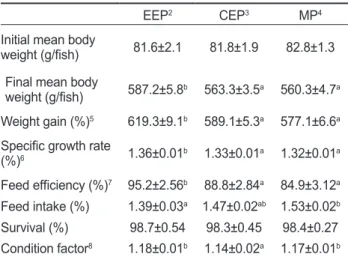
의양식현장사육실험결과는Table 2
에나 타내었다.
생존율은모든실험구에서98%
이상으로높았다.
최 종평균체중,
증체량,
일간성장률및사료효율은EEP
실험구가
CEP
및MP
실험구보다유의적으로높은값을보였으나(P<0.05), CEP
및MP
실험구간에는유의적인차이를보이지 않았다.
사료섭취율에서는MP
실험구가EEP
실험구보다유 의적으로높은값을나타내었으며, CEP
실험구와는유의적인 차이를보이지않았다.
비만도는EEP
실험구와MP
실험구간 에유의적으로차이가없었으며, CEP
실험구에서유의적으로 낮은값을보였다.
본실험결과와유사한사료조성표
(CEP)
로실험용배합사료 를제조하여MP
사료와비교한결과성장률이대등한결과는 이미많은연구를통해보고하였다(Cho et al., 2005; Cho et al., 2009; Kim et al., 2006).
본연구에서는소맥분을타피오카전 분으로대체한EEP
실험구가CEP
실험구및MP
실험구보다 유의적으로높은성장을보였다.
이것은실험사료의조성표및 일반성분분석결과에서알수있듯이소맥분을타피오카전 분으로대체하여그함량을최소화하면서어분및어유의함 량을최대화하여사료의단백질,
지질및에너지함량증가뿐 만아니라영양소의소화율이향상되었기때문으로판단된다(Table 1, 6).
전어체의일반성분분석결과는
Table 3
에나타내었다.
조단 백질은EEP
실험구가CEP
및MP
실험구보다유의적으로높 은함량을나타내었으며, CEP
및MP
실험구는유의적인차이 가없었다.
수분함량에있어서는MP
실험구가EEP
및CEP
실 험구보다유의적으로높은값을보였다.
이것은실험사료조성 표및일반성분분석결과에서알수있듯이소맥분을타피오카 전분으로대체하면서어분및어유의함량을최대화하여사료 의영양소및영양소소화율이향상되었기때문으로판단된다.
MP
실험구의경우EEP
실험구보다실험사료의단백질함량은높지만전어체의단백질함량이유의적으로낮은값을보인것 은
,
사료내수분함량이높고이에따라사료의유실량이많아 Table 2. Growth performance of olive flounder Paralichthys oliva- ceus fed the experimental diets1EEP2 CEP3 MP4
Initial mean body
weight (g/fish) 81.6±2.1 81.8±1.9 82.8±1.3 Final mean body
weight (g/fish) 587.2±5.8b 563.3±3.5a 560.3±4.7a Weight gain (%)5 619.3±9.1b 589.1±5.3a 577.1±6.6a Specific growth rate
(%)6 1.36±0.01b 1.33±0.01a 1.32±0.01a Feed efficiency (%)7 95.2±2.56b 88.8±2.84a 84.9±3.12a Feed intake (%) 1.39±0.03a 1.47±0.02ab 1.53±0.02b Survival (%) 98.7±0.54 98.3±0.45 98.4±0.27 Condition factor8 1.18±0.01b 1.14±0.02a 1.17±0.01b
1Values are means from two replicate groups of fish where the val- ues in each row with different superscripts are significantly differ- ent (P<0.05). 2EEP = Experimental extruded pellet; 3CEP = Moist pellet. 4MP = Commercial extruded pellet. 5Weight gain (%) = (fi- nal weight - initial weight) × 100 / initial weight. 6Specific growth rate (%) = (loge final wt. – loge initial wt.)/ days. 7Feed efficiency (%) = wet weight gain (g) × 100 / dry feed intake (g). 8Condition factor ={(fish wt. (g) /total length (cm)3}×100.
Table 3. Proximate composition (%) of whole-body for olive flounder Paralichthys olivaceus fed the experimental diets1 Diets Moisture
(%) Crude protein
(%) Crude lipid
(%) Ash
(%) EEP2 71.1±0.58a 22.1±0.21b 3.2±0.05 3.6±0.12 CEP3 71.5±0.58a 21.6±0.27a 3.1±0.15 3.8±0.36 MP4 72.1±0.72b 21.4±0.23a 3.3±0.09 3.2±0.23
1Values are means from three replicate groups of fish where the values in each column with different superscripts are signifi- cantly different (P<0.05). 2EEP=Experimental extruded pellet.
3CEP=Commercial extruded pellet. 4MP = Moist pellet.
실제섭취단백질및사료섭취량이
EEP
및CEP
실험구보다낮 기때문으로판단된다.
조지질및조회분은모든실험구에서유 의적인차이를보이지않았다.
전어체의지방산조성은
Table 4
에나타내었다. EEP, CEP
및MP
사료를공급한넙치전어체의포화지방산(saturated fatty acid, SFA)
으로는공통적으로palmitic acid (16:0)
의함량이가 장많았고,
불포화지방산(unsaturated fatty acid)
으로는vacce- nic acid (18:1n-7)
와docosahexaenoic acid (22:6n-3)
가가장 많이함유되어있었다.
습사료를공급한실험구는포화지방산 의stearic acid (18:0)
함량이EEP
실험구보다유의적으로높 게나타났으나CEP
실험구와는차이가없었으며,
단일불포화 지방산의vaccenic acid (18:1n-7) 햠
량은EEP
및CEP
실험구 보다유의적으로높았다.
반면에EEP
실험구는CEP
실험구보다
ω3
계열지방산인linolenic acid (18:3n-3), EPA (20:5n-3)
및DHA (22:6n-3)
함량이높게나타났다.
이는EEP
실험구가CEP
실험구보다지방함량을2%
정도높임으로서전체적으 로필수지방산함량이높아져요구량을충족함으로서성장및 사료효율에연관관계가있을것으로사료된다.
전어체의구성아미노산성분결과는
Table 5
에나타내었다.
모 든실험구는공통적으로넙치전어체의필수아미노산중에서lysine
의함량이가장높았으며,
구성아미노산의대부분을차지하고있는것은
glutamic acid, aspartic acid, lysine, leucine
순 이었다. EEP
및CEP
실험구에서는threonine, cysteine
및ly- sine
함량이MP
실험구보다유의적으로높았고, MP
실험구 에서는proline
및glycine
함량이EEP
와CEP
실험구보다유 의적으로높았다.
전체적으로EEP
실험구가CEP
및MP
실험 구보다아미노산함량이다소높게나타난것은전어체의높은 단백질함량이어체내아미노산축적과상관관계가있을것으 로사료된다.
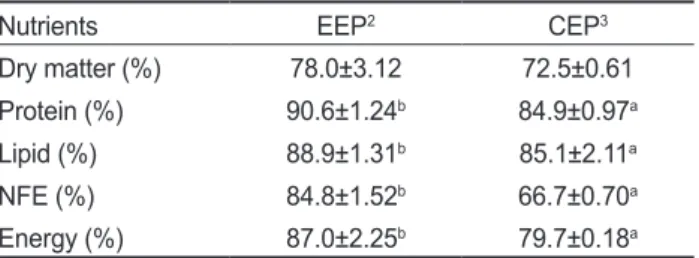
Table 6
은EEP
및CEP
사료의소화율평가결과를보여주Table 4. Fatty acid composition (%) of the whole-body for
olive flounder Paralichthys olivaceus fed the experimental diets
1Fatty acid Diets Pooled
SEM5
EEP2 CEP3 MP4
14:0 2.85 2.90 3.12 0.12
16:0 15.34 15.55 16.26 1.08
18:0 2.38a 2.58ab 2.85b 0.06
SFA6 20.57 21.03 22.23
16:1n-7 5.60 5.55 6.36 1.10
18:1n-7 13.88a 13.75a 16.50b 0.68
20:1n-9 2.88 2.88 3.58 0.20
24:1n-9 0.23b 0.21ab 0.16a 0.03
MUFA7 22.59 22.39 26.60
18:2n-6 6.29 6.19 5.82 0.68
18:3n-6 0.43 0.45 0.46 0.09
18:3n-3 0.88b 0.79a 0.89b 0.02
20:4n-6 1.32 1.32 1.30 0.03
20:5n-3 8.91b 8.12a 8.79b 0.05
22:4n-6 0.37 0.39 0.35 0.03
22:5n-3 3.49 3.78 3.23 0.16
22:6n-3 27.13b 25.23ab 22.30a 1.32
PUFA8 48.82 46.27 43.14
1
Values are means from two replicate groups of fish where the values in each row with different superscripts are signifi- cantly different (P<0.05).
2
EEP=Experimental extruded pellet.
3CEP=Commercial extruded pellet.
4MP=Moist pellet.
5Pooled stan- dard error of means: SD/√n.
6SFA=saturated fatty acid.
7MUFA=monounsaturated fatty acid.
8
PUFA=polyunsaturated fatty acid.
Table 5. Amino acid contents of the whole-body for olive flounder Paralichthys olivaceus fed the experimental diets (% to total amino acid)1
Amino acid Diets Pooled
SEM5
EEP2 CEP3 MP4
Aspartic
acid 10.24 10.03 9.50 0.35
Threonine 4.66b 4.62b 4.40a 0.06
Serine 4.27 4.39 4.32 0.02
Glutamic
acid 15.39 15.19 14.85 0.65
Proline 1.18a 1.18a 2.60b 0.22
Glycine 6.96a 6.90a 8.20b 0.06
Alanine 6.69 6.53 6.60 0.12
Cystine 0.78b 0.79b 0.52a 0.01
Valine 5.35 5.14 5.20 0.06
Methionine 2.79 2.74 2.70 0.08
Isoleucine 4.66 4.51 4.15 0.04
Leucine 7.89 7.84 7.40 0.14
Tyrosine 3.41 3.22 3.15 0.03
Phenylala-
nine 4.18b 4.12ab 3.95a 0.02
Histidine 2.49 2.35 2.44 0.02
Lysine 9.49b 9.37b 8.89a 0.06
Arginine 6.48 6.36 6.41 0.04
1Values are means from four replicate groups of fish where the val- ues in each row with different superscripts are significantly differ- ent (P<0.05).
2EEP=Experimental extruded pellet. 3CEP=Commercial extruded pellet. 4MP=Moist pellet. 5Pooled standard error of means: SD/√n.
고 있다
. EEP
사료의건물,
단백질,
지질,
에너지및 탄수화 물(NFE)
의외견상영양소소화율값은 각각78.0%, 90.6%, 88.9%, 84.8%
및87.0%
로나타났다. EEP
사료가CEP
사료보 다소화율이유의적으로높은것을알수있었다.
특히탄수화 물(NFE)
소화율은EEP
실험구(84.8%)
가CEP
실험구(66.7%)
보다
18.1%
높게나타났다.
이것은탄수화물의전체적인함량차이및전분의호화도등이영향을미친것으로판단된다
.
탄수화물원료로타피오카전분을첨가한
EEP
사료가소맥분을첨가한
CEP
사료보다탄수화물소화율이높은것을볼때,
넙 치는소맥분보다타피오카전분을보다더잘이용하는것으 로판단된다.
본 연구결과를 종합해 보면
,
사료내 탄수화물원료인 소맥 분을타피오카전분으로대체한결과가공물성(
부상)
및형태유지에전혀문제가되지않았으며
,
적은량(11%)
으로소맥분(19%)
을대체할수있어어분과지질함량을최대화하여단백질과지질함량을높일수있었다
.
또한탄수화물원료의함량 이최소화되면서단백질,
지질,
탄수화물및에너지소화율이 모두향상되는것을알수있었으며,
상업용배합사료및습사 료보다성장률이뛰어난배합사료의조성(formulation)
을설 계할수있었다.
사 사
이연구는국립수산과학원
(
친환경실용배합사료개발및품질 관리연구, RP-2014-AQ-129)
의지원에의해운영되었습니다.
References
Ahn GJ. 2005. Quality characteristics of the chol-pyon added tapioca powder. Korean J Culinary Res 11, 179-189.
AOAC (Association of Official Analytical Chemists). 2000. Of- ficial Methods of Analysis of the Association of Official An-
alytical Chemists, 17th Edition. Cunniff P, ed. Association of Official Analytical Chemists, Inc, Arlington, VA, U.S.A.
Chee KM. 1986. Nutritive values of tapioca. Korean J Animal Nut Feedstuffs 10, 18-35.
Cho MJ, Oh YK, Park SH, Lee HY, Kang YJ and Park MA.
2009. Effects of extruded pellet and moist pellet feed on health conditions of olive flounder Paralichthys olivaceus.
J Fish Pathol 22, 283-291.
Cho SH, Lee SM and Lee JH. 2005. Effects of the extruded pellets and raw fish-based moist pellet on growth and body composition of flounder, Paralichthys olivaceus L. for 10 months. Kor J Fish Aquat Sci 18, 60-65.
Divakaran S, Leonard GO, and Ian PF. 2002. Note on the meth- ods for determination of chromic oxide in shrimp feeds. J Agric Food Chem 50, 464-467. http://dx.doi.org/10.1021/
jf011112s.
Folch J, Lee M and Sloane–Stanley GH. 1959. A simple method for the isolation and purification of total lipids from animal tissues. J Biol Chem 226, 497-509.
Kim KW, Kang YJ, Lee HY, Kim KD, Choi SM, Bai SC and Park HS. 2006. Commercial scale evaluation of practical extruded pellet feed for the olive flounder (Paralichthys
olivaceus). Kor J Fish Aquat Sci 39, 100-105. http://dx.doi.
org/10.5657/kfas.2006.39.2.100.
Kim IS, Joo DS, Kim DS and Kim JD. 2007. Food and health.
Shinkwang munhwasa, Seoul, Korea, 144-145.
Lee JK, Oh SH and Lim JK. 2013. Effects of tapioca starch- es on quality characteristics of rice cookies. Korean J Food Cookery Sci 29, 469-478. http://dx.doi.org/10.9724/
kfcs.2013.29.5.469.
Lee SM, Seo JY, Lee YH, Kim KD, Lee JH and Jang HS. 2005.
Evaluation of experimental extruded pellet, commercial pellet and raw fish-based moist pellet for growing flounder,
Paralichthys olivaceus. Kor J Fish Aquat Sci 18, 287-292.
Mishra S and Rai T. 2006. Morphology and functional proper- ties of corn, potato and tapioca starches. Food Hydrocolloids 20, 557-566.
NRC (Nutrient Research Council). 2011. Nutrient requirements of fish and shrimp. The National Academy Press, Washing- ton DC, U.S.A.
Song JC and Park HJ. 2000. Food rheology. Ulsan University Press Center, Ulsan. pp 151, 166, 202.
Yoon YK. 2011. Effects of corn starch, potato starch and tapioca starch on the quality of gluten-free rice bread. MS Thesis.
Dankook University, Gyeonggi, Korea.
Table 6. Apparent digestibility coefficient (%, ADC) of dry matter, crude protein, nitrogen-free and energy in the experimental diets determined by fecal collection method (Guelph system) for olive flounder Paralichthys olivaceus 1
Nutrients EEP2 CEP3
Dry matter (%) 78.0±3.12 72.5±0.61
Protein (%) 90.6±1.24b 84.9±0.97a
Lipid (%) 88.9±1.31b 85.1±2.11a
NFE (%) 84.8±1.52b 66.7±0.70a
Energy (%) 87.0±2.25b 79.7±0.18a
1Mean values of triplicate groups, values are presented as mean ± SD. Values in the same row having different superscript letters are significantly different (P< 0.05).
2EEP = Experimental extruded pellet. 3CEP = Commercial extrud- ed pellet.