Clinical Experience of Weight Loss Surgery in Morbidly Obese Korean Adolescents
Ji Yeon Park, Dan Song, and Yong Jin Kim
Department of Surgery, Soonchunhyang University Seoul Hospital, Seoul, Korea.
Received: November 6, 2013 Revised: December 24, 2013 Accepted: January 9, 2014
Corresponding author: Dr. Yong Jin Kim, Department of Surgery,
Soonchunhyang University Seoul Hospital, 59 Daesagwan-ro, Yongsan-gu,
Seoul 140-743, Korea.
Tel: 82-2-709-9479, Fax: 82-2-795-1687 E-mail: [email protected]
∙ The authors have no financial conflicts of interest.
© Copyright:
Yonsei University College of Medicine 2014 This is an Open Access article distributed under the terms of the Creative Commons Attribution Non- Commercial License (http://creativecommons.org/
licenses/by-nc/3.0) which permits unrestricted non- commercial use, distribution, and reproduction in any medium, provided the original work is properly cited.
Purpose: Comprehensive multidisciplinary weight management programs en- compassing various conservative measures have shown only modest weight loss results in obese children and adolescents; therefore, bariatric surgery for this popu- lation has become a matter of discussion. This study aimed to present our experi- ence with and outcomes for laparoscopic sleeve gastrectomy (LSG) and laparo- scopic Roux-en-Y gastric bypass (LRYGB) in morbidly obese Korean adolescents.
Materials and Methods: The prospectively established database of all patients undergoing bariatric surgery at Soonchunhyang University Seoul Hospital, Korea between January 2011 and January 2013 was retrospectively reviewed. Adoles- cents aged 14 to 20 years were included in the present analyses. Results: Twenty- two adolescents underwent bariatric surgery during the study period; 14 underwent LSG and 8, LRYGB. Of these, 17 were female and 5 were male. The mean age was 19 years. Their mean body weight and body mass index (BMI) before surgery were 115 kg and 40.1 kg/m2. The only postoperative complication was intralumi- nal bleeding in 1 patient, which was managed conservatively. The mean BMI de- creased to 29.1 kg/m2 after a mean follow-up of 10 months. The percent excess weight loss (%EWL) at 1, 3, 6, and 12 months postoperatively were 19.6, 39.9, 52.6, and 74.2%, respectively. Only 1 patient showed %EWL less than 30% at 12 months after surgery. All patients with diabetes and sleep apnea were cured of their disease, and other comorbidities also improved or resolved after surgery. Conclu- sion: Bariatric surgery leads to significant short-term weight loss along with reso- lution of obesity-related comorbidities in obese children and adolescents.
Key Words: Morbid obesity, adolescent obesity, bariatric surgery, gastric bypass
INTRODUCTION
Obesity has become one of the most important public health problems worldwide, in not only adults but also children and adolescents.1 Obesity in childhood is close- ly associated with several conditions including hypertension, dyslipidemia, and in- sulin resistance/glucose intolerance that comprise metabolic syndrome, a precursor to type 2 diabetes and cardiovascular diseases.2,3 The development of obesity in childhood and adolescence serves as a predictor of subsequent obesity in adult- hood and carries an increased risk of adult morbidity and mortality.4,5 Childhood
gical options, possible outcomes, possible complications, and necessary postoperative lifestyle changes. All patients underwent comprehensive psychological and nutritional evaluations before surgery. Informed consent was obtained from parents with assent from the patient for those younger than 18 years of age or directly from patients for those old- er than 18 years of age.
All patients underwent either sleeve gastrectomy or Roux- en-Y gastric bypass. All the procedures were performed laparoscopically by a single experienced surgeon, who had performed more than 300 laparoscopic bariatric surgeries before the start of this series. The decision to perform lapa- roscopic sleeve gastrectomy (LSG) versus laparoscopic Roux-en-Y gastric bypass (LRYGB) was made on an indi- vidual basis by the surgeon, in discussion with the patient.
All patients were counseled on the specific risks associated with each procedure. The possibility of developing nutri- tional deficiency following LRYGB was well discussed.
Patients choosing LSG were informed of the risks of inade- quate weight loss and the possibility that revisional surgery might be required.
Surgical procedures
LRYGB was performed via three 5-mm and two 12-mm ports. A small gastric pouch with approximately 30 mL vol- ume was created along the lesser curvature by using laparo- scopic linear staplers. A 40-cm biliopancreatic limb and a 100-cm alimentary limb were constructed. The Roux limb was positioned in an antecolic fashion. Gastrojejunostomy was constructed with the linear stapler and anastomotic leak- age was assessed intraoperatively via air or methylene blue- stained saline injection into the gastric pouch. All mesenteric defects were closed with non-absorbable suture materials.
LSG was performed by using five trocar incisions and the otherwise standard technique that has been described previously.7 Gastric resection was performed with laparo- scopic linear staplers, creating a staple line parallel to the lesser curvature of the stomach under 34-Fr bougie dilator guidance. The staple line was selectively reinforced with ei- ther the interrupted method or the continuous oversewing method, especially where bleeding persisted or staples were overlapped.
Postoperative management and data collection
Patients initiated oral intake in the morning of the first post- operative day and were discharged once they had achieved adequate oral intake, their pain was under control, and they obesity has also been related to a variety of health problems
such as obstructive sleep apnea, orthopedic problems, poly- cystic ovarian syndrome, and non-alcoholic fatty liver dis- ease and to psychosocial problems that can have a marked influence on quality of life.
Although prevention is the long-term solution to this cru- cial health problem, efforts toward prevention are not al- ways successful. Moreover, various conservative measures including lifestyle modification and medical treatment result in only modest weight reduction in the long term. Therefore, interest in bariatric surgery for morbidly obese adolescents has been increasing. Previous clinical trials demonstrated that bariatric surgery may be the most effective treatment available for sustained long-term weight loss and resolution of obesity-related illnesses in the adult population.6 Howev- er, it is still controversial whether this rather drastic approach can be safely used in children and adolescents. There is a considerable variation among the recommendations and guidelines for surgical approaches for the management of morbid obesity and obesity-related comorbidities. The long- term effectiveness of bariatric surgery in this young popula- tion remains questionable as well.
Here, we report our initial experience with bariatric sur- gery performed in morbidly obese adolescents in Korea.
We analyzed surgical outcomes, including weight loss and comorbidity status, during short-term follow-up and aimed to evaluate the feasibility and efficacy of bariatric surgery in Korean adolescents.
MATERIALS AND METHODS
The medical records of all consecutive adolescent patients 20 years old or younger who underwent bariatric surgery at Soonchunhyang University Seoul Hospital in Korea between January 2011 and January 2013 were retrospectively re- viewed. Baseline, operative, and follow-up data from a pro- spectively established database were thoroughly reviewed and summarized.
Patients were selected according to the National Institutes of Health consensus guidelines for bariatric surgery. As such, adolescents with a body mass index (BMI) greater than 35 kg/m2 with serious obesity-related comorbidities (e.g., diabe- tes, sleep apnea, hypertension, or obesity related-arthropathy) or with a BMI of 40 kg/m2 or greater were considered for bariatric surgery. Patients and their parents received inter- disciplinary education about potential surgical and nonsur-
(≥130 mg/dL) or high-density lipoprotein cholesterol (<40 mg/dL) levels, or current lipid lowering medication.10 The re- mission of hypertension was defined as normal blood pres- sure values without medication.
Statistical analysis
All statistical analyses were performed by using SPSS ver- sion 18 for Windows (SPSS Inc., Chicago, IL, USA). Medi- ans and ranges of the variables were calculated and com- pared between the two different procedures. The chi-square test or Fisher’s exact test was applied to analyze categorical variables, and the Mann-Whitney U test was used for con- tinuous variables. All tests were two-tailed and a p-value
<0.05 was considered significant.
RESULTS
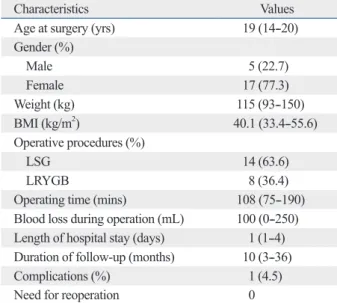
Twenty-two patients aged between 14 and 20 years under- went bariatric surgery at our institution for the treatment of morbid obesity and combined comorbidities. The demo- graphic characteristics of the patients are described in detail in Table 1. The study cohort consisted of 5 males and 17 fe- males. The mean age of the enrolled patients was 19 years (range, 14--20). Their mean body weight and BMI before surgery were 115 kg (range, 93--150) and 40.1 kg/m2 (range 33.4--55.6). Fourteen patients underwent sleeve gastrecto- my, while the other eight patients underwent Roux-en-Y gastric bypass surgery. All operations were performed lapa- roscopically and none were converted to laparotomy. No patients experienced intraoperative complications. Most pa- tients were discharged from hospital within 1 day after sur- gery without any adverse events. One patient was presented with immediate postoperative intraluminal bleeding after LRYGB, which spontaneously discontinued after a few days of close observation. She required 2 units of packed red blood cells and was discharged on the fourth postopera- tive day after the absence of continued bleeding was con- firmed. The mean follow-up period was 10 months (range, 3--36 months). There were no hospital readmissions and/or deaths during the follow-up period. Seven patients (4 fol- lowing LSG, 3 following LRYGB) required empirical pro- ton-pump inhibitors to manage heartburn or epigastric sore- ness. Three patients developed symptomatic nephrolithiasis.
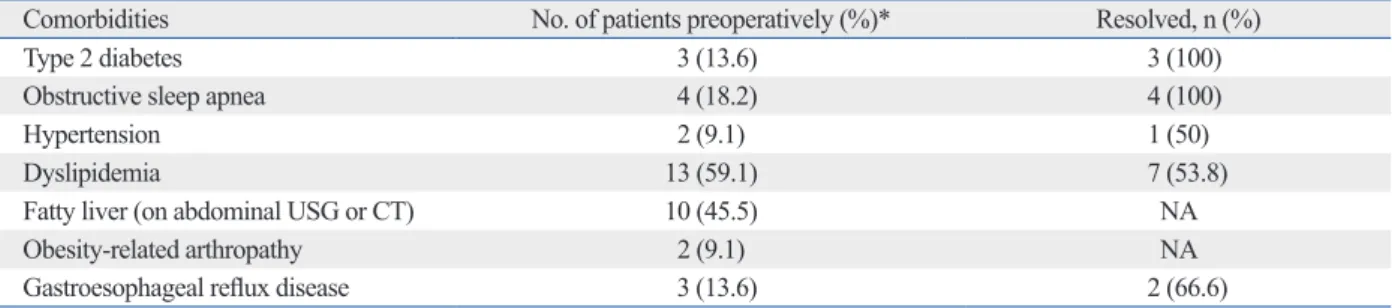
Most patients had one or more obesity-related comorbid- ities preoperatively. The types and frequencies of comor- bidities are summarized in Table 2. Dyslipidemia (13/22, were ambulating without difficulty. The postoperative nu-
tritional regimen consisted of a liquid or soft diet for the first 3 weeks, with gradual increases in food texture thereaf- ter. Patients returned to the outpatient clinic 2 weeks after surgery, and then every 3 months for the first postoperative year to monitor weight loss, appetite, dysphagia or food in- tolerance, eating behavior, comorbidity status, and the pres- ence of any complications. Follow-up was then decreased to every 12 months after the first year. Telephone inter- views were also used to monitor patients who could not visit the outpatient clinic.
Follow-up data analysis
The degree of weight loss was assessed with percent excess weight loss (%EWL), which was calculated from the fol- lowing formula:8
%EWL= preoperative weight-current weight preoperative weight-ideal weight ×100
The diagnosis of type 2 diabetes was made according to the criteria established by the American Diabetes Association [fasting blood glucose (FBS) ≥126 mg/dL or HbA1c level
≥6.5%] or when the patient was on antidiabetic medication for the condition. The criteria for diabetic remission was de- fined as FBS <126 mg/dL and HbA1c level <6.5% without the use of any antidiabetic medications (oral hyperglycemic agents or insulin) after surgery.9 We defined dyslipidemia as the presence of one or more abnormalities in serum triglycer- ides (≥130 mg/dL), low-density lipoprotein cholesterol
Table 1. Clinical Characteristics of the Enrolled Patients (n=22)
Characteristics Values
Age at surgery (yrs) 19 (14--20)
Gender (%)
Male 5 (22.7)
Female 17 (77.3)
Weight (kg) 115 (93--150)
BMI (kg/m2) 40.1 (33.4--55.6)
Operative procedures (%)
LSG 14 (63.6)
LRYGB 8 (36.4)
Operating time (mins) 108 (75--190)
Blood loss during operation (mL) 100 (0--250) Length of hospital stay (days) 1 (1--4) Duration of follow-up (months) 10 (3--36)
Complications (%) 1 (4.5)
Need for reoperation 0
BMI, body mass index; LSG, laparoscopic sleeve gastrectomy; LRYGB, laparoscopic Roux-en-Y gastric bypass.
Figures are presented as median (range) or number of patients (%).
The median BMI decreased from 40.1 to 29.1 kg/m2 at a mean follow-up of 10 months. The postoperative BMI and
%EWL at each follow-up time point are shown in detail in Table 3. By 6 months postoperatively, 10 of 14 patients (71.4%) with available body weight data had achieved 50%
or more EWL. The median %EWL at this time point was 52.6% (range, 33.2--94.0). Only 1 of 7 patients showed
%EWL less than 30% at 12 months after surgery; a 20-year old female patient had mental retardation and had under- gone LSG.
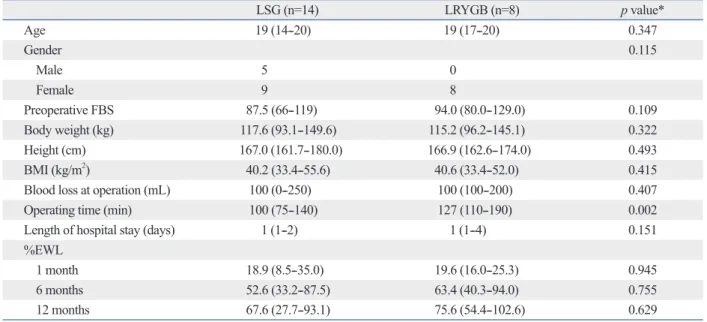
The enrolled patients were further divided into 2 sub- groups according to operative procedure (LSG vs. LRYGB) and their surgical outcomes were compared (Table 4). Pre- operative demographic characteristics and anthropometric measures in both groups were similar. The operating time was significantly longer in the LRYGB group than in the LSG group, with a difference of approximately 30 minutes (127 min vs. 100 min). The %EWL at 1, 6, and 12 months after surgery did not show a statistically significant differ- ence between both groups.
DISCUSSION
In Korea, the overall prevalence of obesity in children and adolescents significantly increased from 5.8% in 1997 to 59.1%) diagnosed biochemically and fatty liver disease
(10/22, 45.5%) noted on preoperative evaluation by perform- ing ultrasonography or abdominal computed tomography were the most common of these. Three patients (18.2%) had type 2 diabetes, and one of them was newly diagnosed dur- ing the preoperative evaluation. Hypertension was present in two patients (9.1%), and both were taking antihypertensive medications. Four patients (18.2%) were on treatment with continuous positive airway pressure for obstructive sleep apnea. Gastroesophageal reflux was confirmed in three pa- tients (13.6%) by performing endoscopy or barium upper gastrointestinal radiography. Additionally, the majority of female patients (12/17, 70.6%) were suffering from men- strual irregularity with the diagnosis of polycystic ovarian disease and four patients (18.2%) had concurrent psychoso- cial problems, such as depression.
The resolution of comorbidities after surgery was ob- served in a majority of the patients after a mean follow-up of 10 months (Table 2). All patients with diabetes were cured of their disease and those with sleep apnea were relieved from the symptoms. Other comorbidities such as hyperten- sion, dyslipidemia and gastroesophageal reflux had also im- proved or resolved after surgery in more than half of the pa- tients for whom data were available. Three out of four patients taking antidepressants also discontinued their med- ication during the follow-up period.
Table 2. Prevalence of Comorbidities Associated with Obesity and Its Remission Rate during Follow-Up
Comorbidities No. of patients preoperatively (%)* Resolved, n (%)
Type 2 diabetes 3 (13.6) 3 (100)
Obstructive sleep apnea 4 (18.2) 4 (100)
Hypertension 2 (9.1) 1 (50)
Dyslipidemia 13 (59.1) 7 (53.8)
Fatty liver (on abdominal USG or CT) 10 (45.5) NA
Obesity-related arthropathy 2 (9.1) NA
Gastroesophageal reflux disease 3 (13.6) 2 (66.6)
USG, ultrasonography; CT, computed tomography; NA, not available.
*Patients with the condition at baseline who have preoperative clinical and laboratory data available.
Table 3. Weight Loss in Korean Teenagers Following Bariatric Surgery
Time point No. of patients (%) Weight (kg) BMI (mg/m2) %EWL
Preoperatively 22 115 (93--150) 40.1 (33.4--55.6)
1 month 13 (59.1) 109 (87--142) 38.1 (31.4--52.8) 19.0 (8.5--35.0)
3 months 11 (50.0) 97 (70--130) 33.3 (25.5--48.3) 39.9 (22.0--76.9)
6 months 14 (63.6) 86 (66--120) 30.9 (22.5--44.6) 52.6 (33.2--94.0)
12 months 7 (31.8) 78 (65--100) 27.5 (21.5--37.2) 74.2 (27.7--102.6)
24 months 6 (27.3) 77 (57--97) 26.3 (20.8--29.9) 82.7 (61.8--111.8)
36 months 1 (4.5) 78 28.0 75.6
BMI, body mass index; EWL, excess weight loss.
Figures are presented as median (range).
gery in Korean adolescents.
We adopted LRYGB and LSG for our patient cohort amongst various bariatric procedures; the choice of proce- dure was made on an individual basis by the surgeon in dis- cussion with the patient and his or her parents. In the present study, patients achieved EWL of 62.8% at a mean follow-up duration of 10 months. One patient showed only 27.7%
EWL at 1 year postoperatively following LSG, and the rea- son seems to be poor compliance with perioperative man- agement due to her mental retardation. This patient was re- ferred to surgery primarily because of severe obstructive sleep apnea, and the symptom eventually resolved after LSG despite her unsatisfactory weight loss. There are cur- rently no standards for defining weight loss success or fail- ure after bariatric surgery. Generally, a cut-off value for EWL of 50% or more has been used to define success14 and EWL of 25% or less is often considered failure.15 However, some researchers consider that %EWL is not the optimal indicator for monitoring weight loss in children, as height increase, which directly influences ideal body weight dur- ing follow-up, is not reflected in this indicator.16,17 The age of the patients included in the present study ranged from 14 to 20 years, with a median age of 19, and the majority of the enrolled patients were over 15 years old. At this age, most have passed their growth spurt and completed the bulk of their physical growth, which suggests that the im- pact of the height difference on final outcomes is largely 9.7% in 2005.11 Although the prevalence of obesity in Ko-
rean adolescents is still far lower than that in American ado- lescents,12 it is true that the number of Korean children suf- fering from morbid obesity is rapidly increasing. This issue has become a growing national concern as a public health problem, especially in view of the possible obesity-related comorbidities.
Childhood obesity is closely related to subsequent obesity, morbidity, and mortality in adulthood,4,5 which in turn results in prolonged impairment of quality of life. Various traditional methods of weight loss have been tried in an attempt to achieve sustained weight loss and the resolution of comor- bidities in children. Although intensive behavioral interven- tions and pharmacologic treatment can be effective in man- aging weight in obese children and adolescents, the effect is only modest and often fails to satisfy long-term goals.13 Bar- iatric surgery in childhood, therefore, has gradually drawn attention, and an increasing number of investigators have demonstrated the safety and effectiveness of bariatric sur- gery for children and adolescents by reporting successful surgical outcomes. However, most of the clinical data avail- able on the efficacy and complications of the surgical inter- vention in adolescents are based on several small case series, usually from Western populations. Therefore, we intended to report our initial experience of weight loss surgery performed in morbidly obese Korean adolescents. To our knowledge, this is the first study to review the outcomes of bariatric sur-
Table 4. Comparison of Surgical Outcomes According to the Surgical Procedures
LSG (n=14) LRYGB (n=8) p value*
Age 19 (14--20) 19 (17--20) 0.347
Gender 0.115
Male 5 0
Female 9 8
Preoperative FBS 87.5 (66--119) 94.0 (80.0--129.0) 0.109
Body weight (kg) 117.6 (93.1--149.6) 115.2 (96.2--145.1) 0.322
Height (cm) 167.0 (161.7--180.0) 166.9 (162.6--174.0) 0.493
BMI (kg/m2) 40.2 (33.4--55.6) 40.6 (33.4--52.0) 0.415
Blood loss at operation (mL) 100 (0--250) 100 (100--200) 0.407
Operating time (min) 100 (75--140) 127 (110--190) 0.002
Length of hospital stay (days) 1 (1--2) 1 (1--4) 0.151
%EWL
1 month 18.9 (8.5--35.0) 19.6 (16.0--25.3) 0.945
6 months 52.6 (33.2--87.5) 63.4 (40.3--94.0) 0.755
12 months 67.6 (27.7--93.1) 75.6 (54.4--102.6) 0.629
LSG, laparoscopic sleeve gastrectomy; LRYGB, laparoscopic Roux-en-Y gastric bypass; FBS, fasting blood sugar; BMI, body mass index; EWL, excess weight loss.
Figures are presented as median (range).
*Mann-Whitney U test.
population.21
A recent publication revealed that the bariatric procedure rate for adolescent patients in the United States has pla- teaued between 2003 and 2009, contrary to the expectation that it would have rapidly increased along with the worsen- ing childhood obesity epidemic.22 The major concerns with regard to performing bariatric surgery in pediatric patients are the physiologic implications of this rather drastic ap- proach in this age group, a potential to induce metabolic and growth consequences, and a lack of information about long-term efficacy.23 Little is known about the long-term safety of adolescent bariatric surgery, because these proce- dures have only recently been applied to this population.
Unfortunately, this study could not elucidate any possible outcomes regarding the impact of physical maturation or long-lasting nutritional effect due to its short-term follow up period. Further studies with long-term follow-up will answer many emerging questions regarding the role of bar- iatric surgery in adolescents.
There are many limitations to the present study. This study is based on a retrospective review, and this may have introduced bias in analysis of the outcomes. The results from two different surgical procedures are combined togeth- er for the outcome analyses. The number of enrolled patients is so small that it is difficult to detect statistically significant differences between procedures. The diagnosis for obesity- related comorbidities is generally based on clinical findings rather than the application of strict diagnostic criteria and the follow-up data for those comorbidities were often miss- ing, which may have introduced bias. Furthermore, there were several patients who were unreachable even by tele- phone interview and their outcomes were not known after short-term follow-up. Furthermore, the follow-up period was relatively short, less than 1 year on average, and the long-term results need to be seen in the future.
In conclusion, successful weight loss occurred with mini- mal complications after both LSG and LRYGB in morbidly obese Korean adolescents, leading to significant resolution of the obesity-related comorbidities. Further studies are necessary to elucidate the long-term safety and efficacy of bariatric surgery in morbidly obese adolescents.
ACKNOWLEDGEMENTS
This research was supported by the Soonchunhyang Uni- versity Research Fund.
moot in this patient cohort. Intraluminal bleeding was the only postoperative complication noted and it spontaneously halted during conservative observation. Interestingly, a rela- tively large number of patients (7/22, 31.8%) complained of heartburn or epigastric soreness during postoperative fol- low-up, implying the presence of reflux or marginal ulcer, and they were managed symptomatically with proton-pump inhibitors. Gastroesophageal reflux disease and marginal ul- cer are already well-known as the most common postopera- tive complications after LSG and LRYGB, respectively.
Since few studies of adolescent bariatric surgery have re- ported on such clinical symptoms, it is impossible to com- pare our results with others. Otherwise, this study shows similar short-term results with previous studies of adoles- cent bariatric surgery, although the long-term outcomes re- main to be seen. LRYGB seems to be slightly superior to LSG in terms of %EWL, although it was not statistically significant due to the small number of enrolled patients.
Longer follow-up may elaborate the further difference be- tween the procedures.
In addition to the emphasis on weight, the resolution of the obesity-related comorbid conditions should be an impor- tant metric by which the success of bariatric surgery is eval- uated. This is even more important in the Korean popula- tion, because Asians have a higher risk of comorbid diseases at a lower BMI than do Western populations.18 Furthermore, Korean adolescents seems to be more vulnerable to certain factors of the metabolic syndrome when compared to Amer- ican adolescents.12,19 In the present study, the baseline BMI is relatively low compared to that reported in previous stud- ies, with a median BMI of 40.1 kg/m2, but the prevalence of comorbid conditions seems to be comparable.20 It appears that, in our patient cohort, bariatric surgery was indicated for adolescent patients with relatively low BMI because of their comorbid conditions; this is consistent with the aforemen- tioned characteristic of Asian populations. In this initial ex- perience, the majority of obesity-related comorbidities, es- pecially diabetes and obstructive sleep apnea, improved or resolved after surgery. No consensus has been reached as yet regarding the appropriate BMI cut-offs for adolescent bariat- ric surgery candidacy. Recommendations point out that the criteria should be tailored for individual patients considering their needs and maturity level. It seems that the distinct char- acteristics of the Asian adolescent population needs to be considered when establishing proper guidelines for adoles- cent bariatric surgery in Asians, just as different indications have been adopted for morbidly obese adults in the Asian
Prevalence of metabolic syndrome and obesity in adolescents aged 12 to 19 years: comparison between the United States and Korea. J Korean Med Sci 2010;25:75-82.
13. Whitlock EP, O’Connor EA, Williams SB, Beil TL, Lutz KW. Ef- fectiveness of weight management interventions in children: a tar- geted systematic review for the USPSTF. Pediatrics 2010;125:
e396-418.
14. O’Brien PE, Sawyer SM, Laurie C, Brown WA, Skinner S, Veit F, et al. Laparoscopic adjustable gastric banding in severely obese adolescents: a randomized trial. JAMA 2010;303:519-26.
15. Angrisani L, Favretti F, Furbetta F, Paganelli M, Basso N, Doldi SB, et al. Obese teenagers treated by Lap-Band System: the Italian experience. Surgery 2005;138:877-81.
16. Cole TJ, Faith MS, Pietrobelli A, Heo M. What is the best mea- sure of adiposity change in growing children: BMI, BMI %, BMI z-score or BMI centile? Eur J Clin Nutr 2005;59:419-25.
17. Alqahtani AR, Antonisamy B, Alamri H, Elahmedi M, Zimmer- man VA. Laparoscopic sleeve gastrectomy in 108 obese children and adolescents aged 5 to 21 years. Ann Surg 2012;256:266-73.
18. WHO Expert Consultation. Appropriate body-mass index for Asian populations and its implications for policy and intervention strategies. Lancet 2004;363:157-63.
19. Lim S, Jang HC, Park KS, Cho SI, Lee MG, Joung H, et al.
Changes in metabolic syndrome in American and Korean youth, 1997-2008. Pediatrics 2013;131:e214-22.
20. Treadwell JR, Sun F, Schoelles K. Systematic review and meta- analysis of bariatric surgery for pediatric obesity. Ann Surg 2008;248:763-76.
21. Kasama K, Mui W, Lee WJ, Lakdawala M, Naitoh T, Seki Y, et al.
IFSO-APC consensus statements 2011. Obes Surg 2012;22:677- 22. Kelleher DC, Merrill CT, Cottrell LT, Nadler EP, Burd RS. Recent 84.
national trends in the use of adolescent inpatient bariatric surgery:
2000 through 2009. JAMA Pediatr 2013;167:126-32.
23. Iqbal CW, Kumar S, Iqbal AD, Ishitani MB. Perspectives on pediat- ric bariatric surgery: identifying barriers to referral. Surg Obes Relat Dis 2009;5:88-93.
REFERENCES
1. Kimm SY, Obarzanek E. Childhood obesity: a new pandemic of the new millennium. Pediatrics 2002;110:1003-7.
2. Weiss R, Dziura J, Burgert TS, Tamborlane WV, Taksali SE, Yeckel CW, et al. Obesity and the metabolic syndrome in children and adolescents. N Engl J Med 2004;350:2362-74.
3. Kiess W, Galler A, Reich A, Müller G, Kapellen T, Deutscher J, et al. Clinical aspects of obesity in childhood and adolescence. Obes Rev 2001;2:29-36.
4. Guo SS, Wu W, Chumlea WC, Roche AF. Predicting overweight and obesity in adulthood from body mass index values in child- hood and adolescence. Am J Clin Nutr 2002;76:653-8.
5. Must A, Jacques PF, Dallal GE, Bajema CJ, Dietz WH. Long-term morbidity and mortality of overweight adolescents. A follow-up of the Harvard Growth Study of 1922 to 1935. N Engl J Med 1992;
327:1350-5.
6. Sjöström L. Review of the key results from the Swedish Obese Subjects (SOS) trial - a prospective controlled intervention study of bariatric surgery. J Intern Med 2013;273:219-34.
7. No JH, Kim Z, Kim YJ, Cho SW, Choi DH, Hur KY, et al. Initial experience of laparoscopic sleeve gastrectomy in morbidly obese patients. J Korean Surg Soc 2010;79:460-6.
8. Deitel M, Gawdat K, Melissas J. Reporting weight loss 2007.
Obes Surg 2007;17:565-8.
9. Expert Committee on the Diagnosis and Classification of Diabetes Mellitus. Report of the expert committee on the diagnosis and classification of diabetes mellitus. Diabetes Care 2003;26 Suppl 1:S5-20.
10. National Cholesterol Education Program (NCEP): highlights of the report of the Expert Panel on Blood Cholesterol Levels in Children and Adolescents. Pediatrics 1992;89:495-501.
11. Oh K, Jang MJ, Lee NY, Moon JS, Lee CG, Yoo MH, et al. Preva- lence and trends in obesity among Korean children and adoles- cents in 1997 and 2005. Korean J Pediatr 2008;51:950-5.
12. Park J, Hilmers DC, Mendoza JA, Stuff JE, Liu Y, Nicklas TA.