Introduction
Paeonia lactiflora has been one of the traditional medicinal herbs widely used in Asia for many years (Ahn et al., 2018;
Bang et al., 1999; He and Dai, 2011; Mao et al., 2008; Park et al., 2009; Soka, 1985; Zheng et al., 2019; Zhu et al., 2018).
Paeonia ‘Red Charm’ is soft-stemmed peony hybrid of P.
lactiflora and P. officinalis. It is a shrubby perennial that will display attractive foliage in mid-spring throughout the summer and autumn and gives red double blooms. The root extracts of Paeonia lactiflora (P. lactiflora) cv. ‘Red Charm’
has been studied by many research groups, however little attention has been paid to its flower petal. Compared to functional aspects of the roots of P. lactiflora, very little attention has been given to those of its flower petals. To determine the detailed components of flower petals of P.
lactiflora, we conducted the Fourier transform ion cyclotron resonance (FT-ICR) MASS spectrophotometric analysis.
This analysis identified the twenty-four different types of components from the ethanol extracts of the flower petals of P. lactiflora cv. ‘Red Charm’. The main compounds were kaemperol glucopyranosides, quercetin glucopyranosides, paonioflolol and methyl gallate (Kim et al., 2016). We there- fore further examined its functional activity of extracts. First, we examined anti-oxidant activity and the radical scavenging activity with 2,2-diphenyl-1-picrylhydrazyl (DPPH) of the P.
lactiflora extracts was 87.9-90.4% at 0.1 mg/mL. This result showed that these flower petal extracts have approximately 5-fold stronger anti-oxidant activity than a previous report with those of root (Bang et al., 1999). The result of tyrosinase inhibition assay of P. lactflora petal extract was similar to those of arbutin, a well-known standard except significantly higher effect in the coral sunset extract at 0.1% concentration.
Hyaluronidase inhibition assay also showed 76.5% inhibition
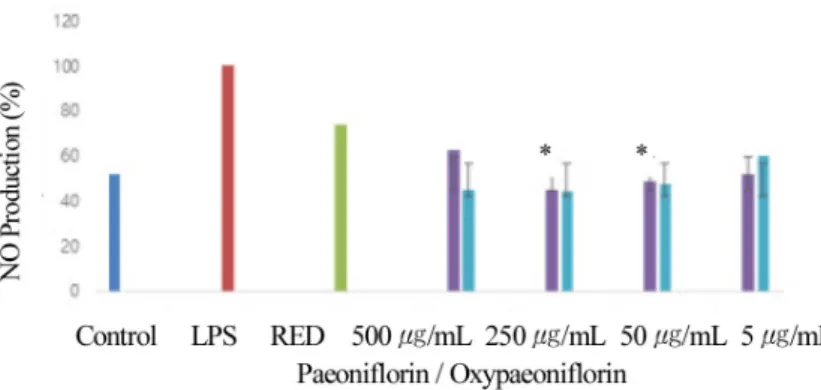
Anti-inflammatory and Anti-Oxidant Effects of Oxypaeoniflorin, Paeoniflorin and Paeonia lactiflora cv. ‘Red Charm’ Flower Petal
Extracts in Macrophage Cells
Soo-Ah Kim
1, Eun-Seo Jang
1, A-Yeon Lee
1, Soo-Jung Lee
1and June-Hyun Kim
2*
1