A novel Rhodobacteraceae bacterium, strain SC52 was isolated from the gut content of a sea cucumber Apostichopus japonicus collected from the coastal sea near Namhae, Republic of Korea.
The strain was distantly related to known species within the family Rhodobacteraceae (below 95.9% in 16S rRNA gene comparison). One chromosome (2.6 Mbp), seven circular plasmids (15 kb~391 kb), and one linear plasmid (7 kb) sequences (a total of 3,893,634 bp) were obtained by using PacBio RS II platform. A total of 3,853 genes, 3,794 CDSs, 49 tRNAs, and 9 rRNAs were annotated in the contigs. Genome annotation identified genes related to biosynthesis of possible nutrient sources such as various vitamins and amino acids, which will contribute to investigate the genetic diversity of the Rhodobacteraceae group that was frequently detected in the sea cucumbers.
Keywords: Apostichopus japonicus, Rhodobacteraceae, complete genome sequence, sea cucumber
The family Rhodobacteraceae is one of the major bacterial groups within the phylum Proteobacteria and harbors many
aquatic bacteria inhabiting freshwater and marine environments (Elifantz et al., 2013). The members of Rhodobacteraceae have diverse physiologic and metabolic characteristics and are often found in marine animals as symbiotic bacteria (Pujalte et al., 2014). Previous studies also reported that members of Rhodobacteraceae were frequently detected as a core group in the intestine of A. japonicus based on the culture-independent analysis (Sha et al., 2016; Wang et al., 2018; Zhang et al., 2019). Isolation and whole genome sequencing analysis of a novel strain will help us to understand the roles of the Rhodobacteraceae group in sea cucumbers.
Strain SC52 was isolated by standard dilution plating method from the gut content of a sea cucumber Apostichopus japonicus collected from the coastal sea near Namhae, South Korea, after incubation at 25°C for 3 days on marine agar (MA, Difco). The phylogenetic analysis showed that strain SC52 formed a phylogenetic lineage with Meridianimarinicoccus roseus TG-679
T(with 95.9% of 16S rRNA sequence similarity), Ruegeria lacuscaerulensis ITI-1157
T(95.3%) and Epibacterium mobile DSM 23403
T(95.2%). Genomic DNA of strain SC52 was extracted using a genomic DNA extraction kit (BIOFACT) and sequenced by PacBio RSII platform (Pacific Biosciences).
Korean Journal of Microbiology (2020) Vol. 56, No. 2, pp. 186-189 pISSN 0440-2413
DOI https://doi.org/10.7845/kjm.2020.0044 eISSN 2383-9902
Copyright ⓒ 2020, The Microbiological Society of Korea
Whole genome sequence of Rhodobacteraceae strain SC52 from gut content of sea cucumber Apostichopus japonicus
Sang-Eon Kim
1†, Young-Sam Kim
1†, and Kyoung-Ho Kim
1,2*
1
Department of Microbiology, Pukyong National University, Busan 48513, Republic of Korea
2
School of Marine and Fisheries Life Science, Pukyong National University, Busan 48513, Republic of Korea
해삼 Apostichopus japonicus의 장 내에서 분리된 Rhodobacteraceae sp. SC52의 전장유전체
김상언
1†・ 김영삼
1†・ 김경호
1,2*
1
부경대학교 미생물학과,
2부경대학교 해양수산생명과학부
(Received May 12, 2020; Revised June 8, 2020; Accepted June 15, 2020)
†
The authors contributed equally to this work.
*For correspondence. E-mail: [email protected];
Tel.: +82-51-629-5611; Fax: +82-51-629-5619
Complete genome sequence of Rhodobacteraceae strain SC52 ∙ 187
Korean Journal of Microbiology, Vol. 56, No. 2 Through the single-molecule real-time sequencing of PacBio, a
total of 135,690 subreads (total subread base, 1,345,248,063;
N50, 13,830; mean subread length, 9,914) were yielded. The subreads were then de novo assembled by Hierarchical Genome Assembly Process [HGAP, Version 3.0; Chin et al.
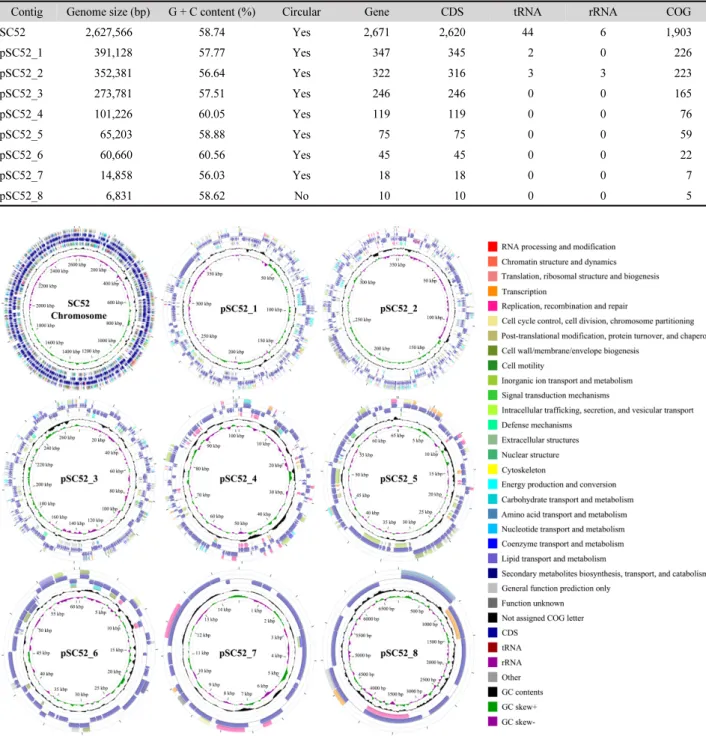
(2013)] and a total of nine contigs including one chromosome (2,627,566 bp with 58.74 mol% G + C content) and eight plasmids (391,128 bp with 57.77 mol%; 352,381 bp with 56.64 mol%; 273,781 bp with 57.51 mol%; 101,226 bp with 60.05 mol%; 65,203 bp with 58.88 mol%; 60,660 bp with 60.56
Table 1. Genomic features of contigs of strain SC52
Contig Genome size (bp) G + C content (%) Circular Gene CDS tRNA rRNA COG
SC52 2,627,566 58.74 Yes 2,671 2,620 44 6 1,903
pSC52_1 391,128 57.77 Yes 347 345 2 0 226
pSC52_2 352,381 56.64 Yes 322 316 3 3 223
pSC52_3 273,781 57.51 Yes 246 246 0 0 165
pSC52_4 101,226 60.05 Yes 119 119 0 0 76
pSC52_5 65,203 58.88 Yes 75 75 0 0 59
pSC52_6 60,660 60.56 Yes 45 45 0 0 22
pSC52_7 14,858 56.03 Yes 18 18 0 0 7
pSC52_8 6,831 58.62 No 10 10 0 0 5
Fig. 1. Genome maps of nine contigs of strain SC52. From inside: GC skew (green and purple), G + C content (black), CDSs with multi-colored of COG
categories on the reverse direction, CDSs in reverse direction including RNA, CDSs in forward direction including RNA, CDSs with multi-colored of COG
categories on the forward direction. The scale of each map does not reflect actual size.
188 ∙ Kim et al.
미생물학회지 제56권 제2호
mol%; 14,858 bp with 56.03 mol%; 6.831 bp with 58.62 mol%) were obtained.
Contigs were subjected to NCBI Prokaryotic Genome Annotation Pipeline (PGAP) (Tatusova et al., 2016) and a total of 3,853 genes, 3,794 CDSs, 49 tRNAs, and 9 rRNAs were annotated (Table 1). CGView Comparison Tool [CCT; Grant et al. (2012)] was used to construct genome maps presenting genomic features and assigned Clusters of Orthologous Groups (COGs) categories (Fig. 1). PHAge Search Tool Enhanced Release [PHASTER; http://phaster.ca/; Arndt et al. (2016)]
detected one questionable and one incomplete prophage sequences coding attachment proteins and viral head proteins from the chromosome. Rapid Annotations using Subsystems Technology [RAST; http://rast.nmpdr.org/rast.cgi; Aziz et al.
(2008)] identified gene clusters related to the biosynthesis of various vitamins including thiamin (thiamin phosphate synthase YjbQ; G5B39_09705), cobalamin (cobalamin biosynthesis protein CbiD, CobD/CbiB, CobN, CobT, and cobalamin synthase; G5B39_05710, 01605, 04045, 10005, 07215, and 08650), pyridoxine (pyridoxine 5'-phosphate synthase PdxJ;
G5B39_01030), and folate (dihydrofolate reductase; G5B39_
08470) and amino acids including glutamine (glutamine synthetase GlnA and glutamate synthase domain 2 GltB;
G5B39_02735 and G5B39_06950), glutamate [N-acetylglutamate synthase (N-acetylornithine aminotransferase) ArgJ; G5B39_
01810), histidine (phosphohistidine phosphatase SixA; G5B39_
04915), arginine [arginine decarboxylase (spermidine biosyn- thesis) SpeA; G5B39_07850), threonine (threonine synthase and threonine dehydratase EutB and IlvA; G5B39_00820, G5B39_06385, and G5B39_01670), tryptophan (tryptophan synthase beta chain TrpB and tryptophanyl-tRNA synthetase TrpS; G5B39_00235 and G5B39_05265), glycine (glycine cleavage system protein GcvH, GcvP, and GcvT; G5B39_
07050, G5B39_07045, and G5B39_07055), alanine (alanine dehydrogenase Ald, and alanine racemase Alr; G5B39_01890 and G5B39_05670), and serine (phosphoserine phosphatase SerB, and serine acetyltransferase CysE; G5B39_03190 and G5B39_06610).
It was reported that amino acids such as threonine, leucine, histidine and arginine efficiently increased the growth rate of sea cucumber (Huiling et al., 2005). Sea cucumbers ingest bacteria and bacterial cell components could be important food
sources for A. japonicus (Gao et al., 2014; Pagan-Jimenez et al., 2019). The genomic properties of the strain SC52 might give a clue for its role in the nutrition of sea cucumbers, which should be investigated through further researches.
Nucleotide sequence accession number
The strain was deposited at the Korean Collection for Type Cultures with accession number KCTC 72133 and the complete genome sequences including chromosome and plasmids of strain SC52 were deposited in GenBank under accession numbers CP049028-CP049036.
적 요
신종 균주 SC52는 한국의 남해 연안에서 채집된 해삼 Apostichopus japonicus의 장에서 분리되었다. 이 균주는 기존 에 알려진 Rhodobacteraceae 과에 속하는 균주들과 유사도가 낮은 것(16S rRNA 유전자 유사도 95.9% 이하)으로 확인되었 다. 유전체 서열을 PacBio RS II를 이용하여 분석한 결과, 하나 의 염색체(2.6 Mbp)와 일곱 개의 원형 플라스미드(15 kb~391 kb) 그리고 한 개의 선형(7 kb) 플라스미드 서열이 확인되었으 며, 총 3,853개의 유전자, 3,794개의 CDS, 49개의 tRNA 그리 고 9개의 rRNA 서열이 포함된 것으로 나타났다. 유전체 분석 결과 영양분으로 사용될 수 있는 다양한 비타민과 아미노산의 생합성 관련 유전자들이 확인되었으며 이는 해삼에서 자주 발 견되는 Rhodobacteraceae 집단의 유전적 다양성을 연구하는 데 기여할 것이다.
Acknowledgments
This research was supported by Basic Science Research Program through the National Research Foundation of Korea (NRF) funded by the Ministry of Education (2016R1D1A3 B04935909).
References