• 검색 결과가 없습니다.

3-D Structured Cu2ZnSn (SxSe1-x)4 (CZTSSe) Thin Film Solar Cells by Mo Pattern using Photolithography

N/A
N/A
Protected

Academic year: 2021

Share "3-D Structured Cu2ZnSn (SxSe1-x)4 (CZTSSe) Thin Film Solar Cells by Mo Pattern using Photolithography"

Copied!
5
0
0

로드 중.... (전체 텍스트 보기)

전체 글

(1)

Nomenclature

CZTSSe : Cu 2 ZnSn(S,Se) 4 V oc : open-circuit voltage, V J sc : short-circuit current, mA/cm 2 FF : fill factor

EQE : External quantum efficiency

Subscript

TFSCs : thin film solar cells RTA : rapid thermal annealing XRD : X-ray diffraction

FE-SEM : field emission scanning electron microscopy

1. 서 론

Cu 2 ZnSn(S,Se) 4 (CZTSSe)는 kesterite 기반의 물질로서 기존 의 박막형 태양전지인 CdTe와 Cu(In,Ga)S 2 (CIGS) 가 갖는 독성 과 희토류 금속 사용이라는 한계를 극복하여 차세대 박막형 태양 전지의 흡수층으로 각광받고 있다. 이러한 CZTSSe 흡수층은 풍 부한 자원과 무독성의 물질을 사용하며 10 4 cm -1 의 높은 흡수계 수와 1.1~1.5eV의 직접천이형 밴드갭의 특성을 보임으로써 저 비용, 고효율의 잠재력을 가진 물질로 평가 되었다 1-3) .

CZTSSe의 합성 방법으로는 evaporation 4) , pulsed laser deposition 5) , electro-deposition 6) , sol-gel 7) , sputtering 8) 등이 있 으며 여러 가지 합성 방법 중 무독성의 고품질 합성 방법인 sputtering 은 초기 katagri 그룹에서 CZTS박막으로 6.77% 효율 을 보고한 바 있다 9) . 또한 최근 IBM에서 hydrazine을 이용한 나 노 합성 방법으로 세계최고 효율인 12.7%을 달성하였다 10) .

그러나 이러한 노력에도 CZTSSe박막 태양전지는 CIGS 의

DOI:https://doi.org/10.21218/CPR.2017.5.1.020 eISSN 2508-125X

Mo 패턴을 이용한 3-D 구조의 Cu

2

ZnSn (S

x

Se

1-x

)

4

(CZTSSe) 박막형 태양전지 제작

조은진

1)

ㆍ강명길

1)

ㆍ신형호

1)

ㆍ윤재호

2)

ㆍ문종하

1)

ㆍ김진혁

1)

*

1)전남대학교 신소재공학부, 광주광역시, 61186

2)한국에너지기술연구원 신재생에너지연구본부, 대전광역시, 61005

3-D Structured Cu 2 ZnSn (S x Se 1-x ) 4 (CZTSSe) Thin Film Solar Cells by Mo Pattern using Photolithography

Eunjin Jo

1)

․ Myeng Gil Gang

1)

․ Shin hyeong ho

1)

․ Jae Ho Yun

2)

․ Jong-ha Moon

1)

․ Jin Hyeok Kim

1)

*

1)

Optoelectronic(s) Convergence Research Center and Department of Materials Science & Engineering, Chonnam National University, 300, Yongbong-Dong,Buk-Gu, 61186, Gwangju, South Korea

2)

Photovoltaic Laboratory, Korea Institute of Energy Research, 152 Gajeong-ro, Yuseong-gu, 61005,Daejeon, South Korea

ABSTRACT: Recently, three-dimensional (3D) light harvesting structures are highly attracted because of their high light harvesting capacity and charge collection efficiencies. In this study, we have fabricated Cu

2

ZnSn(S

x

Se

1-x

)

4

based 3D thin film solar cells on PR patterned Molybdenum (Mo) substrates using photolithography technique. Specifically, Mo patterns were deposited on PR patterned Mo substrates by sputtering and the thin Cu-Zn-Sn stacked layer was deposited over this Mo patterns by sputtering technique. The stacked Zn-Sn-Cu precursor thin films were sulfo-selenized to form CZTSSe pattern. Finally, CZTSSe absorbers were coated with thin CdS layer using chemical bath deposition and ZnO window layer was deposited over CZTSSe/CdS using DC sputtering technique. Fabricated 3-D solar cells were characterized by X-ray diffraction (XRD), X-ray fluorescence (XRF) analysis, Field-emission scanning electron microscopy (FE-SEM) to study their structural, compositional and morphological properties, respectively. The 3% efficiency is achieved for this kind of solar cell. Further efforts will be carried out to improve the performance of solar cell through various optimizations.

Key words: 3-D structure, Thin film solar cell, CZTSSe, Deposition of Mo

*Corresponding author: [email protected]

Received February, 11, 2017; Revised February, 26, 2017;

Accepted March, 03, 2017

ⓒ 2017 by Korea Photovoltaic Society

This is an Open Access article distributed under the terms of the Creative Commons Attribution Non-Commercial License (http://creativecommons.org/licenses/by-nc/3.0)

which permits unrestricted non-commercial use, distribution, and reproduction in any medium, provided the original work is properly cited.

20

(2)

율이 높아지고 전하 수집 또한 증가하여 태양전지 효율 개선에 잠재력을 가지고 있다 11-13) . 서울대에서 발표한 논문에 따르면 Si 기반의 잘 정렬된 3-D 구조의 태양전지는 평면 태양전지 효 율에 비해 약 2% 증가한 8.1%의 효율을 달성하여 3-D 구조의 태양전지의 효율증대의 가능성을 보였다 13) . 그러나 plasmon을 이용한 복잡한 구조이며 실리콘기반이기 때문에 저비용 고효 율의 한계를 보였으며 이후 현재까지 CZTSSe 기반의 잘 정렬 된 3-D 구조의 태양전지에 관한 보고가 극히 드물다.

따라서 본 연구에서는 sputtering를 이용하여 증착한 평면 CZTSSe 흡수층의 조성비 유지와 동시에 3-D구조를 적용하기 위한 방법으로 후면 전극인 Mo를 패턴화 했다. 이를 이용하여 3-D구조의 흡수층을 가진 태양전지 소자를 제작하였고 그에 따 른 특성을 평가 하였다.

2. 실험방법

2.1 기판준비

2.5×2.5 cm 2 크기의 soda lime glass 기판위에 Mo 박막을 DC sputtering법을 이용하여 1 µm 두께로 제조하였다. 기판 표면 의 불순물을 제거하기 위하여 증류수와 1:3 비율로 희석한 암모 니아 용액에 30초간 세척후 증류수로 린스하였다.

2.2 3-D 구조의 CZTSSe 박막 제조

2.2.1 Photoresist(PR) 패턴 제작

Mo 가 증착된 SLG기판을 아세톤과 메탄올용액에 순서대로 150°C에서 10분간 각각 세척하였다. 기판위에 phoresist 용액 (AZ LoF 2035)을 4500rpm으로 스핀코팅 후 포토리소그래피 를 통하여 지름, 간격, 높이가 각각 5 µm, 1 µm , 3 µm인 PR 패 턴을 제작하였다.

2.2.2 Mo 패턴 제작

PR 패턴된 기판과 Mo층의 접착력을 위해 DC sputtering법 으로 1.5mtorr의 공정압력에서 30분 그리고 30mtorr의 공정압 력에서 25분동안 순서대로 PR패턴 기판위에 증착하였다.

이후 기판의 PR을 제거하기 위해 아세톤에서 1분간 세척하 여 Mo 패턴을 제작하였다.

2.2.3 CZT 금속 전구체 제조

Zn, Sn, Cu의 금속타겟을 사용한 DC sputtering법으로 Mo가

전구체의 Cu-Zn와 Cu-Sn alloy 형성을 위해 Furnace를 이용 하여 300°C에서 1시간동안 열처리를 진행하였다. 황화-셀렌화 공정은 단시간 열처리 공정을 통하여 Rapid thermal annealing (RTA)장비를 이용하여 진행하였다. graphite box 안에 전구체 와 함께 Se과S의 혼합 분말0.2 g (Se : S = 10 : 1) 을 넣고 520°C 에서 10분간 열처리를 하여 CZTSSe 흡수층 박막을 합성하였 고 황화-셀렌화 공정이 끝난후에는 자연 상태에서 냉각 시켰다.

2.3 3-D 구조의 CZTSSe 박막 특성 분석

3-D 구조 박막의 미세구조및 표면과 단면의 형태분석을 위하 여 전계 방출형 주사 현미경(Field Emission Scanning Electron Microscopy, FE-SEM, JSCM-6701F, Japan)을 이용하였다. X 선 회절 분석기(X-ray diffraction, XRD, X’pert PRO, Philips, Netherlands), Raman spectroscopy를 이용하여 결정성을 확인 하였다.

2.4 3-D 구조의 CZTSSe 박막의 태양전지 제작 및 효율 측정
3-D 구조의 CZTSSe 박막위에 Chemical bath deposition (CBD) 법을 이용하여 80°C에서 CdS buffer 층을 증착하고 RF sputtering 법으로 진성 산화 아연(i-ZnO)과 알루미늄이 도핑된 산화아연(ZnO:Al)을 증착한 후 DC sputtering 법으로 알루미 늄 전극을 올려 태양전지를 제작하였다. SLG/Mo/Mo pattern/

CZTSSe/CdS/i-ZnO/AZO/Al 의 순서로 제작된 태양전지의 효 율과 특성을 Solar simulator (PV measurement, Inc., USA), 양 자효율 측정 장비 (Quantum Efficiency, QE, Sol31, Oriel, USA) 를 통해 측정하였다. 모든 측정은 상온에서 수행되었다.

3. 실험 결과 및 고찰

Fig. 1은 FE-SEM 분석을 통한 3-D 구조를 가진 CZTSSe 흡

수층 제조의 단계별 표면과 단면이미지이다. Mo 패턴의 경우

초기 PR 패턴의 지름, 간격, 높이에서 비슷한 수치의 hole 모양

의 규칙척인 패턴의 모습으로 관찰되었다. 한편 단면 이미지에

서는 패턴되지 않은 Mo 층과 그 위의 패턴된 Mo 층 사이의 큰

공공들은 PR 제거시 발생한 것으로써 이러한 공공들은 shunt

path 로 작용하여 태양전지 소자의 carrier 수집을 저해하는 요인

이 될 것으로 보인다. DC sputtering 방법으로 증착한 CZT 전구

체의 표면과 단면이미지 에서는 Mo 패턴과 동일한 패턴의 모습

(3)

을 유지하며 약1 µm의 두께로 Mo 패턴위에 전구체가 증착된 것을 확인하였다. 황화-셀렌화 공정을 거쳐 합성된 CZTSSe 박 막은 치밀한 미세구조를 가졌으며 1 µm이상의 입자가 분포하 며 두께도 약 1.5 µm로 확인되었다. 전체 공정 단계마다 패턴의 형태를 유지하였으며 두께는 3 µm에서 6 µm까지 증가하는 모 습을 보였다.

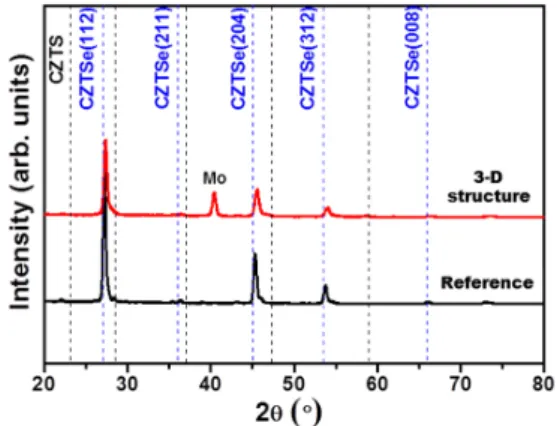
Fig. 2는 3-D 구조를 가진 CZTSSe 박막과 기존의 평면 CZTSSe 박막을 비교한 X선 회절 분석이다. X선 회절 패턴에서 27.62°, 47.14°, 54.23° 3 개의 강한 회절 peak이 관찰되었는데, CZTS kesterite CZTSSe 결정구조의 (112), (204), (312) 면에서 회절된 것으로써 CZTSSe상을 형성하였음을 나타낸다[JCPDS

#52-0868]. 이외의 다수의 약한 크기의 회절 피크가 관찰되었 으며, 모두 kesterite CZTSSe 결정구조에서 기인한 것이다. 3-D 구조를 가지는 샘플은 Mo 패턴의 영향으로 40.5°에서 Mo의 회 절피크가 관찰되었다[JCPDS #89-4896].

Fig. 3은 3-D구조를 가진 흡수층의 Raman 분석 결과이다, X 선 회절패턴에서 관찰된 Mo의 이상 존재 여부 위한 분석하였 으나 이상은 발견되지 않았다. 196 cm -1 에서 강한 peak가 관찰

되었으며 이는 CZTSe peak로 확인되었다. 또한 338 cm -1 에서 약한 peak CZTS peak이 관찰되다. 따라서 3-D구조의 CZTSSe 박막이 합성되었음을 확인하였다.

3-D 구조의 CZTSSe 박막을 이용하여 제작한 태양전지 J-V 특성 분석 결과를 Fig. 4의 (a) 와 Table 1에 나타내었다. 공공으 로 인한 FF의 감소, R s 의 증가, R sh 의 감소로 인해 reference 샘 플보다 낮은 효율을 보였다. 그러나 3-D 구조의 태양전지로서 3% 의 효율을 보였으며 개방전압 (V oc ) 은 292 mV, 단락전류 (J sc ) 는 27.1 mA/cm 2 를 나타냈다. Fig. 4의 (b)는 300 nm부터 1400 nm에서 구간의 양자효율 결과이며 단파장영역 450 nm(CdS 버퍼층)의 앞 구간에서는 같은 EQE를 보이지만 장파 장영역으로 갈수록 그 차이 커지는 것을 확인할 수 있었다.

낮은 효율을 보인 주된 이유는 낮은 R sh 값으로 Fig. 1에서 확 Fig. 1. Surface and cross-sectional FE-SEM images along with

its schematics of CZTSSe absorber layer fabricated with 3-D structure

Fig. 2. X-ray diffraction (XRD) patterns of the 3-D structured CZTSSe absorber layer along with the reference sample

Fig. 3. Raman spectrum of the 3-D structured CZTSSe absorber layer

Table 1. Electrical properties of 3-D structured thin film solar cell compared with reference sample

V

oc

(mV) J

sc

(mA/cm

2

) FF (%) η(%) R

s

(ohm) R

sh

(ohm)

Ref. 363 35.30 51.10 6.60 9.89 406.98

3-D 292 27.10 37.30 3.00 19.36 87.00

(4)

인한 Mo 패턴사이의 공공과 완벽하게 제거 되지 않은 PR이 shunt path의 존재를 가정하게 하며 이로 인하여 전하운송자의 재결합이 발생하였고 결국 V oc 와 J sc 가 감소되었다는 것을 예상 할 수 있다. 추후연구에서는 이러한 결함 개선을 통하여 효율 향 상을 기대할 수 있을 것이다.

4. 결 론

본 연구에서는 Mo패턴을 이용한 3-D 구조 박막형 태양전지 를 성공적으로 제작하였으며 구조적, 결정학적, 전기적 특성 분 석하였다.

FE-SEM분석을 통해 3-D구조의 소자 제작의 미세구조에서 규칙적인 공공을 발견하였으며 X선 회절패턴과 Raman 분석을 통하여 CZTSSe 합성을 확인하였다. 또한 J-V 분석으로 소자의 V oc =292 mV, J sc =27.10 mA/cm 2 and FF=37.3%를 보이며3%의 효율을 달성 하였다. 이를 통해 태양전지로서의 전기적 특성을 확인하였으며 3-D구조의 CZTSSe 박막형 태양전지 구현 가능 성을 제시하였다.

References

1. Teodor K. Todorov, Kathleen B. Reuter and David B. Mitzi,

“High-Efficiency Solar Cell with Earth-Abundant Liquid- Processed Absorber”, ADV MATER, Vol.22, E156-E159, 2010.

2. J. S. Seol, S. Y. Lee, J. C. Lee, H. D. Nam, K. H. Kim,

“Electrical and optical properties of Cu

2

ZnSnS

4

thin films prepared by rf magnetron sputtering process”, Sol. Energy Mater. Sol. Cells, Vol.75, no.1-2, pp.155-162, 2003.

3. L. Sun, J. He, H. Kong, F. Yue, P. Yang, J. H.Chu,“Structure, composition and optical properties of Cu

2

ZnSnS

4

thin films deposited by Pulsed Laser Deposition method”, Sol. Energy Mater. Sol. Cells, Vol.95, no.10, pp.2907-2913, 2011.

4. Kaune, G., Hartnauer, S., Scheer, R., “In situ XRD investigation of Cu

2

ZnSnSe

4

thin film growth by thermal co-evaporation”

physica status solidi (a), Vol. 211, pp. 1991-6, 2014.

5. K. Moriya, K. Tanaka, H. Uchiki, “Fabrication of Cu

2

ZnSnS

4

thin-film solar cell prepared by pulsed laser deposition, Jpn. J.

Appl. Phys. Vol.46, 9A, pp.5780-5781, 2007.

6. Vauche, L., Dubois, J., Laparre, A., Mollica, F., Bodeux, R., Delbos, S., Ruiz, C. M., Pasquinelli, M., Bahi, F., de Monsabert, T. G., Jaime, S., Bodnar, S., Grand, P.-P., “Cu

2

ZnSnSe

4

thin film solar cells above 5% conversion efficiency from electro- deposited Cu Sn Zn precursors”. physica status solidi (a), Vol.

211, pp. 2082-5, 2014.

7. Fangyang Liu, Fangqin Zeng, Ning Song, Liangxing Jiang, Zili Han, Zhenghua Su, Chang Yan, Xiaoming Wen, Xiaojing Hao, Yexiang Liu, “Kesterite Cu

2

ZnSn (S,Se)

4

Solar Cells with beyond 8% Efficiency by a Sol –Gel and Selenization Process”, ACS Appl. Mater. Interfaces, 7, 26, pp 14376-14383, 2015.

8. Myeng Gil Gang, Seung Wook Shin, Chang Woo Hong, K. V.

Gurav,Jihye Gwak, Jae Ho Yun, Jeong Yong Lee, Jin Hyeok Kim, “Sputtering processed highly efficient Cu

2

ZnSn(S,Se)

4

solar cells by a low-cost, simple, environmentally friendly, and up-scalable strategy, Green Chem. 18, 700-711, 2016.

9. H. Katagiri, N. Sasaguchi, S. Hando, S. Hoshino, J. Ohashi, and T. Yokota, “Preparation films by and evaluation of Cu

2

ZnSnS

4

thin sulfurization of E-B evaporated precursors, Sol. Energy Mater. Sol. Cells 49, 407, 1997.

10. Jeehwan Kim, Homare Hiroi, Teodor K. Todorov, Oki Gunawan, Masaru Kuwahara, Tayfun Gokmen, Dhruv Nair, Marinus Hopstaken, Byungha Shin, Yun Seog Lee, Wei Wang, Hiroki Sugimoto, and David B. Mitzi, “High Efficiency Cu

2

ZnSn(S,Se)

4

Solar Cells by Applying a Double In

2

S

3

/CdS Fig. 4. (a) J–V characteristics and (b) the external quantum

efficiency (EQE) results of the 3-D structured thin film

solar cell compared with reference sample

(5)

Emitter, Adv. Mater., 26, 7427-7431 ,2014.

11. Kwang Jun Ahn, “Enhanced Photon Absorption of Organic Solar Cells by Three-dimensional Metallic Structures” Journal of the Korean Physical Society, 67, No. 12, 2101-2104, 2015.

12. Huanping Zhou, Wan-Ching Hsu, Hsin-Sheng Duan, Brion Bob, Wenbing Yang,Tze-Bin Song, Chia-Jung Hsu and Yang Yang, “CZTS nanocrystals: a promising approach for next generation thin film photovoltaics”, Energy Environ. Sci., 6, 2822 –2838, 2013.

13. Kyungyeon Ha, Eunseok Jang, Segeun Jang, Jong-Kwon Lee, Min Seok Jang, Hoseop Choi, Jun-Sik Cho and Mansoo Choi,

“A light-trapping strategy for nanocrystalline silicon thin-film solar cells using three-dimensionally assembled nanoparticle, Nanotechnol., 27, 055403, 2016.

14. J. B. Li, V. Chawla, and B. M. Clemens, “Investigating the role of grain boundaries in CZTS and CZTSSe thin film solar cells with canning probe microscopy”, Advanced Materials, 24, No.6, 720-723 , 2012.

15. G. Lindwall, S. Shang, Neal R. Kelly, T. Anderson, Zi K. Liu,

“Thermodynamics of the S-Sn system: Implication for synthesis

of earth abundant photovoltaic absorber materials”, Solar

Energy, Vol.125 , 314-323, 2016.

수치

Fig. 2. X-ray diffraction (XRD) patterns of the 3-D structured  CZTSSe absorber layer along with the reference sample

참조

관련 문서