• 검색 결과가 없습니다.

Prognostic Implication of QRS Variability during Hospitalization in Patients with Acute Decompensated Heart Failure

N/A
N/A
Protected

Academic year: 2022

Share "Prognostic Implication of QRS Variability during Hospitalization in Patients with Acute Decompensated Heart Failure"

Copied!
8
0
0

로드 중.... (전체 텍스트 보기)

전체 글

(1)

Korean Circulation Journal

Introduction

Heart failure (HF) continues to have a poor prognosis despite the advances in medical treatment.

1)

Previous studies suggested sever- al predictors for mortality in HF population. QRS duration is a pre- dictor of poor prognosis in HF.

2)3)

Wide QRS duration was found in

Print ISSN 1738-5520 • On-line ISSN 1738-5555

Prognostic Implication of QRS Variability during Hospitalization in Patients with Acute Decompensated Heart Failure

So-Ryoung Lee, MD 1 , Eue-Keun Choi, MD 1 , Do-Yoon Kang, MD 1 , Myung-Jin Cha, MD 1 , Youngjin Cho, MD 1 , Il-Young Oh, MD 2 , and Seil Oh, MD 1

1

Department of Internal Medicine, Seoul National University Hospital, Seoul,

2
Cardiovascular Center, Seoul National University Bundang Hospital, Seongnam, Korea

Background and Objectives: Heart failure (HF) patients display more varied QRS duration. We investigated whether QRS variability during hospitalization for acute decompensated HF is associated with poor clinical outcomes after discharge.

Subjects and Methods: One hundred seventy three patients (64% males; age 60±13 years) admitted for acute decompensated HF with severe left ventricular (LV) dysfunction (LV ejection fraction ≤35%) were consecutively enrolled. QRS variability was calculated by the dif- ference between maximum and minimum QRS duration acquired during hospitalization. The prognostic implications on composite end- points of death or urgent heart transplantation were analyzed.

Results: Forty-two patients (24.3%) died and three patients (1.7%) underwent urgent heart transplantation during the follow-up of 51±18 months. Patients who reached composite endpoints (n=45) showed greater QRS variability than those who did not (n=128) (20±23 ms vs. 14±

14 ms, p=0.046). Patients who had high QRS variability (more than 22 ms; n=36) tended to have a higher event rate than those with QRS variability <22 ms {39% vs. 23%, hazard ratio (HR), 1.88; 95% confidence interval (CI) 1.001-3.539, p=0.05}. Adjusting with other vari- ables, high QRS variability was an independent predictor for composite outcome (HR 1.94; 95% CI 1.023-3.683, p=0.042).

Conclusion: QRS variability measured during hospitalization for acute decompensated HF has a prognostic impact in HF patients with severe LV dysfunction. (Korean Circ J 2014;44:22-29)

KEY WORDS: Heart failure; Heart decompensation; Electrocardiography, variation; Prognosis.

Received: July 10, 2013

Revision Received: October 1, 2013 Accepted: November 18, 2013

Correspondence: Eue-Keun Choi, MD, Department of Internal Medicine, Seoul National University Hospital, 101 Daehak-ro, Jongno-gu, Seoul 110- 744, Korea

Tel: 82-2-2072-0688, Fax: 82-2-762-9662 E-mail: [email protected]

• The authors have no financial conflicts of interest.

This is an Open Access article distributed under the terms of the Creative Commons Attribution Non-Commercial License (http://creativecommons.

org/licenses/by-nc/3.0) which permits unrestricted non-commercial use, distribution, and reproduction in any medium, provided the original work is properly cited.

20-30% of HF patients, especially in those with severe left ventric- ular (LV) dysfunction.

2)4)5)

Patients with wide QRS duration display in- creased prevalence of sudden cardiac death and all-caused death.

3)6-8)

One of the possible explanations for poor outcomes in those with wide QRS duration is LV dyssynchrony.

9)

Cardiac resynchronization therapy could improve LV dyssynchrony and promote reverse re- modeling, resulting in better outcomes in this high-risk popula- tion, especially those with wide QRS duration.

10)11)

QRS duration can vary widely even within the same individual. HF

patients are reported to have a wide QRS variation compared to those

without HF, which changes maximally during HF exacerbation.

12)

A

previous study reported on the prognostic value of QRS duration

using electrocardiogram (ECG) on the day of admission and dis-

charge for decompensated HF.

13)

There is little information whether

the variation of QRS duration during HF exacerbation is related with

prognosis. The change of QRS duration during HF exacerbation

might occur from a transient or permanent non-specific intraven-

tricular conduction delay and bundle branch block (BBB). Although

(2)

BBB in HF patients shows poor clinical outcomes, few studies have addressed QRS variability and BBB in HF patients.

13-16)

This study was undertaken to investigate whether QRS variation during hospitalization for acute decompensated HF is prognostically influential for clinical outcomes after discharge.

Subjects and Methods

Study population

A total of 548 patients with LV ejection fraction (LVEF) ≤35% ad- mitted for acute decompensated HF between December 2004 and April 2007 at Seoul National University Hospital (Seoul, Korea) were screened. Acute decompensated HF was defined as new onset or recurrence of gradually or rapidly developing symptoms and signs of HF requiring urgent or emergent therapy resulting in hospitaliza- tion.

17)

We selected 259 patients who had two or more ECGs during hospitalization. Among these patients, we excluded 10 without sur- vival data and 59 with advanced malignancy with an expected sur- vival of <6 months. Also, five patients with an implanted pacemaker or implantable cardioverter-defibrillator, or who underwent cardiac resynchronization therapy were excluded. Other exclusions included death (n=6) and heart transplantation (n=6) during index hospital- ization. Finally, 173 patients were included for analysis.

Clinical and laboratory findings

We reviewed demographic variables, comorbidities, characteris- tics of admission, and biochemical data from the electrical medical records. Blood pressure, serum hemoglobin, serum creatinine, se- rum sodium, serum potassium, and serum B-type natriuretic peptide measured at admission day were included. Medications at admis- sion and at discharge were reviewed. We also analyzed the presence

of arrhythmia including atrial flutter (AFL), ventricular premature beat, or ventricular tachyarrhythmia during admission.

Echocardiographic imaging

Electrocardiography performed within one month of admission was selected. Standard two-dimensional and color Doppler image trig- gered by the QRS complex were used for analysis. We collected left ventricular end diastolic dimension and LVEF using the M-mode.

Electrocardiogram analysis and definition of QRS variability We collected and reviewed all 12-lead ECGs performed during hospitalization (numbers of ECG, mean 7±4 per patient). All patients had their initial inpatient ECG within eight days of admission and 164 patients (95%) performed within one day after admission.

QRS duration was defined as the mean duration among all 12-leads as measured on a MAC1200 computer system (GE Healthcare, Chal- font St Giles, Buckinghamshire, UK). We selected maximum and minimum QRS duration value in each patient. Maximum QRS dura- tion was defined as QRS duration with widest value and minimum QRS duration with narrowest value among whole ECG acquired dur- ing admission. QRS variability was defined as the difference be- tween maximum and minimum QRS duration. Prolonged QRS dura- tion was defined as a QRS duration exceeding 120 ms.

3)8)

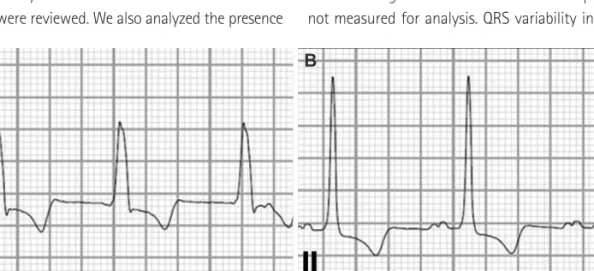
High QRS variability was defined QRS variability more than 22 ms based on upper quintile value of QRS variability in study population. Fig. 1 de- picts a representative case showing QRS variability.

To evaluate whether QRS duration in patients with atrial fibrilla- tion (AF) or AFL varied in the present study, we measured QRS width manually in 10 consecutive beats and calculated mean duration.

ECGs showing aberrant conduction due to rapid ventricular rate were not measured for analysis. QRS variability in patients with AF/AFL

Fig. 1. Representative QRS variability calculation. A: shows initial QRS duration (144 ms) taken on admission day. B: after HF treatment (hospital day 17), QRS duration became shortened to 108 ms. QRS variability was 36 ms. This patient has died of unknown cause during 20 months follow-up. HF: heart fail- ure, ECG: electrocardiogram.

ECG at hospital day 17 QRS duration=108 ms QRS variability=A-B=36 ms

ECG at hospital day 1 QRS duration=144 ms

A B

(3)

(n=61) was not different from those without (16.4±21.9 vs. 15.6±

13.4, p=0.766).

Follow-up and study endpoints

We analyzed clinical outcome with composite endpoints of death or urgent heart transplantation.

18)19)

After discharge from index ad- mission, we obtained follow-up data from hospital medical records and death certificates obtained from Ministry of Public Administra- tion and Security of Korea. Patients who underwent heart transplan- tation during follow-up were censored on their transplantation date.

Patients who survived without heart transplantation were censored in December 31, 2010.

Statistical analyses

Continuous variables were expressed as mean±standard deviation and categorical variables as numbers and percentages. Comparison of continuous variables was performed using Student’s t-test or in case of non-normal distribution, Mann-Whitney U test when ap- propriate. Chi-square test was used for categorical variables. Event- free survival curves were constructed by the Kaplan-Meier survival curves and significance was tested with the log-rank test. The dif- ference of each characteristic between two groups were analyzed by the hazard ratio (HR) and a 95% confidence interval (CI) using uni- variate Cox proportional hazard regression model. To evaluate the effects of the risk factors on composite endpoints, backward step- wise multivariate Cox regression analysis was performed. The vari- ables with p<0.10 on univariate analysis were considered as candi- date variables for multivariate analysis. Two-sided p<0.05 were con- sidered statistically significant. Statistical Package for the Social Sciences software version 19.0 (IBM Corporation, Armonk, NY, USA) was used for all statistical analyses.

Results

Baseline characteristics of study patients

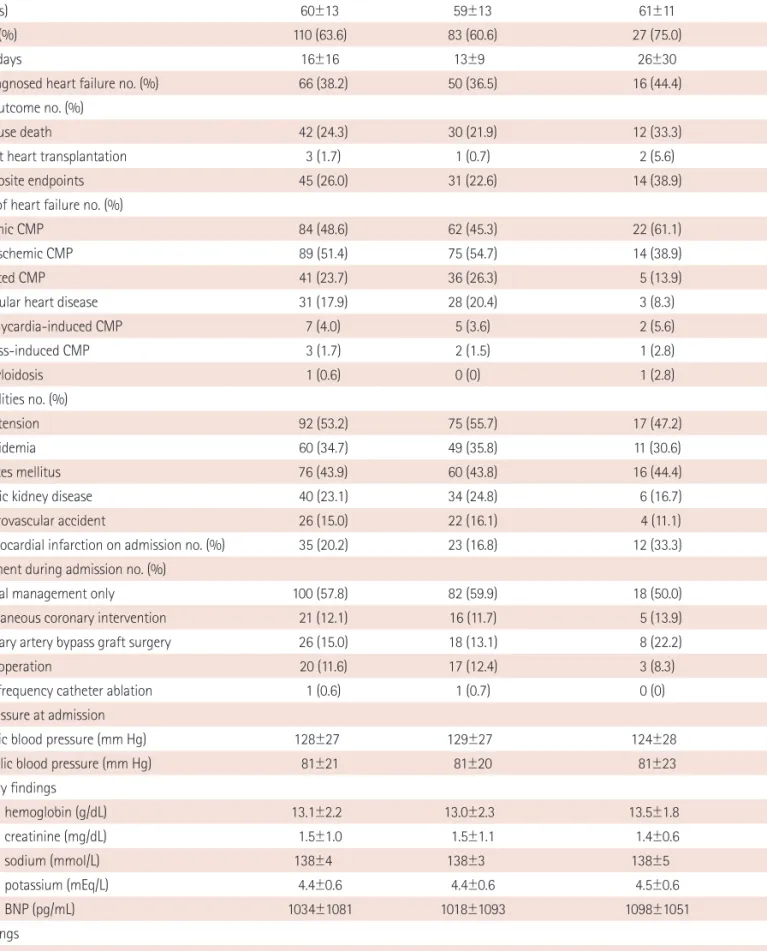
The baseline characteristics of study population are presented in Table 1. The 173 patients (110 males, 63.6%) had a mean age of 60±

13 years. The mean follow-up duration was 51±18 months and 42 patients (24.3%) died and 3 patients (1.7%) underwent urgent heart transplantation during follow-up. One hundred seven patients (61.8%) and 66 (38.2%) were already diagnosed as HF and newly diagnosed as HF, respectively. The most common underlying etiology of HF was ischemic cardiomyopathy (n=84, 48.6%) and prevalence of acute myocardial infarction (AMI) on admission was 20% (n=35).

Among 107 patients who were already diagnosed as HF before hos- pitalization, 54 (50.5%) patients were prescribed angiotensin con- verting enzyme inhibitors/angiotensin blockers and 30 (28%) patients

received beta-blockers before index admission. Diuretics and aldo- sterone antagonists were prescribed in 49 (46%) and 20 (19%) pa- tients, respectively. Medication history before index admission showed no significant difference between patients with or without composite endpoints events.

Patients had been admitted for mean 16±16 days (1 to 126 days).

During admission, most patients (n=100, 57.8%) received conven- tional HF medical therapy only, whereas 21 patients (12.1%) under- went percutaneous coronary intervention and 26 patients (15.0%) received coronary artery bypass surgery. Twenty patients underwent valve operation; aortic valve replacement (n=7), mitral valve replace- ment (n=7), mitral valve plasty and mitral annuloplasty (n=3), dual valve replacement (n=2), and Bentall operation (n=1). One patient received AF ablation procedure during hospitalization.

Comparing the baseline characteristics according to composite outcome, the gender, comorbidities, medication at discharge, and prevalence of AMI on admission were similar in both groups. Pa- tients with composite endpoints were older (64±11 years vs. 58±

13 years, p=0.007), less newly diagnosed HF (20.0% vs. 44.5%, p=

0.004), more ischemic cardiomyopathy (64.4% vs. 43.0%, p=0.013), less valvular heart disease (4.4% vs. 22.7%, p=0.006), and less valve operation (2.2% vs. 14.8%, p=0.023) than patients without com- posite endpoints. There were no significant differences between two groups in blood pressure, laboratory, and echocardiographic findings.

In ECG findings, 65% of patients were in sinus rhythm. There were no significant differences in heart rate, rhythm, and presence of arrhythmia in both groups. However, patients who reached com- posite endpoints showed significantly greater initial inpatient QRS duration (116±27 ms vs. 108±23 ms, p=0.049), last inpatient QRS duration (115±27 ms vs. 106±23 ms, p=0.028), maximum QRS du- ration (128±31 ms vs. 114±23 ms, p=0.006), and QRS variability (20±23 ms vs. 14±14 ms, p=0.046) than patients without com- posite endpoints.

QRS variability during hospitalization as a predictor of clinical outcome

The baseline characteristics of all subjects by QRS variability are summarized in Table 1. High QRS variability (QRS variability ≥22 ms) was observed in 36 patients (20.8%). Patients with high QRS vari- ability showed greater maximum QRS duration (137±32 ms vs.

112±21 ms, p<0.001) and shorter minimum QRS duration (98±20 ms vs. 102±22 ms, p=0.260) than those with low QRS variability.

High QRS variability group included more ischemic cardiomyopathy

patients (61.1% vs. 45.3%, p=0.090) and less dilated cardiomyopa-

thy patients (13.9% vs. 26.3%, p=0.120) than low QRS variability

group without statistical significance. Patients with high QRS vari-

ability had longer hospital days (26±30 days vs. 13±9 days, p=

(4)

Table 1. Baseline characteristics of study patients categorized by QRS variability

Parameters Total

(n=173)

Low QRS variability (<22 msec) (n=137)

High QRS variability

(≥22 msec) (n=36) p

Age (years) 60±13 59±13 61±11 0.521

Male no. (%) 110 (63.6) 83 (60.6) 27 (75.0) 0.110

Hospital days 16±16 13±9 26±30 0.021

Newly diagnosed heart failure no. (%) 66 (38.2) 50 (36.5) 16 (44.4) 0.347

Clinical outcome no. (%)

All-cause death 42 (24.3) 30 (21.9) 12 (33.3) 0.154

Urgent heart transplantation 3 (1.7) 1 (0.7) 2 (5.6) 0.048

Composite endpoints 45 (26.0) 31 (22.6) 14 (38.9) 0.048

Etiology of heart failure no. (%)

Ischemic CMP 84 (48.6) 62 (45.3) 22 (61.1) 0.090

Non-ischemic CMP 89 (51.4) 75 (54.7) 14 (38.9) 0.090

Dilated CMP 41 (23.7) 36 (26.3) 5 (13.9) 0.120

Valvular heart disease 31 (17.9) 28 (20.4) 3 (8.3) 0.092

Tachycardia-induced CMP 7 (4.0) 5 (3.6) 2 (5.6) 0.606

Stress-induced CMP 3 (1.7) 2 (1.5) 1 (2.8) 0.590

Amyloidosis 1 (0.6) 0 (0) 1 (2.8) 0.050

Comorbidities no. (%)

Hypertension 92 (53.2) 75 (55.7) 17 (47.2) 0.421

Dyslipidemia 60 (34.7) 49 (35.8) 11 (30.6) 0.559

Diabetes mellitus 76 (43.9) 60 (43.8) 16 (44.4) 0.944

Chronic kidney disease 40 (23.1) 34 (24.8) 6 (16.7) 0.302

Cerebrovascular accident 26 (15.0) 22 (16.1) 4 (11.1) 0.460

Acute myocardial infarction on admission no. (%) 35 (20.2) 23 (16.8) 12 (33.3) 0.028

Management during admission no. (%)

Medical management only 100 (57.8) 82 (59.9) 18 (50.0) 0.287

Percutaneous coronary intervention 21 (12.1) 16 (11.7) 5 (13.9) 0.718

Coronary artery bypass graft surgery 26 (15.0) 18 (13.1) 8 (22.2) 0.175

Valve operation 20 (11.6) 17 (12.4) 3 (8.3) 0.496

Radiofrequency catheter ablation 1 (0.6) 1 (0.7) 0 (0) 0.607

Blood pressure at admission

Systolic blood pressure (mm Hg) 128±27 129±27 124±28 0.320

Diastolic blood pressure (mm Hg) 81±21 81±20 81±23 0.939

Laboratory findings

Serum hemoglobin (g/dL) 13.1±2.2 13.0±2.3 13.5±1.8 0.114

Serum creatinine (mg/dL) 1.5±1.0 1.5±1.1 1.4±0.6 0.539

Serum sodium (mmol/L) 138±4 138±3 138±5 0.569

Serum potassium (mEq/L) 4.4±0.6 4.4±0.6 4.5±0.6 0.568

Serum BNP (pg/mL) 1034±1081 1018±1093 1098±1051 0.744

ECG findings

Numbers of ECG (times) 7±4 6±4 10±5 <0.001

Heart rate (beat/min) 100±27 100±26 100±29 0.980

Normal sinus rhythm no. (%) 112 (64.7) 86 (62.8) 26 (72.2) 0.291

Paroxysmal AF/AFL no. (%) 23 (13.3) 16 (11.7) 7 (19.4) 0.222

(5)

0.021), more frequent ECG evaluation (10±5 times vs. 6±4 times, p<0.001), and higher prevalence of AMI on admission (33.3% vs.

16.8%, p=0.028).

Composite endpoints occurred more frequently in patients with high QRS variability than in patients with low QRS variability (38.9%

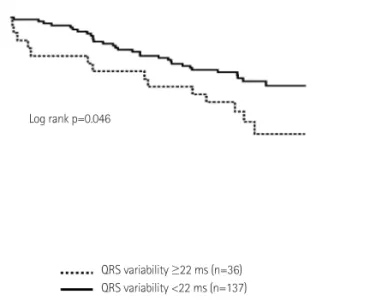
vs. 22.6%, HR 1.882; 95% CI 1.001-3.539, p=0.050). Kaplan-Meier analysis revealed a better event-free survival rate among patients with low QRS variability (log-rank p=0.046) (Fig. 2).

Univariate Cox regression analysis showed that five of nine risk factors

20)21)

could be candidate predictors of an increased risk of com- posite endpoints; age, ischemic cardiomyopathy, serum hemoglobin levels, serum sodium levels, and high QRS variability, whereas pro- longed initial inpatient QRS duration was not (Table 2). The unad- justed HR of high QRS variability for composite endpoints was 1.882 (95% CI 1.001-3.539, p=0.050). After adjustment with other sig- nificant variables, high QRS variability (HR 1.942, 95% CI 1.023-3.683, p=0.042), age (HR 1.030, 95% CI 1.005-1.057, p=0.020) and serum sodium levels (HR 0.935, 95% CI 0.875-0.999, p=0.046) were signif- icant predictors of composite endpoints (Table 2).

Association of bundle branch block during hospitalization with QRS variability

Thirty-two (18.5%) patients presented BBB more than once during

admission. According to the type of BBB, eight patients showed left BBB (LBBB) and 24 patients showed right BBB (RBBB). Patients with high QRS variability showed higher prevalence of BBB during ad- mission than those with low QRS variability (41.7% vs. 12.4%, p<

0.001). In patients with BBB, only five (14.3%) patients were AMI on admission. There was no relationship between presence of BBB and AMI on admission (p=0.472).

Composite endpoints were more frequent in the patients who presented BBB during admission than those without (46.9% vs. 21.3%, HR 2.46, 95% CI 1.32-4.57, p=0.008). The rate of composite end- points was the highest in patients with LBBB (50.0%), intermediate in those with RBBB (45.8%), and the lowest in those without BBB (21.3%). RBBB was a statistically significant risk predictor of com- posite outcome (HR 2.17, 95% CI 1.10-4.29, p=0.022), while LBBB was not (HR 2.37, 95% CI 0.85-6.62, p=0.101).

There were three patients with bifascicular block. Presence of bi- fascicular block was not a statistically significant risk factor of com- posite endpoints (HR 2.36, 95% CI 0.57-9.73, p=0.237).

Discussion

QRS variability measured during acute decompensated HF was an independent predictor of composite endpoints in HF patients with Table 1. Continued

Parameters Total

(n=173)

Low QRS variability (<22 msec) (n=137)

High QRS variability

(≥22 msec) (n=36) p

Persistent AF/AFL no. (%) 38 (22.0) 35 (25.5) 3 (8.3) 0.026

Ventricular premature beat no. (%) 28 (16.2) 20 (14.6) 8 (22.2) 0.269

Non-sustained VT no. (%) 3 (1.7) 1 (0.7) 2 (5.6) 0.048

Sustained VT no. (%) 1 (0.6) 0 (0) 1 (2.8) 0.050

Initial inpatient QRS (ms) 110±24 108±23 116±27 0.106

Last inpatient QRS (ms) 108±24 107±23 114±27 0.146

Minimum QRS (ms) 102±22 102±22 98±20 0.260

Maximum QRS (ms) 117±26 112±21 137±32 <0.001

QRS variability (ms) 16±17 10±5 39±25 <0.001

ECG findings

LVEF (%) 27±7 27±6 27±7 0.996

LVEDD (mm) 60.9±9.2 61.2±9.1 59.9±9.6 0.471

Amiodarone during admission no. (%) 36 (20.8) 28 (20.4) 8 (22.2) 0.814

Digoxin during admission no. (%) 71 (41.0) 61 (44.5) 10 (27.8) 0.069

Medication at discharge no. (%)

ACE inhibitors/angiotensin receptor blocker 71 (41) 59 (43.1) 12 (33.3) 0.291

Beta-blockers 31 (17.9) 26 (19.0) 5 (13.9) 0.479

Diuretics 56 (32.4) 47 (34.3) 9 (25.0) 0.288

Aldosterone antagonists 20 (11.6) 16 (11.7) 4 (11.1) 0.924

CMP: cardiomyopathy, BNP: B-type natriuretic peptide, ECG: electrocardiographic, AF/AFL: atrial fibrillation/atrial flutter, VT: ventricular tachyarrhythmia,

LVEF: left ventricular ejection fraction, LVEDD: left ventricular end-diastolic diameter, ACE: angiotensin converting enzyme

(6)

severe LV dysfunction.

QRS duration in heart failure

QRS duration showed greater variability in HF patients than those without HF.

12)

Previous studies reported that prolongation of QRS duration (≥120 ms) occurs in approximately 30% among HF pa- tients and is associated with increased risk of mortality.

3)

In consis- tent with previous reports, 33% of our study population showed prolonged QRS duration during hospitalization. Furthermore, the average of the mean QRS duration was more prolonged in the de- ceased group in our study.

Few studies have examined the change of QRS duration and its clinical significance in HF patients. Incremental changes of QRS du- ration could be related to progression of LV remodeling and intra- ventricular asynchrony, predicting more rapid progression to end state HF.

22)

We found that a wide variation of QRS duration including

widening and shortening during acute decompensated state was an important predictor of poor clinical outcome in HF patients with se- vere LV dysfunction.

Wang et al.

13)

found that patients who developed prolonged QRS duration during hospitalization showed an increased risk of cardio- vascular death compared to those with normal QRS duration. In ad- dition, patients who presented with prolonged QRS duration at ad- mission but who had normal QRS duration later during hospita- lization still demonstrated an increased risk of mortality compared to patients with normal QRS duration on both initial and last ECG.

In our study, patients who had high QRS variability but normal QRS duration (<120 ms) on their last inpatient ECG (n=25) showed a trend for worse clinical outcome of death or heart transplantation than patients who had low QRS variability and normal QRS duration in their last inpatients ECG (n=110, composite endpoints, 32.0% vs.

20.9%, p=0.234). Therefore, the change of QRS duration during hos- pitalization has more clinical implication than QRS duration itself in HF patients.

QRS variability and clinical outcome

It is unclear why high QRS variability is related to worse clinical outcome. A failing heart undergoes electrical remodeling resulting increased PR interval and QRS duration.

23)

Also, metabolic abnor- malities, myocardial ischemia or infarction, or pharmacological ag- ents could aggravate conduction disturbance in HF. Prolonged QRS duration in HF patients is related to LV dyssynchrony.

3)

LV dyssyn- chrony could be reversed by cardiac resynchronization, resulting im- provement of hemodynamic indices and long-term survival.

24)

Also, conduction delay in failing heart provides a substrate, such as scarred myocardium, for the development of ventricular tachyar- rhythmia, and inducible ventricular tachycardia, suggesting the in- creased risk of sudden cardiac death.

25)

Though we could not define the cause of death in every individual patient, 44% died from pro- gression of HF and 33% died from sudden cardiac arrest that could Fig. 2. Kaplan-Meier analysis of composite endpoints according to QRS vari-

ability. Patients with marked QRS variability showed higher event-rate than those with low QRS variability.

100

80

60

40

20

Time from discharge (days)

Event free survival (%)

0 500 1000 1500 2000 2500 QRS variability ≥22 ms (n=36)

QRS variability <22 ms (n=137) Log rank p=0.046

Table 2. Cox regression analysis for composite endpoints

Parameters Unadjusted HR (95% CI) p Adjusted HR (95% CI)* p

Age (years) 1.031 (1.006-1.057) 0.014 1.030 (1.005-1.057) 0.020

Male gender 1.055 (0.573-1.943) 0.863 - -

High QRS variability 1.882 (1.001-3.539) 0.050 1.942 (1.023-3.683) 0.042

Ischemic cardiomyopathy 2.071 (1.125-3.814) 0.019 - -

AMI on admission 1.375 (0.696-2.714) 0.359 - -

Serum hemoglobin (g/dL) 0.879 (0.773-0.999) 0.049 0.887 (0.775-1.015) 0.080

Serum sodium (mmol/L) 0.925 (0.864-0.991) 0.026 0.935 (0.875-0.999) 0.046

Serum creatinine (mg/dL) 1.111 (0.879-1.403) 0.378

Initial QRS duration ≥120 ms 1.288 (0.676-2.456) 0.441 - -

*adjusted with age, serum hemoglobin, serum sodium, high QRS variability, and ischemic cardiomyopathy. HR: hazard ratio, CI: confidence interval, AMI:

acute myocardial infarction

(7)

be associated with fatal arrhythmia among patients with known cause of death (n=18, 42.9% of deceased patients).

Most HF patients display incremental QRS duration during acute decompensation.

12)

However, whether the degree of QRS duration change has clinical significance is unclear. We hypothesized that QRS variability would be an early predictor of later QRS prolongation af- ter discharge. QRS variability defined as a temporal fluctuation of QRS duration during acute decompensated state would predict QRS prolongation. Although QRS duration was normal at compen- sated state, the patients who showed high QRS variability might have had ventricular electrical and mechanical instability, render- ing them prone to develop QRS prolongation in near feature.

Several studies have reported the relation of BBB to clinical out- come in HF patients.

15)

Whether the type of BBB is associated with outcome is debatable. Barsheshet et al.

14)

reported that RBBB has a 58% increased risk of 4-year mortality in patients with LVEF <30%.

In the present study, RBBB was significantly associated with wors- ened clinical outcome, consistent with a previous study.

14)

However, the number of patients with LBBB in this study (n=8, 4.6%) might be insufficient to verify the impact of LBBB on clinical outcome.

Relationship among QRS variability, frequency of electrocardiogram follow-up, and severity of patients

Patients with high QRS variability received more ECG testing dur- ing admission (10±5 vs. 6±4, p<0.001) (Table 1). Patients who ch- ecked ECG frequently (more than five times during admission; n=88, 50.8%) showed higher QRS variability (19.9±15.2 ms vs. 11.8±17.6 ms, p=0.002). Also, the number of checked ECG and QRS variability showed significant correlation (Pearson’s correlation coefficient=

0.277, p<0.001). We analyzed whether the frequency of ECG test was related with severity. Although it was not possible to quantify the patient’s severity due to lack of information, patients who re- ceived ECGs more than five times (n=88, 50.8%) showed longer hospital days (19±21 days vs. 13±8 days, p=0.022), higher preva- lence of AMI on admission (35.2% vs. 4.7%, p<0.001), and received more percutaneous coronary intervention during admission (21.6%

vs. 2.4%, p<0.001) than those who had less frequent ECG testing.

Considering that more severe patients might perform more frequent ECG follow-up, high QRS variability and high number of ECG follow- up could be the factors that represent the severity of the patients.

The number of performed ECG during admission did not show a significant difference between patients with and without compos- ite endpoints (7±5 vs. 6±4, p=0.840).

Limitations

Our study collected data retrospectively so that ECGs were per- formed without a prespecified schedule. Although the initial inpatient

ECG was performed within 8 days, the time of last inpatient ECG varied. Only 53 patients (29%) had the final inpatient ECG within one day of discharge day. Although the final inpatient ECG might not have been the ECG at discharge, most of the final ECGs were re- corded following recovery from decompensated HF. In addition, we could not collect detailed information on volume status, heart rate change during admission, and intravenously administered pharma- cologic agents, which can influence QRS duration. We could also not analyze serum magnesium levels, which could affect QRS duration, because the levels were measured only in 14 patients.

Although the population of our study included various causes of HF, analysis according to their etiologies was limited. QRS variability was measured during acute decompensated period; therefore it would be different with QRS duration measure in stable condition.

Therefore, the results of our study should be carefully interpreted into specific condition rather than general HF patients.

Conclusion

QRS variability during hospitalization for acute decompensated HF was an independent predictor for poor clinical outcome in HF pa- tients with severely reduced LVEF. Therefore, patients who present high QRS variability during acute decompensation may regard as high risk population for death or heart transplantation. Further in- vestigations are needed to apply the results of the present study to general HF patients.

Acknowledgments

This study was supported by grant number 03-2011-0370, 04-2010- 0260, 04-2010-1140 from the Seoul National University Hospital re- search fund.

References

1. Cleland JG, Gemmell I, Khand A, Boddy A. Is the prognosis of heart failure improving? Eur J Heart Fail 1999;1:229-41.

2. Shenkman HJ, Pampati V, Khandelwal AK, et al. Congestive heart fail- ure and QRS duration: establishing prognosis study. Chest 2002;122:

528-34.

3. Kashani A, Barold SS. Significance of QRS complex duration in patients with heart failure. J Am Coll Cardiol 2005;46:2183-92.

4. Murkofsky RL, Dangas G, Diamond JA, Mehta D, Schaffer A, Ambrose JA. A prolonged QRS duration on surface electrocardiogram is a specif- ic indicator of left ventricular dysfunction. J Am Coll Cardiol 1998;32:

476-82.

5. Sandhu R, Bahler RC. Prevalence of QRS prolongation in a community hospital cohort of patients with heart failure and its relation to left ventricular systolic dysfunction. Am J Cardiol 2004;93:244-6.

6. Brilakis ES, Mavrogiorgos NC, Kopecky SL, et al. Usefulness of QRS du-

ration in the absence of bundle branch block as an early predictor of

(8)

survival in non-ST elevation acute myocardial infarction. Am J Cardiol 2002;89:1013-8.

7. Kalra PR, Sharma R, Shamim W, et al. Clinical characteristics and sur- vival of patients with chronic heart failure and prolonged QRS dura- tion. Int J Cardiol 2002;86:225-31.

8. Iuliano S, Fisher SG, Karasik PE, Fletcher RD, Singh SN; Department of Veterans Affairs Survival Trial of Antiarrhythmic Therapy in Congestive Heart Failure. QRS duration and mortality in patients with congestive heart failure. Am Heart J 2002;143:1085-91.

9. Bleeker GB, Schalij MJ, Molhoek SG, et al. Relationship between QRS duration and left ventricular dyssynchrony in patients with end-stage heart failure. J Cardiovasc Electrophysiol 2004;15:544-9.

10. Cleland JG, Daubert JC, Erdmann E, et al. The effect of cardiac resyn- chronization on morbidity and mortality in heart failure. N Engl J Med 2005;352:1539-49.

11. Sipahi I, Carrigan TP, Rowland DY, Stambler BS, Fang JC. Impact of QRS duration on clinical event reduction with cardiac resynchronization therapy: meta-analysis of randomized controlled trials. Arch Intern Med 2011;171:1454-62.

12. Aranda JM, Carlson ER, Pauly DF, et al. QRS duration variability in pa- tients with heart failure. Am J Cardiol 2002;90:335-7.

13. Wang NC, Maggioni AP, Konstam MA, et al. Clinical implications of QRS duration in patients hospitalized with worsening heart failure and reduced left ventricular ejection fraction. JAMA 2008;299:2656-66.

14. Barsheshet A, Goldenberg I, Garty M, et al. Relation of bundle branch block to long-term (four-year) mortality in hospitalized patients with systolic heart failure. Am J Cardiol 2011;107:540-4.

15. McCullough PA, Hassan SA, Pallekonda V, et al. Bundle branch block patterns, age, renal dysfunction, and heart failure mortality. Int J Car- diol 2005;102:303-8.

16. Baldasseroni S, Gentile A, Gorini M, et al. Intraventricular conduction defects in patients with congestive heart failure: left but not right bundle branch block is an independent predictor of prognosis. A report from the Italian Network on Congestive Heart Failure (IN-CHF data- base). Ital Heart J 2003;4:607-13.

17. Gheorghiade M, Pang PS. Acute heart failure syndromes. J Am Coll Car- diol 2009;53:557-73.

18. Lee CW, Lee JH, Lim TH, et al. Prognostic significance of cerebral met- abolic abnormalities in patients with congestive heart failure. Circula- tion 2001;103:2784-7.

19. Gulati A, Ismail TF, Jabbour A, et al. The prevalence and prognostic sig- nificance of right ventricular systolic dysfunction in nonischemic di- lated cardiomyopathy. Circulation 2013;128:1623-33.

20. Parameshwar J, Keegan J, Sparrow J, Sutton GC, Poole-Wilson PA. Pre- dictors of prognosis in severe chronic heart failure. Am Heart J 1992;

123:421-6.

21. Hunt SA, Abraham WT, Chin MH, et al. ACC/AHA 2005 Guideline Up- date for the Diagnosis and Management of Chronic Heart Failure in the Adult: a report of the American College of Cardiology/American Heart Association Task Force on Practice Guidelines (Writing Commit- tee to Update the 2001 Guidelines for the Evaluation and Management of Heart Failure): developed in collaboration with the American Col- lege of Chest Physicians and the International Society for Heart and Lung Transplantation: endorsed by the Heart Rhythm Society. Circula- tion 2005;112:e154-235.

22. Shamim W, Yousufuddin M, Cicoria M, Gibson DG, Coats AJ, Henein MY. Incremental changes in QRS duration in serial ECGs over time identify high risk elderly patients with heart failure. Heart 2002;88:

47-51.

23. Xiao HB, Roy C, Fujimoto S, Gibson DG. Natural history of abnormal conduction and its relation to prognosis in patients with dilated car- diomyopathy. Int J Cardiol 1996;53:163-70.

24. Leclercq C, Cazeau S, Le Breton H, et al. Acute hemodynamic effects of biventricular DDD pacing in patients with end-stage heart failure. J Am Coll Cardiol 1998;32:1825-31.

25. Horwich T, Lee SJ, Saxon L. Usefulness of QRS prolongation in pre- dicting risk of inducible monomorphic ventricular tachycardia in pa- tients referred for electrophysiologic studies. Am J Cardiol 2003;92:

804-9.

수치

Fig. 1. Representative QRS variability calculation. A: shows initial QRS duration (144 ms) taken on admission day
Table 1. Baseline characteristics of study patients categorized by QRS variability Parameters Total (n=173) Low QRS variability (&lt;22 msec) (n=137) High QRS variability (≥22 msec) (n=36) p Age (years) 60±13 59±13 61±11 0.521 Male no
Table 2. Cox regression analysis for composite endpoints

참조

관련 문서

Preoperative evaluation of pelvic lateral lymph node of patients with lower rectal cancer: comparison study of MR imaging and CT in 53 patients?.

Intermittent hemodialysis(IDH) and Continuous renal replacement therapy (CRRT) has been used widely for treating critically ill patients with acute renal failure, We

Drug-intoxicated patients were predominantly male, with the highest incidence of intoxication among patients above the seventh decade of age(21.5%) and the

Therefore, nurses should be responsible for the relations to resolve the needs of care between nurses and patients and through communication with the patients,

period was prolonged unavoidably, (3) by explaining the risk factors associated with the failure to patients honestly, and subsequently performing

Glucose level before use of mannitol and peak osmolarity during mannitol treatment were associated with renal failure in univariate analysis.. In logistic regression

(Background) Gallbladder wall thickening(GWT) and gallbladder contraction are often observed in patients with acute hepatitis.. The incidence of acute hepatitis A

The risk of complicated acute appendicitis should be evaluated in terms of medical factors, including psychi- atric disease entity, psychotropic prescription, and