https://doi.org/10.5763/kjsm.2017.35.2.112 pISSN 1226-3729 eISSN 2288-6028
11 + 프로그램이 고등학교 축구선수의 기술능력 및 균형능력에 미치는 영향
한서대학교 대학원 물리치료학과1, 서남대학교 사회체육학과2
최 영 인1ㆍ강 준 구2
The Effects of 11+ Program on Technical Skills and Balance Ability of High School Soccer Players
Youngin Choi1, Junkoo Kang2
1Department of Physical Therapy, The Graduate School, Hanseo University, Seosan,
2Department of Social Physical Education, Seonam University, Namwon, Korea
This study aims to examine the effect of 8-week 11+ program on technical skills and balance abilities of high school soccer players. This study targeted 40 soccer players from G and K club in Gyeonggi-do and 20 players from G team and 20 players from K team were placed in the training group and the control group, respectively.
For data analysis, variable values of the two groups before and after intervention were calculated as averages and standard deviations using the SPSS ver. 21.0 statistic program. For analyzing within-group differences, paired t-test was conducted and for analyzing between-group differences, independent sample t-test was conducted. The statistical significance level was set at 0.05. The major study findings are as follows. First, the 11+ program was more effective in improving Jug 200 and short pass ability than static stretching. Second, the 11+ program was more effective in the posteromedial and posterolateral areas of Y-balance test than static stretching. These results demonstrate that the 11+ program is relatively effective in improving technical skills and balance abilities of soccer players. Therefore, it is considered that it is important to introduce and distribute the 11+ program to leaders, who are responsible for enhancing skills of soccer players.
Keywords: Soccer, Warm-up exercise, Postural balance, Proprioception
Received: April 25, 2017 Revised: August 16, 2017 Accepted: August 18, 2017
Correspondence: Junkoo Kang
Department of Social Physical Education, Seonam University, 439 Chunhyang-ro, Namwon 55724, Korea
Tel: +82-2-755-2113, Fax: +82-2-419-6926 E-mail: [email protected]
Copyright ©2017 The Korean Society of Sports Medicine
CC This is an Open Access article distributed under the terms of the Creative Commons Attribution Non-Commercial License (http://creativecommons.org/
licenses/by-nc/4.0) which permits unrestricted non-commercial use, distribution, and reproduction in any medium, provided the original work is properly cited.
서 론
축구는 전 세계에서 가장 인기 있는 운동 종목이다1). 국제축 구연맹의 주관 하에 4년마다 개최되는 월드컵(World Cup)은 대규모 축구대회로써 단일 종목으로는 지구촌 최대의 축제라 할 수 있다. 이를 증명하듯 대회 기간 내내 경기장은 관중으로 가득 차고, TV 시청자는 약 30억 명에 이른다2). 이와 더불어 국제축구연맹에 등록된 공식 선수는 265만 명으로 매년 증가 추세에 있는데3), 이는 다른 종목에 비해 월등히 높은 참여율이
Table 1. Physical characteristics of subjects
Group Age (yr) Height (cm) Weight (kg) 11+ (n=20) 18.40±0.75 177.05±5.47 72.95±5.77 Stretching
(n=20)
18.45±0.75 177.10±5.53 74.20±4.95
Values are presented as mean±standard deviation.
며 축구의 인기를 실감할 수 있는 수치이다4).
축구선수는 불안정한 환경에서 움직임이 발생하고 급작스 러운 방향전환과 특정 패턴의 동작을 반복하기 때문에 부상 발생 위험도가 매우 높다5). 축구선수의 부상은 조기 은퇴 및 경기수행력 저하와 같은 개인적 문제뿐 아니라 소속팀의 경제적 손해를 일으킴과 동시에 팬들의 재미를 반감시키는 요인이 된다1). 축구선수의 부상 부위는 하지 영역에 집중되어 있으며6), 부상 기전은 상대 선수와의 신체접촉 여부에 따라 접촉성 손상(contact injury)과 비 접촉성 손상(non-contact injury)으로 구분한다2). 엄정한 경기규칙의 적용, 선수 개개인 의 기술능력 향상 및 페어플레이(fair play) 정신을 통해 접촉성 손상빈도는 감소할 수 있지만2,7), 비 접촉성 손상은 고유수용성 훈련(proprioceptive training) 프로그램으로 예방할 수 있었다7). 이를 뒷받침하는 후속 연구들이 계속 보고됨에 따라 선수들의 부상 방지에 책임이 있는 국제축구연맹은 다방면의 전문가들 로 구성된 여러 집단에 의뢰하여 역동적 몸풀기 운동인 11+
프로그램을 제작 및 보급하는데 이르렀다2).
11+ 프로그램은 달리기, 균형훈련, 근력운동, 플라이오메 트릭(plyometric), 그리고 능동 신장 운동(active stretching)이 포함된 손상 예방 프로그램으로 균형능력 및 협응능력 향상에 이은 2차 효과를 통해 손상률을 감소시킬 수 있다. 이와 관련된 선행연구를 살펴보면, 11+ 프로그램을 실시한 팀은 손상빈도 가 훈련 중 37%, 경기 중 29%로 하락하는 것을 볼 수 있다1).
생역학적(biomechanics) 관점을 가지고 슛, 패스, 드리블, 그리고 트래핑 등과 같은 축구의 기술 동작을 살펴보면 이들 과제는 한 다리 서기(one-leg stance)와 같은 균형능력이 필수요 소임을 알 수 있다8). 또한, 일정하지 않은 상황에서 공의 소유권 을 유지하고 의도된 플레이를 실행하기 위해서는 여러 관절의 조화로운 복합 움직임과 관계된 협응 능력이 요구된다8). 이상 의 내용을 종합해 보았을 때, 11+ 프로그램은 손상 예방을 위한 목적으로 제작되었으나 균형능력 및 협응 능력에 미친 긍정적 영향을 고려할 때 축구선수의 기술능력 증진에도 효과 적일 수 있다고 추론된다. 하지만, 지금까지 11+ 프로그램에 대해서는 손상률 저하와 관계된 연구1), 몸풀기 프로그램으로 써 선호도를 조사한 연구밖에 없는 실정이다9).
이에 본 연구는 11+ 프로그램을 고등학교 축구선수에게 적용하여 기술능력에 미치는 영향을 검정하고 부가적으로 균형능력에 대한 효과를 알아보기 위해 실시하였다.
연구 방법
1. 연구 대상
본 연구는 경기도 소재 G, K 클럽팀에 소속된 고등학교 축구선수를 대상으로 실시하였다. 연구 목적에 따라 G팀 20명 은 훈련군에 배정되어 일반적인 몸풀기 운동 대신 11+ 프로그 램을 시행한 반면, 대조군의 K팀 20명은 전통적인 몸풀기 운동인 정적 신장 운동(static stretching)을 고수하였다. 모든 대상자는 연구에 참여하기 전 프로그램에 관한 설명을 들은 후 자발적인 참여 의사를 밝혔으며, 최근 6개월 동안 부상 경험이 있거나 내·외과적 질환을 가진 대상자는 제외하였다.
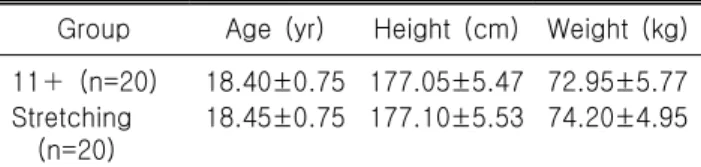
연구 대상자의 일반적 특성은 Table 1에 나타낸 바와 같다.
2. 측정 방법
8주간의 11+ 프로그램이 고등학교 축구선수의 기술능력 및 균형능력에 미치는 영향을 검정하기 위하여 사전-사후검사 통제집단설계를 따랐다.
1) 기술능력 측정
우세 다리를 결정하기 위하여 대상자에게 공을 굴린 후 차게 하였다. 그 결과 모든 대상자의 우세 다리는 오른쪽으로 판명되었다. 따라서 기술능력 측정 중 킥을 할 때에는 오른발 만 시도하였으며, 각각의 검사 전 1번의 연습 기회를 제공하였 다. 또한, 피로 누적을 최소화하기 위해 측정 간 휴식시간으로 5분을 허락하였다.
(1) Jug 200: 공을 지면에 떨어뜨리지 않는 리프팅 능력 검사로 양발을 사용하였다. 2번의 기회가 주어지며 각 시도 당 리프팅 100번을 목적으로 한다. 1번 리프팅 할 때마다 1점씩 가산되고 최고 점수는 200점이다8).
(2) Jug body: 다양한 신체 영역으로 공을 다루는 능력이다.
검사자가 5 m 앞에 서서 선수에게 공을 던지면, 선수는 다음의 순서로 공을 조절한다: 가슴–오른발–머리(Jug body 1), 머리–
왼발–오른발(Jug body 2), 발–가슴–머리(Jug body 3). 3번씩
측정하였으며, 과제를 성공적으로 완수할 경우 1점을 부여하 였다8).
(3) 짧은 패스: 움직이는 동안 짧은 패스의 정확성을 측정하 는 방법이다. 바닥에 선으로 표시된 직사각형 내에서 4 m 정도 드리블한 후 11 m 떨어져 있는 작은 골에 패스한다.
골 안에 공이 들어갈 경우 3점, 골포스트 혹은 크로스바를 맞추면 1점, 이를 제외한 나머지 경우는 0점을 부과한다. 5번 실시하였으며 총점을 결과값으로 이용하였다8).
(4) 긴 패스: 긴 패스의 정확성을 평가하는 방법으로 공과 1 m 떨어진 지점에서 준비한다. 36 m 떨어진 원 안에 공을 낙하시키는 과제로 총 5회 실시하여 총점을 기록한다. 공의 낙하지점이 지름 2 m 원 안에 위치하면 3점을 부과하며 지름 6 m는 2점, 지름 10 m의 경우에는 1점을 부여한다8).
(5) 슈팅: 정적 자세에서 슈팅의 정확도를 측정하는 방법이 다. 공은 골의 중간 지점으로부터 16 m 떨어진 곳에 위치시키 며, 선수는 제자리 슈팅을 시도한다. 골은 6개의 영역으로 구분되어 있는데, 상부 영역의 오른쪽을 향해서 슈팅한 후 왼쪽으로 킥을 한다. 만약 검사자가 지시한 지점을 강타한 경우 3점이 수여되며 상부 영역의 다른 지점을 강타하거나 골포스트 혹은 크로스바를 맞추면 1점을 부여한다. 공이 하부 영역을 향하거나 노골일 경우 0점이며, 6번 시도하여 총점을 산출하였다8).
2) 균형능력 측정
연구 대상자의 균형능력을 측정하기 위해 현장에서 활용 가능한 Y-균형 검사를 선택하였다. 이것은 별 변위 균형 검사 (star excursion balance test)의 재현성 증진과 임상적 접근을 쉽게 하기 위해 고안된 검사방법으로 하지의 근력, 안정성, 유연성, 그리고 고유수용성 감각 및 신경근조절 능력을 평가할 수 있다10). 검사자 내 신뢰도와 검사 간 신뢰도는 각각 0.84–
0.87, 0.89–0.93으로 측정된 바 있다11).
중앙 발판 위에 한 다리로 서 있는 동안 전면, 후내측, 후외측 방향에 있는 네모난 구조물을 반대 발로 밀어 변위된 거리를 측정하였다. 학습효과를 최소화함과 동시에 검사방법에 익숙 해지기 위하여 각 방향으로 4번의 연습을 허용하였고12), 3분간 의 휴식 후 3회 측정하여 최고값을 기록하였다. 모든 대상자는 신발에 의한 이점을 제거하기 위해 맨발로 검사에 임했으며13), 우세다리가 오른쪽이었다. 따라서 킥을 할 때 왼쪽 다리의 안정성이 요구되므로 균형능력은 왼 다리만 측정하였다. 그리 고 연구 대상자마다 하지 길이가 다르기 때문에 검사 전 전상장 골극부터 내측과에 이르는 하지 길이를 측정하여 네모난 구조
물의 이동거리를 표준화하였다14).
만약 지지하고 있는 발이 지면에서 떨어지거나 뻗은 다리가 본래 위치로 되돌아오지 못하는 경우 실패로 간주하였다. 또 한, 균형유지를 위해 뻗은 발로 바닥을 지탱하고, 네모난 구조 물을 멀리 이동시킬 목적으로 차는 것 역시 제어하였으며 양손이 허리에서 떨어지면 재측정하였다15).
균형능력에 영향을 미칠 수 있는 변수를 배제하기 위하여 측정은 중재 전후 같은 시간대에 외부환경과 차단된 공간에서 진행되었고, 측정 전 3일 동안 공식 경기가 잡히지 않았으며 당일 훈련 계획이 없을 때 시행되었다.
3. 운동 방법
8주간의 11+ 프로그램이 고등학교 축구선수의 기술능력 및 균형능력에 미치는 영향을 알아보기 위하여 정적 신장 운동 집단과 11+ 훈련 집단으로 구분하여 연구를 하였다.
각각의 프로그램은 주 5회, 1일 운동시간 30분으로 동일하게 적용하였으며, 숙련된 체력 강사와 물리치료사에 의하여 본 운동 전에 시행되었다.
1) 11+ 프로그램
11+ 프로그램은 세 영역으로 구분되어 있으며 15종류의 운동방법이 있다(Table 2). 첫 번째 영역은 능동 신장 운동과 동료와의 신체접촉이 포함된 느린 속도 달리기로 6가지 동작 을 2회 반복한다. 두 번째 영역은 몸통 중심 및 다리 근력, 균형, 그리고 순발력과 플라이오메트릭에 초점을 둔 6가지 동작으로 이루어져 있으며, 9번 동작을 제외하고 한 동작 당 유지 시간 30초, 6회 실시하였다. 마지막 영역은 착지 동작과 방향전환이 특징적으로 나타나고, 중간 혹은 빠른 속도 달리기 과제로 구성된 3가지 종류의 운동을 2회 반복하였다2).
11+ 프로그램 수행 시 가장 중요한 사항은 바른 자세와 자세조절 능력을 적정 상태로 유지하는 데 있으며, 이를 위해 다음의 사항을 항상 염두 해야 한다. 다리는 항상 곧게 뻗어 1자를 만들고, 서 있는 자세에서 다리를 구부릴 경우 무릎이 발가락을 넘어가서는 안 되며, 착지 동작을 수행할 경우 무릎 을 구부려 부드럽게 착지해야 한다3). 운동강도는 두 번째 영역에서만 점진적으로 증가하였는데, 1–3주까지는 레벨 1, 4–6주까지는 레벨 2, 7–8주 동안은 레벨 3의 동작들을 실시하 였다2).
Table 2. 11+ Program
Exercise Action
1. Running straight ahead
Jog straight to the last cone.
2. Running hip out Jog to the first cone and stop. Lift your knee forwards and outward rotate.
3. Running hip in Jog to the first cone and stop. Lift your knee to the side and inward rotate.
4. Running circling partner
Jog to the first cone and shuffle sideways at a 90° towards your partner.
5. Running jumping with shoulder contact
Jog to the first cone and jump sideways towards each other to make shoulder to shoulder contact.
6. Running quick forth/backs sprints
Run two cones forwards and one cone backwards. Keeping your hips and knees slightly bent.
7. The bench 1) Lie prone on elbow. Lift your whole body until your body is in a straight line from head to foot.
2) Make the bench static position. Lift each leg in turn.
3) Make the bench static position. Lift one leg off the ground and hold the position for 20-30 seconds.
8. Sideways bench 1) Lie sideways on elbow. Lift your pelvis and top leg until they form a straight line.
2) Lie sideways on elbow. Lift your whole body until they form a straight line.
3) Make the sideways bench position. Lift your top leg up and slowly lower it.
9. Hamstrings In the kneeling position, slowly lean forward and trying to hold the position with your hamstrings. Fall into a press-up position. Level 1 (3-5 repetitions), level 2 (7-10 repetitions), level 3 (12-15 repetitions).
10. Single leg balance 1) Hold your balance and keep your body weight on the ball of your foot.
2) Keep your balance while you throw the ball to one another.
3) Keep your balance while you and your partner in turn try to push the other.
11. Squats 1) Slowly bend your hips, knees and ankles until your knees are flexed to 90°.
2) Lunge forwards slowly at an even pace. Bend your hips and knees until flexion 90°.
3) Bend your knee at the same time as your partner. Bend your knee, if possible until flexion 90°.
12. Jumping 1) Make the squats position. Hold this position for 1 second, then jump as high as you can.
2) Jump approximately 1 m to the side from your supporting leg onto your other leg.
3) Make the squats position. Jump forwards and backwards, from side to side, and diagonal.
13. Running across the pitch
Run approximately 40 m across the pitch at 75%-80% of maximum pace.
14. Running bounding Take a few warm-up steps then take 6–8 bounding steps with a high knee lift.
15. Running plant/cut Jog 4-5 steps straight ahead. Then plant on the right leg and cut to left and accelerate again.
2) 정적 신장 운동
Faigenbaum 등16)에 의해 제안된 방법과 관련 교재를 참고하 여 본 연구자가 재구성한 정적 신장 운동은 15개의 동작으로 이루어졌다(Table 3)17). 축구선수가 공을 차는 동안 활성화되 는 다리근육에 초점을 두었으며, 목표 근육은 장딴지근, 뒤넙 다리근, 넙다리네갈래근, 큰볼기근, 엉덩관절 굽힘근 및 모음 근이었다18). 신장 운동 시 강조되었던 사항은 동작을 천천히 수행하는 것과 신체정렬 상태를 항상 바르게 하는 것이었으며, 대상자는 약간 불편한 지점에서 15초 동안 자세를 유지한 후 5초 이완하였다. 모든 동작은 2번 반복하여 시행하였고, 좌우를 구분한 신장 운동만 같은 방식으로 반대쪽 다리에
적용하였다16).
4. 자료 처리
자료 분석은 SPSS ver. 21.0 (IBM Corp., Armonk, NY, USA) 통계 프로그램을 이용하였고, 측정된 변수값은 평균과 표준편 차로 산출되었다. 중재 전후 집단 내 차이는 대응표본 t-test를 활용하여 검정하였으며, 중재 전후 집단 간 차이는 독립표본 t-test로 확인하였다. 통계학적 유의수준은 0.05로 설정하였다.
Table 3. Static stretching
Exercise Action
1. Adductor stretch In the seated position with an erect spine, touch soles of feet together, bend knees, and allow knees to drop.
2. Modified hurdlers stretch
In a seated position with one leg straight, place the other leg on the inside of the straight leg and reach forward.
3. Seated knee flexor Stretch
In a long-sitting position, bend at the waist and lower the head toward the legs. If possible, keep the back of the knees on the floor.
4. Seated knee flexor/
hip adductor stretch
In a long-sitting position with legs extended in a V position. Keep both knees straight and reach the hands out toward center with trunk flexion.
5. Hip external rotator/back extensor stretch
Sit on the floor with the one leg extended. Bend the other leg and place the other foot on the outside of the one knee. Bend the one arm and position the outside of the one elbow against the outside of the upraised other knee. Brace the other arm against the floor near other hip. Twisting the trunk as far as possible to the other.
6. One leg kneeling knee extensor stretch
In a lunge position with rear lower leg lies on the floor. Move the hips forward, pushing the forth knee in front of the forth ankle and dorsiflexing that ankle.
7. Hip extensor/back extensor stretch
In a supine position, bend the one knee and bring it toward the chest. While keeping the other leg flat, grasp the one knee and pull it down toward the chest as far as possible.
8. Hip rotator stretch In a supine position, cross one leg over the other, forming a figure 4, and flex both hips to or past 90 by pulling on the uncrossed leg.
9. Hip external rotator/extensor stretch
In a supine position, while outwardly rotating the one leg, bend the one knee and bring the one foot to the body’s midline. While keeping the other leg flat, pull the lower leg.
10. Front lying position In a prone position, place both hands palms down. Slowly arch the back, contracting the buttock.
Continue arching the back and lift your head and chest off the floor.
11. Bent-over toe raise From a standing position with the heel of one foot slightly in front of the toes of the other foot, dorsiflex front foot towards shin while leaning downward with upper body.
12. Quadriceps stretch In the standing position with an erect spine, bend one knee and bring heel towards buttocks while holding the foot with one hand.
13. Arched back In a standing position with hands placed on the hips. Slowly arch the back, contracting the buttocks and pushing the hips forward while dropping backward with head.
14. Standing bent knee hip adductor stretch
In a wide-squat position, lower the body to a half squat position, bending the one knee and keep the other knee straight. Place the hands on the top of the one knee for support.
15. Calf stretch In a standing position with feet staggered about 2 or 3 feet from a wall, lean against the wall with both hands, keeping the back leg straight and the front leg slightly bent.
결 과
1. 기술능력의 변화
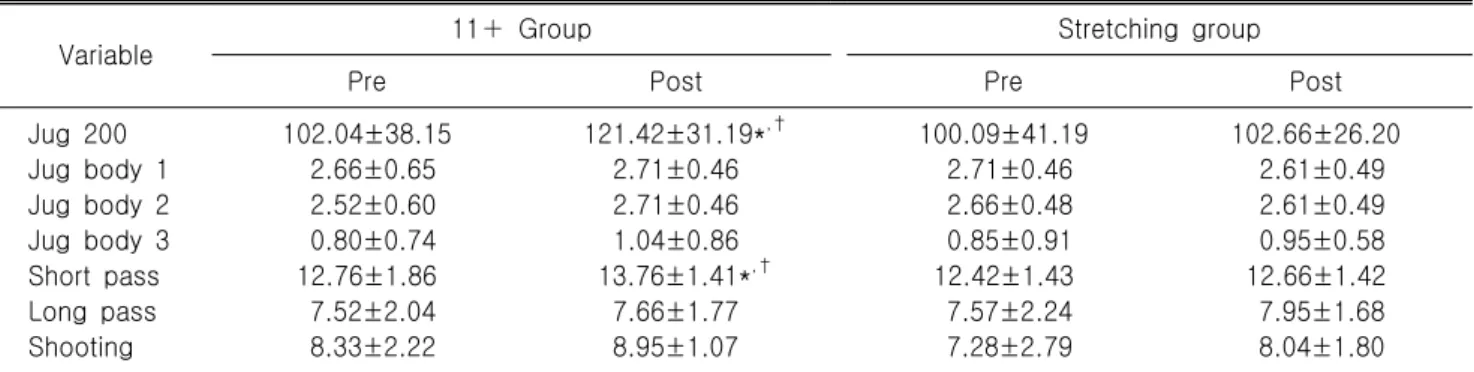
두 집단의 기술능력에 대한 측정결과는 다음과 같다. 중재 전후 집단 내 변화는 11+ 프로그램 집단에서 Jug 200과 짧은 패스 항목이 유의한 변화를 일으켰고(p<0.05), 정적 신장 운동 집단은 모든 항목에서 유의한 변화가 나타나지 않았다. 중재 전후 집단 간 차이는 Jug 200과 짧은 패스 항목에서 유의성을 보여주었다(p<0.05) (Table 4).
2. 균형능력의 변화
두 집단의 균형능력에 대한 측정결과는 다음과 같다. 중재
전후 집단 내 변화는 11+ 프로그램 집단에서 전면(p<0.01), 후내측(p<0.001), 후외측(p<0.001) 방향에서 유의한 변화를 일으켰고, 정적 신장운동 집단은 전면(p<0.05)에서만 유의한 변화가 나타났다. 중재 전후 집단 간 차이는 후내측(p<0.001), 후외측(p<0.01) 방향에서 유의성을 보여주었다(Table 5).
고 찰
본 연구는 11+ 프로그램을 8주간 실시한 후 고등학교 축구 선수의 기술능력 및 균형능력에 미친 영향을 정적 신장 운동과 비교하여 검정한 결과, 기술능력은 Jug 200과 짧은 패스에서 유의한 차이가 나타났고 균형능력은 Y-균형 검사의 후내측, 후외측 거리에서 유의한 향상을 볼 수 있었다.
Table 4. Comparison of technical skills between groups
Variable 11+ Group Stretching group
Pre Post Pre Post
Jug 200 102.04±38.15 121.42±31.19*,† 100.09±41.19 102.66±26.20
Jug body 1 2.66±0.65 2.71±0.46 2.71±0.46 2.61±0.49
Jug body 2 2.52±0.60 2.71±0.46 2.66±0.48 2.61±0.49
Jug body 3 0.80±0.74 1.04±0.86 0.85±0.91 0.95±0.58
Short pass 12.76±1.86 13.76±1.41*,† 12.42±1.43 12.66±1.42
Long pass 7.52±2.04 7.66±1.77 7.57±2.24 7.95±1.68
Shooting 8.33±2.22 8.95±1.07 7.28±2.79 8.04±1.80
Values are presented as mean±standard deviation.
Pre: before exercise program was applied, Post: after exercise program was applied.
*Significant difference to pre (p<0.05); †Significant difference to stretching group (p<0.05).
Table 5. Comparison of balance ability between groups
Variable
11+ Group Stretching group
Pre Post Pre Post
Anterior 67.36±5.27 70.12±4.30* 66.90±5.94 68.48±4.75*
Posteromedial 76.38±5.69 81.17±3.78*,† 73.72±5.31 75.42±4.60
Posterolateral 72.60±5.43 76.94±3.91*,† 71.49±3.89 72.53±4.70
Values are presented as mean±standard deviation.
Pre: before exercise program was applied, Post: after exercise program was applied.
*Significant difference to pre (p<0.05); †Significant difference to stretching group (p<0.05).
정적 신장 운동은 관절가동범위의 끝 지점에 팔다리를 위치 시킨 후 일정 시간 동안 근 길이가 늘어난 자세를 유지하는 운동방법으로 축구선수의 몸풀기 프로그램에 필수 요소라 여겨져 왔다. 관절가동범위 향상, 근육힘줄단위(musculoten- dinous unit)의 길이 증가 및 경직도 완화를 통해 탄성 에너지 저장능력이 증대되어 장거리 달리기와 하강 점프 과제의 수행 능력에서는 긍정적인 결과를 끌어냈지만, 액틴(actin)과 미오 신(myosin)에 의한 교차 다리(cross bridge) 형성이 적정 수준보 다 떨어져 길이-장력 관계에 의거하여 힘 생성 능력은 감소하 게 된다19). 이에 대해 Power 등20)은 정적 신장 운동 적용 2시간 후 측정했을 때 넙다리네갈래근의 최대근수축력(maximum voluntary contraction) 및 근육 활성도(muscle activation)가 각각 9.5%, 5.4%로 떨어진다 하였으며, 발바닥굽힘근을 검정한 Fowles 등21)의 연구에서는 최대 근수축능력이 신장 운동 후 즉시 28%, 60분 후 9% 감소한 것으로 나타났다. 이처럼 몸풀기 프로그램으로써 정적 신장 운동의 효용성을 의심할만한 연구 결과가 계속 보고됨에 따라 움직임에 기초한 동적 신장 운동 (dynamic stretching)이 대안으로 제시되었고19), 축구선수의 운 동수행력18)과 협응능력 및 킥 정확성22) 향상에 관하여 정적 신장운동보다 효과적이었다는 연구가 발표되었다. 본 연구도
축구선수의 기술능력 및 균형능력 증진에 대해 다소 차이는 있지만, 정적 신장 운동의 효능이 상대적으로 미약하게 나타났 는데, 이러한 결과는 선행연구를 뒷받침해준다.
Jug 200은 공을 바닥에 떨어트리지 않는 리프팅 능력 검사로 기술능력 중 기초에 해당하는 부분이다. 이와 관련된 국내 연구를 살펴보면, Park23)은 리프팅이 안정된 자세를 요구하는 운동과제이기 때문에 자세조절능력을 증진하는 평형성 운동 으로 향상될 수 있음을 보여주었고, Evangelos 등8)은 발목뼈로 공을 맞히는 것이 상대적으로 어렵지 않기 때문에 고유수용성 및 균형 훈련 프로그램을 통한 지지 다리의 안정성 향상만으로 도 리프팅 능력을 증진할 수 있다고 제언하였다. 본 연구에서 도 Jug 200의 유의한 변화가 확인되었는데, 이는 균형능력 향상에 이바지할 수 있는 여러 요소가 11+ 프로그램에 내재되 어 있음을 시사하는 바이다.
짧은 패스는 현대축구에서 공의 점유율을 높일 수 있는 주요 방법으로 본 연구에서는 실제 경기상황과 유사한 조건에 서 과제를 수행하도록 하기 위해 4 m 가량 드리블을 시행한 후 목표 지점에 패스하도록 하였다. 그 결과 11+ 프로그램을 실시한 집단이 정적 신장 운동을 실시한 집단보다 유의하게 높은 정확성을 보여주었다. 역동적인 환경에서의 패스 동작은
불안정한 상태에 직면할 가능성이 커지기 때문에 디딤발로 대변되는 지지 다리의 견고한 안정성은 무엇보다 중요하다24). 이에 대해 Chew-Bullock 등24)은 왼쪽 다리의 안정성 측정이 오른발의 패스 능력에 관한 예측인자가 될 수 있다고 하였다.
11+ 프로그램의 운동과제는 정적 자세 유지 혹은 제한된 동적 움직임을 이용한 균형 및 근력 강화 운동과 점프와 달리기 같은 역동적 움직임에 초점을 둔 운동으로 구분할 수 있다2). 이 중 우리가 주목해야 할 부분은 역동적 운동과제이다. 왜냐 하면, 과제수행 시 강조되었던 사항이 하지관절의 부적합한 역동적 외반자세(dynamic valgus)가 나타나지 않도록 주의하 는 것이었기 때문이다2). 동작 분석에 기초한 선행 연구들은 축구선수의 전방십자인대 손상과 관련된 위험요인으로 하지 관절의 역동적 외반자세를 보고하고 있으며, 이러한 정렬상태 가 하지관절의 불안정을 야기한다고 하였다25). 이때 생역학적 변수를 수치화하여 검정한 결과 무릎관절의 굽힘각도는 감소 되고 벌림각도는 증가되는 것으로 나타났는데, 이는 무릎관절 의 폄 및 벌림 모멘트(moment) 발생과 관련이 있다25). 따라서 무릎관절의 폄 및 벌림 모멘트가 증대되어 나타나는 양상은 지지 다리의 안정성 결여로 인한 킥 수행력 저하와 손상 위험이 커지고 있음을 대변하는 것이며, 이를 뒷받침하는 결과가 축구 선수를 대상으로 한 Sinclair와 Hobbs26)의 연구에서 보고되었 다. 이상의 내용을 종합해 보면, 역동적 외반 자세 제어에 역점을 두는 11+ 프로그램의 훈련방식이 축구선수의 지지 다리 안정성 향상과 이를 통한 패스 정확도 증진에 효과적인 접근방법임을 유추해 볼 수 있다.
긴 패스와 슈팅 과제에서는 두 집단 간에 유의한 차이가 발견되지 않았다. 기술능력 중 킥 수행력에 해당하는 긴 패스 와 슈팅은 정지된 공을 차는 과제이므로 4 m 드리블 후 공을 차는 짧은 패스 과제보다 지지 다리의 안정성이 크게 위협받지 않는 상황임을 짐작해 볼 수 있다. 이처럼 정적 및 동적 과제 간의 환경변화에 따라 성공적인 과제 수행을 위한 요인의 중요도는 지지 다리의 안정성보다 공의 스윗지점(sweet spot) 을 정확하게 가격하고 적정 강도로 찰 수 있는 감각이 상대적으 로 높아졌다고 판단된다. 또한, Shan과 Westerhoff27)는 높은 수준의 킥 수행력을 발휘하기 위한 조건으로 팔의 벌림과 폄, 그리고 몸통 돌림에 의해 형성되는 긴장성 원호(tension arc)를 강조하였는데, 이는 공을 차는 동작이 단순하게 다리에 의해서만 이루어지는 것이 아니라 상ㆍ하체 간의 운동학적 연결을 통해 실행된다는 의미이다. 따라서 공을 차는 운동과제 가 포함되지 않은 11+ 프로그램의 구조적 특징이 공에 대한 발의 감각과 킥 동작에 요구된 협응 작용 훈련에는 효과적이지
못한 것으로 판단된다.
균형은 기저면 내에 무게중심을 유지하는 능력으로 일상생 활 및 운동경기 동안 여러 과제를 수행하는 데 있어 중요한 역할을 담당한다. 신체 접촉을 허용한 축구는 상대 선수의 압박을 이겨내면서 원하는 방향으로 공을 정확하게 보내야 하기 때문에 높은 수준의 균형조절 능력이 필수적이다8). 이를 재해석해 보면 기량이 월등한 축구선수는 균형조절 능력이 우수함을 암시하는 것으로 국가대표와 국내리그 선수의 균형 능력을 비교한 Paillard 등28)의 연구를 통해 이를 확인할 수 있다. 지금까지 축구선수의 균형능력을 측정한 연구는 신체 무게중심의 변위를 객관적 수치로 도출하기 위해 컴퓨터와 힘판이 장착된 검사 장비를 활용하였다. 이것은 대상자의 균형 능력을 과학적이고 표준화된 방식으로 측정할 수 있는 장점이 있지만, 가격이 비싸고 현장에서 일선 지도자가 사용하는 데 어려움이 있다. 따라서 본 연구는 신뢰도가 높게 나타나고 언제, 어디서나 쉽게 적용할 수 있는 Y-균형 검사를 측정 도구로 선택하였다. 본 연구의 11+ 프로그램 집단은 Y-균형 검사의 후내측ㆍ후외측 영역에서 통계학적으로 유의하게 향 상된 결과를 보여주었다. 균형은 다양한 활동을 수행하는 데 있어 필수조건으로 작용하기 때문에 스포츠 영역을 비롯한 여러 분야에서는 다각적 견해를 가지고 연구가 이루어져 왔다.
균형능력 개선에 효과가 입증된 선행 연구를 살펴보면 중심근 력29) 향상과 밀접한 관련이 있음을 알 수 있고, 플라이오메트 릭30)은 민첩성 훈련보다 별변위 균형 검사의 뻗기 거리를 증가시키는데 효능이 있음을 알 수 있었다. 따라서 이러한 훈련 요소가 포함된 11+ 프로그램은 정적 신장 운동과 달리 신체의 여러 운동 기능에 긍정적 영향을 미쳐 균형능력을 더욱 증진시킬 수 있었다.
본 연구의 제한점은 대상자의 수가 40명에 불과해 연구결과 를 일반화하는 데 어려움이 있다는 것이다. 또한, 운동 강도를 개인별 맞춤형이 아닌 중재 기간에 따라 일괄적으로 증가시켜 프로그램의 질적 수준을 대상자에 맞게 일정한 상태로 맞추지 못하였다. 마지막으로 11+ 프로그램의 어떠한 운동방법이 기술능력 및 균형능력 향상에 긍정적 영향을 미쳤는지 명시하 는데 난해한 부분이 있다. 추후 연구에서는 과학적인 장비를 이용하여 영향인자를 명확하게 파악하는 노력이 필요하고, 다양한 연령층의 선수들에게 적용하여 11+ 프로그램의 효능 을 보다 광범위하게 검정할 필요가 있다고 여겨진다.
본 연구는 국제축구연맹에서 제작한 11+ 프로그램을 축구 선수에게 적용하여 기술 및 균형 능력에 대해 효능을 보고한 첫 중재연구라는 점에서 연구 가치가 있을 것으로 생각하며
다음과 같이 결론을 내렸다. 첫째, 11+ 프로그램은 정적 신장 운동보다 고등학교 축구선수의 기술능력 중 Jug 200과 짧은 패스에서 유의한 향상을 보여주었다. 둘째, 11+ 프로그램은 정적 신장운동보다 고등학교 축구선수의 Y-균형 검사 후내측·
후외측 영역에서 유의한 향상을 보여주었다. 본 연구를 통해 11+ 프로그램이 고등학교 축구선수의 기량 향상에 도움이 되는 유용한 중재방법임을 알 수 있었다.
Conflict of Interest
No potential conflict of interest relevant to this article was reported.
References
1. Soligard T, Myklebust G, Steffen K, et al. Comprehensive warm-up programme to prevent injuries in young female footballers: cluster randomised controlled trial. BMJ 2008;
337:a2469.
2. F-MARC. The "11+" manual. Zurich: FIFA; 2006.
3. FIFA. FIFA big count 2006: 270 million people active in football [Internet]. Zurich: FIFA; c2006 [cited 2017 Aug 23].
Available from: https://www.fifa.com/mm/document/fifafacts/
bcoffsurv/bigcount.statspackage_7024.pdf.
4. Emery CA, Meeuwisse WH, McAllister JR. Survey of sport participation and sport injury in Calgary and area high schools. Clin J Sport Med 2006;16:20-6.
5. Tscholl P, O'Riordan D, Fuller CW, Dvorak J, Gutzwiller F, Junge A. Causation of injuries in female football players in top-level tournaments. Br J Sports Med 2007;41 Suppl 1:i8-14.
6. Brito J, Fontes I, Ribeiro F, Raposo A, Krustrup P, Rebelo A. Postural stability decreases in elite young soccer players after a competitive soccer match. Phys Ther Sport 2012;
13:175-9.
7. Kraemer R, Knobloch K. A soccer-specific balance training program for hamstring muscle and patellar and achilles tendon injuries: an intervention study in premier league female soccer. Am J Sports Med 2009;37:1384-93.
8. Evangelos B, Georgios K, Konstantinos A, Ioannis G, Christos P, Aristomenis S. Proprioception and balance training can improve amateur soccer players' technical skills.
J Physic Educ Sport 2012;12:81-9.
9. Soligard T, Nilstad A, Steffen K, et al. Compliance with a comprehensive warm-up programme to prevent injuries in
youth football. Br J Sports Med 2010;44:787-93.
10. Plisky PJ, Gorman PP, Butler RJ, Kiesel KB, Underwood FB, Elkins B. The reliability of an instrumented device for measuring components of the star excursion balance test. N Am J Sports Phys Ther 2009;4:92-9.
11. Plisky PJ, Rauh MJ, Kaminski TW, Underwood FB. Star excursion balance test as a predictor of lower extremity injury in high school basketball players. J Orthop Sports Phys Ther 2006;36:911-9.
12. Robinson R, Gribble P. Kinematic predictors of performance on the star excursion balance test. J Sport Rehabil 2008;
17:347-57.
13. Gribble PA, Hertel J. Effect of lower-extremity muscle fatigue on postural control. Arch Phys Med Rehabil 2004;
85:589-92.
14. Robinson RH, Gribble PA. Support for a reduction in the number of trials needed for the star excursion balance test.
Arch Phys Med Rehabil 2008;89:364-70.
15. Lee DK, Kim GM, Ha SM, Oh JS. Correlation of the Y-balance test with lower-limb strength of adult women. J Phys Ther Sci 2014;26:641-3.
16. Faigenbaum AD, Bellucci M, Bernieri A, Bakker B, Hoorens K. Acute effects of different warm-up protocols on fitness performance in children. J Strength Cond Res 2005;19:
376-81.
17. Nelson AG, Kokkonen J. Stretching anatomy. Champaign:
Human Kinetics; 2007.
18. Little T, Williams AG. Effects of differential stretching protocols during warm-ups on high-speed motor capacities in professional soccer players. J Strength Cond Res 2006;20:
203-7.
19. Behm DG, Chaouachi A. A review of the acute effects of static and dynamic stretching on performance. Eur J Appl Physiol 2011;111:2633-51.
20. Power K, Behm D, Cahill F, Carroll M, Young W. An acute bout of static stretching: effects on force and jumping performance. Med Sci Sports Exerc 2004;36:1389-96.
21. Fowles JR, Sale DG, MacDougall JD. Reduced strength after passive stretch of the human plantarflexors. J Appl Physiol (1985) 2000;89:1179-88.
22. Frikha M, Derbel MS, Chaari N, Gharbi A, Chamari K.
Acute effect of stretching modalities on global coordination and kicking accuracy in 12-13 year-old soccer players. Hum Mov Sci 2017;54:63-72.
23. Park S. The effects of 8 weeks balance training programs have on middle school soccer players' physical fitness and soccer skills [dissertation]. Busan: Kyungsung University;
2010.
24. Chew-Bullock TS, Anderson DI, Hamel KA, Gorelick ML, Wallace SA, Sidaway B. Kicking performance in relation to balance ability over the support leg. Hum Mov Sci 2012;31:1615-23.
25. Stearns KM, Pollard CD. Abnormal frontal plane knee mechanics during sidestep cutting in female soccer athletes after anterior cruciate ligament reconstruction and return to sport. Am J Sports Med 2013;41:918-23.
26. Sinclair J, Hobbs SJ. Bilateral differences in knee and ankle loading of the support limb during maximal instep soccer kicking. Sci Sports 2016;31:e73-8.
27. Shan G, Westerhoff P. Full-body kinematic characteristics of the maximal instep soccer kick by male soccer players and
parameters related to kick quality. Sports Biomech 2005;4:
59-72.
28. Paillard T, Noe F, Riviere T, Marion V, Montoya R, Dupui P. Postural performance and strategy in the unipedal stance of soccer players at different levels of competition. J Athl Train 2006;41:172-6.
29. Ozmen T, Aydogmus M. Effect of core strength training on dynamic balance and agility in adolescent badminton players.
J Bodyw Mov Ther 2016;20:565-70.
30. Cho HR, Lee KS. The effects of plyometric training on dynamic balance ability with twenty normal adults six weeks.
J Korean Proprioceptive Neuromuscul Facil Assoc 2010;8:
59-65.