• 검색 결과가 없습니다.

Discrepancy of the Cause of Death in Autopsy Cases of Cardiovascular Disease with a Focus on Cause of Death Statistics

N/A
N/A
Protected

Academic year: 2022

Share "Discrepancy of the Cause of Death in Autopsy Cases of Cardiovascular Disease with a Focus on Cause of Death Statistics"

Copied!
7
0
0

로드 중.... (전체 텍스트 보기)

전체 글

(1)

Introduction

Determining an individual’s cause of death (COD) is a difficult, yet very important task. On an individual level, determining the COD represents the final decision of death, whereas from a social perspective, determining the COD in individual cases can provide basic data for establishing social policies concerning public health

and social safety. Hospital autopsy rates are decreasing worldwide, but autopsies remain useful [1]. Most autopsies performed in Korea are forensic autopsies and the autopsy rate in Korea is very low [2]. An autopsy is recognized as the gold standard procedure for investigating death, including the determination of COD [3]. Therefore, it is very difficult for countries with low autopsy rates, such as Korea, to establish accurate https://doi.org/10.7580/kjlm.2017.41.4.100

Discrepancy of the Cause of Death in Autopsy Cases of

Cardiovascular Disease with a Focus on Cause of Death Statistics

Joo-Young Na

1

, Ji Hye Park

2

, Bong-Woo Lee

3

, Bo-Young Lee

3

1

Biomedical Research Institute, Chonnam National University Hospital, Gwangju, Korea,

2

Forensic Medicine Division, National Forensic Service Gwangju Institute, Jangseong, Korea,

3

Medical Examiner’s Office, National Forensic Service, Wonju, Korea

Determining the cause of death (COD) is important not only as personal information, but also as social statistical data. An autopsy is the gold standard for investigating death and determining the COD. CODs determined by an autopsy in countries with low autopsy rates, such as Korea, can serve as important data in constructing nationwide statistics. We compared and analyzed cases of CODs corresponding with the same cases of cardiovascular disease determined by autopsy and CODs from Statistics Korea. Among autopsies performed in Korea during 2015, the present study selected 1,920 cases of cardiovascular disease as the COD and analyzed 1,468 of those that could be confirmed by Statistics Korea. Main CODs included ischemic heart disease, acute myocardial infarction, sudden cardiac death, intracerebral hemorrhage, subarachnoid hemorrhage, aortic aneurysm and dissection, pulmonary embolism, and esophageal varix. Among these, COD by autopsy was confirmed with Statistics Korea data in more than 90% of cases involving acute myocardial infarction, intracerebral hemorrhage, subarachnoid hemorrhage, and aortic aneurysm and dissection, whereas cases involving ischemic heart disease, sudden cardiac death, pulmonary embolism, and esophageal varix showed a relatively wide variety of CODs from Statistics Korea. It is believed that forensic autopsies should be effectively reflected for more accurate COD statistics.

Thus, final CODs from Statistics Korea should be determined based on careful discussions between the forensic pathologist and staff in charge at Statistics Korea, and a systematic upgrade that would allow for reconfirmation of the final COD is necessary.

Key Words: Cause of death; Statistics; Autopsy; Cardiovascular diseases Received: October 16, 2017

Revised: November 14, 2017 Accepted: November 20, 2017 Correspondence to Joo-Young Na

Biomedical Research Institute, Chonnam National University Hospital, 42 Jebong-ro, Dong-gu, Gwangju 61469, Korea

Tel: +82-62-220-5716

Fax: +82-62-225-9402

E-mail: [email protected]

(2)

nationwide COD statistics from a comprehensive investigation of COD. Statistics Korea determines COD by referencing death certificates by doctors, and various additional data including medical records, traffic crash reports from the National Police Agency, and registration data from the National Cancer Center. Among such data, autopsy data from the National Forensic Service (NFS) represent one of the most important data in determining the COD. Accordingly, we aimed to compare and analyze CODs determined by autopsy reports and CODs corresponding with Statistics Korea.

Materials and Methods

Among the 6,610 cases with confirmed COD by autopsy from all deaths that occurred in Korea in 2015, the present study investigated cases of cardiovascular disease as the COD. Among autopsies performed in Korea during 2015, the COD was cardiovascular disease in 1,920 cases, with cardiac and vascular diseases accounting for 1,417 and 503 cases, respectively [2].

There were 1,468 cases for which the COD could be confirmed by data from Statistics Korea; the numbers of cases involving cardiac and vascular diseases were 1,075 and 393 cases, respectively. The reasons for choosing cardiovascular disease for the present study were as follows. First, we determined that there would be more cases with an unclear COD among natural deaths than among unnatural deaths. Second, cardiovascular diseases accounted for the highest proportion of natural deaths in a statistical study on COD by autopsy [2]. Third, there is an increasing trend in cardiovascular disease among CODs in total death statistics in Korea;

thus, cardiovascular disease represents an important disease that leads to death among Koreans. Lastly, various cardiovascular diseases lead to death, so we determined that there would be wide variability in determining the COD for cardiovascular diseases.

We compared CODs between the autopsy reports and CODs corresponding with the same autopsy cases of cardiovascular disease from Statistics Korea. Moreover, causes of any discrepancies were analyzed from the viewpoint of a forensic pathologist who performed the autopsy and from Statistics Korea.

Identification information of a death was not collected.

This study was based on data from medicolegal auto- psies with a court’s warrant requested by the public prosecutor. The authors and institution that approved this study adjudged this study exempt from institutional review board approval.

Results

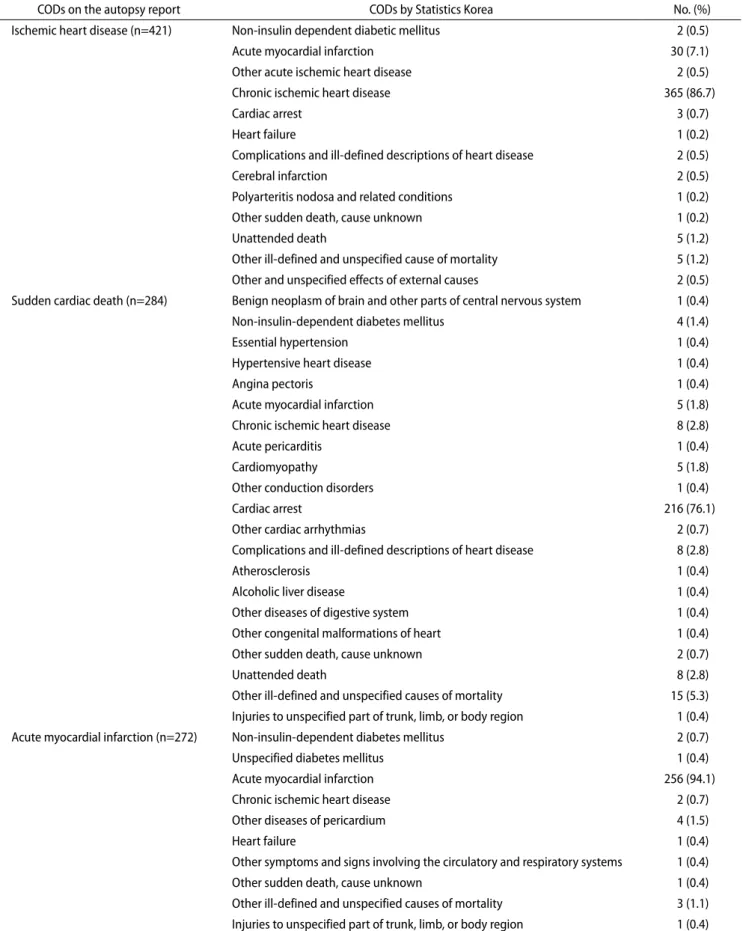
Among 1,075 cases of cardiac disease, main CODs listed on autopsy reports included ischemic heart disease (IHD) in 421 cases, sudden cardiac death (SCD) in 284 cases, and acute myocardial infarction (AMI) in 272 cases.

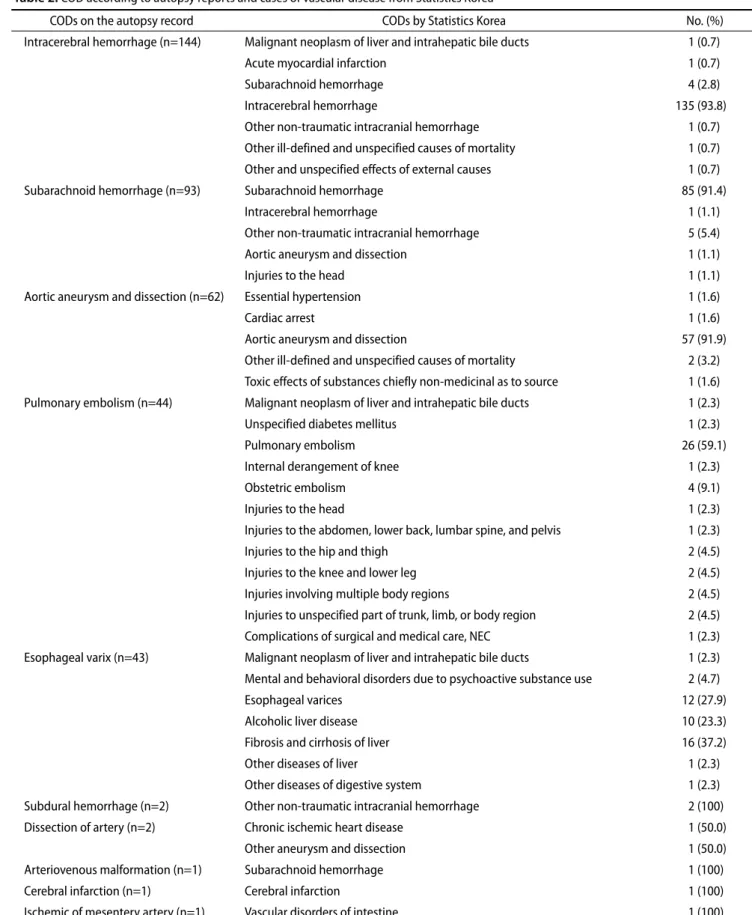
Among 393 cases of vascular diseases, main CODs on autopsy reports included intracerebral hemorrhage (ICH) in 144 cases, subarachnoid hemorrhage (SAH) in 93 cases, and aortic aneurysm and dissection (AAD) in 62 cases.

CODs by Statistics Korea for 1,075 cases of cardiac

disease were as follows (Table 1). Among cases of IHD,

the most common COD by Statistics Korea was chronic

IHD in 365 cases (86.7%), followed by AMI with 30

cases. Other CODs included unattended death and

other ill-defined and unspecified causes of mortality

in five cases, cardiac arrest in three, and other acute

IHD in two. Among cases of SCD, 21 different causes

of death were noted from Statistics Korea. The most

common COD confirmed from Statistics Korea was

cardiac arrest in 216 cases (76.1%), followed by other

ill-defined and unspecified causes of mortality in 15

cases; unattended death complications and ill-defined

descriptions of heart disease in eight cases; and AMI

and cardiomyopathy in five cases each. Among cases of

AMI, the most common COD from Statistics Korea was

AMI in 256 cases (94.1%), followed by other diseases of

the pericardium in four cases and other ill-defined and

unspecified causes of mortality in three cases. Among

other cardiac diseases listed on autopsy reports as the

COD, there were 28 cases of coronary atherosclerosis,

of which chronic IHD was the most common in 23

cases, followed by two cases of AMI and one case each

of cardiac arrest, atherosclerosis, and systemic lupus

erythematosus. Among 21 cases of cardiomyopathy,

there were 16 cases of cardiomyopathy and five cases

of cardiac arrest. For myocarditis, complications and ill-

defined descriptions of heart diseases were the most

(3)

Table 1. COD according to autopsy reports and cases of cardiac disease from Statistics Korea

CODs on the autopsy report CODs by Statistics Korea No. (%)

Ischemic heart disease (n=421) Non-insulin dependent diabetic mellitus 2 (0.5)

Acute myocardial infarction 30 (7.1)

Other acute ischemic heart disease 2 (0.5)

Chronic ischemic heart disease 365 (86.7)

Cardiac arrest 3 (0.7)

Heart failure 1 (0.2)

Complications and ill-defined descriptions of heart disease 2 (0.5)

Cerebral infarction 2 (0.5)

Polyarteritis nodosa and related conditions 1 (0.2)

Other sudden death, cause unknown 1 (0.2)

Unattended death 5 (1.2)

Other ill-defined and unspecified cause of mortality 5 (1.2)

Other and unspecified effects of external causes 2 (0.5)

Sudden cardiac death (n=284) Benign neoplasm of brain and other parts of central nervous system 1 (0.4)

Non-insulin-dependent diabetes mellitus 4 (1.4)

Essential hypertension 1 (0.4)

Hypertensive heart disease 1 (0.4)

Angina pectoris 1 (0.4)

Acute myocardial infarction 5 (1.8)

Chronic ischemic heart disease 8 (2.8)

Acute pericarditis 1 (0.4)

Cardiomyopathy 5 (1.8)

Other conduction disorders 1 (0.4)

Cardiac arrest 216 (76.1)

Other cardiac arrhythmias 2 (0.7)

Complications and ill-defined descriptions of heart disease 8 (2.8)

Atherosclerosis 1 (0.4)

Alcoholic liver disease 1 (0.4)

Other diseases of digestive system 1 (0.4)

Other congenital malformations of heart 1 (0.4)

Other sudden death, cause unknown 2 (0.7)

Unattended death 8 (2.8)

Other ill-defined and unspecified causes of mortality 15 (5.3) Injuries to unspecified part of trunk, limb, or body region 1 (0.4)

Acute myocardial infarction (n=272) Non-insulin-dependent diabetes mellitus 2 (0.7)

Unspecified diabetes mellitus 1 (0.4)

Acute myocardial infarction 256 (94.1)

Chronic ischemic heart disease 2 (0.7)

Other diseases of pericardium 4 (1.5)

Heart failure 1 (0.4)

Other symptoms and signs involving the circulatory and respiratory systems 1 (0.4)

Other sudden death, cause unknown 1 (0.4)

Other ill-defined and unspecified causes of mortality 3 (1.1) Injuries to unspecified part of trunk, limb, or body region 1 (0.4)

continued

(4)

common in nine cases, followed by acute myocarditis in six cases and cardiomyopathy in two cases.

Analysis results of the COD from Statistics Korea for 393 cases of vascular diseases were as follows (Table 2). Among cases of ICH, the most common COD from Statistics Korea was ICH in 135 cases (93.8%), followed by SAH in four cases. Among cases of SAH, the most common COD by Statistics Korea was SAH in 85 cases (91.4%). AAD accounted for most cases of COD (57 cases, 91.9%), along with two cases of other ill-defined and unspecified causes of mortality. For cases of pulmonary embolism (PE) and esophageal varix, various CODs by Statistics Korea were identified. Among cases of PE, the most common COD from Statistics Korea was PE in 26 cases, but this accounted for only 59.1%, and there were 11 other diverse CODs. Among cases of esophageal varix, the most common COD from Statistic Korea was fibrosis and cirrhosis of the liver in 16 cases (37.2%),

followed by esophageal varix in 12 cases (27.9%) and alcoholic liver disease in 10 cases (23.3%).

Discussion

The present study showed that cases involving AMI, ICH, SAH, and AAD showed a relatively high concordance with COD determination. However, cases involving IHD, SCD, PE, and esophageal varix had a relatively low concordance with COD determination.

The present study analyzed cases with mismatching CODs confirmed by autopsy and CODs confirmed by Statistics Korea. We identified cases with errors contained in the COD data provided to Statistics Korea from the NFS after autopsy. For example, in a case in which the COD was diagnosed as AMI after autopsy, the information provided to Statistics Korea was for a COD corresponding to “natural death-cardiovascular

CODs on the autopsy report CODs by Statistics Korea No. (%)

Coronary atherosclerosis (n=28) Acute myocardial infarction 2 (7.1)

Chronic ischemic heart disease 23 (82.1)

Cardiac arrest 1 (3.6)

Atherosclerosis 1 (3.6)

Systemic lupus erythematosus 1 (3.6)

Cardiomyopathy (n=21) Cardiomyopathy 16 (76.2)

Cardiac arrest 5 (23.8)

Cardiac disease (n=18) Complications and ill-defined descriptions of heart disease 18 (100)

Acute myocarditis 6 (35.3)

Myocarditis (n=17) Cardiomyopathy 2 (11.8)

Complications and ill-defined descriptions of heart disease 9 (52.9)

Multiple valve diseases 1 (25.0)

Valvular disease (n=4) Non-rheumatic mitral valve disorder 1 (25.0)

Non-rheumatic aortic valve disorder 1 (25.0)

Endocarditis, valve unspecified 1 (25.0)

Conduction disorder (n=3) Other conduction disorders 1 (33.3)

Other cardiac arrhythmia 2 (66.7)

Heart failure (n=2) Heart failure 2 (100)

Hypertensive heart disease (n=2) Hypertensive heart disease 1 (50.0)

Complications and ill-defined descriptions of heart disease 1 (50.0)

Pericarditis (n=1) Other diseases of pericardium 1 (100)

Infective endocarditis (n=1) Acute and subacute endocarditis 1 (100)

Cardiomegaly (n=1) Cardiomyopathy 1 (100)

COD, cause of death.

(5)

Table 2. COD according to autopsy reports and cases of vascular disease from Statistics Korea

CODs on the autopsy record CODs by Statistics Korea No. (%)

Intracerebral hemorrhage (n=144) Malignant neoplasm of liver and intrahepatic bile ducts 1 (0.7)

Acute myocardial infarction 1 (0.7)

Subarachnoid hemorrhage 4 (2.8)

Intracerebral hemorrhage 135 (93.8)

Other non-traumatic intracranial hemorrhage 1 (0.7)

Other ill-defined and unspecified causes of mortality 1 (0.7)

Other and unspecified effects of external causes 1 (0.7)

Subarachnoid hemorrhage (n=93) Subarachnoid hemorrhage 85 (91.4)

Intracerebral hemorrhage 1 (1.1)

Other non-traumatic intracranial hemorrhage 5 (5.4)

Aortic aneurysm and dissection 1 (1.1)

Injuries to the head 1 (1.1)

Aortic aneurysm and dissection (n=62) Essential hypertension 1 (1.6)

Cardiac arrest 1 (1.6)

Aortic aneurysm and dissection 57 (91.9)

Other ill-defined and unspecified causes of mortality 2 (3.2) Toxic effects of substances chiefly non-medicinal as to source 1 (1.6) Pulmonary embolism (n=44) Malignant neoplasm of liver and intrahepatic bile ducts 1 (2.3)

Unspecified diabetes mellitus 1 (2.3)

Pulmonary embolism 26 (59.1)

Internal derangement of knee 1 (2.3)

Obstetric embolism 4 (9.1)

Injuries to the head 1 (2.3)

Injuries to the abdomen, lower back, lumbar spine, and pelvis 1 (2.3)

Injuries to the hip and thigh 2 (4.5)

Injuries to the knee and lower leg 2 (4.5)

Injuries involving multiple body regions 2 (4.5)

Injuries to unspecified part of trunk, limb, or body region 2 (4.5)

Complications of surgical and medical care, NEC 1 (2.3)

Esophageal varix (n=43) Malignant neoplasm of liver and intrahepatic bile ducts 1 (2.3) Mental and behavioral disorders due to psychoactive substance use 2 (4.7)

Esophageal varices 12 (27.9)

Alcoholic liver disease 10 (23.3)

Fibrosis and cirrhosis of liver 16 (37.2)

Other diseases of liver 1 (2.3)

Other diseases of digestive system 1 (2.3)

Subdural hemorrhage (n=2) Other non-traumatic intracranial hemorrhage 2 (100)

Dissection of artery (n=2) Chronic ischemic heart disease 1 (50.0)

Other aneurysm and dissection 1 (50.0)

Arteriovenous malformation (n=1) Subarachnoid hemorrhage 1 (100)

Cerebral infarction (n=1) Cerebral infarction 1 (100)

Ischemic of mesentery artery (n=1) Vascular disorders of intestine 1 (100)

COD, cause of death; NEC, not elsewhere classified.

(6)

system-heart-IHD.” The COD for this case was confirmed as “chronic IHD” by Statistics Korea, instead of AMI.

Moreover, another case of death by cardiac tamponade due to AMI, as determined by autopsy, was provided to Statistics Korea as “natural death-cardiovascular system-heart-cardiac tamponade.” The COD for this case was confirmed as “other disease of the pericardium” by Statistics Korea, instead of AMI. In such a case, it would be necessary for forensic pathologists to draft the COD data in detail so that the information on the COD determined by autopsy would be accurately relayed to Statistics Korea.

We also found cases with errors in the determination of CODs by Statistics Korea. For example, non-traumatic ICH was diagnosed as a COD after autopsy, but the final COD determined by Statistics Korea was malignant neoplasm of the liver and intrahepatic bile ducts. The person who died had underwent surgery for liver cancer about 4 years earlier. In addition, a case of SAH caused by vertebral artery dissection was confirmed to be AAD as the final COD by Statistics Korea. It is believed that for such a case, education is required, and systematic improvement is needed through more active discussion between the staff in charge at Statistics Korea and the forensic pathologists.

Lastly, the present study identified cases with differences between the medical COD and statistical COD. Clinically, PE and esophageal varix themselves are determined as important CODs; however, statistically, the reasons that cause PE and esophageal varix are considered important for determining the COD.

Therefore, for cases involving PE, the final COD is often determined based on bodily injury or diseases that cause an immobilization. For similar reasons, the final COD is often determined as hepatic disease for cases involving esophageal varix. This type of discrepancy is due to a different purpose for determining the CODs between medical and statistical aspects. The underlying COD is more important than the immediate COD in the statistical aspect. Additionally, CODs determined by Statistics Korea are preferentially determined based on death certificates.

In conclusion, our study showed a high concordance between the COD by autopsy and by Statistics Korea [4]. However, the present study also found other cases

in which the final COD by Statistics Korea varied in contrast to the COD on autopsy reports. We analyzed a few causes of this, and accordingly, examined the areas that need further discussion and the measures needed for improvement. Autopsies performed in Korea are mostly forensic autopsies; therefore, autopsies performed by the NFS are not for COD determination by Statistics Korea. However, in any given society, statistics on the COD are the most fundamental health statistics. For countries with low autopsy rates, such as Korea, autopsy-based COD data can serve as important data when considering nationwide COD statistics. Additionally, to obtain more accurate COD statistics, we think that forensic autopsy results should also be efficiently reflected in COD statistics.

To achieve this, the forensic pathologist should draft post-autopsy COD data based on an understanding of the rules for determining COD by Statistics Korea, and provide such data to Statistics. Moreover, the staffs in charge of the COD determination at Statistics should determine the final COD based on an understanding of the medical and statistical aspects of COD. Finally, the COD should be determined through closer discussions between the forensic pathologist and staff in charge at Statistics Korea, and systematic improvement for reconfirming CODs is deemed necessary. Furthermore, an independent organization that monitors deaths and the establishment of rules for determining COD seem to be needed. We limited our study to cardiovascular disease as the COD in the present study. However, this comparative study should be expanded to include various death COD to obtain COD statistics that are more accurate because mismatching cases were confirmed by this study.

Conflicts of Interest

No potential conflict of interest relevant to this article was reported.

Acknowledgments

This work was supported by the National Forensic

Service (NFS2017MED04), Ministry of Interior, Republic

of Korea.

(7)

References

1. Levy B. Informatics and autopsy pathology. Surg Pathol Clin 2015;8:159-74.

2. Park JH, Na JY, Lee BW, et al. A statistical analysis on forensic autopsies performed in Korea in 2015. Korean J Leg Med

2016;40:104-18.

3. Turnbull A, Martin J, Osborn M. The death of autopsy? Lancet 2015;386:2141.

4. Kim HG, Park JW, Cho WY, et al. The discrepancy of the cause and manner of death between death certificates and autopsy reports.

Korean J Leg Med 2014;38:139-44.

수치

Table 1. COD according to autopsy reports and cases of cardiac disease from Statistics Korea
Table 2. COD according to autopsy reports and cases of vascular disease from Statistics Korea

참조

관련 문서

• 이명의 치료에 대한 매커니즘과 디지털 음향 기술에 대한 상업적으로의 급속한 발전으로 인해 치료 옵션은 증가했 지만, 선택 가이드 라인은 거의 없음.. •

extracranial arteries, patients diagnosed with a transient ischemic attack or without a confirmed stroke on MRI brain DWI, patients with an atypical cause of ischemic stroke

The proposal of the cell theory as the birth of contemporary cell biology Microscopic studies of plant tissues by Schleiden and of animal tissues by Microscopic studies of

In a prospective 2-year study by Kaandorp et al with 154 patients (adults and children), 21% of cases resulted in poor patient outcome (death or severe functional deterioration),

It considers the energy use of the different components that are involved in the distribution and viewing of video content: data centres and content delivery networks

After first field tests, we expect electric passenger drones or eVTOL aircraft (short for electric vertical take-off and landing) to start providing commercial mobility

1 John Owen, Justification by Faith Alone, in The Works of John Owen, ed. John Bolt, trans. Scott Clark, "Do This and Live: Christ's Active Obedience as the

* Unvaccinated cases were more likely to present classic manifestations of measles [OR=3.656 (p <0.000)](among 330 measles cases with available data)... Outbreak Name