CLINICAL
EXPERIMENTAL VACCINE
RESEARCH
Introduction
There is no doubt that vaccine is one of the most effective and important measures to control infectious diseases in public health [1]. However, for the fundamental mecha- nism how a vaccine is working is a mock infection of a pathogen, presuming adverse event following immunization (AEFI) is not difficult, while the AEFI may be expect- able or unexpectable, and minimal or severe, even lethal [2,3]. Besides, usually, a vac- cine is a biological substance administered to large, healthy population to prevent dis- eases, a small safety issue may have great impact on overall vaccine coverage rate and its final effectiveness. Therefore, vaccine safety is being more spotlighted in the public as National Immunization Program (NIP) has been launched recently in Korea [4].
Obtaining confidence not only of vaccinees, parents, and guardians, but also of pri- mary care pediatricians in vaccine safety is crucial to operate successful public vaccine program, for the physicians who care children and adolescents are in the forefront of 53
© Korean Vaccine Society.
This is an Open Access article distributed under the terms of the Creative Commons Attribution Non-Com- mercial License (http://creativecommons.org/licenses/
by-nc/3.0) which permits unrestricted non-commercial use, distribution, and reproduction in any medium, pro- vided the original work is properly cited.
K O R E A N V A C C I N E S O C I E T Y
K O R E A N K O R E A N A C C I N E O C I E T Y V
S
http://www.ecevr.org/
Clin Exp Vaccine Res 2013;2:53-57 http://dx.doi.org/10.7774/cevr.2013.2.1.53 pISSN 2287-3651 • eISSN 2287-366X
Dae Sun Jo1,2, Jung Soo Kim1,2
1Department of Pediatrics, Chonbuk National University Medical School; 2Biomedical Research Institute, Chonbuk National University Hospital, Chonbuk National University Medical School, Jeonju, Korea
Received: November 27, 2012 Revised: December 20, 2012 Accepted: December 29, 2012 Corresponding author: Jung Soo Kim, MD Department of Pediatrics, Chonbuk National University Hospital, Chonbuk National University Medical School, 20 Geonji-ro, Deokjin-gu, Jeonju 561-712, Korea
Tel: +82-63-250-1468, Fax: +82-63-250-1464 E-mail: [email protected]
No potential conflict of interest relevant to this article was reported.
The authors appreciate the contribution of Prof.
Eun Sook Suh (Department of Pediatrics, Soon- chunhyang University College of Medicine) and Dr. Geun-Ryang Bae (Division of Vaccine Prevent- able Disease Control and National Immunization Program, Korea Cen ters for Disease Control and Prevention [KCDC]) in preparation of the survey questionnaire used in this study. This study was supported in part by funding from KCDC and Bio- medical Research Institute of Chonbuk National University Hospital.
Purpose: Since National Immunization Program (NIP) was implemented recently in Korea, public attention on vaccine safety is increasing. This study was aimed to investigate percep- tions of pediatricians on the vaccine injury compensation program and to acquire their sug- gestions to improve the program.
Materials and Methods: Pediatricians working in primary care were surveyed at the sites of the annual Korean Pediatric Society meeting or its regular regional branch meetings during September and October 2012. A questionnaire consisted of 15 items about the Korean National Vaccine Injury Compensation Program (KNVICP) was distributed and collected directly from the pediatricians.
Results: A total of 340 responses were collected. While only 16% of responded pediatricians answered they knew the program well, 11% answered they did not. Twenty-six percent an- swered a need to expand the types of vaccines and its injuries. Most responders (82%) wished the compensation program to cover the injuries of non-NIP vaccines. On the filing procedures for compensation, they preferred reducing the minimum medical cost limit to claim (94%).
Conclusion: On the basis of this survey, it is suggested to provide more active informative education on KNVICP to primary care pediatricians and to improve the program considering the pediatricians’ opinions.
Keywords: Pediatrics, Data collection, Vaccines
Perspectives on vaccine injury compensation program in Korea:
the pediatricians’ view
the field. However, there has been no study on the attitude or perspectives of vaccine providers on the vaccine safety man- agement system in Korea.
Since established in 1994, Korea National Vaccine Injury Compensation Program (KNVICP) has been an important and essential measure to assure both public and healthcare providers on the vaccine safety [4,5]. After 16 years experi- ence of the program, this study was performed to see how pediatricians recognize the KNVICP and to hear any sugges- tions to improve the program.
Materials and Methods
Study setting and population
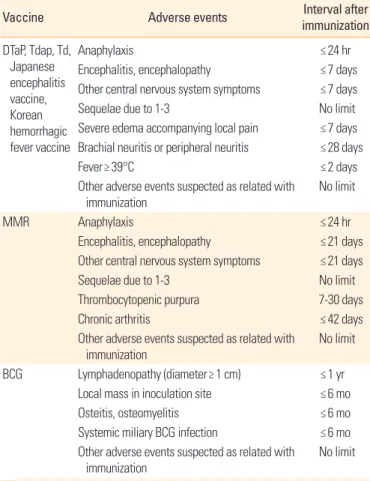
During September and October 2012, a survey was performed to randomly selected primary care pediatricians distributed nationwide in Korea who attended annual Korean Pediatric Society meeting or its regular regional branch meetings. At the time the survey was carried on, about 3,500 pediatricians were working in primary care, and the total number of board- certified pediatricians was around 5,800. A brief introduction was provided before the meetings or intermissions, and ques- tionnaires were administered to the pediatricians and col- lected directly. For vaccines injuries covered by KNVICP re- fers to the table of AEFI and its time criteria (Table 1) [6], it was also presented.
Survey design
The questionnaire was composed of 15 items which were cat- egorized into 3 sections: each section regarded the percep- tion of vaccine injury compensation program, opinions on the appropriateness of vaccine injury reporting system for compensation, and suggestions for the improvement of the program. It was developed in collaboration with Korea Cen- ters for Disease Control and Prevention (KCDC). Question- naire did not ask the characteristics of each responder.
Results
Perception of vaccine injury compensation program
Questionnaires from a total of 340 pediatricians were collect- ed; i.e., about 10% of total primary care pediatricians in Korea were participated in this survey. Of them, 89% answered they knew well or roughly knew the KNVICP, while 11% answered they did not know the program.
Opinions on the guidelines for the reporting of AEFI Variety of adverse events and vaccines to report
Slightly over a half of the responders agreed to maintain the types of adverse events to be reported. However, 26% acknow- ledged a need to expand the types of vaccine injuries such as severe pain, skin rash, and complications associated with fe- ver. They also suggested the reportable vaccines should not be limited to the vaccines listed in the reportable AEFI table.
Time interval after administration
Sixty-two percent of responders agreed with the time criteria of the injury table. Fourteen percent answered some modifi- cation on the criteria such as lengthening the time for neuro- logic sequelae in case of delayed recognition. Some answers indicated longer interval might cause difficulty in differential diagnosis.
Table 1. Reportable adverse events following immunization and its time criteria defined in the Communicable Disease Control Act in Korea
Vaccine Adverse events Interval after
immunization D TaP, Tdap, Td,
Japanese encephalitis vaccine, Korean hemorrhagic fever vaccine
Anaphylaxis ≤24 hr
Encephalitis, encephalopathy ≤7 days
Other central nervous system symptoms ≤7 days
Sequelae due to 1-3 No limit
Severe edema accompanying local pain ≤7 days Brachial neuritis or peripheral neuritis ≤28 days
Fever≥39°C ≤2 days
Other adverse events suspected as related with
immunization No limit
MMR Anaphylaxis ≤24 hr
Encephalitis, encephalopathy ≤21 days
Other central nervous system symptoms ≤21 days
Sequelae due to 1-3 No limit
Thrombocytopenic purpura 7-30 days
Chronic arthritis ≤42 days
Other adverse events suspected as related with immunization
No limit
BCG Lymphadenopathy (diameter≥1 cm) ≤1 yr
Local mass in inoculation site ≤6 mo
Osteitis, osteomyelitis ≤6 mo
Systemic miliary BCG infection ≤6 mo Other adverse events suspected as related with
immunization No limit
Adverse events of inactivated polio vaccine, hepatitis B vaccine, varicella vaccine, influenza vaccine, typhoid vaccine should be referred to the criteria for DTaP.
DTaP, diphtheria and tetanus toxoids and acellular pertussis vaccine; Tdap, tetanus and diphtheria toxoids and acellular pertussis vaccine-adolescent and adult pre- paration; Td, tetanus and diphtheria toxoids-adolescent and adult preparation;
MMR, mumps, measles, and rubella; BCG, bacille Calmet-Guerin.
Report criteria for inactivated polio vaccine, hepatitis B vaccine, varicella vaccine, influenza vaccine, and typhoid vaccine Fifty-three percent of responders agreed with the present cri- teria, i.e., criteria for diphtheria and tetanus toxoids and acel- lular pertussis vaccine (DTaP). However, 31% said adverse events of each vaccine should be described in detail.
Opinions on compensation for percutaneous bacille Calmet-Guerin (BCG) vaccine and live attenuated Japanese encephalitis vaccine
While intradermal BCG vaccine and inactivated Japanese en- cephalitis vaccine are included in NIP, percutaneous BCG vaccine and live attenuated Japanese encephalitis vaccine are non-NIP vaccines, but approved by Korea Food and Drug Administration and administered actively in Korea. We asked the pediatricians’ opinion on the need for compensation for the injuries after these two vaccines. Eighty-two percent fa- vored the inclusion of percutaneous BCG vaccine, while 10%
disagreed. In addition, 78% positively answered for live atten- uated Japanese encephalitis vaccine.
Opinions on filing objection after decision of Korea Advisory Committee on Vaccine Injury Compensation
With or without new reasons, only a single filing objection is allowed in the present KNVICP. We asked the pediatricians if it is appropriate, and 59% answered filing objection should be allowed only when a new reason was identified, while 35%
said no need for amendment.
Opinions on mandatory autopsy
Seventy-one percent responded the need of mandatory au- topsy in lethal cases while 25% answered that the autopsy should be done under legal guardian’s will.
Opinions on eligible period to file a claim
According to the present Korean law, a claim must be filed within 5 years after occurrence of AEFI. However, the patients and/or parents might neither realize the initial symptoms nor remember the day of adverse events beginning. On this mat- ter, 47% answered the criteria should start on the day when adverse events started, and 40% answered the day of diagno- sis. For the appropriate duration of filing period, 61% answer- ed within 5 years, same as at present while 14% answered with- in 3 years, 13% no limit, and 10% within 10 years.
Number of times to requesting compensation payment
At present, compensation money can be requested 4 times when adverse event becomes chronic. Forty-four percent re- sponders accepted present system, while 33% suggested it might be paid once and 21% answered need of amendment such as increasing times of requesting.
Minimal amount of injury treatment money to request compensation
To be requested, the personal burden of medical treatment money should be KRW300,000 (about US$300) or more. Nine- ty-four percent answered the minimum should be lowered, but 6% suggested that the minimum would be KRW500,000.
Compensation for the money caused by disability before the disability is finally diagnosed
At least 2 years are required to confirm the disability due to vaccine. However, the current rule does not allow the cost of braces, prosthetics, or assistances are compensated before the 2 years of preliminary period. On this matter, 75% answer- ed these auxiliary cost should also be compensated even it was paid before the diagnosis was confirmed. Others took the present rules (16%), or answered they didn’t know (9%).
Discussion
Safety issue is one of the major obstacles to successful mas- sive immunization practices [4,5,7-9]. For NIP is mainly for children and adolescents, primary care pediatricians are usu- ally responsible for reporting AEFI when they notice the sus- pected case. Therefore, it is important for pediatricians to be familiar with laws and acts on vaccine safety management system, such as AEFI management system and vaccine injury compensation program. In this study, we found only 16% of pediatricians who participated in our survey answered that they knew well about KNVICP. Moreover, to the question ask- ing about time criteria of AEFI, 22% selected the answer say- ing that they did not know at all. These findings suggest more active informative education on vaccine safety management is needed as an essential part of NIP.
In Korea, at present, many non-NIP vaccine products are having been licensed and administered to prevent the same infectious diseases that NIP covers [10]. These non-NIP vac- cines, such as transcutaneous BCG vaccine and live attenuat- ed Japanese encephalitis vaccine, are not included in NIP, for their cost-benefit is not superior than that of NIP vaccines or
they are not accepted as standards by authority. However, most primary care pediatricians answered these non-NIP vaccines should be guaranteed by KNVICP, for the vaccines cover same diseases as NIP vaccines do. Internationally, how the compensation program is administered and where the fund comes from are different from country to country: na- tional/state government vs. pharmaceutical manufacturers, Treasury vs. tax on vaccine distribution. The governmental authority operates the program and the fund is from Treasury in Korea. This issue should be carefully taken into account for the KNV ICP improvement, because these are used more popularly in private sector, and the private pediatricians are key vaccine providers in NIP.
Generally in our study, pediatricians showed consensus on expanding the variety of injuries/sequelae and lowering hurdle to file the claims. In Korea, a law suit is still available even KNVICP had decided the injury or unwanted event is not to be compensable. However, the suit usually takes lon- ger and easily tires a no-fault-physician than the compensa- tion program. This may explain why pediatricians prefer the program as a safety gear.
Determining the criteria starting eligible period to file a claim is a complex. It is hard to decide when the symptoms really started, because it is uncertain and vague to tell when vaccinees or their guardians realize the symptoms. As 40% of responders answered in our study, it could be an objective approach to decide on the criteria to be the point when a medical diagnosis is made. Acquiring a solid scientific evi- dence is basic to justify if the unwanted event is related to the immunization or not, especially in a lethal case. Nonetheless, for Korea tradition, culture, and laws, the autopsy is not man- datory, and a consent should be obtained from legal guard- ians to perform an autopsy. The authors agree with the 40%
of the responders on that autopsy should be performed to find the causality and to accumulate the data on deadly ad- verse events.
Reportable AEFI table and vaccine injury table for compen- sation are a little different among countries. The table of KN- VICP in effect today was established more than 15 years ago and is not in detail, while those of other countries are [9,11].
Now in Korea, more than 70 vaccine products with various combinations of components are used, and many newly de- veloped vaccines are also being licensed and introduced to the public. Accordingly, we suggest amendment of the table, such as specification of each vaccine with injuries and with specific time criteria, should be made.
This study has limitations. The responders were all pedia- tricians, but physicians with other specialty also take parts in NIP. We did not asked the characteristics of each responder, such as age, sex, how long they had been working with pedi- atric specialty, or in which province they were working. So, we could not see any possible bias related with their charac- teristics on selecting the answers.
In conclusion, we could see in this survey that pediatricians should be aware vaccine injury compensation program and its importance. In addition, we suggest that amendments of the program could be made in consideration of the opinions of pediatricians, the front-line vaccine providers.
References
1. Plotkin SA. Vaccines, vaccination, and vaccinology. J In- fect Dis 2003;187:1349-59.
2. American Academy of Pediatrics. Active and passive im- munization. In: Pickering LK, Baker CJ, Kimberlin DW, Long SS, editors. Red book: report of the Committee on Infectious Diseases. 28th ed. Elk Grove Village, IL: Ameri- can Academy of Pediatrics; 2009. p.9-67.
3. Centers for Disease Control and Prevention. Principles of vaccination. In: Atkins W, Wolfe C, Hamborsky J, editors.
Epidemiology and prevention of vaccine-preventable dis- eases. 12th ed. Washington, DC: Public Health Founda- tion; 2011. p.1-7.
4. The Korean Pediatric Society. Immunization and adverse event. In: Lee HJ, editor. Immunization guideline. 7th ed.
Seoul: The Korean Pediatric Society; 2012. p.29-39.
5. Sohn YM. Vaccine adverse reaction and national vaccine injury compensation. J Korean Med Assoc 1997;40:1635- 47.
6. The Korean Pediatric Society. Vaccine adverse event re- porting system and National Vaccine Injury Compensa- tion Program. In: Lee HJ, editor. Immunization guideline.
7th ed. Seoul: The Korean Pediatric Society; 2012. p.265- 70.
7. Forsyth K, Nagai M, Lepetic A, Trindade E. Pertussis im- munization in the global pertussis initiative international region: recommended strategies and implementation considerations. Pediatr Infect Dis J 2005;24(5 Suppl):S93-7.
8. Galazka A. Control of pertussis in the world. World Health Stat Q 1992;45:238-47.
9. Cook KM, Evans G. The National Vaccine Injury Compen- sation Program. Pediatrics 2011;127(Suppl 1):S74-7.
10. Korea Centers for Disease Control and Prevention. Ad- verse event following immunization management guide- line. Seoul: Korea Centers for Disease Control and Pre- vention; 2012.
11. Looker C, Kelly H. No-fault compensation following ad- verse events attributed to vaccination: a review of interna- tional programmes. Bull World Health Organ 2011;89:
371-8.