Chemotherapy
Infect Chemother 2014;46(2):115-119 pISSN 2093-2340 · eISSN 2092-6448
Received: July 11, 2013 Revised: August 23, 2013 Accepted: August 23, 2013 Corresponding Author : Jae-Phil Choi, MD
Department of Internal Medicine, Seoul Medical Center, 156 Sinnae-ro, Jungrang-gu, Seoul 131-795, Korea
Tel: +82-2-2276-7813, Fax: +82-2-2276-7820 E-mail: [email protected]
Alternative Corresponding Author : Yeon Sang Jeong, MD
Department of Internal Medicine, Seoul Medical Center, 156 Sinnae-ro, Jungrang-gu, Seoul 131-795, Korea
Tel: +82-10-9838-9590, Fax: +82-2-2276-7820 E-mail: [email protected]
This is an Open Access article distributed under the terms of the Creative Commons Attribution Non-Commercial License (http://creativecommons.org/licenses/by-nc/3.0) which permits unrestricted non-commercial use, distribution, and repro- duction in any medium, provided the original work is properly cited.
Copyrights © 2014 by The Korean Society of Infectious Diseases | Korean Society for Chemotherapy
www.icjournal.org
A Case of Severe HIV-Associated Psoriasis Successfully Treated with Acitretin Therapy
Yeon Sang Jeong
1, Min Sung Kim
1, Jin Ho Shin
1, Jin Kyung Cho
1, Hyang Im Lee
2, Hyun Jung Kim
3, and Jae-Phil Choi
1Departments of 1Internal Medicine, 2Pathology, and 3Dermatology, Seoul Medical Center, Seoul, Korea
Psoriasis is a chronic inflammatory skin disease that involves immune-mediated cutaneous inflammation and keratinocyte hy- perproliferation. Psoriasis in patients with HIV responds poorly to treatment and has a high morbidity rate, thus posing a chal- lenge to clinicians. Until now, there have been no documented cases of acitretin therapy for HIV-associated psoriasis in Korea.
Here, we report a case of safe and successful therapy with acitretin in a 52-year-old man with HIV-associated psoriasis that re- sponded poorly to previous treatments including steroids and ultraviolet B phototherapy. We also review the relevant literature.
Key Words: Human immunodeficiency virus; Psoriasis; Acitretin
Introduction
Although some dermatologic diseases develop more fre- quently among people living with Human immunodeficiency virus (HIV) than among the general population, the preva- lence of psoriasis is about the same in these groups at approx- imately 1–4% [1, 2]. When accompanied by severe pruritus and skin lesions, HIV-associated psoriasis may profoundly af- fect an individual’s quality of life. Moreover, HIV-associated psoriasis responds poorly to treatment. Furthermore, treat-
ment must be considered carefully because of the characteris- tics of immunosuppression and the immunosuppressive effect of systemic anti-psoriasis therapy [3]. Therefore, appropriate treatment is of great importance. So far, there has been no case report on HIV-associated psoriasis in the Korean literature de- spite extensive reviews in other languages. Here, we report a case of severe HIV-associated psoriasis successfully treated with acitretin and review the relevant literature.
Case Report
A 52-year-old man living with HIV/AIDS was hospitalized because of severe pruritus with a generalized skin rash with scaling that began months ago and responded poorly to thera- py with oral antihistamine and topical steroids. He was diag- nosed with HIV–tuberculosis co-infection 4 years ago, with a CD4 count of 30 cells/mm3. Antiretroviral therapy was changed to boosted atazanavir and raltegravir owing to virologic failure.
The subject had no history of smoking, alcohol consumption, lithium or β-blocker treatment, or family history of psoriasis.
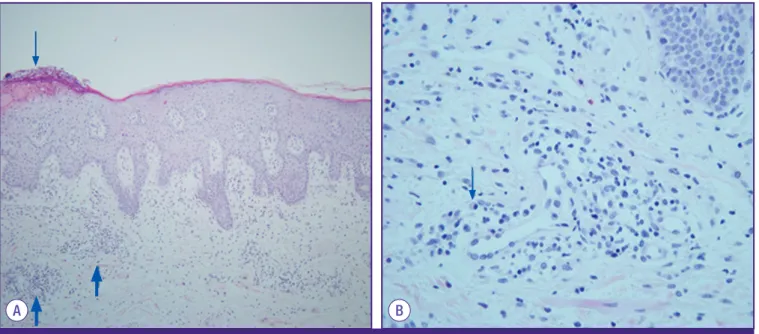
Six months ago, he began visiting an outpatient clinic prompted by severe pruritus and rashes all over his body. An- tihistamine and topical steroid ointment treatment had no ef- fect. A skin biopsy was taken from a skin lesion on the posteri- or back, which was covered with scaly plaques. Optical microscopy revealed lymphocytes, macrophages, and multi- nucleated giant cells in corium-layer blood vessels. Irregular acanthosis, parakeratosis, and microabscesses were con- firmed in the dead skin cells of the epidermal layer, which is consistent with psoriatic-form dermatitis (Fig. 1). The patient was treated with 3 courses of ultraviolet B radiation (300–397 mJ) delivered by a Cosmolux N-UVB 6,000 C (Choyang Med- ics, Seongnam, Korea).
The patient was admitted to the hospital because of aggrava- tion of the skin lesions. On admission, blood pressure was 130/80 mmHg, pulse rate was 106 bpm, respiration rate was
20 breaths per minute, and body temperature was 36.6°C.
Papuloerythematous skin lesions accompanied by silver- white scales were observed on his scalp and over his entire body (60% of body surface area) (Fig. 2A and B). No other un- usual signs in the chest or abdominal area were observed.
Neither arthralgia nor arthritis was observed in the extremi- ties.
The laboratory test results were as follows: white blood cells, 4,800/mm3 (neutrophils, 68%; lymphocytes, 13.3%; mono- cytes, 9.7%; eosinophils, 8.2%); hemoglobin, 12.5 g/dL; plate- lets, 376,000/mm3; aspartate aminotransferase, 19 IU/L; alanine aminotransferase, 11 IU/L; alkaline phosphatase, 71 IU/L; total protein, 8.3 g/dL; albumin, 3.7 g/dL; total bilirubin, 0.4 mg/dL;
blood urea nitrogen, 22 mg/dL; creatinine, 0.8 mg/dL; total cholesterol, 154 mg/dL; triglyceride, 181 mg/dL; and C-reactive protein, 0.26 mg/dL. Serology was negative for anti-hepatitis B virus and anti-hepatitis C virus antibodies. CD4 T-cell count was 44/mm3, and HIV RNA was 1.66 × 10⁵ copies/mL.
Starting on the 1st hospitalization day, acitretin 30 mg (Neoti- gasonTM, Actavis Inc., Hafnarfjordur, Iceland) was prescribed to treat pruritus together with a topical steroid ointment. On the 8th day of acitretin administration, papuloerythematous skin le- sions diminished and the scales disappeared (Fig. 2C and D).
The dose of acitretin was reduced to 20 mg because of dimin- ished pruritus. The patient was discharged on the 9th day.
When he visited an outpatient clinic 2 months later, most of the scales and papuloerythematous skin lesions had disap-
Figure 1. Pathologic findings. (A) The epidermis shows irregular acanthosis, partial parakeratosis, and focal microabscesses in the keratin layer (thin arrow). The upper dermis shows perivascular inflammatory cells infiltration (thick arrow) (hematoxylin & eosin, × 10). (B) High- power field, showing, some plasma cells (arrow), mature lymphocytes, and macrophages in the perivascular area (hematoxylin & eosin, × 40).
A B
peared (Fig. 2E and F). Acitretin 10 mg was continued for 3 more months (Fig. 3). As of writing, the patient is still being monitored at the outpatient clinic and has not experienced relapse after 1.5 years.
Discussion
Dermatologic disorders in people living with HIV/AIDS can be classified as primary or secondary. Primary diseases in- clude seborrheic dermatitis, xerosis, atopic dermatitis, eosino- philic folliculitis, and psoriasis. Secondary diseases are associ- ated with opportunistic viral, bacterial, or fungal infections and some neoplastic ones, which are more prevalent than in primary diseases [4]. Psoriasis causes severe pruritus and pain, and responds poorly to treatment; thus, it may pro- foundly affect an individual’s quality of life and can even be fa- tal in some cases.
There is no agreed upon definition of HIV-associated psoria- sis; the term is often used together with psoriasis in HIV sero- positive patients out of confusion. Traits of HIV-associated psoriasis distinguishing it from classic seronegative psoriasis are sudden onset as well as its more severe, acral, extensive, and recalcitrant nature [4]. The disease also exhibits various morphological types in the same patients, appearing in one- third of their histories, along with a high frequency of arthritis.
Notably, exacerbation due to staphylococcal and streptococ- cal infection is more common among HIV-infected individu- als [5, 6]. In the present case, psoriasis began suddenly and was immediately severe (involving 60% of body surface area) during the course of diminished immune function (CD4 count, 44/mm3) without other risk factors such as excessive alcohol intake, smoking, and the use of drugs such as lithium and β-blockers [6]. No infectious complications occurred dur- ing treatment under close follow-up.
Psoriasis is associated with T-cell activation. Treatments that decrease T-cell count improve psoriasis, but HIV-associ- ated psoriasis is more severe as a result of weakened immu- nosuppression [7, 8]; its risk is 9-fold greater with a CD4 count
< 200/mm3 [9]. Thus, HIV-associated psoriasis acts as a marker of immune suppression. In addition, this makes HIV-associat- ed psoriasis paradoxical. There are 3 competing hypotheses attempting to address this paradox. First, psoriasis is charac- terized by T cells that produce type-1 cytokines (i.e., interleu- kins 12 and 23, interferon γ, and tumor necrosis factor-α) [10];
however, in AIDS, T cells produce type-2 cytokines (i.e., inter- leukins 4, 5, and 10) [11]. The onset and subsequent exacerba- tion of psoriasis are associated with the numbers of CD8 T cells and their memory subsets in the dermis and epidermis of lesional skin [12-14]. CD8 T-cell counts are elevated in HIV- associated psoriasis, possibly accounting for the psoriasis [15].
The second hypothesis involves the depletion of CD4 suppres- sor T cells, which results in unchecked pro-inflammatory Figure 2. Photographs showing symmetrical, erythematous, and scaly
plaques cutaneous lesion on the anterior trunk (A) and dorsum (B). On the 8th day of acitretin administration, the scaly lesions on the anterior trunk and dorsum had improved (C, D). After 2 months of treatment, the ery- thematous and scaly plaque cutaneous lesions nearly disappeared (E, F).
A
C
E
B
D
F
pathways due to the T cell imbalance, which may in turn cause psoriasis [16]. The third hypothesis states that because superantigen-mediated autoimmunity is characterized by au- toreactive T cells bearing cutaneous lymphocyte-associated antigen, the recognition of autoantigens may result in molecu- lar events that cause psoriasis [17, 18].
The treatment of HIV-associated psoriasis depends on the severity of the disease. Mild cases (< 2% body surface area) can be treated topically with emollients, corticosteroids, tar, vitamin D analogues, and retinoids. Meanwhile, moderate and severe (2–10% and < 10% of body surface area, respec- tively) cases can be treated with systemic therapies including phototherapy, acitretin, cyclosporin, hydroxyurea, and tumor necrosis factor-α inhibitors (i.e., etanercept or infliximab) with effective anti-retroviral treatments [6]. The treatment of mod- erate and severe HIV-associated psoriasis is challenging, and the risk-to-benefit ratio specific to these patients needs to be taken into account when selecting therapies.
In the present case of severe HIV-associated psoriasis, acitretin, a second-generation retinoid, was prescribed as a second-line treatment after the failure of first-line ultraviolet B phototherapy [19]. Buccheri et al. [20] report good to excellent responses in 6 (54%) of 11 patients with HIV-associated psori- asis and found complete clearance in 4 patients (36%) after 20 weeks of acitretin monotherapy.
Although oral retinoids are generally well tolerated, side ef- fects can limit their use and negatively affect lipid profiles and liver functions [5]. HIV seropositive patients can have altered lipid profiles with hyperlipidemia at baseline. Accordingly, lipid profile and liver enzymes were closely monitored in the present case.
In summary, we report the first case of HIV-associated pso- riasis in Korea. HIV-associated psoriasis is a serious condition that requires careful treatment selection and monitoring. This case report corroborates the safety and efficacy of acitretin
therapy for the treatment of HIV-associated psoriasis. Never- theless, additional case reports and research are required to clarify the characteristics and pathogenesis of psoriasis in pa- tients with HIV.
References
1. Griffiths CE, Barker JN. Pathogenesis and clinical features of psoriasis. Lancet 2007;370:263-71.
2. Muñoz-Pérez MA, Rodriguez-Pichardo A, Camacho F, Colmenero MA. Dermatological findings correlated with CD4 lymphocyte counts in a prospective 3 year study of 1161 patients with human immunodeficiency virus dis- ease predominantly acquired through intravenous drug abuse. Br J Dermatol 1998;139:33-9.
3. Weitzul S, Duvic M. HIV-related psoriasis and Reiter's syn- drome. Semin Cutan Med Surg 1997;16:213-8.
4. Cedeno-Laurent F, Gómez-Flores M, Mendez N, Ancer- Rodríguez J, Bryant JL, Gaspari AA, Trujillo JR. New in- sights into HIV-1-primary skin disorders. J Int AIDS Soc 2011;14:5.
5. Leal L, Ribera M, Daudén E. Psoriasis and HIV infection.
Actas Dermosifiliogr 2008;99:753-63.
6. Morar N, Willis-Owen SA, Maurer T, Bunker CB. HIV-asso- ciated psoriasis: pathogenesis, clinical features, and man- agement. Lancet Infect Dis 2010;10:470-8.
7. Gupta AK, Ellis CN, Nickoloff BJ, Goldfarb MT, Ho VC, Ro- cher LL, Griffiths CE, Cooper KD, Voorhees JJ. Oral cyclo- sporine in the treatment of inflammatory and noninflam- matory dermatoses. A clinical and immunopathologic analysis. Arch Dermatol 1990;126:339-50.
8. Mallon E, Bunker CB. HIV-associated psoriasis. AIDS Pa- tient Care STDS 2000;14:239-46.
9. Goh BK, Chan RK, Sen P, Theng CT, Tan HH, Wu YJ, Paton Figure 3. Treatments administered.
Acitretin 30, 20, and 10 mg were ad- ministered for 21 weeks. Phototherapy involving 3 courses of ultraviolet B radiation (300–397 mJ) was admin- istered for 6 weeks. Anti-retroviral therapy involving boosted atazana- vir and raltegravir was administered throughout the treatment period.
16th
Acitretin 30 mg for 1 weeks
20 mg for 8 weeks 10 mg for 12 weeks
Phototherapy
Topical steroid
Anti-histamine
Anti-retroviral therapy
22th 35th 61th 100th (weeks)
NI. Spectrum of skin disorders in human immunodefi- ciency virus-infected patients in Singapore and the rela- tionship to CD4 lymphocyte counts. Int J Dermatol 2007;46:695-9.
10. Lew W, Bowcock AM, Krueger JG. Psoriasis vulgaris: cuta- neous lymphoid tissue supports T-cell activation and
"Type 1" inflammatory gene expression. Trends Immunol 2004;25:295-305.
11. Klein SA, Dobmeyer JM, Dobmeyer TS, Pape M, Ottmann OG, Helm EB, Hoelzer D, Rossol R. Demonstration of the Th1 to Th2 cytokine shift during the course of HIV-1 infec- tion using cytoplasmic cytokine detection on single cell level by flow cytometry. AIDS 1997;11:1111-8.
12. Austin LM, Coven TR, Bhardwaj N, Steinman R, Krueger JG. Intraepidermal lymphocytes in psoriatic lesions are activated GMP-17(TIA-1)+CD8+CD3+ CTLs as deter- mined by phenotypic analysis. J Cutan Pathol 1998;25:79- 88.
13. Baker BS, Griffiths CE, Lambert S, Powles AV, Leonard JN, Valdimarsson H, Fry L. The effects of cyclosporin A on T lymphocyte and dendritic cell sub-populations in psoria- sis. Br J Dermatol 1987;116:503-10.
14. Vissers WH, Arndtz CH, Muys L, Van Erp PE, de Jong EM, van de Kerkhof PC. Memory effector (CD45RO+) and cy- totoxic (CD8+) T cells appear early in the margin zone of spreading psoriatic lesions in contrast to cells expressing natural killer receptors, which appear late. Br J Dermatol
2004;150:852-9.
15. Roederer M, Dubs JG, Anderson MT, Raju PA, Herzenberg LA, Herzenberg LA. CD8 naive T cell counts decrease pro- gressively in HIV-infe cte d adults. J Clin Invest 1995;95:2061-6.
16. Fife DJ, Waller JM, Jeffes EW, Koo JY. Unraveling the para- doxes of HIV-associated psoriasis: a review of T-cell sub- sets and cytokine profiles. Dermatol Online J 2007;13:4.
17. Leung DY, Gately M, Trumble A, Ferguson-Darnell B, Schlievert PM, Picker LJ. Bacterial superantigens induce T cell expression of the skin-selective homing receptor, the cutaneous lymphocyte-associated antigen, via stimula- tion of interleukin 12 production. J Exp Med 1995;181:747- 53.
18. Nickoloff BJ, Wrone-Smith T. Superantigens, autoantigens, and pathogenic T cells in psoriasis. J Invest Dermatol 1998;110:459-60.
19. Menon K, Van Voorhees AS, Bebo BF Jr, Gladman DD, Hsu S, Kalb RE, Lebwohl MG, Strober BE; National Psoriasis Foundation. Psoriasis in patients with HIV infection: from the medical board of the National Psoriasis Foundation. J Am Acad Dermatol 2010;62:291-9.
20. Buccheri L, Katchen BR, Karter AJ, Cohen SR. Acitretin therapy is effective for psoriasis associated with human immunodeficiency virus infection. Arch Dermatol 1997;133:711-5.