Treatment persistence with a fixed-dose
combination of tadalafil (5 mg) and tamsulosin (0.4 mg) and reasons for early discontinuation in patients with benign prostatic hyperplasia and erectile dysfunction
Sun Tae Ahn , Dong Hyun Lee , Hyeong Guk Jeong , Jong Wook Kim , Mi Mi Oh , Hong Seok Park , Du Geon Moon
Department of Urology, Korea University Guro Hospital, Seoul, Korea
Purpose: The primary aim of this study was to assess treatment persistence with a fixed-dose combination (FDC) of tadalafil (5 mg) and tamsulosin (0.4 mg). This study also evaluated the reasons for early treatment discontinuation.
Materials and Methods: This retrospective observational study included patients with benign prostatic hyperplasia and erectile dysfunction who started an FDC treatment of tadalafil (5 mg) and tamsulosin (0.4 mg) between July 2017 and February 2018.
Treatment persistence and reasons for early discontinuation were evaluated during the first 6 months. The cumulative discontinua- tion rate and differences in various parameters were assessed using Kaplan–Meier analysis and the log-rank test, respectively. Fac- tors related to persistence were analyzed using a Cox proportional hazard model.
Results: Overall, 97 patients were included in the study. The cumulative persistence rate at 30, 90, and 180 days was 88.7%, 66.0%, and 54.6%, respectively. The cumulative persistence over 6 months differed significantly according to the administration of FDC therapy (log-rank p=0.005) and age (log-rank p=0.024). Younger patients (odds ratio, 2.049; p=0.021) and treatment-naive pa- tients (odds ratio, 2.461; p=0.006) were more likely to discontinue therapy within 6 months. The common reasons for discontinuing therapy were side effects (63.6%) and perceived poor efficacy (22.7%).
Conclusions: Side effects were reported to be the main reason for treatment discontinuation. Thus, to improve compliance for a once-daily FDC of tadalafil (5 mg) and tamsulosin (0.4 mg), it is recommended to select patients who show adaptation to a combi- nation of α-blockers and phosphodiesterase type 5 inhibitors prior to FDC treatment.
Keywords: Fixed-dose; Medication persistence; Tadalafil; Tamsulosin
This is an Open Access article distributed under the terms of the Creative Commons Attribution Non-Commercial License (http://creativecommons.org/licenses/by-nc/4.0) which permits unrestricted non-commercial use, distribution, and reproduction in any medium, provided the original work is properly cited.
Received: 10 July, 2019 • Accepted: 6 August, 2019
Corresponding Author: Du Geon Moon https://orcid.org/0000-0002-9031-9845
Department of Urology, Korea University Guro Hospital, 148 Gurodong-ro, Guro-gu, Seoul 08308, Korea TEL: +82-2-2626-3201, FAX: +82-2-2626-1321, E-mail: [email protected]
ⓒ The Korean Urological Association
www.icurology.org
Investig Clin Urol 2020;61:81-87.
https://doi.org/10.4111/icu.2020.61.1.81 pISSN 2466-0493 • eISSN 2466-054X
INTRODUCTION
Erectile dysfunction (ED) and lower urinary tract symp- toms (LUTS) secondary to benign prostatic hyperplasia (BPH) often occur in older males [1]. The association between ED and LUTS has been previously shown in various large-scale community-based studies [2-5]. Approximately 70% males with LUTS/BPH have concurrent ED [6]. As the population ages, the number of males with all the three conditions is increasing, and these conditions can have a profound impact on quality of life [7].
While α-blockers and phosphodiesterase type 5 (PDE5) inhibitors are effective in alleviating LUTS and ED, re- spectively, polypharmacy (which is most commonly defined as taking ≥5 medications) is considered for patients with a high prevalence of medical comorbidities (e.g., hypertension, diabetes mellitus, and metabolic syndrome) that need mul- tidrug therapy [8]. Polypharmacy can increase adverse drug reactions and medication noncompliance, especially in the elderly [9]. To improve compliance, a fixed-dose combination (FDC) medication that shows efficacy and safety needs to be developed.
A recent randomized controlled trial investigating the efficacy and safety of a once-daily FDC of tadalafil (5 mg) and tamsulosin (0.4 mg) showed that the FDC of tadalafil (5 mg) and tamsulosin (0.4) mg was superior to that of tadalafil (5 mg) monotherapy for LUTS/BPH treatment and was similar to that of tadalafil (5 mg) monotherapy for ED treat- ment; no clinically significant safety issues were observed [10]. As a result, it was approved for use in Korea by the Ko- rean Food and Drug Administration and released under the tradename “Gugutams 0.4/5 mg®” in 2016 [11].
Single-tablet administration is expected to improve treat- ment compliance; however, adherence to a once-daily single- tablet FDC of tadalafil (5 mg) and tamsulosin (0.4 mg) has never been investigated. Furthermore, there are no pub- lished data regarding treatment patterns in males receiving an FDC of tadalafil (5 mg) and tamsulosin (0.4 mg), especial- ly in real-world practice settings. Thus, the primary aim of this study was to assess treatment persistence with a once- daily single-tablet FDC of tadalafil (5 mg) and tamsulosin (0.4 mg) in males with LUTS/BPH and ED over a 6-month peri- od. The secondary aim was to identify the reasons for treat- ment discontinuation over a follow-up period of 6 months.
MATERIALS AND METHODS
1. Study design and subjects
This was a retrospective, observational, and single-center
study (Korea University Guro Hospital, Seoul) of males with LUTS/BPH and ED who received a prescription for a once- daily single-tablet FDC of tadalafil (5 mg) and tamsulosin (0.4 mg). Adults aged ≥18 years who were first prescribed the target drug between July 2017 and February 2018 were eligible for inclusion. This period was based on the avail- ability of an FDC of tadalafil (5 mg) and tamsulosin (0.4 mg) and the need for at least 6 months of patient follow-up. The main exclusion criteria were as follows: episodic treatment, less than 6 months of treatment, and/or insufficient data for analysis. The first prescription date for an FDC of tadalafil (5 mg) and tamsulosin (0.4 mg) was defined as the index date. One hundred and thirteen patients received their first prescription of an FDC of tadalafil (5 mg) and tamsulosin (0.4 mg) during the study period. Of them, 16 patients were ex- cluded because the follow-up period was less than 6 months.
Therefore, only 97 patients were included in this study.
The patients’ medical records were reviewed for demo- graphic information, previous and concomitant medica- tions, and symptom questionnaires, including International Prostate Symptom Score (IPSS) and International Index of Erectile Function-5 (IIEF-5) before the index date. The study protocol was reviewed and approved by the Institutional Review Board (IRB) of Korea University Guro Hospital (ap- proval number: 2019GR0221). The need for informed consent was waived by the IRB based on the retrospective nature of the study.
2. Study outcomes
The primary outcome measures were treatment persis- tence and factors associated with treatment persistence with an FDC of tadalafil (5 mg) and tamsulosin (0.4 mg). Treat- ment persistence was measured from the index date to the discontinuation date of the target drug. Data on the mean time to discontinuation and the persistence rate at 6 months were obtained. Age, polypharmacy, baseline symptom sever- ity, and previous treatment status were considered factors associated with treatment persistence. Previous treatment status was subdivided into a treatment-naive group, defined as having no experience with coadministration of α-blockers and PDE5 inhibitors before the index date, and a treatment- experienced group, defined as having experience with α-blockers and PDE5 inhibitors before the index date. The secondary outcome was the identification of the reasons for discontinuation. Causes of treatment discontinuation were classified as follows: side effects, inconvenience of daily ad- ministration, perceived poor efficacy, patient preference (i.e., seeking other treatment options), and drug cost.
3. Statistical analysis
The baseline characteristics of patients were analyzed descriptively. Categorical variables were reported as number and percentages, while continuous variables were reported as mean±standard deviation (range). Kaplan–Meier curves were used to present the cumulative discontinuation rate over 6 months. Differences in treatment persistence accord- ing to the demographics and clinical variables were assessed using a log-rank test. The bivariate Cox proportional hazard model was used to identify factors associated with treat- ment discontinuation. Factors associated with the dependent variable at a value of p<0.05 were included in the multivari- ate logistic regression model. The causes of discontinuation in the cohort were analyzed descriptively. All analyses were performed using IBM SPSS Statistics ver. 22.0 (IBM Co., Ar- monk, NY, USA). All p-values <0.05 were considered signifi- cant.
RESULTS
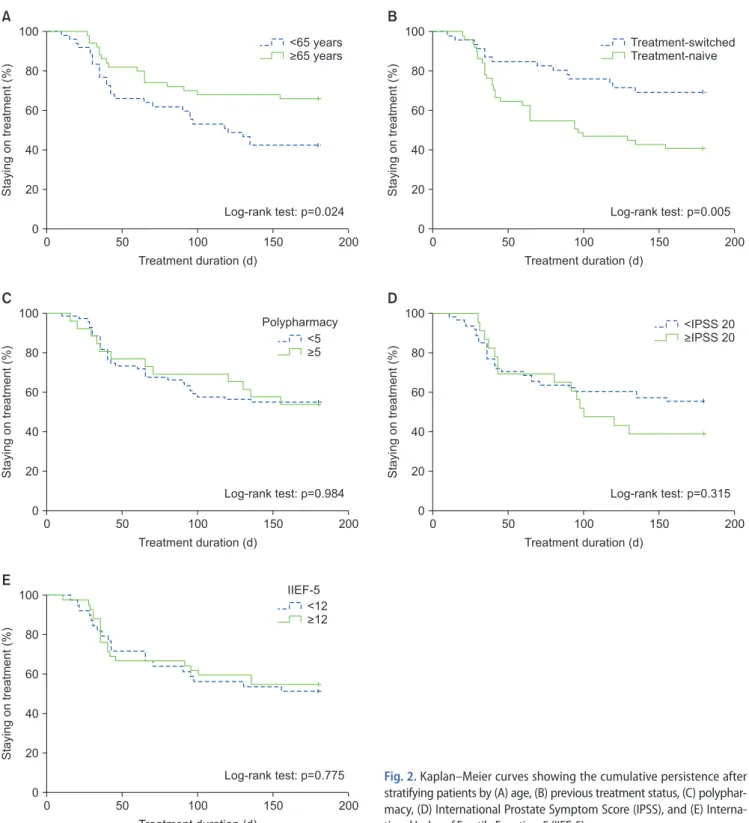
Baseline clinical characteristics of these patients are presented in Table 1. Overall, 44 of 97 patients (45.4%) dis- continued their treatment within 6 months. The mean time to treatment discontinuation (95% confidence interval [CI]) was 125 days (112.6–138.4). The cumulative persistence rate at 30, 90, and 180 days was 88.7%, 66.0%, and 54.6%, respectively (Fig. 1). The cumulative persistence was significantly differ- ent after stratifying patients by previous treatment status (log-rank p=0.005) and age (log-rank p=0.024). However, no
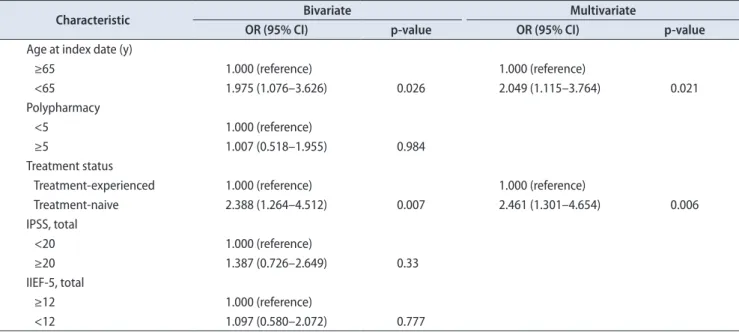
difference in cumulative persistence was found regarding polypharmacy (log rank p=0.984) and symptom severity, ac- cording to patient questionnaires, including IIEF-5 (log rank p=0.775) and IPSS (log rank p=0.315) (Fig. 2). Additionally, previous silodosin (8 mg) or tamsulosin (0.4 mg) medica- tion history and concurrent hypertension medication status did not affect cumulative persistence (log rank p=0.112 and p=0.930, respectively). The results of bivariate and multivari- ate analysis revealed that younger patients (odds ratio [OR], 2.049; 95% CI, 1.115–3.764; p=0.021) and patients in the treat- ment-naive group (OR, 2.461; 95% CI, 1.301–4.654; p=0.006) were more likely to discontinue therapy within 6 months (Table 2).
The most common reasons for discontinuation were side effects (63.6%), perceived poor efficacy (22.7%), cost (9.1%), and inconvenience of daily usage (4.5%) (Table 3). Ejaculatory dysfunction and dizziness were the most commonly reported adverse events (Table 3).
DISCUSSION
As males age, ED symptoms and LUTS tend to increase in severity concurrently [12]. Both LUTS and ED worsen with aging; hence, long-term treatment is required. There- fore, as with other chronic diseases, persistence and com- pliance for LUTS and ED medications are important for improving the patient’s symptoms and quality of life [13,14].
Although it is expected that the use of an FDC will result in treatment persistence and compliance, this has never been investigated in a real-world practice setting. This study is the first retrospective, longitudinal observational study to evaluate the treatment persistence with a once-daily FDC of tadalafil (5 mg) and tamsulosin (0.4 mg).
Table 1. Baseline characteristics of patients
Characteristic Total patients (n=97)
Age at index date (y) 64.4±7.0
Age at index date (y)
<65 47 (48.5)
≥65 50 (51.5)
Treatment status
Treatment-naive 51 (52.6)
Treatment-experienced 46 (47.4)
Polypharmacy 3.18±3.2
Polypharmacy
<5 58 (59.8)
≥5 39 (40.2)
IPSS total 15.2±7.3 (3–34)
IPSS QoL 3.7±1.5 (1–6)
IIEF-5 12.2±6.4 (1–24)
Values are presented as mean±standard deviation, number (%), or mean±standard deviation (range).
IPSS, International Prostate Symptom Score; QoL, quality of life; IIEF-5, International Index of Erectile Function-5.
0 100
80
60
40
20
200
Stayingontreatment(%)
Treatment duration (d) 0
50 100 150
Fig. 1. Kaplan–Meier curves for treatment continuation over 6 months in patients who received a fixed-dose combination of tadalafil (5 mg) and tamsulosin (0.4 mg).
In this study, we found that 45.4% patients discontinued the FDC medication within 6 months. This finding was simi- lar to that in previous Korean studies evaluating treatments for other urologic conditions, including LUTS/BPH and overactive bladder [15-17]. However, this finding was much lower than that in previous western studies evaluating treatment persistence with once-daily tadalafil for ED [18].
Unfortunately, no study has evaluated treatment persistence
with once-daily tadalafil in Korea. Interestingly, the discon- tinuation rate in our study was much higher than that in a previous phase 3 clinical trial of an FDC of tadalafil (5 mg) and tamsulosin (0.4 mg) [10]. The lower discontinuation rate in clinical practice was due to increased patient motivation and cooperation with prescribed recommendations in the clinical trial setting [10]. Moreover, in phase 3 clinical trials, patients are given their medication without cost and are
0 100
80
60
40
20
200
Stayingontreatment(%)
Treatment duration (d) 0
50 100 150
A
<65 years
>65 years
Log-rank test: p=0.024
0 100
80
60
40
20
200
Stayingontreatment(%)
Treatment duration (d) 0
50 100 150
B
Treatment-switched Treatment-naive
Log-rank test: p=0.005
0
0 100
100 80
80 60
60 40
40 20
20
200
200
Stayingontreatment(%)Stayingontreatment(%)
Treatment duration (d)
Treatment duration (d) 0
0
50
50
100
100
150
150
C
E
Log-rank test: p=0.984
Log-rank test: p=0.775
0 100
80
60
40
20
200
Stayingontreatment(%)
Treatment duration (d) 0
50 100 150
D
Log-rank test: p=0.315
<5
>5
Polypharmacy <IPSS 20
>IPSS 20
<12
>12 IIEF-5
Fig. 2. Kaplan–Meier curves showing the cumulative persistence after stratifying patients by (A) age, (B) previous treatment status, (C) polyphar- macy, (D) International Prostate Symptom Score (IPSS), and (E) Interna- tional Index of Erectile Function-5 (IIEF-5).
intensively observed during the study period [19]. This may enhance the persistence rate. In contrast, in real-world clini- cal practice, patients pay for their medication, which might lead to higher expectations and increased vulnerability to side effects with their prescription. These factors allow more enlightening clinical studies to be carried out in real-world practice settings; therefore, actual treatment persistence rates may be more accurate.
The most common reason for treatment discontinuation in this study was adverse drug side effects. Although most side effects were self-limiting, they were directly related to the patient’s satisfaction with treatment. The most common undesirable effect was ejaculatory dysfunction, a well-known side effect of selective α-blockers [20]. This has previously been shown to be the main factor related to low satisfac-
tion with combination treatment using α-blockers and PDE5 inhibitors [21]. However, other adverse events related to tadalafil may have less impact on treatment persistence, based on previous studies with once-daily tadalafil that re- ported discontinuation rates due to the side effect as low as 1% to 6% [22-24]. Therefore, it can be inferred that ejacula- tory dysfunction was a major cause for discontinuation of a once-daily FDC of tadalafil (5 mg) and tamsulosin (0.4 mg).
Interestingly, none of the 9 patients who discontinued due to ejaculatory dysfunction received silodosin or tamsulosin (0.4 mg) before taking a once-daily FDC of tadalafil (5 mg) and tamsulosin (0.4 mg).
In this study, patients who were treatment-naive for α-blockers and PDE5 inhibitors were more likely to discon- tinue treatment early. This is understandable when consid- ering side effects were the main cause for withdrawal. It is also noteworthy that the persistence rates were high in the treatment-experienced group, who had previous coadminis- tration of α-blockers and PDE5 inhibitors. The high persis- tence rate may be because treatment-experienced patients probably did not switch to an FDC when they had side ef- fects. Another factor associated with treatment persistence was age. Patients aged <65 years were more likely to dis- continue treatment at 6 months. Although reasons for this finding are unclear, we inferred that younger patients were more vulnerable to sexual side effects related to α-blockers.
Other potential factors associated with treatment per- sistence, including polypharmacy and subjective symptom severity, did not affect persistence rates. However, it is difficult to draw conclusions regarding the true effects of Table 2. Bivariate and multivariate Cox regression analysis for predicting factors associated with treatment persistence
Characteristic Bivariate Multivariate
OR (95% CI) p-value OR (95% CI) p-value
Age at index date (y)
≥65 1.000 (reference) 1.000 (reference)
<65 1.975 (1.076–3.626) 0.026 2.049 (1.115–3.764) 0.021
Polypharmacy
<5 1.000 (reference)
≥5 1.007 (0.518–1.955) 0.984
Treatment status
Treatment-experienced 1.000 (reference) 1.000 (reference)
Treatment-naive 2.388 (1.264–4.512) 0.007 2.461 (1.301–4.654) 0.006
IPSS, total
<20 1.000 (reference)
≥20 1.387 (0.726–2.649) 0.33
IIEF-5, total
≥12 1.000 (reference)
<12 1.097 (0.580–2.072) 0.777
OR, odds ratio; CI, confidence interval; IPSS, International Prostate Symptom Score; IIEF-5, International Index of Erectile Function-5.
Table 3. Reasons for treatment discontinuation within 6 months
Reason Patients (n=44)
Side effects 28 (63.6)
Ejaculatory dysfunction 9 (20.5)
Dizziness 6 (13.6)
Headache 3 (6.8)
Nasal congestion 3 (6.8)
Flushing 2 (4.5)
Orthostatic hypotension 2 (4.5)
Othersa 3 (6.8)
Perceived poor efficacy 10 (22.7)
Cost 4 (9.1)
Inconvenience of daily administration 2 (4.5) Values are presented as number (%).
a:Ocular hyperemia, palpitations, and dyspepsia.
polypharmacy from these results as patients may have been receiving other treatments for various conditions. Further studies are needed to identify key factors associated with polypharmacy-related persistence.
In this study, the second most common reason for discon- tinuation treatment was the lack of response to treatment, regardless of symptom severity; treatment persistence and symptom severity were not correlated. The degree of symp- tom improvement had a more significant effect on treat- ment persistence than symptom severity.
This study has several limitations. First, patients who were excluded due to no recorded follow-up examinations could not be analyzed; it is unknown if they were receiving treatment from another hospital or discontinued treatment.
Therefore, the persistence rate might be an overestimation.
This is, however, an inevitable limitation due to the retro- spective study design. Second, this study did not consider probable confounding factors of treatment persistence re- lated to physicians. The doctor-patient relationship is well known to affect a patient's compliance with treatment [25- 27]. Therefore, further studies will need to evaluate whether satisfaction with the doctor affects treatment persistence.
Third, the sample for this study was small and from one center. However, it has been less than 3 years since the drug was approved and prescribed. Moreover, this study was meaningful as an initial investigation of treatment persis- tence with a once-daily FDC of tadalafil (5 mg) and tamsulo- sin (0.4 mg) and its related factors. A large scale, prospective trial considering these limitations should be performed to further investigate factors influencing FDC treatment per- sistence.
CONCLUSIONS
In this study, 54.6% patients with LUTS and ED contin- ued a once-daily FDC of tadalafil (5 mg) and tamsulosin (0.4 mg) for 6 months. Patients who had experience with coad- ministration of α-blockers and PDE5 inhibitors before the FDC prescription were likely to continue their treatment.
The most common reason for discontinuation was adverse drug side effects. To improve patient compliance for a once- daily FDC of tadalafil (5 mg) and tamsulosin (0.4 mg), it is recommended to select patients who show adaptation to a combination of α-blockers and PDE5 inhibitors prior to FDC treatment.
CONFLICTS OF INTEREST
The authors have nothing to disclose.
AUTHORS’ CONTRIBUTIONS
Research conception and design: Du Geon Moon and Sun Tae Ahn. Data analysis and interpretation: Jong Wook Kim, Mi Mi Oh, and Hong Seok Park. Statistical analysis: Dong Hyun Lee and Hyeong Guk Jeong. Drafting of the manu- script: Sun Tae Ahn. Critical revision of the manuscript: Du Geon Moon. Approval of final manuscript: all authors.
REFERENCES
1. Seftel AD, de la Rosette J, Birt J, Porter V, Zarotsky V, Viktrup L.
Coexisting lower urinary tract symptoms and erectile dysfunc- tion: a systematic review of epidemiological data. Int J Clin Pract 2013;67:32-45.
2. Boyle P, Robertson C, Mazzetta C, Keech M, Hobbs R, Four- cade R, et al. The association between lower urinary tract symptoms and erectile dysfunction in four centres: the UrEpik study. BJU Int 2003;92:719-25.
3. Braun MH, Sommer F, Haupt G, Mathers MJ, Reifenrath B, Engelmann UH. Lower urinary tract symptoms and erectile dysfunction: co-morbidity or typical "Aging Male" symptoms?
Results of the "Cologne Male Survey". Eur Urol 2003;44:588- 94.
4. Brookes ST, Link CL, Donovan JL, McKinlay JB. Relationship between lower urinary tract symptoms and erectile dysfunc- tion: results from the Boston Area Community Health Survey.
J Urol 2008;179:250-5; discussion 255.
5. Rosen R, Altwein J, Boyle P, Kirby RS, Lukacs B, Meuleman E, et al. Lower urinary tract symptoms and male sexual dysfunc- tion: the multinational survey of the aging male (MSAM-7).
Eur Urol 2003;44:637-49.
6. Oelke M, Bachmann A, Descazeaud A, Emberton M, Gravas S, Michel MC, et al.; European Association of Urology. EAU guidelines on the treatment and follow-up of non-neurogenic male lower urinary tract symptoms including benign prostatic obstruction. Eur Urol 2013;64:118-40.
7. Song WH, Park J, Yoo S, Oh S, Cho SY, Cho MC, et al. Changes in the prevalence and risk factors of erectile dysfunction dur- ing a decade: the Korean Internet Sexuality Survey (KISS), a 10-year-interval web-based survey. World J Mens Health 2019;37:199-209.
8. Hovstadius B, Petersson G. Factors leading to excessive poly- pharmacy. Clin Geriatr Med 2012;28:159-72.
9. Sergi G, De Rui M, Sarti S, Manzato E. Polypharmacy in the elderly: can comprehensive geriatric assessment reduce inap- propriate medication use? Drugs Aging 2011;28:509-18.
10. Kim SW, Park NC, Lee SW, Yang DY, Park JK, Moon DG, et al. Efficacy and safety of a fixed-dose combination therapy
of tamsulosin and tadalafil for patients with lower urinary tract symptoms and erectile dysfunction: results of a ran- domized, double-blinded, active-controlled trial. J Sex Med 2017;14:1018-27.
11. National Institute of Food and Drug Safety Evaluation. "Gu- gutams 0.4/5 mg®" approval report [Internet]. Cheongju: Min- istry of Food and Drug Safety; 2016 Oct 20 [cited 2019 Sep 23]. Available from: http://www.nifds.go.kr/brd/m_88/down.
do?brd_id=board_mfds_191&seq=26016&data_tp=A&file_
seq=1.
12. Kirby M, Chapple C, Jackson G, Eardley I, Edwards D, Hackett G, et al. Erectile dysfunction and lower urinary tract symp- toms: a consensus on the importance of co-diagnosis. Int J Clin Pract 2013;67:606-18.
13. Krueger KP, Berger BA, Felkey B. Medication adherence and persistence: a comprehensive review. Adv Ther 2005;22:313- 56.
14. Park HJ. The role of the urologist in men's health. World J Mens Health 2017;35:57-8.
15. Kim TH, You HW, Park JH, Lee JG, Choo MS, Park WH, et al.
Persistence of solifenacin therapy in patients with overactive bladder in the clinical setting: a prospective, multicenter, ob- servational study. Int J Clin Pract 2016;70:351-7.
16. Kim TH, Choo MS, Kim YJ, Koh H, Lee KS. Drug persistence and compliance affect patient-reported outcomes in overactive bladder syndrome. Qual Life Res 2016;25:2021-9.
17. Koh JS, Cho KJ, Kim HS, Kim JC. Twelve-month medica- tion persistence in men with lower urinary tract symptoms suggestive of benign prostatic hyperplasia. Int J Clin Pract 2014;68:197-202.
18. Hatzichristou D, d'Anzeo G, Porst H, Buvat J, Henneges C, Rossi A, et al. Tadalafil 5 mg once daily for the treatment of erectile dysfunction during a 6-month observational study (EDATE): impact of patient characteristics and comorbidities.
BMC Urol 2015;15:111.
19. Shiovitz TM, Bain EE, McCann DJ, Skolnick P, Laughren T,
Hanina A, et al. Mitigating the effects of nonadherence in clinical trials. J Clin Pharmacol 2016;56:1151-64.
20. Abdel-Hamid IA, Ali OI. Delayed ejaculation: pathophysiolo- gy, diagnosis, and treatment. World J Mens Health 2018;36:22- 40.
21. Lee LK, Goren A, Boytsov NN, Donatucci CF, McVary KT.
Treatment satisfaction among men with concurrent benign prostatic hyperplasia and erectile dysfunction treated with tadalafil or other phosphodiesterase type-5 inhibitor combina- tions. Patient Prefer Adherence 2016;10:1205-15.
22. Won JE, Chu JY, Choi HC, Chen Y, Park HJ, Dueñas HJ. Safety and effectiveness of once-daily tadalafil (5 mg) therapy in Korean men with benign prostatic hyperplasia/lower urinary tract symptoms in a real-world clinical setting: results from a post-marketing surveillance study. World J Mens Health 2018;36:161-70.
23. Porst H, Rajfer J, Casabé A, Feldman R, Ralph D, Vieiralves LF, et al. Long-term safety and efficacy of tadalafil 5 mg dosed once daily in men with erectile dysfunction. J Sex Med 2008;5:2160-9.
24. Rajfer J, Aliotta PJ, Steidle CP, Fitch WP 3rd, Zhao Y, Yu A.
Tadalafil dosed once a day in men with erectile dysfunction: a randomized, double-blind, placebo-controlled study in the US.
Int J Impot Res 2007;19:95-103.
25. Yu KD, Zhou Y, Liu GY, Li B, He PQ, Zhang HW, et al. A pro- spective, multicenter, controlled, observational study to evalu- ate the efficacy of a patient support program in improving pa- tients' persistence to adjuvant aromatase inhibitor medication for postmenopausal, early stage breast cancer. Breast Cancer Res Treat 2012;134:307-13.
26. Sawada N, Uchida H, Suzuki T, Watanabe K, Kikuchi T, Handa T, et al. Persistence and compliance to antidepressant treatment in patients with depression: a chart review. BMC Psychiatry 2009;9:38.
27. Emanuel EJ, Dubler NN. Preserving the physician-patient rela- tionship in the era of managed care. JAMA 1995;273:323-9.