Vol. 38, No. 2, 136–143 (2010)
Detection of Novel Polyketide Synthase Genes in Sorangium cellulosum Isolated in Korea
Youn, Jinkwon, Dohee Kim, Hanbit Lee, Kyewon Lee, and Kyungyun Cho* Myxobacteria Bank, Department of Biotechnology, Hoseo University, Asan 336-795, Korea
DNA fragments encoding the ketosynthase (KS) domain of polyketide synthase (PKS) genes were amplified using polymerase chain reaction (PCR) from 9 strains of Sorangium cellulosum isolated in Korea, cloned into a plasmid vector and sequenced. A total of 83 cloned DNA fragments were analyzed, and similar fragments were excluded, leaving 43 independent DNA fragments encoding the KS domains. The predicted amino acid sequences of 32 fragments were 70%-100% identical to the amino acid sequences of already known PKS genes, while the remaining 11 fragments were ≤67% or less identical to the known sequences, suggesting that these genes are novel PKS genes.
Key words: Myxobacteria, polyketide synthase, PKS, Sorangium cellulosum
Introduction
Myxobacteria, gram-negative soil bacteria, are a rich source of bioactive secondary metabolites. More than 500 bioactive substances have been identified from myxobac- teria [6, 12, 25]. The majority of the bioactive substances isolated from myxobacteria are polyketides or hybrids of polyketide and non-ribosomal peptides [25]. Polyketides biosynthesized from acyl-coenzyme A monomers by poly- ketide synthases (PKSs) [24] and non-ribosomal peptides biosynthesized from amino acids by non-ribosomal peptide synthetases [3] are two large classes of natural products that have important pharmaceutical properties. PKSs are composed of multiple covalently linked domains grouped into modules, each of which is responsible for a round of polyketide chain extension and functional group modifica- tion [2, 23]. Thus, PKSs provide an attractive framework for engineering assemblies that produce novel polyketides.
Among myxobacteria, Sorangium cellulosum is the most proficient producer of bioactive substances [5, 6]. Approxi- mately 47% of the bioactive substances identified from myxobacteria are from this species [6], including epothilones− a potential new class of anticancer compounds. Because of their pharmaceutical importance, several PKS genes have
been cloned from S. cellulosum and other species of myxobacteria [1]. However, genomic studies have indicated that there are still many other unidentified PKS genes in myxobacteria; these genes may produce novel polyketides [19, 22, 25]. The detection of PKS genes by polymerase chain reaction (PCR) without cloning has also indicated the presence of many unidentified PKS genes in myxobacteria [13, 15]. Using PCR, Li et al. detected 56 ketosynthase (KS) domains of PKSs from 10 S. cellulosum strains that appeared to be novel; these genes had identities between 54% and 83% to known PKSs in the databases [15]. Komaki et al. detected 80 PKS genes by PCR from diverse myxobacteria that appeared to be novel with less than 70% identity to known PKSs [13].
Previously, we reported the isolation of 591 S. cellulosum strains from soil samples collected from various locations in Korea [7]. In this paper, we report the detection of PKS genes from 9 strains of S. cellulosum, each of which were isolated from a different province of Korea.
Materials and Methods
Strains and Culture Conditions
All strains of S. cellulosum used in this study were iso- lated in Korea (Table 1) [7]. Competent cells of Escheri- chia coli DH5α were purchased from Donginbiotech Co., Korea. ST21P medium [7] was used to culture S.
cellulosum, and LB medium [20] was used to grow E. coli.
*Corresponding author
Tel: 82-41-540-5627, Fax: 82-41-548-6231 E-mail: [email protected]
S. cellulosum was cultured at 32oC and E. coli was cultured at 37oC.
Isolation of Genomic DNA from S. cellulosum Cells grown on ST21P plates for 7 days were dissolved in 15 mL lysis solution (20 mM Tris-HCl (pH 8.0), 10 mM NaCl, 0.5% SDS, and 100 µg/mL proteinase K) in a 50 mL tube and incubated at 50oC for 12 hours. The lysate was extracted with 1 volume of phenol-chloroform-isoamyl alcohol (25:24:1) mixture and then with 1 volume of chloroform. The extraction mixture was centrifuged (5,000 rpm, 10oC for 10 min), and the supernatant was transferred to a new tube. Next, a 0.1 volume of 3 M sodium acetate solution (pH 5.5) and two volumes of 100% ethanol were added to the solution to precipitate the genomic DNA. The precipitated DNA was washed with ice-cold 70% (v/v) ethanol, dried, and dissolved in TE buffer (10 mM Tris- HCl, 1 mM EDTA, pH 8.0).
Polymerase Chain Reaction and Sequence Analysis The PKS genes of S. cellulosum were amplified using the genomic DNA isolated from S. cellulosum strains and a set of oligonucleotides (5'-GCSATGGAYCCSCARCAR- CGSVT-3' and 5'-GTSCCSGTSCCRTGSSCYTCSAC-3' reported by Schirmer et al. [21]) as primers. Denaturation was conducted at 94oC for 30 sec, annealing at 66oC for 30 sec, and extension was carried out at 72oC for 1 min. A total of 25 cycles of PCR were performed with Taq DNA polymerase (Solgent Co., Korea). The resultant PCR fragments were ligated into a pGEM-T Easy plasmid vector (Promega, USA), and the ligation products were used to transform E. coli DH5α, resulting in the cloning of the PCR fragments into the plasmid vector. The DNA sequences of the cloned PCR fragments were determined by Macrogen Inc., Korea, using SP6 and T7 primers. The
DNA sequences and the predicted amino acid sequences were analyzed using NCBI BLAST [9] and ClustalX2 [14]
programs.
Results and Discussion
Detection of PKS Genes from S. cellulosum by PCR S. cellulosum strains KYC3013, KYC3014, KYC3043, KYC3046, KYC3048, KYC3060, KYC3074, KYC3175, and KYC3176 were isolated from 9 different provinces of Korea [7]. To detect the PKS genes, PCR was carried out using the genomic DNA of these strains as templates and two oligonucleotides that bind specifically to the KS domains of PKS. PCR with the genomic DNA from all 9 strains yielded about 680 bp DNA fragments, which were the expected size of the PCR product. The resultant PCR fragments were then cloned into a plasmid vector, and the DNA sequences of the cloned fragments were determined.
A total of 83 fragments encoding the KS domains of the PKS genes were analyzed, and similar fragments with more than 90% identity among the fragments from the same strain were excluded, which left 43 independent cloned PCR fragments.
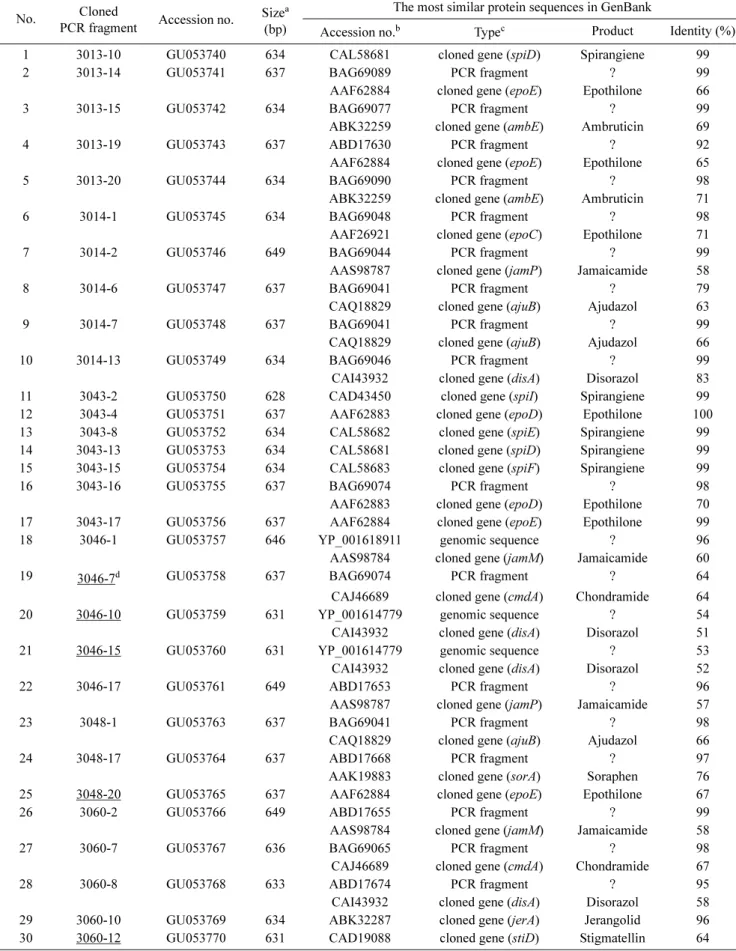
PKS Genes Highly Homologous to Known PKS Genes The predicted amino acid sequences of the cloned fragments were compared to the amino acid sequences in GenBank by use of the BLASTP program (Table 2). It appears that the predicted amino acid sequences of 32 fragments (of the 43 cloned fragments) were 70%-100%
identical to those in GenBank. Among them, 18 fragments were 70%-100% identical to those encoded by PKS genes whose polyketide products were already known (Table 3).
The predicted amino acid sequence of cloned fragment 3013-10, which was from the strain KYC3013, was 99%
identical to SpiD (Fig. 1, Table 2). The amino acid sequence of fragments 3043-2, 3043-8, 3043-13, and 3043- 15, which were from strain KYC3043, were 99% identical to SpiI, SpiE, SpiD, and SpiF, respectively (Fig. 1, Table 2). The deduced amino acid sequence of fragment 3175-2, which was from strain KYC3175, was 99% identical to SpiE (Fig. 1, Table 2). SpiI, SpiE, SpiD, and SpiF are enzymes involved in the biosynthesis of spirangiene [4].
Thus, these results indicate that strains KYC3013, KYC4043, and KYC3175 carry genes for the biosynthesis of spirangiene.
The predicted amino acid sequences of cloned fragments Table 1. Sorangium cellulosum strains used in this study.
Strains Geographical origin References
KYC3013 Jeju, Jeju-do 8
KYC3014 Haenam, Jeollanam-do 7
KYC3043 Dangjin, Chungcheongnam-do 7
KYC3046 Icheon, Gyeonggi-do 7
KYC3048 Yeongdeok, Gyeongsangbuk-do 7
KYC3060 Jumunjin, Gangwon-do 7
KYC3074 Danyang, Chungcheongbuk-do 7
KYC3175 Muju, Jeollabuk-do 7
KYC3176 Changnyeong, Gyeongsangnam-do 7
Table 2. Polyketide synthase genes detected by polymerase chain reaction (PCR) in this study.
No. Cloned
PCR fragment Accession no. Sizea (bp)
The most similar protein sequences in GenBank
Accession no.b Typec Product Identity (%)
1 3013-10 GU053740 634 CAL58681 cloned gene (spiD) Spirangiene 99
2 3013-14 GU053741 637 BAG69089 PCR fragment ? 99
AAF62884 cloned gene (epoE) Epothilone 66
3 3013-15 GU053742 634 BAG69077 PCR fragment ? 99
ABK32259 cloned gene (ambE) Ambruticin 69
4 3013-19 GU053743 637 ABD17630 PCR fragment ? 92
AAF62884 cloned gene (epoE) Epothilone 65
5 3013-20 GU053744 634 BAG69090 PCR fragment ? 98
ABK32259 cloned gene (ambE) Ambruticin 71
6 3014-1 GU053745 634 BAG69048 PCR fragment ? 98
AAF26921 cloned gene (epoC) Epothilone 71
7 3014-2 GU053746 649 BAG69044 PCR fragment ? 99
AAS98787 cloned gene (jamP) Jamaicamide 58
8 3014-6 GU053747 637 BAG69041 PCR fragment ? 79
CAQ18829 cloned gene (ajuB) Ajudazol 63
9 3014-7 GU053748 637 BAG69041 PCR fragment ? 99
CAQ18829 cloned gene (ajuB) Ajudazol 66
10 3014-13 GU053749 634 BAG69046 PCR fragment ? 99
CAI43932 cloned gene (disA) Disorazol 83
11 3043-2 GU053750 628 CAD43450 cloned gene (spiI) Spirangiene 99
12 3043-4 GU053751 637 AAF62883 cloned gene (epoD) Epothilone 100
13 3043-8 GU053752 634 CAL58682 cloned gene (spiE) Spirangiene 99
14 3043-13 GU053753 634 CAL58681 cloned gene (spiD) Spirangiene 99
15 3043-15 GU053754 634 CAL58683 cloned gene (spiF) Spirangiene 99
16 3043-16 GU053755 637 BAG69074 PCR fragment ? 98
AAF62883 cloned gene (epoD) Epothilone 70
17 3043-17 GU053756 637 AAF62884 cloned gene (epoE) Epothilone 99
18 3046-1 GU053757 646 YP_001618911 genomic sequence ? 96
AAS98784 cloned gene (jamM) Jamaicamide 60
19 3046-7d GU053758 637 BAG69074 PCR fragment ? 64
CAJ46689 cloned gene (cmdA) Chondramide 64
20 3046-10 GU053759 631 YP_001614779 genomic sequence ? 54
CAI43932 cloned gene (disA) Disorazol 51
21 3046-15 GU053760 631 YP_001614779 genomic sequence ? 53
CAI43932 cloned gene (disA) Disorazol 52
22 3046-17 GU053761 649 ABD17653 PCR fragment ? 96
AAS98787 cloned gene (jamP) Jamaicamide 57
23 3048-1 GU053763 637 BAG69041 PCR fragment ? 98
CAQ18829 cloned gene (ajuB) Ajudazol 66
24 3048-17 GU053764 637 ABD17668 PCR fragment ? 97
AAK19883 cloned gene (sorA) Soraphen 76
25 3048-20 GU053765 637 AAF62884 cloned gene (epoE) Epothilone 67
26 3060-2 GU053766 649 ABD17655 PCR fragment ? 99
AAS98784 cloned gene (jamM) Jamaicamide 58
27 3060-7 GU053767 636 BAG69065 PCR fragment ? 98
CAJ46689 cloned gene (cmdA) Chondramide 67
28 3060-8 GU053768 633 ABD17674 PCR fragment ? 95
CAI43932 cloned gene (disA) Disorazol 58
29 3060-10 GU053769 634 ABK32287 cloned gene (jerA) Jerangolid 96
30 3060-12 GU053770 631 CAD19088 cloned gene (stiD) Stigmatellin 64
3043-4 and 3043-17, which were from strain KYC3043, were 100% and 99% identical to EpoD and EpoE, respectively (Fig. 1, Table 2). EpoD and EpoE are enzymes involved in the biosynthesis of epothilone [10, 16]. The predicted amino acid sequence of cloned fragment 3060- 10, which was from strain KYC3060, was 96% identical to
JerA (Fig. 1, Table 2)−an enzyme responsible for the bio- synthesis of jerangolid [11]. The amino acid sequence of cloned fragment 3060-17 was 96% identical to AmbE (Fig.
1, Table 2), which is an enzyme responsible for the bio- synthesis of ambruticin [11]. Thus, these results indicate that strain KYC3043 carries genes for the biosynthesis of Table 2. Continued
No. Cloned
PCR fragment Accession no. Sizea (bp)
The most similar protein sequences in GenBank
Accession no.b Typec Product Identity (%)
31 3060-17 GU053771 634 ABK32259 cloned gene (ambE) Ambruticin 96
32 3074-5 GU053772 638 AAF62883 cloned gene (epoD) Epothilone 65
33 3074-7 GU053773 631 AAK57189 cloned gene (mxaE) Myxalamid 78
34 3074-8 GU053774 637 ABD17671 PCR fragment ? 99
AAK57190 cloned gene (mxaF) Myxalamid 71
35 3074-11 GU053775 637 BAG69041 PCR fragment ? 99
CAQ18829 cloned gene (ajuB) Ajudazol 66
36 3074-16 GU053776 640 AAF62883 cloned gene (epoD) Epothilone 64
37 3175-2 GU053777 634 CAL58682 cloned gene (spiE) Spirangiene 99
38 3175-16 GU053778 637 ABD17630 PCR fragment ? 76
AAS98783 cloned gene (jamL) Jamaicamide 62
39 3176-7 GU053779 637 AAF62883 cloned gene (epoD) Epothilone 77
40 3176-8 GU053780 640 AAT70105 cloned gene (curJ) Curacin 67
41 3176-11 GU053781 640 CAD19092 cloned gene (stiH) Stigmatellin 63
42 3176-14 GU053782 640 CAD19086 cloned gene (stiB) Stigmatellin 59
43 3176-18 GU053783 637 CAJ46690 cloned gene (cmdB) Chondramide 67
aThe size of the cloned PCR fragments after the length of primers was subtracted.
bAccession numbers of the most similar protein sequences in GenBank are shown. If the most similar protein sequence in the databases was one deduced from the gene whose polyketide product was not known, the accession number of the most similar protein sequence originating from the gene with a known product is also shown.
cCloned gene: complete amino acid sequence deduced from a cloned gene with known polyketide products; PCR fragment: partial amino acid sequence deduced from a PCR fragment of a gene whose polyketide products are not known; genomic sequence: complete amino acid sequence originated from genomic sequence.
dCloned PCR fragments 67% or less identical to published sequences in the databases are underlined.
Table 3. Strains of Sorangium cellulosum and their polyketide synthase genes detected by polymerase chain reaction.
Strains
Number of cloned PCR fragments Encoding polyketide
synthases (PKSs)
After similar clones were excluded
70%–100% identical to known PKSs
67% or less identical to known PKSs
KYC3013 12 5 5(3)a 0
KYC3014 9 5 5(3) 0
KYC3043 9 7 7(1) 0
KYC3046 10 5 2(1) 3
KYC3048 9 3 2(1) 1
KYC3060 10 6 5(3) 1
KYC3074 7 5 3(1) 2
KYC3175 9 2 2(1) 0
KYC3176 8 5 1(0) 4
Total 83 43 32(14) 11
a( ): Number of cloned PCR fragments that were 70%-100% identical to PKSs whose polyketide products have not been identified but 69% or less identical to PKSs whose polyketide products have been identical.
epothilone and that KYC3060 carries genes for the bio- synthesis of jerangolid and ambruticin.
Meanwhile, the deduced amino acid sequences of the
other 14 fragments among the 32 cloned fragments were 71%–99% identical to those encoded by PKS genes whose polyketide products were not identified yet. They were Fig. 1. Neighbor-joining tree based on the amino acid sequences of the KS domains in PKSs. Only the bootstrap values (expressed as percentages of 1,000 replications) greater than 50% are indicated at the nodes. The 212 amino acid sequence (104–316 aa) of EpoA (AAF62880) was used as an outgroup (not shown). Cloned PCR fragments ≤67% identical to the reported amino acid sequences in the database are shaded and those 96%–100% identical to known PKS genes are boxed. Scale bar, 0.1 substitutions per nucleotide position.
only 69% or less identical to PKSs with known polyketide products (Table 3). For instance, the deduced amino acid sequence of fragment 3013-14 was 99% identical to a PKS (BAG69089) whose product had not been identified, while it was 66% (to AAF62884) or less identical to PKSs whose polyketide products were known. BAG69089 is the deduc- ed amino acid sequence of a partially PCR amplified PKS gene whose product is unknown [13], whereas AAF62884 is the complete amino acid sequence of the EpoE protein, a type I polyketide synthase containing epothilone synthase modules 7 and 8, involved in epothilone biosynthesis [10].
Since their products have not been identified yet and their sequence similarities to the KS genes with known products are low, it is expected that characterization of these genes would lead to the discovery of new polyketide compounds from S. cellulosum.
PKS Genes ≤69% Identical to Known PKS Genes The remaining 11 other cloned PCR fragments of the 43 cloned fragments were ≤67% identical to sequences in the database (Table 3). Komaki et al. reported that KS domains involved in the synthesis of structurally related polyketide molecules in Streptomyces were, in almost all cases, more than 70% identical to each other [13]. Based on this, they classified the PKS genes whose sequences were less than 70% identical to the amino acid sequences of known genes as novel PKS genes. If this is true, many of the 11 cloned fragments that we have detected in this study would be novel PKS genes that synthesize novel PKS compounds.
Characterization of these genes would lead to the cloning of new PKS genes or the discovery of new polyketide compounds.
Strain KYC3013 is known to have an epothilone biosyn- thetic gene cluster and produce epothilone [8]. However, none of epothilone biosynthetic genes were detected in KYC3013 (Table 2), indicating that the PCR-based detec- tion method used in this study was not sensitive enough to detect all PKS genes in the strains. We reason that if the primers bind one PKS gene with higher affinity than the other PKS genes, the chance that the other genes would be amplified is low. As a result, genes with a low affinity to the primers would be difficult to detect by PCR and cloning.
Despite this problem, 11 fragments of the 43 cloned PCR fragments were ≤67% identical to published amino acid sequences in the database and are expected to carry novel PKS genes. Interestingly, 4 out of 5 cloned PCR fragments
obtained from strain KYC3176 (3176-8, 3176-14, 3176-11, and 3176-18) were ≤67% identical to published amino acid sequences (Table 2). The other cloned fragment 3176-7 was 77% identical to EpoD. Because the EpoD epothilone synthases from different strains share more than 98%
identity among their amino acid sequences, it is unlikely that strain 3176-7 encodes a PKS involved in epothilone biosynthesis. Thus, it appears that that all 5 cloned PCR fragments from KYC3176 carry novel PKS genes. In addition, 3 fragments from KYC3046, 2 fragments from KYC3074, and 1 fragment from KYC3048 and KYC3060 appear to carry novel PKS genes. S. cellulosum is known to carry multiple polyketide synthesis pathways [22], thus it is possible that each of these genes is involved in production of different polyketide compounds.
Currently, we are trying to knock out these genes to generate mutants that are unable to produce the polyketides biosynthesized by these genes. Characterization of these mutants will accelerate the discovery of new polyketide molecules and cloning of their biosynthetic genes.
Acknowledgement
This work was supported by a National Research Foundation of Korea (NRF) grant funded by the Korean Government (MEST) (2009-0074547).
REFERENCES
1. Bode, H. B. and R. Müller. 2006. Analysis of myxobacterial secondary metabolism goes molecular. J. Ind. Microbiol.
Biotechnol. 33: 577-588.
2. Cane, D. E., C. T. Walsh, and C. Khosla. 1998. Harnessing the biosynthetic code: combinations, permutations, and mutations. Science 282: 63-68.
3. Finking, R. and M. A. Marahiel. 2004. Biosynthesis of non- ribosomal peptides. Annu. Rev. Microbiol. 58: 453-488.
4. Frank, B., J. Knauber, H. Steinmetz, M. Scharfe, H. Blöcker, S. Beyer, and R. Müller. 2007. Spiroketal polyketide forma- tion in Sorangium: identification and analysis of the biosyn- thetic gene cluster for the highly cytotoxic spirangienes.
Chem. Biol. 14: 221-233.
5. Gerth, K., O. Perlova, and R. Müller. 2008. Sorangium cellu- losum. pp. 329-348. In Whitworth, D. E. (ed.), Myxobacte- ria: multicellularity and differentiation. ASM Press, Washington, D.C.
6. Gerth, K., S. Pradella, O. Perlova, S. Beyer, and R. Müller.
2003. Myxobacteria: proficient producers of novel natural products with various biological activities-past and future
biotechnological aspects with the focus on the genus Sor- angium. J. Biotech. 106: 233-253.
7. Hyun, H., J. Chung, H. Lee, J. Youn, C. Lee, D. Kim, and K.
Cho. 2009. Isolation of cellulose-degrading myxobacteria Sorangium cellulosum. Kor. J. Microbiol. 45: 48-53.
8. Hyun, H., J. Chung, J. Kim, J. S. Lee, B. -M. Kwon, K. -H.
Son, and K. Cho. 2008. Isolation of Sorangium cellulosum carrying epothilone gene clusters. J. Microbiol. Biotechnol.
18: 1416-1422.
9. Johnson, M., I. Zaretskaya, Y. Raytselis, Y. Merezhuk, S.
McGinnis, and T. L. Madden. 2008. NCBI BLAST: a better web interface. Nucleic Acids Res. 36: W5-W9.
10. Julien, B., S. Shah, R. Ziermann, R. Goldman, L. Katz, and C. Khosla. 2000. Isolation and characterization of the epothilone biosynthetic gene cluster from Sorangium cellulo- sum. Gene 16: 153-160.
11. Julien, B., Z. Q. Tian, R. Reid, and C. D. Reeves. 2006.
Analysis of the ambruticin and jerangolid gene clusters of Sorangium cellulosum reveals unusual mechanisms of polyketide biosynthesis. Chem. Biol. 13: 1277-1286.
12. Kim, Y. S., W. C. Bae, and S. J. Back. 2003. Bioactive sub- stances from myxobacteria. Kor. J. Microbiol. Biotechnol.
31: 1-12.
13. Komaki, H., R. Fudou, T. Iizuka, D. Nakajima, K. Okazaki, D. Shibata, M. Ojika, and S. Harayama. 2008. PCR detec- tion of type I polyketide synthase genes in myxobacteria.
Appl. Environ. Microbiol. 74: 5571-5574.
14. Larkin, M. A., G. Blackshields, N. P. Brown, R. Chenna, P.
A. McGettigan, H. McWilliam, F. Valentin, I. M. Wallace, A.
Wilm, R. Lopez, J. D. Thompson, T. J. Gibson, and D. G.
Higgins. 2007. Clustal W and Clustal X version 2.0. Bioin- formatics 23: 2947-2948.
15. Li, Z. F., J. Y. Zhao, Z. J. Xia, J. Shi, H. Liu, Z. H. Wu, W.
Hu, W. F. Liu, and Y. Z. Li. 2007. Evolutionary diversity of ketoacyl synthases in cellulolytic myxobacterium Sor- angium. Syst. Appl. Microbiol. 30: 189-196.
16. Molnar, I., T. Schupp, M. Ono, R. Zirkle, M. Milnamow, B.
Nowak-Thompson, N. Engel, C. Toupet, A. Stratmann, D. D.
Cyr, J. Gorlach, J. M. Mayo, A. Hu, S. Goff, J. Schmid, and J. M. Ligon. 2000. The biosynthetic gene cluster for the microtubule-stabilizing agents epothilones A and B from Sorangium cellulosum So ce90. Chem. Biol. 7: 97-109.
17. Reichenbach, H. 2005. Myxococcales. pp. 1059-1144. In Brenner, D.J., N.R. Krieg, J.T. Staley, and G.M. Garrity (ed.),
Bergey's Manual of Systematic Bacteriology, 2nd ed.
Bergey's Manual Trust, East Lansing, MI.
18. Reichenbach, H. and M. Dworkin. 1992. The myxobacteria.
pp. 3416-3487. In Balows, A., H.G. Trüper, M. Dworkin, W.
Harder, and K.-H. Schleifer (ed.), The Prokaryotes, 2nd ed., vol. IV, Springer Verlag, NY.
19. Ronning, C. M. and W. C. Nierman. 2008. The genomes of Myxococcus xanthus and Stigmatella aurantiaca, pp. 285- 298. In Whitworth, D. E. (ed.), Myxobacteria: multicellular- ity and differentiation. ASM Press, Washington, D.C.
20. Sambrook, J., E. F. Fritsch and T. Maniatis. 1989. Molecular Cloning: A Laboratory Manual, 2nd ed. Cold Spring Harbor Laboratory Press, Cold Spring Harbor, N.Y.
21. Schirmer, A., R. Gadkari, C. D. Reeves, F. Ibrahim, E. F.
DeLong, and C. R. Hutchinson. 2005. Metagenomic analy- sis reveals diverse polyketide synthase gene clusters in microorganisms associated with the marine sponge Disco- dermia dissoluta. Appl. Environ. Microbiol. 71: 4840-4849.
22. Schneiker, S., O. Perlova, O. Kaiser, K. Gerth, A. Alici, M.
O. Altmeyer, D. Bartels, T. Bekel, S. Beyer, E. Bode, H. B.
Bode, C. J. Bolten, J. V. Choudhuri, S. Doss, Y. A. Elnakady, B. Frank, L. Gaigalat, A. Goesmann, C. Groeger, F. Gross, L. Jelsbak, L. Jelsbak, J. Kalinowski, C. Kegler, T. Knauber, S. Konietzny, M. Kopp, L. Krause, D. Krug, B. Linke, T.
Mahmud, R. Martinez-Arias, A. C. McHardy, M. Merai, F.
Meyer, S. Mormann, J. Muñoz-Dorado, J. Perez, S. Pradella, S. Rachid, G. Raddatz, F. Rosenau, C. Rückert, F. Sasse, M.
Scharfe, S. C. Schuster, G. Suen, A. Treuner-Lange, G. J.
Velicer, F.J. Vorhölter, K. J. Weissman, R. D. Welch, S. C.
Wenzel, D. E. Whitworth, S. Wilhelm, C. Wittmann, H.
Blöcker, A. Pühler, and R. Müller. 2007. Complete genome sequence of the myxobacterium Sorangium cellulosum. Nat.
Biotechnol. 25: 1281-1289.
23. Staunton, J. and B. Wilkinson. 2001. Combinatorial biosyn- thesis of polyketides and nonribosomal peptides. Curr. Opin.
Chem. Biol. 5: 159-164.
24. Staunton, J. and K. J. Weissman. 2001. Polyketide biosynthe- sis: a millennium review. Nat. Prod. Rep. 18: 380-416.
25. Weissman, K. J. and R. Müller. 2009. A brief tour of myxo- bacterial secondary metabolism. Bioorg. Med. Chem. 17:
2121-2136.
(Received March 3, 2010/May 17, 2010
국문초록
국내에서 분리한 Sorangium cellulosum의 신규 Polyketide Synthase 유전자 검출 윤진권·김도희·이한빛·이계원·조경연*
호서대학교 생명공학과 점액세균은행
국내에서 분리한 9균주의 Sorangium cellulosum로부터 중합효소연쇄반응(PCR)을 통해 polyketide synthase(PKS)의 ketosynthase(KS) domain을 암호화하는 DNA를 증폭하고, 플라스미드 벡터에 클로닝한 후, 염기서열을 결정하였다.
전체 83개의 클로닝된 DNA 조각을 분석하여 유사한 조각을 배제한 결과, 43조각이 KS domain을 암호화하는 독립 된 DNA 조각으로 판명되었다. 43조각 중 32조각의 아미노산 서열이 이미 클로닝된 PKS 유전자의 아미노산 서열과 70%-100% 유사하였으며, 나머지 11 조각은 알려진 서열과 67% 이하의 상동성을 가져 새로운 PKS 유전자일 가능 성이 매우 높음을 보여주었다.