Extraction and Characterization of an Anti-
hyperglycemic α-Glucosidase Inhibitor from Edible Mushroom, Pleurotus cornucopiae
Sang-Min Bae
1, Sang-Min Han
1, Yun-Hae Lee
2, Youn-Kyung Jung
2, Jeong-Hyun Ji
2, and Jong-Soo Lee
1*
1
Department of Biomedical Science and Biotechnology, Paichai University, Daejeon 35345, Republic of Korea
2
Mushroom Research Institute, Gyeonggi-do Agricultural Research & Extension Service, Gwang 18388, Republic of Korea
Received: February 3, 2016 / Revised: March 2, 2016 / Accepted: March 3, 2016
Introduction
Recently, the health-enhancing effects of some mush- rooms have been reported in addition to the taxonomy, reproduction, and cultivation of mushrooms [4, 6, 7, 12, 22]. Pleurotus cornucopiae is classified as a part of the Pleurotus genus of the Pleurotus family in the Basidio- mycetes. This mushroom is found exclusively in Korea, China, Japan, Turkey, Europe, and North America. It also generally grows well in the leaned or stumps of lati- foliate trees from summer to autumn. Some medicinal and healthy properties of Pleurotus cornucopiae such as anti-AIDSs, antibacterial, antitumor, anti-obesity [3, 21],
and antihypertensive angiotensin I - converting enzyme inhibitors have been studied [6].
α-Glucosidase (EC3.2.1.20) plays a role in controlling the glucose contents in the blood and it is the key enzyme that catalyzes the degradation of disaccharides and oligosaccharides to glucose [2]. Some commercial α- glucosidase inhibitors such as acarbose [23], nojirimy- cin [18], voglibose [14], and 1-deoxynojirimycin [1] have been developed and used as diabetic drugs. However, these chemicals have side effects such as insomnia, headaches, flatulence, vomiting, and diarrhea [11, 19].
Even though some studies have been performed to find effective α-glucosidase inhibitors from microor- ganisms [8, 9, 11, 19] and plants [20], a potent industrial α-glucosidase inhibitor without side effects has not been developed yet.
In the previous paper [19], we selected potent Neo- lentinus lepideus and Pleurotus cornucopiae, which The extraction and purification of the anti-hyperglycemic α-glucosidase inhibitor from an edible mush- room, Pleurotus cornucopiae, were investigated. The inhibitor was maximally extracted when the P. cornu- copiae fruiting body was treated with distilled water at 30°C for 12 h. Purification was achieved using Sephadex G-100 and G-50 filtration chromatography, pepsin hydrolysis, and reverse-phase HPLC. The com- pound’s solid yield and inhibitory activity were 12.2% and 9.10 mg/ml of IC
50, respectively. The purified inhibitor contained two hexapeptides with Thr-Ile-Ala-Phe-Ile-Asp (A) and Tyr-Tyr-Ala-Ile-Gly-Asp (B) sequences and molecular weights of 678.79 Da (A) and 643.7 Da (B). The purified inhibitor showed a mixed inhibition pattern to α-glucosidase and a dose-dependent anti-hyperglycemic effect in a streptozotocin- induced diabetic Sprague-Dawley rat model, exhibited by decreased blood glucose levels at doses of 50 and 300 mg/kg.
Keywords: Anti-hyperglycemic, α-glucosidase inhibitor, diabetic rat, edible mushroom, Pleurotus cornucopiae
*Corresponding author
Tel: +82-42-520-5385, Fax: +82-70-4362-6305 E-mail: [email protected]
© 2016, The Korean Society for Microbiology and Biotechnology
showed high α-glucosidase inhibitory activity, to develop a new anti-hyperglycemic agent from edible mushrooms.
In this study, we investigated the extraction conditions of the α-glucosidase inhibitor from Pleurotus cornucopiae.
Furthermore, the α-glucosidase inhibitior was purified and characterized.
Materials and Methods
Mushroom, chemicals and rats
Pleurotus cornucopiae was obtained from the Mush- room Research Station, Gyeonggi-do Agricultural Research and Extension Service in Gwangju, South Korea.
α-Glucosidase from baker’s yeast was purchased from Sigma Chemical Co. (USA). Sephadex G-50 and G-100 were purchased from Pharmacia Fine Chemicals (Uppsala, Sweden), and acarbose, streptozotocin as a diabetic-induced chemical, and ammonium formate were purchased from Sigma Chemical Co. (USA). Aceto- nitrile was purchased from J.T. Baker (NJ, USA).
Unless otherwise specified, all chemicals and solvents were of analytical grade.
Sprague-Dawley male rats, weighing 180 −200 g and 7 weeks old, were purchased from Orientbio Co., Korea.
Extraction of α-glucosidase inhibitor
Dried fruiting body (1 g) of Pleurotus cornucopiae was pulverized and then added to 30 ml distilled water. After being extracted at 30
oC for 12 h by stirring, the extracts were centrifuged at 5000 g for 30 min and filtrated with a Whatman No. 41 filter paper. The supernatant was lyophilized.
Assay of α-glucosidase inhibitory activity
α-Glucosidase inhibitory activity was assayed by using the method described in a previous paper [7]. A sub- strate, pNPG and α-glucosidase were dissolved in a 0.1 M potassium phosphate buffer (pH 6.8), respectively.
α-Glucosidase 50 μl solution (0.2 units/ml) was preincu- bated at 37
oC for 5 min with 50 μl of the sample solution (dissolved in a potassium phosphate buffer, pH 6.8 at 20 mg/ml). A potassium phosphate buffer was used as the blank solution. The reaction was initiated by the addition of 30 μl of pNPG (0.2 mM), and the mixture was
incubated for 20 min at 37
oC. The reaction was stopped by the addition of 100 μl of sodium carbonate solution (0.1 M, pH 9.8).
The α-glucosidase inhibitory activity was determined by measuring the optical density (OD) of the p-nitrophenol released from pNPG at 405 nm using an ELISA reader and calculated as following formula.
Inhibitory activity (%)
= 100 × (Sample OD – Blank OD) / (Control OD – Blank OD) Purification of the α-glucosidase inhibitor
The water extracts of Pleurotus cornucopiae fruiting body applied to a Sephadex G-100 column (3.0 × 35 cm) were equilibrated with distilled water and eluted with distilled water at a flow rate of 1.5 ml/min. The α- Glucosidase inhibitory activity of all elutes were deter- mined and the active fractions were obtained.
In order to investigate the effects of various proteases and carbohydrases on the increase of the α-glucosidase inhibitory activity, the active fraction was digested with 1% pepsin, pancreatin, trypsin, α-amylase and maltase under their optimal reaction temperature and pH. Then, the reactions were stopped by heating in boiling water at 80
oC for 10 min. After the precipitate was removed by centrifugation at 5,000 g for 10 min at 4
oC, the filtrates was lyophilized, and further α-glucosidase inhibitory activity of the resolubilized solution was determined.
The active fraction was then applied to a Sephadex G- 50 column (3.0 × 35 cm) equilibrated with distilled water and eluted at a flow rate of 1.5 ml/min distilled water.
The active fraction was applied to a reverse phase-high performance liquid chromatography column (FORTIS, C18 column, 5 μm, 4.6 × 250 mm; FORTIS Technology Co., IL, USA) equilibrated with acetonitrile. The col- umn’s absorbance was monitored at 210. The active frac- tion was performed acetonitrile/0.1% acetic acid in water (20:80) under isocratic conditions at a flow rate of 1.0 ml/
min. Finally, the purified α-glucosidase inhibitor was obtained [9].
Determination of molecular weight and amino acid sequence
The purified α-glucosidase inhibitor which was solubi-
lized in distilled water eluted on an Acclaim RSLC 120
C18 (2.1 × 100 mm, 2.2 um, DIONEX) at a flow rate of
200 μl/min by applying a gradient 0−95% acetonitrile for 45 min. All mass spectrometry (MS) and tandem mass spectromery (MS/ MS) spectra in the Micro Q-TOF III Mass Spectrometer (Bruker Daltonics, 255748 Ger- many) were obtained in ESI + MS/MS. For peptide iden- tification, the MS/MS spectra were performed using a De-novo sequencing program [9].
Determination of inhibition pattern on α-glucosidase The purified α-glucosidase inhibitor was added to each reaction mixture of various concentrations of substrate, pNPG, and α-glucosidase. All of the α-glucosidase activi- ties were measured. The kinetics of α-glucosidase in the presence of the inhibitor was determined by Line- weaver-Burk plots [9].
In vivo anti-hyperglycemic action
The anti-glycemic effect of the purified α-glucosidase inhibitor from the Pleurotus cornucopiae fruiting body was performed using Sprague-Dawley (SD) rats under the Guidelines on the Animal Breeding of Animal Exper- iment-Ethics Committee of Pai Chai University (Regis- tration No 2014.pcu-001).
Male SD rats (age, 6 weeks; weight, 180 −200 g) were maintained on a 12 hr light/dark cycle in a temperature and humidity-controlled room for 1 week. All of the rats were randomly distributed into experimental groups (n = 5/ group). The diabetes inducer, streptozotocin, was used to induce hyperglycemic rats [5, 10, 13, 15 −17]. The rats were injected intraperitoneally with streptozotocin (65 mg/kg) for 3 days. Then, 50 mg/kg and 300 mg/kg of the purified α-glucosidase inhibitor from Pleurotus
cornucopiae and 15 mg/kg of the commercial anti-dia- betic agent, acarbose, were administrated orally. After 0, 10, 30, 60, 90 and 120 min of administration, the glucose contents of each of the rats’ bloods were determined.
Statistical analysis
Each experiment was performed three times or more and their quantitative data were expressed as mean ± SD values.
Results and Discussion
Extraction condition of α-glucosidase inhibitior from Pleurotus cornucopiae
In the previous paper [19], we selected edible Pleuro- tus cornucopiae as a potent mushroom- containing anti- diabetic α-glucosidase inhibitor. In this study, the effects of temperature on the extraction of the α-glucosidase inhibitor from Pleurotus cornucopiae were investigated from 20
oC to 70
oC. The water extracts from the 30
oC extraction showed a higher α-glucosidase inhibitory activity (49.1%) than those of 20
oC extracts (38.3%) and 50
oC extracts (19.4%) and 70
oC extracts (5.1%) (data not shown). The effect of time on the extraction of the α-glu- cosidase inhibitor at 30
oC were investigated in the range of 30 min to 48 h. The water extracts from the 12 h extraction showed the highest α-glucosidase inhibitory activity (77.9%, IC
5023.2 mg/ml) and its solid yield was 42.7% (Table 1). The α-glucosidase inhibitory activity was lower than that of 95% ethanol extracts (86.3%) from Neolentinus lepideus [19], whereas its extraction time was shorter than that of Neolentinus lepideus [19].
It was also higher than those of Pichia burtonii Y257-7 (55.6%) [11] and Aspergillus oryzae N159-1 (65.9%) [9].
Purification of the α-glucosidase inhibitor
Sephadex G-100 filtration chromatography was per- formed on the water extracts of Pleurotus cornucopiae and an active fraction with an α-glucosidase inhibitory activity of 17.30 mg/ml of IC
50was obtained. After the active fraction was hydrolyzed by proteases and amy- lase, we obtained an active pepsin hydrolysate (IC
50: 11.88 mg/ml). The active hydrolysate was then subjected to a Sephadex G-50 filtration chromatography. The active elutes had IC
50, 10.72 mg/ml of α-glucosidase inhibitory activity. The active elutes were applied to RP- Table 1. Effect of extraction time on the α-glucosidase inhib-
itory activities of water extract from Pleurotus cornucopiae fruiting body.
Extraction time (h)
*α-Glucosidase inhibitory activity of water extracts (%)
0.5 27.8 ± 0.1
1.0 38.8 ± 0.8
3.0 55.7 ± 0.6
6.0 64.9 ± 0.1
12.0 77.9 ± 0.8 (Yield; 42.7%)
24.0 48.5 ± 0.4
48.0 42.3 ± 0.7
*Extraction temp.; 30
oC.
HPLC by using a Vydac protein/peptide reverse-phase 218T P54 column. The purified α-glucosidase inhibitor also obtained a solid yield of 12.2% and an α-glucosidase inhibitory activity of IC
50, 9.10 mg/ml (Fig. 1, Table 2).
The inhibitory activity of the purified α-glucosidase inhibitor was lower than that of Aspergillus oryzae (IC
503.1 mg/ml) [9] and Pichia burtonii (IC
500.82 mg/ml) [11].
Characterization of the α-glucosidase inhibitor
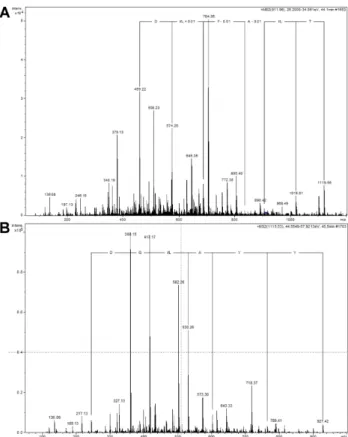
The purified α-glucosidase inhibitor was analyzed by LC-MS/MS spectrometry and, finally, two hexapeptides that had sequences of Thr-Ile-Ala-Phe-Ile-Asp (A) and Tyr-Tyr-Ala-Ils-Gly-Asp (B) were obtained (Fig. 2). Their two A, B oligopeptides were chemically synthesized by Cosmogenetech. Co., Korea and their inhibitory activi- ties were investigated. The inhibitory activities of their chemically synthesized oligopeptides showed IC
50, 10.98 mg/ml (A) and 11.01 mg/ml (B), respectively. The molec- ular weight of the A and B oligopeptides were also esti- mated to be 678.79 Da and 643.7 Da, respectively.
Kang et al. [9] reported that the purified α-glucosidase
inhibitor from Aspergillus oryzae was a tripeptide with a sequence of Pro-Phe-Pro and its molecular weight was 350.1 Da. Jeon [8] also reported that the α-glucosidase inhibitor from Streptomyces sp. CK-4416 was purified by ion exchange chromatography and two kinds of purified α-glucosidase inhibitors with C
25H
43NO
20(M.W, 677.61 Da) and C
37H
63NO
30(M.W, 1001.30 Da) were obtained.
The inhibitor also showed inhibitory effects against blood glucose increment.
Furthermore, the purified α-glucosidase inhibitor from Pleurotus cornucopiae showed a typical mixed-inhibition type to α-glucosidase from the Lineweaver-Burk plot (Fig. 3).
Atihyperglycemic effect of the purified α-glucosidase inhibitor
The antihyperglyecmic action of the purified α-glucosi- dase inhibitor from RP-HPLC chromatography was evaluated in streptozotocin-induced diabetic rats.
Fig. 1. RP-HPLC chromatography on FORTIS C18 column of active fraction P-2-1 from Sephadex G-50 chromatography.
Separation was performed isocratically by 20% acetonitrile in 0.1% acetic acid.
Table 2. Purification summary of α-glucosidase inhibitor from Pleurotus cornucopiae.
Purification steps
α-Glucosidase inhibitory activity
(IC
50: mg/ml)
Solid yield (%)
Purification fold (times)
Water extract 23.20 42.7 1
Sephadex G-100
column chromatography
17.30 37.4 1.4
Pepsin hydrolysates 11.88 30.0 2.0
Sephadex G-50
column chromatography
10.72 12.5 2.2
RP-HPLC 9.10 12.2 2.6
Fig. 2. Amino acid sequence of the two purified α-glucosidase inhibitory peptides using liquid chromatography-tandem mass spectrometry. *Reverse: (A) Thr-Ile-Ala-Phe-Ile-Asp,
*Reverse: (B) Tyr-Tyr-Ala-Ile-Gly-Asp.
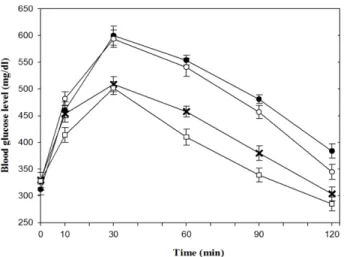
As shown in Fig. 4, the blood glucose level at 30 min after administering the soluble starch (3 g/kg) signifi- cantly increased to 465 −600 mg/dl from 315 mg/dl in dia- betic rats and α-glucosidase inhibitor-treated diabetic rats. After 120 min, the blood glucose level decreased to 325-360 mg/dl dose-dependently.
This suggests that the water extracts from the Pleuro- tus cornucopiae fruiting body containing the α-glucosi-
dase inhibitor has an antiglycemic effect in diabetic rats at a dosage of 50 mg/kg. This tendency of decreased blood glucose contents in α-glucosidase inhibitor – treated diabetic rats 120 min after oral administration was similar to those of the commercial anti-diabetic drug, acarbose, and water extracts (50 −300 mg/kg) from Neo- lentinus lepideus fruiting body- containing α-glucosidase inhibitors [19].
Acknowledgments
This study was funded by Paichai University (2016), Republic of Korea.
References
1. Asano N, Oseki K, Tomioka E, Kizu H, Matsui, K. 1994. N-contain- ing sugars from Morus alba and their glycosidase inhibitory activities. Carbohydr. Res. 259: 243−255.
2. Fatmawati S, Shimizu K, Kondo R. 2011. Ganoderol B: a potent α- glucosidase inhibitor isolated from the fruiting body of Gano- derma lucidum. Phytomed. 18: 1053 −1055.
3. Gutiérrez A, Caramelo L, Prieto A, Martínez MJ, Martínez AT.
1994. Anisaldehyde production and aryl-alcohol oxidase and dehydrogenase activities in ligninolytic fungi of the genus Pleu- rotus. Appl. Environ. Microbiol. 60: 1783–1788.
4. Gern RM, Wisbeck E, Rampinelli JR, Ninow JL, Furlan SA. 2008.
Alternative medium for production of Pleurotus ostreatus bio- mass and potential antitumor polysaccharides. Bioresour. Tech- nol. 99: 76 −82.
5. Hue JJ, Kim JS, Kim JH, Nam SY, Yun YW, Jeong JH, et al. 2010.
Anti-glycemic effect of L-carnosine in streptozotocin-induced diabetic mice. Korean J. Vet. Res. 50: 105 −111.
6. Jang JH, Jeong SC, Kim JH, Lee YH, Ju YC, Lee JS. 2011. Character- ization of a new antihypertensive angiotensin I-converting enzyme inhibitory peptide from Pleurotus cornucopiae. Food.
Chem. 127: 412 −418.
7. Jang IT, Hyun SH, Shin JW, Lee YH, Ji JH, Lee JS. 2014. Characteri- zation of an anti-gout xanthine oxidase inhibitor from Pleurotus ostreatus. Mycobiol. 42: 296 −300.
8. Jeon HS. 2001. Studies on the structural property of an α-gluco- sidase inhibitor from Streptomyces sp. and its inhibitory charac- teristics of blood glucose increment [dissertation]. Seoul: Korea University.
9. Kang MG, Yi SH, Lee JS. 2013. Production and characterization of a new α-glucosidase inhibitory peptide from Aspergillus oryzae N159-1. Mycobiol. 41: 149 −154.
10. Kim GY, Yoon YJ, Kim EJ. 2013. Improvement of lipid metabolism and antihyperglycemic by Lentinus edodes in high fat-fed and streptozotocin −treated rats. Korean J. Orien. Physiol. Pathol. 27:
196 −201.
Fig. 3. Lineweaver-Burk plot of the purified α-glucosidase inhibitor an α-glucosidase at different concentrations of chemical substrate, pNPG. ▼: 1.0 mg of the purified inhibitor;
○: 0.5 mg of the purified inhibitor; ●: control.
Fig. 4. Changes of blood glucose levels up to 120 minute
after administration of 3 g/kg soluble starch and various
concentration of the purified α-glucosidase inhibitor from
Pleurotus cornucopiae in streptozotocin-induced diabetic
SD-rat. : Soluble starch + D.W, : Soluble starch + puri-
fied α-glucosidase inhibitor (dosage; 50 mg/kg), : Soluble
starch + purified α-glucosidase inhibitor (dosage; 300 mg/kg),
: Soluble starch + commercial anti-diabetic acarbose (dos-
age; 15 mg/kg).
11. Kim YH, Shin JW, Lee JS. 2014. Production and anti- hyperglyce- mic effects of α-glucosidase inhibitor from yeast, Pichia burtonii Y257-7. Korean J. Microbiol. Biotechnol. 42: 219–224.
12. Lee DH, Kim JH, Park JS, Choi YJ, Lee JS. 2004. Isolation and char- acterization of a novel angiotensin I-converting enzyme inhibi- tory peptide derived from the edible mushroom Tricholoma giganteum. Peptides. 25: 621−627.
13. Marcelo BM, Cristiane MF, Kamilla FE, Marx ANL, Nilsa SYW, Erna EB. 2014. Effect of dietary supplementation with Agaricus sylvati- cus schaeffer on glycemia and cholesterol after streptozotocin- induced diabetes in rats. Evid. Complement. Altern. Medi. 2014:
10 −20.
14. Murai A, lwamura K, Takada M, Ogawa K, Usui T, Okumura J.
2002. Control of postprandial hyperglycaemia by galactosyl maltobionolactone and its novel anti-amylase effect in mice. Life.
Sci. 71: 1405 −1415.
15. Park HS, Lee YS, Choi SJ, Kim JK, Lee YL, Kim HG, et al. 2009.
Effects of herbal complex on blood glucose in streptozotocin- induced diabetic rats and in mice model of metabolic syndrome.
Korean J. Pharmacogn. 40: 196 −204.
16. Park JH, Chu WM, Lee JM, Park HR, Park EJ. 2011. Antihyperglyce- mic of Gleditschiae Spina extracts in streptozotocin-nicotinamide induced type 2 diabetic rats. J. Korean Soc. Food. Sci. Nutr. 40:
321−326.
17. Park YK, Kim JS, Jeon EJ, Kang MH. 2009. The improvement of Chaga mushroom (Inonotus obliquus) extract supplementation on the blood glucose and cellular DNA damage in streptozoto- cin-induced diabetic rats. Korean J. Nutr. 42: 5 −13.
18. Reese ET, Parrish FW, Ettlinger M. 1971. Nojirimycin and D-glu- cono-1,5-lactone as inhibitors of carbohydrases. Carbohydr. Res.
18: 381−388.
19. Shin JW, Bae SM, Han SM, Lee YH, Jeong YK, Lee JS. 2015.
Extraction and antihyperglycemic action of α-glucosidase inhibi- tor from basidiomycetes, Neolentinus lepideus. Korean J. Mycol.
43: 174 −179.
20. Shipp GM. 2012. Purification of alpha-glucosidase inhibitors from grape extract [dissertation]. Wayne State University.
21. Sumisa F, Iijima N, Ando A, Shiga M, Kondo K, Amano K, et al.
2004. Properties of mycelial aggregate-specific lectin of Pleurotus cornucopiae produced in Pichia pastoris. Biosci. Biotechnol. Bio- chem. 4: 959–960.
22. Wang H, Gao J, Ng TB. 2000. A new lectin with highly potent anti- hepatoma and antisarcoma activities from the oyster mushroom Pleurotus ostreatus. Biochem. Biophys. Res. Commun. 275: 810 − 816.
23. Wehmeier UF, Piepersberg W. 2004. Biotechnology and molecu- lar biology of the alpha-glucosidase inhibitor acarbose. Appl.
Microbiol. Biotechnol. 63: 613−625.
국문초록
식용버섯인 노랑느타리버섯으로부터 혈당상승억제성 α-glucosidase 저해제의 추출 및 특성 배상민
1, 한상민
1, 이윤혜
2, 정윤경
2, 지정현
2, 이종수
1*
1
배재대학교 바이오 · 의생명공학과
2