ARTICLE
Received: June 10, 2019 Revised: June 18, 2019 Accepted: June 19, 2019
†These authors contributed equally to this study.
*Corresponding author : Kwang-Young Song
Center for KU Food Safety and Department of Public Health, College of Veterinary Medicine, Konkuk University, Seoul, Korea, and Dept. of Biological Engineering, Yanbian University of Science & Technology, Yanji, China.
Tel : +82-2-450-4121 Fax : +82-2-3436-4128 E-mail : [email protected] Copyright © 2019 Korean Society of Milk Science and Biotechnology.
This is an Open Access article distributed under the terms of the Creative Commons Attribution Non-Commercial License (http://
creativecommons.org/licenses/by-nc/3.0) which permits unrestricted non-commercial use, distribution, and reproduction in any medium, provided the original work is properly cited.
ORCID Se-Hyung Kim
https://orcid.org/0000-0003-4747-7394 Jung-Whan Chon
https://orcid.org/0000-0003-0758-6115 Kwang-Young Song
https://orcid.org/0000-0002-5619-8381 Dongkwan Jeong
https://orcid.org/0000-0002-6305-794X Kun-Ho Seo
https://orcid.org/0000-0001-5720-0538
Organoleptic Profiles of Kefir and Yogurt Supplemented with Various Concentrations of Mentha piperita's
(Peppermint) Oil: A Preliminary Study
Se-Hyung Kim
1†, Jung-Whan Chon
1,2, Kwang-Young Song
1,3*, Dongkwan Jeong
4, and Kun-Ho Seo
1†1Center for KU Food Safety and Department of Public Health, College of Veterinary Medicine, Konkuk University, Seoul, Korea
2College of Veterinary Medicine, Oklahoma State University, Stillwater, OK, USA
3Dept. of Biological Engineering, Yanbian University of Science and Technology, Yanji, China
4Dept. of Food and Nutrition, Kosin University, Busan, Korea
Abstract
The objective of this study was to evaluate the organoleptic profiles of Kefir and yogurt supplemented with Mentha piperita's (peppermint) oil. The organoleptic profiles of Kefir and yogurt were evaluated by 15 trained panelists between 20 to 50 years of age. The products of Kefir and yogurt were prepared with Mentha piperita's oil at concentrations of 0%, 0.1%, 0.3%, 0.5%, and 1.0%. Taste, color, and overall acceptability scores were the same or lower in Kefir supplemented with 0.1%, 0.3%, 0.5%, or 1.0% Mentha piperita's oil than the control group (0%). The scores of all categories were higher for yogurt containing 0.1% Mentha piperita's oil than the control group. Taste, color, and overall acceptability decreased in proportion to the added amount of Mentha piperita's oil. Further studies are needed to evaluate the functionalities and effectiveness of Mentha piperita's oil in promoting human health.
Keywords
Mentha piperita's (peppermint) oil, organoleptic profiles, Kefir, Yogurt
Introduction
Mentha piperita L. and its extracts have been used for the treatment of various diseases for a long time (Alankar, 2009; Lim et al., 2018). Especially, Mentha piperita L is widely known as peppermint or mint (Lim et al., 2018). According to many recent studies, various effects of Mentha piperita L have been found in cancer, diabetes, asthma, heart problems, and so on (Mucciarelli et al., 2007; Cash et al., 2016; Lim et al., 2018).
Especially, the recently most widely produced and consumed essential oil is peppermint oil (Loolaie et al., 2017; Lim et al., 2018). Furthermore, peppermint oil could show the excellent antimicrobial activity against food poisoning bacteria and pathogenic bacteria, and peppermint oil is also widely used as a food additive (Cash, 2015; Schmitz et al., 2015; Lim et al., 2018). Hence, it is possible for the application of Mentha piperita’s (peppermint) oil to add directly to various dairy products for improving both the sensory attributes and nutritional property of the final product.
Therefore, the purpose of this study was to manufacture Kefir and Yogurt added with Mentha piperita’s (peppermint) oil with improving the organoleptic profiles. In this experiment, among several categories of quality in Kefir and Yogurt produced with
Mentha piperita’s (peppermint) oil, organoleptic profiless were analyzed.
Materials and Methods
1.
Mentha piperita’s
(peppermint) oilThe oil of Mentha piperita’s (peppermint) was produced by Borak Company (Korea) and was purchased from Serim Food Company (Korea), respectively. In this study, Mentha piperita’s (peppermint) oil was 100% purity as the food additive grade.
2. The preparation of Kefir added with
Mentha piperita’s
(peppermint) oilThe Kefir grains obtained from Center for KU Food Safety (College of Veterinary Medicine, Konkuk University in Seoul, Korea), and also were applied for fermenting milk to manufacture Kefir (Jeong et al., 2017). Kefir samples were added with different concentration of Mentha piperita’s (peppermint) oil (control as 0%, 0.1%, 0.3%, 0.5%, and 1.0%), and then The final Kefir products were kept at 4±0.5℃.
3. The preparation of Yogurt added with
Mentha piperita’s
(peppermint) oil The oil of Mentha piperita’s (peppermint) was added to Yogurt premix at concen- trations of 0% (control), 0.1%, 0.3%, 0.5%, and 1.0%, and then mixed thoroughly (Jeong et al., 2017). A commercial Yogurt starter culture Lyofast YAB 450AB (Sacco srl., Codaragok, Italy) were inoculated and fermented for 5 h, and then the final Yogurt products were kept around 4±1℃ for 24 h.4. The pH and TA of Kefir and Yogurt added with
Mentha piperita’s
(peppermint) oil According to method of Jeong et al. (2017), the pH and TA (titratable acid) of Kefir and Yogurt was analyzed by the pH meter (Orion Star A211, USA) and by titration with 0.1 N NaOH, respectively.5. The organoleptic profiles of Kefir and Yogurt added with
Mentha piperita’s
(peppermint) oilThe organoleptic profiles were investigated by fifteen panelists between 20 and 50 years of age. The samples coded with three digit numbers were randomly prepared in disposable plastic cups (10±0.5 mL) at 10±1℃. All assessors completed a test assess- ment form to compare the five organoleptic profiles (taste, color, flavor, texture, and overall acceptability) using the five-point hedonic scale (5, excellent; 4, good; 3, fair;
2, poor; 1, extremely poor). All panelists participated in the organoleptic profiles of this study after hearing and agreeing to it fully.
6. Statistical analysis
GraphPad Prism 5 (GraphPad Softward Inc., San Diegeo, CA, USA) as statistical software was used for analyzing all data which obtained from two separate experiments with triplicate assays. All data were expressed as means±standard deviation. Statistical
significance was considered at p<0.05.
Results and Discussion
1. The pH and TA of Kefir and Yogurt added with
Mentha piperita’s
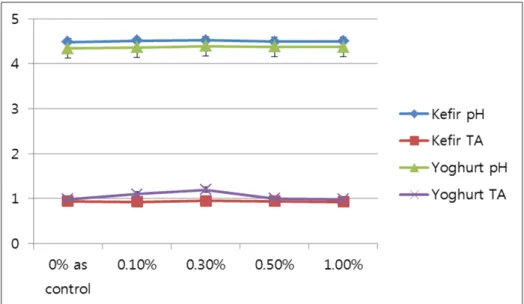
(peppermint) oil In general, pH was high depending on the increase of TA. The pH of Kefir and Yogurt was decreased to around 4.48–4.51 and 4.33–4.39, respectively, and also the TA of Kefir and Yogurt was increased to around 0.93%–0.95% and 0.98%–1.12%, respectively (Fig. 1).In this study, the pH and TA value of Kefir and Yogurt added with Mentha piperita’s (peppermint) oil (0.1%, 0.3%, 0.5%, and 1.0%) showed similar to that of Kefir and Yogurt added with Mentha piperita’s (peppermint) oil (control as 0%) (Fig. 1). Hence, there was not any statistical difference of pH and TA of Kefir and Yogurt between control group and treated group. The results of this experiment showed a similar trend with the results of other experiments (Jeong et al., 2017).
2. The organoleptic profiles of Kefir added with
Mentha piperita’s
(peppermint) oil The organoleptic profiles of Kefir were evaluated by 15 trained panelists of ages 20 to 50 years, and the results are summarized in Fig. 2. Kefir was prepared with Mentha piperita’s (peppermint) oil at concentrations of 0%, 0.1%, 0.3%, 0.5%, and 1.0%, respectively. According to statistical analysis of the organoleptic profiles, there was not any statistical difference in flavor and texture, but in taste, color and overall accep- tability between control group and treated group (p<0.05).The scores of taste in Kefir with Mentha piperita’s (peppermint) oil (control as 0%, 0.1%, 0.3%, 0.5%, and 1.0%) showed 3.5, 1.9, 1.6, 1.5, and 1.3, respectively. The scores of color in Kefir with Mentha piperita’s (peppermint) oil (control as 0%, 0.1%, 0.3%, 0.5%, and
Fig. 1. Comparison of pH and TA of Kefir and Yogurt added with Mentha piperita’s (peppermint) oil (control as 0%, 0.1%, 0.3%, 0.5%, and 1.0%).
Fig. 2. Comparison of the organoleptic profiles of Kefir added with Mentha piperita’s (peppermint) oil (control as 0%, 0.1%, 0.3%, 0.5%, and 1.0%).
1.0%) showed 3.6, 2.4, 2.2, 1.9, and 2.3, respectively. The scores of flavor in Kefir with Mentha piperita’s (peppermint) oil (control as 0%, 0.1%, 0.3%, 0.5%, and 1.0%) showed 3.6, 3.8, 3.8, 3.8, and 3.8, respectively. The scores of texture in Kefir with Mentha piperita’s (peppermint) oil (control as 0%, 0.1%, 0.3%, 0.5%, and 1.0%) showed 3.6, 3.5, 3.5, 3.5, and 3.6, respectively. And the scores of overall acceptability in Kefir with Mentha piperita’s (peppermint) oil (control as 0%, 0.1%, 0.3%, 0.5%, and 1.0%) showed 3.6, 2.3, 1.8, 1.5, and 1.6, respectively.
Consequently, among the treated group compared with the control group (0%), the scores of taste, color and overall acceptability were the same or lower in Mentha piperita’s (peppermint) oil-containing Kefir with 0.1%, 0.3%, 0.5%, and 1.0%.
3. The organoleptic profiles of Yogurt added with
Mentha piperita’s
(peppermint) oil The Yogurt was prepared with Mentha piperita’s (peppermint) oil at concentrations of 0%, 0.1%, 0.3%, 0.5%, and 1.0%, respectively, and the results are summarized in Fig. 3.The scores of taste in Yogurt with Mentha piperita’s (peppermint) oil (0.1%, 0.3%, 0.5%, and 1.0%) ranged from 2.5 points to 1.2 point, which were lower than those of Yogurt added with Mentha piperita’s (peppermint) oil (control as 0%) (3.9 points). The scores of color in Yogurt with Mentha piperita’s (peppermint) oil (0.1%, 0.3%, 0.5%, and 1.0%) ranged from 2.8 points to 1.7 point, which was comparable to those of Yogurt added with Mentha piperita’s (peppermint) oil (control as 0%) showed 3.8 points. The scores of flavor in Yogurt with Mentha piperita’s (peppermint) oil (0.1%, 0.3%, 0.5%, and 1.0%) ranged from 3.9 points to 3.89 point, whereas those of Yogurt added with Mentha piperita’s (peppermint) oil (control as 0% ) showed 3.8 points. The scores of texture in Yogurt with Mentha piperita’s (peppermint) oil (0.1%, 0.3%, 0.5%, and 1.0%) ranged from 3.8 points to 3.7 point, whereas those of Yogurt added with Mentha piperita’s
Fig. 3. Comparison of the organoleptic profiles of Yogurt added with Mentha piperita’s (peppermint) oil (control as 0%, 0.1%, 0.3%, 0.5%, and 1.0%).
(peppermint) oil (control as 0%) showed 3.8 points. And the scores of the overall acceptability decreased with increasing amounts of added Mentha piperita’s (pepper- mint) oil. Among the treated group, the high scores were received by Mentha piperita’s (peppermint) oil-containing Yogurt with 0.1% compared with the control group (0%). To summarize the results, the scores of the taste, color and overall acceptability decreased in proportion to the added amount of Mentha piperita’s (peppermint) oil.
In general, the characteristics of Mentha piperita’s (peppermint) oil has been used for improving food’s texture and physical properties, for increasing food’s viscosity and stickiness, and for enhancing food’s emulsion stability (Shams et al., 2015; Lim et al., 2018). Especially, Mentha piperita’s (peppermint) oil is mainly used as a thickener in foods (Baliga and Rao, 2010). This study also showed that the addition of Mentha piperita’s (peppermint) oil did not affect the organoleptic profiles of taste and texture in Kefir and Yogurt. Hence, further research in this area will be carried out.
Acknowledgements
This research was supported by Basic Science Research Program through the National Research Foundation of Korea (NRF) funded by the Ministry of Education (NRF-2017R1- D1A1B03035427), and this paper was written as part of Konkuk University’s research support program for its faculty on sabbatical leave in 2018.
References
Alankar, S. 2009. A review on peppermint oil. Asian J. Pharm. Clin. Res. 2:27-33.
Baliga, M. S. and Rao, S. 2010. Radioprotective potential of mint: A brief review. J.
Cancer Res. Ther. 6:255-262.
Cash, B. 2015. Novel peppermint oil formulation for dietary management of irritable bowel syndrome. Gastroenterol. Hepatol. 11:631-633.
Cash, B. D., Epstein, M. S. and Shah, S. M. 2016. A novel delivery system of peppermint oil is an effective therapy for irritable bowel syndrome symptoms. Dig. Dis. Sci.
61:560-571.
Jeong, D., Kim, D. H., Chon, J. W., Song, K. Y., Kim, H. and Seo, K. H. 2017.
Preparation of bioactive Kefir with added flaxseed (Linum usitatissimum L.) extract.
J. Milk Sci. Biotechnol. 35:176-183.
Jeong, D., Kim, D. H., Oh, Y. T., Chon, J. W., Kim. H., Jeong, D. W., Kim, H. S., Kim, Y. G., Song, K. Y., Kim, Y. J., Kang, I. B., Park, J. H., Chang, H. S., Lim, H. W. and Seo, K. H. 2017. Production of bioactive Yogurt containing Cichorium intybus L.
(Chicory) extract: Preliminary study. J. Milk Sci. Biotechnol. 35:9-15.
Lim, H. W., Kim, D. H., Kim, S. H., Lee, J. M., Chon, J. W., Song, K. Y., Bae, D., Kim, J., Kim, H. and Seo, K. H. 2018. Antimicrobial effect of Mentha piperita (peppermint) oil against Bacillus cereus, Staphylococcus aureus, Cronobacter sakazakii, and Salmo- nella Enteritidis in various dairy foods: Preliminary study. J. Milk Sci. Biotechnol.
36:146-154.
Loolaie, M., Moasefi, N., Rasouli, H. and Adibi, H. 2017. Peppermint and its fun- ctionality: A review. Arch. Clin. Microbiol. 8:54.
Mucciarelli, M., Camusso, W., Maffei, M., Panicco, P. and Bicchi, C. 2007. Volatile terpenoids of endophyte-free and infected peppermint (Mentha piperita L.): Chemical partitioning of a symbiosis. Microb. Ecol. 54:685-696.
Schmitz, D., Shubert, V. A., Betz, T. and Schnell, M. 2015. Exploring the conformational landscape of menthol, menthone, and isomenthone: A microwave study. Front.
Chem. 3:15.
Shams, R., Oldfield, E. C., Copare, J. L. and Johnson, D. A. 2015. Peppermint oil: Clinical uses in the treatment of gastrointestinal diseases. JSM Gastroenterol. Hepatol. 3:1036.