© 2012 The Korean Academy of Medical Sciences.
This is an Open Access article distributed under the terms of the Creative Commons Attribution Non-Commercial License (http://creativecommons.org/licenses/by-nc/3.0) which permits unrestricted non-commercial use, distribution, and reproduction in any medium, provided the original work is properly cited.
pISSN 1011-8934 eISSN 1598-6357
EML4-ALK Fusion Gene in Korean Non-Small Cell Lung Cancer
A fusion gene between echinoderm microtubule-associated protein-like 4 (EML4) and the anaplastic lymphoma kinase (ALK) has been identified in non-small cell lung cancers (NSCLCs). Although a few studies have evaluated EML4-ALK fusion genes in Korean NSCLCs, the prevalence of different EML4-ALK fusion variants has yet to be clearly assessed. Herein, we have examined the profiles of EML4-ALK fusion gene variants in Korean patients of NSCLCs. EML4-ALK fusion genes have been detected in 10 (6.0%) of 167 patients of NSCLCs and in 9 (7.4%) of 121 patients of adenocarcinoma. Of the 10 patients with fusion genes identified, 8 (80%) were E13;A20 (variant 1) and 2 (20%) were E6;A20, with an additional 33-bp sequence derived from intron 6 of EML4 (variant 3b).
These results indicate that the profiles of EML4-ALK fusion gene variants in Korean patients of NSCLC may differ from those in other ethnic populations. Herein, we describe for the first time the profiles of EML4-ALK fusion variants of Korean patients with NSCLCs.
Key Words: ALK; EML4; Carcinoma, Non-Small-Cell Lung Guang Jin1,*, Hyo-Sung Jeon1,*,
Eung Bae Lee2, Hyo-Gyoung Kang1, Seung Soo Yoo3, Shin Yup Lee3,
Jae Hee Lee3, Sung Ick Cha3, Tae In Park4, Chang Ho Kim3, Sang Hoon Jheon5, and Jae Yong Park1,3
Departments of 1Biochemistry and Cell Biology,
2Thoracic Surgery, 3Internal Medicine, and
4Pathology, Kyungpook National University School of Medicine, Daegu; 5Department of Thoracic and Cardiovascular Surgery, Seoul National University College of Medicine, Seongnam, Korea
*Guang Jin and Hyo-Sung Jeon contributed equally to this work.
Received: 2 November 2011 Accepted: 2 January 2012 Address for Correspondence:
Jae Yong Park, MD
Lung Cancer Center, Kyungpook National University Medical Center, 807 Hoguk-ro, Buk-gu, Daegu 702-210, Korea Tel: +82.53-200-2631, Fax: +82.53-200-2027 E-mail: [email protected]
This study was supported by the National R&D Program for Cancer Control (0720550-2) Ministry of Health & Welfare, Republic of Korea Government.
http://dx.doi.org/10.3346/jkms.2012.27.2.228 • J Korean Med Sci 2012; 27: 228-230
BRIEF COMMUNICATION
Oncology & Hematology
Non-small cell lung cancer (NSCLC) accounts for approximate- ly 80%-85% of all cases of lung cancer, and is the leading cause of cancer deaths worldwide including Korea, with only 15% of patients surviving for more than 5 yr (1-3). Although cytotoxic chemotherapy remains the mainstay treatment for the majority of patients with advanced NSCLC, molecular-targeted therapy played an increasingly important role, particularly in genetical- ly defined subsets of patients (4). Therefore, the identification of patients that harbor genetic alterations of the key oncogene for NSCLC is extremely important for selecting those most like- ly to derive benefit from a specific molecular targeted agent (5).
The echinoderm microtubule-associated protein-like 4 (EML4)- anaplastic lymphoma kinase (ALK) fusion oncogene resulting from the chromosome inversion inv(2) (p21; p23) represents a novel molecular target in NSCLC. Since its first report by Soda et al. (6), the EML4-ALK fusion gene has been indentified in 3%- 7% of NSCLCs (7). Additionally, ALK kinase inhibitors have been developed and have been shown to be highly effective in NSCLCs harboring EML4-ALK fusion gene (8-10). Therefore, it is clearly imperative to identify NSCLC patients with EML4-ALK fusion gene (11).
Thus far, multiple EML4-ALK variants have been identified in NSCLCs (7, 12). All involve the intracellular tyrosine kinase do- main of ALK beginning at the portion encoded for by exon 20.
However, EML4 is variably truncated (occurring at exons 2, 6, 13, 14, 15, 18, and 20) and gives rise to diverse variants of EML4- ALK. Among the variants known thus far, it has been reported that E13;A20 (the nomenclature refers to the exon in EML4 [E]
fused to the exon of ALK [A], variant 1) and E6a/b;A20 (variant 3a/b) are the most common variants, accounting for 33% and 29%, respectively, of all the EML4-ALK variants identified in NSCLCs (7, 12). Although a few studies have evaluated EML4- ALK fusion genes in Korean NSCLCs (13, 14), the prevalence of different EML4-ALK fusion variants has not been particularly well studied. Considering the differences in genetic and envi- ronmental factors related to lung cancer, it is possible that the profile of EML4-ALK fusion variants in the context of Korean lung cancer may differ from those of other countries. To answer this question, we evaluated EML4-ALK fusion variants using reverse-transcriptase-polymerase chain reaction (RT-PCR) in Korean NSCLCs.
Tumor and corresponding non-malignant lung tissue speci-
Jin G, et al. • EML4-ALK Fusion Gene in Non-Small Cell Lung Cancer
http://jkms.org 229
http://dx.doi.org/10.3346/jkms.2012.27.2.228
mens were provided by the National Biobank of Korea - Kyung- pook National University Hospital, Daegu, Korea, which is sup- ported by the Ministry of Health, Welfare, and Family Affairs.
All materials derived from the National Biobank were obtained in accordance with institutional review board-approved proto- col, Kyungpook National University Medical Center (Approval No., KNUHBIO_10_1016).
This study included 167 NSCLC patients who underwent cu- rative resection at the Kyungpook National University Hospital, in Daegu, Korea between January 2001 and December 2009.
Patients who underwent chemotherapy or radiotherapy prior to surgery were excluded in order to avoid effects on RNA. All patients included in this study were ethnic Koreans. This study included 46 patients with squamous cell carcinoma (SCC) and 121 patients with adenocarcinoma (AC). The study cohort com- prised 85 males and 82 females. The patient population com- prised 94 never-smokers and 73 smokers. Of the 121 patients with AC, 93 were never-smokers. All of the tumor and macro- scopically-normal lung tissue samples were obtained at the time of surgery, then rapidly frozen in liquid nitrogen and stored at -80oC. Only tumors with greater than 80% of the tumor compo- nent were sent for analysis.
Total RNA was extracted from fresh frozen tissues using the RNeasy Mini kit (Qiagen Valencia, CA, USA), and the RNA ex- tract was incubated with RNase-free DNase I (Qiagen) to remove contaminating DNA. Reverse transcription of total RNA was carried out using a Qiagen kit to generate complementary DNA (cDNA). In order to identify all possible EML4-ALK fusion cDNA, we conducted RT-PCR assays using two sense primers (5´-TCA- CTGTGCTAAAGGCGGCTTTGG-3´, on exon 2 of EML4, and 5´-CCACACCTGGGAAAGGACCTAAAG-3´, on exon 13 of EML4)
and a single antisense primer (5´-CAGGGCTTCCATGAGGAA- ATCCAG-3´, on exon 22 of ALK). PCR reactions were performed in a total volume of 20 μL containing 50 ng of cDNA, 0.2 mM of each primer, 0.2 mM dNTPs, 1 unit of Taq polymerase (Takara, Shuzo Co., Otus, Shiga, Japan), and 1 × reaction buffer (10 mM Tris-HCl [pH8.3], 50 mM KCl, and 1.5 mM MgCl2). The PCR cy- cle conditions consisted of an initial denaturation step at 95oC for 5 min, followed by 35 cycles of 30 sec at 95oC; 30 sec at 66oC;
30 sec at 72oC; and a final elongation at 72oC for 10 min. We used the primers 5´-GTCAGTGGTGGACCTGACCT-3´ (forward) and 5´-TGAGCTTGACAAAGTGGTCT-3´ (reverse) to amplify the glycer-aldehyde-3-phospate dehydrogenase (GAPDH) gene as an internal control. GAPDH amplification was carried out by preincubation for 5 min at 95oC for initial denaturation, followed by 35 cycles of 30 sec at 95oC; 30 sec at 58oC; 30 sec at 72oC; and a final elongation at 72oC for 10min. The PCR products were purified using a GENECLEAN Turbo kit (Q-Biogene, Carlsbad, CA, USA). Sequencing was performed using an ABI Prism 3100 Genetic Analyzer (PE Biosystems, Foster City, CA, USA). We also analyzed mutations in the EGFR (exons 18-21), ERBB2 (ex- ons 19-20) and KRAS (exon 2) genes in the tumors harboring EML4-ALK fusion genes using PCR and direct sequencing, as described in our previous study (15).
Using RT-PCR, EML4-ALK fusion transcripts were detected in 10 (6.0%) of the 167 NSCLCs. When the patients were strati- fied by median age, the fusion transcripts were significantly more
Table 1. Relations between EML4-ALK fusion gene and clinicopathologic features
Features No. Fusion gene, No. (%)
P value Positive Negative
All subjects 167 10 (6.0) 157 (94.0)
Age (yr) ≤ 64 > 64
93 74
10 (10.8)
0 (0.0)
83 (89.2) 74 (100.0)
0.002 Gender
Male Female
85 82
4 (4.7) 6 (7.3)
81 (95.3) 76 (92.7)
0.351 Smoking status
Ever Never
73 94
3 (4.1) 7 (7.4)
70 (95.9) 87 (92.6)
0.288 Pack-years of smoking*
< 30 ≥ 30
23 50
1 (4.3) 2 (4.0)
22 (95.7) 48 (96.0)
0.685 Histology
Squamous cell carcinoma Adenocarcinoma
46 121
1 (2.2) 9 (7.4)
45 (97.8) 112 (92.6)
0.183 Pathologic stage
Stage I Stage II-IIIA
93 74
4 (4.3) 6 (8.1)
89 (95.7) 68 (91.9)
0.241
*In ever-smokers.
Marker 279 346 347 351 72 517 646 694 194 495
Variant 3b Variant 1
A
B
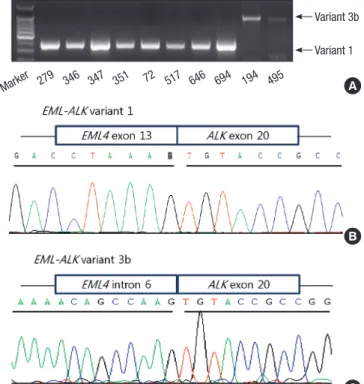
C Fig. 1. Detection of EML4-4LK fusion genes by RT-PCR and sequencing. RT-PCR results of 10 positive cases with EML4-ALK fusion genes (A). Necleotide sequencing of the PCR products of variant 1 (B) and variant 3b (C).
Jin G, et al. • EML4-ALK Fusion Gene in Non-Small Cell Lung Cancer
230 http://jkms.org http://dx.doi.org/10.3346/jkms.2012.27.2.228
common in younger patients than in older patients (10.8% vs 89.2%, P = 0.002). The fusion transcripts were more common in females, never-smokers, and ACs than in males, smokers, and SCCs, respectively, although not statistically significant (Table 1).
All of 10 patients who harbored the EML4-ALK fusion transcripts had no mutations in EGFR, ERBB2, and KRAS genes. Nucleotide sequencing of the PCR products for the 10 identified positive cases revealed that 8 specimens (80%) harbored variant 1 (E13;
A20), and 2 specimens (20%) harbored variant 3b (E6;A20 with an additional 33-bp sequence derived from intron 6 of EML4) (Fig. 1).
In this study, the frequency of EML4-ALK fusion genes in our series of NSCLCs was 6.0% (7.4% in ACs), which was consistent with the frequency of 3%-13% reported in East Asian patients with NSCLC (7, 12). Additionally, this was also similar to the fre- quency reported in a previous Korean study (4.2% of NSCLCs and 6.8% in ACs) (13), in which EML4-ALK fusion genes were analyzed by fluorescence in situ hybridization (FISH).
FISH is a standard method for detection of ALK rearrange- ment. However, unlike PCR, FISH cannot distinguish between different EML4-ALK fusion variants. Therefore, we employed RT-PCR assays to evaluate the profile of EML4-ALK fusion gene variants in Korean NSCLCs. Notably, the E13;A20 (variant 1) and E6a;A20 (variant 3b) account for 80% and 20%, respectively, of all the EML4-ALK variants identified in the current study. This frequency distribution of EML4-ALK fusion variants differed from those reported among other ethnic populations (7). Al- though all known variants have been demonstrated to possess potent oncogenic activity, it is possible that these different fu- sion variants have functional or therapeutic differences. There- fore, future studies will be required to clarify whether there are any functional or therapeutic differences amongst the different fusion variants.
One must consider a number of limitations of the present study.
Because this study included only cases with available RNA, the demographic and clinicopathologic characteristics of the study population were somewhat different from those of a nationwide lung cancer survey (16). In addition, the results of RT-PCR anal- ysis were not confirmed by FISH. Therefore, there might be false positive results (7).
REFERENCES
1. Parkin DM, Bray F, Ferlay J, Pisani P. Global cancer statistics, 2002. CA Cancer J Clin 2005; 55: 74-108.
2. Jung KW, Park S, Kong HJ, Won YJ, Boo YK, Shin HR, Park EC, Lee JS.
Cancer statistics in Korea: incidence, mortality and survival in 2006-2007.
J Korean Med Sci 2010; 25: 1113-21.
3. Jung KW, Won YJ, Park S, Kong HJ, Sung J, Shin HR, Park EC, Lee JS.
Cancer statistics in Korea: incidence, mortality and survival in 2005. J Korean Med Sci 2009; 24: 995-1003.
4. Lynch TJ, Bell DW, Sordella R, Gurubhagavatula S, Okimoto RA, Bran- nigan BW, Harris PL, Haserlat SM, Supko JG, Haluska FG, Louis DN, Christiani DC, Settleman J, Haber DA. Activating mutations in the epi- dermal growth factor receptor underlying responsiveness of non-small- cell lung cancer to gefitinib. N Engl J Med 2004; 350: 2129-39.
5. Dempke WC, Suto T, Reck M. Targeted therapies for non-small cell lung cancer. Lung Cancer 2010; 67: 257-74.
6. Soda M, Choi YL, Enomoto M, Takada S, Yamashita Y, Ishikawa S, Fuji- wara S, Watanabe H, Kurashina K, Hatanaka H, Bando M, Ohno S, Ishi- kawa Y, Aburatani H, Niki T, Sohara Y, Sugiyama Y, Mano H. Identifica- tion of the transforming EML4-ALK fusion gene in non-small cell lung cancer. Nature 2007; 448: 561-6.
7. Sasaki T, Rodig SJ, Chirieac LR, Janne PA. The biology and treatment of EML4-ALK non-small cell lung cancer. Eur J Cancer 2010; 46: 1773-80.
8. Koivunen JP, Mermel C, Zejnullahu K, Murphy C, Lifshits E, Holmes AJ, Choi HG, Kim J, Chiang D, Thomas R, Lee J, Richards WG, Sugarbaker DJ, Ducko C, Lindeman N, Marcoux JP, Engelman JA, Gray NS, Lee C, Meyerson M, Jänne PA. EML4-ALK fusion gene and efficacy of an ALK kinase inhibitor in lung cancer. Clin Cancer Res 2008; 14: 4275-83.
9. McDermott U, Iafrate AJ, Gray NS, Shioda T, Classon M, Maheswaran S, Zhou W, Choi HG, Smith SL, Dowell L, Ulkus LE, Kuhlmann G, Gren- inger P, Christensen JG, Haber DA, Settleman J. Genomic alterations of anaplastic lymphoma kinase may sensitize tumors to anaplastic lym- phoma kinase inhibitors. Cancer Res 2008; 68: 3389-95.
10. Kwak EL, Bang YJ, Camidge DR, Shaw AT, Solomon B, Maki RG, Ou SH, Dezube BJ, Jänne PA, Costa DB, Varella-Garcia M, Kim WH, Lynch TJ, Fidias P, Stubbs H, Engelman JA, Sequist LV, Tan W, Gandhi L, Mino- Kenudson M, Wei GC, Shreeve SM, Ratain MJ, Settleman J, Christensen JG, Haber DA, Wilner K, Salgia R, Shapiro GI, Clark JW, Iafrate AJ. Ana- plastic lymphoma kinase inhibition in non-small cell lung cancer. N Engl J Med 2010; 363: 1693-703.
11. Bronte G, Rizzo S, La Paglia L, Adamo V, Siragusa S, Ficorella C, Santini D, Bazan V, Colucci G, Gebbia N, Russo A. Driver mutations and differ- ential sensitivity to targeted therapies: a new approach to the treatment of lung adenocarcinoma. Cancer Treat Rev 2010; 36: S21-9.
12. Horn L, Pao W. EML4-ALK: honing in on a new target in non-small cell lung cancer. J Clin Oncol 2009; 27: 4232-5.
13. Kim H, Yoo SB, Choe JY, Paik JH, Xu X, Nitta H, Zhang W, Grogan TM, Lee CT, Jheon S, Chung JH. Detection of ALK gene rearrangement in non- small cell lung cancer: a comparison of fluorescence in situ hybridiza- tion and chromogenic in situ hybridization with correlation of ALK pro- tein expression. J Thorac Oncol 2011; 6: 1359-66.
14. Kim HR, Shim HS, Chung JH, Lee YJ, Hong YK, Rha SY, Kim SH, Ha SJ, Kim SK, Chung KY, Soo R, Kim JH, Cho BC. Distinct clinical features and outcomes in never-smokers with non-small cell lung cancer who harbor EGFR or KRAS mutations or ALK rearrangement. Cancer 2011.
Doi:10.1002/cncr.26311.
15. Lee SY, Kim MJ, Jin G, Yoo SS, Park JY, Choi JE, Jeon HS, Cho S, Lee EB, Cha SI, Park TI, Kim CH, Jung TH, Park JY. Somatic mutations in epider- mal growth factor receptor signaling pathway genes in non-small cell lung cancers. J Thorac Oncol 2010; 5: 1734-40.
16. Lee C, Kang KH, Koh Y, Chang J, Chung HS, Park SK, Yoo K, Song JS. Char- acteristics of lung cancer in Korea, 1997. Lung Cancer 2000; 30: 15-22.