INTRODUCTION
A nonsteroidal benzothiophene derivative, raloxifene, has a tissue-selective estrogen agonist/antagonist profile. Ralox- ifene is a classical antiestrogen in the breast and uterus (1, 2) whereas it has a bone-preserving effect and a cholesterol lowering effect in nonreproductive tissues as an estrogen agonist (3, 4). Recently it was found that raloxifene sends its bone-preserving signals to the genes by a route, different from the one traced for estrogen in reproductive tissues (5).
Activation of the gene encoding transforming growth factor - 3 (TGF- 3), an important cytokine in regulating osteo- clast differentiation (5), demonstrated a distinct pathway from that of an estrogen response element (ERE) containing gene.
The novel DNA response element, raloxifene response element (RRE), was identified in the 5′untranslated region of TGF- 3 gene (6). RRE-mediated pathway might be one of the possible explanations for the wide spectrum of estro- gen effects, especially in nonreproductive tissues including the bone. Moreover, it might have an answer for the tissue
specificity of raloxifene that acts as an antagonist in repro- ductive system, while acts as an agonist in non-reproductive system.
We, therefore, hypothesized that RRE of the TGF- 3 gene could be important in bone preservation and any mutants on the RRE sequence could affect the development of low bone mass. We investigated whether a polymorphic site or mutation exists on the RRE sequence of the TGF- 3 gene in postmenopausal Korean women.
MATERIALS AND METHODS
Two hundred healthy postmenopausal women of Korean ethnicity were investigated. Women with early menopause (before 40 yr of age) and those who had had an ovariectomy were excluded. None had a history of bone disease, illness, or drug use that might affect bone turnover. Bone mineral density (BMD) at the lumbar spine (L2-4) was measured by dual energy radiography absorptiometry using a XR-36 (Norland Co., Fort Atkinson, WI, U.S.A.). The precision
Ki Ok Han*, Young Soon Kang�, Chang Sun Hwang�, In Gul Moon�, Chang Hoon Yim*, Ho Yeun Chung*, Hak Chul Jang*, Hyun Koo Yoon*, In Kwon Han*, Young Kil Choi�
Department of Internal Medicine*, and Endocrinology Research Laboratory�, Samsung Cheil Women’s Healthcare Center and Hospital, Sungkyunkwan University School of Medicine;
Department of Internal Medicine�,
Kyung-Hee University School of Medicine, Seoul, Korea
Received : 20 March 2001 Accepted : 29 June 2001
Address for correspondence Ki Ok Han, M.D.
Department of Medicine, Endocrinology Research Laboratory, Samsung Cheil Women’s Healthcare Center and Hospital, 1-19 Mukjung-dong, Choong-gu, Seoul 100-380, Korea Tel : +82.2-2000-7367, Fax : +82.2-2273-8502 E-mail : [email protected]
549 J Korean Med Sci 2001; 16: 549-52
ISSN 1011-8934
Copyright � The Korean Academy of Medical Sciences
Identification of a Mutation in the Human Raloxifene Response Element of the Transforming Growth Factor- 3 Gene
The human transforming growth factor- 3 (TGF- 3) is an important cytokine to maintain bone mass by inhibiting osteoclast differentiation. Recently raloxifene response element (RRE), a new enhancer with a polypurine sequence for estro- gen receptor (ER)-mediated gene activation, was identified on the TGF- 3 gene.
Functional analysis of the RRE-mediated pathway has shown that this would be an important pathway for bone preserving effect. We found a novel mutation in the RRE sequence by single-strand conformational polymorphism analysis in one of 200 Korean women. Cloning and sequencing revealed a heterozygote in which one allele had an insertion of 20 nucleotides (AGAGAGGGAGAGGGAGA GGG) between nucleotide +71 and +72 and a point mutation at nucleotide +75 (G-A transition), and the other allele had normal sequence. The insertion was a nearly perfect tandem duplication of the wild type DNA sequence. The bone min- eral density of the affected woman was not much lower than that of age-matched controls. Transient transfection of the mutant allele showed no significantly differ- ent activity compared with that of the wild type allele. These observations sug- gest that the heterozygote variation of the RRE sequence seems not to be oper- ative in determination of bone mass.
Key Words : Transforming Growth Factor- 3; Raloxifene; Response Elements; Mutation
550 K.O. Han, Y.S. Kang, C.S. Hwang, et al.
error (coefficient of variation of repeated measurements on individuals) was 0.7%.
To investigate whether a polymorphic site or mutation exists on the RRE sequence of the TGF- 3 gene, the region between nucleotide -258 and+125 relative to the transcrip- tion start site was amplified by polymerase chain reaction (PCR) from the genomic DNA prepared from peripheral white blood cells. The forward primer (5′-GGGCTCATC GGAGTAACTTTCC-3′) and the reverse primer (5′-TCTC TCGGTCATTCCCTTGG-3′) were used for PCR. PCR was carried out by using thermal cycler (Perkin Elmer 9600, Norwalk, Conn, U.S.A.) with 35 cycles consisting of 30 sec at 94℃, 30 sec at 58℃, and 30 sec at 72℃. The reaction mixture was heated at 94℃for 4 min before the first cycle and at 72℃for 7 min after the last cycle. For single-strand conformation polymorphism analysis (SSCP), a 5.5% non- denaturing polyacrylamide gel was used and was run in 1× TBE buffer at 30 watt for 4 hr at 4℃. The PCR product from the mutant was cloned by TA cloning kit (Invitrogen, San Diego, CA, U.S.A.) and both alleles were sequenced using a Sequenase version 2.0 kit (USB, Cleveland, OH, U.S.A.).
The 41 bp wild type and 61 bp mutant type DNA oligonu- cleotides were synthesized as the following sequences: wild type: 5′-AGAGAGAGGGAGAGGAGCGAGAGGGAG AGGGAGAGGGAGAG-3′; mutant type: 5′-AGAGAG AGGGAGAGGAGCGAGAGGGAGAGGGAGAGGG AGAGAGGGAGAGGGAGAGGGAGAA-3′.
They cloned into the pGEM-7zf (Promega) encoding luciferase reporter construct (pGEM-7zf-Luc). For function- al evaluation of two cloned plasmids such as the wild type RRE in pGEM-7zf-Luc (pRREw-luc) and the mutant type RRE in pGEM-7zf-Luc (pRREm-luc), transient transfections of HELA cells were carried out in 48 well culture plates using
LipofectAMINETMreagent (GIBCO) and the dual-luciferase reporter assay system (Promega). Cells were cotransfected with the expression plasmid encoding human ER c-DNA (pCMVER ) and the reporter plasmids, either pRREw-luc or pRREm-luc. As a positive control, cells were also cotrans- fected with pCMVER and pGEM-7zf-Luc encoding mul- tiple ERE sequences (pEREs-luc).
After 4 hr of transfection, cells were treated with 17 - estradiol (10-6M) or raloxifene (10-6 M) for 18 hr. Dual luciferase activity was analyzed in cell lysates according to the manufacturer’s instruction. Light intensity was mea- sured with a Turner luminometer, and firefly luciferase activity was normalized versus Renilla luciferase activity.
RESULTS
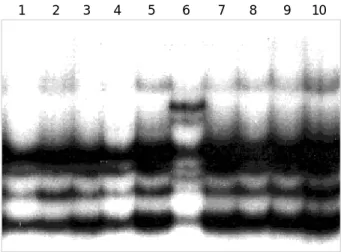
A polymorphic band was found in one subject. The PCR product of the subject was cloned into a plasmid vector for sequencing. One allele had an insertion of 20 nucleotides (AGAGAGGGAGAGGGAGAGGG) between nucleotide 71 and 72 and a point mutation at nucleotide 75 that replaced G with A, and the other allele was revealed to have normal sequence. An insertion was a nearly perfect tandem duplica-
Fig. 1.Single-strand conformation polymorphism (SSCP) analy- sis on a 5.5% nondenaturing polyacrylamide gel. Different pat- tern of the bands in lane 6 suggests the existence of genomic variation.
Fig. 2.DNA sequence of the wild and mutant allele. Direct DNA sequencing shows a 20 base insertion and a substitution 75 G- A in the mutant allele.
+50 +80 bp
insertion point mutation Wild : AGCGAGAGGGAGAGGGAGAGGGAGAGAGAGA
Mutant: AGCGAGAGGGAGAGGGAGAGGGAGAGAGGGAGAGGGAGAGGGAGAAGAGA
3 5
T
Wild Mutant
C G A T C G A
+75 bp G-A 20 bp insertion
+75 +50
1 2 3 4 5 6 7 8 9 10
New Mutation of TGF- 3 Gene 551
tion, which had a 19 base repeat sequence of the wild type DNA between nucleotide 53 and 71 (Fig. 1, 2).
A 55-yr-old woman with this mutant RRE was 160 cm tall. She had one daughter and one son. The morphology of the breast was normal and the external genitalia and ovaries were intact. She had had a hysterectomy because of myoma at the age of 45. The lipid profile was normal. Z score (the value of the SD obtained when the average of the data was adjusted to zero) of her spine BMD was -0.93.
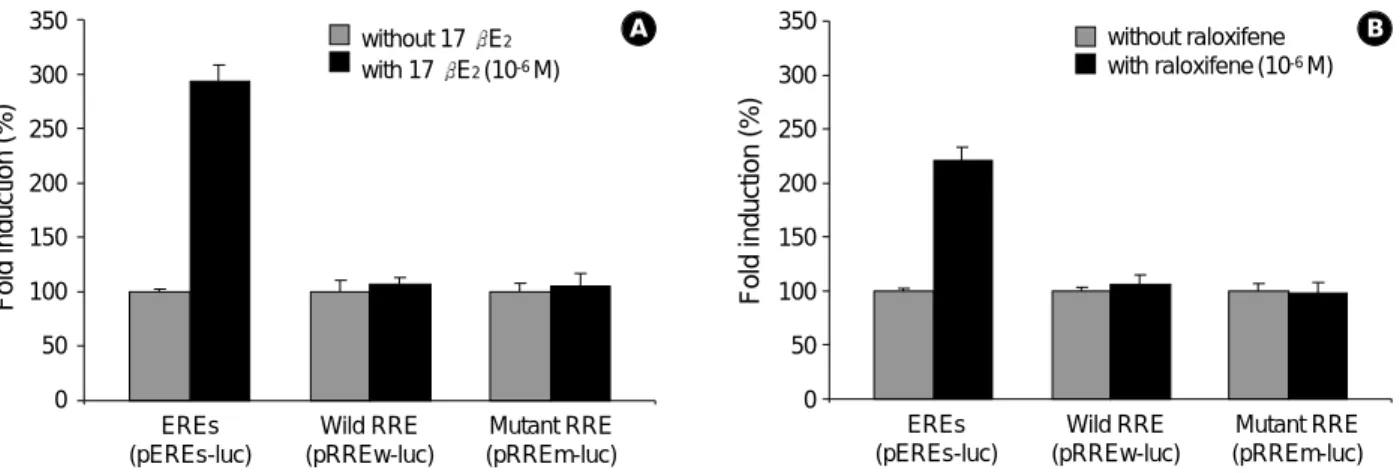
The luciferase activity in pEREs-luc transfected cells were shown to increase significantly after treatment of estrogen or raloxifene whereas the luciferase activity in both wild and mutant type RRE did not increase even after treatment of estrogen or raloxifene. There were no significantly different activities between the wild type and mutant type RRE either before or after treatment of estrogen or raloxifene (Fig. 3).
DISCUSSION
We found a heterozygote with a 20 base insertion and one point mutation of the RRE site in the TGF- 3 gene. Other polymorphic site could not be found in 200 women.
The functional significance of the mutant RRE remains unknown. BMD of the subject was comparable to that of the age-matched controls. These findings suggest that the RRE mutant of one allele is not likely to be responsible for the determination of BMD, and the mutant does not seem to have a dominant effect. However, the possibility can not be excluded that the homozygote may affect the bone preser- vation. In case of glucokinase gene, the heterozygote of the mutant in -cell specific promoter was more frequently found in patients with glucose intolerance and showed a lower transcriptional activity. The homozygote of the variant was found only in non-insulin-dependent diabetic patients (7). Further investigation needs to be performed in a large
population to find the homozygote.
Transient transfection study of this heterozygotic mutant RRE did not show any significant difference in activity com- pared with the wild type activity. Furthermore, both wild and mutant type RRE did not induce the luciferase activity even after the treatment of raloxifene. These findings suggest that the wild type RRE as well as the mutant type RRE is not influenced by raloxifene treatment. This suggestion can be supported by the report that demonstrated the RRE was not sufficient to mediate the full hormonal regulation of the TGF- 3 gene (8).
Our data suggest that the novel RRE mutant seems not to be a functional mutant and the RRE promoter region may not be essential to mediate the target gene regulation.
ACKNOWLEDGMENT
We are grateful to Dr. Sug Oh, Jeil Women’s Hospital for proofreading our manuscript.
REFERENCES
1. Gottardis MM, Jordan VC. Antitumor actions of keoxifene and tamox- ifen in the N-nitrosomethylurea-induced rat mammary carcinoma model. Cancer Res 1987; 47: 4020-4.
2. Gottardis MM, Ricchio ME, Satyaswaroop PG, Jordan VC. Effect of steroidal and nonsteroidal antiestrogens on the growth of a tamoxifen- stimulated human endometrial carcinoma (EnCa101) in athymic mice. Cancer Res 1990; 50: 3189-92.
3. Draper MW, Flowers DE, Huster WJ, Neild JA, Harper KD, Arnaud C. A controlled trial of raloxifene (LY139481) HCl: impact on bone turnover and serum lipid profile in healthy postmenopausal women.
J Bone Miner Res 1996; 11: 835-42.
4. Black LJ, Sato M, Rowley ER, Magee DE, Bekele A, Williams DC,
Fold induction (%)
350 300 250 200 150 100 50 0
Fold induction (%)
350 300 250 200 150 100 50 0
EREs (pEREs-luc)
Wild RRE (pRREw-luc)
Mutant RRE (pRREm-luc)
Fig. 3. Transient cotransfection study with human ER (pCMVERa) and several reporter plasmids (pEREs-luc, pRREw-luc, or pRREm- luc) in Hela cells. Significant increase of luciferase activities can not be seen in either wild or mutant type RRE after treatment of estrogen (A) or raloxifene (B).
without 17 E2
with 17 E2 (10-6 M)
EREs (pEREs-luc)
Wild RRE (pRREw-luc)
Mutant RRE (pRREm-luc) without raloxifene with raloxifene (10-6 M)
A B
552 K.O. Han, Y.S. Kang, C.S. Hwang, et al.
Cullinan GJ, Bendele R, Kauffman RF, Bensch WR, Frolik CA, Ter- mine JD, Bryant HU. Raloxifene (LY139481 HCl) prevents bone loss and reduces serum cholesterol without causing uterine hypertrophy in ovariectomized rats. J Clin Invest 1994; 93: 63-9.
5. Yang NN, Bryant HU, Hardikar S, Sato M, Galvin RJS, Glasebrook AL, Termine JD. Estrogen and raloxifene stimulate transforming growth factor- 3 gene expression in rat bone: a potential mecha- nism for estrogen-or raloxifene-mediated bone maintenance.
Endocrinology 1996; 137: 2075-84.
6. Yang NN, Venugopalan M, Hardikar S, Glasebrook A. Identification of an estrogen response element activated by metabolites of 17 - estradiol and raloxifene. Science 1996; 273: 1222-5.
7. Matsutani A, Noda K, Tao T, Tanizawa Y, Kaku K. Variation of promoter activity of glucokinase gene in human. Diabetes 1993;
42(sl): 94A.
8. Yang NN, Venugopalan M, Hardikar S, Glasebrook A. Correction:
raloxifene response element needs more than an element. Science 1997; 275: 1249.