3
Current Status of the Institutional Review Boards in Korea : Constitution, Operation, and Policy for Protection of Human Research Participants
Ock-Joo Kim+, Byung-Joo Park*+, Dong-Ryul Sohn�, Seung-Mi Lee*, Sang-Goo Shin�+
Department of Medical Education, Korea University College of Medicine; Department of Preventive Medicine, Seoul National University College of Medicine*; Department of Clinical Pharmacology, Soonchunhyang University College of Medicine�; Department of Pharmacology, Seoul National University College of Medicine and Clinical Pharmacology Unit/SNUH�, and The Korean Association of Institutional Review Boards (KAIRB)+, Seoul, Korea
Address for correspondence Sang-Goo Shin, M.D.
Department of Pharmacology, Seoul National University College of Medicine and Clinical Pharmacology Unit/SNUH, 28 Yeongon-dong, Chongno-gu, Seoul 110-799, Korea Tel : +82.2-760-1910, FAX : +82.2-742-9252 E-mail :[email protected]
*This work was supported by the Science Culture Research Center (SCRC) Grant in 2002.
Received : 3 December 2002 Accepted : 30 December 2002
� SPECIAL ARTICLE�
The institutional review board is crucial to ensure the scientific and ethical quali- ty of human participant research. This paper analyzes a survey on the current constitution and operation of institutional review boards (IRBs) in Korea, conduct- ed by the Korean Association of Institutional Review Boards in April 2002. Out of 74 IRBs, 63 responded to the survey (85.1% response rate). IRB membership has a male-to-female ratio of approximately 80:20, a predominance of male clini- cians (60%) and an underrepresentation of community people unaffiliated to the institutions (less than 10%). Most IRBs (around 80%) confine the scope of their reviews to the clinical evaluation of drugs or devices, leaving the remaining areas of research involving human participants untouched. As their role is limited, the majority of IRBs do not operate actively: 72% of responding IRBs reviewed less than one protocol per month in 2001. Sixty two percent of institutions have never discussed the need for insuring research participants’risks or making indemnity arrangements. This survey reveals many shortcomings and points for improve- ment by the institutional support bodies, including the need to establish regular edu- cation programs for IRB members and investigators.
Key Words : Ethics Committees, Research; Ethics Committees, Chinical; Ethics, Institutional; Ethics, Research; Human Experimentation
INTRODUCTION
The Declaration of Helsinki uniformly requires that all biomedical research involving human participants, including- research on identifiable human material or data, should be approved by an ethical review committee (1). Having evolved out of the scandalous unethical research practices of the mid- and late twentieth century, the ethics review of study proto- cols, by independent ethics committees (IECs) or institution- al review boards (IRBs), has become the international standard of ethically and scientifically acceptable biomedical research.
Today, concerns over the quality of the IRB function are increasing worldwide. Globalization of the clinical trial in the last decade has caused more people in developing countries to participate in trials, international efforts to assure partici- pants’rights and safety. Accordingly, recently more guide- lines and regulations are being produced and more organiz-
ing conferences on ethics reviews have been held. Neverthe- less, voices of concern about the protection of research partici- pants have been increasing among researchers in developing countries and among the overseeing bodies in developed countries. Most importantly, the IRB function, to ensure the quality of research in terms of both its scientific and ethical aspects, differs from place to place for various reasons. In spite of the growing importance of ethics review on research involv- ing human participation, concrete information on the perfor- mance of IRBs is not available, even in the developed coun- tries. This scarcity of data on the quality of IRB performance implies an unsatisfactory situation with respect to the over- seeing system for human participant research.
In Korea, the enactment of the KGCP (Korean Good Clin- ical Practice) in 1995 required that clinical trials be reviewed and continuously monitored by IRBs. Several studies have shown that the enforcement of the KGCP has exerted remark-
ably positive influences on the infrastructure and quality of clinical trials in Korea (2-4). In January 2001, the Korean gov- ernment revised the KGCP based upon the ICH-GCP(E6), an international ethics guideline for clinical trials (5). This revision required that legal and institutional bases be estab- lished to ensure that the constitution and operation of IRBs be standardized and upgraded to international levels (6).
However, given their short history the current situation of IRBs in Korea is neither desirable nor satisfactory. Most IRBs confine their roles to review only drug-related research, leav- ing large area of human participant research untouched by any ethics review. Despite any standardizing effect of the KG- CP regulation, actual IRB practice varies greatly from one institution to another, depending on each institution’s local situation, experience, and resources. While globalization and the expansion of clinical trials and biomedical research call for transparent and competent ethics review, no regulations or guidelines are available for ethics reviews of biomedical researches, except the KGCP for clinical trials in Korea.
Set against this backdrop, in March 2002, IRB members in major hospitals, biomedical researchers, medical directors of pharmaceutical companies and officers from health authori- ties founded the Korean Association of Institutional Review Boards (KAIRB) under the auspice of the Korean Academy of Medical Sciences. The main mission of the KAIRB is to help Korean IRBs build up ethical review capacity to the international level. For this purpose, KAIRB adopted various initiatives, namely, the co-hosting of the Korea-NIH Confer- ence on Ethical and Regulatory Aspects of Human Partici- pant Research in June 2002, with the aim of developing strategies to improve IRB ethics review quality based on con- crete data. Accordingly, KAIRB conducted the first nation- wide survey to evaluate the current situation with respect to the structures of the IRBs and the actual review processes conducted.
METHODS
Based upon the data on IRBs submitted to the Health and Welfare Committee of the Korean Congress in 2001, 74 IRBs were chosen as correspondents of this nationwide survey. After developing a questionnaire containing 67 question items on constitution, review process, and institutional policy with respect to research participant protection, the questionnaire was sent to a nominated individual at each IRB; these were identified by telephone calling each IRB and requesting the name of the most knowledgeable person about the IRB. Con- ducted in April 2002 as the first project of the KAIRB, this survey explicitly notified individuals that the purpose of the survey was to improve the quality of ethics review, and that all information provided would be kept confidential, to en- hance the reliability of the data obtained. Of the 74 IRBs mail- ed, 63 returned the questionnaire in due time (response rate:
63/74=85.1%).
After the returned questionnaires had been reviewed for the completeness and correctness of information, a computerized database was constructed for statistical analysis. The data are presented as proportions in the Tables and figures because most of the data were categorical variables.
RESULTS
All returned questionnaires were found to be valid for the analysis. Accordingly, 63 questionnaires were subjected to the computer analysis.
Establishment of the IRBs
The survey demonstrated that most of the IRBs in Korea were established after the implementation of the KGCP in
Medicine
Physicians 6.54 52.0 (2-16) 0.83 6.6 (0-4) 7.37 58.5 (3-16)
Medical scientists 1.02 8.1 (0-4) 0.14 1.1 (0-2) 1.16 9.2 (0-4)
Pharmacists 0.24 1.9 (0-1) 0.81 6.4 (0-3) 1.05 8.3 (0-3)
Nurses 0.03 0.3 (0-1) 0.38 3.0 (0-2) 0.41 3.2 (0-2)
Professionals for ethics
Lawyers 0.14 1.1 (0-2) 0.03 0.3 (0-1) 0.17 1.4 (0-2)
Religion 0.73 5.8 (0-2) 0.32 2.5 (0-2) 1.05 8.3 (0-3)
Administration
Administrators 0.38 3.0 (0-3) 0.14 1.1 (0-1) 0.52 4.2 (0-3)
Non-affiliated
Medicine 0.27 2.1 (0-3) 0.00 0.0 0 0.27 2.1 (0-3)
Layperson 0.46 3.7 (0-3) 0.10 0.8 (0-2) 0.56 4.4 (0-5)
Miscellaneous 0.02 0.1 (0-1) 0.02 0.1 (0-1) 0.03 0.3 (0-1)
Total 9.83 78.1 (2-26) 2.76 21.9 (0-9) 12.59 100.0 (7-30)
*average of the number of members.
Field Profession Male Female Total
Average No.* % Range Average No.* % Range Average No.* % Range
Table 1.Constitution of IRB members (n=63)
1995. Of 63, only 14 IRBs (22%) existed before the enforce- ment of the KGCP. Thirty-five IRBs (56%) were established between 1995-1997, and 11 (17%) between 1998-2001. In most IRBs (90%), the president of the hospital is responsi- ble for appointing members. In more than two thirds of IRBs, the chairperson of the IRB is appointed without an election process within the IRB: the presidents appoint the chair in 29 IRBs (46.0%) and vice-presidents automatically take the chair in 19 IRBs (30.2%). While 37 (58.7%) of IRBs have their own administrators charged to ensure efficient IRB oper- ation, 24 (38.1%) have no administrative support from the institution.
Constitution of IRB membership
Since the sound constitution of the IRB members is a pre- requisite for proper review, the authors tried to collect detailed information on the composition of each IRB’s membership.
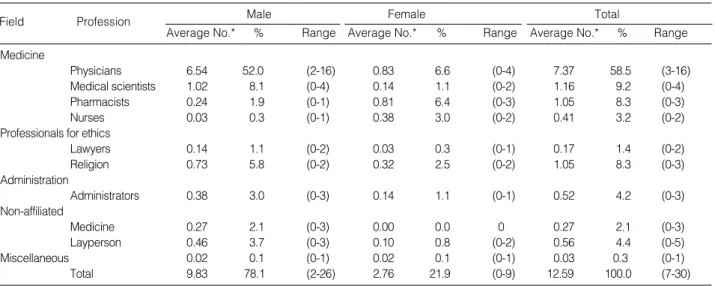
The average number of members in an IRB in Korea is 12.6 (range: 7-30). The average percentage of members from med- ical fields is 79.4%, comprised as follows: physicians (58.5%;
range 3-16), medical scientists (9.2%; range 0-4), pharmacists (8.3%; range 0-3), and nurses (3.2%; range 0-2). The average percentage of professionals for ethics review is 9.7% including religious professionals (8.3%; range 0-3) and lawyers (1.4%;
range 0-2). Non-affiliated layperson members comprised 4.4%
(range 0-5) (Table 1). The gender ratio of the members is 78/
22 (M/F). While 90% of IRBs have professionals for ethics review, including religious and legal professionals, only 43%
have layperson members. About 40% do not have members who are not affiliated to the institution.
Education of IRB members and investigators
Of the 63 IRBs, only 11 provide education to their mem- bers, and only 7 provide education for investigators on a reg- ular basis, at least once per year (Table 2).
Ninety percent of IRBs replied that they have written Stan-
dard Operating Procedures (SOPs) for IRB review, which means that 10% breach the KGCP.
Regularity and frequency of IRB meetings
Twenty-eight IRBs (44%) hold meetings regularly, while 54% replied that they have irregular meetings (Table 3). Only 19 IRBs (30%) hold meetings once a month or more. These data mean that more than half of all IRBs are relatively inac- tive.
Scope of IRB review and review burden in 2001
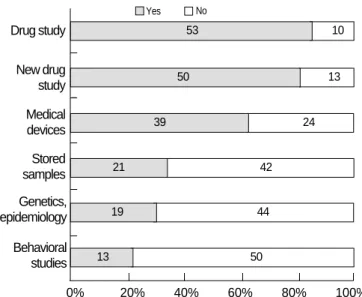
To the question, ‘What kinds of research should be reviewed in each IRB?’, about 30% of IRBs make it a rule to review studies on epidemiology or on genetics and 33% of IRBs review studies involving stored biological samples. Only 21%
review behavioral studies. On the other hand, 84% of IRBs replied that they should review drug studies, including post- marketing surveillance, 79% review new drug studies, and 62% medical device studies (Fig. 1).
When asked about the number of research protocols review- ed in 2001, 24 IRBs (38%) replied that they reviewed 1-5 protocols, 11 (17.5%) reviewed 6-10 protocols, and 8 (12.7%) reviewed 11-20 protocols (Table 4). Nine IRBs reviewed more than 50 protocols in 2001. Academic research was reviewed at 19 IRBs (30.2%), of which only 2 (3.2%) dealt with more than 10 academic research protocols in 2001.
The review process
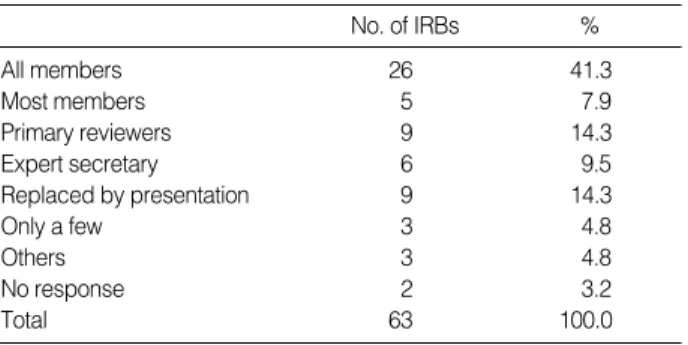
To the question, ‘Whether and how the protocols are re- viewed before a formal meeting?’, about 41.3% of IRBs replied that all the members attend a formal meeting after reading
No response 2 3.2 2 3.2
Regularly (at least once per year) 11 17.5 7 11.1
Irregularly 29 46.0 32 50.8
Never done 21 33.3 22 34.9
Total 63 100.0 63 100.0
Education IRB members % Investigators %
Table 2.Education of IRBs members and investigators (n=63)
No response 1 1.6
Regular meeting 28 44.4
Irregular meeting 34 54.0
Total 63 100.0
Regularity No. of IRBs %
Table 3. Regularity of IRB meeting (n=63)
Fig. 1.Proportion of IRBs which review the study protocol by the type of research.
Drug study
New drug study Medical devices Stored samples Genetics, epidemiology
Behavioral studies
Yes No
0% 20% 40% 60% 80% 100%
53
50
39
21
19
13
10
13
24
42
44
50
all protocols. Fourteen percent of IRBs adopt a primary review system, in which the protocols are thoroughly reviewed before the formal meeting. In about 30% of IRBs, the members do not read the protocols before the meeting; some of those IRBs replace reading with an investigator’s presentation (Table 5).
Layperson members participate actively in the meeting in 54% of IRBs, and moderately understand protocols. In 54 IRBs (86%), principal investigators are allowed to attend IRB meetings only when asked by the IRB (52.4%), while they are not allowed to attend in 6 (9.5%) IRBs. If an IRB mem- ber is the investigator of a protocol under review, the mem- ber cannot attend the meeting in 9 IRBs (14.3%), or the mem- ber may attend to reply to questions but cannot review in 53 IRBs (80.9%) (Table 6). Only one IRB allows a member, who is also the investigator, to attend and review the protocol.
The IRB decision is reached by consensus in 36 IRBs (57%), and by a majority vote in 24 (38%) (Table 7).
Continuing review
Thirty-four IRBs (54%) perform continuing review, while 26 IRBs (41%) do not. The patterns of continuing review among the IRBs are quite different. Some IRBs have reason- able criteria for the review interval for each protocol, but oth- ers have fixed review intervals for all protocols. The interval of the continuing review varies from every three months to once per year (Fig. 2).
Expedite review
Most IRBs in Korea have an expedite review system to en- sure that appropriate action is taken after initial review of re- search protocols. Of 56 IRBs (89%) that have an expedite review system, 27 IRBs (43%) use a subcommittee system or pre-assigned members to conduct expedite review, and 19 (30%) collect opinions from individual members. Immedi- ately reported serious adverse drug reaction is the most impor- tant topic category for expedite review (81%), but the cate- gorizations used at expedite reviews vary among institutions (Table 8).
Policy for protecting human participants from research risk
To the question concerning the review of compensation for research participants, 46 IRBs (73%) review only mone-
Secret majority vote 3 4.8
Open majority vote 21 33.3
Consensus 36 57.1
Discussion 1 1.6
Chairperson 1 1.6
No response 1 1.6
Total 63 100.0
No. of IRBs %
Table 7. Decision making process (n=63)
Fig. 2.Continuing review and its intervals.
0 7 (11.1) 8 (12.7) 44 (69.8) 45 (71.4) 1-5 24 (38.1) 27 (42.9) 14 (22.2) 9 (14.3)
6-10 11 (17.5) 11 (17.5) 3 (4.8) 3 (4.8)
11-20 8 (12.7) 8 (12.7) 0 (0.0) 1 (1.6)
21-30 2 (3.2) 2 (3.2) 1 (1.6) 2 (3.2)
31-50 2 (3.2) 3 (4.8) 0 (0.0) 0 (0.0)
51 9 (14.3) 4 (6.3) 1 (1.6) 3 (4.8)
Total 63 (100.0) 63 (100.0) 63 (100.0) 63 (100.0) Number of
Total Clinical trial Academic
Others protocols
No. (%) No. (%) research
No. (%)
reviewed No. (%)
Table 4.Distribution of total number of protocols reviewed in each IRB in 2001 by the type of research
No response 5%
No 41%
Yes 54%
3 months 5%
6 months 14%
3, 6 months 2%
3, 6, 12 months 5%
Once per year 10%
Occasionally 3%
Others 10%
No response 6%
All members 26 41.3
Most members 5 7.9
Primary reviewers 9 14.3
Expert secretary 6 9.5
Replaced by presentation 9 14.3
Only a few 3 4.8
Others 3 4.8
No response 2 3.2
Total 63 100.0
No. of IRBs %
Table 5. Person(s) who review(s) protocols before IRB meet- ing (n= 63)
No response 2 3.2
Cannot attend 9 14.3
Attend to reply to questions but cannot review 53 80.9
Attend and review 1 1.6
Total 63 100.0
No. of IRBs % Table 6. Attendance of an IRB meeting when the investigator is an IRB member (n=63)
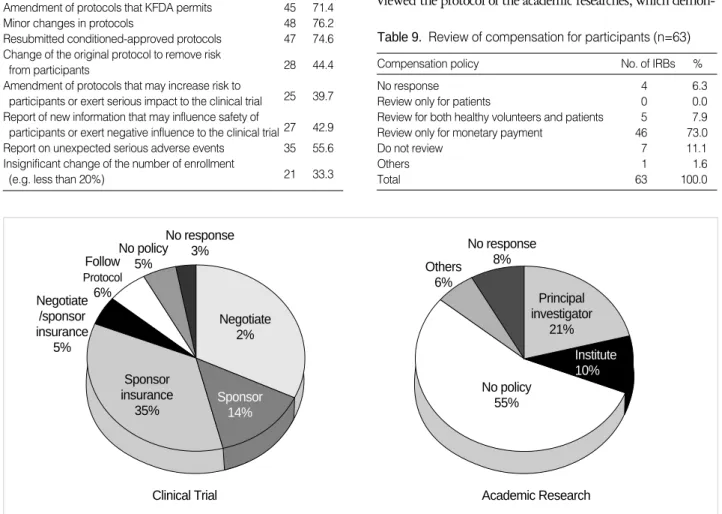
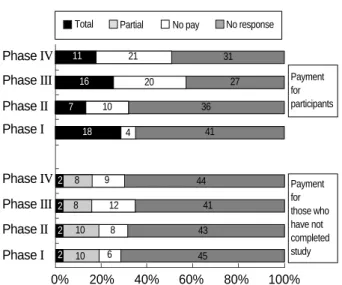
tary payment, and 7 IRBs (11%) do not review any kinds of compensation (Table 9). Only 22 IRBs (35%) make it obli- gatory for sponsors to have insurance for indemnity against participant injury. In terms of academic research, 35 institu- tions (62%) do not have any indemnifying policy for research participants (Fig. 3). Since non-response rates were high for questions on payment policy, it is difficult to form an over- all picture on the current payment situation. Institutions have various payment policies, which vary according to the phase of a clinical trial (Fig. 4). For those who have not completed study, 9-19% of institutions are allowing for non-payment for the participants.
Self-reported problems of each IRB
To the open question asking about the problems and dif- ficulties that each IRB faces, respondents replies ranged from one to several items (Fig. 5).
DISCUSSION
This study reveals many shortcomings in the Korean IRB system. The problems found by this survey can be summa- rized into three categories: (1) the structure of the ethics review system for research involving human subjects; (2) the review process; and (3) IRB policy with respect to protection of re- search participants.
Problems in the structure of ethics review system for research involving human participants
The most serious problem is limited scope of the IRBs re- view. All human-related research is not reviewed by IRBs; a very few categories of human research are covered by the IRB review system. Most IRBs limited their review only to legally bound research. Researches seeking Korean Food and Drug Administration (KFDA) approval for clinical trials upon new drugs, biologics, or devices must undergo the IRB review process by the KGCP regulation. Since the KGCP is the only regulation to obligate IRB review, the regulation does not apply to all the other researches that do not seek KFDA appro- val. The survey showed that only 30% of the whole IRBs re- viewed the protocol of the academic researches, which demon-
Fig. 3.Policy for indemnity.
Immediately reported adverse drug reaction 51 81.0 Report at the end of clinical trial 34 54.0 Amendment of protocols that KFDA permits 45 71.4
Minor changes in protocols 48 76.2
Resubmitted conditioned-approved protocols 47 74.6 Change of the original protocol to remove risk
28 44.4 from participants
Amendment of protocols that may increase risk to
25 39.7 participants or exert serious impact to the clinical trial
Report of new information that may influence safety of
27 42.9 participants or exert negative influence to the clinical trial
Report on unexpected serious adverse events 35 55.6 Insignificant change of the number of enrollment
21 33.3 (e.g. less than 20%)
Categories Yes Yes %
Table 8. Categories of expedite review (n=56)
No response 4 6.3
Review only for patients 0 0.0
Review for both healthy volunteers and patients 5 7.9
Review only for monetary payment 46 73.0
Do not review 7 11.1
Others 1 1.6
Total 63 100.0
Compensation policy No. of IRBs %
Table 9. Review of compensation for participants (n=63)
Follow Protocol Negotiate6%
/sponsor insurance
5%
No policy 5%
No response 3%
Negotiate 2%
Sponsor insurance
35%
Clinical Trial Sponsor
14%
Others 6%
No response 8%
Principal investigator
21%
Institute 10%
No policy 55%
Academic Research
strated that there is room for improving the current IRB review system for better protecting research participants in academ- ic studies (Table 4). The remaining mechanism of human sub- ject protection is the publication requirement of the ethics review on topics involving the participation of human sub- jects, but these are not effective due to a lack of compliance by researchers in Korea. Recently, positive signs appeared for increasing the coverage of IRB review system. The Stem Cell Research Project supported by the Korean Ministry of Science and Technology, starting October 2002, set internal guide- lines that all research protocols funded by the Project should be reviewed by the ethics committee and by the IRB of each institution where the research is conducted. In terms of resear- ch that is both socially and ethically controversial, such as stem cell research, the establishment of an ethics review system will increase the transparency of research practice, and thereby bet- ter protect the public.
Second, few research institutions other than hospitals have IRBs. More than half of the IRBs in Korea were established in the hospitals accredited in 1993 for clinical trials immedi- ately before the implementation of KGCP in 1995. Many other institutions conducting human participant research or equivalent research in universities or biomedical research cen- ters do not have IRBs yet. However, the researchers in biomed- ical research field in Korea have recognized the importance of ethical consideration for human related research. This will evoke the establishment of new IRBs at biomedical research institutions other than hospitals in the near future.
Third, most IRBs suffer from lack of independence. The very heart of the ethics review is the independence of the IRBs from political, institutional, professional, and market influ- ences in terms of their composition, procedures, and decision- making (7). In 91% of IRBs, the president of the hospital appoints members, and in more than two thirds of IRBs, the chairperson is appointed by the president (n=29, 46%) or the
president automatically takes the chair (n=19, 30.2%). As Wood et al. (8) pointed out, the IRB has inherent institu- tional conflicts of interest because most IRB members work for the very institution conducting the research they review.
This makes the IRB and individual members inclined to be influenced by the senior officials and their peer relationships with researchers within the institution.
Fourth, IRBs are not properly balanced in their member- ship constitution. To conduct competent and independent re- views, it is crucial to have IRBs that are soundly composed.
An IRB should include relevant scientific and ethical exper- tise and laypersons, with balanced professional, age and gen- der distributions (8). Our survey shows that with the excep- tion of male physicians (50% of all members), IRB compo- sitions do not reflect diversity in terms of the representations of professions or genders. The most serious problem is that only 43% have layperson members and about 40% do not have members who are not affiliated to the institute. This may lead to a weakening of IRB independence and to depriving the community of research awareness.
Finally, yet importantly, IRB members and investigators do not get adequate education. Although the KGCP requires the regular education of IRB members and clinical investi- gators, our survey shows that less than 20% of institutions provide regular education to IRB members and only about 10% to investigators (Table 2). Some institutes provide annu- al workshop programs and courses on human research for re- searchers and IRB members, but there is no specified stan- dard curriculum available for training ethical research prac- tice, even in these institutions.
Problems in the review process
The survey results showed significant variability in terms of the quality and expertise of IRB reviews. A small number of IRBs have members with more diverse expertise for review- ing the various protocols, while the remainders do not. Review practice itself varies among the IRBs. While members read and reviewed documents before a meeting in 41% of IRBs, the document review is replaced by an investigator’s presen-
Fig. 5.Self-reported problem areas of each IRB.
1. Expertise for IRB review
2. Knowledge and experience on IRB operation 3. Recognition of the importance of IRB functions 4. Resources and support from the institute 5. Active participation of IRB members 6. Independence
Fig. 4.Payment for research participants.
Phase IV
Payment for participants
Payment for those who have not completed study 11
16 7
18
2 2 2
2 10 6
8 12 9
10 8 8
4 10
20
21 31
27 36
41
44 41 43 45
Phase III Phase II Phase I
Phase IV Phase III
0% 20% 40% 60% 80% 100%
Phase II Phase I
No pay No response Total Partial
tation in 14% of IRBs. As the respondents replied (Fig. 5), the lack of experience and expertise of the IRB review and operation are the most serious problems for many IRBs.
Although the KGCP, revised in 2001, addresses continuing review, only half of the responding IRBs conduct continuing review. Since the questionnaire was not detailed enough to gather information as to how continuing review is conduct- ed, we cannot judge how effectively and efficiently the con- tinuing reviews are conducted as an assuring system to pro- tect research participants. As the concept of continuing review was recently introduced to the KGCP in 2001, several IRBs have been gearing toward installing continuing review that uses electronic database systems.
While most IRBs in Korea have an expedite review system to deal with reports on serious adverse events or minor proto- col changes, about 10% do not have expedite review system, which may cause time-consuming, inefficient review process.
The categories of expedite review are also variable. Even 40%
IRBs use an expedite review system to review the amendment of protocols that may increase risks to participants, or exert serious impact to clinical trial, which itself should be reviewed at a regular IRB meeting. These results (Table 8) suggest that specific guidelines on expedite review should be prepared.
Policy problems related to the protection of research participants
One of the most important functions of the IRB is to ensure the protection of research participants, which includes review- ing and overseeing the safety measures taken to protect par- ticipants. Although international guidelines suggest reviewing all kinds of compensation, such as treatment, prorated pay- ments, indemnity, gifts, and other benefits, the survey shows that most IRBs review only for monetary payment. About 10% of IRBs do not review any kind of compensation for par- ticipants.
In case of clinical trials, about 50% of institutions make sponsors indemnify against juries or harm to participants. Only 22 IRBs (35%) make it obligatory for sponsors to have insur- ance indemnity for participant injury. Except 3 institutions that have no policy, most have some kind of policy that cov- ers participants in clinical trials, mainly because sponsors pro- vide the necessary funding.
More serious than the case for clinical trials is the lack of policies in place for the protection of participants in academ- ic research. Currently, this has become more obvious and more serious, as more academic researchers face the problem. The financial resources required to indemnity participants in aca- demic research are not as available as they are in clinical trials.
Usually, research funds come from the government or pub- lic research institutes, which have tight research budgets. Two- thirds of institutions do not have any policy for the indemni- fication of research participants. In 21% institutions, princi- pal investigators have to pay for indemnity; in fact, in 10%
of institutions they have the responsibility to do so. To date no insurance system for academic research has been developed, and problems in this quarter will undoubtedly grow.
SUGGESTIONS AND CONCLUSIONS
In spite of the problems with the IRB system, these data are neither complete nor without error. Since this study relied solely on the reply of an expert member of each IRB to the questionnaire, further evaluation by an independent third party is necessary for the systematic collection of thorough and valid data. To improve the current situation of human research participant protection in Korea, We make the fol- lowing suggestions.
In order to provide the public with assurance, it is neces- sary to make regulations to obligate all human research cat- egories to be reviewed by research ethics review committees.
In spite of the explosive growth of human resource research in Korea, there exists only a regulation concerning research requiring KFDA approval (KGCP). At least, government- funded research, which is virtually citizen and taxpayer finan- ced, should be reviewed by IRBs to ensure the protection of research participants.
To improve the quality of the IRB review, it is important to build networks at regional, national, and international lev- els, to exchange information, utilize resources efficiently, and standardize the quality of review. KAIRB is expected to play important supportive role for local IRBs, by regularly pro- viding necessary information and by educating IRB members.
KARIB has recently developed general guidelines for the con- stitution and operation of IRBs, which encompass hitherto uncovered areas of human participant research. There is also a need to organize regional IRB meetings in Korea, and to cre- ate joint IRBs to adequately manage the requirements of multi-centered research. At the international level, the WHO is organizing regional forums of ethics committees charged to review biomedical research (9).
To improve the quality of the IRB review system, continu- ing education and training is essential. As several important reports, as well as our survey respondents pointed out, one of the serious problems of facing IRBs in developing countries, including Korea, is lack of expertise in the IRBs. Primarily individual institutions ought to take the responsibility for training IRB members and the investigators, in ethics of re- search involving human participants. Realistically speaking, when lack of resources at an individual institute becomes a real problem, the KAIRB, relevant academic societies, the KFDA, or some other responsible governmental organizations should be able to develop and provide curricula and course programs, which include basic, advanced, and specific courses for all IRB members and investigators.
Eventually, we need to build a quality assurance system (ac- creditation) for research institutions. As more researchers now
recognize the importance of the IRB review, it is timely to consider an accreditation system requiring the continuing self- assessment, self-improvement, and auditing of IRBs. With the globalization of biomedical research, the number of inter- national agencies overseeing IRBs will increase through audit- ing or inspection (9-12). As a part of the peer review or for educational purposes, the auditing or surveying of IRBs should be introduced in Korea. After all, these activities will demon- strate the continuous efforts made by our Korean IRBs to build capacity for conducting biomedical research of the highest attainable quality in terms of both science and ethics.
REFERENCES
1. The World Medical Association. Declaration of Helsinki. Revised at 52nd WMA General Assembly, Edinburgh, Scotland, October 2000.
2. Shin SG. Current status of clinical trials and GCP in the Republic of Korea. Drug Inf J 1997; 31: 1079-87.
3. Shin SG. The current status of clinical trials in the Republic of Korea.
Drug Inf J 1998; 32: S1217-22.
4. Howard L, Charles K, Shin SG. Changes in clinical trial practice and the working environment in the Korean pharmaceutical indus- try since the implementation of Good Clinical Practice. Drug Inf J
2001; 35: 203-10.
5. ICH Harmonized Tripartite Guideline: E6. Good Clinical Practice:
Consolidated Guideline. May 1996.
6. Korean Ministry of Health and Welfare. Guidelines of Korean Good Clinical Practice Guidelines. January 2001.
7. World Health Organization. Operational guidelines for ethics commit- tees that review biomedical research. Geneva: WHO, 2000.
8. Wood A, Grady C, Emanuel EJ. The crisis in human participants re-
search: identifying the problems and proposing solutions. http://www.
bioethics.gov/emanuelpaper.html
9. Office of the Inspector General, Department of Health and Human Services. The globalization of clinical trials: a growing challenge in protecting human subjects. September 2001. OEI-01-00-00190.
10. World Health Organization. Surveying and evaluating ethical review practices, a companion guideline to the TDR WHO operational guide- lines for ethics committees that review biomedical research (2000).
Geneva: WHO, 2002.
11. European Forum for Good Clinical Practice. European guidelines for auditing independent ethics committees. Brussels: EFGCP, 2002.
12. European Network of GCP Auditors and Other GCP Experts. The ENGAGE guideline: optional guideline for good clinical practice compliance and quality systems auditing. Salve 1. Supplement to The EFGCP News, September 1998.