ABSTRACT
Ectopic male breast cancer is very rare. Consequently, there is a lack of prospective clinical trials, and most recommendations for treatment are based on the experiences of clinicians and data from female breast cancer patients. The United States Food and Drug Administration has recently approved palbociclib combined with endocrine therapy for advanced male breast cancer because of the positive results of its use in metastatic female breast cancer. Therefore, it is worth considering cyclin-dependent kinase 4/6 inhibitors as alternatives to conventional chemotherapies for advanced male breast cancer patients with hormone receptor-positive and human epidermal growth factor receptor 2-negative cancers. The present case report introduces the use of palbociclib plus letrozole as first-line therapy for an elderly male patient with relapsed ectopic breast cancer, notwithstanding the limitations of the current national health insurance policy.
Keywords:
Breast neoplasms; Male; Palbociclib
INTRODUCTION
Male breast cancer accounts for less than 1% of all breast cancers [1]. Although much progress has been made regarding the diagnosis and treatment of female breast cancer over the years, there have been insufficient studies on male breast cancer because of its rarity. Moreover, only a few cases of ectopic breast cancer, a congenital anomaly of breast cancer located in various sites, have been reported [2]. Because ectopic male breast cancer is quite rare, prospective clinical trials are lacking, and most of the treatment approaches are based on the experience of the clinicians and data on female breast cancer. Although the treatment efficacy between men and women may be inconsistent in many aspects due to biological differences, strategies gleaned from cases of female breast cancer may be helpful [3]. Therefore, curative surgical resection followed by adjuvant chemotherapy is regarded as a standard treatment for non-metastatic male breast cancer, and adjuvant treatment, which includes chemotherapeutic agents and endocrine therapy in hormone receptor-positive cases, is similar to that for female breast cancer [4-6].
Case Report
Received: Mar 22, 2020 Accepted: Jun 9, 2020 Correspondence to Yee Soo Chae
Department of Oncology/Hematology, Kyungpook National University Chilgok Hospital, Kyungpook National University Cancer Research Institute, Kyungpook National University School of Medicine, 807 Hoguk-ro, Buk-gu, Daegu 41404, Korea.
E-mail: [email protected]
© 2020 Korean Breast Cancer Society This is an Open Access article distributed under the terms of the Creative Commons Attribution Non-Commercial License (https://
creativecommons.org/licenses/by-nc/4.0/) which permits unrestricted non-commercial use, distribution, and reproduction in any medium, provided the original work is properly cited.
ORCID iDs Dong Won Baek
https://orcid.org/0000-0003-4446-1549 Jee Young Park
https://orcid.org/0000-0002-1857-813X Soo Jung Lee
https://orcid.org/0000-0003-0066-4109 Yee Soo Chae
https://orcid.org/0000-0002-8585-4982 Conflicts of Interest
The authors declare that they have no competing interests.
Dong Won Baek
1, Jee Young Park
2, Soo Jung Lee
1, Yee Soo Chae
11 Department of Oncology/Hematology, Kyungpook National University Chilgok Hospital, Kyungpook National University Cancer Research Institute, Kyungpook National University School of Medicine, Daegu, Korea
2 Department of Pathology, Kyungpook National University Chilgok Hospital, Kyungpook National University Cancer Research Institute, Kyungpook National University School of Medicine, Daegu, Korea
The Therapeutic Effect of
Cyclin-Dependent Kinase 4/6 Inhibitor on Relapsed Ectopic Male Breast
Cancer
Author Contributions
Conceptualization: Baek DW, Lee SJ, Chae YS; Data curation: Baek DW; Formal analysis:
Baek DW; Investigation: Baek DW, Chae YS;
Software: Baek DW; Supervision: Lee SJ, Chae YS; Validation: Lee SJ, Chae YS; Visualization:
Baek DW, Park JY; Writing - original draft: Baek DW, Park JY, Lee SJ, Chae YS; Writing - review
& editing: Baek DW, Chae YS.
Meanwhile, as a systemic treatment for metastatic female breast cancer, the use of cyclin- dependent kinase 4/6 (CDK4/6) inhibitors such as palbociclib along with endocrine therapy has been shown to improve clinical outcomes [7]. There have been no clinical trials of CDK4/6 inhibitors in male breast cancer, partially because the Korean health insurance does not cover the cost of these inhibitors for the treatment of male breast cancer. However, the United States Food and Drug Administration (FDA) recently approved palbociclib combined with endocrine therapy for the treatment of advanced male breast cancer [8]. Therefore, CDK4/6 inhibitors should be considered as an alternative to conventional chemotherapies for advanced male breast cancer. Since the multidisciplinary treatment board of the Kyungpook National University Chilgok Hospital has permitted the use of palbociclib plus letrozole for metastatic male breast cancer patients who are hormone receptor-positive and human epidermal growth factor receptor 2 (HER2)-negative, we would like to share our experience of administering palbociclib plus letrozole to treat an elderly male patient with relapsed ectopic breast cancer.
CASE REPORT
A 69-year-old Korean male was transferred from a nearby clinic after presenting with metastatic adenocarcinoma of unknown primary site confirmed with a perineal mass biopsy. At the time of admission to the oncology department on March 2016, the patient's general condition was good with an Eastern Cooperative Oncology Group performance status of 1, and he did not have any specific disease history. He complained of a palpable left inguinal mass (Figure 1), and histology of the resected inguinal mass revealed invasive breast cancer of ectopic breast origin. Immunohistochemistry analysis revealed it to be hormone receptor-positive and HER2-negative. The tumor was 28 mm in size, and the resection margin was clear. Subcutis and muscle involvement were noted, but there was no lymphovascular or perineural invasion.
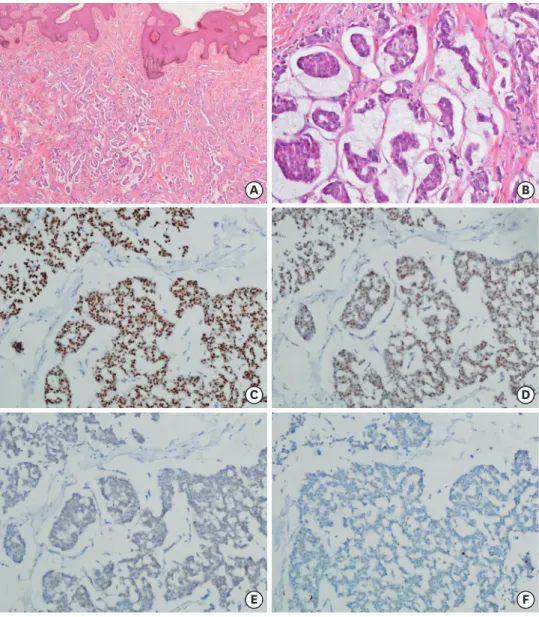
The tumor cells had an estrogen receptor (ER) score of 8, a progesterone receptor (PR) score of 8, and a Ki-67 labeling index of 10%. The histologic grade was 3 (Figure 2). The patient had no family history of breast or ovarian cancer, and no pathogenic germline breast cancer susceptibility gene (BRCA) 1/2 mutations were identified in the peripheral blood. However, an
Figure 1. PET-CT scan of the patients at the time of diagnosis. PET-CT scan showing a solitary left inguinal mass, measuring approximately 3 cm, shown to be invasive breast cancer of ectopic breast origin (March 2016).
PET-CT = positron emission tomography-computed tomography.
unclassified genetic variation of BRCA2 was detected (Table 1). Although 4 cycles of doxorubicin plus cyclophosphamide (AC) regimen followed by twelve cycles of weekly paclitaxel were planned as adjuvant chemotherapy, the patient completed only 8 cycles of weekly paclitaxel after 4 cycles of AC because he developed grade 2 neuropathy. Thereafter, tamoxifen was started without evidence of disease relapse at that time.
Table 1. BRCA2 unclassified variation was detected
Exon BIC nomenclature HGVS nomenclature Effect on amino acid Variation type
14 7280C > G c.7052C > G p.Ala2351Gly Unclassified variation
BIC = breast cancer information; HGVS = human genome variation society.
A B
C D
E F
Figure 2. Representative features and immunohistochemical findings. (A) Irregular infiltration of tumor cell clusters suspended in extracellular mucin at the sub-epidermal tissue (H&E stain; ×20 on magnification). (B) Tumor cell clusters showing intermediate nuclear grade and extracellular mucin production (H&E stain; ×200).
(C) Estrogen receptor positivity (> 95%; Allred score, 8 = 5 + 3, IHC; ×200). (D) Progesterone receptor positivity (> 90%; Allred score, 8 = 5 + 3, IHC; ×200). (E) ERBB2 (human epidermal growth factor receptor 2) incomplete staining (1+, IHC; ×200). (F) Low Ki-67 proliferation index (less than 2%, IHC; ×200).
H&E = hematoxylin and eosin; IHC = Immunohistochemistry
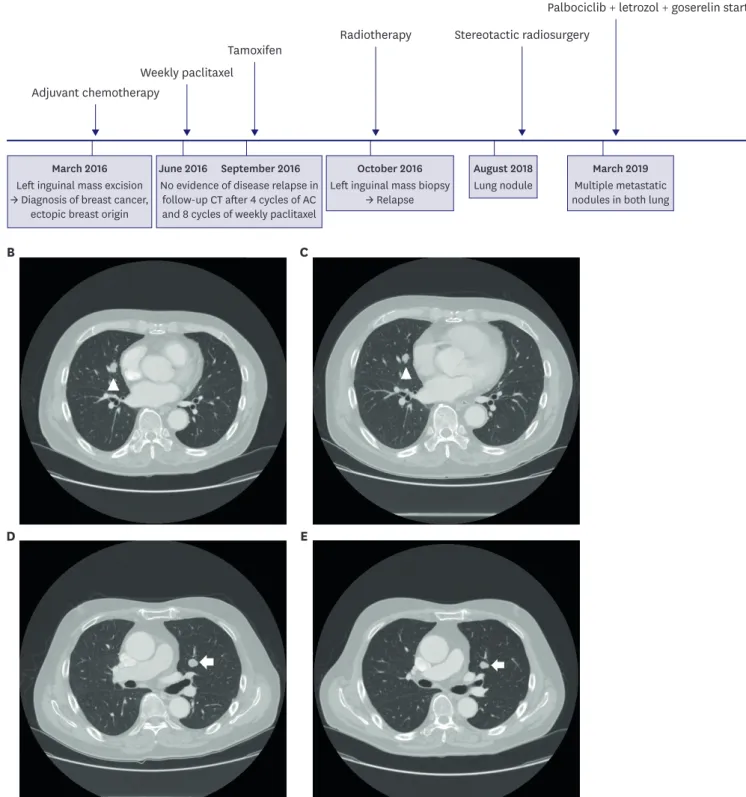
In October 2016, enlargement of the left inguinal mass was noted, and further analysis revealed adenocarcinoma with abundant mucin pools. The recurrent tumor cells showed an ER score of 8, a PR score of 8, HER2-negative, and a Ki-67 labeling index of 10%. After undergoing radiation therapy for local relapse, tamoxifen treatment was continued because there was no evidence of disease relapse and his health insurance did not cover for the use of aromatase inhibitors at that time. In September 2018, a 1-cm sized single nodule was identified in the right upper lung during a routine follow-up imaging study; this nodule was considered evidence of metastasis. The patient underwent stereotactic radiosurgery, but other metastatic nodules were found in both lobes of the lung. After receiving permission from the institutional multidisciplinary board, the patient was started on letrozole (2.5 mg orally once daily) plus goserelin (3.6 mg subcutaneously every 4 weeks) and palbociclib (125 mg orally once daily for 21 days followed by 7 days off treatment in 28-day cycles) in March 2019 based on the cumulative evidence of its benefits in female breast cancers. Recently, the patient completed his 12th cycle of palbociclib, letrozole, and goserelin combination therapy without any severe toxicity, and follow-up chest computed tomography showed a slight decrease in metastatic lung lesions (Figure 3). This study was approved by the Institutional Review Board of Kyungpook National University Chilgok Hospital (KNUCH 2020-04-012), and informed consent was obtained.
DISCUSSION
Generally, the diagnosis of male breast cancer tends to be delayed when compared with that in women due to the lack of adequate screening and clinician awareness. Therefore, male breast cancer patients are more likely to be diagnosed at a more advanced stage than female breast cancer patients [1]. Besides, de novo metastatic disease has been reported in more than 4% of all male breast cancer cases; the most common sites are the bones, lungs, and distant lymph nodes [9]. The most common histological subtype is invasive ductal carcinoma, and individuals can present with various symptoms, such as painless masses and ulceration. If a male patient is diagnosed with breast cancer, it is important to investigate their family history for possible genetic abnormalities [10]. In fact, more than 15% of male breast cancer patients have a family history of breast or ovarian cancer, and approximately 10% of patients showed a hereditary breast cancer-related genetic mutation such as a BRCA mutation. In particular, a BRCA2 mutation is a known risk factor for breast cancer in the male population [11].
Ectopic breast cancer can present anywhere along the milk line as a result of incomplete normal embryological development of the breast bud. Ectopic breast cancer is rare and accounts for less than 1% of all breast cancers. More than 90% of all ectopic breast cancer cases are diagnosed in female patients [12]. The axillar is the most frequent site identified as a primary tumor, and histologically, invasive ductal carcinoma is the most common type. The regimens for postoperative adjuvant therapy for ectopic breast cancer are similar to those for breast cancer [13]. However, the treatment response and prognosis of ectopic breast cancer are difficult to determine because of the limited patient population and lack of clinical trials.
Palbociclib is a CDK4/6 inhibitor, and preclinical studies have shown its ability to inhibit the
growth of ER-positive breast cancer cells, acting synergistically with antiestrogens [14]. In a
phase II study (PALOMA-2) on previously untreated ER-positive and HER2-negative advanced
breast cancer, palbociclib combined with letrozole showed significantly longer progression-
free survival than letrozole alone [7]. In the United States, the FDA has already approved the
Adjuvant chemotherapy
Weekly paclitaxel
Tamoxifen Radiotherapy Stereotactic radiosurgery
Palbociclib + letrozol + goserelin start
No evidence of disease relapse in follow-up CT after 4 cycles of AC and 8 cycles of weekly paclitaxel
Left inguinal mass biopsy
→ Relapse Lung nodule Multiple metastatic nodules in both lung Left inguinal mass excision
→ Diagnosis of breast cancer, ectopic breast origin
March 2016 June 2016 September 2016 October 2016 August 2018 March 2019
A
B C
D E
Figure 3. Timeline of treatment and lung nodules. (A) Summary of the overall treatment administered. (B) CT scan showing right upper lung mass (arrowhead).
(C) The right upper lung mass (arrowhead) was slightly decreased after letrozole plus palbociclib and goserelin combination therapy. (D) CT scan showing left upper lung mass (arrow). (E) The left upper lung mass (arrow) was also decreased after treament, demonstrating a stable disease.
CT = computed tomography.
use of CDK4/6 inhibitor and letrozole combination regimens for patients with ER-positive and HER2-negative advanced breast cancer [15]. All of these promising results were obtained in female patients; unfortunately, there is a lack of clinical trials for male breast cancer patients. However, clinicians should consider palbociclib plus letrozole combination therapy as an alternative for ER-positive, HER2-negative advanced male breast cancer because efficacy and safety have already been demonstrated with the use of palbociclib in breast cancer.
Male breast cancer may appear similar to female breast cancer in many characteristics, but subtle differences exist. There have been many valuable studies on female breast cancer, and we can apply these results to create treatment strategies for male patients with breast cancer.
However, well-designed studies for novel agents such as CDK4/6 inhibitors, mammalian target of rapamycin inhibitors, and PARP inhibitors, alone or as combined regimens, are still necessary, and clinical investigators should be encouraged to enroll male breast cancer patients in clinical trials. Herein, we reported the successful use of palbociclib with letrozole to treat relapsed ectopic breast cancer in a 69-year-old man. Palbociclib should be considered as a treatment for advanced male breast cancer irrespective of the limitations posed by the current national health insurance policy.
REFERENCES
1. Siegel RL, Miller KD, Jemal A. Cancer statistics, 2017. CA Cancer J Clin 2017;67:7-30.
PUBMED | CROSSREF
2. Ortiz-Mendoza CM. Axillary ectopic breast tissue fibroadenoma: report of three cases and review of the literature. Ginecol Obstet Mex 2012;80:99-103.
PUBMED
3. Anderson WF, Althuis MD, Brinton LA, Devesa SS. Is male breast cancer similar or different than female breast cancer? Breast Cancer Res Treat 2004;83:77-86.
PUBMED | CROSSREF
4. Cardoso F, Bartlett JMS, Slaets L, van Deurzen CHM, van Leeuwen-Stok E, Porter P, et al. Characterization of male breast cancer: results of the EORTC 10085/TBCRC/BIG/NABCG international male breast cancer program. Ann Oncol 2018;29:405-17.
PUBMED | CROSSREF
5. Culell P, Solernou L, Tarazona J, Roma J, Martí E, Miguel A, et al. Male breast cancer: a multicentric study.
Breast J 2007;13:213-5.
PUBMED | CROSSREF
6. Cutuli B, Le-Nir CC, Serin D, Kirova Y, Gaci Z, Lemanski C, et al. Male breast cancer. Evolution of treatment and prognostic factors. Analysis of 489 cases. Crit Rev Oncol Hematol 2010;73:246-54.
PUBMED | CROSSREF
7. Finn RS, Martin M, Rugo HS, Jones S, Im SA, Gelmon K, et al. Palbociclib and letrozole in advanced breast cancer. N Engl J Med 2016;375:1925-36.
PUBMED | CROSSREF
8. Wedam S, Fashoyin-Aje L, Bloomquist E, Tang S, Sridhara R, Goldberg KB, et al. FDA approval summary:
palbociclib for male patients with metastatic breast cancer. Clin Cancer Res 2020;26:1208-12.
PUBMED | CROSSREF
9. Korde LA, Zujewski JA, Kamin L, Giordano S, Domchek S, Anderson WF, et al. Multidisciplinary meeting on male breast cancer: summary and research recommendations. J Clin Oncol 2010;28:2114-22.
PUBMED | CROSSREF
10. Vermeulen MA, Slaets L, Cardoso F, Giordano SH, Tryfonidis K, van Diest PJ, et al. Pathological characterisation of male breast cancer: results of the EORTC 10085/TBCRC/BIG/NABCG international male breast cancer program. Eur J Cancer 2017;82:219-27.
PUBMED | CROSSREF
11. Tai YC, Domchek S, Parmigiani G, Chen S. Breast cancer risk among male BRCA1 and BRCA2 mutation carriers. J Natl Cancer Inst 2007;99:1811-4.
PUBMED | CROSSREF
12. Shin SJ, Sheikh FS, Allenby PA, Rosen PP. Invasive secretory (juvenile) carcinoma arising in ectopic breast tissue of the axilla. Arch Pathol Lab Med 2001;125:1372-4.
PUBMED
13. Fracchioli S, Puopolo M, De La Longrais IA, Scozzafava M, Bogliatto F, Arisio R, et al. Primary “breast- like” cancer of the vulva: a case report and critical review of the literature. Int J Gynecol Cancer 2006;16 Suppl 1:423-8.
PUBMED | CROSSREF
14. Finn RS, Crown JP, Lang I, Boer K, Bondarenko IM, Kulyk SO, et al. The cyclin-dependent kinase 4/6 inhibitor palbociclib in combination with letrozole versus letrozole alone as first-line treatment of oestrogen receptor-positive, HER2-negative, advanced breast cancer (PALOMA-1/TRIO-18): a randomised phase 2 study. Lancet Oncol 2015;16:25-35.
PUBMED | CROSSREF
15. Dickler MN, Tolaney SM, Rugo HS, Cortés J, Diéras V, Patt D, et al. MONARCH 1, a phase II study of abemaciclib, a CDK4 and CDK6 inhibitor, as a single agent, in patients with refractory HR+/HER2- metastatic breast cancer. Clin Cancer Res 2017;23:5218-24.
PUBMED | CROSSREF